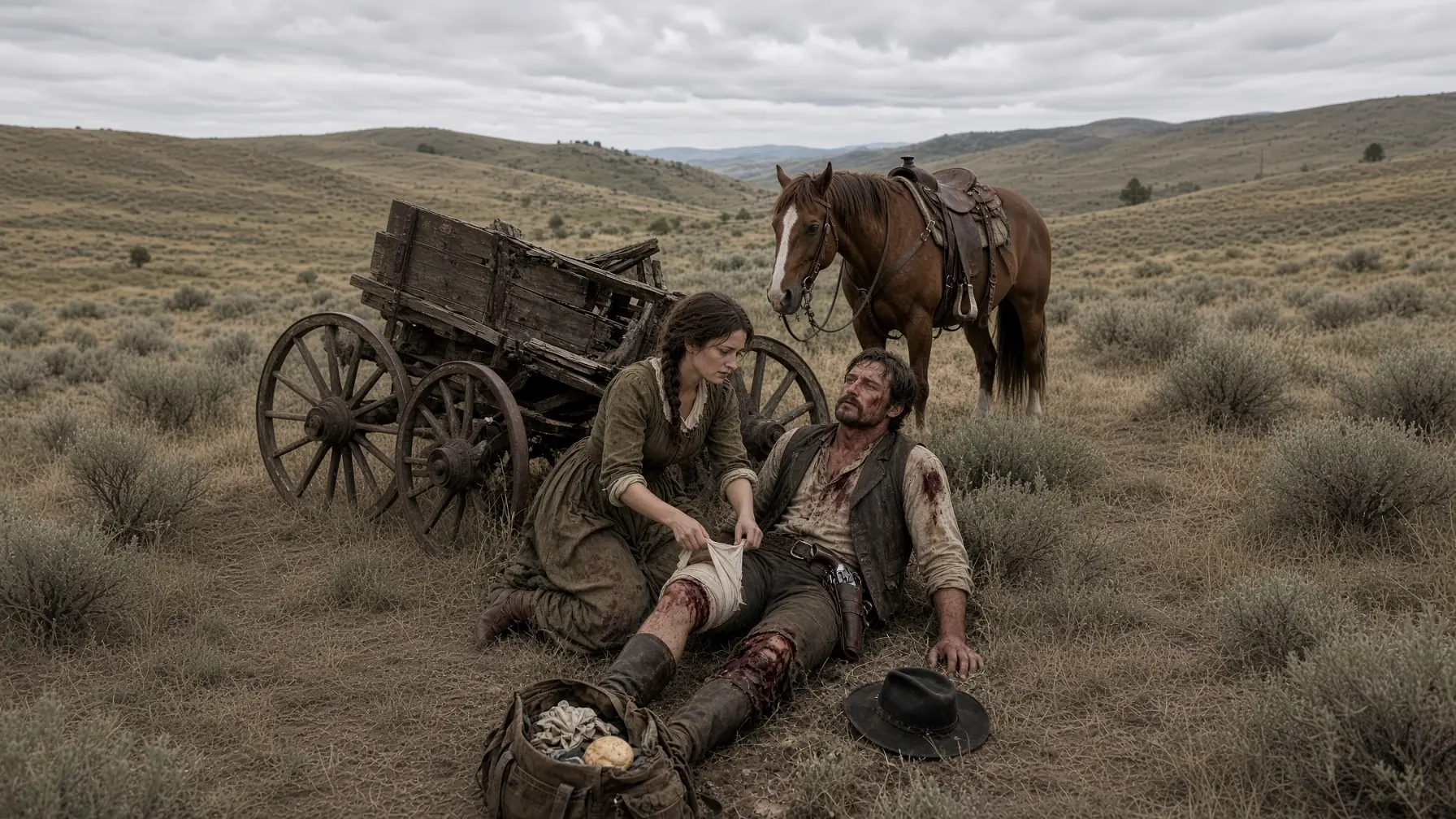
Clara Bennett pressed her last biscuit into the hands of a man she had never met. He was bleeding into the Montana dirt alone beneath a broken wagon, and she had not eaten since dawn. She did not stop to ask his name. She did not stop to count the cost. She simply knelt beside a dying stranger and gave him everything she had left because she still believed that was what decent people did.
She was wrong about many things that summer. But she was never wrong about that. The letter had promised her a future. Three pages written in a careful hand describing a ranch in Montana territory where the grass ran long in summer and the mornings smelled of pine and river water. The man who wrote it, a Mr.
William Carter, had described himself plainly, a working man, a man of property, a man who had decided after years of solitude that he wanted a wife who valued honesty over elegance. Clara Bennett had read that letter 17 times. She had read it on the train leaving Boston. She had read it again at the junction in Billings, where she changed coaches, and a woman beside her asked if she was headed somewhere good. She had read it a third time in the back of a crowded stage coach pressed between a traveling salesman and a widow moving west to live with her son, and she had thought, "Yes, yes, I think I am. " She had believed it because she needed to believe it.
That was the truth. She didn't say out loud. Clara was 25 years old and she had nothing. The school where she had taught for three years had closed in February. The funding dried up by a wealthy trustee who decided Boston had enough educated women.
She had looked for other positions. She had written 14 letters. She had received three responses, two of which informed her that the post had already been filled, and one of which suggested that a woman her age ought to be focused on securing a husband rather than a classroom. She had crumpled that one and thrown it into the fire. But she had kept William Carter's letter, because he had written to her 3 months before any of that happened, responding to a correspondence she'd placed in a frontier gazette at the encouragement of her neighbor, Mrs.
Aldrich, who had done the same thing 12 years ago and ended up in Colorado with a man she called the finest she'd ever known. "You've got good sense and a kind heart," Mrs. Aldrich had told her. "That's worth more than gold out west. " Clara hadn't been sure, but she'd been willing to find out. And now she was standing on a wooden platform at a way station called Ridgeline, Montana with one traveling trunk, a small canvas bag, and the slow sinking certainty that no one was coming.
The platform was empty except for an old man sweeping dust from one end to the other, working in a slow, deliberate circle, as though he had nowhere else to be. The stage coach that had deposited Clara here had already disappeared down the trail, taking its passengers and its noise with it. The afternoon sun pressed down on everything with a flat, heavy hand. Clara stood very still. She had been standing very still for 2 hours.
Excuse me, she finally said to the old man. Is there any chance a message has come through for me? My name is Clara Bennett. I was expected by a Mr. William Carter.
The old man stopped sweeping. He turned to look at her with the particular expression of a man who has seen many things and is deciding how much of what he knows to share. William Carter, he repeated. Yes, sir. He leaned on his broom.
Miss William Carter owns half this valley. Clara blinked. I beg your pardon. Half the valley? The man said again with the patience of someone explaining something obvious.
Maybe more. His ranch runs from the northern ridge all the way down past Miller's Creek. He's got 40 ranch hands, a bunk house big enough to sleep 60, and more cattle than you can count on a clear day. Clara looked down at the letter in her hand. A working man, it had said.
A man of property. He didn't mention, she began. No. The old man agreed with a small, dry smile. I expect he wouldn't.
She stood there another moment. The wind moved through the station, kicking up a thin line of dust along the platform's edge. A horse tied at the far post swished its tail and stamped. "Is there a town nearby? " she asked at last. "Somewhere I might find lodging. " "Cedar Falls," the man said.
"3 mi west. " He pointed with his broom handle. "Follow the trail. You'll see the church steeple before anything else. " Clara picked up her canvas bag. She looked at her trunk. Too heavy to carry, too important to abandon.
I'll send someone for that, the old man said, reading her face. I'll keep it safe. Thank you, she said. You're very kind. He waved a hand.
It's nothing, miss. Safe travels. She walked off the platform and onto the trail. She told herself she was not angry. She told herself there was a reasonable explanation.
Perhaps he had been delayed. Perhaps a message had gone astray. People were not always late because they didn't care. Sometimes the world simply got in the way. She told herself all of that for about half a mile.
Then she stopped telling herself anything and just walked. The trail was dry and pale, cutting through open land that stretched wide in every direction. She could see mountains at the far edge of the world, blue gray and enormous like something out of a painting. The grass on either side of the path moved in long, slow waves. It was beautiful.
The kind of beautiful that doesn't care whether you're watching or not. Clara walked. The sun moved. Her shoes, which were Boston shoes and not trail shoes, began to make their feelings known around the second mile. She was looking down at the dust around her feet, thinking about nothing in particular when she heard it.
A sound, low and rough and ragged. She stopped. She looked up. 20 yards off the trail, half hidden by scrub brush and the long shadow of a broken wagon, something moved. Not an animal, a man.
He was on the ground. His left leg was pinned beneath the rear axle of the wagon, which had collapsed sideways and come down hard. One arm was extended, hand pressing flat into the dirt, as if he had been trying to push himself free. His shirt, pale cotton darkened with blood along the shoulder, clung to him in the heat. His hat had fallen several feet away.
His eyes were closed. A horse stood a short distance beyond him. Rains trailing, watching the scene with the calm attention of a creature that has done what it can and is waiting for someone else to take over. Clara did not think. That was the truth of it.
Later she would wonder about that moment about what she should have thought about, whether a wiser woman would have calculated the risk, assessed the situation, made a reasonable decision. But she didn't think. She simply moved. She dropped her bag on the trail and crossed the distance between them at a run. "Sir," she said, dropping to her knees beside him.
"Sir, can you hear me? " His eyes didn't open. She pressed two fingers to the side of his neck, the way her grandmother had shown her once in a different lifetime, and found his pulse fast and thin, but present. "All right," she said to no one in particular. "All right," she assessed the situation with the brisk, unscentimental eye of a woman who has taught other people's children for 3 years, and learned that panic is only useful if you have time for it. The wagon axle was heavy, too heavy for her alone.
But the ground beneath it was soft, and the wheel had sunk slightly into the earth on one side. If she could find something, a long branch, a fence post, she might be able to lever it enough to drag him clear. She stood. She looked around. She found a cedar post half buried in the scrub longer than she was tall, thick enough to hold weight.
She pulled it free with both hands, arms burning, and carried it back. This is going to hurt, she told the unconscious man. I'm sorry. She wedged the post beneath the axle. She pushed down with every bit of weight she had.