The man who confessed was Tony Ray Peralta, 37, of Roswell, New Mexico. The victim was William “Bill” Blodgett, a 69-year-old Roswell resident who had been Peralta’s landlord. Blodgett was not simply an unidentified man buried beneath a house. He had been the subject of a missing-person investigation dating back to early January 2009, after his son reported that the family had been unable to reach him since late December 2008.
The original transcript correctly places Peralta’s confession on May 1, 2023, but some of its later details need qualification. Peralta initially faced a first-degree murder charge and entered a not-guilty plea through his public defender, which was a procedural plea at that stage of the case. He later pleaded guilty to second-degree murder and received a 15-year prison sentence followed by two years of parole. A precise future release date should not be presented as guaranteed because prison credits, parole rules, and later corrections decisions can affect actual release timing.
The transcript also presents the dispute over Blodgett’s wallet and Peralta’s possible eviction as the likely motive. Police records did show that Blodgett had accused Peralta of taking his wallet and had been trying to remove him from the property. However, Peralta repeatedly told detectives in 2023 that he did not know why he killed Blodgett and said he had no excuse. The wallet and eviction dispute is therefore an important piece of background, not a motive that Peralta himself definitively confirmed.
Finally, the remains were not identified merely because Peralta pointed to the location. Investigators recovered a boot, bones, and dentures beneath floorboards in an attached or detached side structure at the property. The dentures were compared with dental records obtained during the original missing-person investigation and helped confirm that the remains were William Blodgett’s.
The Call That Reopened a Fourteen-Year Mystery
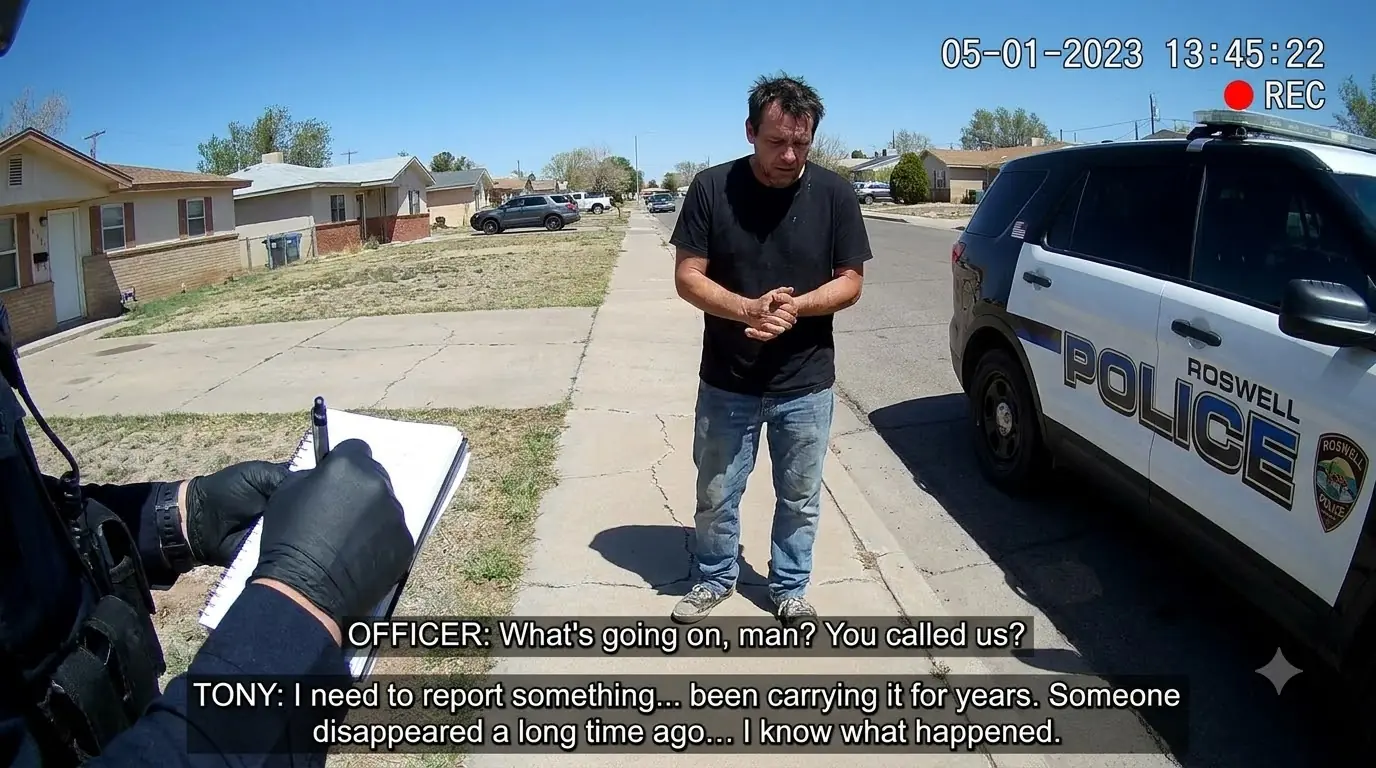
On May 1, 2023, a man in Roswell borrowed a cellphone at an Allsup’s convenience store and called 911. What he told the dispatcher sounded almost too extraordinary to be real. He said he had killed someone years earlier and that he was finally ready to confess.
When officers arrived, they found Tony Peralta nearby. He did not run. He did not try to talk his way out of the call or pretend someone else had made it. Instead, he calmly repeated the central claim: he had killed a man a long time ago, and the man had been buried at his own property.
The first officers were cautious because Peralta’s account was vague. He could not immediately give them a precise date. He did not clearly explain why the killing had happened. Even the address initially came out only as a house on East Fifth Street. Yet Peralta insisted there was a body there and said he was tired of living with what he had done.
“I’m just tired of covering it up,” he told officers in substance. His explanation was not that investigators had discovered new evidence or that someone was threatening to expose him. He described the burden as internal. The guilt, he said, had stayed with him.
A Confession Officers Could Not Yet Know Was True
The officers still had to treat the statement as an allegation until it could be corroborated. People sometimes make false confessions for reasons ranging from intoxication to mental-health crises, and Peralta acknowledged that he had been drinking. During the encounter, he also told officers that he had taken several blood-pressure pills earlier in the day.
That made the situation more complicated rather than less serious. Officers had to consider his physical condition while also determining whether he was describing a real homicide. Peralta nevertheless remained consistent about one essential point: there was a dead man buried at the property where he once lived.
He volunteered to show police the location. Officers transported him while arranging for detectives to become involved. During the ride, Peralta seemed anxious and physically uncomfortable, at times complaining about the handcuffs and saying he felt weak. He asked questions about what would happen next but continued telling police he wanted to confess.
At the station, detectives began the formal process of gathering information and advising him of his rights. But before any complete account of the killing could emerge, Peralta offered investigators something far more useful than a story. He could show them where to look.
The White House on Fifth Street
Peralta accompanied police back toward the neighborhood. When they reached the area, he identified a white house and pointed toward a small side structure. He told the officers that Blodgett had been buried beneath that part of the property.
The claim was specific enough that detectives sought legal authority to search. After obtaining a warrant, investigators began removing material from the floor area Peralta had indicated. What they found transformed the encounter from a strange confession into the reopening of a long-unsolved disappearance.
Beneath the flooring, investigators discovered a boot and human skeletal material. Dentures were also recovered. Police later compared the dental evidence with records that had been collected years earlier when William Blodgett was first reported missing.
The remains were identified as Blodgett’s. Peralta had not invented the burial site. He had led police directly to a man whose family had spent more than fourteen years without knowing what had happened to him.
William Blodgett Disappears
To understand why the discovery mattered, the case has to return to the winter of 2008. William Blodgett was 69 years old and living in Roswell. Peralta was his tenant, occupying living space at or near the front portion of Blodgett’s property.
Family members lost contact with Blodgett around Christmas 2008. His son, Greg, eventually reported him missing on January 3, 2009 after repeated attempts to reach him failed. What began as concern about an older relative soon developed into a police investigation.
Investigators learned that Blodgett and Peralta had been having problems. According to information given to police, Blodgett had accused Peralta of stealing his wallet. He was also reportedly trying to evict him.
Those facts gave police a reason to look closely at the tenant. Peralta was interviewed during the original investigation. Officers also examined the property, and a cadaver dog was reportedly brought to the house. But the search produced no discovery of Blodgett’s remains, and Peralta gave investigators nothing that allowed them to prove a crime had occurred.
The disappearance became a cold case. Blodgett’s dental records were preserved, but there was no body, no confirmed crime scene, and no confession. For years, the family had no definitive answer.
Why the First Search Failed
The most unsettling detail in hindsight is that the remains were eventually recovered from the same property police had examined in 2009. That does not automatically mean investigators ignored an obvious burial site. The body had been concealed beneath flooring in a side structure, and the original search did not reveal it.
Cadaver dogs can assist investigators, but they do not guarantee a discovery in every environment. Construction materials, the precise location of remains, environmental conditions, the passage of time, and the way a search is conducted can all affect whether evidence is located. What is established is that officers searched the property and interviewed Peralta, yet the case did not produce enough evidence for an arrest.
The missing-person file therefore remained unresolved while Peralta continued his life. Blodgett’s relatives were left with uncertainty rather than a confirmed death. They knew he had vanished; they did not know that his remains were still at the property.
That situation lasted until Peralta himself ended it.
Inside the Interview Room
After investigators confirmed that human remains were present, Peralta was interviewed again. His demeanor in the released footage was unusual for a homicide suspect. At points he appeared exhausted, emotional, or resigned. A detective brought him food and again reminded him of his Miranda rights before asking him to explain what had happened.
Peralta was willing to admit responsibility but reluctant or unable to provide a complete narrative. Asked why he killed Blodgett, he said he did not know. Asked for details about their dispute, he repeatedly said he could not remember.
The detective raised information from the old investigation, including the wallet dispute. Peralta did not adopt that explanation as his motive. Instead, he returned again and again to the reason he had contacted police in 2023: he could no longer live comfortably with what he had done.
When the detective asked why he had finally come forward, Peralta said the killing had been eating at him every day. He described Blodgett as someone who had been good to him and said the victim had not deserved what happened.
The Weapon
For much of the interview, Peralta answered questions about the killing with variations of “I don’t remember.” Investigators wanted to know how Blodgett had died and whether any weapon could still be recovered.
Eventually, Peralta gave one crucial detail. He said he had killed Blodgett with a screwdriver.
That statement became part of the evidence supporting the murder case, but the weapon itself was not recovered in the 2023 search. Nearly fifteen years had passed. Peralta said he did not know where it was.
Investigators also questioned him about the burial. They wanted to understand the physical space beneath the floor and how the body had been placed there. Peralta again said he could not remember many of the details. The detective pressed him because the structure of the floor suggested investigators might encounter practical difficulties while recovering the remains, but Peralta provided little additional explanation.
What mattered most had already been corroborated. A man had vanished in 2008. Peralta had been one of the people investigated at the time. In 2023, without police confronting him with newly discovered remains, he voluntarily called 911, confessed to killing Blodgett, identified the burial site, and then led officers to human remains later identified as the missing man.
The Meaning of the Old Wallet Dispute
Once the confession became public, attention naturally returned to the conflict police had learned about in 2009. Blodgett had reportedly accused Peralta of stealing his wallet and was trying to evict him. That sequence offers an obvious possible explanation for hostility between landlord and tenant.
But a documentary account should separate evidence from inference. Peralta did not tell detectives, “I killed him because he was evicting me,” and he denied or failed to recall key parts of the dispute when questioned. The police records establish that the conflict existed. They do not establish that it was the sole or definitive motive.
Peralta’s own description was far less satisfying. He told the detective that Blodgett had been good to him and that he had taken his life “for no reason.” Whether that meant there literally was no immediate trigger or that Peralta refused to explain it, the released material does not resolve the question.
For Blodgett’s family, motive may have been less important than finally knowing the truth. Their missing relative had not simply walked away. He had been killed, concealed beneath the property, and left there while the investigation went cold.
From First-Degree Murder to a Guilty Plea
After the remains were discovered, Peralta was arrested and charged with first-degree murder. At an early court appearance, his public defender entered a not-guilty plea on his behalf. That sometimes appears contradictory when a defendant has already confessed, but an initial not-guilty plea does not erase a confession and does not necessarily mean the defense is claiming innocence permanently. It preserves the defendant’s rights while attorneys review evidence, possible defenses, and plea negotiations.
The case did not ultimately go to a first-degree murder trial. Peralta later pleaded guilty to second-degree murder.
He was sentenced to 15 years in prison, followed by two years of parole. The plea brought the case to a legal conclusion without requiring Blodgett’s family to wait through a murder trial in which Peralta’s recorded confession, his directions to the burial location, the recovered remains, and the earlier missing-person evidence would have been central issues.
The sentence also corrected an uncertainty that had existed since 2008. William Blodgett was no longer simply a missing person. His death was formally treated as a homicide, and the former tenant who had led police to his remains accepted criminal responsibility in court.
The Strange Calm of the Body-Camera Footage
What makes this case memorable is not a lengthy forensic breakthrough or an elaborate undercover operation. It is the contrast between the seriousness of the crime and the almost ordinary manner in which the truth finally surfaced.
Peralta was sitting near a convenience store. Officers spoke to him calmly. He smoked, asked for water, complained about his handcuffs, discussed music, and thanked police for arriving. Then he took them to a house and pointed toward the place where he said a man had been buried for years.
The officers did not know at first whether to believe him. Their uncertainty is visible in the footage. Peralta’s inability to provide a date, address, or coherent motive made the confession sound unstable. Yet he possessed one fact that could be tested immediately: where the body was hidden.
Once the floor was opened, the ambiguity disappeared.
A Family Finally Gets an Answer
Blodgett’s son had been the person who reported him missing in 2009. The family’s last known contact with him had been around the Christmas period. For more than a decade, no one could tell them with certainty whether he had left voluntarily, suffered an accident, or become the victim of a crime.
The 2023 confession answered the central question in the worst possible way. Blodgett had never really been far from the place where police first looked for him. His remains had been concealed beneath the property where Peralta had once lived.
Peralta told investigators that Blodgett was a good man. He asked that the family be told the victim did not deserve what he had done. Those words could not undo the killing or the years of uncertainty, but they reflected the guilt Peralta repeatedly said had driven him to make the call.
The confession was not the discovery of a new eyewitness. It was not DNA identifying a suspect from an old evidence box. It was the offender himself deciding, nearly fifteen years later, that continuing to keep the secret had become intolerable.
What the Case Does Not Establish
Some details commonly repeated in retellings of this case should be handled carefully. The known dispute involving a wallet and eviction provides context but does not amount to a confirmed motive. Peralta’s drinking on May 1, 2023 and his statement that he had taken blood-pressure medication explain part of his physical condition during the encounter, but they do not invalidate the confession, particularly because his claim about the burial site was independently corroborated.
It is also misleading to describe the case as though police discovered the body first and then extracted a confession. The sequence was the opposite. Peralta initiated contact, confessed, and supplied the location. Investigators then obtained a search warrant and recovered evidence from the place he identified.
Likewise, a projected release year should not be treated as an absolute date. What can be stated confidently is the sentence imposed: 15 years of imprisonment followed by two years of parole.
Most importantly, Blodgett should not disappear from his own story. He was 69 years old, had a son who actively sought answers, and had already taken steps to remove Peralta from his property after a dispute. For years, public attention centered on a missing man. In 2023, the case finally became what it had been all along: a homicide.
Conclusion
William Blodgett vanished from Roswell in late December 2008. His son reported him missing on January 3, 2009, and police learned that Blodgett had recently been in conflict with his tenant, Tony Peralta. Peralta was interviewed, the property was searched, and even a cadaver dog was used, but investigators found no body and no evidence strong enough to make an arrest.
The case went cold.
Then, on May 1, 2023, Peralta borrowed a stranger’s phone at an Allsup’s store and called 911. He told the dispatcher he had killed someone years earlier. When officers arrived, he repeated the confession and said the victim was buried at the house where he had once lived.
Peralta led police to the Fifth Street property and pointed to a side structure. After obtaining a search warrant, investigators removed floorboards and recovered a boot, skeletal remains, and dentures. Dental records from the old missing-person investigation helped identify the remains as William Blodgett.
During questioning, Peralta struggled to explain why he had killed him. He repeatedly said he could not remember important details, but he eventually told detectives that he had used a screwdriver. He also said Blodgett had been good to him, did not deserve to die, and that the guilt had been eating at him for years.
Police records from 2009 showed that Blodgett had accused Peralta of stealing his wallet and had been trying to evict him shortly before the disappearance. Those circumstances provided investigators with possible context, but Peralta never definitively confirmed that dispute as the motive for the killing.
Peralta initially faced first-degree murder and entered a not-guilty plea through counsel. He later accepted responsibility in court by pleading guilty to second-degree murder. The court sentenced him to 15 years in prison followed by two years of parole.
For nearly fifteen years, William Blodgett’s disappearance had remained unresolved despite the fact that investigators had once searched the very property where his remains were hidden. The case was not finally broken by a new forensic technology or a witness coming forward. It ended because the man responsible decided he could no longer keep the secret.
Peralta told officers that his heart hurt and that he thought about the killing every day. Whatever finally pushed him to pick up a borrowed cellphone on May 1, 2023, the call accomplished what the original investigation could not: it led police beneath the floor, gave Blodgett’s family an answer, and turned a fourteen-year missing-person mystery into a solved homicide case.