The alarm screamed the second Mrs. Lillian Grace stepped through the front doors of Northgate Market.
It was not a soft sound. It was sharp, ugly, and loud enough to cut through the Sunday afternoon hum of the store. Carts stopped rolling. Registers stopped beeping for half a breath. A little girl near the bakery covered her ears and looked up at her mother.
Lillian froze with both hands wrapped around the handle of her cart.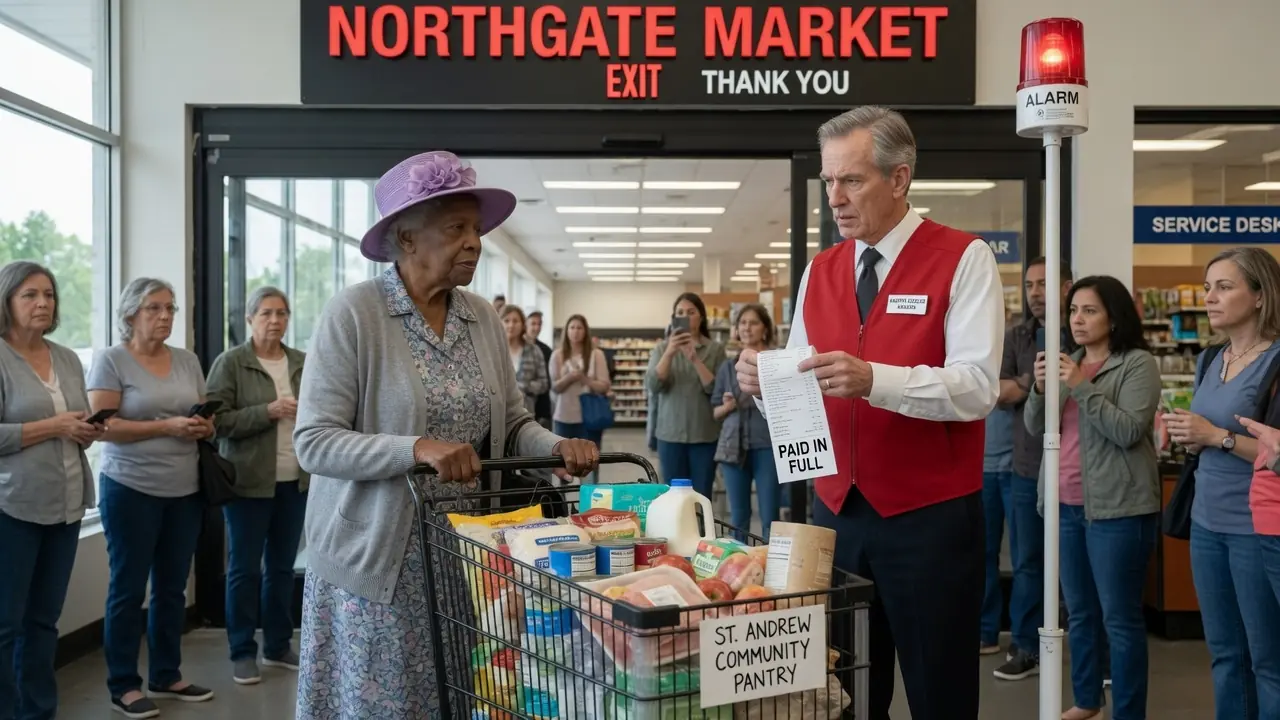
She was seventy-four years old, a Black woman with silver hair pinned neatly beneath a lavender church hat, a soft gray cardigan buttoned over a blue floral dress, and brown leather shoes polished so carefully they looked newer than they were. Her cart was full enough to make people stare even before the alarm started. Rice, flour, canned beans, milk, chicken, apples, oatmeal, soap, diapers, and two large bags of oranges sat stacked in careful rows.
She had not bought any of it for herself.
Most of it was going to the St. Andrew Community Pantry, a small food program she had helped run from the basement of an old brick church for eleven years. On Wednesdays, older men came for coffee because loneliness had become more painful than hunger. Young mothers came for diapers and formula with apology already written across their faces. Children came for peanut butter sandwiches and told Lillian they were not that hungry, though she could hear their stomachs telling the truth.
She had paid for every item in the cart.
The receipt was folded neatly inside her purse.
But the alarm did not know what she had paid.
And neither did the man already storming toward her from the service desk.
“Ma’am,” the manager snapped, “step away from that cart.”
His name was Martin Kessler.
He was in his late fifties, thin-lipped, narrow-eyed, and dressed in a red manager vest that he wore like a judge’s robe. His gray hair was combed back with such precision it looked painted in place. He had managed Northgate Market for nearly eighteen years and had come to believe the store belonged less to the company than to his personal temper.
Lillian turned toward him calmly.
“Mr. Kessler, I already paid.”
Martin stopped in front of the cart and glanced over the groceries like a man inspecting evidence.
“Then you should have no trouble proving it.”
The accusation landed in front of everyone.
Phones started rising almost immediately.
A teenage boy near the soft-drink aisle whispered, “She tried to steal all that?”
His father said, “Hush,” but did not correct him.
That silence hurt more than the whisper.
Lillian tightened her hands around the cart handle. She had lived long enough to know how quickly a room could decide a Black woman was guilty before she even opened her purse. She had been followed through department stores, ignored at counters, questioned at pharmacies, and watched by security guards who pretended to straighten shelves whenever she walked past.
But she had also raised four children, buried a husband, survived breast cancer, taught Sunday school for thirty-five years, and fed people from a church kitchen with a stove that only worked when it felt like praying.
Martin Kessler was not the first man to mistake her calm for weakness.
He would not be the last.
But today, he had chosen the wrong woman.
Lillian opened her purse slowly.
Martin leaned forward as if expecting stolen jewelry, fake coupons, or some kind of confession to fall out.
Instead, she pulled out a long receipt folded into three neat sections.
She opened it carefully.
The paper stretched almost to her knees.
At the top, in bold letters, it read:
NORTHGATE MARKET — REGISTER FOUR
MANAGER APPROVAL REQUIRED
M. KESSLER
The timestamp read 2:09 p.m.
The clock above the exit read 2:15 p.m.
At the bottom, beneath every item in the cart, were three words:
PAID IN FULL.
Lillian held the receipt up.
“You approved the order yourself.”
Martin’s jaw tightened.
“I approved a transaction. That does not mean every item in this cart was paid for.”
A young cashier at register four went pale.
Her name was Tessa Miller.
She was nineteen, maybe twenty, with nervous brown eyes and a name tag pinned too high on her shirt. Lillian had seen her several times over the past month. The girl smiled like someone who had been told smiling was safer than speaking.
Tessa opened her mouth.
Martin turned sharply.
“Back to your register.”
The girl closed her mouth.
Lillian saw it.
The habit.
The training of silence.
She turned back to Martin.
“You scanned every item yourself.”
His face reddened. “Ma’am, I am trying to handle this professionally.”
“No,” Lillian said. “You are trying to make public humiliation sound like procedure.”
The store went quiet.
Martin’s eyes hardened.
Then the automatic doors slid open again.
Two police officers stepped inside.
And Lillian understood this had not been an accident.
The taller officer approached first, scanning the cart, then the manager, then Lillian.
“What’s going on here?”
Martin spoke before anyone else could breathe.
“This woman triggered the theft alarm while attempting to leave with unpaid merchandise.”
A murmur moved through the store.
Lillian felt the words spread through the aisles like cold air.
This woman.
Unpaid merchandise.
Attempting to leave.
Not customer.
Not Mrs. Grace.
Not elderly church volunteer.
This woman.
The officer turned toward Lillian. “Ma’am, did you pay for these groceries?”
“Yes,” Lillian said. “And Mr. Kessler is holding the receipt.”
Martin looked down.
The receipt was still in his hand.
For one brief second, irritation crossed his face instead of embarrassment, as though the paper itself had betrayed him by continuing to exist.
The shorter officer took the receipt from him and read it carefully.
“Manager approval,” he said. “M. Kessler.”
Martin cleared his throat. “That only shows I authorized part of the purchase.”
The officer looked at the bottom of the receipt. “It says paid in full.”
“It says payment was processed,” Martin replied. “The alarm indicates something in that cart was not properly cleared.”
Lillian looked directly at him.
“Then perhaps we should ask why something was not properly cleared after you personally handled the transaction.”
A woman near the bread aisle stepped forward.
She wore a green coat and held a loaf of sourdough against her chest.
“I watched him ring her up,” she said.
Martin snapped, “Ma’am, please continue shopping.”
She lifted her chin.
“My name is Helen Watkins. I am not continuing anything until this is settled. I saw what happened.”
A second voice came from register four.
“She paid.”
Every head turned.
Tessa stood behind the register with both hands trembling against the counter.
Martin’s face darkened.
“Tessa.”
The girl swallowed.
“She paid for everything. I was standing right there. Mr. Kessler told me to move aside because the order was too big and he wanted to handle it himself.”
Martin’s voice dropped. “You are putting your job at risk.”
Tessa’s eyes filled with tears.
“No,” she said. “I think I put myself at risk every time I stayed quiet before.”
Lillian looked at her.
The girl was terrified.
But she remained standing.
The taller officer looked at Martin. “We need to see the security footage.”
Martin stiffened. “Our camera system has been unstable all week.”
Tessa whispered, “No, it hasn’t.”
Martin spun toward her.
Before he could speak, another man stepped forward from near the entrance.
He was the store security guard, early thirties, broad-shouldered, tired-eyed, and wearing a black uniform with a name tag that read Marcus.
“The cameras are working,” Marcus said.
Martin stared at him. “You need to be very careful.”
Marcus looked at Lillian.
Then at the officers.
“They are working. And the exit alarm was manually reset from the manager’s office about fifteen minutes ago.”
The whole store seemed to inhale.
Lillian’s fingers tightened around her purse strap.
For the first time, Martin’s confidence cracked.
“That is internal equipment,” he said. “He does not understand the system.”
Marcus’s voice hardened. “I understand enough to know the sensors do not reset themselves from your desk.”
The taller officer turned toward Martin.
“Security room. Now.”
Lillian remained beside the cart while the officers followed Martin and Marcus toward the small room near the back.
No one knew what to say to her.
That was the strange thing about public accusation. People became gentle only after the damage had already been done. Eyes that had judged her now softened into regret, as if regret could erase what their silence had helped carry.
Helen in the green coat stepped closer.
“Mrs. Grace, I’m sorry.”
Lillian looked at her.
“Sorry is a beginning.”
Helen lowered her eyes. “I should have spoken sooner.”
“Yes,” Lillian said quietly. “You should have.”
A few shoppers looked away.
Not because she had said it cruelly.
Because she had said it truthfully.
Tessa left her register and came to Lillian with tears on her cheeks.
“I should’ve stopped him when he started treating you like that.”
Lillian’s expression softened.
“You spoke before it was too late.”
The girl wiped her face. “He does this. Maybe not always like this, but he does it. He talks about people from East Brook like they’re all lying, like they’re always trying to get something free.”
Lillian’s eyes sharpened.
“What else does he say?”
Tessa glanced toward the security room.
“He says charity orders are the easiest to hide things in because nobody checks poor people’s paperwork carefully. He says pantry shoppers always come with a story.”
Helen made a disgusted sound.
Lillian closed her eyes for one second.
East Brook.
That was what Martin meant.
Not only her.
Her neighborhood.
Her people.
The old men who came for coffee and stayed because nobody at home remembered their stories. The mother who cried the first time Lillian gave her diapers. The boy who helped carry pantry boxes after school and pretended he was only doing it for volunteer credit.
People Martin Kessler had never cared to know.
People he had already judged.
Minutes later, the officers returned.
Their faces had changed.
Marcus walked behind them.
Martin came last.
Pale.
The taller officer held a tablet in one hand.
“We reviewed the footage,” he said.
The store fell completely silent.
“It shows Mr. Kessler scanning the full order, accepting payment, and printing the receipt.”
Lillian did not move.
The officer continued.
“It also shows him removing a security tag from his vest pocket and placing it beneath a bag of rice after the transaction was completed.”
The store erupted.
Gasps.
Whispers.
Someone cursed under their breath.
Tessa covered her mouth.
Helen looked as if she might throw the sourdough at Martin’s head.
The officer turned toward him.
“Mr. Kessler, place your hands behind your back.”
Martin’s face twisted. “This is being taken completely out of context.”
Marcus snapped, “You planted it.”
Martin pointed at him. “You are done here.”
“No,” Marcus said. “I think you are.”
The officer stepped between them. “Hands behind your back.”
Martin resisted for one second.
Only one.
Then the cuffs clicked around his wrists.
Phones lifted again.
This time, they were not filming Lillian as a suspect.
They were filming the man who had tried to make her one.
Lillian did not smile.
She looked at Martin with something heavier than anger.
Maybe disappointment.
Maybe exhaustion.
Maybe the grief of recognizing a kind of cruelty she had spent a lifetime surviving.
As officers led him forward, Martin leaned toward her.
“You think you won?” he hissed. “You have no idea what you just started.”
Lillian stepped closer.
“No, Mr. Kessler. You have no idea why I came.”
Martin froze.
For the first time, real fear moved across his face.
The officer stopped. “Mrs. Grace?”
Lillian reached into her purse again.
This time, she did not pull out a receipt from Northgate Market.
She pulled out a small folded slip of paper, yellowed at the edges and soft from years of being opened and handled with care.
Martin’s face changed.
He recognized the kind of paper before he understood why.
Helen whispered, “What is that?”
Lillian unfolded it slowly.
“My husband owned a little market on Harlan Street for thirty-two years,” she said.
The store quieted again.
“Grace Corner Grocery. It was not fancy. The floor creaked near the onions. The freezer made a sound like an old tractor. The sign out front lost the letter G in a storm, and my husband never fixed it because he said everybody knew where they were.”
A few older shoppers smiled faintly.
Some remembered.
Lillian held up the paper.
“This was the first receipt he ever printed after buying that store.”
At the top, faded nearly brown, were the words:
GRACE CORNER GROCERY
FIRST SALE — PAID IN FULL
APRIL 3, 1984
Lillian brushed her thumb gently along the edge.
“He sold a loaf of bread, two cans of black-eyed peas, and one jar of peanut butter to a young mother who did not have enough money. He paid the difference himself and still printed paid in full because he said nobody should have to carry shame home with groceries.”
The store remained silent.
“My husband died believing his store failed because the neighborhood changed.”
Her voice tightened.
“But I came here today because I learned that was not true.”
Martin went gray.
Lillian turned to the officers.
“For months, St. Andrew Community Pantry has been placing large orders through this store. We were told Northgate was giving us a community discount.”
She reached into her purse again and pulled out a folder.
“But the receipts did not match the bank withdrawals. Discounts appeared on invoices, then vanished from final charges. Donations were logged, then redirected. Every adjustment required manager approval.”
The officer looked down at the earlier receipt.
“M. Kessler.”
Lillian nodded.
“He has been stealing from a food pantry.”
A wave of outrage moved through the store.
Martin snapped, “That is a lie.”
Lillian looked at him.
“No. A lie is what you built. This is the paper trail.”
Marcus stepped forward.
“There is more.”
Martin stared at him with pure hatred.
Marcus looked at the officers.
“I copied manager adjustment logs last night. Not customer information. Internal overrides. Charity invoices. Refund reversals. I was going to report it, but I didn’t know who to trust.”
Lillian turned to him.
Marcus’s voice lowered.
“My mother gets groceries at St. Andrew on Fridays.”
That sentence changed his hesitation into courage.
The officer looked at Martin. “Where is your office?”
Martin said nothing.
The search began fifteen minutes later.
They found envelopes first.
Cash tucked behind the bottom drawer of Martin’s filing cabinet.
Then they found altered receipts.
Then copies of pantry invoices.
Then a spreadsheet with charity accounts and columns labeled shrink recovery.
But it was the dusty file box in the storage closet that made Lillian sit down.
Marcus carried it out himself.
On the side, written in black marker, were the words:
HARLAN STREET ACQUISITION — 2010
Lillian stared at it as if the box had brought a ghost into the store.
“My husband’s market closed in 2010.”
The officer opened the lid.
Inside were inspection complaints.
Vendor warnings.
Lease letters.
Insurance notices.
Loan documents.
Internal memos from Northgate’s regional development office.
Lillian took the first page with trembling hands.
Her husband’s name sat near the top.
Samuel Grace.
The paper blurred.
For thirteen years, she had believed Samuel lost the market because he could not keep up with the chain store moving into the area. Suppliers stopped extending credit. Repair bills kept coming. Customers left for cheaper prices. The landlord grew impatient. Samuel blamed himself until the last month of his life.
“I should’ve been smarter,” he told her one night from his hospital bed.
Lillian had held his hand and said, “You were good. That mattered more.”
Now she looked at the documents and realized goodness had not been the thing that failed.
It had been surrounded.
Marcus read from one memo, his voice tight.
“Vendor pressure recommended. Property vulnerable. Owner unlikely to survive prolonged compliance action.”
Helen whispered, “My God.”
The officer found another page.
A memo signed by Martin Kessler.
At the time, he had been an assistant regional manager.
The memo recommended repeated safety complaints, delayed deliveries, quiet pressure on the landlord, and a pricing strategy designed to “accelerate local displacement.”
The purpose was clear.
Northgate had not simply outcompeted Grace Corner Grocery.
It had helped destroy it.
Lillian placed one hand over her mouth.
For a moment, the store disappeared.
She saw Samuel behind the old counter, counting change under buzzing lights. Samuel carrying milk crates with his bad back. Samuel letting people pay later, even when later rarely came. Samuel sitting at their kitchen table with his glasses in one hand and unpaid bills spread before him like bad news.
“I don’t understand what I did wrong,” he had whispered.
He had done nothing wrong.
That truth was mercy.
And cruelty.
Lillian’s knees weakened.
Tessa and Helen moved to her sides.
She did not collapse.
She would not give Martin that.
But tears slipped down her face.
Martin stood handcuffed near the customer service counter, looking away.
Lillian’s voice came out low.
“My husband died ashamed.”
No one spoke.
She turned toward Martin.
“You let a good man carry your sin to his grave.”
Martin’s mouth opened.
No defense came.
Because there was none.
He was taken out through the same automatic doors where Lillian had been stopped.
No one cheered.
No one laughed.
The silence was better.
It had weight.
Outside, police lights flashed against the glass. The same shoppers who had watched Lillian become a suspect now watched Martin become one.
Before the officers placed him in the cruiser, Martin turned once.
His eyes found Lillian.
For a moment, she thought he might apologize.
Instead, he said, “It was business.”
Lillian walked toward the doors.
The officers paused.
She stood just inside the entrance, between the alarm sensors that had screamed at her minutes earlier.
“No,” she said. “Business is selling bread. What you did was theft wearing a name tag.”
Martin looked away.
The cruiser door closed.
The store remained quiet long after he was gone.
Then Tessa walked to register four, printed a fresh copy of Lillian’s transaction, and brought it over with both hands.
“I think you should have another one,” she said.
Lillian looked at the receipt.
At the bottom, the words appeared again.
PAID IN FULL.
This time, they meant something different.
Lillian folded the receipt carefully and placed it beside Samuel’s first one.
Weeks passed.
The investigation grew larger than Northgate wanted.
Martin was charged with fraud, theft, evidence tampering, and filing false internal reports connected to Grace Corner Grocery. Northgate’s regional office tried to call him a lone actor, but the documents inside the Harlan Street acquisition box made that lie difficult to sell.
News vans came to East Brook.
Lillian refused most interviews.
When she finally agreed to speak, she stood outside St. Andrew Baptist Church, where the pantry still operated from a basement that smelled like soup, bleach, and donated coats.
She wore the same lavender hat.
A reporter asked, “Mrs. Grace, what do you want people to remember about what happened?”
Lillian looked into the camera.
“Not the alarm.”
The reporter blinked. “Not the accusation?”
“No.”
“Then what?”
Lillian’s voice stayed steady.
“I want people to remember how fast they believed it.”
That answer aired that evening.
By the next morning, volunteers lined up outside the church.
Some brought groceries.
Some brought checks.
Some brought apologies.
Helen came every Tuesday.
Tessa quit Northgate and started working at the pantry while taking night classes in social work.
Marcus became the new security director after Northgate reopened under corporate review, and the first policy he changed was the alarm response procedure.
No customer would be publicly accused without evidence.
No customer would be surrounded.
No customer would be humiliated because a machine made noise.
But the biggest change came four months later.
Under pressure from the investigation, the lawsuits, and community outrage, Northgate’s corporate office sold the building to a local nonprofit coalition.
The sign came down on a rainy Thursday morning.
Lillian stood across the street beneath a clear umbrella.
Beside her stood Tessa, Marcus, Helen, and half of East Brook.
The new sign went up slowly.
GRACE COMMUNITY MARKET
Under it, in smaller letters, were Samuel’s words:
Dignity Is Always Paid In Full.
Lillian covered her mouth.
For the first time since Samuel died, the wound of the lost store opened without bleeding.
The market reopened six weeks later.
It sold groceries at fair prices.
It hosted pantry pickups every Wednesday and Saturday.
It kept a wall of community receipts near the entrance.
Not receipts for purchases.
Receipts for kindness.
A teacher paid for ten lunch bags.
A mechanic covered groceries for a widow.
A teenager bought formula with money from his first paycheck.
A little girl donated four dollars and wrote, “For somebody hungry.”
In the center of the wall, framed behind glass, were two pieces of paper.
Samuel Grace’s first receipt from 1984.
And Lillian Grace’s receipt from the day Martin Kessler tried to shame her.
Both ended with the same words.
PAID IN FULL.
On opening morning, Lillian arrived wearing her lavender hat and carrying a small bouquet of yellow flowers.
She placed them beneath Samuel’s photograph near the entrance.
In the picture, he stood behind the counter of Grace Corner Grocery, smiling in a white apron with one hand resting on the old register.
Lillian touched the frame.
“You were not a failure,” she whispered.
Behind her, a soft voice said, “Mrs. Grace?”
She turned.
A young woman stood near the doorway, nervous, pale, and holding a folded envelope in both hands.
“My name is Rachel Kessler.”
The room shifted.
Marcus moved a little closer.
Lillian lifted one hand to stop him.
Martin Kessler’s daughter stepped forward.
“I volunteered at St. Andrew last winter,” Rachel said. “You probably don’t remember me.”
Lillian studied her.
Then she nodded slowly.
“You served soup on Christmas Eve.”
Rachel’s eyes filled.
“Yes.”
“You wore a red scarf.”
Rachel broke then.
She pressed the envelope to her chest.
“My father forgot my birthday that year. I came to the church because I didn’t want to be alone. You gave me soup and sent me home with sweet potatoes, even though I told you I didn’t need anything.”
Lillian’s face softened.
Rachel held out the envelope.
“I found the old file box. I moved it where Marcus would see it. And I sent my father the anonymous warning that someone was checking the pantry invoices.”
Marcus stared at her.
“Why warn him?”
Rachel wiped her cheek.
“Because I needed to see what he would do.”
Lillian understood.
“And he set the trap.”
Rachel nodded.
“I am so sorry.”
Lillian took the envelope.
Inside was a handwritten letter and a cashier’s check.
Rachel said, “It is not enough. It can never be enough. But it is everything I received before the court froze the rest. Please use it for the pantry.”
Lillian looked at the amount and inhaled sharply.
Then she reached into her purse and pulled out Samuel’s first receipt.
She unfolded it with care.
“My husband used to say money can pay a bill,” Lillian said, “but only truth can settle a debt.”
Rachel lowered her head.
“I told the truth too late.”
“Yes,” Lillian said gently. “But not never.”
Rachel began crying.
Lillian stepped forward and took her hand.
The young woman looked startled.
Lillian held it firmly.
“Your father forgot how to be human,” she said. “That does not mean you have to.”
Rachel sobbed.
Tessa wiped her eyes.
Marcus looked away.
Helen whispered, “Amen.”
That afternoon, Grace Community Market opened its doors.
People came slowly at first.
Then in waves.
Old customers who remembered Samuel.
New families who had only heard the story.
Children who ran straight toward the fruit bins.
Seniors who settled at the little coffee table by the front window and stayed longer than they needed to.
Lillian moved through the aisles greeting people by name.
No alarm screamed.
No manager stormed forward.
No one was asked to prove dignity.
At sunset, after the last customer left, Lillian stood near the doors.
The sensors blinked quietly on either side of her.
Marcus noticed her looking at them.
“You all right, Mrs. Grace?”
Lillian nodded.
“I was just thinking.”
“About what?”
She looked around the market.
At the shelves.
At Samuel’s photo.
At the receipt wall.
At the place once used to shame her, now returned to the people it should have served all along.
“That day,” she said, “when the alarm went off, everyone looked at me like the machine had told the truth.”
Marcus said nothing.
Lillian’s smile faded into something calmer.
“But machines only make noise. People decide what they believe.”
She stepped through the doors.
The sensors stayed silent.
Outside, evening settled warmly over East Brook. Streetlights blinked on one by one. Across the road, a little boy held his grandmother’s hand while carrying a bag of oranges almost too heavy for his arms.
Lillian watched them go.
Then she touched the folded receipts in her purse.
Paid in full.
Not because Martin had been arrested.
Not because the market had changed names.
Not because money had come back.
Those things mattered.
But they were not the whole of it.
Paid in full because Samuel’s shame had finally been returned to the people who earned it.
Paid in full because a young cashier found her voice.
Because a security guard chose truth over fear.
Because strangers learned that silence can become part of an accusation.
Because kindness given years earlier had come back through the daughter of the man who tried to destroy her.
Lillian looked up at the new sign.
Grace Community Market.
For a moment, she could almost hear Samuel laughing behind the counter.
“Too many words on that sign, Lily.”
She smiled through tears.
“Hush,” she whispered. “It looks beautiful.”
And for the first time since the alarm screamed her name in front of everyone, Mrs. Lillian Grace walked home with her head high, carrying no shame that did not belong to her.