Monica Avery did not look like what Celeste Monroe expected wealth to look like.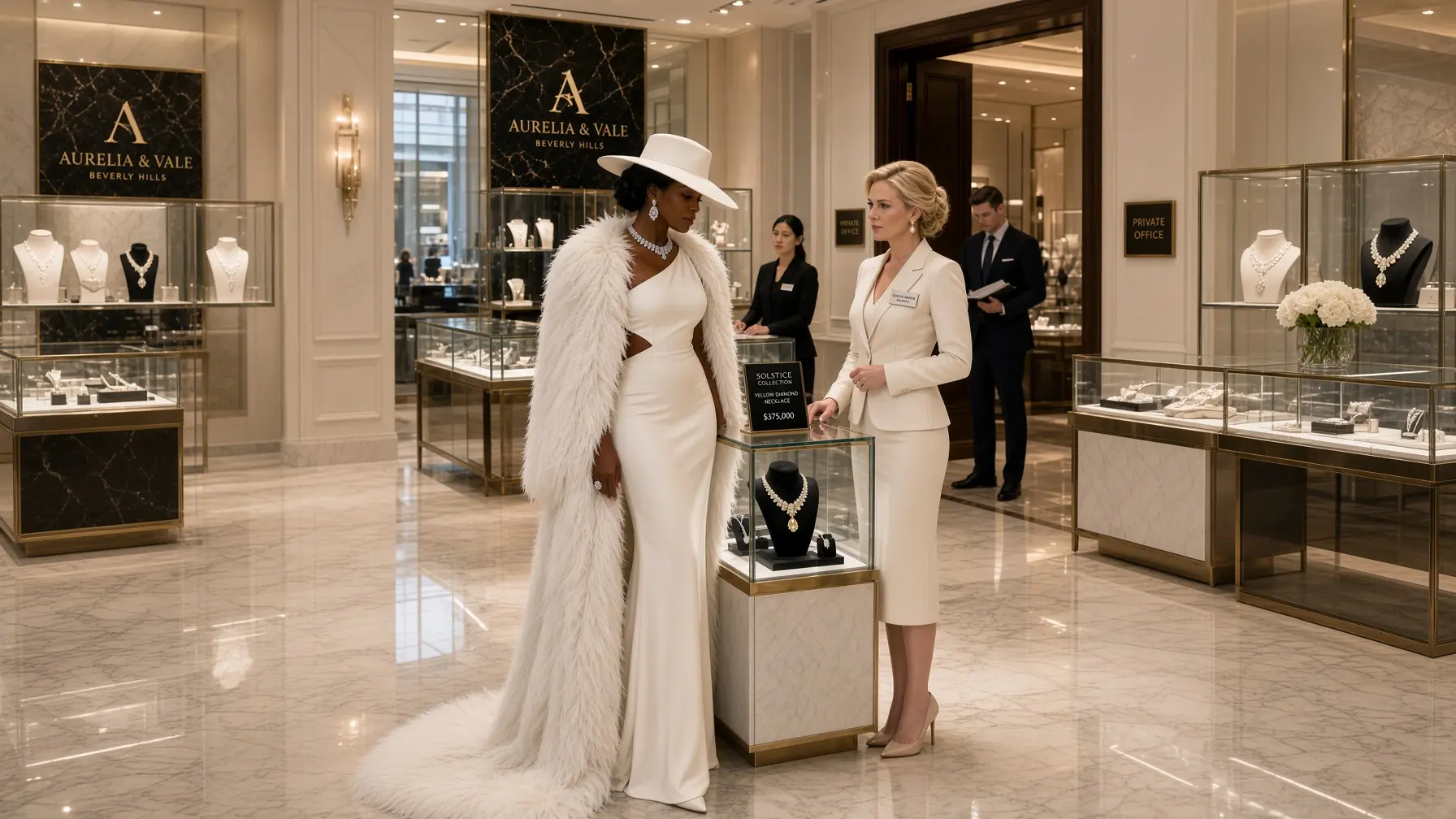
That was the first mistake.
Not the loudest mistake.
Not the one that would cost Celeste her job, her reputation, and the polished Beverly Hills life she had spent years arranging around herself. But it was the first one, and almost every disaster that followed grew from it.
Monica stepped through the glass doors of Aurelia & Vale on Rodeo Drive just after 10:00 on a Thursday morning.
The store was quiet, chilled, and spotless in the way luxury spaces often are, as if silence itself had been polished before opening. Light fell carefully from hidden fixtures, striking diamonds at angles designed to make people forget numbers and remember desire. The air smelled faintly of white tea, fresh flowers, and money old enough not to announce itself.
Monica paused near the entrance.
She noticed the flowers first.
Not because they were beautiful, though they were.
Because the arrangement was wrong.
The white orchids in the front display had been placed too high, blocking the line of sight toward the central case. It was a small thing, the kind of detail no ordinary customer would notice. But Monica Avery had designed the store herself, down to the angle of the lights, the velvet shade inside the drawers, and the exact distance between the door and the first greeting.
She knew when something was off.
She touched the silver bracelet on her wrist, the tarnished one with a tiny blue stone set crooked near the clasp, and reminded herself not to correct anything yet.
That bracelet had belonged to her grandmother.
It was worth maybe forty dollars if a person judged it by metal.
To Monica, it was worth more than every diamond in the room.
She wore it every day she visited one of her stores unannounced. It helped her remember why she had built Aurelia & Vale in the first place. Not to sell jewelry to people who already knew they belonged everywhere, but to create a space where nobody was made to feel small before being seen.
Monica was forty-three years old, Black, self-made, and richer than most people who recognized her name could fully understand.
Aurelia & Vale had started as one rented counter in Atlanta, a secondhand loupe, and a loan no bank wanted to give her. Twenty-one years later, the company owned fifty-one boutiques across thirteen states, generated nearly two hundred million dollars a year, and designed engagement rings that appeared in magazines, movies, red carpets, and quiet family proposals nobody ever wrote about.
Her pieces had been worn by actresses, senators’ wives, tech founders, musicians, and women who saved for years to buy one meaningful thing.
Forbes had put her on its self-made women list nine years in a row.
Business schools studied her supply chain.
Luxury magazines called her “the woman who softened American jewelry.”
Still, she drove a 2004 Toyota Corolla.
The same blue Corolla she had bought when her first store finally became profitable enough for her to stop riding buses with inventory in her lap. The paint had faded on the roof. The radio worked only when it felt respected. The driver’s seat had a small tear patched with black tape.
People asked her why she kept it.
She always gave the same answer.
“Because it still gets me where I need to go. And because every time I open that door, I remember who I was before anyone opened doors for me.”
That morning, the Corolla was parked legally two blocks away, between a Mercedes SUV and a matte-black Bentley.
A valet had looked at it like it might be contagious.
Monica had smiled and kept walking.
She wore a navy blazer, ivory blouse, dark trousers, simple flats, and the bracelet. No obvious diamonds. No logo handbag. No entourage. No assistant. No board member beside her to make strangers stand straighter.
That was the point.
Her unannounced visits were not traps.
At least, she never thought of them that way.
They were temperature checks.
She wanted to know what happened inside her stores when nobody expected the founder to appear. She wanted to know how customers were greeted when they walked in wearing sneakers, work uniforms, thrift-store coats, old jewelry, tired faces, or confidence that did not match the room’s expectations.
“I built this company,” she told managers every year, “because I know what it feels like to have money in your pocket and still be treated like you wandered into the wrong place.”
Most employees remembered that.
Some did not.
Celeste Monroe was one of those who did not.
Celeste was thirty-nine, white, polished, and proud of being the kind of woman who could say “old family” without needing to explain which one. She had grown up in Greenwich, gone to the right schools, worn pearls before she learned payroll taxes existed, and carried herself with a refined coldness that some people mistook for sophistication.
She had been hired eight months earlier to manage the Beverly Hills flagship.
In her mind, she had been brought in to elevate the brand.
Not sell jewelry.
Elevate.
That word had become dangerous in her hands. It gave her permission to decide who looked serious, who looked aspirational, who looked useful, and who looked like a risk to the store’s image. She never wrote those judgments down, of course. People like Celeste rarely put ugly rules on paper.
They simply enforce them with smiles.
Working under her was Ryan Bell, twenty-eight, assistant manager, smart, ambitious, and still decent enough to be uncomfortable when something was wrong. There was also Mia Zhang, twenty-four, a sales associate and part-time design student who loved jewelry for the same reason Monica did: because small beautiful things could carry impossible amounts of feeling.
And there was Arthur Gaines, the security guard.
Arthur was forty-seven, a former Marine, steady-eyed, quiet, and badly in need of the job. He had two daughters in college and a mother whose prescriptions cost more than anyone should have to pay to stay alive. He took orders seriously, but not blindly.
That would matter.
Monica walked deeper into the store and headed toward the centerpiece display.
The Solstice Collection.
It was her personal masterpiece.
A two-million-dollar arrangement of rare diamonds and colored stones built around a necklace with a golden yellow diamond at the center, priced at three hundred and seventy-five thousand dollars. Monica had spent eighteen months approving sketches, rejecting settings, changing stone placements, and arguing with master jewelers about the exact emotional temperature of the piece.
She loved that necklace.
Not because it was expensive.
Because it looked like morning breaking over water.
“Good morning,” Celeste said. “Are you looking for something special today?”
Monica looked up.
“Yes. I’d like to see the Solstice Collection.”
The smile changed.
Not enough for a casual observer.
Enough for Monica.
Celeste’s eyes moved once over Monica’s blazer, her shoes, her bracelet, and perhaps the absence of visible money. The evaluation lasted less than two seconds. The conclusion was immediate.
“Oh,” Celeste said. “Those are our highest-value pieces. They begin around two hundred thousand dollars.”
“I know,” Monica said.
Celeste waited for more.
None came.
Monica looked back at the case.
“I’d still like to see them.”
Celeste’s fingers rested on the key at her waist, but she did not unlock the case right away.
“May I ask what the occasion is?”
Monica turned slightly.
“Does there need to be one?”
Celeste’s smile tightened.
“It just helps us guide clients toward pieces appropriate for their needs.”
Clients.
Not customers.
Not guests.
Clients.
At Aurelia & Vale, that word had always been meant to make people feel respected. On Celeste’s tongue, it had become a gate.
“I understand my needs,” Monica said. “Please open the case.”
For a moment, Celeste looked as if she might refuse.
Then she unlocked it.
Slowly.
Protectively.
As if Monica had already given her reason to worry simply by wanting to see what was inside.
Monica leaned in, studying the necklace without touching it. The stones caught the light beautifully, but the clasp angle was a fraction too low. One side of the setting had been tightened more than the other, barely visible unless a person knew what to look for.
“The center stone is excellent,” Monica said. “But the right shoulder setting is slightly uneven.”
Celeste blinked.
“I’m sorry?”
“The prongs are clean, but the shoulder line pulls a little low. It changes the fall of the necklace by maybe two millimeters.”
Celeste’s face stiffened.
“Our pieces are made by master craftsmen.”
“I know they are.”
“And each one is inspected before display.”
“It should still be corrected.”
Celeste stared at her.
A customer wearing a cotton coat and simple flats was not supposed to speak like that.
She was not supposed to know setting language, stone balance, or design intent. She was supposed to admire, ask the price, feel embarrassed, and drift toward cheaper cases where Celeste could forget her.
The front door chimed before Celeste could answer.
An older white couple entered together.
Walter and Evelyn Prescott.
Regular clients.
Old Los Angeles money.
The kind of people Celeste understood immediately and treated with genuine warmth because they fit the story she liked telling herself about luxury.
Her whole face lit up.
“Mr. and Mrs. Prescott,” she called, already turning away from Monica. “What a pleasure. Are we looking for something for the gala this weekend?”
Monica remained beside the open Solstice case.
Celeste did not excuse herself properly.
She did not close the case.
She did not tell another associate to assist.
She simply left Monica standing there and hurried toward the Prescotts as if the real customers had finally arrived.
Mia Zhang noticed.
She had been arranging a tray of diamond studs near the side counter, but her eyes kept moving to Monica. She saw the ignored case. She saw Celeste’s shift in tone. She saw Monica standing patiently in the kind of patience people force themselves to wear when they know getting angry will only be used against them.
Mia walked over.
“Ma’am,” she said gently, “would you like me to help you continue viewing the collection?”
Monica looked at her.
There was warmth in Mia’s voice.
Real warmth.
Before Monica could answer, Celeste called from across the room.
“Mia, I need you in the back checking the new inventory.”
Mia froze.
“It can wait,” she said carefully.
Celeste’s smile toward the Prescotts did not move, but her eyes sharpened.
“Now, please.”
Mia looked back at Monica, embarrassed.
“It’s all right,” Monica said softly. “Thank you for offering.”
Mia nodded once and went to the back.
Monica waited.
Five minutes.
Then ten.
Then fifteen.
She watched Celeste seat the Prescotts in the private viewing area. She watched champagne appear in crystal flutes. She watched Celeste remove pieces from cases without hesitation, place them on velvet trays, explain history, sourcing, design, craftsmanship, and emotion.
Exactly the experience every Aurelia & Vale customer was supposed to receive.
Meanwhile, Monica stood beside the open case in her own store, invisible except as a problem Celeste hoped would solve itself by leaving.
Ryan Bell looked up from paperwork near the office door.
He saw enough to feel his stomach tighten.
He should have stepped in earlier.
He knew that even before the thought finished forming.
After fifteen minutes, Monica walked toward the private viewing area and stopped at a respectful distance.
“Excuse me,” she said. “I’m still interested in the Solstice necklace.”
Celeste turned slowly.
Not surprised.
Annoyed.
“Ma’am, as I explained, those pieces require a significant financial commitment.”
“I’d like to purchase the necklace.”
The store changed around that sentence.
Even the Prescotts stopped moving.
Celeste stared.
Then she laughed.
Not politely.
Not lightly.
A full laugh, sharp enough to cut the room open.
“You want to purchase the Solstice necklace?”
“Yes.”
“The three-hundred-and-seventy-five-thousand-dollar necklace?”
“Yes.”
Celeste’s lips parted into a smile that held no kindness.
“In that case, I’ll need proof of funds before we continue.”
Monica’s voice remained calm.
“Is that company policy?”
“For transactions of this magnitude, yes.”
Monica looked toward the Prescotts.
“They were shown pieces in the same range.”
Celeste’s face tightened.
“They are established clients.”
“I could become one.”
Celeste glanced at the bracelet on Monica’s wrist.
“I think you would be more comfortable in our silver gift collection. We have lovely pieces under five hundred dollars.”
The words landed exactly as Celeste intended them to.
Softly enough to deny.
Clearly enough to wound.
Monica’s jaw tightened.
“I did not ask for the silver gift collection.”
Celeste stepped closer.
“No, but perhaps you should have.”
Arthur shifted near the door.
Ryan took one step forward.
Mia had returned from the back and now stood frozen near the side counter.
Monica looked directly at Celeste.
“I am asking to purchase a piece from the Solstice Collection. You have asked me for proof of funds after failing to ask other customers the same thing. You left me standing for fifteen minutes after deciding I did not deserve your time. You are now trying to redirect me to the cheapest section of the store.”
Celeste’s cheeks flushed.
“That is completely inappropriate.”
“Yes,” Monica said. “It is.”
Celeste crossed her arms.
“I treat customers according to store standards.”
“Your standards seem to change depending on who is standing in front of you.”
The Prescotts looked uncomfortable now.
Evelyn Prescott lowered her champagne glass.
Celeste’s voice sharpened.
“I am going to ask you to leave.”
“No.”
The word did not come loudly.
It did not need to.
It stood in the middle of the store with more force than shouting.
Celeste blinked.
“Excuse me?”
“I said no.”
“You are creating a disruption.”
“You created this disruption when you decided I did not belong here.”
Celeste’s face went hard.
“I decide how this store operates.”
Monica’s eyes changed.
Something behind them cooled.
“This store?”
“Yes,” Celeste snapped. “My store. And I will not have someone walk in here, waste my staff’s time, insult our craftsmanship, and pretend she can buy a necklace she clearly cannot afford.”
Ryan stepped forward.
“Celeste, we should pause.”
She turned on him.
“Stay out of this.”
Mia’s hand covered her mouth.
Arthur moved a little closer but said nothing yet.
Celeste pointed toward the entrance.
“You need to leave right now.”
“I want to speak with your superior.”
“There is no one above me at this location.”
“Then call someone who is above this location.”
Celeste laughed again, but this time fear had begun to hide beneath the sound.
“You think corporate is going to take a call because you’re offended?”
“I know they will.”
Celeste reached for her phone.
“I’m calling security first.”
Arthur straightened.
Celeste looked at him.
“Arthur, escort this woman out.”
Arthur’s expression stayed controlled.
“Ma’am, has she committed a crime?”
Celeste’s eyes flashed.
“She is refusing to leave.”
“She asked to buy a necklace.”
Celeste’s voice rose.
“She looks like she came here to steal it.”
The entire store went silent.
There are sentences that cannot be taken back.
That was one of them.
Monica stood very still.
The old silver bracelet rested against her wrist.
For a moment, she was no longer in Beverly Hills. She was twenty-six again, standing in a jewelry district showroom with a supplier who asked whether she was picking something up for her employer. She was thirty-one, being ignored at a trade show until a white colleague introduced her as the buyer. She was thirty-seven, sitting in a bank lobby while a loan officer explained risk to her as if she had not already built the financials he was reading.
Then she was forty-three again.
In her own store.
Facing an employee whose paycheck came from the company Monica had built to make sure nobody felt the way she was feeling now.
Monica reached into her bag and removed her phone.
Celeste snapped, “Do not record me.”
“I am not recording you.”
“Then what are you doing?”
Monica’s hands were steady now.
“I am calling my board.”
Celeste frowned.
“Your what?”
Monica tapped a number she knew by heart.
The call connected on the second ring.
“Eleanor,” Monica said. “It’s Monica Avery. Emergency board call. Now. Include legal, HR, and operations.”
Ryan’s face lost color.
Mia’s eyes widened.
Arthur looked from Monica to Celeste and quietly stepped away from the door, no longer positioned as if he might remove the wrong woman.
Celeste stared at Monica, confused and irritated.
The name Monica Avery circled her mind, searching for a place to land.
It had been on memos.
Training videos.
Corporate newsletters.
Policy documents she had skimmed while believing values were for lower-tier stores and Beverly Hills required a different touch.
Monica continued.
“Yes. I am at the Beverly Hills flagship. We have a serious violation.”
Flagship.
Not store.
Not boutique.
Flagship.
Ryan whispered, “Oh no.”
Mia pulled out her phone and began searching.
Celeste heard the words, saw Mia’s face, saw Ryan’s fear, and still did not fully understand. Arrogance can delay comprehension even when the truth is standing in front of it.
Monica looked at Celeste while she spoke.
“Discrimination. Refusal of service. False accusation of theft. Threatened removal by security. Violation of customer dignity policy and brand conduct standards.”
Each phrase struck the room like a bell.
Celeste’s mouth opened.
“What are you talking about?”
Monica ended the call and placed the phone back into her bag.
Then she reached into a side pocket and removed a black business card.
She held it between two fingers and set it on the glass counter.
Celeste looked down.
Monica Avery
Founder and Chief Executive Officer
Aurelia & Vale
For three seconds, Celeste did not move.
Then her face changed all at once.
Not gradually.
All at once.
The blood drained from her cheeks. Her mouth parted, but no sound came out. She looked from the card to Monica’s face, then back to the card, as if the letters might rearrange themselves into something survivable.
“You can’t be,” she whispered.
Monica’s voice was quiet.
“Can’t be what, Celeste?”
Celeste swallowed.
Monica stepped closer.
“Can’t be the founder? Can’t be the owner? Can’t be the woman whose name appears on your employment contract?”
Nobody breathed.
“Or can’t be the person who walked in wearing no diamonds, drove an old Toyota, and still had every right to be treated with dignity?”
Celeste’s eyes filled with tears now.
Desperate tears.
Not regretful ones.
Not yet.
“I didn’t know.”
Monica studied her.
“That is not the defense you think it is.”
Celeste shook her head.
“I mean, if I had known you were Ms. Avery, I never would have—”
“Never would have what?” Monica asked. “Ignored me? Asked for proof of funds? Sent me to the cheapest section? Accused me of theft? Ordered security to remove me?”
Celeste’s lips trembled.
Every answer condemned her.
If she said yes, she admitted she reserved respect for power.
If she said no, she admitted she saw nothing wrong with how she treated an ordinary customer.
Monica turned away from her and faced the staff.
“Ryan.”
Ryan straightened.
“Yes, Ms. Avery.”
“You tried to intervene.”
“Too late,” he said quietly.
Monica looked at him for a moment.
The answer mattered.
“Yes,” she said. “Too late. But you did try.”
His eyes dropped.
“Mia.”
Mia’s eyes were wet.
“Yes, ma’am.”
“You approached a customer who was being ignored. You did what this company trains people to do before anyone told you to.”
Mia nodded, unable to speak.
“Arthur.”
The security guard stood taller.
“You questioned an order that did not feel lawful or right. That takes judgment. And judgment is what I need in people who protect my stores.”
Arthur’s throat moved.
“Thank you, ma’am.”
Then Monica turned back to Celeste.
The whole store seemed to lean away from the silence.
“You violated the purpose of this company,” Monica said. “Not just a rule. Not just a policy line. The purpose.”
Celeste began crying harder.
“Please. I made a mistake.”
“No,” Monica said. “You made a series of choices.”
Celeste wiped her face, mascara streaking beneath her eyes.
“I was trying to protect the store.”
“From what?”
Celeste could not answer.
Monica did it for her.
“From someone who did not fit your idea of a high-value customer.”
The words sat there, clean and merciless.
Celeste reached toward the counter.
“I can take training. I can change. Please, I have a mortgage. I have children.”
Monica’s expression softened by one degree.
Not enough to save her.
“You should have remembered that every person who walks through that door has a life too.”
Celeste covered her mouth.
Monica’s voice remained steady.
“Clear out your office. Your employment with Aurelia & Vale ends today.”
A sound escaped Celeste, half sob and half gasp.
Ryan closed his eyes briefly.
Mia looked down.
Arthur did not move.
The Prescotts stood from the private viewing area in silent embarrassment. Walter Prescott placed his untouched champagne glass on the table. Evelyn looked at Monica, then at Celeste, then at the door.
“We should have said something,” Evelyn said quietly.
Monica looked at her.
“Yes.”
Evelyn nodded once, accepting the weight of it.
Then she and her husband left.
The other customers remained, many still holding phones, many unsure whether they should keep recording or put the devices away. Monica noticed. She had built a business in the age of cameras. She knew the video would be online before Celeste finished packing her desk.
She did not fear that.
Let people see.
Not because humiliation was enjoyable.
Because concealment protects patterns.
Monica turned to Ryan.
“As of this moment, you are acting store manager.”
Ryan stared.
“Ms. Avery, I—”
“You are not being rewarded for being perfect,” Monica said. “You are being trusted because you recognized the problem and you are honest enough to know you should have moved faster. That honesty is useful.”
Ryan nodded slowly.
“I understand.”
“Mia, you are assistant manager effective immediately.”
Mia’s hand flew to her mouth.
“Me?”
“Yes. You showed more leadership in one minute than this store’s manager showed in thirty.”
Tears filled Mia’s eyes.
“Thank you.”
“Arthur,” Monica said, turning to him, “you will receive a formal commendation, a raise, and authority to refuse any removal order that does not meet legal and company standards. I will put that in writing before I leave.”
Arthur looked down once, collecting himself.
“Yes, ma’am.”
Celeste sank into one of the chairs she had offered the Prescotts but never offered Monica.
The irony was not lost on anyone.
She looked smaller there.
Not humbled in a noble way.
Reduced by the sudden absence of the authority she had misused.
Monica watched her for a moment, then said, “Arthur, please allow Ms. Monroe to gather her personal items. Do not rush her. Do not humiliate her. Make sure she leaves safely.”
Celeste looked up, startled.
Monica met her eyes.
“You denied me dignity. I will not copy you.”
That was the first moment Celeste’s apology sounded real.
“I’m sorry,” she whispered.
Monica nodded once.
“I believe you are beginning to be.”
Celeste flinched because the sentence held no forgiveness inside it.
Only accuracy.
While Celeste packed, Monica walked back to the Solstice case.
The necklace lay where it had been, catching light as if nothing ugly had happened around it. Monica adjusted the velvet beneath it, then corrected the shoulder setting with a note for the master jeweler. She also lowered the orchids near the front display by three inches.
Small repairs.
Necessary ones.
Ryan approached quietly.
“Should we close for the day?”
“No.”
He looked surprised.
Monica turned toward the store.
“We stay open. We serve every customer who walks in with the dignity they deserved before this happened.”
Mia wiped her eyes and nodded.
Arthur returned to his post, but something about his stance had changed. Not pride exactly. Permission. The kind that comes when a person realizes doing the right thing will not cost him his place in the room.
A woman who had recorded the confrontation stepped forward.
“Ms. Avery,” she said, “what you did was extraordinary.”
Monica smiled faintly.
“It should not have needed to be.”
The woman lowered her phone.
“I’m still going to post it.”
“I know.”
“Are you worried?”
“No,” Monica said. “I am responsible.”
The video spread within hours.
By evening, the first clip had millions of views.
Luxury Store Manager Accuses Black CEO Of Theft In Her Own Store.
Jewelry Founder Fires Manager After Discrimination Incident.
CEO Handles Racism With Ice-Cold Grace.
Monica hated most of the headlines.
They made the story sound like a twist designed for public satisfaction. They focused on Celeste’s shock, Monica’s reveal, the business card on the counter, and the instant promotions. People loved the part where arrogance discovers too late that the person it dismissed has power.
But Monica knew that was the least important part.
The point was not that Celeste had mistreated the wrong woman.
There is no right woman to mistreat.
No right customer to ignore.
No right person to accuse because their car is old, their bracelet is plain, their skin is Black, or their money does not announce itself loudly enough for a manager’s imagination.
The next morning, Monica returned to the Beverly Hills flagship.
This time, she arrived with HR, legal counsel, and her chief operating officer, Naomi Price, a woman who had been at her side since the company’s second store and had no patience for polished cruelty.
They reviewed the security footage.
Every minute.
Celeste’s smile shifting.
Mia being sent away.
The Prescotts receiving champagne.
Monica waiting.
The proof-of-funds demand.
The theft accusation.
Arthur being ordered to remove her.
The footage was clear.
No misunderstanding.
No missing context.
No difficult customer narrative.
Just choices.
Monica asked HR to pull complaints from the Beverly Hills store for the past eight months.
At first, there were only three.
Then Naomi asked for anonymous customer feedback, abandoned purchase forms, and staff exit comments.
The number changed.
A Latina bride who said she had been steered away from engagement rings above ten thousand dollars despite having an appointment.
A young Black attorney who wrote that Celeste asked whether she was “shopping for someone else.”
A Middle Eastern father who left after being asked for additional payment verification on a watch already paid for online.
Two former employees who described Celeste’s “client quality” language.
One staff note from Mia that had never been escalated because she had feared retaliation.
Monica read every line.
She felt anger again, deeper this time, because now the story had expanded beyond her. Her experience had not been an isolated spark. It had been a lit match revealing smoke that had already filled the walls.
Patterns rarely announce themselves.
They accumulate.
Monica ordered a full company audit.
Not because the videos were viral.
Because the company needed to deserve the values printed in its handbook.
Within two weeks, every Aurelia & Vale store manager attended mandatory retraining, but Monica refused to let the word training become a decoration. She changed policy.
Mystery-shopper evaluations were expanded.
Customer treatment audits became tied to bonuses.
Proof-of-funds requests required written justification and regional approval.
Security removal requests required a documented behavioral basis, not a manager’s feelings.
Employees were given a protected channel to report discriminatory service practices.
And every store received a new sentence printed beneath the customer service standard.
Luxury is not exclusion. Luxury is care.
Monica wrote that line herself.
Ryan struggled at first as acting manager.
Not because he lacked ability.
Because the store had to unlearn the tension Celeste had taught it. Some customers loved the changes. Some did not. A few regulars complained that the store felt “less selective” now, which told Monica everything she needed to know.
Mia flourished.
She had an eye for design, but more than that, she had the rare gift of making people feel safe while looking at expensive things. She could explain a diamond to a billionaire and a silver pendant to a teenager buying a birthday gift with equal respect.
Arthur became the person staff went to when they were unsure whether an order crossed a line.
He never enjoyed attention, but he carried the commendation letter folded in his jacket for weeks before finally framing it at home.
Three months later, Monica hosted a private reopening event for the Beverly Hills flagship.
Not because the store had closed.
Because its culture had.
And because openings deserve witnesses.
The guest list was different from what Celeste would have chosen. There were celebrity clients and wealthy collectors, yes. But there were also local teachers, young couples, longtime customers, former staff, small business owners, and several people who had written complaints but agreed to return after Monica personally invited them.
The Solstice Collection stood at the center of the room.
The orchids were properly placed.
Ryan greeted guests at the door.
Mia led the first private viewing.
Arthur stood near the entrance, steady as ever.
Monica wore a black dress, simple earrings, and her grandmother’s bracelet.
When she spoke, the room quieted.
“This store was built to celebrate value,” she said. “Not the kind value others assign when they look at you. The kind you carry before anyone asks your name, checks your wallet, sees your car, or learns your title.”
She looked at the Solstice necklace.
“Jewelry marks proposals, anniversaries, grief, birthdays, survival, promises, and second chances. It is intimate. People do not come here only to buy objects. They come carrying stories.”
Then she looked around the room.
“If we treat a person carelessly at the door, we have already failed the jewelry before we ever open the case.”
No one spoke.
Good.
Some truths need a quiet room.
After the event, Monica stayed late.
The staff had gone.
The lights had been lowered.
Rodeo Drive outside shimmered with headlights and reflections from windows too expensive to look ordinary even after dark. Monica walked to the central case and stared at the Solstice necklace one last time.
Ryan appeared near the office.
“Ms. Avery?”
“Yes?”
“Did you ever actually want to buy it?”
Monica smiled.
“No.”
He laughed softly, then looked embarrassed.
“I’m sorry.”
“Don’t be.”
“Then why ask for it?”
Monica looked at the necklace.
“Because every customer has the right to ask.”
Ryan nodded.
That was a lesson he would remember.
Celeste Monroe tried to defend herself for a few weeks.
Her attorney drafted a statement claiming misunderstanding, stress, unclear policy, and an unfortunate interaction taken out of context. Then more customer complaints surfaced. More footage. More witness statements. The statement was never released.
She later sent Monica a handwritten apology.
Monica read it once.
It was better than the first apology.
Less desperate.
More honest.
Celeste admitted she had confused exclusivity with judgment. She admitted she had treated appearance as evidence. She admitted she had used the store’s prestige to protect her own prejudice.
Monica did not rehire her.
But she kept the letter.
Not for sentiment.
For training.
Names removed, context preserved.
A year later, Aurelia & Vale used the Beverly Hills incident in leadership onboarding. New managers watched edited footage from the security cameras. They saw how polite discrimination looked before it became loud. They saw the manager’s smile change. They saw Mia try to help. They saw Ryan hesitate too long. They saw Arthur ask the right question at the right moment.
Then Monica entered the room.
Every time, the managers sat a little straighter.
She did not enjoy that.
She did not want fear.
She wanted understanding.
“What you just watched,” she would tell them, “is not a story about recognizing me.”
Then she would pause.
“It is a story about recognizing everyone.”
That was the part she cared about.
Not the business card.
Not the board call.
Not the manager crying in a chair.
The recognition that should come before a title is revealed.
Years later, people still told the story like instant justice.
A Black woman walked into a Beverly Hills jewelry store.
The manager treated her like a thief.
Then she revealed she owned the whole company and fired the manager on the spot.
That version was true.
It was also too small.
The real story was about a woman who built a luxury business from hunger, rejection, and stubborn grace. A woman who kept driving an old Corolla because she refused to forget the years when people looked at her and saw less. A woman who walked into her own flagship not to catch someone failing, but to see whether the company still remembered its soul.
It almost did not.
Mia remembered.
Arthur remembered.
Ryan remembered late, but he remembered.
Celeste forgot completely.
So Monica corrected the store the way she corrected the crooked orchids and the uneven necklace setting. Not with noise for its own sake. Not with revenge dressed up as justice. With precision, consequence, and the kind of grace that does not excuse harm but refuses to become it.
The tarnished bracelet stayed on her wrist.
The Corolla stayed in her driveway.
The Solstice necklace eventually sold to a woman who arrived in jeans, cried when Mia placed it around her neck, and explained that she had just survived cancer and wanted one impossible thing to mark the life she still had.
No one asked her for proof of funds.
No one asked why she wanted it.
No one suggested a cheaper section.
Mia brought her water.
Ryan completed the sale.
Arthur walked her safely to her car, which was older than Monica’s.
And when Monica heard about it later, she sat in her office for a long time, turning the bracelet around her wrist.
That was the victory.
Not Celeste losing her job.
Not the viral videos.
Not the headlines.
The victory was the next woman walking through the door and being treated like she belonged before anyone knew what she could afford.
That was why Monica built Aurelia & Vale.
Not to prove she belonged in rooms like that.
To make the rooms better once she did.
And somewhere in the Beverly Hills flagship, beneath diamonds and soft lights and velvet trays, a new rule lived without needing to be spoken.
Do not judge the person at the door.
You may be looking at a customer.
You may be looking at the owner.
But before either of those things, you are looking at a human being.
And that should have been enough all along.