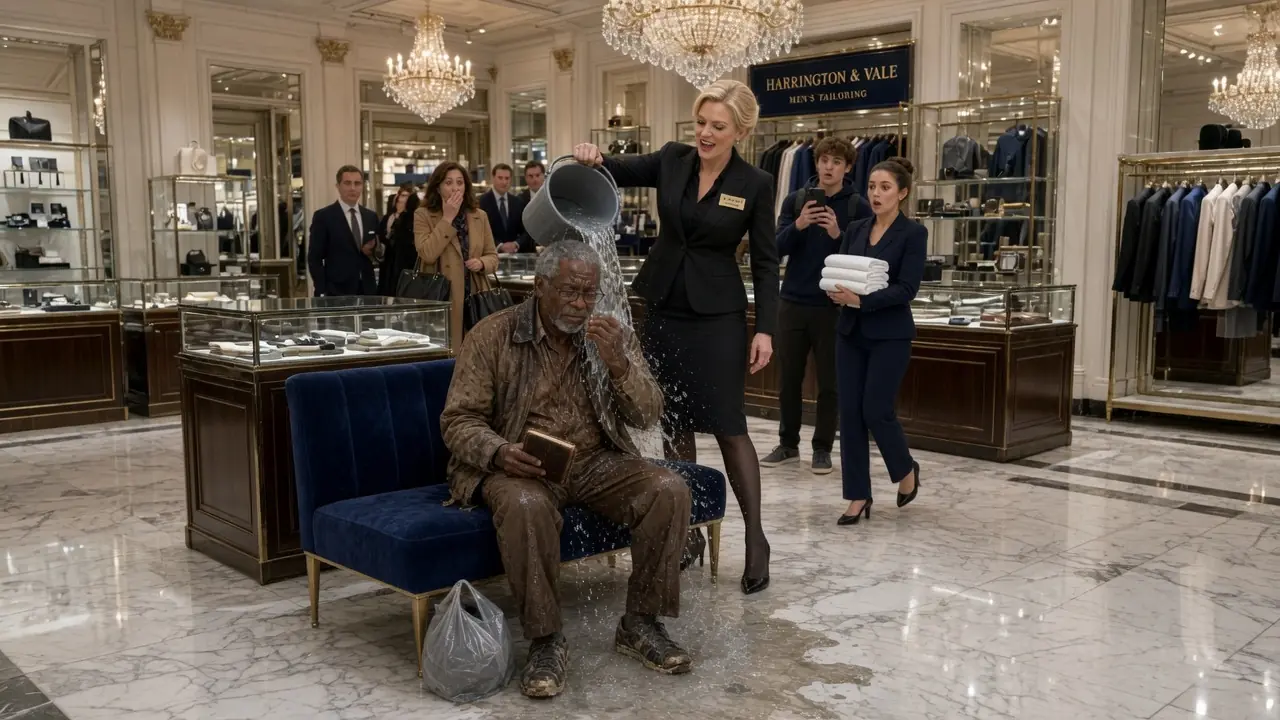
“People like you don’t shop here. People like you get removed.”
The words landed across the marble floor of the Harrington & Vale flagship store like something spilled and left there on purpose.
A Black man stood near the men’s tailoring section, wearing a faded brown jacket, a wrinkled work shirt, pants that ended too high above his shoes, and sneakers with the soles beginning to split at the front. In one hand, he carried a plastic grocery bag. In the other, he held a cashmere overcoat with a price tag hanging from the sleeve.
The floor manager, Marlene Beckett, stared at him as though he had dragged mud into a cathedral.
Then she grabbed the gray mop bucket from the cleaning station, lifted it with both hands, and dumped the dirty water straight over his chest and shoes.
The sound was worse than the splash.
Water slapped against fabric, hit marble, and spread in a gray puddle beneath him. It soaked his shirt, ran down his pants, filled the torn edges of his shoes, and carried the sour smell of old detergent and floor grime through a room that had been perfumed with luxury candles ten seconds earlier.
Several customers froze.
A woman near the handbag wall covered her mouth. A teenager by the sunglasses display raised his phone. Two sales associates looked away because looking directly at cruelty meant deciding whether they were part of it.
Marlene pointed at the drenched man.
“There,” she said. “Now you look like the kind of floor you belong on.”
The man did not shout.
He did not lunge.
He did not curse her out, though half the room was waiting for him to give them a reason to make the story easier for themselves. He only wiped water from his eyes, reached beneath the soaked edge of his shirt, and pressed a tiny button hidden inside one of the cheap plastic buttons.
A red light blinked once.
Marlene did not see it.
She did not know the shabby man standing in her puddle was Isaiah Reed, founder and majority owner of Harrington & Vale Retail Group, forty-two luxury department stores, nearly three billion dollars in annual revenue, and the man whose signature sat at the bottom of every executive contract in the building.
Seventy-two hours earlier, Isaiah had been seated at the head of a glass conference table in Atlanta, wearing a navy suit, a white shirt, and the silver cufflinks his mother bought him after his first store turned a profit. Behind him, the skyline sat bright and clean beyond floor-to-ceiling windows. In front of him, a report glowed on the screen.
Customer discrimination complaints were up 312 percent in two years.
The Boston flagship on Newbury Street led the company.
His chief legal officer, Dana Bell, placed a folder in front of him without a word. Isaiah opened it and saw complaint after complaint, all saying versions of the same thing. Black customers followed. Latino shoppers ignored. Older customers redirected to clearance. Young men treated like thieves before they touched a display.
One line held him still.
A customer wrote, “The manager told me the coat was not meant for people from my neighborhood.”
Isaiah closed the folder.
The room waited for a speech.
They did not get one.
“Book me to Boston,” he said. “No announcement. No regional briefing. No PR memo. I want security two blocks away and legal watching the feed.”
Dana looked at him carefully.
“You’re going in yourself.”
“Yes.”
“Isaiah, we can send testers.”
He looked at the report again.
“They already sent us the truth. We ignored it. Now I want to feel what we ignored.”
The next evening, Isaiah stood in a hotel room overlooking Boston Common while his head of security, Jonah Price, unpacked a duffel bag on the bed.
Everything inside had been purchased from thrift stores and discount bins. A faded jacket with frayed cuffs. A brown shirt washed thin at the collar. Pants too short by two inches. Sneakers with one toe peeling open. Drugstore reading glasses. A plastic grocery bag from a corner market.
Isaiah removed his watch first.
Then his wedding band.
Then his cufflinks.
He placed each item on the bathroom counter in a neat row, not because he cared about the objects, but because removing them felt strangely like stepping out of armor. Wealth had weight. So did the absence of it.
Jonah fitted a small camera into one shirt button and tested the audio through a laptop.
“Clear picture. Clean sound. Battery will hold six hours.”
Isaiah looked in the mirror.
He did not look dangerous. He did not look criminal. He did not even look homeless. He looked tired, underpaid, and ordinary in the way working people often look when their clothes have been asked to last longer than they should.
“Are you sure?” Jonah asked.
Isaiah adjusted the cheap glasses.
“The Boston complaints mentioned men who looked like they worked maintenance, delivery, or day labor. If this company punishes people for looking poor, I need to see how deep the rot goes.”
He picked up a worn leather notebook and placed it into the plastic bag.
It had belonged to his mother, Ruth Reed, a woman who cleaned offices at night and raised three boys on paychecks so thin they seemed impossible in hindsight. On the first page, in her handwriting, she had written a sentence Isaiah carried like scripture.
Build a door nobody has to beg to enter.
He had built the door.
Now he was going to find out who had been guarding it.
At 10:07 the next morning, Isaiah Reed walked into his own Newbury Street flagship.
No one recognized him.
The store was three floors of polished ambition. Marble floors, brass rails, velvet seating, glass display cases, private styling rooms, chandeliers shaped like falling rain. The air smelled like leather, perfume, cedar, and money pretending it had no smell at all.
Isaiah walked slowly, plastic bag at his side.
A customer glanced at his shoes, then looked away. A man near watches shifted his body slightly so Isaiah would not pass too close. A woman holding a designer scarf studied him with the quick, silent alarm of someone who had already decided he did not fit the room.
Then a young associate approached.
Her name tag read Lila Monroe.
“Good morning,” she said. “Welcome to Harrington & Vale. Let me know if you’d like to see anything.”
Isaiah looked at her.
Her smile was nervous, but real.
“I’m interested in that sandalwood cologne.”
“Of course.”
She took a sample strip, sprayed it, and handed it to him like she had done it for a thousand customers and his shoes changed nothing about the task. Isaiah smelled the strip, nodded, and asked a question about the fragrance notes. She answered honestly and admitted when she was not sure.
Good employee.
Good instincts.
Still human.
Then the sound of heels came from the far side of the floor.
Marlene Beckett appeared from behind a mirrored column.
She was forty-eight, sharp-featured, dressed in black, and walking with the irritated confidence of someone who believed every room functioned better once she took control of it. Her eyes moved over Isaiah from head to toe. Jacket. Shirt. Pants. Shoes. Plastic bag.
Her face closed.
“Lila,” she said, not looking away from Isaiah. “Second floor. Now.”
Lila hesitated.
“I’m helping a customer.”
“I’ll handle this.”
The words left no space for discussion.
Lila stepped back, but she did not move immediately. Isaiah saw the conflict in her face before she lowered her eyes and walked toward the escalator.
Marlene turned to him.
“Sir, are you waiting for someone?”
“No. I’m shopping.”
Her smile was almost invisible.
“Shopping for what, exactly?”
He held up the sample strip.
“Cologne. Maybe a coat.”
Marlene glanced toward the price tag on the fragrance bottle.
“That line starts at three hundred and twenty dollars.”
“I saw.”
“We have more affordable options downstairs.”
“I’d like to stay here.”
Her expression cooled another degree.
“Then I need you to keep your bag visible and avoid touching merchandise unless assisted by staff.”
Isaiah looked down at the plastic grocery bag.
Inside sat a notebook, a pen, and a folded newspaper.
“Is that policy?”
“It is store discretion.”
There it was again.
The phrase that appeared in three complaints, four emails, and one internal training note legal had flagged months earlier.
Store discretion.
The place where bias hid when it learned corporate language.
Isaiah moved to the men’s tailoring section. He did not rush. He did not provoke. He picked up a navy cashmere overcoat, read the tag, and held it against his chest to judge the fit.
Marlene was beside him in less than ten seconds.
“Sir, put that down.”
He looked at her calmly.
“I’d like to try it on.”
“That piece is over two thousand dollars.”
“I understand.”
“Do you?”
Her voice rose enough for nearby customers to hear.
A couple near the shoe wall paused. A sales associate at watches kept his eyes on a register that did not need his attention. The security guard near the entrance touched his earpiece, then pretended he had not.
Marlene stepped closer.
“You are making paying customers uncomfortable.”
“I am a paying customer.”
“With what?”
The words came out before she could polish them.
Isaiah gave her three seconds to hear herself.
She did not.
Instead, she lifted her radio and spoke clearly.
“Security, monitor the male customer in men’s tailoring. Brown jacket, plastic bag, no visible purchase intent.”
No visible purchase intent.
Isaiah almost smiled.
He had spent thirty years building retail systems. He knew every phrase employees used when they wanted to say poor, Black, suspicious, unwanted, without saying the words where legal could find them. Marlene was not subtle. She was simply used to being protected.
A young guard named DeShawn Avery came within twelve feet and stopped.
He was maybe twenty-seven, wide-shouldered, and uncomfortable immediately. He did not look hostile. He looked trapped between a paycheck and a conscience. Isaiah knew that look too.
Marlene leaned toward another associate and whispered, but the button camera caught it cleanly.
“Don’t waste time on him. He’s here for warmth or trouble.”
Isaiah sat on a bench near the fitting rooms.
He opened the plastic bag and pulled out his mother’s leather notebook. He began writing, slow and neat. Customer response. Security activation. Language used. Associate interference.
That was what broke Marlene.
Not the coat.
Not the cologne.
The writing.
A shabby man taking notes in her luxury floor made her suddenly aware that he believed his experience mattered. That belief offended her more than anything else he had done.
She disappeared behind a service door.
When she returned, she was rolling a mop bucket.
The wheels squeaked across the marble.
Everyone heard them.
The bucket was half-full of gray water from the morning cleaning crew. It smelled of ammonia, soap, and old dirt. Marlene rolled it until it stopped at Isaiah’s feet.
“Since you’re so comfortable sitting around,” she said, “maybe you can help clean the mess you brought in.”
Isaiah closed the notebook.
“Marlene, I would like to speak with your supervisor.”
That made her laugh.
“I am the supervisor.”
“Then I would like your full name and employee number.”
“A complaint?” she said. “From you?”
She looked around the floor, inviting the room to share the joke.
Some people looked away.
That was how cowardice often entered a room. Quietly. With its eyes lowered.
Marlene gripped the mop bucket.
“You want to sit on my floor like you belong here?”
She lifted it.
“Then look the part.”
The water came down across Isaiah’s legs and shoes, then higher across his lap and shirt when she tipped the bucket harder. It splashed against the bench, spread over the marble, and soaked through the thin fabric against his skin.
Cold.
Dirty.
Public.
The room became silent.
Isaiah looked at the water pooling around his shoes.
Then at Marlene.
His voice stayed low.
“Please say your name again.”
She laughed.
“Marlene Beckett. Floor director. Put that in your little notebook.”
He did.
Outside, two blocks away, Jonah Price watched the live feed from the surveillance van with both hands clenched around the table edge. Dana Bell was beside him, expression carved from stone.
Jonah picked up his phone.
“Bring the suit.”
On the sales floor, Lila Monroe had returned from upstairs and stopped at the edge of the scene. She saw Isaiah drenched in dirty water. She saw Marlene standing over him. She saw customers watching like the room had become a theater and nobody wanted responsibility for the script.
Lila moved first.
She grabbed towels from a display drawer and knelt beside Isaiah.
“I’m so sorry, sir,” she said, wiping water from his shoes though it soaked into her own slacks. “This was wrong. I saw it. I’ll say I saw it.”
Isaiah looked down at her.
“What is your full name?”
“Lila Monroe.”
He wrote it in the notebook.
Then underlined it twice.
A teenager by the sunglasses display uploaded his video before anyone stopped him.
The caption read:
Luxury store manager dumps mop water on Black customer because he looks poor.
Within an hour, it had half a million views.
But the internet still did not know the real story.
At 11:18 a.m., Marlene was in the back office laughing with another manager.
“You should have seen him,” she said. “Sitting there like he was writing a review for the Times. Maybe now he’ll go warm up somewhere else.”
The desk phone rang.
The caller ID read: Harrington & Vale Executive Office.
Marlene straightened instantly.
“This is Marlene Beckett.”
Dana Bell’s voice came through the line.
“Ms. Beckett, this is Dana Bell, chief legal officer for Harrington & Vale Retail Group. You are currently subject to an executive conduct review.”
Marlene blinked.
“I don’t understand.”
“Mr. Reed will speak with you directly.”
“Mr. Reed? He’s in Boston?”
Dana paused.
“Ms. Beckett, Mr. Reed has been in your store since 10:07 this morning.”
Marlene did not move.
Her mouth opened, but no sound came out.
On the sales floor, three security professionals entered through the main doors. They were not store security. Everyone understood that immediately. Their suits fit too well, and their eyes moved with the calm precision of people who did not ask permission from panic.
Jonah Price walked directly to Isaiah.
“Sir,” he said, “your things.”
He handed Isaiah a garment bag.
The floor watched.
Isaiah stood in the puddle Marlene had made. He unbuttoned the soaked brown shirt and let it drop into the gray water. He removed the ruined jacket. The torn shoes came off next.
He put on a white dress shirt.
Then a charcoal suit jacket.
Then the silver cufflinks with Ruth Reed’s initials.
Jonah handed him his watch and wedding band.
By the time Isaiah turned around, the shabby man was gone only from the room’s imagination. The man himself had always been there. That was the point.
Lila whispered, “Oh my God.”
A sales associate beside her asked, “Who is he?”
Lila looked at Isaiah.
“That’s Mr. Reed.”
“The CEO?”
“The owner.”
Marlene emerged from the back hallway, saw him, and stopped so abruptly that the associate behind her nearly walked into her.
Her face went slack.
Then pale.
Then frantic.
“Mr. Reed, I didn’t know.”
Isaiah looked at her.
“That is the problem you think you have?”
She swallowed.
“I mean, you looked like—”
“Finish that sentence.”
She could not.
Every ending was a confession.
Isaiah stepped toward her.
“If I were the man you thought I was, a man with torn shoes and a plastic bag, you believe what you did would be acceptable.”
“No.”
“You did it.”
“I was protecting the store.”
“You were protecting your assumptions.”
The room was silent.
He turned to Jonah.
“Secure every camera angle. Internal, external, register, body, floor audio where available. Preserve the mop bucket, the uniform items, the towels, the notebook, and all radio traffic.”
“Yes, sir.”
Isaiah turned to the staff.
“Any employee who tells the truth today will be protected. Any employee who deletes, edits, hides, or pressures anyone about evidence will be terminated for cause.”
Then he looked at Lila.
“Ms. Monroe.”
She stood quickly.
“Yes, sir?”
“You treated me as a customer before you knew I could affect your life.”
Her eyes filled.
“That should have been normal.”
“Yes,” Isaiah said. “It should have.”
By sunset, the video had spread across the country.
The public version still showed only the humiliation.
A Black man in shabby clothes sitting near a fitting room.
A white floor manager dumping dirty mop water over him.
Customers frozen.
The man asking calmly for her name.
Marlene laughing.
The clip was so clear, so ugly, and so familiar to millions of people that it did not need explanation to become a fire.
By midnight, the hashtag Dirty Water Manager was trending.
By morning, former customers were telling their stories.
A nurse from Roxbury said she had been followed through the shoe department for twenty-five minutes.
A retired teacher said Marlene asked whether she was shopping for an employer.
A young father said security walked behind his thirteen-year-old son until the boy asked in the car, “Dad, why did they think I was stealing?”
The video had not created outrage.
It had opened a door outrage had been waiting behind.
At headquarters, Isaiah refused to release a statement immediately.
His PR team hated that.
Dana understood.
Jonah understood too.
“Let them reveal themselves first,” Isaiah said.
For forty-eight hours, he watched.
Regional director Charles Waverly moved first.
He issued a draft statement without Isaiah’s approval, calling the incident “inconsistent with our values” and placing Marlene on paid administrative leave pending review. Paid leave. Gentle language. No accountability. A cushion disguised as procedure.
Then Charles called Marlene.
The call was recorded under the investigation hold.
“Say nothing,” he told her. “Do not talk to press. Do not post. This will burn out. I’ve handled worse.”
Marlene whispered, “Charles, you don’t understand. It was Mr. Reed.”
A pause.
“What?”
“The man. The customer. It was Isaiah Reed.”
Charles went silent.
Then he said, “You are absolutely certain?”
“His security dressed him on the floor.”
Charles hung up.
Within three minutes, he began deleting emails.
IT recovered them before lunch.
That was when the investigation widened.
Every discrimination complaint from every Harrington & Vale store in the past five years was pulled. All forty-two locations. Every customer report. Every employee complaint. Every HR recommendation. Every resolution entry. Every termination within ninety days of a complaint.
The numbers came back like a verdict.
One hundred eighty-six customer discrimination complaints across the chain.
Ninety-four from the Boston flagship.
Sixty-eight marked resolved by Charles Waverly’s regional office without evidence of follow-up.
Twenty-seven employees who had filed internal complaints were fired within three months.
Official reasons included poor attitude, dress code, failure to meet sales standards, and lack of team alignment.
One associate had been terminated for “unprofessional conduct” two weeks after refusing to shadow a Black family through the jewelry department.
Another had been fired for “negative workplace energy” after reporting Marlene’s comment that “some customers lower the room.”
Isaiah read the audit alone in his office.
The longer he read, the less angry he looked.
Anger burns hot and moves.
What settled over him was heavier.
“This happened under my name,” he said.
Dana stood across from his desk.
“You did not know.”
“I should have known.”
She did not argue.
Good lawyers know when truth does not need softening.
Then IT delivered the recovered emails.
Charles Waverly had known for years.
One email from HR recommended formal discipline for Marlene after five customer complaints in six months. Charles replied, “Marlene’s floor drives premium conversion. Coach quietly.”
Another email described an associate’s complaint that Marlene ordered staff not to greet customers who looked “off-brand.” Charles forwarded it to Marlene with one line.
Be smarter with wording.
Not stop.
Not fix.
Be smarter.
The worst document was the compensation structure.
Charles’s annual bonus included a store harmony metric tied partly to low complaint escalation numbers. Low complaint counts meant higher payouts. Over three years, he had earned $410,000 in supplemental bonuses while burying complaints and punishing employees who filed them.
Four hundred ten thousand dollars.
That was what silence had paid him.
The first article ran two days later.
Nina Alvarez, an investigative reporter at the Boston Globe, had already been collecting retail discrimination stories when the video went viral. A former employee sent her internal complaint logs, and once she matched them against state filings, the gap was impossible to ignore.
Her headline was brutal.
Inside Harrington & Vale: The Complaints They Buried Before The Mop Water Video
The story named patterns.
It named dates.
It named employees.
It named Charles Waverly.
It quoted Lila Monroe, who agreed to be identified.
“I treated him like a customer because he was one,” she said. “That should not be heroic. It should be the job.”
Charles hired a crisis firm within hours.
Their strategy was obvious.
Turn the investigation against Isaiah.
A business blog ran a planted piece the next morning.
Did Harrington & Vale’s CEO Stage His Own Discrimination Scandal?
The article suggested Isaiah had dressed poorly to provoke a reaction, recorded employees without warning, and manufactured a viral crisis to position himself as a reformer. Some commentators took the bait. So did a few board members who had never liked Isaiah’s habit of reminding them the company had been built from a thrift store, not inherited from an estate.
An emergency board meeting was called.
Three members pushed for Isaiah to step back during the investigation.
One said, “You created a reputational crisis through an unauthorized undercover operation.”
Isaiah sat at the head of the table and listened.
Then he opened a folder.
“The crisis was created by one hundred eighty-six ignored complaints, ninety-four from Boston, twenty-seven retaliatory terminations, recovered emails proving regional knowledge, and a bonus structure that rewarded suppressed escalation.”
The boardroom went quiet.
He placed the mop water clothes on the table.
The brown shirt.
The ruined jacket.
The torn shoes.
The cheap glasses.
“They did not humiliate a costume,” he said. “They humiliated a person they thought had no power. The only reason some of you are uncomfortable is because the person turned out to be me.”
No one moved.
The motion to sideline him failed by one vote.
That night, Isaiah sat alone in his Boston hotel room.
The torn shoes were beside the trash can, still smelling faintly of mop water despite being sealed in an evidence bag earlier. He opened his mother’s notebook and touched the first page.
Build a door nobody has to beg to enter.
For the first time since the incident, his composure cracked.
He did not cry loudly.
He was not built that way.
But his breath broke once.
Then again.
“I’m sorry, Mama,” he whispered. “I built it tall, but I didn’t keep the doorway clean.”
His phone rang.
Jonah.
“You all right?”
“No.”
A pause.
“Do you want me to come up?”
“No.”
“What do you want?”
Isaiah looked at the notebook.
“The whole truth. No more pieces.”
The whole truth came through Lila Monroe.
She walked into the legal office the next morning carrying a spiral notebook, three printed screenshots, and a flash drive.
“I started writing things down my second month,” she said. “Nobody believed the first complaint I made. So I decided the next time, I’d bring dates.”
Her notebook documented seventeen incidents that matched buried complaints.
Names.
Times.
Phrases.
Managers present.
Customers followed.
Displays refused.
Security calls made without cause.
She had screenshots from a private sales-floor group chat. Marlene had used it to instruct senior associates on who deserved “full service” and who should be “managed toward exit.” One message was so clear that Dana Bell stared at it for several seconds before speaking.
If they look like they can’t afford the doorman’s shoes, don’t waste a greeting.
Lila also had a screenshot from Charles.
Keep conversion high. Keep complaints low. Handle optics locally.
That sentence would end him.
Five former employees came forward within the week.
They did not hide their faces.
One said she had been ordered to follow Black customers within thirty seconds of entry while white customers were given space.
One said Marlene refused to unlock a watch case for a Black doctor until the man’s white colleague arrived.
One said he filed a report about racial profiling and was fired forty-one days later for “tone issues.”
One said Charles’s office called her complaint “a cultural misunderstanding.”
One said, “I loved luxury retail. I hated what they made me ignore.”
Nina Alvarez released a twelve-minute documentary with their testimonies.
It reached five million views in four days.
The hashtag changed.
Dirty Water Manager became Not In My Store.
By the following Friday, the movement had left the internet.
Hundreds gathered outside the Newbury Street flagship holding candles, signs, and printed copies of dismissed complaints. Pastor Roland Ames, who led a church two neighborhoods away, spoke into a microphone while the store’s glass windows reflected the crowd back at itself.
“We are not here for a better apology,” he said. “We are here because dignity should not depend on shoes, skin, neighborhood, or who signs your paycheck.”
Customers stepped forward one after another.
A woman said security followed her mother until she left in tears.
A man said his son stopped wanting to go shopping after being shadowed through sneakers at age twelve.
A former employee said she was told to make certain customers “feel seen enough to leave.”
Isaiah watched the vigil from headquarters on a live feed.
His PR team wanted him there.
He refused.
“This is not my stage,” he said. “It belongs to the people we failed.”
He released one sentence that night.
I will answer publicly on Friday, and the answer will include consequences.
The press conference filled the atrium at Harrington & Vale headquarters.
Reporters lined the back wall. Cameras crowded the center aisle. The livestream reached more than two million viewers before Isaiah walked in.
He entered wearing his real suit, his mother’s cufflinks, and no expression arranged for television.
On a table beside the podium lay the clothes from the undercover visit.
The faded jacket.
The soaked shirt.
The torn shoes.
The plastic bag.
The cheap glasses.
The leather notebook.
Isaiah let the room look at them.
Then he spoke.
“My mother cleaned offices in Baton Rouge for twenty-eight years,” he said. “She once told me rich people love clean floors until they have to learn the name of the person cleaning them.”
The room was silent.
“I built this company so people would not have to shrink themselves at the front door. Last week, I walked into one of my own stores wearing clothes that should not have mattered, and I learned that the door I built had guards I never authorized but failed to remove.”
He looked down at the torn shoes.
“That failure is mine.”
Then the screens behind him lit up.
First came the unedited body-camera footage.
Not the viral clip.
The full sequence.
Lila greeting him correctly.
Marlene interrupting.
The radio call.
The whispers.
The fitting room confrontation.
The mop bucket.
The water.
The laugh.
Then came the audit.
One hundred eighty-six complaints.
Ninety-four in Boston.
Sixty-eight buried by regional leadership.
Twenty-seven retaliatory terminations.
Then the emails.
Be smarter with wording.
Coach quietly.
Handle optics locally.
Then the money.
Four hundred ten thousand dollars in bonus payments tied to low escalation numbers.
The room grew colder with each slide.
Isaiah did not dramatize anything.
The facts did enough.
He read the actions.
Marlene Beckett terminated for cause.
Charles Waverly terminated for cause and referred for civil investigation tied to complaint suppression and bonus fraud.
Every buried complaint forwarded to the state civil rights office.
An independent review opened for all twenty-seven terminated employees.
A three-million-dollar restitution and legal support fund for affected customers and workers.
A permanent civil rights ombudsman in every store.
A new complaint system managed by an outside firm, not regional leadership.
Executive bonuses tied not to low complaint numbers, but to verified resolution quality, service equity, and employee protection.
Then he paused.
“Lila Monroe is promoted to assistant floor manager of Newbury Street, effective immediately.”
Applause broke across the room.
Not from everyone.
Enough.
Isaiah lifted one hand, and the room settled.
“This is not a redemption story for the company,” he said. “Redemption is not announced. It is proven over time.”
A reporter asked whether Marlene planned to sue.
“She may,” Isaiah said. “That is her right. We will answer with evidence.”
Another reporter asked if he regretted going undercover.
Isaiah looked at the clothes on the table.
“I regret that it took me wearing torn shoes to make my company believe people who had been telling the truth for years.”
That was the line every news outlet used.
But Isaiah preferred a different one.
Near the end, when asked what the lesson was, he said, “A customer should not need power in order to be treated like a person.”
Three months later, the Newbury Street flagship reopened after a thirty-day closure and full restructuring.
The marble was the same.
The chandeliers were the same.
The fragrance counter still stood near the entrance.
But the back office was different. The complaint system was different. The incentive structure was different. Employees had completed training that did not feel like a checkbox, because it was connected to real discipline and real money.
Five employees resigned rather than continue.
Isaiah considered that data.
Lila Monroe stood at the fragrance counter with her new badge catching the light.
Assistant Floor Manager.
When Isaiah returned, he came through the front door in his real clothes. Customers looked at him now because they recognized him from television. Employees straightened, but not with terror. With awareness.
Lila smiled.
“Good afternoon, Mr. Reed.”
“Good afternoon, Ms. Monroe.”
“Still interested in the sandalwood?”
Isaiah laughed.
“I think I earned a bottle.”
She rang him up properly.
No ceremony.
No performance.
Just service done right.
Before leaving, Isaiah walked to the bench near the fitting rooms. The mop water was long gone. The floor had been polished. No stain remained. That bothered him, somehow, though he knew stains on marble were not the point.
People were harder to clean.
Systems harder still.
A week later, in Atlanta, Jonah placed a new folder on Isaiah’s desk.
Dallas flagship.
Different store.
Similar pattern.
Isaiah opened the folder and read the first page.
A customer had written, “They told me the private floor was for serious buyers only, then welcomed the next man who walked in wearing a watch.”
Isaiah closed the folder.
He looked toward the closet in the corner of his office.
Inside, the thrift-store jacket hung on a hook.
Below it sat the torn shoes.
Waiting.
Jonah watched him.
“You want me to book Dallas?”
Isaiah picked up his mother’s notebook.
“Yes.”
He ran one finger over the first page.
Build a door nobody has to beg to enter.
People would tell the easy version of the story.
A store manager dumped dirty mop water on a shabby Black customer.
Then learned he owned the entire chain.
That version had a twist.
It had satisfaction.
It had the kind of justice people like because it arrives fast and embarrasses the cruel in public.
But Isaiah knew the deeper truth.
The problem was not that Marlene had humiliated the wrong man.
There was no right man to humiliate.
No right customer to soak in dirty water.
No right worker to silence.
No right person to judge by shoes, skin, bag, accent, or the amount of wealth they were willing to display before being granted dignity.
Isaiah did not become worthy when he put on the suit.
He was worthy in the torn shoes.
He was worthy holding the plastic bag.
He was worthy when he smelled the cologne.
He was worthy sitting on that bench with his mother’s notebook in his hand, before anyone knew his name, before cameras spread the truth, before lawyers secured the footage, before executives realized the man in the puddle could end their careers.
Power did not create his dignity.
It only exposed who had been refusing to see it.
And that was why he kept the flannel.
Not as a costume.
As evidence.
As a reminder.
As a promise to his mother that the door would not simply look open from the outside.
It would be open.
For real.
Every time.