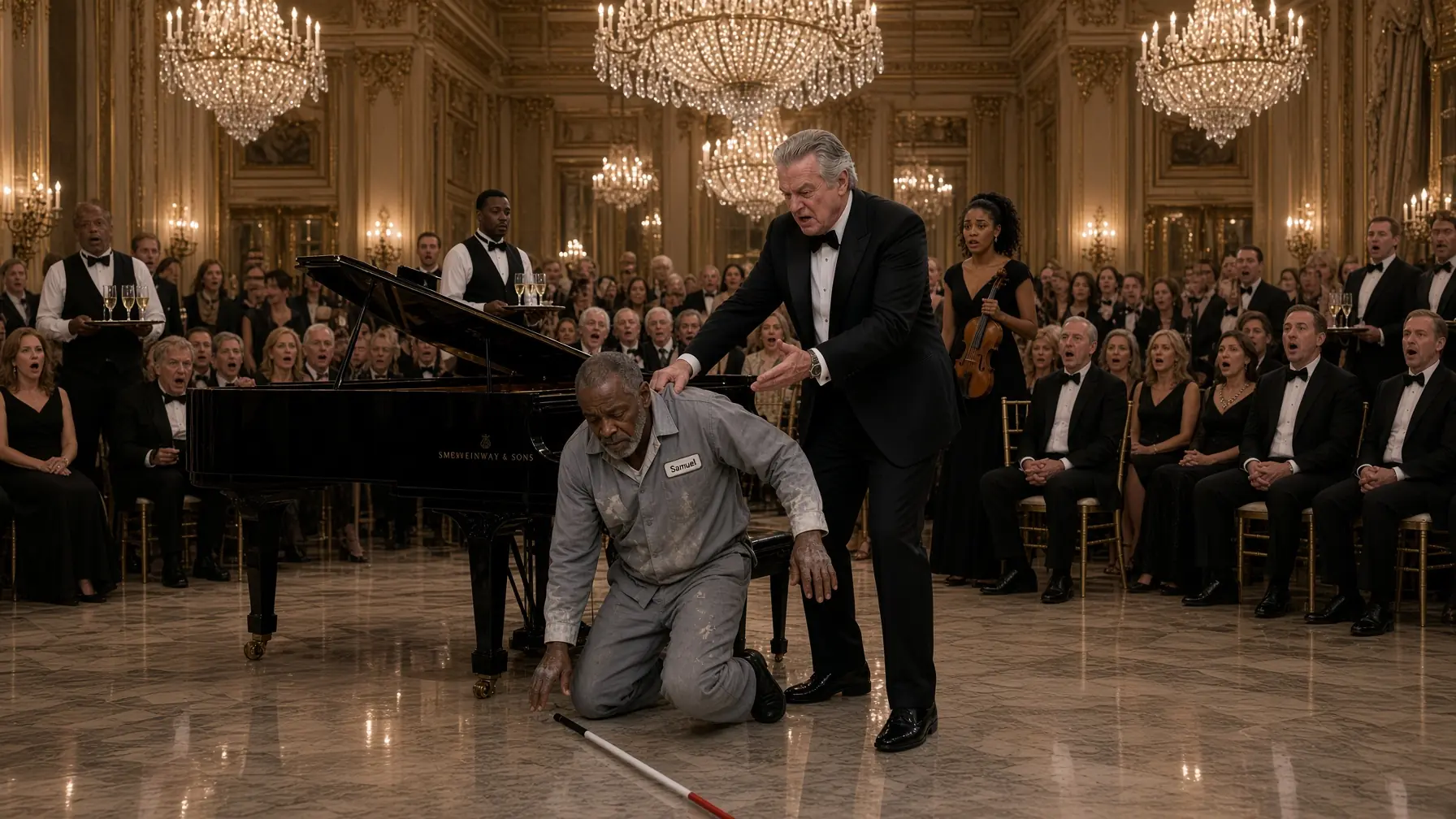
“Who allowed the cleaning man near my piano?”
The question cut through the ballroom like a glass dropped on marble.
People turned before they understood what they were turning toward. Waiters paused with trays in their hands. A woman in diamonds lowered her champagne flute. Near the stage, a young violinist stopped tuning and looked over her shoulder with the frightened stillness of someone who had just heard power become cruel.
Samuel Bennett stood beside the black Steinway grand with one hand resting lightly on the bench.
He was still wearing his gray janitor uniform.
His white cane leaned against the piano leg.
His fingers, thin and dark and marked with small scars from years of work, hovered inches above the keys as if they had found their way home without asking permission.
The man who had spoken was Richard Wainwright.
He was sixty-two, rich in a way that made people laugh too quickly at his jokes, and polished in the way of men who believed money could turn bad character into sophistication. His tuxedo fit perfectly. His silver hair had been arranged with the care of a museum display. On his wrist was a watch worth more than Samuel had earned in the past five years.
Richard walked toward the stage slowly.
He liked a room to watch him move.
“Sir,” Samuel said quietly, “I only wanted to play one song.”
“One song?” Richard repeated, turning toward the guests. “You hear that? The janitor wants to play one song.”
A ripple of nervous laughter moved through the front tables.
Not everyone laughed.
But too many did.
Richard stepped closer, eyes traveling over Samuel’s uniform, the name patch, the worn cuffs, the faint bleach stains on the sleeves.
“Those are mop hands,” he said. “Not Steinway hands.”
Samuel’s face did not change.
That was something people misunderstood about him.
They thought blindness made him unaware of a room. It did not. If anything, Samuel knew more than most people standing under the chandeliers that night. He heard the laughter that wanted permission to grow louder. He heard the silence from the staff near the service doors. He heard the shameful pause from those who knew Richard was wrong but were waiting for someone else to say it first.
Richard enjoyed that pause.
He had built a life inside it.
“Well,” Richard said, spreading his hands with fake generosity, “go ahead. Play. Give us something memorable. Let’s all see what a man like you can do with a two-hundred-thousand-dollar piano.”
Samuel stood perfectly still.
Then he sat down.
His fingers trembled when they touched the keys.
And what no one in that room knew was that those same hands had once played for three American presidents, a queen, two prime ministers, and a hall full of people who had risen to their feet before the final note had faded.
That morning had started like every morning in Samuel Bennett’s life now.
At 5:10 a.m., the radiator in his apartment began clicking.
Three clicks.
A hiss.
A pause.
Three clicks.
A hiss.
The sound came from beneath the window in his small apartment in Northeast Washington, where the wallpaper peeled near the floor and the kitchen light flickered even though Samuel had not seen light in almost sixteen years.
He lay still for a moment, listening.
Above him, Mrs. Ortega’s grandson dragged a chair across the floor. Outside, the first bus sighed at the curb. Somewhere down the hall, a dog barked twice, then stopped. The building was old, tired, and always talking.
Samuel knew all its voices.
He rose slowly and counted his steps to the kitchen.
Twelve from bed to doorway.
Five to the counter.
Two to the cabinet.
His left hand trailed the wall, fingers reading the apartment the way other men read morning headlines. The coffee jar sat on the second shelf, right side, behind the sugar. His late wife, Clara, had placed a Braille label on it the first year his sight began to fail.
Clara had labeled everything.
Coffee.
Rice.
Soap.
Aspirin.
Tea.
Rent receipts.
She did it gently, never making a lesson of it, never making him feel like the world had become smaller. She had simply built him a map and pretended it was housekeeping.
Cancer took her seven years earlier.
The kind that started quietly and ended loudly.
Four months from diagnosis to funeral. That was all the time the world gave them to say things that should have had decades left to be said.
On the little table beside his bed sat a framed photograph Samuel had not seen since before the darkness became complete. Still, every morning, he touched the glass. He knew the picture by memory. Clara standing beside him backstage at Carnegie Hall, one hand on his arm, laughing at something he could not remember saying.
He did not linger on the photograph.
Some memories are warm only if you do not hold them too long.
Samuel ironed his janitor uniform by touch.
The creases mattered.
Not to the hotel guests, who rarely looked closely enough to notice him at all, but to him. Clara used to say dignity was what you gave yourself before anyone else decided whether to offer it. So he pressed the collar, smoothed the sleeves, and pinned his name badge exactly where it belonged.
The bus ride to the Westbridge Grand Hotel took forty-six minutes.
Samuel sat in the third row on the right, near the window he could no longer see through. He liked that seat because the engine hum felt steady there, and because the driver, a woman named Renee, always greeted him by name.
“Morning, Mr. Bennett.”
“Morning, Renee.”
“Cold one today.”
“Sounds like it.”
That was often the first conversation of his day.
Sometimes the only one that did not require him to move aside.
The Westbridge Grand was one of Washington’s proudest old hotels. Presidents had slept there. Foreign ministers had entered through its private doors. Celebrities had stood in its lobby pretending not to enjoy being recognized. The building had marble floors, carved ceilings, brass rails, and chandeliers imported from Vienna before half the guests’ grandparents were born.
Samuel had cleaned those floors for eight years.
Eight years of pushing a mop past men whose shoes cost more than his rent.
Eight years of polishing brass handles that reflected faces he could not see.
Eight years of saying, “Excuse me,” and hearing nothing in return because people often confuse service workers with furniture that breathes.
He was not bitter.
At least that was what he told himself.
Bitterness required a kind of energy he could no longer afford. Samuel showed up, did the work, learned the schedules, memorized the service corridors, and kept his own counsel. That was how a man survived after the world stopped calling his name.
His only real friend at the hotel was Calvin Moore.
Calvin was thirty-six, broad-shouldered, quick to laugh, and incapable of letting Samuel carry a supply bucket alone. He worked maintenance, which meant he knew every pipe, fuse box, locked door, and broken hinge in the building. He also knew Samuel could play piano.
He had learned it by accident.
Two years earlier, during a late snowstorm, Calvin had been checking a heating vent near the staff lounge when he heard music behind the door. The staff lounge had an old upright piano no one tuned properly and almost no one used. Yet what Calvin heard was not casual playing. It was full, deep, alive, the kind of sound that made the ugly room beyond the door feel suddenly unworthy of itself.
Calvin opened the door a crack.
Samuel was at the piano.
His head was bowed.
His fingers moved with a quiet certainty that made the missing notes in the old instrument seem like the instrument’s failure, not his. Calvin stood there for nearly fifteen minutes and forgot to breathe through most of it.
The next morning, he asked one question.
“Sam, who were you before this place?”
Samuel smiled.
“The same man. Just with better hours.”
Calvin knew that answer gave him nothing.
He also knew not to push.
What Calvin did not know, what almost no one at the Westbridge Grand knew, was that Samuel Bennett had once been one of the most celebrated concert pianists in the country. He had been admitted to the Ashford Conservatory at seventeen on a full scholarship, the son of a postal worker and a church secretary from Baltimore who saved programs from every recital like they were government documents.
At twenty-eight, he made his Carnegie Hall debut.
At thirty-two, he played at the White House for the first time.
The president at the time had risen after the performance and held Samuel’s hands in both of his. The photo made the papers. Two more presidents later requested him by name. Diplomats called him elegant. Critics called him fearless. Clara called him impossible when he practiced until three in the morning.
Then came retinitis pigmentosa.
The doctors were careful at first.
Degenerative.
Progressive.
Unpredictable.
Then they stopped softening it.
Irreversible.
Samuel lost the edges of the world first. Then the center began to fade. He learned faces by voice, doors by echo, rooms by temperature. His hands did not forget the music, but the industry forgot what to do with him.
At first, agents tried to market him as an inspirational story.
The blind pianist who refused to quit.
Triumph in darkness.
Music beyond sight.
Samuel hated every headline before anyone wrote it.
He did not want to be sold as bravery wrapped in suffering. He was not a lesson. He was a musician. He wanted people to listen to the notes, not clap because he found the bench without help.
When he refused interviews, the calls slowed.
When Clara got sick, the calls stopped.
After her funeral, silence arrived and stayed.
Under Samuel’s bed sat a wooden case with three signed programs from the White House, a photograph from Carnegie Hall, and a handwritten note from Clara tucked into the lid.
Your hands know the way back.
He had not opened it in years.
Not because he had forgotten.
Because remembering hurt too cleanly.
At the hotel, nobody needed Samuel Bennett the pianist.
They needed Samuel Bennett to clean spilled wine from marble and scrub soap from bathroom sinks.
So he did.
And on the night of the Wainwright Arts Trust Gala, he was supposed to mop the east corridor, empty trash from the ballroom prep area, clock out at eight, and catch the 8:21 bus home.
Nothing more.
Richard Wainwright arrived at 6:40 p.m.
He did not enter the Westbridge Grand so much as occupy it.
His black car stopped at the private entrance, and hotel staff formed themselves into usefulness before the door opened. One man held an umbrella though the sky was clear. Another reached for luggage that did not exist. A third adjusted a velvet rope no guest had touched.
Richard stepped out in a tuxedo so sharp it looked hostile.
His wife, Helena, followed.
She was elegant, quiet, and beautiful in the careful way of women who have spent years being corrected by rich husbands for standing too close, laughing too loudly, or speaking before being introduced. She wore emerald earrings and a silver gown. She walked half a step behind him, then corrected herself to two full steps, as if some old warning had touched her shoulder.
Richard did not look at the staff.
He never looked directly at people unless they had money, power, or something he wanted.
The Wainwright Arts Trust Gala was his annual masterpiece. Four hundred guests. Senators, judges, foundation heads, donors, executives, actors, lobbyists, and art world figures who knew how to praise generosity without asking where the money had come from. Officially, the gala raised funds for underserved music programs.
Unofficially, it reminded Washington that Richard Wainwright liked being thanked in public.
The ballroom had been arranged around his ego.
His name appeared on the programs, the donation cards, the stage banner, and the brass plate attached to the Steinway grand he had donated the year before.
Richard Wainwright
Patron of the Arts
He touched the plate after entering, running his thumb over his own name.
Not lovingly.
Possessively.
To Richard, the piano was not an instrument.
It was a monument that happened to make sound.
He moved through the room with three men orbiting him like trained moons. They laughed when he tilted his head toward humor. They frowned when he frowned. They agreed with unfinished sentences because waiting for the end might suggest doubt.
Near the stage, a young violinist named Amara Lewis held her instrument case with both hands. She had been invited to play a short opening piece before the headline pianist. She was twenty-four, newly graduated, nervous, and wearing a black dress her mother had hemmed the night before.
When Richard passed, Amara stepped forward.
“Mr. Wainwright, I just wanted to thank you for supporting young musicians.”
Richard did not stop.
“Is the real performance ready?” he asked his assistant.
Amara’s hand remained in the air for one embarrassed second.
Then she lowered it.
Samuel was thirty feet away, mopping a wine spill near the service corridor.
He heard the whole thing.
He did not move.
A person can recognize cruelty without having room to carry it.
At 7:30, the headline pianist had not arrived.
At 7:45, the event coordinator’s voice began to tighten.
At 8:00, the schedule collapsed.
The pianist’s flight from New York had been grounded due to a mechanical failure. The backup was unreachable. Every local contact was either booked, sick, traveling, or too far away. In a room built around wealth, status, and control, nobody had prepared for the possibility that music might fail to appear on command.
Richard was furious.
Not openly.
Open fury was for people without breeding.
He pulled the coordinator aside near the stage.
“You have four hundred guests staring at an empty piano with my name on it.”
“Mr. Wainwright, I’m calling everyone I know.”
“Then know better people.”
He walked away before she could answer.
The room began to murmur.
Programs rustled.
Phones came out.
The empty Steinway sat under the spotlight like an accusation.
Samuel had finished his shift.
He returned his mop, rinsed the bucket, unclipped his badge, and took his coat from the staff locker. His cane tapped the service hallway floor in a rhythm he knew well. Twenty steps to the turn. Eleven to the staff exit. Four to the door.
Then he heard the piano.
Not a performance.
Only the tuner’s final chord drifting through the propped side entrance of the ballroom.
F major.
Open.
Clean.
Waiting.
Samuel stopped.
His cane hovered just above the tile.
The chord was gone in the air, but not in him.
For fifteen years, he had trained himself not to turn toward that feeling. Pianos were everywhere in Washington if you knew how to hear them: hotel bars, churches, reception halls, conservatory practice rooms, private lounges behind closed doors. He had walked past all of them.
That night, something in him did not keep walking.
Maybe it was Clara’s voice.
Maybe it was the rent notice folded on his kitchen counter.
Maybe it was the young violinist’s silence after Richard dismissed her.
Maybe it was the fact that the Steinway was waiting and Samuel’s hands had been waiting longer.
He turned toward the ballroom.
He entered through the side door.
No one noticed him at first.
That was the privilege of being invisible.
He crossed the edge of the room by memory. He had cleaned this ballroom often enough to know where the stage steps began, where the carpet gave way to polished wood, where the piano stood beneath the chandelier’s centerline. His cane found the first step, then the second, then the third.
He reached the bench.
Touched it.
Sat.
For three seconds, he was not the janitor at the Westbridge Grand.
He was simply a man at a piano.
Then Richard saw him.
A hand grabbed the back of Samuel’s uniform and yanked him sideways before his fingers could fully settle on the keys. His cane struck the floor and rolled. Samuel dropped to one knee on the marble beside the stage.
The room gasped, but no one moved.
Richard’s voice filled the silence.
“Who allowed the cleaning man near my piano?”
Samuel pushed one palm against the floor, steadying himself.
“I only wanted to play one song, sir.”
“Play?” Richard said, turning toward the crowd. “He wants to play.”
A few people laughed because they thought the room wanted them to.
Richard looked down at Samuel’s hands.
“Those are mop hands. Bleach hands. Not music hands.”
Samuel found his cane by sound and touched the handle.
Richard lifted his voice.
“Fine. Play. Show us what a man like you can do with a Steinway. Give the guests a story to tell.”
Samuel remained on one knee.
For a moment, he considered leaving.
He knew the bus schedule.
He knew the cost of losing this job.
He knew the final rent notice waiting at home, the empty space where Clara’s wedding ring had been before he pawned it, the thin margin between a man’s dignity and a locked apartment door.
If he played and Richard complained, he would be fired before midnight.
If he walked away, he could keep his job.
Maybe.
He pressed his fingertips against the marble.
Cold.
Hard.
Real.
Then he heard Clara in the old place where grief keeps the voices it refuses to surrender.
Your hands know the way back.
Samuel stood.
The crowd expected him to leave.
Richard had already started to turn away.
Samuel did not leave.
He walked back to the bench and sat down.
Richard spun around.
“Are you deaf too?”
Samuel placed both hands on the keys.
“I heard you, sir,” he said softly. “But the piano didn’t.”
The ballroom went still.
Not quiet.
Still.
Waiters stopped mid-step. Conversations died before the next word could form. A woman near the front lowered her glass so slowly it made no sound when it reached the table.
Samuel sat beneath the spotlight he could not see.
His left hand trembled.
Then he began.
The first notes of Beethoven’s Piano Sonata No. 14, the Moonlight Sonata, entered the room like a door opening at night. Soft. Measured. Almost fragile. The melody moved slowly, each note placed with the caution of a man stepping onto ground he had not trusted in years.
Some guests exchanged glances.
Richard folded his arms.
A man near the front whispered, “This is uncomfortable.”
And maybe, for a few bars, it was.
Samuel’s hand shook. One note landed softer than the others. Another came late enough for trained ears to notice. The weight of fifteen silent years pressed into his wrists, his shoulders, his breathing.
Then he stopped.
The last note hung alone, unfinished.
Richard opened his mouth.
Samuel’s fingers came down again.
Everything changed.
The same sonata deepened until the entire ballroom seemed to darken around it. The left hand settled into its pulse, steady as a heartbeat beneath grief. The right hand sang above it, clean and aching, each note shaped with a tenderness no one had expected from a man they had just watched be dragged from the bench.
The tremor vanished.
His shoulders lowered.
His spine straightened.
The uniform no longer defined him.
It was simply fabric on a man who had found the center of himself again.
The room understood it before it knew what it understood.
Samuel was not playing at the piano.
He was speaking through it.
The Moonlight Sonata grew under his hands, not louder exactly, but truer. It was loneliness. It was a cold apartment at dawn. It was a radiator clicking beside a bed made for two. It was a photograph touched every morning by a man who could no longer see the woman inside it.
A woman in the third row pressed a hand to her chest.
Amara Lewis, the young violinist Richard had dismissed, sat forward with tears already forming.
Then Samuel turned.
The Beethoven did not end.
It opened.
The final phrase folded into Duke Ellington’s “Come Sunday” so naturally that the musicians in the room inhaled as one. Classical grief became gospel longing. The ballroom changed shape. The polished wealth, the expensive suits, the brass plate on the piano, all of it seemed suddenly smaller than the sound moving through it.
Samuel’s right hand carried the melody with a warmth that felt like church doors open in summer.
His left hand answered with chords deep enough to make the floor hum.
There was sorrow in it.
But not surrender.
There was faith too, not the kind preached loudly, but the kind that survives in kitchens, hospital rooms, bus rides, and empty apartments where people keep living because someone they loved once told them they could.
Richard’s face had lost all color.
His arms dropped slowly to his sides.
He looked at the piano as if the instrument had betrayed him.
But the Steinway had not betrayed anyone.
It had simply told the truth.
Samuel moved from Ellington into something no one recognized.
It began with three notes.
Simple.
Almost childlike.
Then a fourth.
Then a phrase that returned, altered, and returned again.
This was Clara’s piece.
He had written it when her hair first began to fall out, then changed it after the diagnosis worsened, then changed it again after the funeral. It had never been published. Never recorded. Never performed in public.
Until that night.
The melody was Clara laughing in the kitchen with flour on her cheek.
It was her hand guiding his over a Braille label.
It was the sound of her saying, “You’re still you,” on the first morning he woke up and could no longer make out her face.
The piece warmed first.
Then it broke.
A dissonant chord entered so quietly most people did not notice until it began spreading through the harmony. The music became the hospital room, the antiseptic air, the doctor’s pause before bad news, the small betrayal of hope when numbers stopped being encouraging.
Samuel’s hands moved with increasing force.
Not wild.
Controlled.
Anger entered the lower keys.
Not rage for display.
Rage with discipline.
The kind that had lived inside him for years without a safe room to enter.
It was the anger of phone calls not returned after he lost his sight. The anger of interview requests that wanted inspiration more than music. The anger of agents who wanted his blindness packaged, softened, made useful for ticket sales. The anger of being a master reduced to a uniform, a name patch, and a mop bucket.
The bass thundered.
Champagne glasses trembled.
Somewhere in the back, Calvin Moore stood in the service doorway with one hand over his mouth.
He had heard Samuel play before.
He had never heard this.
Then, slowly, the anger softened.
It did not disappear.
It found its place.
That was what made the piece unbearable in the best way. It did not pretend loss became beautiful just because time passed. It did not ask grief to behave. It let grief remain grief, then gave it enough room to become music.
The melody returned.
Clara’s melody.
Older now.
Carrying the darkness, the silence, the work uniform, the bus rides, the rent notices, the cane tapping tile, the lonely mornings, the memory of three presidents standing, and the pain of a man who had once disappeared because the world only wanted him back as a story.
Samuel was not a story.
He was an artist.
By the final movement, nobody in the ballroom was sitting casually anymore.
People leaned forward without realizing it.
A senator’s wife was crying into both hands.
The young violinist had stopped trying to hide her tears.
Even Helena Wainwright had moved away from Richard, not dramatically, just three careful steps to the left, creating a space between them that felt larger than the ballroom.
Samuel’s hands climbed higher.
The melody brightened.
Not happy.
More honest than happy.
The music gathered itself into one final chord, full and ringing, using every reach his hands could manage. It filled the ballroom, pressed against the ceiling, moved through glass, silver, silk, bone.
Then he pulled back.
One note.
Soft.
Another.
Softer.
The final tone floated alone in the air, fading slowly until silence took it.
Samuel lifted his hands and placed them in his lap.
For five seconds, no one moved.
Then Lydia Harcourt stood.
Seventy-eight years old, one of the greatest concert pianists America had ever produced, Lydia had heard everyone worth hearing and corrected half of them in private. She rose slowly from table four, both hands shaking, eyes fixed on the stage.
She began to clap.
Alone.
One clap.
Then another.
Then Senator Marian Vale stood.
Then the young violinist.
Then a judge.
Then a waiter.
Then the entire room rose at once.
The applause did not begin politely.
It broke open.
Four hundred people stood clapping, shouting, crying, turning toward the stage as if they had just witnessed something holy and were ashamed it had taken humiliation to make them listen. Phones lifted everywhere, but even those recording seemed to understand they were holding evidence of something larger than a viral moment.
Calvin stepped fully into the ballroom, tears running down his face.
“Sam,” he whispered, though no one could hear him over the ovation.
Samuel sat still at the bench.
He could not see the standing ovation.
But he felt it in the floor.
In the vibration under the pedals.
In the air changing around him.
After fifteen years of silence, his hands were finally still and the room was the thing trembling.
Richard stood near the stage.
He did not clap.
He did not move.
His expression passed through disbelief, panic, calculation, and the slow horror of a man realizing his cruelty had become permanent. Not whispered about. Not forgotten. Recorded. Witnessed. Answered by genius.
Senator Vale walked to the stage and accepted a microphone from the event coordinator, whose hands were shaking.
The applause slowly lowered but did not vanish.
People remained standing.
The senator turned toward the room.
“The man sitting at that piano is Samuel Bennett,” she said. “Graduate of the Ashford Conservatory. Carnegie Hall soloist. White House performer for three sitting presidents. Composer of one of the most moving works ever played at a state dinner in this country.”
The room went silent again.
This time, the silence was shame.
“He was not discovered tonight,” Senator Vale continued. “He was recognized late.”
That sentence landed harder than applause.
She turned toward Richard.
“The host of this gala humiliated a man because of his uniform, his blindness, and his work. He confused service with smallness. He confused ownership of an instrument with understanding of art.”
Richard stepped forward.
“I had no idea who he was.”
Samuel turned his face toward the voice.
The room waited.
Richard swallowed.
“If I had known—”
Samuel spoke quietly.
“You should not need a résumé to treat a man with dignity.”
The room erupted.
Not only in applause this time.
In agreement.
In release.
In the sound of a room that had watched something wrong happen and finally found the courage to admit it.
Richard’s mouth remained open, but nothing useful came out.
For the first time all night, he looked exactly as small as he had made others feel.
Lydia Harcourt approached the piano.
She placed one hand on the Steinway, then held the other out toward Samuel.
He reached for her voice and found her fingers.
“Mr. Bennett,” she said softly, away from the microphone, “I have been waiting twenty years to hear someone play Beethoven like that.”
Samuel gave a tired smile.
“I’ve been busy cleaning floors.”
Lydia laughed once.
Then she cried.
The gala did not continue as planned.
The auction was forgotten.
The donor speech was abandoned.
The program collapsed and became something better.
People came toward Samuel not with pity, but with respect. That difference mattered more to him than any applause. A federal judge shook his hand and could not finish his sentence. A music director read his phone number aloud while Calvin typed it into Samuel’s phone. A foundation president apologized for not knowing his name, and Samuel told her there were many names people did not know.
Amara Lewis, the young violinist, came last.
She stood in front of him with her instrument case held against her chest.
“I almost quit,” she said.
Samuel tilted his head.
“Music?”
She nodded, then realized he could not see it.
“Yes.”
“Why?”
“People like him,” she said.
Samuel was quiet for a moment.
Then he said, “People like him are loud, but they are not music.”
Amara began crying again.
Samuel reached out, and she placed her hand in his.
“Do not quit because someone empty made noise,” he said.
“I won’t.”
“Good.”
Richard and Helena Wainwright left through a side exit at 9:22 p.m.
There was no announcement.
No farewell.
No applause.
Helena walked ahead of him.
Three steps.
Not behind.
Ahead.
Richard did not correct her.
A small thing.
A beginning.
By Sunday morning, the video had reached the internet.
By Sunday night, millions had seen it.
The clip that spread fastest was not the thunderous middle section or the standing ovation. It was the moment after Richard said, “If I had known,” and Samuel answered, “You should not need a résumé to treat a man with dignity.”
People repeated that line everywhere.
Some used it honestly.
Some used it because the internet loves simple truth when it is spoken by someone who has earned it painfully.
The Westbridge Grand suspended the event director first, then reinstated her after staff statements showed she had tried to stop Richard from touching Samuel. Richard Wainwright’s foundation lost donors faster than his publicist could draft apologies. His official statement used phrases like unfortunate incident, lapse in judgment, and sincere regret.
Nobody believed it.
Apologies written by committees do not sound like human beings.
Lydia Harcourt did something more useful.
She called Samuel herself.
Not through an assistant.
Not through the hotel.
She called Calvin, who put the phone in Samuel’s hand during lunch break.
“Mr. Bennett,” Lydia said, “I want to sponsor your return to the stage.”
Samuel sat in the staff break room, holding a sandwich he had forgotten to unwrap.
“I don’t know if I have a stage life left.”
“That is not for the stage to decide.”
He smiled faintly.
“You always this direct?”
“I’m too old to be decorative.”
He liked her immediately.
Within three weeks, Samuel had a residency offer from the Kennedy Center, a recording contract for Clara’s piece, and enough donations to cover his rent without him asking anyone for a dime. He accepted the residency on one condition.
A fellowship.
For young musicians who had been dismissed, underestimated, priced out, pushed aside, or told their lives were too complicated to make room for art.
He named it the Clara Bennett Fellowship.
When a reporter asked why, Samuel said, “She kept a map for me when the world went dark. I’d like to help somebody else find a door.”
He did not quit the hotel immediately.
People found that strange.
Calvin did not.
“You sure you still want to mop floors?” Calvin asked one afternoon.
Samuel rested both hands on the handle of his cane.
“No.”
“Then why are you here?”
“Because I am leaving properly.”
Calvin nodded.
That made sense.
Some exits deserve dignity too.
On his last day, the hotel staff gathered in the service hallway with coffee, cake, and the battered upright piano from the staff lounge, which Calvin had somehow convinced maintenance to move without breaking a wall. Samuel laughed when he heard the first wrong note.
“You tuned this?”
“I tried,” Calvin said.
“You failed.”
“Beautifully?”
“Confidently.”
They laughed.
Then Samuel played one song for the people who had known him before the world remembered. Not Beethoven. Not Clara’s piece. A simple hymn his mother used to sing while cooking Sunday dinner.
This time, nobody recorded it.
That made it feel more real.
Months later, Samuel Bennett returned to the Kennedy Center stage.
The concert sold out in eleven minutes.
People expected spectacle.
They expected the viral janitor.
They expected the line, the twist, the humiliation answered by genius.
Samuel gave them music.
That was all he had ever wanted to give.
The second half of the program opened with Clara’s piece. In the front row, Calvin sat beside Lydia Harcourt, wearing the nicest suit he owned and trying not to look terrified by the ticket price. Amara Lewis performed later that season as the first Clara Bennett Fellow.
Samuel could not see any of it.
But he could hear the room.
He could hear the difference between people waiting to be impressed and people ready to listen.
At the end of the concert, the applause rose again.
Long.
Warm.
But this time, Samuel did not feel like a man being restored by strangers.
He felt like a man returning something that had always belonged to him.
The next morning, he woke at 5:10.
The radiator clicked.
Three clicks.
A hiss.
A pause.
The apartment was the same, except the rent notice was gone from the counter, and the wooden case beneath the bed was open on the kitchen table. Inside were the signed programs, the Carnegie Hall photograph, and Clara’s note.
Your hands know the way back.
Samuel touched the note.
Then the photograph.
Then the empty space on his ring finger where Clara’s wedding ring used to be.
He had already spoken to the pawn shop.
The ring was still there.
Held in a drawer because the owner, a woman named Nadine, had known Clara from church and never had the heart to melt it down.
Samuel would pick it up that afternoon.
For now, he stood in the kitchen with his coffee and listened to the building breathe around him.
Mrs. Ortega’s grandson dragged the chair upstairs.
A bus sighed at the curb.
The old pipes knocked behind the wall.
Ordinary life.
Sacred life.
Life that had kept going even when no one clapped.
Samuel lifted his coffee cup toward the framed photograph beside the bed.
“I found the way back, Clara,” he whispered.
The world did not hear that.
It did not need to.
Some words are not meant for the world.
They are meant for the person who believed in your hands long before anyone else remembered what they could do.