The Mistress Mocked the Wife in Court — Until the Judge Asked One Question About the Shares

The Mistress Mocked the Wife in Court — Until the Judge Asked One Question About the Shares
Reader Theme:
Font Size:
24px

The gavel’s sharp crack echoed through the mahogany-paneled walls of Courtroom 302. Jessica Lawson sat in the gallery, a smirk playing on her cherry-red lips, clad in a custom-tailored suit paid for by the man sitting at the defendant’s table. She had spent the last eighteen months publicly parading her victory, reducing the quiet woman across the aisle to nothing more than a discarded relic. Richard Sterling was about to walk away with a $90 million empire, leaving his wife of fifteen years with absolute pennies.
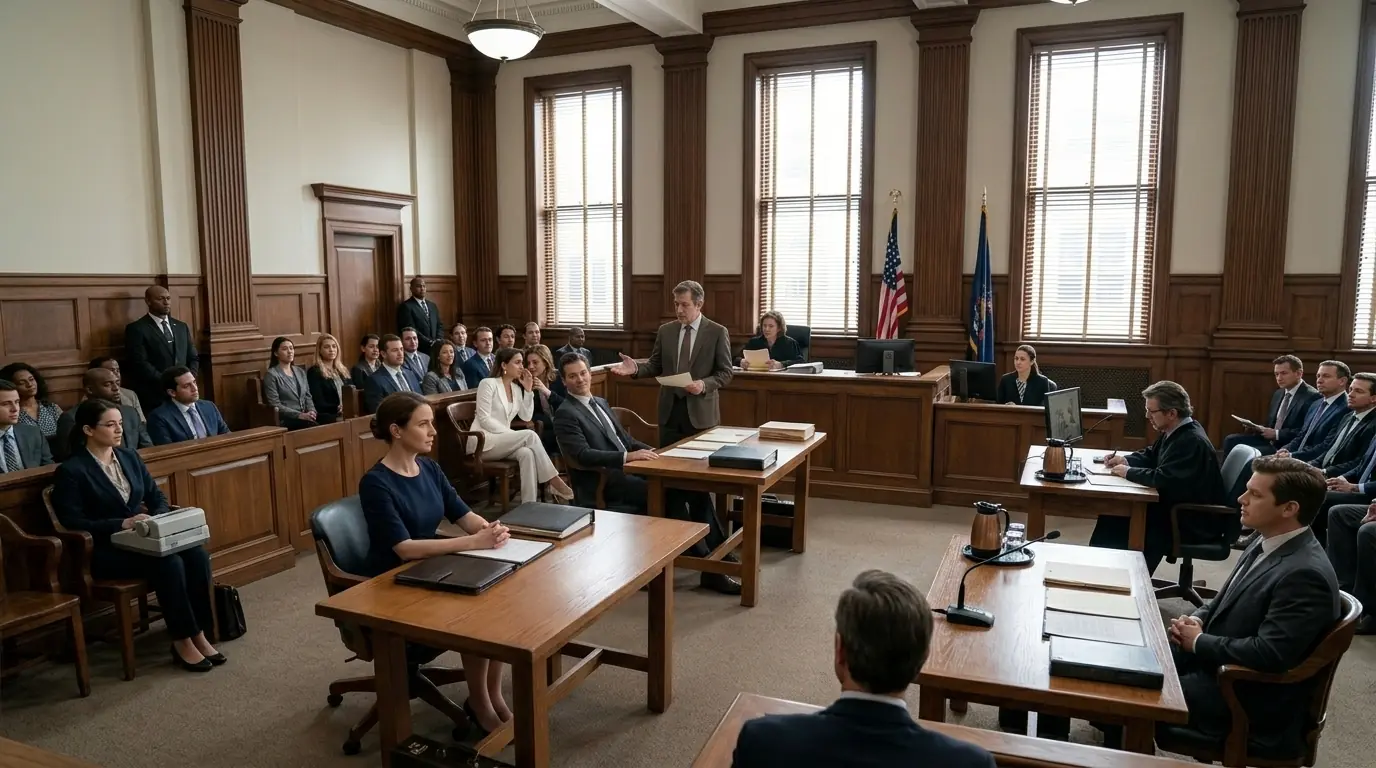


It was a flawless victory, until Judge Patricia Carmichael adjusted her glasses, looked down at a single financial disclosure document, and asked the one question about the Class A shares that made the blood drain entirely from Richard’s face.

To the outside world, Richard and Sarah Sterling were the epitome of a self-made American success story. They lived in a sprawling six-bedroom colonial in the wealthy suburbs of Boston, complete with perfectly manicured lawns, a pair of luxury SUVs in the driveway, and two bright children attending a prestigious private academy. Richard was the charismatic, silver-tongued CEO of Sterling Freight and Logistics, a mid-sized, tech-driven supply chain company that had revolutionized how local manufacturing plants tracked their shipments. He was the man on the magazine covers, the keynote speaker at industry conferences, the visionary.

Sarah, on the other hand, was known merely as the supportive wife. She hosted charity dinners, managed the household, and stayed quietly in the background. Her friends at the country club saw her as pleasant, softly spoken, and fiercely dedicated to her family. What they did not know, and what Richard himself had conveniently chosen to forget, was that before the money, before the sprawling estate, and before the title of CEO, Sarah was the one who had written the foundational algorithm that made Sterling Freight possible.

They had met at MIT. Sarah was a brilliant but introverted data science major. Richard was a business student with boundless ambition but limited technical skills. When Richard came up with the idea for a revolutionary freight-tracking platform, he had no idea how to build it. Sarah spent three years in their cramped one-bedroom apartment, fueled by black coffee and sheer willpower, coding the entire proprietary system from scratch.

When the company launched, Richard naturally took the role of the public-facing executive. Sarah did not mind. She hated the spotlight and was terrified of public speaking. A few years later, when she became pregnant with their first child, she officially stepped down from her role as chief technology officer, transferring her day-to-day responsibilities to a newly hired team. She transitioned seamlessly into the role of a stay-at-home mother, trusting her husband to pilot the ship they had built together.

For a decade, the arrangement worked beautifully. The company’s valuation skyrocketed, but as the millions rolled in, Richard began to change. The late nights at the office turned into weekend executive retreats. His wardrobe became flashier. His ego, once grounded by Sarah’s quiet pragmatism, inflated to dangerous proportions. He started believing his own press clippings. He truly began to believe that he, and he alone, was the genius behind the Sterling empire.

Then came Jessica Lawson.

Jessica was hired as the new vice president of corporate communications. Ten years younger than Sarah, she was striking, fiercely ambitious, with a master’s degree in public relations and a razor-sharp instinct for climbing the corporate ladder. She did not just want a high-paying job. She wanted an empire. And she quickly identified Richard Sterling as the easiest vessel to get her there.

The affair began the way these things often do: lingering looks in the boardroom, working lunches that stretched into the late afternoon, and eventually a conveniently booked pair of hotel rooms at a logistics summit in Chicago. Jessica was everything Sarah was not. Loud, demanding, and constantly feeding Richard’s massive ego. She told him he was a titan, an unparalleled genius being held back by a domestic, boring wife who did not understand the pressures of his greatness. Richard drank it in like a man dying of thirst.

Sarah first noticed the shift in Richard’s demeanor during their fifteenth wedding anniversary. Instead of the intimate dinner they usually shared, Richard had booked a loud, ostentatious party at a downtown steakhouse, inviting mostly his executives, including Jessica. That night, Sarah watched as Jessica laughed a little too loudly at Richard’s jokes, her hand resting just a second too long on his forearm. When Sarah quietly brought it up on the drive home, Richard exploded.

“Are you insane?” he snapped, gripping the steering wheel. “Jessica is a crucial part of the executive team. I am carrying the weight of a $90 million company on my back, Sarah. For once, could you not act like a paranoid, ungrateful housewife?”

The gaslighting was brutal, and for a few months, it worked. Sarah convinced herself she was imagining things. She doubled down on trying to be the perfect wife. But the truth, much like the data algorithms Sarah used to write, always leaves a trail.

She found out on a rainy Tuesday morning. Richard had left his secondary iPad on the kitchen counter, and an iCloud sync error caused an iMessage notification to pop up on the locked screen. It was not a text. It was a calendar invite from Jessica Lawson: “St. Barts getaway, just the two of us. Can’t wait to celebrate your freedom.”

Sarah did not scream. She did not throw the iPad against the wall. Instead, the mind of the data scientist woke up from a ten-year slumber. She calmly unlocked the iPad using the passcode Richard thought she did not know, exported the entire message history, the hidden photo albums, and the digital receipts for diamond earrings and luxury hotel suites. She backed everything up onto three separate encrypted flash drives.

Then she placed the iPad exactly where she had found it, made herself a cup of chamomile tea, and began to plan.

Two weeks after the iPad discovery, Richard sat Sarah down in his heavy mahogany home office. He did not look remorseful. He looked annoyed.

“I’m filing for divorce,” he stated, his voice devoid of warmth. “I’ve outgrown this marriage, Sarah. You’ve become too complacent, and frankly, we are moving in completely different directions. My lawyer will be in touch.”

He admitted to the relationship with Jessica, but framed it not as a betrayal, but as an inevitable evolution.

“She understands the business,” Richard justified smoothly. “She understands me.”

Sarah sat perfectly still, her hands folded in her lap. “And what about our lives? The children? The company we built?”

Richard scoffed. “The company I built, Sarah. Let’s not rewrite history. You helped out a bit in the beginning, sure, but I secured the funding. I made the sales. I am the face. The company is mine.”

He then pulled out his trump card.

Seven years earlier, right before the company went public with a massive Series B funding round, Richard had asked Sarah to sign a postnuptial agreement. He had framed it as a standard liability shield to protect their personal assets, the house, and their savings in case the company was ever sued for a data breach. Trusting her husband implicitly, Sarah had signed it without having her own independent counsel review it.

“The postnup is ironclad,” Richard said coldly. “You keep the house, your car, and I’ll pay you a generous alimony of $20,000 a month for five years. But Sterling Freight is off the table. It’s a premarital asset shielded by the postnup. If you fight me on this, my legal team will bury you. You’ll drain what little money you have and end up with nothing. Take the graceful exit, Sarah.”

Richard packed his bags that afternoon and moved into a $15,000-a-month luxury penthouse downtown. Jessica moved in three days later.

If Richard was cold, Jessica was relentlessly cruel. Having secured the prize, she felt the need to make sure the world knew it. She began a targeted campaign of humiliation. Jessica took to Instagram and Facebook, posting photos of the penthouse, expensive dinners, and the gifts Richard showered upon her. Her captions were thinly veiled daggers aimed directly at Sarah.

“Finally with a man who needs a partner, not a dependent.”

“Some people settle for silver. I waited for the gold.”

“Upgrades.”

Jessica even showed up at the children’s private school functions, introducing herself to the other mothers as Richard’s fiancée despite the divorce not even being finalized. She made a point of looking Sarah up and down with an expression of performative pity whenever they crossed paths.

In the tight-knit, gossipy circles of Boston’s elite, Sarah quickly became the tragic dumped housewife. Friends she had known for years suddenly stopped returning her calls, not wanting to alienate the powerful and wealthy Richard Sterling. Sarah endured it all in silence.

She hired a modest, unassuming family lawyer named David Horowitz. Compared with Richard’s attorney, Benjamin Croft, a notoriously aggressive shark who charged a thousand dollars an hour, David looked like a substitute teacher. When Croft sent over the initial settlement offer, heavy-handed and full of threats about dragging Sarah through a grueling deposition, David simply replied that they would review it.

Behind closed doors, however, David and Sarah were not cowering.

“He’s right about the postnup, Sarah,” David warned during their first meeting, pushing his reading glasses up his nose. “It’s a nasty piece of work. Croft buried a clause in there that essentially waives your right to any appreciation in the company’s value during the marriage. Trying to pierce this agreement in court will take years and cost a fortune.”

“I don’t want to pierce the agreement, David,” Sarah said, her voice eerily calm.

She reached into her leather tote bag and pulled out a thick manila folder, placing it gently on David’s desk.

“I want to enforce it. To the absolute letter.”

David frowned and opened the folder. Inside were corporate filing documents, original incorporation papers from Delaware, and a series of stock transfer ledgers from fifteen years ago.

“Richard is an arrogant man,” Sarah explained quietly. “And arrogant men do not read the fine print. When we incorporated Sterling Freight before the marriage, we didn’t have money for a fancy lawyer. We used an online filing service. And because I was the one who actually sat at the computer and filed the paperwork while he was out networking…”

David’s eyes widened as he scanned the yellowed incorporation document. He looked up at Sarah, a slow, disbelieving smile spreading across his face.

“Does he know?” David whispered.

“Richard hasn’t looked at the original cap table in fifteen years,” Sarah replied, a cold fire finally burning in her eyes. “He assumes he owns it all because he’s the CEO. He’s about to find out exactly what it means to cross a data scientist.”

For the next twelve months, Sarah played her part perfectly. She let Richard and Benjamin Croft drag her through endless, agonizing mediation sessions. She let them talk down to her. She let Jessica sit in the waiting room during depositions, flashing her oversized diamond promise ring and whispering loudly to friends on the phone about how sad and desperate Sarah was acting.

Sarah conceded on the house. She conceded on the cars. She did not fight the paltry alimony offer. She acted like a defeated, broken woman, desperate to keep whatever scraps her husband threw at her. Richard grew increasingly smug, confident that his brute-force legal strategy was breaking her will.

He had no idea he was walking blindly into a trap that had been set a decade and a half earlier.

The stage was set for the final court hearing, the day the judge would stamp the final decree and formally separate their assets. Jessica had picked out her custom Dior suit for the occasion. Richard had booked a table at Le Bernardin to celebrate. They thought it was the finish line.

They were wrong.

The weeks leading up to the final court date were a masterclass in hubris. Richard Sterling was not merely content with divorcing his wife. He needed to completely erase her from his narrative.

Sterling Freight and Logistics was preparing for a massive acquisition. A global conglomerate had expressed interest in buying Richard’s company for a staggering $90 million. For the deal to go through smoothly, Richard needed his personal life aggressively sterilized and his cap table pristine. He needed the divorce finalized, and he needed Sarah gone.

Jessica Lawson, fully embracing her role as the incoming queen of the Sterling empire, escalated her campaign of psychological warfare. Having secured the penthouse and the promise ring, she now wanted the social validation that came with her impending marriage. She began leaking “accidental” details to Boston socialite circles about an upcoming winter wedding at the Plaza in New York.

Her audacity peaked during a chillingly orchestrated encounter at Copley Place, an upscale shopping gallery in downtown Boston. Sarah had gone there to purchase a simple navy dress for the upcoming court date. As she stepped out of a boutique, she found her path blocked by Jessica, who was weighed down by designer shopping bags and flanked by two of the company’s junior marketing executives.

“Sarah. Oh my goodness, how are you holding up?” Jessica cooed, her voice pitched perfectly to ensure everyone within twenty feet could hear. She wore a sympathetic pout that did not reach her cold, calculating eyes.

“I’m fine, Jessica,” Sarah replied evenly, attempting to sidestep her.

Jessica moved to block her again, reaching out to touch the fabric of the garment bag Sarah was holding. “Shopping for the big day? You know, Richard and I were just talking about your situation. We genuinely want you to land on your feet. If you ever need a reference for a little administrative job somewhere, Richard would be happy to make a call. You’ll need to start budgeting now, after all.”

The junior executives shifted uncomfortably, but Jessica simply beamed, radiating the toxic confidence of a woman who believed she held all the cards.

Sarah looked at the younger woman. For a brief, terrifying second, the mask of the defeated housewife slipped and the brilliant analytical architect of Sterling Freight looked back. But Sarah quickly blinked, lowered her eyes, and tightened her grip on the shopping bag.

“Thank you, Jessica. That’s very generous of you. Excuse me.”

As Sarah walked away, she heard Jessica laugh softly behind her and murmur to her companions, “It’s honestly just sad at this point. No fight left in her at all.”

A week later, the final mediation session took place in the glass-walled conference room of Benjamin Croft’s high-rise law firm. Croft, a man whose expensive cologne arrived in the room a full minute before he did, slapped a thick stack of papers onto the table.

“Let’s make this painless,” Croft barked, leaning over the table like a predator sizing up a wounded animal. “The terms are exactly as we discussed. We are enforcing the postnuptial agreement. My client retains 100% ownership of his premarital asset, Sterling Freight. Your client retains the marital home, her vehicle, and receives the agreed-upon alimony of $20,000 a month for sixty months. Sign here, here, and here, and we can all move on with our lives.”

David Horowitz adjusted his wire-rimmed glasses and methodically leafed through the pages. He looked nervous, his hands slightly trembling, a performance he and Sarah had rehearsed flawlessly.

“Mr. Croft,” David stammered softly, “we do concede the validity of the postnuptial agreement. My client recognizes that she signed it of her own free will. We only ask that the court strictly enforce Section Four, Paragraph B, which states that all premarital shares held by either party shall remain their sole and separate property.”

Croft rolled his eyes, a smirk playing on his lips. “Yes, David. That’s the entire point of the document. Richard’s shares are his. Sarah gets nothing of the company. Are we done here?”

“We are,” Sarah said softly.

She reached for the heavy Montblanc pen Croft had pushed across the table. Without a second moment of hesitation, she signed the final settlement agreement, legally binding herself to the terms of the postnup.

Richard, who had been aggressively scrolling through his phone the entire time, finally looked up. He let out a loud, theatrical sigh of relief.

“Finally,” he muttered.

He did not even look at Sarah as he stood, buttoning his suit jacket. “Have the final decree filed by Friday, Ben. I have a board meeting to prepare for.”

As Richard and Croft celebrated their perceived victory with single-malt scotch in the partner’s office, David and Sarah rode the elevator down to the lobby in total silence. It was not until they reached the privacy of David’s sedan that the lawyer let out a long, shaky breath.

“They took the bait,” David said, his hands gripping the steering wheel. “They didn’t even check.”

Sarah stared out the window at the bustling Boston traffic, a cold, serene smile finally breaking across her face.

“I told you, David. Richard only looks at what’s in front of a mirror. He never looks at the foundation.”

The morning of the final hearing broke with heavy gray skies, a fitting backdrop for Courtroom 302. Jessica Lawson arrived looking less like a woman attending a divorce proceeding and more like someone walking a red carpet. She wore a tailored white Dior suit, a deliberate, mocking nod to her upcoming nuptials, paired with stilettos that clicked loudly against the courthouse’s marble floors.

Richard walked beside her, practically vibrating with smug energy in a custom Brioni suit. He looked like a man about to be crowned king.

Sarah arrived quietly through a side entrance, accompanied only by David Horowitz. She wore the simple navy dress she had purchased at Copley Place, her hair pulled back into a neat, unassuming bun. When she took her seat at the plaintiff’s table, she kept her eyes fixed firmly on the heavy wooden desk in front of her.

Judge Patricia Carmichael was a veteran of the family court system, a severe, sharp-eyed woman in her late fifties who had spent decades wading through the bitter wreckage of broken marriages. She had no patience for theatrics. As she took the bench, her gaze immediately landed on Jessica, whose presence in the gallery dressed in bridal white was a blatant display of triumph. Judge Carmichael’s eyes narrowed almost imperceptibly, making a silent assessment of Richard Sterling’s character before the proceedings even began.

“Case number 482-B, Sterling versus Sterling,” the bailiff announced.

“All right, let’s get this over with,” Judge Carmichael said, pulling the heavy case file toward her. “I have a signed settlement agreement before me. Mr. Croft, I understand your client is seeking to expedite this final decree based on a pre-existing postnuptial contract?”

Benjamin Croft stood, projecting his booming voice to ensure everyone in the gallery, especially Jessica, could hear his triumph.

“That is correct, Your Honor. The parties have agreed to a fair and equitable division of the marital assets. Furthermore, both parties have stipulated to the validity of a postnuptial agreement signed seven years ago, which expressly protects my client’s premarital asset, Sterling Freight and Logistics, from any division.”

“Mr. Horowitz,” Judge Carmichael said, looking over her reading glasses at Sarah’s table. “Does your client understand that by stipulating to this agreement, she is waiving any claim to the appreciation of this company during the marriage?”

David stood slowly. “She does, Your Honor. In fact, we are relying entirely on the strict enforcement of that exact postnuptial agreement today. Specifically, the clause that dictates each party shall retain their exact premarital shares of the company as their sole and separate property.”

Croft let out a patronizing chuckle. “As I stated, Your Honor, the company is entirely my client’s premarital property. This is a simple rubber stamp.”

Judge Carmichael frowned and opened a secondary folder that David Horowitz had filed the previous afternoon.

“Well, Mr. Croft, if it’s a simple rubber stamp, then you won’t mind explaining this discrepancy in the financial disclosures.”

The courtroom fell silent. Richard stopped chewing his thumbnail. Jessica leaned forward in the pews, her brow furrowing.

“Discrepancy, Your Honor?” Croft asked, a hint of genuine confusion creeping into his voice.

“Yes,” Judge Carmichael said, her tone turning suddenly cold and precise. She held up a yellowed, watermarked document. “I am looking at Exhibit C, filed by Mr. Horowitz. These are the original incorporation documents and the initial capitalization table filed in the State of Delaware fifteen years ago, before the marriage took place. The exact documents that establish the premarital shares your postnup protects.”

Croft waved a dismissive hand. “Your Honor, those are just boilerplate filings from when my client started the business in his garage. He is the founder and CEO.”

“He may be the CEO, Mr. Croft,” Judge Carmichael said, her voice dropping, “but according to these legally binding foundational documents, he is not the sole founder, nor is he the majority shareholder.”

Richard’s blood ran cold. The color drained from his face so fast he looked as though he might pass out. He turned slowly toward Sarah, but she was no longer looking at the desk. She was looking directly at him, her eyes as sharp and cold as cut diamonds.

“Let me read this aloud for the record,” Judge Carmichael continued, the silence in the room now absolute. “According to the original capitalization table of Sterling Freight, which has never been amended, restructured, or bought out, there were 100,000 initial Class A voting shares issued. Richard Sterling was issued 49,000 shares.”

The judge paused, allowing the number to hang in the air.

“And Sarah Sterling,” she concluded, her eyes locking onto Richard’s panicked face, “was issued 51,000 shares, making her the 51% majority owner of the company.”

A collective gasp echoed from the gallery. Jessica Lawson dropped her $4,000 Chanel handbag, the metal chain clattering loudly against the wooden floorboards.

“That’s impossible,” Richard stammered, abandoning all decorum as he bolted to his feet. “I built that company. I am the face of it. She just did some coding in the background. I own it.”

“Sit down, Mr. Sterling,” Judge Carmichael barked, striking her gavel with a sharp crack.

Benjamin Croft was frantically shuffling through his own paperwork, his hands slick with sudden sweat.

“Your Honor, we have been operating under the assumption—”

“Operating under an assumption is not a legal defense, Counsel,” the judge snapped. “Did you not pull the original corporate charters during discovery? Did you not verify the chain of title on a $90 million asset before drafting your entire litigation strategy around it?”

“We—my client assured me he was the sole proprietor before the Series A funding,” Croft stammered, abandoning Richard with breathtaking speed.

“Well, your client is either a liar or a fool,” Judge Carmichael stated bluntly.

She turned her attention back to Sarah. “Mrs. Sterling, you prepared these original incorporation documents?”

Sarah stood. For the first time in eighteen months, she did not look like a defeated housewife. She stood tall, her posture immaculate, her voice steady and carrying undeniable authority.

“I did, Your Honor. Fifteen years ago, Richard handled the networking, but I handled the data, the architecture, and the legal filings. Because I wrote the proprietary algorithm the entire company is based upon, I structured the initial shares to reflect my intellectual property contribution. I assigned myself 51% of the voting shares. Richard never read the paperwork when he signed it. He simply assumed that because he had the title of CEO, he held the power.”

Sarah turned slightly, locking eyes for a moment with a horrified Jessica in the gallery before looking back at the judge.

“I signed the postnup seven years ago because I knew exactly what it protected,” Sarah continued. “It protects my majority ownership. And since Mr. Croft has so aggressively demanded that we strictly enforce this agreement today, I am officially invoking my rights as the majority shareholder of Sterling Freight.”

Judge Carmichael leaned back in her leather chair, a slow, grim smile forming on her lips. She looked at Richard, who was now gripping the edge of his table and breathing hard.

“Well, Mr. Croft,” the judge said softly, “it appears your client has successfully protected his premarital assets, all 49% of them as a minority shareholder, and he has successfully protected Mrs. Sterling’s 51% controlling stake.”

The judge picked up her pen.

“I will sign the final decree enforcing the postnuptial agreement exactly as written. Court is adjourned.”

The gavel fell a second time, and in the suffocating silence of Courtroom 302, it sounded like the slamming of a prison door.

For ten agonizing seconds, nobody moved. Richard Sterling stood frozen at the defendant’s table, his knuckles turning white as he gripped the polished oak. His mouth opened and closed, unable to form a coherent sentence. The blood had rushed from his face, leaving him pale and trembling.

The $90 million acquisition, his carefully crafted public persona, his entire identity as a self-made titan of industry, all of it had just evaporated with a single stroke of a pen.

“Wait. No. No, this is a mistake,” Richard finally choked out, his voice cracking into a desperate whine. He turned toward his high-priced attorney. “Ben, fix this. Tell her it’s a mistake. I am the CEO.”

Benjamin Croft, the $1,000-an-hour shark, was already packing his monogrammed leather briefcase with frantic, uncoordinated movements. The arrogance that had defined his posture for eighteen months was gone, replaced by the panic of a lawyer who had just committed a catastrophic error.

“I can’t fix a signed, court-ordered decree based on documents you signed fifteen years ago, Richard,” Croft hissed, his face flushed with anger and embarrassment. “You told me you owned the company. You told me the postnup protected your asset. You lied to me.”

“I didn’t lie. I didn’t know,” Richard shouted, completely abandoning the composed image he had projected. “She was just my wife. She set up the company online. It was just paperwork.”

“It was the capitalization table of a $90 million corporation,” Croft snapped, slamming his briefcase shut. “And you just forced the judge to strictly enforce it. You played yourself, Richard. I suggest you find new counsel for whatever comes next, because I am done here.”

Croft did not look back as he hurried down the aisle and out the double doors of the courtroom.

In the gallery, the scene was even more pathetic. Jessica Lawson was still staring at her dropped Chanel bag on the floor. Her impeccably tailored white Dior suit suddenly looked less like a bridal victory outfit and more like a costume from a celebration that had never existed. The junior marketing executives she had brought along to witness Sarah’s humiliation were now staring at her with wide, horrified eyes, slowly inching away from her on the wooden pew.

Jessica’s mind, always calculating, was desperately trying to process the math.

Fifty-one percent.

Majority shareholder.

Controlling stake.

Richard was not the king. He was just the mascot. And she had spent the last year and a half publicly, relentlessly mocking the woman who actually held the keys to the castle.

Sarah Sterling did not gloat. She did not cheer, nor did she shed a tear of relief. She calmly picked up her purse, smoothed the skirt of her modest navy dress, and turned to David Horowitz.

“Thank you, David,” she said softly, her voice steady and serene. “Your performance during mediation was Oscar-worthy.”

David wiped a bead of sweat from his forehead, a massive grin breaking across his unassuming face.

“I have to admit, Sarah, waiting eighteen months to drop the hammer took a level of nerve I didn’t know existed. But the look on Croft’s face? I’ll cherish that until the day I retire.”

As Sarah turned to walk down the center aisle, her path was blocked by Richard. He stepped in front of her, his chest heaving, his eyes wild with a mixture of fury and absolute terror.

“You planned this,” Richard seethed, pointing a shaking finger at her. “From the very beginning. You sat there for a year acting like a victim, knowing you had this piece of paper.”

Sarah stopped. She looked at the man she had loved, the man she had built a life with, the man who had thrown her away the moment he decided she no longer served his ego. She looked at his expensive Brioni suit, paid for by the company she had coded from scratch.

“I didn’t plan your affair, Richard,” Sarah said, her voice dropping to a terrifyingly calm whisper that carried across the quiet courtroom. “I didn’t plan your cruelty, and I certainly didn’t write the postnuptial agreement you tried to use to destroy me. I simply let you be exactly who you are: an arrogant man who refuses to read the fine print.”

Jessica, having finally recovered her voice, scrambled up from the pew and rushed over, grabbing Richard’s arm. Her face was flushed, her voice shrill.

“You can’t do this. The acquisition deal with Global Logistics is closing in three weeks. You’re going to tank the whole company.”

Sarah slowly shifted her gaze from Richard to Jessica. She looked the younger woman up and down, taking in the white suit, the stilettos, and the oversized promise ring.

“Jessica,” Sarah said, offering a small, pitying smile. “I believe you mentioned at Copley Place that if I ever needed a little administrative job, Richard could make a call. I appreciate the offer, but I don’t think I’ll be needing it.”

Sarah stepped around them, the click of her practical flats echoing softly as she pushed open the heavy oak doors of the courtroom, leaving her ex-husband and his mistress standing in the wreckage of their own making.

Richard spent the weekend entirely in denial. Locked inside his $15,000-a-month penthouse, he paced the hardwood floors, downing glasses of scotch while aggressively assuring Jessica that it was a minor legal hurdle.

“She has paper, Jess, but I have the board,” Richard insisted, his voice slightly slurred. “I have the executive team. I’m the one who negotiated the $90 million buyout. She’s a housewife who hasn’t written a line of code in ten years. She doesn’t know how to run a company. We’ll tie her up in litigation, freeze her out of the day-to-day, and force her to sell her shares back to me at a discount.”

Jessica desperately wanted to believe him. She spent the weekend frantically deleting every mocking Instagram and Facebook post she had made over the last year, trying to scrub her digital footprint of the harassment campaign she had waged against the new majority owner of her company.

Monday morning arrived with a torrential downpour. Richard, running on two hours of sleep and pure adrenaline, put on his most aggressive power suit and had his driver take him to the Sterling Freight and Logistics corporate campus in Cambridge. He planned to walk in, call an emergency executive meeting, and project total dominance. He needed the staff to know he was still the undisputed king.

He strode through the sliding glass doors of the grand lobby at exactly 8:00 a.m., Jessica trailing slightly behind him, clutching her coffee like a life preserver.

“Morning, Brenda,” Richard barked at the head receptionist. “Call the executive team. I want everyone in the main boardroom in ten minutes. No exceptions.”

Brenda, who usually greeted him with a bright smile and a deferential nod, did not move. She looked at Richard, her eyes darting nervously toward the elevator banks.

“Mr. Sterling, I can’t do that, sir.”

Richard stopped dead. “Excuse me? What do you mean you can’t do that?”

Before Brenda could answer, the silver doors of the executive elevator chimed and opened. Stepping out into the lobby was a uniformed private security contractor. Behind him stood two more security guards, and between them was Sarah Sterling.

She was not wearing a modest navy dress today. She wore a razor-sharp charcoal-gray tailored suit. Her hair was professionally styled, her posture impeccable, and she carried a sleek leather portfolio. She looked exactly like what she was.

A CEO.

“They can’t do that, Richard, because Brenda no longer answers to you,” Sarah said, her voice carrying across the marble lobby.

Employees who had been getting their morning coffee stopped dead. The entire lobby froze and turned to watch.

“What is this?” Richard demanded, his face flushing with immediate rage. He took a step forward, but the lead security guard smoothly stepped into his path, placing a firm hand out to stop him.

“Sarah, you are out of your mind. You can’t just walk in here with security guards. I am the chief executive officer of this company.”

“You were the chief executive officer,” Sarah corrected him, opening her leather portfolio.

She pulled out a stack of freshly printed documents on heavy corporate letterhead.

“As of 7:00 a.m. this morning, I exercised my 51% voting rights to convene an emergency shareholder resolution. The first order of business was restructuring the board of directors. The second order of business was a vote of no confidence in your leadership.”

Sarah held out the paper.

“You are officially terminated as CEO of Sterling Freight, effective immediately, for gross negligence regarding the corporate capitalization structure and for violating the conduct provisions of your executive contract.”

Richard stared at the paper as though it were coated in poison.

“You can’t do this. The board would never allow this.”

“The board,” Sarah replied evenly, “was legally obligated to recognize the majority shareholder. When I showed them the court order verifying my 51% stake and reminded them of their fiduciary duty to the actual controlling owner of the company, they fell in line very quickly. Particularly when I pointed out that your legal incompetence nearly jeopardized a $90 million acquisition.”

Richard was breathing hard now, his eyes darting around the lobby, looking for a friendly face, an ally, anyone who might step in and stop the nightmare. But the employees simply stared, silent and wide-eyed.

“I built this,” Richard shouted. “You sat at home with the kids while I was on airplanes. I made this company worth $90 million.”

“No, Richard,” Sarah said, her voice dropping low and cold. “You sold a product. I built the product. And because I built it, I own it.”

She continued before he could answer.

“You will receive your standard severance package for a terminated executive, minus any lawful offsets relating to costs the company incurs untangling your legal and governance failures. You retain your 49% minority shares, but they no longer give you control of this company.”

Jessica, sensing the collapse of everything she had planned, stepped forward, her voice trembling.

“Sarah—Mrs. Sterling, please. We can be adults about this. We can sit down and figure out a transition plan. The Global Logistics acquisition—”

Sarah turned her gaze to Jessica, stopping the younger woman mid-sentence.

“Ah, yes. The vice president of corporate communications,” Sarah said dryly. “Ms. Lawson, your position has been eliminated. I find that your recent public communications concerning the company’s internal affairs do not meet the level of professionalism required for our brand.”

Jessica’s jaw dropped. “You’re firing me? You can’t fire me because of a personal grudge. I’ll sue you for wrongful termination.”

“You are an at-will employee, Jessica,” Sarah replied without missing a beat. “And I assure you, it is not a personal grudge. It is simply good business to remove toxic liabilities before a major corporate transaction.”

Sarah gestured to the security guards.

“Gentlemen, please escort Mr. Sterling and Ms. Lawson to their former offices. Supervise them while they pack their personal belongings, then escort them off the property. Ensure their key cards and corporate devices are collected.”

“Sarah, please,” Richard suddenly begged, his anger breaking into genuine desperation. “The acquisition. The $90 million. We can split it. Don’t do this to me.”

“The acquisition is moving forward,” Sarah said, turning her back on him and walking toward the elevator.

She paused and looked over her shoulder one final time.

“But as the controlling shareholder, I have informed Global Logistics that I will not be selling my 51%. I am retaining controlling interest. They are, however, very interested in buying out the minority shareholder at a heavily discounted rate. I believe their opening offer for your shares is roughly twenty cents on the dollar.”

She offered him a cold, final smile.

“Take the graceful exit, Richard.”

With that, Sarah stepped into the elevator. The silver doors slid shut, leaving Richard and Jessica standing in the lobby surrounded by security, their $90 million dreams reduced to ashes.

The days following the takeover at the Cambridge corporate campus were a brutal descent into reality for Richard Sterling. He had built his entire identity around the illusion of untouchable power, but without the title of CEO and the backing of a massive corporate apparatus, he found himself utterly isolated.

His first instinct was to fight. He spent forty-eight hours frantically calling every high-powered corporate litigator in Boston, desperately trying to find someone willing to challenge Sarah’s maneuver. He eventually secured a meeting with Thomas Gregory, a senior partner at a notoriously aggressive firm known for corporate warfare.

Richard paced Gregory’s sprawling corner office, wildly gesticulating as he laid out his grievances.

“It’s extortion, Tom. She ambushed me. I need an injunction to freeze her voting rights, and I need a lawsuit filed against her for breach of fiduciary duty. We have to halt the Global Logistics acquisition until I get my rightful half of the $90 million.”

Thomas Gregory, a gray-haired veteran of a thousand boardroom battles, steepled his fingers and looked at Richard with a mixture of exhaustion and profound pity. He had spent the morning reviewing the original Delaware incorporation documents, the finalized divorce decree, and the postnuptial agreement.

“Richard, sit down,” Gregory instructed, his tone devoid of fighting spirit. “There will be no injunction. There will be no lawsuit.”

“What are you talking about?” Richard demanded, his face flushing red. “I’ll pay whatever retainer you want.”

“You don’t have enough money to pay me to lose a case this disastrous,” Gregory replied bluntly. “Your previous counsel, Benjamin Croft, was a fool for not verifying the cap table. But the fact remains, you signed the postnuptial agreement. You stood in open court and demanded that the judge strictly enforce it to protect premarital assets. The judge did exactly what you asked.”

Gregory leaned forward, his gaze hardening.

“Sarah Sterling did not breach her fiduciary duty. She exercised her legal rights as the 51% majority shareholder, a status you gave her fifteen years ago. You handed her the loaded gun, Richard. You demanded she pull the trigger. There is no judge in Massachusetts who is going to overturn a contract you aggressively championed simply because you were too arrogant to read the foundational documents of your own company. You have no practical legal recourse here.”

Richard sank into the leather chair opposite the desk, the fight completely draining out of him.

“So what do I do?”

“You take the buyout Global Logistics is offering for your minority shares,” Gregory advised, closing his legal pad. “And you pray they don’t lower the offer before you sign.”

Back at the $15,000-a-month penthouse, the walls were rapidly closing in. Jessica Lawson, who had staked her entire future on becoming a wealthy society wife, was spiraling. Without her executive salary, which Sarah had frozen pending a review of corporate expenses, and with Richard’s assets suddenly tied up in a severely devalued minority stake, the lavish lifestyle they had flaunted was bleeding dry.

The breaking point arrived two weeks later. The monthly rent for the penthouse was due, along with the lease payments on Jessica’s new Range Rover and the staggering credit card bills accumulated from their St. Barts getaway and custom Dior suits.

“We need to tap into the savings, Richard,” Jessica said one evening, pacing the living room and clutching a stack of final notices. “The wedding planner from the Plaza needs the second deposit by Friday, or we lose our date.”

Richard, sitting on the sofa with a glass of cheap bourbon, let out a hollow, bitter laugh.

“There is no wedding at the Plaza, Jessica. Call them and cancel it.”

Jessica stopped dead. “Excuse me?”

“I said cancel it,” Richard snapped, his temper flaring. “The company severance package barely covers my outstanding legal debts. Global Logistics is offering me twelve cents on the dollar for my 49% stake because I have no control, and they know I’m desperate. I’m not walking away with $45 million, Jess. By the time I pay capital gains tax and settle the corporate credit lines I guaranteed, I’ll be lucky to walk away with $4 million.”

Four million dollars was a fortune to most people, but to Jessica Lawson, who had been promised a $90 million empire, it felt like collapse.

The realization hit her hard. She looked at Richard, truly looking at him for the first time without the halo of his corporate power. He was not a titan. He was an unemployed, middle-aged man who had been outmaneuvered by his quiet wife.

“I didn’t sign up for this,” Jessica whispered, her voice trembling, not with sadness, but with raw indignation. “I ruined my professional reputation for you. I burned bridges with half of Boston’s corporate sector because you promised me we were going to run the city.”

“You rode my coattails, Jessica,” Richard roared, projecting his self-loathing outward. “You fed my ego because you wanted the penthouse and the ring. Well, the ride is over.”

Jessica did not scream or cry. Her survival instincts simply kicked in. She walked into the master bedroom, pulled out her Louis Vuitton luggage, and began packing. She did not leave a note. By the time Richard woke up the next morning, the penthouse was empty except for the massive stack of unpaid bills sitting on the kitchen island.

The promise ring, a heavy five-carat diamond, was left abandoned on the marble counter.

While Richard’s world collapsed, Sarah Sterling’s new era was just beginning.

She did not stumble in her new role. The transition was seamless, largely because Sarah possessed something Richard never did: an intimate, microscopic understanding of the product. When she sat down with William Horton, the CEO of Global Logistics, she did not offer empty corporate buzzwords or flashy sales pitches. She opened her laptop and showed him exactly how her proprietary algorithm could integrate into their global supply chain, saving them an estimated $30 million in logistical waste within the first two fiscal quarters.

Horton, a pragmatic man who valued substance over style, was deeply impressed.

“Your ex-husband was a decent salesman, Mrs. Sterling,” Horton remarked during their final acquisition meeting. “But it is remarkably clear who the actual architect of this company is. We are thrilled to have you staying on as the head of the autonomous subsidiary.”

The deal was finalized smoothly. Global Logistics acquired Richard’s heavily discounted minority shares for $5.8 million, completely severing his ties to the company he had once claimed as his absolute domain. Sarah, meanwhile, retained her 51% controlling interest, partnering with the conglomerate to expand Sterling Freight, now rebranded simply as Sterling Data Solutions, onto the international stage.

A year later, the dust had fully settled.

Richard had moved out of Boston entirely, unable to face the social and professional humiliation. He relocated to a modest condominium in a mid-sized market in Ohio and attempted to start a consulting firm. Without the backing of Sarah’s coding or the momentum of a successful technology company, however, he struggled to secure clients. He was just another salesman trying to sell outdated ideas in a rapidly evolving industry.

Jessica Lawson attempted to re-enter the corporate communications field, but the very public nature of the court case and her documented history of harassing the current CEO of a major technology subsidiary made her a liability to employers. She eventually moved to Los Angeles, working a mid-level public-relations job for a minor lifestyle influencer, a far cry from the executive boardrooms she had once commanded.

As for Sarah, she did not flaunt her victory. She did not post gloating photos on social media, nor did she seek public validation. She simply went to work.

She continued to live in the sprawling Boston suburb with her two children, providing them with a stable, loving environment. Sometimes, late at night, she would sit in her home office, nursing a cup of chamomile tea, and look at the framed copy of the original Delaware incorporation document hanging discreetly on the wall.

It was a quiet reminder that true power rarely needs to shout.

The courtroom drama of the Sterling divorce stood as a testament to the dangers of unchecked hubris. Richard Sterling and Jessica Lawson spent eighteen months meticulously building an altar to their own egos, entirely convinced they could discard Sarah as a powerless relic of the past. Their fatal mistake was confusing visibility with actual value.

Richard assumed his title made him the king, blinding him to the foundational reality of his own empire. Sarah Sterling’s victory was not born of spite, but of brilliant, methodical patience. She used their arrogance against them, allowing them to confidently construct their own trap with the very legal documents they believed would destroy her.

In the end, the loudest person in the room was never the most dangerous. Real power was in knowing the data, reading the fine print, and understanding that the quiet architect still held the blueprints to the castle.

News in the same category

News Post