The stagecoach stopped so violently outside Ridgeville Mercantile that Martha Bell’s shoulder struck the wooden wall.
Nobody apologized.
The driver cursed the horses.
The horses snorted steam into the cold Montana air.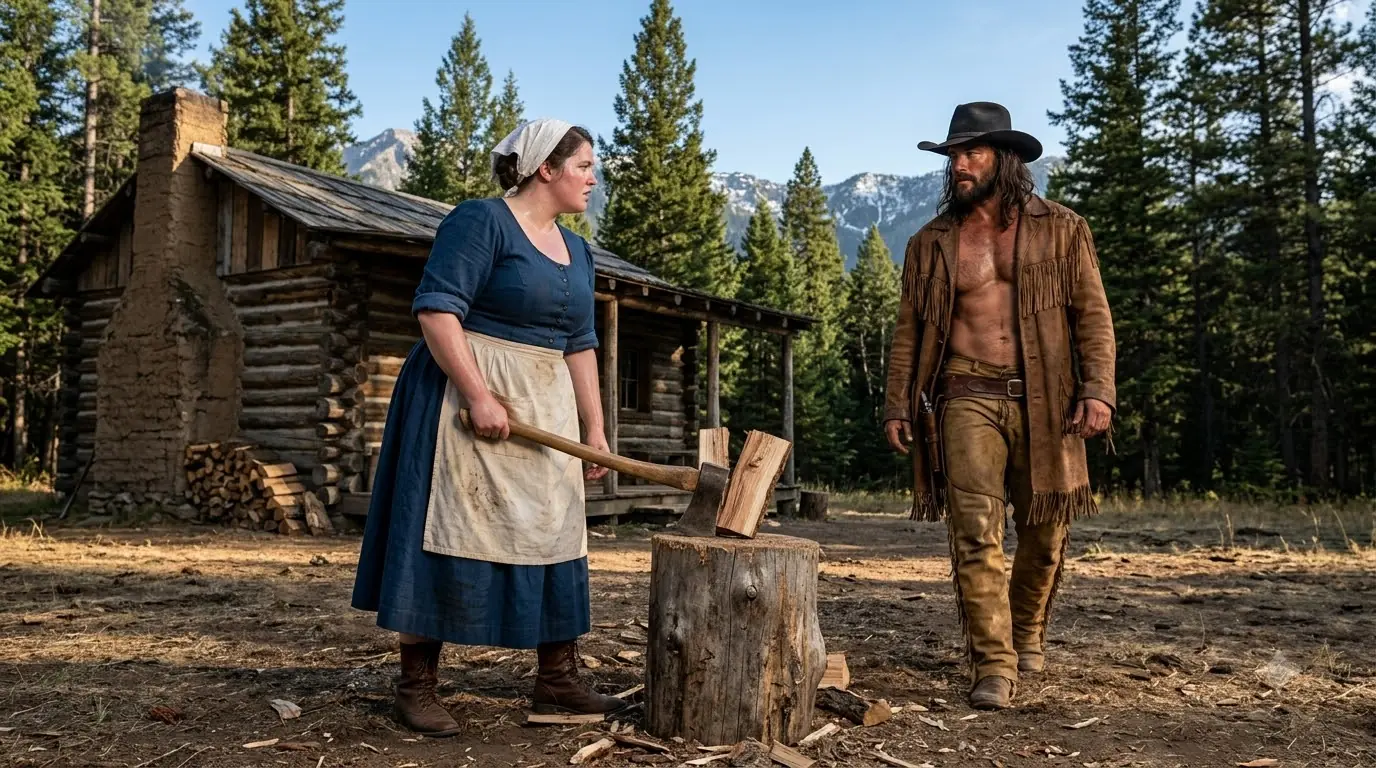
Somewhere beneath the carriage, worn leather suspension straps groaned with the release of several hundred pounds.
Martha heard it.
Everyone did.
It was the kind of sound people pretended not to notice while immediately remembering it forever.
She waited until the door opened.
Then stepped down.
The mud took her boots almost to the ankle.
Martha did not gasp.
She did not ask for help.
She grabbed the side rail, shifted her weight, and pulled her broad body free with a wet sucking sound.
The cold hit next.
October wind came down from the mountains carrying pine, snow, and the promise of something much worse.
It cut through the wool of her faded blue traveling dress.
Martha inhaled deeply.
Then straightened.
Twenty-eight years old.
Five feet seven.
Strong shoulders.
Thick arms.
Heavy breasts.
Wide hips.
Powerful thighs built by years of kitchen work, laundry tubs, flour sacks, stubborn children, and every chore her brothers considered beneath them until they needed it done.
She knew what strangers saw first.
Her size.
Always her size.
The rest required patience most people never bothered to develop.
Her dark-brown hair was pinned beneath a white kerchief.
Her cheeks were flushed from the coach.
Sweat dampened the hair at her temples despite the cold.
A small leather satchel hung from one hand.
Behind her, the driver dragged a heavy wooden trunk from the roof.
It hit the boardwalk with a crash.
Martha turned.
“That contains cast iron.”
The driver spat tobacco into the mud.
“I noticed.”
“You could've lowered it.”
“I could've.”
He climbed back to his seat.
Martha stared.
“Charming man.”
He cracked the whip.
The stagecoach rolled away.
Only after it disappeared around the bend did Martha turn toward the mercantile.
Silence.
Seven men stood under the porch roof.
Two women watched through the front window.
A boy carrying kindling had stopped halfway across the street.
Nobody pretended they had not been staring.
Martha placed both hands on her hips.
“Well?”
Several men immediately looked away.
One smiled.
Another whispered something.
The men beside him laughed.
Martha had been laughed at by better-dressed fools.
She ignored them.
Then the shadow beside the mercantile moved.
Gideon Blackwood stepped forward.
Martha knew him before anyone introduced him.
No other man in town looked as though winter had personally built him out of timber.
Thirty-nine.
Perhaps six-foot-three.
Broad across the chest.
Long dark-brown hair brushing the collar of a weathered fringed leather coat.
Heavy beard threaded with iron gray.
Sun-browned face.
Deep-set eyes the color of storm clouds.
He wore buckskin trousers, scarred boots, gun belt, dark hat.
He looked at Martha.
Not her face.
Her body.
Slowly.
Martha had expected it.
She still disliked it.
His gaze moved from her shoulders to her thick waist.
Her hips.
The trunk.
Back to her.
“You Martha Bell?”
His voice sounded like rocks dragged over boards.
“I am.”
He grunted.
That was all.
Martha waited.
Gideon continued staring.
Finally she said:
“I assume you're Gideon Blackwood.”
Another grunt.
“Wonderful.”
He frowned.
“What?”
“I've traveled twelve days to marry a man whose vocabulary contains one noise.”
A man on the porch choked back laughter.
Gideon looked toward him.
The laughter stopped.
Then Gideon looked at Martha again.
“You're bigger than the photograph.”
Martha’s jaw tightened.
“You're uglier than your description.”
Two men on the porch turned away to hide smiles.
Gideon’s eyes narrowed.
Martha stepped closer.
“Are we finished inventorying flaws?”
He said nothing.
“Because I’m cold, my backside has been numb since Wyoming, and unless that advertisement of yours was a practical joke, I believe there's supposed to be a cabin somewhere on this mountain.”
Gideon looked toward the ridge.
“Day’s climb.”
Martha followed his gaze.
The trail disappeared into dark pine forest.
Far above stood jagged white peaks.
“How far?”
“Seven miles.”
“That's not a day.”
“It is where I live.”
Martha looked back at him.
He seemed to be waiting for concern.
Good.
Let him wait.
She nodded toward the trunk.
“Carry that.”
A flicker crossed his eyes.
“You brought it.”
“You invited me.”
Gideon stared.
Martha stared back.
Finally he bent and lifted the trunk onto one shoulder.
It was perhaps eighty pounds.
He handled it easily.
Martha picked up her satchel.
Gideon turned toward the trail.
“Keep up.”
He began walking.
Martha muttered:
“Romantic already.”
The porch erupted in laughter once they thought Gideon was far enough away not to hear.
He heard.
He did not turn.
Martha followed.
The first mile was uncomfortable.
The second became cruel.
By the third, Martha understood exactly why seven previous women had returned to Ridgeville crying.
Gideon’s trail was barely a trail.
It climbed directly through the mountain as if whoever created it hated switchbacks and knees.
Loose stone.
Roots.
Frozen mud.
Narrow ledges.
Twice they crossed streams.
Once they climbed over a fallen pine nearly as tall as Martha.
Gideon never slowed.
He carried her trunk as if insulted by gravity.
Martha’s breathing grew louder.
Her thighs burned.
Sweat soaked the back of her dress.
Her heavy skirts pulled at her legs with every step.
The friction between her thighs became raw.
Still she climbed.
Gideon looked back occasionally.
Not to check whether she was safe.
To see whether she had broken yet.
Martha recognized tests.
Her oldest brother Henry had tested every man he hired.
Her father had tested horses.
Women tested pie crusts.
Gideon Blackwood apparently tested brides by trying to kill them before supper.
Four miles up, Martha’s right boot slipped on a wet root.
She fell hard.
Her knees hit first.
Then both palms scraped across gravel.
Pain flashed.
She stayed there.
Breathing.
Blood appeared in three thin lines across her left palm.
Gideon stopped.
Turned.
He did not offer his hand.
Martha looked up.
His face contained no concern she could identify.
Only expectation.
He was waiting.
For what?
Tears?
Complaint?
A plea to return?
Anger flooded her.
Good.
Anger was useful.
Martha planted both hands in the dirt.
Pushed herself upright.
Her body protested.
She ignored it.
She wiped the blood on her apron.
Then walked past Gideon without a word.
He watched.
For the first time since meeting her, his expression changed.
Barely.
Interest.
He shifted the trunk and followed.
They reached the cabin at sunset.
Martha stopped in front of it.
Then laughed once.
She could not help herself.
Gideon frowned.
“What?”
“This is your home?”
“Yes.”
“It appears to have lost a fight with the mountain.”
The cabin leaned slightly east.
Rough pine logs.
Stone chimney.
Roof patched with mismatched boards.
One shutter missing.
A narrow porch sagging at the center.
Stacks of hides hung under an overhang.
Antlers decorated one wall.
Woodchips covered the yard.
An axe sat buried in a stump beside several enormous unsplit rounds.
Behind the cabin stood a crude shed and a fenced enclosure containing two goats that looked disappointed by life.
Gideon dropped Martha’s trunk onto the porch.
“Inside.”
She entered.
The smell hit first.
Woodsmoke.
Grease.
Wet wool.
Old hides.
Unwashed man.
Martha had grown up with three brothers.
She knew the scent.
The interior consisted of one large room.
Iron stove.
Rough table.
Four mismatched chairs.
Shelves.
A washstand.
Gun rack.
One enormous bed against the far wall covered in furs.
Martha stared at it.
Then Gideon.
“Where do you sleep?”
He looked at the bed.
Martha nodded.
“And me?”
Gideon looked at the floor.
She waited.
“You're joking.”
“No.”
Martha slowly removed her satchel.
“I climbed seven miles up a mountain after twelve days in a coach so you could point at a floor?”
“You're not my wife yet.”
“Thank God.”