Evan Caldwell wanted only one peaceful Saturday morning.
Not a headline.
Not a briefing.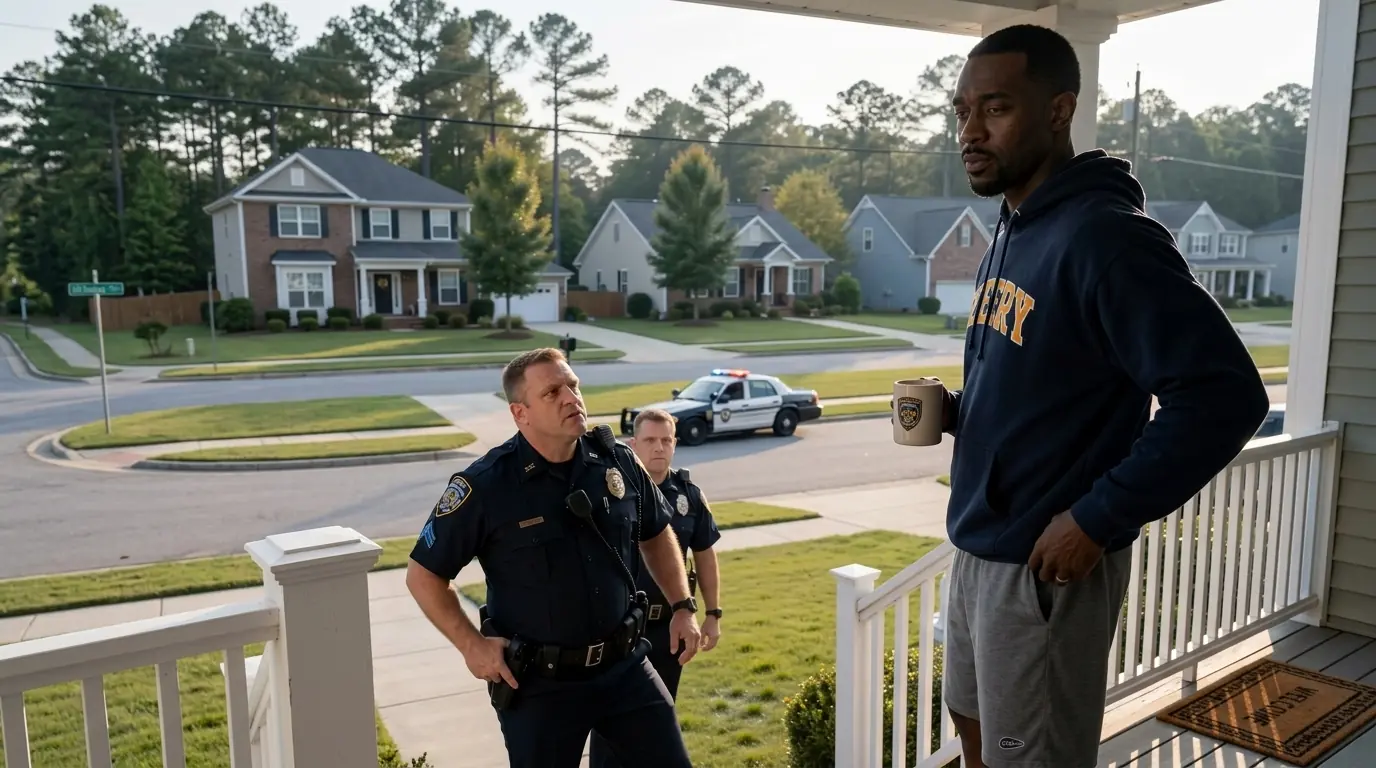
Not another phone call from an agent using the phrase urgent when what he really meant was complicated and politically explosive.
Just coffee.
Ten quiet minutes on the front porch of the house he had bought with twenty years of work, discipline, and the kind of patience life demands from a Black man who spends his career proving he belongs in rooms long after he has already earned the chair.
The house sat on Marigold Lane, inside a gated subdivision called Waverly Oaks, where every mailbox was stone, every lawn looked professionally obedient, and every neighbor waved like they were performing for someone behind glass.
Evan had moved in seventeen days earlier.
Most of his furniture was still wrapped in moving blankets. Boxes lined the foyer in crooked towers. His dining room table had not yet been assembled because every time he opened the instructions, his phone rang with something more important than screws, bolts, and Allen wrenches.
That Friday, he had stood in front of reporters for nearly an hour, explaining a federal indictment that took down a network of corrupt contractors, staffing agencies, and public officials who had been stealing wages from immigrant workers across three states.
Reporters called it historic.
Evan called it unfinished.
By Saturday morning, he was tired in a way sleep could not fix.
So he stepped onto his porch wearing gray sweatpants, a faded Howard University hoodie, black house slippers, and a knit cap pulled low over his short curls. He held a blue ceramic mug in both hands and stood there while the steam rose into the cool October air.
The world felt almost kind.
A leaf skittered down the sidewalk.
Somewhere, a garage door opened.
A dog barked once and then reconsidered the effort.
Evan took one slow sip of coffee and let himself imagine, for one dangerous second, that the day might remain simple.
Across the street and two houses down, Vivian Harrow watched him through her breakfast-room window.
Vivian had lived in Waverly Oaks for nineteen years. She chaired the neighborhood standards committee, approved holiday decorations, corrected people’s recycling bins, and used the phrase “community safety” whenever she wanted to make judgment sound like service. She knew which families belonged to which houses, which gardeners came on which days, and which delivery trucks were allowed to idle without making her uncomfortable.
She did not know Evan.
That alone was enough for suspicion to begin building inside her.
She had received the HOA email announcing the new owner of 42 Marigold Lane, but she had not bothered to remember the name. She remembered only that the sale price had been high, the closing quiet, and the movers came on a Tuesday while she was at pilates.
Now there was a Black man in a hoodie standing on that porch like he owned the place.
Vivian did not step outside.
She did not walk over and introduce herself.
She did not say good morning.
She picked up her phone.
“Yes, I need police on Marigold Lane,” she whispered, though nobody was near enough to hear her. “There’s a suspicious man on the porch of number forty-two. He looks out of place. Maybe homeless. Maybe trying to get inside.”
The dispatcher asked if the man was breaking a window.
“No.”
The dispatcher asked if he had a weapon.
“I can’t tell.”
The dispatcher asked what he was doing.
Vivian looked again.
Evan lifted his mug.
Eight minutes later, Evan bent down to move a small potted lemon tree closer to the sun.
That was when he heard the engines.
Two patrol cars turned onto Marigold Lane faster than they should have.
No sirens.
Only flashing lights cutting red and blue across trimmed hedges, cream brick, black shutters, and porch columns that had probably never seen a scratch. The cruisers stopped at angles in front of Evan’s driveway, blocking his car and part of the street.
He stood slowly.
The coffee remained in his right hand.
Four doors opened.
Two officers stepped out first. The older one had a square jaw, pale skin, and a shaved head that shone under the morning light. His nameplate read D. Barlow. His right hand hovered near his holster, not touching the weapon but close enough to turn the gesture into a message.
The younger officer, Amelia Ross, stepped out behind him.
She looked at the house.
Then at Evan.
Then at the open front door.
Her face shifted slightly, the way a person’s face changes when the facts refuse to fit the story they were given.
Officer Barlow did not seem interested in facts yet.
“Hey,” he barked. “Put the cup down and show me your hands.”
Evan lifted his free hand slowly.
“This is coffee.”
“I didn’t ask what it was.”
“I am standing on my own porch.”
“Step down here.”
“No.”
The word was calm.
That made it louder.
Barlow paused at the bottom of the steps.
Officer Ross glanced at him, then back at Evan.
“Sir, we got a call about a suspicious person at this residence,” Barlow said.
“I gathered that.”
“Possible trespass. Possible break-in.”
Evan looked behind him at his own open front door.
“A break-in while I’m drinking coffee in slippers?”
“Step off the porch.”
“Officer, I own this house.”
“Then show ID.”
“My wallet is inside.”
“Then go get it.”
Evan’s eyes sharpened.
“You want me to turn around, walk into my house, and reach for something inside while you stand behind me with your hand near your gun?”
Officer Ross looked directly at Barlow’s hand.
Barlow moved it slightly, but pride kept it close to the belt.
“Don’t make this difficult,” Barlow said.
“I’m not making it difficult. I am asking you to identify the legal basis for ordering me off my porch.”
Barlow gave a short laugh.
“The legal basis is somebody called police because you don’t belong here.”
The sentence landed harder than he seemed to realize.
Evan set his mug on the small table beside the porch chair.
Not because Barlow told him to.
Because coffee was hot, and bad policing already made enough mess.
The street had begun to wake.
A man in jogging clothes slowed near the corner. A woman holding a small white dog stopped mid-walk. A teenager across the street lifted his phone, cautious at first, then more openly. Curtains moved in at least five houses.
Vivian Harrow stepped out onto her driveway in a cream cardigan, arms folded, watching the scene with the careful satisfaction of someone waiting for the world to confirm her instincts.
Evan noticed her.
Then he looked back at Officer Barlow.
“Your caller’s assumption is not reasonable suspicion,” he said. “Standing on a porch is not trespassing. Drinking coffee is not burglary. Wearing a hoodie in an expensive neighborhood is not probable cause.”
Barlow’s mouth tightened.
“You a lawyer or something?”
“Yes.”
That answer irritated him more than it should have.
“Well, counselor, this is still an active investigation.”
“No,” Evan said. “This is a neighborhood anxiety call. You are trying to turn it into an investigation because backing down would embarrass you.”
Officer Ross went still.
Barlow stepped onto the first porch step.
“Turn around.”
Evan did not move.
“I said turn around.”
“I heard you.”
“Are you refusing a lawful command?”
“I am refusing an unlawful one.”
Barlow unclipped his handcuffs.
Metal sounded small in the open air, but everyone heard it.
Evan looked at the cuffs, then at the officer.
“If you put those on me, this will become the kind of morning your department spends years explaining.”
Barlow smirked.
“Is that a threat?”
“It is legal notice.”
“Turn around.”
Evan reached slowly toward the table.
Both officers stiffened.
“I am picking up my phone,” he said. “It is beside the mug. You can see it from where you stand.”
“Don’t touch it,” Barlow snapped.
Evan stopped.
Then looked at Officer Ross.
“You know this is wrong.”
Her jaw tightened.
She said nothing.
Evan nodded once.
“Remember this moment. There is always a second before harm becomes paperwork.”
That sentence seemed to reach her.
Ross touched the radio at her shoulder.
“Dispatch, Unit 14. Request supervisor to 42 Marigold Lane. Code four, but we need property verification.”
Barlow spun toward her.
“What the hell are you doing?”
She swallowed.
“Verifying.”
“You verify when I tell you to verify.”
“No, sir,” she said, voice shaking but clear. “We should verify now.”
For the first time, Barlow looked uncertain.
Not afraid.
Not yet.
Just aware that the ground had shifted under him.
Evan picked up his phone slowly before Barlow could stop him.
“Call Captain Leona Price,” he said. “Tell her you are attempting to detain Evan Caldwell at 42 Marigold Lane.”
Barlow frowned.
Ross’s face changed immediately.
She knew the name.
Most officers in the city did.
Evan Caldwell had been sworn in six months earlier as the United States Attorney for the Western District. His office worked with local police on federal task forces, corruption cases, civil-rights referrals, trafficking prosecutions, and violent-crime initiatives. His photograph had been included in every interagency memo when the new task force launched.
Officer Ross had read it.
Officer Barlow apparently had not.
“What is that supposed to mean?” Barlow asked.
Evan’s voice stayed level.
“It means the man you are trying to handcuff on his own porch is the chief federal prosecutor for this district.”
The street went silent.
Even the dog stopped pulling at its leash.
Ross stepped back and radioed again, faster this time.
“Dispatch, confirm immediate supervisor. Notify Captain Price. Possible contact with U.S. Attorney Caldwell.”
Barlow stared at Evan.
Then at Ross.
Then at the neighbors recording from the street.
“Everybody calm down,” he said, though he was the only person who had escalated anything.
Evan sat down in the porch chair and picked up his coffee.
“I am calm,” he said. “That has been your problem since you arrived.”
The twelve minutes before Captain Leona Price arrived felt longer than the two-year investigation Evan had just finished prosecuting.
Barlow paced near the driveway, trying to look in control and failing. Ross stood near the cruiser, pale and quiet. Vivian remained on her driveway, but her posture had changed. Her arms were no longer folded. One hand was pressed flat against her chest.
Neighbors gathered in the careful way neighbors gather when they want the details without admitting curiosity.
The teenager kept recording.
Evan did not tell him to stop.
A black city SUV turned onto Marigold Lane at 9:24.
Captain Leona Price stepped out before the engine had fully settled. She was in her early fifties, Black, sharp-eyed, and known for not raising her voice unless someone had already ignored the quiet version. She took in the scene in less than five seconds.
Cruisers blocking a driveway.
Neighbors outside.
An officer too close to the porch.
A younger officer looking sick.
And Evan Caldwell sitting in slippers with a coffee mug.
Her expression hardened.
“Officer Barlow,” she said. “Step away from the porch.”
Barlow opened his mouth.
“Captain, we had a suspicious-person call—”
“Did I ask for your summary?”
“No, ma’am.”
“Step away.”
He did.
Price walked to the bottom step and looked up at Evan.
“United States Attorney Caldwell,” she said. “I apologize.”
The title moved through the street like a gust of wind.
United States Attorney.
Vivian Harrow’s face drained.
Barlow looked as if someone had cut the strings holding his posture together.
Evan stood.
“Captain Price.”
“I want you to know this will be handled.”
“I want more than that,” Evan said.
She nodded.
“I understand.”
“I was ordered off my own porch. Officer Barlow approached with his hand near his firearm, demanded ID without reasonable suspicion, threatened detention, and prepared to handcuff me. Officer Ross recognized the issue but hesitated before intervening.”
Ross lowered her eyes.
Price looked at both officers.
“Body camera footage will be preserved. Dispatch audio will be preserved. Both of you are relieved from this call pending review.”
Barlow tried again.
“Captain, the caller said he wasn’t the homeowner.”
Evan turned toward Vivian.
“No,” he said. “The caller assumed I wasn’t.”
Price followed his gaze.
Vivian took one small step backward.
Evan looked at Captain Price.
“I want the 911 recording played here.”
Price hesitated only a second.
Then made the call.
A dispatcher sent the audio to her department tablet within minutes.
Price pressed play.
Vivian’s voice filled the quiet street.
“There’s a suspicious man standing on the porch of number forty-two. He looks out of place. Maybe homeless. Maybe trying to get inside. That house sold for over a million dollars. I know this neighborhood. He is not the homeowner.”
The recording ended.
No one spoke.
Evan stepped down from the porch and walked toward Vivian’s driveway.
He did not hurry.
Captain Price walked beside him.
Barlow and Ross stayed behind, suddenly irrelevant to the scene they had created.
Vivian tried to smile as Evan approached, but her lips trembled too much to hold it.
“I’m sorry,” she said before he reached the curb. “I didn’t know.”
Evan stopped a few feet from her.
“That is exactly the problem.”
She blinked.
“I was concerned for the neighborhood.”
“No. You were comfortable turning uncertainty into danger.”
“I didn’t mean for anything bad to happen.”
“You called armed officers to my home and told dispatch I was not the homeowner. Not that you were unsure. Not that you wanted a welfare check. You said I was not the homeowner because your imagination could not place me on that porch.”
Her eyes filled with tears.
“I’m not racist.”
Evan looked at her for a long moment.
“That sentence is not evidence.”
A few neighbors looked down.
Vivian’s face tightened.
“I have lived here for nineteen years. I care about this community.”
“Then you should care about the people harmed by your fear.”
“I made a mistake.”
“A mistake is misreading a house number,” Evan said. “You sent the police because a Black man looked too ordinary to own an expensive home.”
The words hung in the air.
Plain.
Unsoftened.
Necessary.
Captain Price stepped forward.
“Mrs. Harrow, this call will be referred for review as a possible misuse of emergency services. We will also be examining your prior call history.”
Vivian looked startled.
“My prior calls?”
“Yes,” Price said.
“But I always call because I’m concerned.”
Evan’s voice cut in quietly.
“Concern becomes dangerous when it never questions itself.”
By noon, the video was online.
The teenager who filmed it posted a simple caption.
They called police on the U.S. Attorney for drinking coffee on his own porch.
By evening, it had spread across the city.
By Sunday morning, national legal commentators were playing clips of Evan explaining reasonable suspicion while standing in slippers beneath his own porch light. Some people laughed at the absurdity. Others saw the danger. The best ones saw both.
Memes appeared first.
Then think pieces.
Then arguments.
Then the familiar chorus of people saying everyone had overreacted.
But Evan was not interested in becoming a viral moment.
He was interested in the pattern underneath it.
On Monday morning, his office requested five years of suspicious-person and trespass calls from Waverly Oaks and three similar subdivisions. The department resisted at first. Captain Price did not. She had already started her own internal review because she knew what Evan knew.
One call is a story.
A hundred calls are a system.
The data came in ugly.
Delivery drivers questioned for sitting in vans.
Black teenagers stopped while walking home from tutoring.
A Latino contractor detained while carrying tools into a house he had been hired to repair.
A Filipino nurse asked for ID outside a patient’s home.
A Black real estate agent surrounded by officers while showing a property to clients.
Three residents questioned outside their own homes.
Vivian Harrow alone had made thirty-two calls in five years.
None led to charges.
Fourteen involved people of color legally present in the neighborhood.
Two involved actual homeowners.
One involved a Black judge’s husband unloading groceries from his own car.
Evan read the report in silence.
Then called Captain Price.
“We are not treating this as an isolated incident.”
“No,” she said. “We are not.”
Officer Barlow was suspended without pay pending termination. His prior complaints were reopened. There were six, including three involving unlawful detentions in wealthy neighborhoods after vague suspicious-person calls. Officer Ross received discipline for failure to intervene sooner, but her radio call was credited as preventing an unlawful arrest.
Vivian Harrow was charged with misuse of emergency services.
Her attorney called it a misunderstanding.
The prosecutor called it a pattern.
Three months later, the Waverly Oaks HOA held an emergency community meeting.
Evan almost did not go.
He had trials to prepare, witnesses to protect, and a thousand better things to do than sit under chandelier lighting while wealthy neighbors tried to turn shame into a vocabulary exercise.
Then he thought about the people in the report.
The nurse.
The contractor.
The teenagers.
The real estate agent.
The homeowners who did not have a title powerful enough to stop a bad morning from becoming a criminal record.
So he went.
The clubhouse was full.
Vivian sat near the front, pale and small in a beige coat, twisting a tissue in her hands. The HOA president, a retired finance executive named Martin Ells, opened with a careful speech about community healing, shared responsibility, and regrettable confusion.
Evan let him speak for one minute.
Then he stood.
“Do not call it confusion.”
The room fell silent.
Evan walked to the front.
“Confusion is ringing the wrong doorbell. What happened on my porch was assumption backed by police power.”
Martin stepped aside.
Wisely.
Evan faced the room.
“Some of you did not call 911 that morning. But many of you have benefited from the same idea that created that call. The idea that belonging here has a look. A sound. A car. A uniform. A skin tone.”
No one moved.
“That idea is why delivery drivers get followed. Why contractors get questioned. Why children walking home become suspicious. Why a man drinking coffee on his own porch becomes a possible intruder.”
Vivian began to cry quietly.
Evan did not look away from the room to comfort her.
“The police failed that morning. But they were invited into that failure by a resident who treated her fear as fact. Systems do not begin with sirens. Sometimes they begin behind curtains.”
That sentence landed hard.
He turned toward Vivian.
“You said you were protecting the neighborhood. From what?”
Vivian stared at the floor.
The room waited.
At last, she whispered, “From what I thought didn’t fit.”
Evan nodded once.
“That is the first honest thing I have heard.”
The HOA changed its rules after that.
The neighborhood alert board was shut down and rebuilt under strict guidelines. No posts about “suspicious” people without specific behavior. No vague warnings about unknown cars, unfamiliar workers, or people “not from around here.” All emergency-call education now included the difference between discomfort and danger.
The police department changed too.
Dispatchers were retrained to ask behavior-based questions before sending officers to vague suspicious-person calls. Officers were trained on unlawful detentions arising from biased reports. Repeat callers were flagged for review when their emergency reports showed patterns unsupported by criminal conduct.
None of it fixed the world.
Evan knew better than to confuse reform with redemption.
But it mattered.
Good policy cannot cure prejudice.
It can make prejudice work harder to become state action.
Nearly a year later, Evan stood on his porch again.
Same hoodie.
Same slippers.
Same blue mug.
The lemon tree he had been moving that morning now sat in a bigger pot near the steps, its leaves glossy and green. He had finally unpacked the house. Books filled the shelves. The dining table stood assembled. The guest room had become a real room instead of a storage confession.
A delivery van stopped across the street.
A young Black driver stepped out carrying a package. He checked the label, walked up to the door of Vivian’s old house, and rang the bell. Vivian had moved away after the case ended. The new owners were a retired couple from Chicago who waved at everyone and offered water to every worker who came near the property.
The door opened.
The driver handed over the package.
No curtains snapped shut.
No cruiser came.
No one turned his presence into an emergency.
Evan watched longer than he meant to.
Then he took a sip of coffee.
It was still hot.
A neighbor walking a golden retriever raised a hand.
“Morning, Mr. Caldwell.”
“Morning,” Evan said.
No explanation.
No demand.
No proof required.
Just morning.
He leaned against the porch rail and looked down Marigold Lane, where the houses remained polished, expensive, and quiet enough to hide almost anything. That was the thing about places like Waverly Oaks. They looked peaceful from the street. But peace built on exclusion is not peace. It is silence with landscaping.
Evan had spent his career learning that systems rarely announce themselves honestly.
Corruption calls itself tradition.
Fear calls itself safety.
Bias calls itself concern.
And power, when left unchallenged, calls itself procedure.
A year earlier, Vivian Harrow looked at him and saw an intruder. Officer Barlow heard her fear and turned it into command. Officer Ross saw the wrong and waited before doing right. The neighborhood watched from behind windows, each person deciding how much truth they could tolerate before breakfast.
That morning had not ruined Evan’s life.
It had revealed something underneath the neighborhood’s clean surface.
That revelation had consequences.
Not enough for everyone harmed before him.
But enough to leave a mark.
Enough to change dispatch scripts.
Enough to reopen complaint files.
Enough to teach one young officer that hesitation can become complicity.
Enough to teach one neighborhood that property values do not outrank human dignity.
Evan finished his coffee slowly.
Then he picked up the lemon tree, moved it six inches deeper into the sunlight, and smiled at the quiet pleasure of watching something live exactly where it belonged.