Marcus Ellison had spent most of Friday explaining to reporters that the indictment was not the end of the investigation.
It was only the part the public could finally see.
By four thirty that afternoon, the federal courthouse in downtown Atlanta felt less like a building than an aquarium. Cameras waited beyond every glass door. Reporters shouted questions across security barriers. Television trucks occupied half the curb.
Marcus stood beneath white courthouse lights with thirty-two pages of charges behind him and twenty-six months of exhaustion beneath his eyes.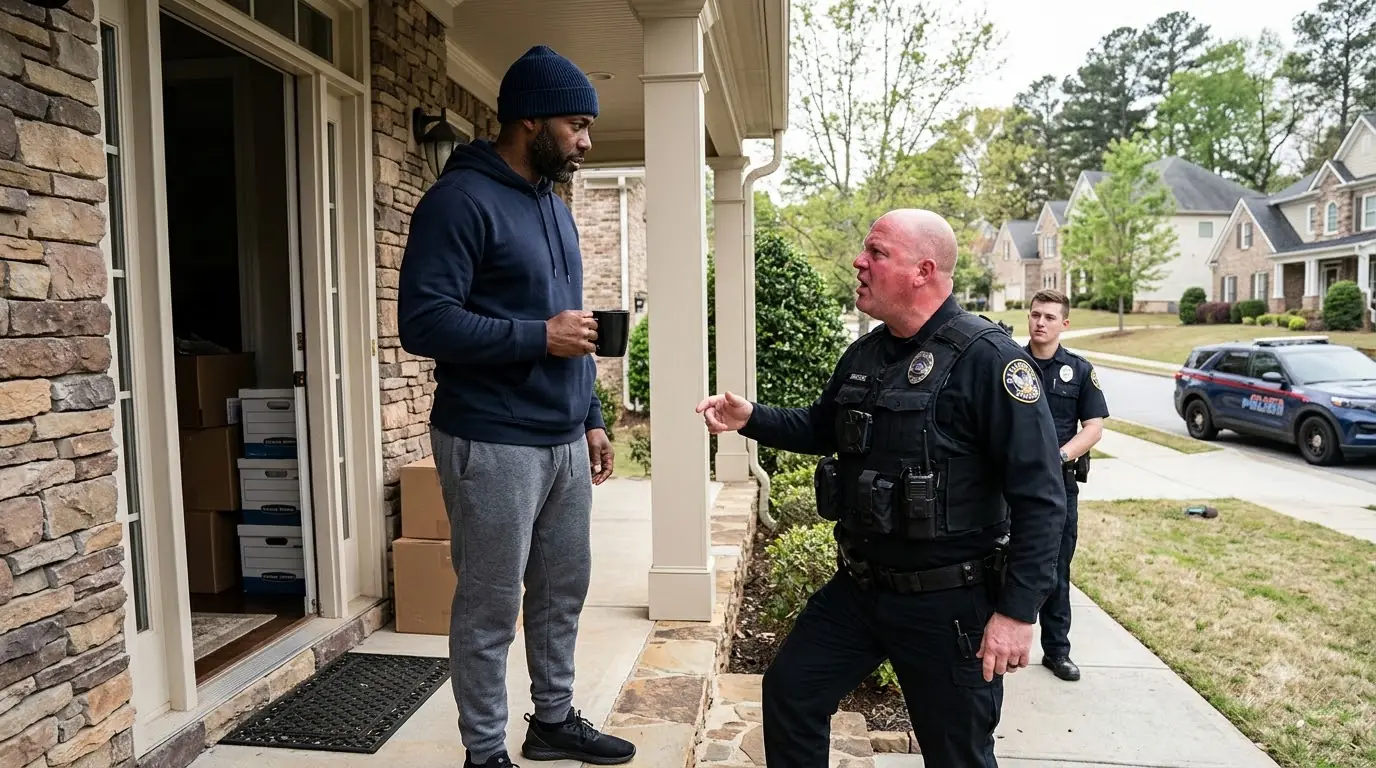
Three states.
Seventeen defendants.
Six shell corporations.
Eight moving companies.
Four warehouses.
Temporary payroll accounts.
Truck routes manipulated to hide human trafficking behind legitimate freight operations.
The case had begun with a missing nineteen-year-old woman and an accountant who noticed payroll entries for workers who did not exist.
It had grown from there.
Marcus had led the prosecution team from the beginning.
He was forty-three, tall, athletic, restrained by temperament, and famous among younger prosecutors for never raising his voice when a quieter sentence would do more damage.
That afternoon, he stood before microphones in a charcoal suit and dark tie.
“We are alleging that the defendants used ordinary commercial infrastructure to conceal extraordinary harm,” he said.
A reporter called from the second row.
“Mr. Ellison, are local law enforcement agencies under investigation too?”
Marcus paused.
The question mattered.
“Yes.”
The cameras clicked faster.
“Several subpoenas have been issued seeking records from municipal departments and private contractors. I am not going to identify uncharged individuals.”
“Does that include police officers?”
“I am not identifying uncharged individuals.”
Another reporter shouted.
“Are elected officials involved?”
“Same answer.”
“Is the investigation expanding?”
Marcus looked directly at the cameras.
“It never stopped.”
That sentence ran on evening television before Marcus even reached his car.
He did not know that twelve miles north, a man named Walter Creighton watched it from a leather chair in a stone mansion.
He did not know Walter muted the television halfway through the segment.
He did not know Walter immediately called someone.
Marcus only knew he was tired.
After twenty-six months of sealed warrants, late-night interviews, frightened witnesses, angry defense lawyers, and enough stale courthouse coffee to qualify as chemical punishment, he wanted one thing.
Silence.
That was why he had bought the house.
Stone front.
Wide porch.
Four bedrooms.
Too large for one man, according to his sister.
Marcus had argued that she and her children visited often enough to justify it.
His sister had laughed.
“You bought a family house without a family.”
Marcus had told her to mind her business.
The truth was simpler.
He had spent fifteen years living in apartments chosen for distance to courthouses.
He wanted trees.
A kitchen large enough to cook in.
A porch.
A room his niece could claim when visiting.
He wanted to wake somewhere that did not feel temporary.
The house sat inside Hawthorne Ridge, an affluent community north of Atlanta filled with stone façades, manicured lawns, winding streets, and mailboxes that looked more expensive than Marcus's first car.
He closed on the property Tuesday.
The movers delivered the first shipment Friday morning while he was at the courthouse.
By six fifteen that evening, Marcus had changed into gray sweatpants, black sneakers, a dark navy hoodie, and a matching navy knit beanie.
His suit hung upstairs.
His federal credentials rested in a drawer near the kitchen.
He made coffee.
Then he stood on his own front porch and did absolutely nothing.
For the first time all week, nobody asked him a question.
Boxes were stacked behind the open front door.
One said BOOKS.
Another said KITCHEN.
His sister had written BORING LAWYER THINGS across a third box before the movers arrived.
Marcus took a drink of coffee and looked at the street.
Late autumn had stripped most of the leaves from the trees.
The neighborhood was quiet.
Across from him stood another enormous house.
A man in a gray pullover was watching from an upstairs window.
Marcus noticed.
The man moved away.
Marcus thought nothing of it.
He had been standing there approximately eleven minutes when the police SUV turned onto the street.
Slowly.
Marcus watched it approach.
The vehicle passed his driveway.
Stopped fifty feet farther.
Then reversed.
A second police cruiser followed.
Marcus lowered the coffee mug.
Two officers stepped out.
The first was bald, white, mid-forties, broad through the waist and shoulders.
His uniform nameplate read MERCER.
The second officer was younger.
Probably early thirties.
His nameplate read BENNETT.
Both looked toward Marcus.
Marcus looked behind himself.
Open door.
Boxes.
No one else.
Officer Mercer approached the steps.
“Sir.”
Marcus waited.
“You live here?”
Marcus looked at the house.
Then back at Mercer.
“Yes.”
Mercer's gaze moved over the navy hoodie.
Gray sweatpants.
Beanie.
Coffee.
Boxes behind him.
“You have identification?”
Marcus did not answer immediately.
“What is this about?”
Mercer's expression changed slightly.
“We received a call about suspicious activity.”
“What suspicious activity?”
“Caller reported somebody hanging around a residence.”
Marcus stared.
“Drinking coffee?”
Mercer frowned.
“I didn't say coffee.”
“I am holding coffee.”
“You need to answer the question.”
“I did. I live here.”
Mercer moved one step closer.
“Identification.”
Marcus remained on the porch.
“No.”
Officer Bennett glanced toward Mercer.
Mercer stared.
“No?”
“Correct.”
“I'm investigating a call.”
“And I answered your question.”
“You haven't shown me anything proving you're supposed to be here.”
Marcus took another drink.
That irritated Mercer.
Marcus saw it immediately.
“I don't need to prove that I belong inside my own house because a neighbor saw me standing outside it.”
Mercer's jaw tightened.
“Sir, don't make this difficult.”
Marcus almost laughed.
The phrase was familiar.
Prosecutors heard versions of it in interview rooms all the time.
Don't make this difficult.
Usually spoken by people already making something difficult.
Marcus set the coffee on a small round patio table.
Officer Mercer moved closer to the first step.
“Step down here.”
“No.”
The younger officer looked at the boxes.
“Lieutenant—”
Mercer raised one hand.
Marcus noticed the rank insignia.
Lieutenant.
Interesting.
Mercer looked back at Marcus.
“I've asked you for identification.”
“And I've told you I live here.”
“Anybody else inside?”
“No.”
“Owner's name?”
Marcus smiled faintly.
“My name.”
Mercer did not appreciate that.
“You think this is funny?”
“No.”
“Then answer.”
Marcus folded his arms.
“Before I answer anything else, tell me exactly what the caller reported.”
Mercer's eyes narrowed.
“I don't have to disclose that.”
“You came onto my property demanding identification based on a call. I want to know what alleged conduct you're investigating.”
“Suspicious person.”
“What conduct?”
“Loitering.”
“On my porch.”
“You haven't established it's your porch.”
Marcus looked toward Officer Bennett.
Bennett looked uncomfortable.
Marcus asked him:
“Did dispatch provide a suspected burglary, forced entry, damaged lock, alarm, broken window, anything beyond a person standing here?”
Bennett opened his mouth.
Mercer interrupted.
“I'm talking to you.”
Marcus returned his gaze.
“Then give me a reason to continue talking.”
Mercer's face reddened.
“You don't dictate this interaction.”
Marcus's expression cooled.
“I dictate quite a lot of what happens on my private property.”
Mercer stepped onto the first porch stair.
“Come down here.”
“No.”
“Sir.”
Marcus said nothing.
Mercer raised his voice.
“Step away from the doorway.”
Marcus stared.
“Why?”
“Officer safety.”
“I'm eight feet above you holding nothing.”
“We don't know what's inside.”
“You don't have a right to know.”
Mercer's hand moved toward his duty belt.
Not his gun.
Close enough to matter.
Marcus noticed the body camera centered on the tactical vest.
Red recording indicator.
Good.
He looked directly at it.
Mercer noticed.
“What are you looking at?”
“Your camera.”
“Worried about it?”
“No.”
That answer came too quickly for Mercer.
Marcus continued.
“I am relieved it's on.”
Officer Bennett lowered his gaze.
Mercer stepped higher.
“I am giving you a lawful order.”
Marcus's voice remained calm.
“No, you're giving me an order. Those are not automatically the same thing.”
Mercer's entire demeanor changed.
“Turn around.”
Marcus stared.
“What?”
“Turn around and put your hands behind your back.”
Officer Bennett said, “Lieutenant.”
Mercer ignored him.
Marcus did not move.
“Am I being detained?”
“Yes.”