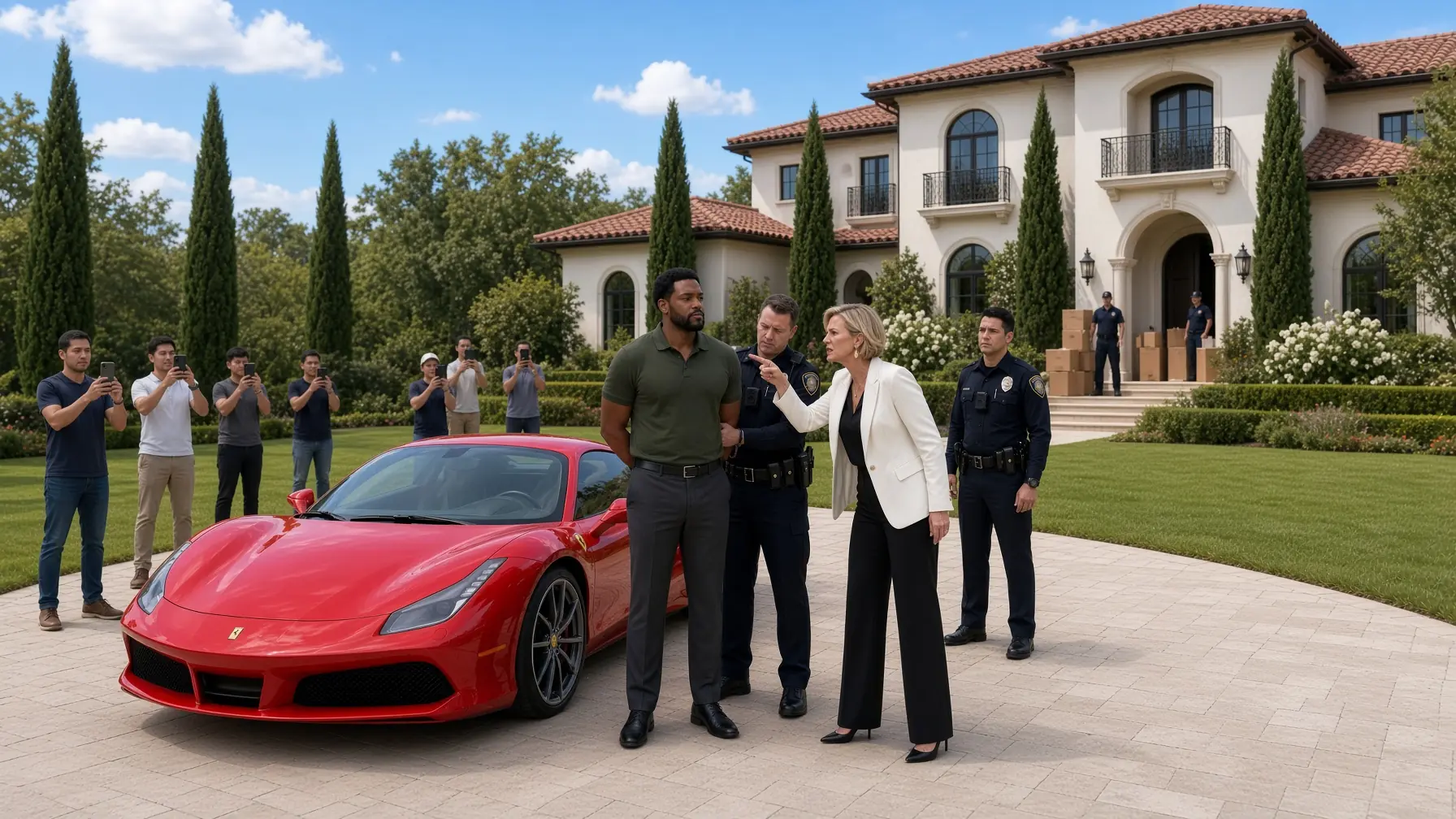
“Step away from that car.”
The voice came from across the driveway, sharp enough to cut through the sound of the moving truck ramp scraping against the pavement. Adrian Knox turned slowly, one hand resting on the roof of his red Ferrari, the other holding a set of house keys he had picked up from the closing attorney less than forty-eight hours earlier.
The woman standing near the edge of his lawn looked at him as if he had crawled out of a drain.
She was tall, white, polished, and furious in the way only certain rich people get when reality refuses to match the picture in their head. Her cream blazer was spotless. Her blonde hair was pulled back so tightly it seemed to sharpen her face. Behind her, a white Mercedes SUV sat crookedly at the curb with the driver’s door still open.
Adrian looked from her to the mansion behind him, then back to the car.
“I’m sorry,” he said calmly. “Can I help you?”
The woman stepped closer, pointing one manicured finger toward the Ferrari.
“You can start by telling me whose car that is.”
Adrian gave her a brief, polite smile.
“Mine.”
She laughed.
It was not the kind of laugh that finds something funny.
It was the kind of laugh people use when they want witnesses to understand that the person in front of them should not be taken seriously.
“Yours,” she repeated. “Right. And I suppose this house is yours too?”
“That is correct.”
The movers behind him slowed down without meaning to. Two men carrying a walnut bookcase exchanged a quick glance before continuing toward the open front door. Across the street, curtains shifted in a second-floor window. Somewhere nearby, a dog started barking.
The woman’s expression hardened.
“My name is Caroline Winslow,” she said. “I sit on the HOA board for Bellhaven Ridge. I know every family on this street, and I can promise you, nobody mentioned a man like you moving in.”
Adrian’s face did not change.
“A man like me?”
She heard the question and disliked how cleanly it had been placed in front of her.
“You know exactly what I mean,” she snapped. “This is a private community. We have standards. You don’t just show up here leaning on a Ferrari and expect people not to ask questions.”
Adrian slipped his keys into his pocket.
“I purchased the house legally. The car is registered to me. The movers are here because I am moving in.”
“Paperwork can be faked.”
“That is true,” Adrian said. “But accusations should not be.”
Her eyes narrowed.
That answer had not given her the reaction she wanted.
People like Caroline Winslow did not always want violence. Often, they wanted obedience. They wanted the other person to become nervous, loud, defensive, anything that confirmed the story they had already written. Adrian knew that game. He had learned it in boardrooms, police stations, gated entrances, hotel lobbies, and banks where men in suits smiled while asking for one more form of identification.
He also knew the danger of playing badly.
So he kept his hands visible.
He kept his voice even.
He stood in his own driveway as if the ground beneath his feet did not need permission from anyone.
Caroline pulled out her phone.
“I’m calling the police.”
“You are free to call whoever you like.”
“You think this is cute?”
“No.”
She pressed the screen hard enough that her nail clicked against the glass.
“I need police at 18 Hawthorne Bend,” she said, turning her voice suddenly thin and frightened. “There is a man here with a stolen Ferrari. He’s refusing to leave. I don’t feel safe.”
Adrian watched her perform fear with professional ease.
That was what bothered him most.
Not the accusation.
The performance.
Three minutes later, the first cruiser turned onto Hawthorne Bend.
It did not arrive with sirens, only flashing blue lights that bounced against the polished windows of the surrounding mansions. The patrol car pulled into the driveway as if Adrian were already a problem to be contained. Officer Ryan Talbot stepped out first, broad-shouldered, white, square-jawed, his right hand resting near his belt before he asked a single question.
His partner, Officer Luis Moreno, stepped out from the passenger side with a slower, more careful expression.
Caroline rushed toward them.
“Thank God,” she said, placing one hand against her chest. “He won’t leave. I tried to ask simple questions, and he got aggressive.”
Adrian stayed where he was.
The Ferrari gleamed beside him in the morning light.
Behind him, movers carried boxes through the front door labeled Office, Kitchen, Private Archive.
Officer Talbot looked at Adrian, then at the car, then at the house.
His face settled into certainty.
“Sir, step away from the vehicle.”
Adrian nodded once.
“Officer, I can provide identification, the vehicle registration, and proof of property ownership.”
“I said step away from the vehicle.”
“I heard you,” Adrian said. “I am trying to comply in a way that also clears up the false report.”
Talbot’s jaw tightened.
Caroline stepped behind him, close enough to be protected by the uniform and far enough to appear fragile.
“He’s been doing this from the beginning,” she said. “Talking in circles. Acting like he belongs.”
Adrian looked at her.
“This is my driveway.”
Caroline took two steps forward and raised her middle finger inches from his face.
“You don’t belong anywhere near this house,” she hissed. “And everybody here knows it.”
The street went quiet.
A woman across the road lowered her watering hose.
A teenage boy on a bicycle stopped at the curb and pulled out his phone.
The movers froze fully this time.
Adrian looked at Caroline’s raised finger, then at the small body camera on Talbot’s chest.
“Officer, is your camera recording?”
Talbot’s grip moved to Adrian’s wrist.
“Turn around.”
“Officer Moreno,” Adrian said calmly, “please run the plate. The registration will come back under my name at this address.”
Moreno looked uneasy.
“Ryan, maybe we should check before we put hands on him.”
Talbot ignored him.
“He matches the call. We’re detaining him until this is sorted.”
Adrian did not resist when Talbot turned him toward the Ferrari and pulled his hands behind his back. The metal cuffs closed around his wrists with a public finality that made several neighbors step closer to their windows. Caroline folded her arms and smiled, not kindly, not nervously, but with the satisfied look of a woman watching the world correct itself.
Moreno walked to the front of the Ferrari and read the plate into his radio.
Adrian kept his voice clear.
“I want the record to show I offered identification before being handcuffed.”
“Stop talking,” Talbot said.
“I am speaking for the cameras.”
That made Talbot’s face change.
Not much.
Enough.
Moreno came back from the cruiser three minutes later with Adrian’s license in his hand and a look that told the truth before he spoke.
“Ryan,” he said quietly. “The car is registered to Adrian Knox. Same address. Property records confirm the house sale closed two days ago. No flags, no theft report, nothing.”
Caroline’s mouth opened.
Then closed.
Then opened again.
“That does not prove he isn’t using someone else’s identity,” she said. “This kind of thing happens all the time.”
“What kind of thing?” Adrian asked.
She pointed at him again.
“People showing up where they don’t belong with things they didn’t earn.”
A gray-haired woman from two houses down stepped off her porch.
“That man was here yesterday,” she called out. “The realtor introduced him as the new owner. I met him myself.”
Talbot turned toward her.
“Ma’am, please step back.”
“I’m on a public sidewalk,” she said. “And I’m old, not blind.”
A few neighbors lowered their eyes.
The teenagers kept recording.
Talbot uncuffed Adrian with stiff, irritated movements, as if the handcuffs had embarrassed him rather than the conduct that led to them. Adrian rubbed one wrist but did not dramatize it.
Talbot cleared his throat.
“You’re free to go. Looks like a misunderstanding.”
“No,” Adrian said. “It was a false report.”
Caroline scoffed.
“I was being cautious.”
“You called police and said I was stealing my own car from my own driveway.”
“I had concerns.”
“Based on what?”
Caroline looked around, realizing too late that too many phones were pointed her way.
Adrian continued, calm as ever.
“Based on the fact that I am Black, standing beside a Ferrari, in a neighborhood where you did not expect me to live.”
No one spoke.
Caroline’s cheeks flushed bright red.
“You don’t get to make this about race.”
“I didn’t,” Adrian said. “You did when you decided evidence mattered less than your assumption.”
Moreno looked down.
Talbot moved toward the cruiser, eager to leave.
Caroline stepped close to Adrian as the officers turned away. Her voice dropped low enough that only he was meant to hear.
“You may have fooled them today,” she whispered. “But you will never be accepted in Bellhaven Ridge.”
Adrian looked at her for a long moment.
Then he smiled faintly.
“Mrs. Winslow, you have no idea whose driveway you stepped into.”
She heard arrogance in that.
She should have heard warning.
By late afternoon, the movers were gone, and the house was finally quiet.
Adrian stood in the main office, surrounded by half-unpacked boxes, looking out at the street where Caroline’s Mercedes sat in her driveway like a white statue of entitlement. His new home had high ceilings, dark floors, tall windows, and the kind of silence that wealth purchases for people who have forgotten how loud ordinary life can be.
He had not bought the house to impress anyone.
He had bought it because his mother had once cleaned homes in neighborhoods like Bellhaven Ridge. She had entered through side doors, carried cleaning supplies in a plastic tote, and listened to women explain how delicate the marble was, how careful she needed to be around silverware, how some rooms were not necessary for her to enter.
Adrian remembered waiting in the back seat as a boy, doing homework beneath a streetlight while his mother finished “just one more house.”
Now one of those houses belonged to him.
That mattered.
His phone buzzed.
It was a text from the gray-haired woman who had spoken up.
Mr. Knox, this is Ruth Ellery from across the street. Caroline is sending a message around saying you frightened her and the police had to intervene. I recorded the full incident. Please let me know if you need it.
Adrian stared at the screen for a moment.
Then another message came.
Then another.
Within an hour, the neighborhood group chat had become a trial.
Some residents demanded a special HOA meeting.
Some asked whether a background check had been done on the new owner.
Others wrote cautious little sentences that revealed more than open hostility ever could.
Maybe both sides overreacted.
We need to preserve the character of the neighborhood.
People have a right to feel safe.
Adrian screenshotted everything.
At 6:15 p.m., a courier delivered a cream-colored envelope with the Bellhaven Ridge HOA seal pressed into the flap.
The letter inside was titled Emergency Notice Of Community Conduct Review.
It accused Adrian of aggressive behavior, creating resident fear, refusing to de-escalate, and disrupting neighborhood harmony. It ordered him to appear at a hearing within five business days. It warned that fines, restrictions, and legal remedies could be considered if the board determined his conduct threatened community standards.
Adrian read it twice.
Not because he was surprised.
Because he wanted to remember every word.
Caroline had moved from police power to social power.
That was common.
If a badge did not make him disappear, maybe the neighborhood could make him unwelcome. If handcuffs did not frighten him, maybe isolation would. If facts were inconvenient, perhaps enough polished lies could take their place.
Adrian took the HOA letter to his desk and placed it beside a much thicker file.
The file had a black tab.
Caldwell Sentinel Systems, Majority Acquisition.
He opened it.
The key facts appeared on the first page.
Purchaser: Knox Equity Group.
Company: Caldwell Sentinel Systems.
Ownership Interest: 51%.
Purchase Price: $52.8 million.
Closing Date: October 18.
Adrian turned to the executive employee directory.
There she was.
Caroline Winslow.
Vice President, Public Affairs.
Division: Municipal Safety Partnerships.
Security Clearance: Executive Confidential.
Salary Grade: E-4.
Caroline Winslow, the woman who had called police on him, who had flipped him off in his driveway, who was now trying to turn the neighborhood against him, worked for the company he had quietly purchased to save from collapse.
Adrian leaned back in his chair.
Then he called his attorney.
Camille Hart answered on the second ring.
“I wondered when your new neighbors would introduce themselves.”
“They called the police.”
“Of course they did.”
“And now the HOA.”
“Even better,” Camille said. “Paperwork is where arrogant people start telling the truth by accident.”
Adrian almost smiled.
“I want to move tomorrow.”
“The board meeting?”
“Yes.”
“You were planning to introduce yourself next week.”
“Caroline accelerated the schedule.”
Camille was quiet for a moment.
“What do you want from the meeting?”
“Everything.”
He looked across the street at Caroline’s house.
“I want all municipal contracts, complaint logs, police partnerships, HOA outreach records, software bias reviews, and any communications between Caroline Winslow and local law enforcement.”
“That will start a war.”
“She already started it.”
Camille’s voice cooled into business.
“Then we let her commit fully before we make the room understand who she committed against.”
The next night, Bellhaven Ridge held its emergency HOA meeting inside the community clubhouse.
The room was too elegant for what was about to happen.
Soft beige walls.
Framed landscape prints.
A polished coffee table with untouched bottled water.
Twenty-seven residents sat in clusters, whispering like people at a funeral where nobody liked the dead. Caroline sat near the front in a navy blazer, legs crossed, a thick folder resting in her lap. Officer Talbot stood near the back wall in civilian clothes, arms crossed, pretending his presence was casual.
It was not.
Adrian entered at exactly 7:00 p.m.
He wore a dark suit and carried one slim folder.
The whispers stopped, then resumed softer.
Caroline watched him walk in with a tight smile.
HOA President Helen Price called the meeting to order. She was a retired corporate attorney with silver hair, a careful voice, and the practiced neutrality of someone who preferred conflict only when she controlled procedure.
“We are here to address concerns involving Mr. Adrian Knox and Mrs. Caroline Winslow,” Helen said. “Mrs. Winslow has requested time to present supporting documentation.”
Caroline stood.
She had dressed for sympathy.
Soft makeup.
Lower voice.
Slight tremble.
“I want to begin by saying I never wanted this to become public,” she said. “I tried to welcome Mr. Knox. I tried to ask simple questions. He became hostile almost immediately.”
Several residents nodded.
Caroline passed out printed screenshots from the driveway incident.
Every image had been cropped.
Every timestamp had been chosen carefully.
One photo showed Adrian gesturing toward the house.
Another showed Caroline stepping backward.
A third showed Officer Talbot standing close to Adrian, making it appear as though Adrian had caused danger rather than endured it.
“This community has always protected itself,” Caroline continued. “We have worked hard to keep Bellhaven Ridge safe, peaceful, and respectable. When someone responds aggressively to reasonable concern, we have a duty to act.”
Adrian took notes without looking up.
Caroline saw that and grew bolder.
“This is not about race,” she added, before anyone had said race. “This is about safety.”
Ruth Ellery’s eyebrows rose across the room.
Adrian stood when Helen invited his response.
“I would like to show the complete video.”
Caroline stiffened.
Helen hesitated.
“Mr. Knox, this is not a courtroom.”
“No,” Adrian said. “But Mrs. Winslow has introduced edited images as evidence. I’m asking the board to review the full record before forming judgment.”
Caroline stood quickly.
“That is unnecessary. The screenshots show enough.”
“Then the video should confirm your story.”
The room turned toward her.
For the first time all evening, Caroline looked uncertain.
Adrian walked to the clubhouse screen and inserted a small drive.
The video began.
It showed the Ferrari.
The movers.
Adrian standing calmly in his own driveway.
Then Caroline storming across the street before Adrian had said a word.
Her voice filled the clubhouse speakers.
“You picked the wrong neighborhood to play rich in.”
A murmur moved through the room.
The video continued.
Caroline accusing him of stealing the car.
Caroline saying people like him did not appear in Bellhaven Ridge unless something illegal was happening.
Caroline calling 911 and performing fear for the dispatcher.
Then the moment she raised her middle finger inches from Adrian’s face.
Ruth Ellery said, “Good Lord.”
Someone else whispered, “She lied.”
Officer Talbot shifted near the back wall.
Caroline’s face had gone pale under the lights.
When the video reached the officers confirming Adrian owned the Ferrari and the house, the room was silent enough to hear the air conditioner click on.
Adrian stopped the playback.
He turned to the residents.
“This is not a misunderstanding. Mrs. Winslow made a false report, misrepresented the encounter, and then circulated edited materials to damage my reputation.”
Helen Price folded her hands.
“Mrs. Winslow?”
Caroline’s lips pressed together.
“He set me up.”
A few people blinked.
“He recorded everything to humiliate me.”
Ruth spoke from her chair.
“Caroline, you walked into his driveway and humiliated yourself.”
Caroline spun toward her.
“You don’t understand what neighborhoods like this have to protect against.”
Adrian looked at her.
“Against what?”
Her mouth tightened.
“You.”
The word was small.
It was also everything.
Adrian closed his folder.
“I think the board has what it needs.”
Before he reached the door, Caroline’s phone rang.
She glanced at the screen.
Her face changed.
Caldwell Sentinel Systems, Executive Office.
She answered with visible irritation.
“This is Caroline.”
The voice on the other end was loud enough for the front row to hear.
“Mrs. Winslow, emergency board meeting at headquarters in one hour. Attendance is mandatory.”
Caroline stared at the phone.
“What is this about?”
“Majority ownership transition. Do not be late.”
The line went dead.
Adrian walked out without looking back.
Caldwell Sentinel Systems occupied the top six floors of a downtown glass tower.
Caroline arrived at headquarters still burning with humiliation from the HOA meeting. She had spent the drive rehearsing explanations, then counterattacks, then revenge. In her mind, Adrian Knox was still a rich outsider who had embarrassed her in front of neighbors.
By the time she stepped out of the elevator into the executive suite, she had almost convinced herself the board meeting had nothing to do with him.
Her mother, Margaret Caldwell, sat at the head of the boardroom table.
Margaret was seventy, elegant, and pale with exhaustion. She had built Caldwell Sentinel with her late husband into a major supplier of community security software, police analytics, gated neighborhood alert platforms, and public safety data tools. For years, the company had looked untouchable from outside.
Inside, it had been bleeding.
Caroline’s father, Preston Caldwell, stood by the windows, red-faced and rigid.
Four board members sat along the table, all silent.
Caroline stopped near the door.
“What happened?”
Margaret looked at her daughter with something close to dread.
“The new majority owner is arriving.”
Caroline frowned.
“I thought the restructuring buyer was a private equity group.”
“It is.”
“Then why does everyone look like somebody died?”
Preston turned from the window.
“Because we should have told you weeks ago.”
The boardroom door opened.
Adrian Knox entered with Camille Hart beside him.
Caroline did not move.
For several seconds, she seemed unable to make sense of what her eyes were telling her. Adrian wore a charcoal suit, no tie, no performance, no visible anger. Camille placed her briefcase on the table and opened it with the calm efficiency of a woman who had come prepared to remove foundations.
Adrian took the empty chair opposite Caroline.
“Good evening.”
Caroline’s voice came out thin.
“What are you doing here?”
Adrian looked at her.
“I own 51% of Caldwell Sentinel Systems.”
The sentence emptied the room of air.
Caroline looked at her mother.
Margaret closed her eyes.
“No.”
Caroline shook her head.
“No. That’s not possible.”
“It is,” Camille said. “Knox Equity Group completed the acquisition under the emergency restructuring agreement signed by Mrs. Margaret Caldwell six weeks ago.”
Preston slammed a hand on the window ledge.
“You didn’t have to say it like that.”
Camille turned to him.
“I said it accurately.”
Adrian opened a folder.
“We’ll begin with municipal contracts.”
Caroline’s face shifted from shock to defensive rage.
“You bought your way into my family’s company to punish me?”
“No,” Adrian said. “I bought control of this company before you walked into my driveway.”
Margaret looked toward Caroline.
“You called the police on him?”
Caroline said nothing.
Adrian continued, “I want all records connected to SentinelWatch, neighborhood alert partnerships, public safety analytics, credibility scoring, police department response agreements, and any communications between company employees and law enforcement.”
The company’s legal counsel, Peter Lang, cleared his throat.
“Mr. Knox, SentinelWatch is proprietary and highly sensitive.”
“It is my company’s proprietary system now.”
Peter lowered his eyes.
Adrian turned a tablet toward the room.
“I’ve reviewed preliminary complaint data. In the last eighteen months, SentinelWatch flagged 312 people as elevated neighborhood risks across five counties. Ninety-one percent were Black or Hispanic. Eighty-six percent were in affluent neighborhoods where they were workers, guests, delivery drivers, contractors, caregivers, or new residents not yet recognized by the system.”
Caroline folded her arms.
“The system does not use race.”
“No,” Camille said. “It uses proxies. Zip code mismatch. Employment category. Resident credibility weight. Complaint frequency. Property ownership recognition delay. The result is the same.”
Preston scoffed.
“That is data, not discrimination.”
Adrian looked at him.
“That is discrimination wearing a spreadsheet.”
No one answered.
Adrian swiped to another page.
“Officer Ryan Talbot’s department uses SentinelWatch under a three-year contract. When Mrs. Winslow called 911 about me, her complaint was elevated because she was a verified Bellhaven Ridge resident and I was not yet fully integrated into the residential registry.”
Caroline’s mouth tightened.
“You’re making it sound like I used the software against you.”
“You did.”
“I made a phone call.”
“You activated a system your department helped market as community protection.”
Caroline’s voice rose.
“I was protecting my neighborhood.”
“You were protecting your assumptions.”
The words landed flat and hard.
Margaret lowered her head.
Adrian turned to legal counsel.
“I am ordering an independent audit of every SentinelWatch contract, complaint escalation, police partnership, and discrimination complaint from the past five years. All municipal clients are to be notified that the company is suspending predictive credibility features immediately.”
Preston stepped forward.
“You cannot just walk in here and destroy what we built.”
Adrian closed the folder.
“I am not destroying it. I am stopping it from doing more damage.”
Three hours later, the board reconvened.
The preliminary internal review had moved faster than anyone expected, mostly because Camille knew exactly where to look. Caroline had not merely defended SentinelWatch publicly. She had shaped its rollout. She had written internal memos recommending “enhanced trust weighting” for verified residents in luxury communities. She had provided law enforcement contacts to HOA boards. She had coordinated with Officer Talbot’s department on response protocols.
Adrian read the findings without raising his voice.
Then he recommended her immediate suspension.
Margaret looked twenty years older.
Preston exploded.
“This is personal.”
“Yes,” Adrian said. “That does not make it false.”
The vote passed.
Caroline was escorted from the building with her belongings in a cardboard box.
As the elevator doors closed, she looked at Adrian with hatred so open it seemed to age her face.
“You think money makes you untouchable,” she said.
“No,” Adrian replied. “I think evidence makes people accountable.”
She left the building and sat in her Mercedes for twenty minutes.
Then she called Officer Talbot.
“Ryan,” she said when he answered. “I need help.”
His voice was cautious.
“Caroline, after that driveway video, you need to be careful.”
“He threatened me.”
A pause.
“What?”
“After the board meeting. He cornered me in the hallway and told me I would regret crossing him.”
“Did anyone see it?”
“No. That is why he did it.”
Talbot said nothing.
Caroline’s voice hardened.
“Remember who helped your department get SentinelWatch. Remember who introduced your captain to our grant team. Remember who made sure your little career kept moving.”
Talbot exhaled.
“What do you want me to do?”
“Your job.”
That evening, Adrian returned home to Bellhaven Ridge thinking he had won the day.
The audit had begun.
Caroline was suspended.
The board had been forced to acknowledge what the data showed.
He parked the Ferrari in his driveway, loosened his tie, and walked toward the front door.
Then two police cruisers turned onto Hawthorne Bend.
Porch lights flickered on.
Neighbors appeared at windows and doorways.
Adrian stopped beside the Ferrari.
Officer Talbot stepped out of the first cruiser with one hand near his belt. Officer Moreno stepped out behind him, visibly troubled.
“Adrian Knox,” Talbot called, loud enough for the street to hear. “We need you to come with us.”
Adrian placed his keys slowly on the hood of the Ferrari.
“What is the allegation?”
“Criminal threats against Caroline Winslow.”
Across the street, Caroline stood on her porch in a soft gray sweater, arms wrapped around herself like a frightened victim. She had changed clothes. Changed face. Changed story.
Adrian looked at her.
She looked back.
Then she spoke clearly enough for everyone nearby to hear.
“You may own the company now,” she said. “But I still know how this town works.”
Adrian turned back to Talbot.
“I want counsel.”
“You can call counsel from the station.”
“Am I under arrest?”
“You’re being detained.”
“Based only on her word?”
Talbot stepped closer.
“Turn around.”
Moreno looked at his partner.
“Ryan.”
“Turn around,” Talbot repeated.
Adrian did.
The cuffs closed around his wrists for the second time in one week.
This time, the humiliation was colder.
The first time, he had been a stranger in their eyes. This time, everyone knew he owned the house. Everyone knew the car was his. Everyone knew Caroline had lied once already. And still, many of them watched in silence as he was placed in the back of a cruiser.
As the car pulled away, Adrian looked at Moreno in the rearview mirror.
“Tell Camille the red folder is enough.”
Moreno blinked.
“What?”
“Just tell her.”
The holding room smelled like old coffee, disinfectant, and fear that had dried into the walls.
Adrian sat on the metal bench with his suit wrinkled and his wrists marked from the cuffs. Talbot had tried to speak with him twice. Adrian had answered each time with the same sentence.
“I’m waiting for counsel.”
At 12:18 a.m., Camille Hart walked into the station wearing a black coat and the expression of a woman who had not come to negotiate.
Talbot stood outside the holding room door.
“Counselor, your client is being held on a serious complaint.”
“My client is being held on a retaliatory complaint filed by a suspended employee of the company he owns, after she was exposed making a prior false report.”
“That is your interpretation.”
Camille held up her phone.
“No, that is now part of a federal civil rights submission timestamped twenty minutes ago.”
Talbot’s face tightened.
She stepped closer.
“Your text history with Caroline Winslow has been preserved. Your department’s SentinelWatch contract has been sent to the state inspector general. Your response patterns in luxury neighborhoods are being reviewed against body camera footage, dispatch priority notes, and demographic outcomes.”
Talbot swallowed.
“You have no authority to threaten me.”
“I am not threatening you,” Camille said. “I am describing the room you walked into.”
Inside, Adrian looked up as she entered.
“Are you hurt?” she asked.
“No.”
“Good. Because we have a long morning.”
“The red folder?”
“Already moving.”
The red folder had been prepared before Adrian moved into Bellhaven Ridge.
It contained the driveway footage, the HOA audio, company memos, SentinelWatch complaint data, Caroline’s communications with police departments, and a draft federal complaint connecting biased technology to discriminatory policing in gated communities.
Camille had sent it to four places before arriving at the station.
The state inspector general.
The FBI civil rights division.
The Caldwell Sentinel independent audit committee.
A federal judge who had previously overseen a technology discrimination settlement and owed Camille no favors, only professional attention.
By 6:10 a.m., the criminal threat complaint against Adrian was suspended pending review.
By 7:00, Officer Talbot had been placed on administrative leave.
By 8:30, Margaret Caldwell requested an emergency meeting with Camille.
By 10:00, Caroline’s retaliation had become the worst mistake of her life.
The county civil hearing took place two days later.
The room was packed before the judge entered.
Reporters filled the back row.
Bellhaven Ridge residents sat in clusters, many looking uncomfortable, some curious, a few defensive. Caroline arrived in a pale blue dress with her father beside her, playing fragile for the cameras. Preston Caldwell held her elbow like she had survived an attack rather than orchestrated one.
Adrian entered with Camille.
He did not look at Caroline.
Judge Denise Warren called the hearing to order.
She was a Black woman in her fifties with silver-framed glasses and a voice that made nonsense feel unwelcome. The hearing would address whether the arrest of Adrian Knox had probable cause and whether civil violations had occurred through the use of biased reporting systems and police cooperation.
Caroline’s attorney spoke first.
He described her as a concerned neighbor, a respected professional, a woman frightened by a powerful man who had used wealth to intimidate her after a misunderstanding.
Camille rose when it was her turn.
“There was no misunderstanding,” she said. “There was a false accusation. Then a cover story. Then retaliation.”
She played the full driveway footage.
The courtroom watched Caroline storm across the lawn.
They heard every word.
They saw the raised finger.
They heard Adrian calmly explain ownership.
They heard Caroline tell police she was afraid of a man who had done nothing but stand in his own driveway.
Then Camille played the HOA recording.
Caroline saying Adrian did not fit Bellhaven Ridge.
Caroline insisting the community had standards.
Caroline claiming she had only asked polite questions, immediately after the video had shown the opposite.
The room shifted.
Caroline’s face went rigid.
Then Officer Moreno testified.
He confirmed Adrian had cooperated.
He confirmed ownership had been verified.
He confirmed Talbot continued treating Adrian as suspicious after the facts were clear.
He confirmed Caroline’s second complaint had no witness, no footage, and no corroboration.
Camille then opened the red folder.
“Your Honor, the most important part of this case is not one bad neighbor or one bad officer. It is the system connecting them.”
She displayed SentinelWatch documents.
She showed how verified residents in luxury neighborhoods received elevated credibility scores.
She showed how complaints against unrecognized individuals were prioritized automatically.
She showed complaint outcomes by race and neighborhood type.
The numbers were devastating.
Caroline’s attorney objected.
Judge Warren overruled him.
Camille called Margaret Caldwell to the stand.
Margaret walked slowly, looking smaller than she had in any boardroom. She took the oath, sat down, and did not look at her daughter.
“Mrs. Caldwell,” Camille said, “what is Adrian Knox’s relationship to Caldwell Sentinel Systems?”
Margaret closed her eyes.
“He owns 51% of the company.”
The courtroom erupted.
Judge Warren struck the gavel.
“Order.”
Camille continued.
“Did your daughter know that when she called police on him?”
“No.”
“Did she know it when she used company and police relationships to retaliate against him?”
Margaret hesitated.
“No.”
“Did she play a role in promoting SentinelWatch to gated communities and police departments?”
“Yes.”
Caroline stood suddenly.
“Mother, stop.”
Judge Warren’s eyes cut to her.
“Sit down, Mrs. Winslow.”
Caroline remained standing.
“He is twisting everything. He came into our neighborhood trying to make me look like some racist villain. He bought our company and used it to destroy me.”
Adrian sat still.
Camille watched calmly.
Caroline’s voice rose.
“He doesn’t belong there. He never belonged there. Everyone knows it, but I’m the only one being punished for saying it.”
The room went silent.
There are moments when people ruin themselves with the truth they meant to keep hidden.
This was one of them.
Judge Warren’s face did not change.
“Mrs. Winslow,” she said, “you will sit down or be removed.”
Caroline sat.
But it was over.
By the end of the hearing, the criminal complaint against Adrian was dismissed with prejudice. Judge Warren referred Officer Talbot, Caroline Winslow, and the SentinelWatch contract program for federal review. She ordered preservation of all communications between Caldwell Sentinel, Bellhaven Ridge HOA leadership, and participating police departments.
Outside the courthouse, reporters crowded the steps.
“Mr. Knox, will you sue?”
“Are you shutting down SentinelWatch?”
“What do you say to people who believed Mrs. Winslow?”
Adrian paused.
He looked at the cameras, then at the street beyond them.
“Accountability is not revenge,” he said. “It is what happens when the truth finally has documentation.”
Then he walked away.
Three weeks later, Bellhaven Ridge looked the same from the street.
Trimmed lawns.
Polished mailboxes.
Quiet fountains.
Homes set far back behind soft lighting and old trees.
But something in the neighborhood had changed.
Caroline’s house had a for-sale sign in front.
Moving boxes lined the entrance.
The same neighbors who had once whispered about Adrian now crossed the street to apologize, some awkwardly, some sincerely, some only because public truth had made silence uncomfortable.
Ruth Ellery came first with a plate of lemon bread.
“I’m not apologizing because the news told me to,” she said. “I’m apologizing because I saw it the first day and should have spoken louder.”
Adrian accepted the plate.
“You spoke when it mattered.”
“Maybe,” she said. “But next time, I’ll speak sooner.”
Officer Moreno came by out of uniform on a Saturday morning.
He stood at the edge of the driveway and removed his cap even though he did not need to.
“I should have stopped Talbot,” he said.
“Yes.”
The direct answer startled him.
Adrian let the silence sit.
Then he added, “But you told the truth afterward.”
“That doesn’t erase the first part.”
“No,” Adrian said. “It tells me what you do with the second.”
Moreno nodded.
A month later, Caldwell Sentinel Systems announced its restructuring.
Caroline Winslow was terminated for misconduct, retaliation, and misuse of corporate influence.
Preston Caldwell resigned from the advisory board.
Margaret Caldwell stepped down as chair but agreed to cooperate with investigators.
SentinelWatch was suspended in every municipality pending audit.
The company created a compensation fund for people wrongly flagged or detained through its systems.
Two police departments canceled contracts immediately.
Three more opened internal reviews.
By the following quarter, Caldwell Sentinel Systems had a new name.
Knox Civic Safety.
New leadership.
New oversight.
New mission.
Adrian did not pretend that a name change fixed everything. Systems built from suspicion did not become clean because a press release said so. But contracts could be rewritten. Algorithms could be audited. Data could be limited. Complaint weighting could be removed. Communities could be forced to ask whether safety meant protection or control.
That was work.
Real work.
The kind that outlasted headlines.
On the morning Caroline moved out, Adrian stood in his driveway beside the Ferrari.
Not to watch her suffer.
Not exactly.
He stood there because it was his driveway, his home, his morning, and he would not shrink himself to make her exit more comfortable.
Caroline walked from her front door to the waiting SUV.
Her face was hidden behind sunglasses.
For one brief second, she looked across the street.
Adrian did not wave.
She did not either.
The SUV pulled away.
Ruth Ellery, watering roses next door, watched it go.
“Well,” she said loud enough for Adrian to hear, “there goes the neighborhood.”
Adrian looked at her.
She smiled.
This time, he laughed.
The sound surprised him.
It carried lightly across the driveway where handcuffs had once closed around his wrists.
Later that day, a young Black couple drove slowly past the house next door, where Caroline’s for-sale sign still stood. The woman in the passenger seat looked out at the lawns, then at Adrian, then quickly away. Adrian recognized the look.
Hope mixed with caution.
The kind that asks whether a place has room for you before you dare imagine living there.
He raised one hand in greeting.
The woman smiled.
Small.
But real.
That night, Adrian sat in his office overlooking Hawthorne Bend. The Ferrari was parked outside, red under the driveway lights. The house was quiet around him. On the desk lay a framed photograph of his mother in her old cleaning uniform, standing beside a bucket and laughing at something outside the frame.
He touched the edge of the frame.
“You should see this place,” he said softly.
Then he looked out the window at Bellhaven Ridge.
The neighborhood had tried to make him prove he belonged.
The police had tried to make him defend his innocence.
The HOA had tried to make him explain his presence.
Caroline Winslow had tried to turn his dignity into suspicion and his success into a crime scene.
In the end, the truth did not arrive with shouting.
It arrived in footage.
Records.
Contracts.
Data.
Witnesses.
Receipts.
A man like Adrian Knox had spent his life learning that calm was not weakness. It was storage. It held what anger could not yet use. It kept memory clean. It made room for evidence to gather until the lie finally had nowhere left to stand.
So when people later told the story, they liked the twist.
The racist neighbor called police on the Black man’s Ferrari.
Then she learned he owned her company.
That part was satisfying.
It was also too small.
The real story was not that Caroline had picked the wrong man to accuse.
There is no right man to accuse without cause.
The real story was that a system had been built to make her fear sound official, her prejudice sound procedural, and her complaint sound more credible than a Black man standing in his own driveway with proof in his hand.
Adrian did not only expose one neighbor.
He exposed the machinery that believed her.
And once machinery is exposed, decent people have a responsibility to decide whether they will repair it, dismantle it, or keep pretending it was never there.
Adrian stayed in Bellhaven Ridge.
He parked his Ferrari in his driveway.
He waved to neighbors who waved first and, eventually, to some who did not.
He planted two magnolia trees in the front yard because his mother had loved them.
And every morning, when the sun hit the red paint of the car and turned it bright as fire, he remembered the first words Caroline Winslow had thrown at him.
Step away from that car.
He never did.
Not from the car.
Not from the house.
Not from the truth.
Not from the place he had earned.
Because belonging is not granted by the frightened.
It is not voted on by the comfortable.
It is not measured by who calls the police first.
Sometimes belonging is a deed, a key, a name on a registry, and a man standing still while the lie burns itself out around him.