Marcus Ellison had spent Friday afternoon under courthouse lights, explaining an indictment that would shake three states and ruin men who had spent years believing money could keep them invisible.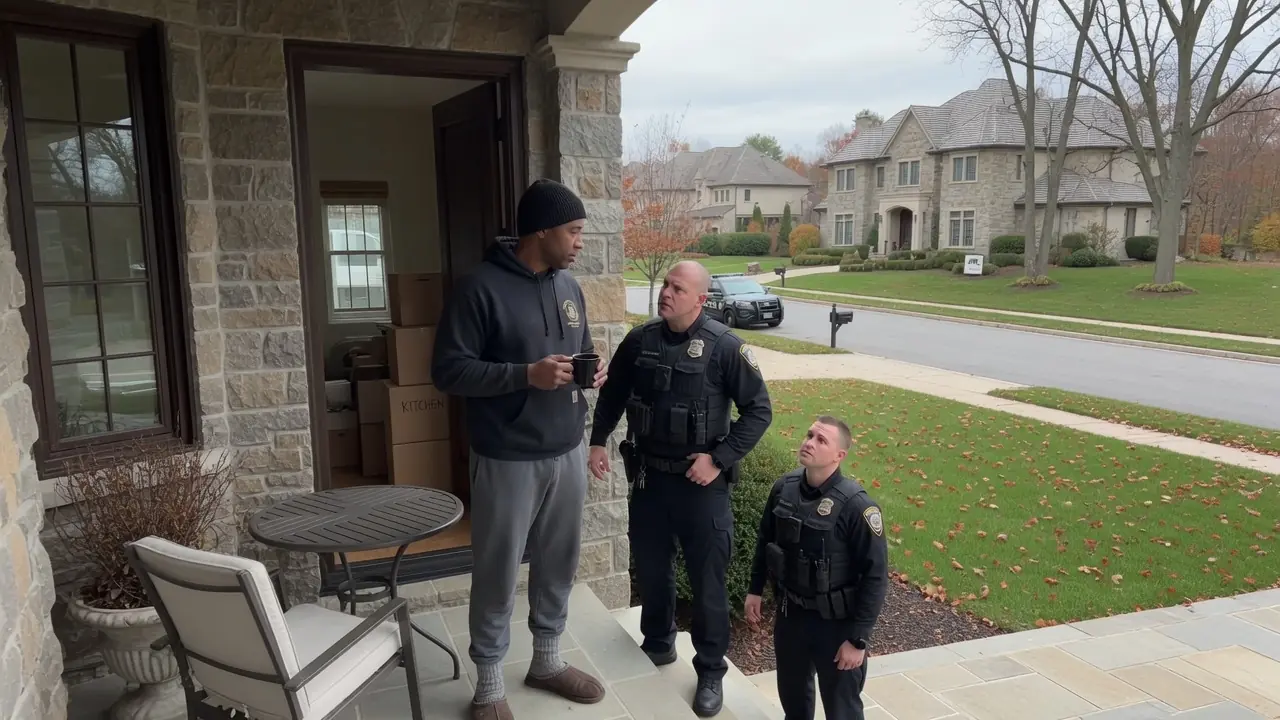
The case had taken twenty-six months, two cooperating accountants, six sealed warrants, and more late nights than Marcus cared to admit. A trafficking network had been hidden behind moving companies, temporary payroll accounts, warehouse leases, and truck routes that looked ordinary until federal agents started matching names to disappearances. Reporters called the indictment historic, but Marcus knew history did not comfort families in courthouse hallways.
By Saturday morning, he did not want microphones, legal briefs, cable-news panels, or agents asking whether they had enough evidence for the next arrest. He wanted coffee on his own porch. Nothing more. Ten quiet minutes where nobody needed him to prove anything beyond a reasonable doubt.
His new house sat on Willowgate Court, inside a wealthy subdivision called Ashford Pines, where the lawns were cut like carpet, the mailboxes matched, and neighbors seemed to know each other mostly through window blinds and HOA emails. The house was a stone-and-cedar place with wide steps, tall windows, and a porch deep enough to make a tired man believe peace might eventually become a habit. Marcus had bought it twenty-three days earlier, though most of his life still sat in cardboard boxes.
The hallway was lined with labels written in thick black marker: kitchen, winter coats, legal books, case binders, shoes, fragile. The dining room table still had moving blankets draped over it because he had not had time to decide where anything belonged. One guest bedroom had become a storage room by accident. The whole house looked less like a finished dream and more like a life trying to land safely after a long fall.
That morning, Marcus stepped outside wearing faded Hampton sweatpants, an old Justice Department hoodie, thick socks pushed into brown slippers, and a black knit cap pulled low over his closely cut hair. He held a white ceramic mug in both hands and let the steam rise into the cool October air. Maple leaves shifted along the curb. Somewhere above the street, a crow balanced on a streetlight like it owned the neighborhood.
No subpoenas waited on the porch. No reporters stood by the driveway. No agent called about evidence logs or witness protection. For the first time in weeks, Marcus heard nothing but leaves, distant sprinklers, and the soft sound of his own breathing.
Four houses down, behind ivory curtains, Patricia Langley watched him.
Patricia had lived in Ashford Pines for nineteen years, and she treated that fact like public office. She chaired the HOA neighborhood standards committee, moderated the private safety page, and corrected contractors if their vans stayed parked too long on the curb. She had a polished way of speaking that made suspicion sound like civic duty.
She had reported unfamiliar people before.
A cable installer.
A hospice nurse.
A teenager waiting for his aunt to unlock the door.
Each time, when nothing criminal happened, Patricia did not take that as evidence she had overreacted. She took it as proof that vigilance worked. In her mind, every harmless ending confirmed that her call had prevented something worse.
When she saw Marcus standing on the porch of the newly sold house in slippers and a hoodie, she did not wave. She did not walk over with a welcome basket. She did not check the new homeowner announcement she had received from the HOA two weeks earlier and ignored because the name did not match the picture she carried in her head.
She saw a Black man on an expensive porch.
And she reached for her phone.
“Yes, dispatch,” Patricia whispered, though no one else was in the room. “I need officers at 742 Willowgate Court. There is a suspicious man standing on the front porch. He looks confused, maybe homeless, maybe trying to get inside.”
The dispatcher asked whether the man was forcing entry.
“No,” Patricia said. “But he is acting like he belongs there. That house just sold for more than a million dollars. I know this street, and he is definitely not the owner.”
Seven minutes later, Marcus bent down to move a potted rosemary plant closer to the sunlight.
That was when he heard the engines.
Not the soft passing of a neighbor leaving for errands. Not the slow roll of a delivery truck. These engines came fast, purposeful, and too heavy for a quiet Saturday morning.
Two police cruisers turned onto Willowgate Court and stopped at angles across his driveway. No sirens. Just red and blue lights spilling over clean stone houses, wet lawns, trimmed hedges, and white garage doors. Marcus stood slowly, coffee still in his hand.
The doors opened almost before the cruisers settled.
The first officer stepped out with the hard confidence of a man who had decided what he was walking into before he arrived. He was white, broad through the shoulders, with a shaved head, narrow eyes, and a jaw clenched so tightly it looked trained. His nameplate read D. Mallory. His right hand rested close to his holster, not drawing, not touching, but near enough to say what his mouth had not yet said.
Behind him came a younger officer named Ethan Park, slimmer, taller, and visibly less certain. His eyes moved from Marcus to the open front door behind him, then to the porch furniture, then to the neighbors’ windows. He looked like a man arriving at a scene and immediately sensing it did not fit the call.
“Hey,” Officer Mallory barked. “Hands where I can see them.”
Marcus lifted one hand slightly. The other still held the mug. “Good morning, officers. What is going on?”
“Put the cup down and step away from the door.”
Marcus glanced at the mug. “It’s coffee.”
“I didn’t ask what it was.”
“I’m standing on my own porch.”
Mallory climbed the first step without permission. “We got a call about a suspicious person at this residence. Possible break-in.”
Marcus looked back at the open door, then down at his slippers, then at the officer. “A break-in? Officer, I am wearing house slippers.”
“Step down.”
The word was quiet.
That made it stronger.
Mallory paused, blinking once as if he had expected compliance and had no prepared response for dignity. Officer Park looked at his partner, then at Marcus, then toward the street where curtains had started shifting. A man in a golf pullover had stopped beside his mailbox. Two women walking a small dog slowed near the curb. A teenager on a bike took one foot off the pedal and lifted his phone.
Marcus took one calm sip of coffee.
He had questioned executives who hid behind shell corporations. He had cross-examined men who lied with soft voices and expensive watches. He knew the difference between authority and performance, and Officer Mallory was performing for an audience he had not expected to grow so quickly.
Mallory’s face reddened. “Sir, don’t make this harder than it needs to be.”
“I’m not making it hard,” Marcus said. “I’m asking you to explain the lawful basis for ordering me off my own porch.”
Mallory gave a short laugh. “The lawful basis is we got a call, and you are standing on property that may not be yours.”
“It is mine.”
“Then show ID.”
“My identification is inside.”
“Then go get it.”
Marcus narrowed his eyes. “Are you ordering me to turn my back, enter my home, and reach for something inside while you stand on my porch with your hand near your firearm?”
Officer Park’s gaze dropped to Mallory’s hand.
Mallory moved it slightly away from the holster, but not far enough to surrender the threat entirely. “Stop playing games. If you live here, prove it.”
“No.”
The street had become a small theater now.
The man in the golf pullover had been joined by his wife. The two women with the dog whispered behind their hands. The teenager on the bike filmed openly. Across the street, an older couple stood behind a glass storm door, watching as if the safety of their own silence depended on not moving.
And four houses down, Patricia Langley stepped onto her driveway in a pale cream cardigan, her arms folded neatly, her face arranged into the concerned expression of a person waiting for fear to be confirmed.
Marcus saw her.
Then he looked back at Mallory.
“Officer Mallory,” he said, reading the nameplate, “under the Fourth Amendment, you cannot compel identification unless you have reasonable, articulable suspicion that I committed, am committing, or am about to commit a crime. A neighbor’s discomfort with my presence is not reasonable suspicion. Drinking coffee on my own porch is not trespass. Being Black in a wealthy subdivision is not burglary.”
Officer Park went very still.
Mallory’s mouth tightened. “You a lawyer or something?”
“Yes.”
That answer annoyed him more than it should have.
“I don’t care what you are,” Mallory said. “Out here, I give the instructions.”
“That is not how the Constitution works.”
Mallory stepped fully onto the porch, closing the distance between them. “Let me explain how this works. You either give me ID, or I detain you for obstruction while we figure out who you are.”
Marcus did not step back.
His voice lowered into the tone judges knew well, the tone he used when bad arguments needed to be taken apart cleanly and without drama.
“Obstruction requires a lawful underlying investigation. You do not have one. You have an unverified caller who turned an assumption into a police response. You are standing on my property without a warrant, probable cause, exigent circumstances, or consent. I suggest you step back onto the sidewalk.”
Mallory stared at him.
Men like him hated correction most when the correction was right.
Officer Park cleared his throat. “Sir, maybe we should verify the property owner through dispatch before we escalate.”
Mallory turned on him. “Stay out of it.”
Marcus looked at the younger officer. “Your instinct is better than your courage right now.”
Park flushed.
Mallory unclipped his handcuffs.
The metallic sound traveled across Willowgate Court.
“Turn around.”
Marcus set his coffee on the small porch table beside the chair.
Not because Mallory told him to.
Because he did not want the officer spilling it.
Then Marcus looked directly into his eyes.
“If you put those cuffs on me, Daniel Mallory, this morning will become the most expensive mistake your department has made in years. You will be dealing with body-camera review, civil liability, a federal inquiry, qualified-immunity arguments you will not enjoy, and a career file that will outlive your temper.”
A hush moved down the street.
Mallory hesitated.
Only for a second.
But Marcus saw it.
So did Park.
Mallory lifted the cuffs. “Are you threatening an officer?”
“No,” Marcus said. “I am giving legal notice.”
His jaw worked.
Marcus raised one hand slowly and pointed toward the cruiser. “Before your pride writes a check your department cannot cover, call your watch commander. Ask for Deputy Chief Elaine Porter. Tell her you are at 742 Willowgate Court. Tell her you are attempting to detain Marcus Ellison.”
Park’s face changed first.
He knew the name.
Of course he did.
The city had circulated a coordination bulletin after Marcus was sworn in as United States Attorney for the district. Federal task-force cooperation. Public corruption referrals. Organized crime cases. Human trafficking prosecutions. His photograph had appeared beside the announcement, though half the department had probably skimmed it and forgotten by lunch.
Mallory either did not know, or his pride would not allow him to show that he did.
“You expect me to call command over a routine trespasser?”
Marcus’s eyes hardened. “I expect you to call command because the man you are attempting to unlawfully detain is the chief federal prosecutor for this district.”
For a moment, even the trees seemed to stop moving.
Then Park acted.
He did not ask permission.
He keyed the radio on his shoulder, voice tight but clear. “Dispatch, Unit 14-Adam. Requesting supervisor to 742 Willowgate Court. Code four, but we need command notification. Possible identity issue.”
Mallory snapped toward him. “What the hell are you doing?”
Park kept his eyes forward. “Making sure.”
Marcus sat back down in the porch chair and picked up his coffee.
“Good,” he said. “We can all learn something this morning.”
The twelve minutes before Deputy Chief Elaine Porter arrived became the longest twelve minutes of Daniel Mallory’s career.
Marcus did not yell.
He did not call a press contact.
He did not perform outrage for the growing line of neighbors standing on lawns and sidewalks. He simply sat on his own porch, coffee in both hands, watching Mallory with the patient stillness of a prosecutor waiting for a witness to decide whether a lie was worth committing to.
Mallory tried to rebuild control, though control had already left the porch.
“We respond to suspicious-person calls every day,” he muttered. “You should understand that if you are really who you say you are.”
“I understand response,” Marcus said. “What I don’t understand is why you skipped observation, verification, reasonable inquiry, and judgment.”
“We had a call.”
“You had a racial-anxiety report.”
“That’s your interpretation.”
“No,” Marcus said. “That is the caller’s language, your conduct, and the absence of criminal facts.”
Officer Park stared at the driveway.
The neighborhood grew bolder with every minute. The teenager on the bike kept filming. The two women with the dog stopped pretending not to listen. The man in the golf pullover whispered something to his wife, and she pressed one hand to her mouth.
Patricia Langley remained at the edge of her driveway.
Her confidence had thinned, but it had not disappeared. She still seemed to believe that if she used the word safety enough times, the morning would rearrange itself in her favor. She had called for help, she told herself. She had protected the neighborhood. She had done what responsible residents do.
Then the black unmarked SUV turned onto Willowgate Court.
No sirens.
No flashing lights.
Still, the urgency came with it.
Deputy Chief Elaine Porter stepped out in a dark uniform jacket, silver hair cropped close, eyes already moving across the scene before she reached the curb. She saw the cruisers. The porch. The neighbors. Mallory standing too close. Park looking like he wanted to disappear into the concrete.
Then she saw Marcus Ellison seated calmly with a coffee mug.
Her face changed.
“Officer Mallory. Officer Park. Step off the property now.”
Mallory tried to speak. “Deputy Chief, we had a possible—”
“Did I ask for a summary?”
“No, ma’am.”
“Step back.”
The command carried the weight Mallory had been pretending to own all morning.
Both officers moved.
Porter removed her cap as she approached the porch steps. She did not posture. She did not pretend confusion. She stopped at the bottom step and looked up at Marcus with the dread of someone who understood not only what had happened, but what it meant.
“United States Attorney Ellison,” she said. “I am deeply sorry.”
The street heard it.
So did Mallory.
His face emptied.
Marcus stood and placed his mug on the table. “Deputy Chief Porter.”
“I attended your swearing-in,” Porter said. “This should never have happened.”
“No,” Marcus replied. “It should not have.”
Mallory’s lips parted, but no sound came out.
Park closed his eyes for one second.
Marcus turned toward both officers. “Officer Mallory ordered me off my own porch, threatened to detain me for obstruction after I explained the absence of reasonable suspicion, entered my porch without consent, and kept his hand near his firearm during the initial contact. Officer Park recognized the issue but waited until I named command before intervening.”
Porter’s jaw tightened.
“Both officers will be removed from active duty pending internal review,” she said. “Body-camera footage will be preserved. Dispatch audio will be preserved. Internal Affairs will receive notification before noon.”
Mallory stepped forward. “Ma’am, the caller said—”
“The caller said a Black man was on a porch,” Marcus cut in.
His voice sharpened.
Not louder.
Sharper.
“And you converted that into a crime scene because her assumption matched yours.”
Porter looked toward the street.
Marcus followed her gaze.
Patricia Langley stood stiff beside her trimmed hedges, suddenly aware that the morning had changed scripts without asking her permission. Her cardigan fluttered lightly in the breeze. Her polished concern had started cracking around the edges.
Marcus turned back to Porter. “I want the 911 audio pulled now.”
Porter nodded. “Of course.”
“On speaker.”
The call took less than three minutes.
Porter listened to her phone, then pressed play.
Patricia’s voice filled Willowgate Court.
“I need officers at 742 Willowgate Court. There is a suspicious man standing on the front porch. He looks confused, maybe homeless, maybe trying to get inside. That house just sold for more than a million dollars. I know this street, and he is definitely not the owner.”
The recording ended.
No one moved.
Marcus looked at Porter. “There it is.”
Porter nodded once.
Marcus stepped down from the porch.
His slippers made a soft sound against the stone walkway as he walked down the driveway. Porter walked beside him. Mallory and Park followed behind, no longer leading anything.
The small procession moved toward Patricia’s house.
Neighbors watched from lawns, sidewalks, porches, and half-open doors.
Some looked ashamed.
Others looked frightened, not because danger had appeared, but because something ugly had been named in a place that preferred polished silence.
Patricia tried to smile when Marcus approached.
The smile collapsed before it reached her eyes.
“Officers,” she said, her voice fluttering, “I’m so glad you responded quickly. I was only trying to protect everyone. These days, you just never know who might be—”
“Mrs. Langley,” Porter said. “Stop talking.”
Patricia blinked.
Marcus stood in front of her, still wearing sweatpants, slippers, hoodie, and knit cap. The same clothes she had treated as evidence against him. Somehow, he looked more commanding than any suit could have made him.
“My name is Marcus Ellison,” he said. “I own 742 Willowgate Court. I closed on the property twenty-three days ago. I am also the United States Attorney for this district.”
Patricia’s face went slack.
The words arrived slowly.
Own.
United States Attorney.
District.
She looked toward Mallory, then Park, then Porter, searching for rescue among people who now needed rescue themselves.
“I didn’t know,” Patricia whispered.
“That is exactly the problem,” Marcus said. “You did not know, but you called 911 as if your assumptions were facts.”
“I was concerned.”
“No,” Marcus replied. “You were comfortable.”
Patricia’s mouth trembled. “That’s unfair.”
Marcus stepped a little closer. “You told dispatch I was definitely not the owner. Not uncertain. Not possibly mistaken. Definitely. You saw a Black man in a hoodie on a porch and decided ownership had a face he did not have.”
“I wasn’t thinking about race.”
“Then what were you thinking about?”
Patricia’s eyes filled with tears. “The house is expensive.”
“And I did not look expensive enough to stand on its porch?”
No answer came.
Because the answer had already been recorded.
A neighbor near the curb lowered his head. His wife stared at the street. The teenager with the phone kept recording, but his expression had changed from excitement to seriousness, as if he understood he was no longer filming drama.
He was filming evidence.
Marcus faced Porter. “I am filing a formal complaint for false reporting and misuse of emergency services. I want dispatch records preserved, and I want every prior call from this address reviewed for pattern.”
Patricia let out a small sob. “You’re going to ruin me over a mistake?”
Marcus looked back at her. “A mistake is writing down the wrong appointment time. You sent armed officers to my home because you turned prejudice into an emergency.”
“I didn’t mean for them to act aggressively.”
“You do not get to control the bullet after you load the gun.”
That sentence moved down Willowgate Court like weather.
Mallory stared at the pavement.
Park looked sick.
Porter nodded. “The matter will be referred appropriately.”
Patricia wiped at her cheeks, but Marcus offered no comfort.
Comfort was not owed simply because consequences frightened the person who caused harm.
Marcus turned to Mallory.
“Officer Mallory.”
He flinched.
“Your badge does not exist to enforce neighborhood imagination. It is not a tool for residents to outsource their bias. You approached me as a suspect because someone told you I did not belong, and you never paused long enough to ask whether she was wrong.”
His face tightened. “Sir, I apologize.”
“No,” Marcus said. “You are sorry you learned who I was.”
The street went still.
That was the kind of truth public spaces often avoid because easier lies keep everyone comfortable.
Then Marcus turned to Park.
“You knew.”
The younger officer nodded, eyes shining. “Yes, sir.”
“And you waited.”
“Yes.”
“Remember that. The officer beside you can become more dangerous than the citizen in front of you. Your duty is not to protect another officer’s pride. It is to protect the law.”
Park swallowed. “I understand.”
“I hope you do.”
By noon, the story had already started spreading.
Not because Marcus leaked it.
He did not need to.
The teenager on the bike posted the video before the police cleared the street. It showed Mallory ordering Marcus off the porch, Marcus citing the Fourth Amendment, Park calling command, Porter recognizing him, and Patricia’s 911 call being played aloud in front of the neighborhood.
The caption was simple.
They tried to arrest the U.S. Attorney for drinking coffee on his own porch.
By Sunday morning, the clip was everywhere.
Local news.
National news.
Legal forums.
Cable panels.
Neighborhood pages that had spent years applauding suspicious-person alerts suddenly filled with people discovering civil liberties as if they had not ignored them when delivery drivers, contractors, Black teenagers, and unfamiliar guests were the ones being questioned.
Marcus spent Sunday reviewing body-camera footage with his civil rights chief.
Not because he wanted personal revenge.
Because he knew what the video meant beyond his own porch.
He saw Mallory’s hand near his gun. He saw Park recognize the stop was wrong and hesitate anyway. He saw himself holding a coffee mug and understood how differently the encounter might have gone if he had been less calm, less trained, less protected by a title the officers recognized too late.
That thought stayed with him.
On Monday morning, Marcus opened an inquiry.
Not into one call.
Into a pattern.
His office requested dispatch records involving Ashford Pines and four nearby affluent subdivisions over the previous five years. Suspicious person. Unknown vehicle. Possible trespass. Loitering. Casing homes. Welfare concern. The words appeared again and again, polite language wrapped around old fear.
The data told a story the homeowners never volunteered.
Black delivery drivers stopped.
Latino landscapers questioned.
A Nigerian surgeon detained outside his cousin’s house.
A Black teenage girl waiting for her math tutor.
A Filipino home health aide asked to show ID twice in one afternoon.
A white teenager walking the same streets after midnight drew no calls at all.
Patricia Langley had made thirty-four calls in five years.
None led to an arrest.
Twelve involved people of color who were legally present.
Four involved actual residents.
Two involved Black real estate agents showing homes to clients.
One involved a federal court clerk delivering documents to the wrong porch.
Marcus read the report in silence.
Then he called Deputy Chief Porter.
“We are not treating this as one bad call,” he said.
Porter did not argue.
Two weeks later, Officer Mallory was suspended without pay pending termination proceedings. His prior complaints were reopened. There were eight. Five came from Black or Latino residents and visitors in affluent neighborhoods. All had been marked unfounded.
Officer Park was reassigned pending review and mandatory retraining. His written statement admitted he knew the detention lacked legal basis before he intervened. That admission did not save him from discipline, but it kept him from becoming a liar.
Patricia Langley was charged with misuse of emergency services and filing a false report.
Her attorney called it confusion.
The court did not.
Two months later, the Ashford Pines HOA held an emergency meeting at the clubhouse.
Marcus nearly skipped it.
He had indictments to prepare, families to protect, witnesses to reassure, and a thousand better uses of his time than sitting beneath recessed lighting while neighbors tried to make embarrassment sound like healing.
Then he thought of the delivery drivers.
The surgeon.
The teenage girl.
The people without titles who had stood where he stood and been treated like intruders inside ordinary life.
So he went.
The clubhouse was full.
Patricia sat in the front row, smaller than Marcus remembered, a folded tissue crushed between both hands. Some neighbors stared straight ahead. Others glanced at Marcus and looked away. The HOA president, a retired insurance executive named Howard Calloway, opened with a speech about unfortunate misunderstandings, community healing, and moving forward.
Marcus let him speak for ninety seconds.
Then he stood.
“Do not call what happened a misunderstanding,” he said.
Howard stopped mid-sentence.
Marcus walked to the front without asking permission.
“Misunderstanding is receiving someone else’s mail. What happened on my porch was assumption backed by armed power.”
No one interrupted.
“You did not know me,” Marcus continued. “That is true. But some of you believed you knew what I could not be. That belief made a coffee mug look suspicious. It made slippers look criminal. It made a homeowner look like an intruder.”
Patricia began crying quietly.
Marcus did not look at her yet.
“The police failed that morning. But before they failed, a neighbor called them to confirm her own fear. That is how systems work. One person imagines danger. Another arrives with a gun. Everyone else watches and later says they were not involved.”
The clubhouse went painfully quiet.
Marcus turned to Patricia.
“You said you were protecting the neighborhood. From what?”
Patricia’s mouth trembled.
She looked around, perhaps hoping someone else would give her a softer answer.
No one did.
Finally, she whispered, “From what I thought didn’t fit.”
Marcus nodded once. “At least that is honest.”
The room absorbed it.
Some people looked wounded by the truth. Others looked relieved that someone had said the ugly part first. Marcus had seen courtrooms react the same way when evidence dragged a hidden story into daylight.
By spring, Ashford Pines changed.
Not completely.
No neighborhood becomes honest because one meeting bruises its pride.
But the HOA shut down its informal alert board and replaced it with a safety policy requiring behavior-based reporting instead of fear-based descriptions. The city updated suspicious-person dispatch protocols, requiring callers to describe specific conduct, not feelings. Officers received new training on unlawful detentions after bias-based calls, and Marcus’s office created a referral process for repeated misuse of emergency services.
People still watched from windows.
But some of them started noticing themselves watching.
That mattered.
One Saturday morning almost a year later, Marcus stood on his porch again in the same old Justice Department hoodie.
Same soft slippers.
Same white mug in his hands.
The maple tree had filled out. The rosemary plant he had been moving that morning now sat in a larger pot near the steps, thriving in the exact light he had been trying to give it before the cruisers came.
Across the street, a delivery van stopped.
A young Black man stepped out carrying two packages. He checked the house numbers, scanned the labels, and walked toward Patricia’s old house. Patricia had moved three counties away after the case settled.
The new owner, a retired librarian named Mrs. Navarro, opened the door before he knocked.
She smiled, signed for the packages, and offered him a bottle of water.
The driver laughed, accepted it, and returned to his van.
No cruiser came.
No curtains snapped open.
No one called 911 because a stranger with brown skin stood on expensive grass.
Marcus watched longer than he meant to.
Then he took a sip of coffee.
It was hot this time.
A neighbor passed with a golden retriever and lifted a hand. “Morning, Mr. Ellison.”
“Morning,” Marcus said.
No explanation.
No performance.
No demand that he prove himself before being greeted like a person.
He leaned against the porch rail and looked down Willowgate Court, where quiet houses sat beneath expensive trees and every window reflected the soft morning sun. The neighborhood still looked polished enough to hide almost anything. But Marcus knew better than most that polished surfaces did not mean clean foundations.
Justice, like a home, required maintenance.
You had to inspect the structure.
Name the rot.
Refuse the lie that silence meant peace.
A year earlier, Patricia Langley had seen Marcus Ellison in a hoodie and decided he could not possibly belong on that porch. Daniel Mallory had heard the call and decided force should arrive before facts. Ethan Park had seen the wrong and waited too long to act.
Each of them had revealed something.
Not only about themselves.
About the systems that wait, ready and armed, for ordinary prejudice to make a phone call.
Marcus finished his coffee slowly.
Then he picked up the rosemary plant, moved it six inches deeper into the sunlight, and smiled at the quiet satisfaction of watching something live exactly where it belonged.