“Drop the tool and put your hands where I can see them.”
The command split the quiet afternoon so sharply that birds lifted out of the maple trees. A rake fell from someone’s porch across the street. A golden retriever behind a white fence stopped barking and stared.
At the center of the wide front lawn stood Isaiah Grant.
He was six foot two, Black, broad through the shoulders, and dressed in faded Army sweatpants, scuffed work boots, and an old olive T-shirt stretched across his chest. Sawdust clung to his forearms. A pry bar and sander lay on the porch steps beside him, right where he had dropped them when the sirens arrived.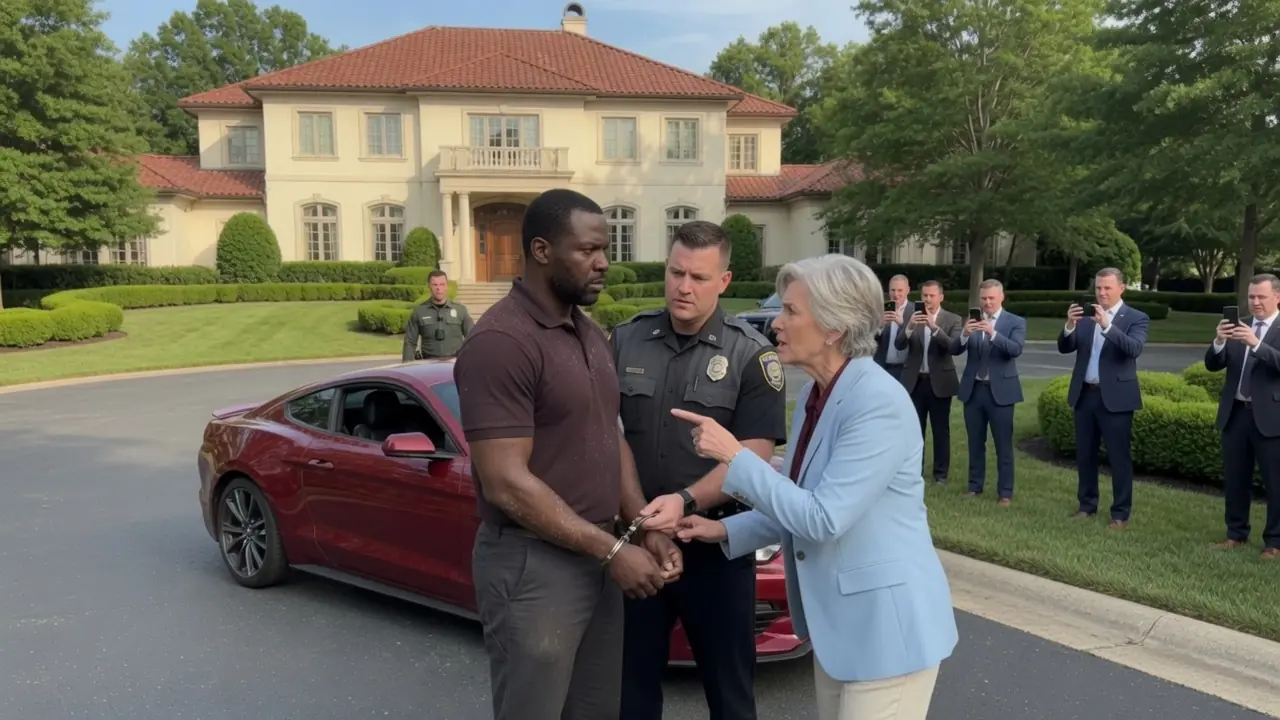
Two police cruisers blocked the front of his driveway at hard angles, red and blue lights flashing across the clean houses of Hawthorne Ridge.
It was the kind of neighborhood where lawns looked trimmed by appointment, where mailboxes matched, and where the loudest argument usually involved fence heights, leaf piles, or a teenager parking too close to somebody’s hydrangeas. The houses sat on quiet streets outside Alexandria, Virginia, wrapped in white columns, brick walkways, wide porches, and the confidence of people who believed danger lived somewhere else.
Isaiah had bought the colonial at 288 Briar Glen Lane three weeks earlier.
Paid in cash.
No mortgage.
No favors.
Just twelve years of military service, five years of high-level defense contracting, and more sleepless nights than he ever planned to explain to any neighbor staring through curtains. He had wanted quiet more than he had wanted luxury. After Afghanistan, quiet felt like medicine.
His twenties had belonged to the United States Army Rangers.
They had belonged to helicopter rotors at midnight, dust storms over mountain roads, the sharp crack of rifle fire somewhere unseen, and the sudden empty silence after explosions. He carried a Silver Star in a locked box upstairs, a scar above his left hip, and a stiffness in his knee that arrived before rain.
He also carried the kind of calm that looked dangerous to people who did not understand discipline.
That afternoon, he had been repairing the front door.
The old frame had swollen from summer humidity, and the heavy oak door had started sticking whenever he tried to close it. Isaiah had spent two hours sanding the edge, tapping the hinges into place, and using the pry bar carefully against the frame. To him, it was ordinary home maintenance.
To the woman across the street, it looked like a threat.
Evelyn Markham lived at 291 Briar Glen Lane, in a white-brick house with blue shutters and a bay window facing Isaiah’s porch. She had lived in Hawthorne Ridge for twenty-one years, long enough to believe longevity was the same thing as ownership. She knew whose lawn service came on Tuesdays. She knew which cars belonged to which driveways. She knew the former owners of Isaiah’s house had moved to South Carolina after retirement.
She did not know Isaiah.
She had not come over with a welcome basket.
She had not checked the HOA email announcing the new homeowner.
She had not noticed the contractor’s truck that had delivered his furniture the day before.
She saw a large Black man in work clothes standing at the front door of an expensive house with a pry bar nearby, and fear rushed in before facts had a chance.
So she called 911.
“Yes, I need police on Briar Glen Lane immediately,” Evelyn told the dispatcher, whispering as if Isaiah could hear her from across the street. “There is a dangerous-looking man breaking into the house at 288. The owners moved out months ago.”
The dispatcher asked whether he was forcing entry.
“He has some kind of weapon,” Evelyn said. “A crowbar or an iron pipe. He is trying to break the door open. Please hurry. I don’t know what he’ll do if he gets inside.”
By the time the cruisers arrived, Isaiah had just taken a drink from a plastic water bottle.
The sirens triggered something deep inside him before his mind could catch up. For half a second, his body was back on a road in Kunar Province, scanning rooftops, counting angles, measuring distance to cover. Then he told himself what he had told himself a thousand times since coming home.
Virginia.
Front yard.
No incoming fire.
But the cruisers did not pass.
They stopped in front of his house.
Officer Nolan Pike came out of the first car with his gun already drawn. He was white, square-faced, thick through the neck, and carried himself like a man who confused speed with control. Behind him, Officer Caleb Morris stepped from the second cruiser with one hand near his holster and uncertainty all over his face.
Pike aimed at Isaiah’s chest.
Isaiah looked down at the water bottle in his hand, then at the tools on the porch.
“I’m unarmed,” he said, voice calm and low. “The tool is on the steps. I was fixing my door.”
“I said drop it.”
Isaiah opened his fingers.
The water bottle fell to the porch and rolled once, spilling across the boards.
“Hands up,” Pike shouted.
Isaiah lifted both hands slowly, palms out, fingers spread. He moved the way soldiers move when they know one wrong motion can kill them. Slow. Clear. Visible.
“I am the homeowner,” he said. “My name is Isaiah Grant. My driver’s license has this address. My wallet is in my back right pocket.”
Pike advanced across the lawn. “Turn around.”
“I can show you identification.”
“Turn around now.”
Officer Morris came up behind his partner, eyes moving between Isaiah, the porch, the tools, and the house numbers mounted beside the door. “Sir, just do what he says.”
Isaiah kept his hands raised. “I am complying. I’m telling you this is my property.”
Pike’s face reddened. “You don’t get to tell me what property you belong on.”
That sentence landed harder than the drawn gun.
Not because Isaiah had never heard anything like it.
Because he had.
In airports.
In hotel lobbies.
At gated entrances.
At the very defense facilities where he carried credentials most people would never be cleared to see.
But hearing it on the lawn he had bought, in front of the home he had chosen as a place to finally breathe, made something inside him go still.
Pike reached him and spun him around with unnecessary force. Isaiah’s shoulder tightened, instinct surging through him like electricity. In another life, under another sky, the man grabbing him would already be on the ground. Isaiah forced himself to stay rigid.
He would not give them the reaction they seemed to expect.
Pike kicked his feet wider apart.
“Hands behind your back.”
“You’re making a mistake,” Isaiah said quietly.
“I make the decisions here.”
The first cuff closed around Isaiah’s wrist.
Cold steel.
Too tight.
Then the second.
Pike ratcheted both down until the metal bit into skin. Isaiah did not flinch, but pain shot up his arms. The sound of the cuffs locking dragged a memory out of places he kept sealed. Detainees on dusty floors. Plastic restraints. Shouted commands in languages breaking under fear.
Now it was him.
On his own lawn.
Officer Morris pulled Isaiah’s wallet from his back pocket. He opened it, read the license, then looked at the house number.
“Pike,” Morris said, voice low. “The license says Isaiah Grant. Address is 288 Briar Glen Lane. This is his house.”
Pike snatched the wallet and stared at it.
“IDs can be fake.”
Morris looked toward the open front door. “The address matches.”
Pike’s jaw worked. “Then explain why he’s prying open the door.”
“I told you,” Isaiah said. “The frame sticks. The sander is on the porch. The door is unlocked. If you had assessed before aiming a weapon at me, you would have seen that.”
Pike shoved him hard between the shoulders.
Isaiah stumbled onto the grass but caught himself before falling.
“Sit on the curb and shut up,” Pike snapped.
Isaiah turned his head slowly.
The look in his eyes made Pike take half a step back before pride pulled him forward again.
“I will not sit on the curb,” Isaiah said.
“Excuse me?”
“I am standing on my own property. You have my identification. You have no reasonable suspicion left. You have illegally detained me, applied excessive restraints, and drawn a firearm on a compliant homeowner.”
Pike’s face twisted. “You think you can lecture me?”
“I think you should call a supervisor.”
By then, Hawthorne Ridge had started gathering.
Doors opened. Neighbors stepped onto porches. Phones came up. A man in golf shorts stood at the end of his driveway recording. A woman in yoga clothes whispered into her phone, narrating as if she were watching a show instead of a man being humiliated in front of his own home.
Across the street, Evelyn Markham stood behind her hedges, one hand pressed against her throat.
Isaiah saw her.
He saw the blinds that had twitched earlier.
He knew.
Pike stepped close enough that Isaiah could smell stale coffee on his breath. “Listen to me. I can take you in for obstruction, disorderly conduct, resisting, whatever I need. I can make this whole day much worse for you.”
Isaiah’s voice stayed low. “You are already making it worse for yourself.”
Pike turned to Morris. “Put him in the cruiser.”
Morris hesitated. “We should wait for a sergeant.”
“I gave you an order.”
Morris swallowed.
Pike grabbed Isaiah by the arm and tried to pull him toward the street.
Isaiah planted his boots in the grass.
He did not jerk away.
He did not fight.
He simply lowered his center of gravity and stood still, rooted like something grown out of the earth. Pike pulled harder, his face reddening as he realized the man he had cuffed was not moving.
“Walk,” Pike shouted. “Or I’ll take you down.”
“You already used force,” Isaiah said.
His wrists were bleeding now, thin red lines where the cuffs had dug into the skin. The pain was sharp, but it moved to the edge of his awareness. He had entered the combat calm, that terrifyingly clear place where every breath, face, object, and angle became information.
He lifted his voice so every phone could hear.
“Officer Pike, I am a decorated combat veteran of the United States Army. I hold an active Top Secret clearance and consult for the Department of Defense. If you strike me or force me into that vehicle after confirming this is my address, your badge will not survive the day.”
Pike raised his baton.
The motion was small.
But everyone saw it.
Morris whispered, “Pike, don’t.”
Before the baton could move, another sound rolled through the street.
Not sirens.
Engines.
Heavy, controlled, and low enough to vibrate beneath people’s shoes.
Three black government SUVs turned onto Briar Glen Lane in a slow convoy. Two Chevrolet Suburbans flanked an armored Lincoln Navigator with tinted windows, reinforced grilles, and federal plates that did not belong to any local agency. They moved through the manicured neighborhood like a shadow crossing a bright room.
Phones lowered.
People stopped whispering.
Even Pike froze with the baton still half raised.
The SUVs stopped in the middle of the street, blocking the cruisers from moving. For one long second, nothing happened. Then all four doors of the Suburbans opened almost at the same time.
Men in dark suits stepped out.
They moved with the kind of efficiency that made everyone watching understand they were not private security hired for a party. Eyes scanning. Hands resting near jacket seams. Formation without wasted motion. Federal protective detail.
One agent opened the rear door of the Lincoln.
A polished black military boot touched the asphalt.
The man who stepped out was in his late fifties, tall, lean, and wearing a full military dress uniform that seemed to carry the weight of every war in modern memory. Four silver stars rested on each shoulder. His chest was covered in ribbons and medals, dense and precise, with the pale-blue ribbon of the Medal of Honor near the top.
General Nathaniel Cross, commander of U.S. Special Operations Command, stepped onto Briar Glen Lane.
He did not look at the neighbors.
He did not look at the houses.
He looked at Isaiah.
Then he saw the cuffs.
The bleeding wrists.
The raised baton.
The temperature of the street seemed to drop.
Officer Pike found his voice, barely. “Sir, this is an active scene. You need to step back.”
General Cross lifted one gloved hand.
Pike stopped talking.
The gesture was small, but it carried more authority than Pike had managed with a gun, a baton, and two cruisers.
Cross walked across the grass toward Isaiah. His security detail moved with him, spreading just enough to make it clear that nobody on that street controlled the space anymore except them.
The general’s voice came out low and hard.
“If those cuffs are not off my godson in five seconds, my men will remove them.”
Silence fell so completely that the distant sprinkler on someone’s side lawn sounded loud.
Pike stared at him, confused by the collapse of his own power.
“Sir, we had a 911 call. The subject was reported as armed and actively breaking into—”
“You have four seconds.”
Morris moved first.
He rushed forward, hands shaking as he pulled the cuff key from his belt.
“I’ve got it, General,” he said. “I’m sorry, Mr. Grant. I’m so sorry.”
The key slipped once before catching.
Click.
Click.
The cuffs opened.
Isaiah brought his arms forward slowly. The blood around his wrists had already darkened. Purple bruising spread beneath the skin.
He looked at General Cross.
“Uncle Nate,” he said quietly.
The general’s face changed.
Not much.
Just enough for everyone close to see fury make room for something older and more personal.
Cross stepped forward and pulled Isaiah into a firm embrace.
For a moment, the decorated general and the battered veteran stood together on the lawn, one holding the other steady while the neighborhood watched the meaning of the scene rearrange itself.
“I’m fine,” Isaiah murmured.
“No,” Cross said, stepping back to examine his wrists. “You are not.”
He turned toward Pike.
“What is your name and badge number?”
Pike swallowed. “Officer Nolan Pike. Badge number 3178.”
“Officer Pike,” Cross said, “you responded to a call, encountered a man performing maintenance on his own home, failed to verify his identification after it was provided, used restraints after the address was confirmed, and prepared to strike a compliant civilian. Did I miss anything?”
Pike’s mouth opened. “General, standard procedure—”
“Do not speak to me about procedure.”
Cross’s voice cracked across the lawn like rifle fire.
Several neighbors flinched.
“I have written tactical engagement protocols your department borrows language from and barely understands. You had time to assess. You had time to verify. You had time to de-escalate. Instead, you saw a Black man with tools in an expensive neighborhood and decided threat was easier to believe than ownership.”
Pike looked toward his cruiser.
Toward his radio.
Toward anywhere except the general’s face.
Cross turned slightly. “Agent Ward.”
A tall agent with an earpiece stepped forward. “Yes, General.”
“Contact the Alexandria chief of police. Tell him he has ten minutes to arrive at 288 Briar Glen Lane. If he does not, I will contact the mayor, the governor, the Department of Justice, and the Secretary of Defense in that order.”
“Yes, General.”
Pike’s color drained.
Morris stood beside the cruiser with the look of a man who had just understood the difference between a bad moment and the end of a career.
Isaiah rubbed one wrist, then looked across the street.
“Who made the call?”
The question moved through Hawthorne Ridge like a cold wind.
Phones lowered further.
Neighbors shifted away from one another, suddenly less eager to be part of the crowd. It had been easy to record the police. It was harder to admit the police had been summoned by someone standing among them.
Isaiah looked at the bay window across the street.
Then at the woman behind the hedges.
“Her,” he said. “She was watching me before the sirens came.”
Every eye turned toward Evelyn Markham.
She froze on her porch.
The expression on her face was no longer righteous concern. It was fear. Not for Isaiah. Not for what had almost happened to him. Fear because consequences had found their way across the street.
General Cross looked at Agent Ward. “Get the 911 audio.”
Before Ward could answer, another siren sounded.
An unmarked black Ford Explorer turned onto Briar Glen Lane and stopped behind the convoy. Chief Marjorie Sloan stepped out quickly, already pale, already scanning the scene the way experienced officials do when they know they have arrived too late.
She saw the federal SUVs.
The general.
The cuff marks.
Officer Pike without control of the moment.
She recognized General Cross immediately. Anyone who had worked within fifty miles of the Pentagon knew his face.
“General Cross,” she said, approaching carefully. “I’m Chief Sloan. I understand there has been an incident.”
Cross did not return her greeting.
“There has been an aggravated assault under color of authority,” he said. “Your officer drew on an unarmed homeowner, restrained him after his identity and address were confirmed, and prepared to use a baton to enforce an unlawful order.”
Sloan looked at Pike.
“Is that accurate?”
Pike said nothing.
Morris looked down.
That silence answered for them.
Chief Sloan looked at Isaiah’s wrists, and her face tightened. “Mr. Grant, I am sorry.”
Isaiah did not respond.
Cross stepped closer to the chief. “Isaiah Grant is not only the homeowner. He is a decorated Army Ranger, a defense cybersecurity contractor, and the lead architect on a classified infrastructure project protecting federal energy systems along the Eastern Seaboard. He was scheduled to brief me here today because this residence includes secured equipment approved for remote work.”
The street went still again.
This was no longer a neighborhood misunderstanding.
This was national security.
“This police response compromised a cleared contractor at a secured residence,” Cross continued. “The Department of Defense will open its own inquiry. The Department of Justice will receive the body-camera footage, radio logs, dispatch audio, and every report connected to this call.”
Chief Sloan swallowed. “We will cooperate fully.”
“Yes,” Cross said. “You will.”
He looked back toward Evelyn’s house.
“And then we will discuss the woman who turned a Black homeowner into an armed threat over the phone.”
Inside the house, after the front door finally closed, the silence felt almost unreal.
Isaiah stood in the foyer with blood drying on both wrists and the adrenaline leaving his body in cold waves. The house smelled faintly of fresh paint, sawdust, and cardboard boxes. It was supposed to smell like beginning.
Instead, for a moment, it smelled like humiliation.
General Cross guided him into the living room, where unpacked boxes sat against the wall and a leather couch faced an empty fireplace.
“Sit,” Cross said.
Isaiah almost argued.
Then he sat.
Agent Ward came in with a medical kit. He knelt, snapped on blue gloves, and began cleaning the cuts. The antiseptic burned hard enough to pull a breath from Isaiah’s chest, but he did not flinch.
Ward’s jaw tightened as he worked. “The cuffs were over-tightened. You may have nerve pain for a while.”
“I’ve had worse,” Isaiah said.
Cross stood by the window, looking out at the street where Chief Sloan was now speaking to Pike beside the cruiser.
“That does not make this acceptable.”
Isaiah looked down at the gauze wrapping around his wrists. “No.”
Agent Ward’s radio crackled softly.
A second agent entered carrying a secure tablet. “General, we have the 911 audio.”
Cross turned. “Play it.”
The recording filled the living room.
The dispatcher’s voice came first.
Then Evelyn Markham’s.
“Yes, I need police on Briar Glen Lane immediately. There is a dangerous-looking man breaking into the house at 288. The owners moved out months ago.”
Isaiah closed his eyes.
The dispatcher asked if the man was forcing entry.
“He has some kind of weapon,” Evelyn said. “A crowbar or an iron pipe. He is trying to break the door open.”
Then came the pause.
The small silence where the entire case changed.
The dispatcher asked whether Isaiah had threatened anyone or entered the house.
Evelyn’s voice sharpened.
“He’s smashing the door. He looked right at my house. I think he has a gun in his waistband. You need to send everyone before he starts shooting.”
The recording stopped.
No one spoke.
Isaiah opened his eyes slowly.
“She swatted me,” he said.
The word belonged to the world of cyber threats and false emergency reports, a malicious call designed to bring armed responders to someone’s door. Isaiah had spent years building systems to defend against digital attacks. Now a neighbor had used the oldest system in the country like a weapon.
“She lied about a gun,” Isaiah said quietly. “She tried to get me killed.”
Cross sat beside him.
For the first time that afternoon, his fury softened into something more painful.
“Yes,” he said. “And she will answer for it.”
The fallout did not stay local.
By Wednesday morning, the incident at 288 Briar Glen Lane had become national news. Not because Isaiah wanted fame. Not because Cross wanted spectacle. But because a decorated Black veteran with a defense clearance had been handcuffed and nearly beaten on his own lawn after a neighbor fabricated a gun threat.
The video was everywhere.
Officer Pike aiming at Isaiah.
The cuffs cutting into his wrists.
The baton raised.
Then the black SUVs arriving.
General Cross stepping onto the lawn.
The headline repeated across television panels and news sites.
Decorated veteran detained outside his own home after false 911 call.
The Alexandria Police Department moved quickly because federal pressure leaves little room for delay. Chief Sloan held a press conference under harsh lights with a face that looked ten years older than it had that morning. She announced Officer Nolan Pike had been terminated and arrested on charges related to assault, false imprisonment, and deprivation of rights under color of law.
Officer Caleb Morris resigned four days later.
His public apology was short and broken.
“I knew it was wrong,” he said. “I waited too long to say so.”
Isaiah read the statement once.
Then he closed his laptop.
He did not know whether he forgave Morris.
But he believed the sentence.
Evelyn Markham tried to defend herself at first.
She told a local reporter she had only been protecting the neighborhood. She said everything happened so quickly. She said she had been scared and confused. She said she had seen a tool and thought it might be a weapon.
Then Isaiah’s legal team released the 911 audio.
The public heard the pause.
They heard the dispatcher ask clarifying questions.
They heard Evelyn invent the gun.
After that, sympathy disappeared quickly.
Two weeks after the incident, a black sedan stopped in front of Evelyn’s house. Two process servers and a detective walked up her brick path. She opened the door only a few inches, leaving the chain latched.
“Evelyn Markham?” the detective asked.
“Yes.”
“You are being served with a grand jury indictment for falsely reporting an emergency resulting in bodily harm.”
The process server slid a thick envelope through the opening.
“You have also been served in a civil action filed by Mr. Isaiah Grant for defamation, intentional infliction of emotional distress, and civil rights violations arising from a malicious false report. Damages sought exceed five million dollars.”
Evelyn’s hand trembled against the door.
The papers fell to the floor.
Across the street, Isaiah stood on his porch with a mug of black coffee in his hand.
He did not smile.
He did not celebrate.
The consequences were necessary, but they did not give back the afternoon. They did not erase the feel of cuffs. They did not erase the sight of neighbors watching him like a captured threat on the very lawn he had earned.
Still, he stayed.
That was the part nobody expected.
Real estate agents began calling within days, offering privacy, acreage, gates, somewhere quieter. Friends suggested he move to a place where nobody could see his front door from across the street. Even Cross told him he could help arrange a secured property outside the city.
Isaiah refused.
He had not survived war to be chased out of a neighborhood by a lie.
Weeks later, the doorframe was finished.
Smooth.
Painted.
Perfect.
On a Friday evening, as the sun dropped behind the trees and turned the lawns gold, Isaiah stood on the porch in a gray sweater and dark jeans. The bandages were gone, though faint pale scars remained near his left wrist.
A silver sedan pulled into the driveway.
General Cross stepped out wearing no uniform this time, only a tweed jacket, slacks, and wire-rimmed glasses tucked into his front pocket.
No convoy.
No agents visible.
Just Uncle Nate coming for dinner.
He walked up the brick path and paused at the front door.
“Hinges look good,” he said.
Isaiah smiled faintly. “Smooth as glass.”
Cross touched the frame, then looked out across the street.
Evelyn’s blinds were closed.
Her house looked smaller somehow.
“Are you all right, son?” Cross asked.
Isaiah took a slow sip of coffee.
The street was quiet now, but not the old kind of quiet. Not the quiet of people pretending nothing ugly lived among them. This quiet had been earned through exposure. People waved now. Some awkwardly. Some sincerely. A few had apologized in letters, admitting they had recorded but not intervened.
Isaiah did not answer every letter.
He did not need to.
Across the street, a moving truck would come for Evelyn in another month. At the next HOA meeting, Hawthorne Ridge voted to rewrite its emergency reporting policy, requiring residents to describe specific behavior instead of feelings, assumptions, or appearance. The police department changed its dispatch protocol for burglary calls involving occupied residences. Officers were required to verify ownership before escalating unless active violence was visible.
None of it fixed everything.
But it changed something.
And sometimes change begins with a street being forced to watch what its fear can do.
“I’m all right,” Isaiah said at last.
Cross studied him.
Isaiah looked at the porch, the repaired door, the lawn, the quiet homes, the place that had almost rejected him before learning what kind of man he was.
Then he looked back at his godfather.
“I’m exactly where I belong.”
Cross nodded.
Inside, steaks waited on the grill pan, and files for the defense briefing sat on the dining table beside two unopened boxes of books. Isaiah opened the door wide and stepped inside without checking who might be watching.
For the first time since the sirens, he did not close it quickly behind him.
He let the door stay open.
Not because he trusted every neighbor.
Not because the world had become safe.
Because the house was his.
The lawn was his.
The peace was his.
And nobody’s fear had the right to take that from him again.