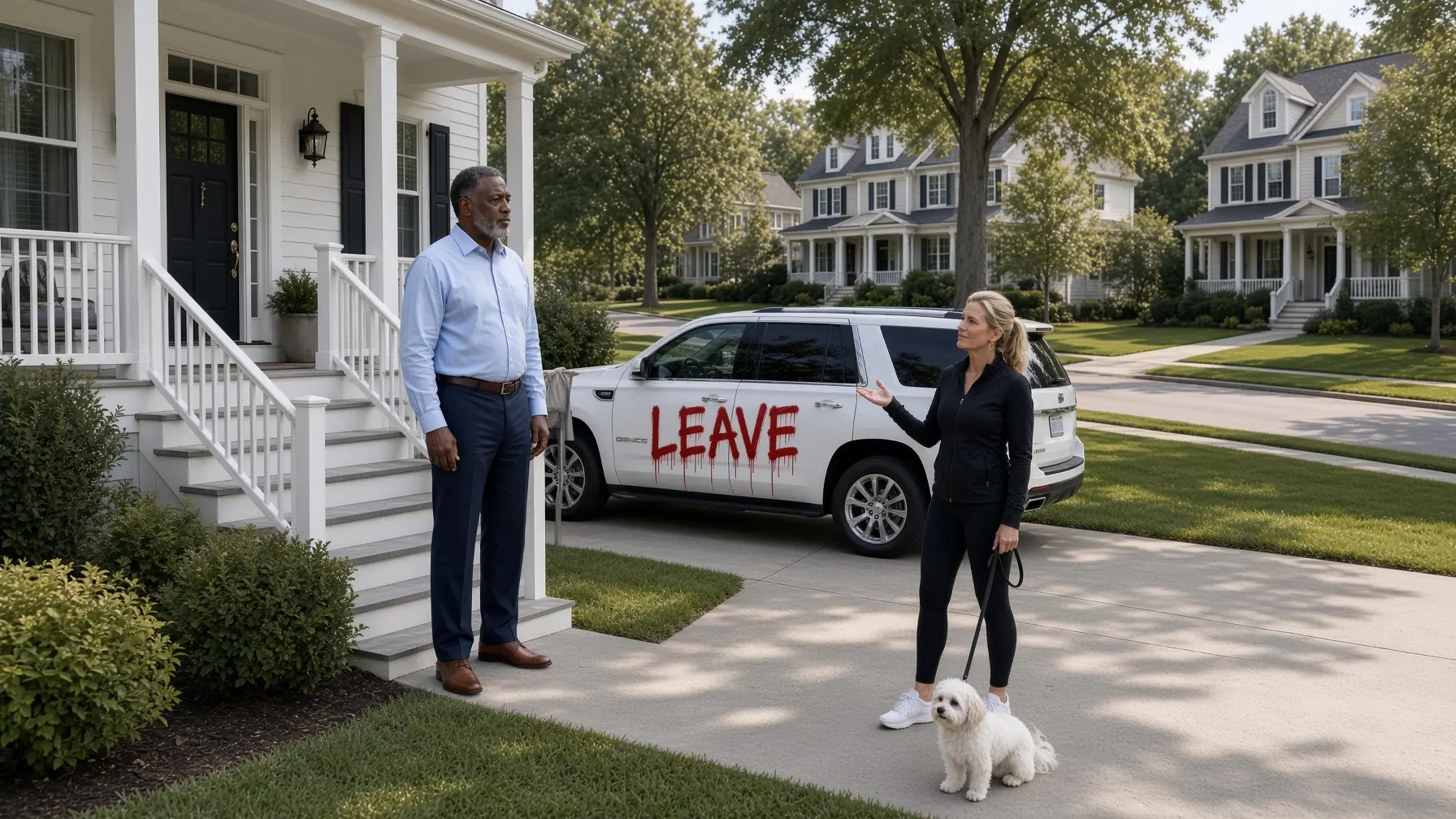
The coffee was still warm when Darius Bell saw the word on his SUV.
LEAVE.
Four red letters stretched across the driver’s side of his black GMC Yukon, wide and dripping, the paint still wet enough to shine beneath the early North Carolina sun. It was not a careless spray from teenagers passing through at midnight. The letters were even. Deliberate. Placed high enough for the whole street to read.
Darius stood at the top of the porch steps with the newspaper tucked under one arm and his mug in the other hand.
For a few seconds, he did not move.
Alder Lane was quiet around him. Birds moved somewhere in the oak trees. A sprinkler clicked three houses down. The morning light slid across the roofs and lawns of Maple Gate Estates as if nothing had changed since the day before, as if the neighborhood had not just spoken to him in red paint.
He set the mug on the porch rail.
Then he went back inside for his phone.
Darius did not curse. He did not shout into the street. He did not run his hand across the paint, because touching evidence before recording it was how small mistakes became big gaps. Six years on the federal bench had taught him that the first version of a story was often the one people tried hardest to erase.
So he photographed everything.
Close shots of the letters. Wide shots showing the SUV in the driveway. The angle of the spray. The paint drips. A faint shoe print in the damp grass beside the concrete. A smear near the rear tire where someone had shifted their weight.
He worked slowly, carefully, breathing through his nose.
That was how he had learned to steady himself after Mariah died.
Small tasks.
Clean steps.
One thing after another.
Mariah had found this house before the cancer came back for the last time. She had turned her laptop toward him one evening at the kitchen table and said, “Darius, look at that porch.” The porch wrapped around the front of the house and curved toward the side yard, white railings, deep shade, enough room for two chairs and a table.
He had signed the closing papers alone.
The realtor had said something gentle. Darius could not remember the words. He remembered the pen skipping across the line where Mariah’s name should have been, and the silence beside him feeling larger than the house itself.
He moved in five weeks later.
Now, standing in that same quiet driveway, looking at the word LEAVE across the SUV he had waxed the night before by garage light, he felt the silence change shape.
This was not grief.
This was a message.
His sister answered on the second ring.
“Sabrina Bell,” she said, crisp and awake, the way prosecutors sound even when they have not yet had coffee.
“Someone spray-painted my car,” Darius said.
There was a pause.
Not confusion.
Calculation.
“What did they write?”
He looked at the SUV.
“Leave.”
Sabrina exhaled once, sharp enough to tell him she had already moved past shock.
“Call the police. Before you wash it, touch it, or let anyone else near it.”
“I’m photographing it now.”
“Of course you are.”
That was the first almost-smile of the morning.
Then she said, “Darius, listen to me. This is not just vandalism.”
“I know.”
“You just moved into a neighborhood with a private HOA, old money, and a long memory for who they think belongs.”
“I know that too.”
He ended the call and stayed on the porch, waiting.
The woman from across the street came out before the police arrived.
Darius had seen her twice before. Once through the kitchen window, walking a small white dog. Once at her mailbox, wearing sunglasses large enough to make her face unreadable. She was polished in the way some people use polish as armor. Blonde hair cut neatly at her jaw. Gold hoops. Black athletic clothes. Perfect posture.
Her name was Celeste Hawthorne.
She crossed the street with her dog trotting ahead of her, nose down, leash thin and bright in the morning sun.
“Oh my,” she said when she reached the edge of his driveway. “Is that your vehicle?”
Darius looked at her.
“It is.”
“That’s just awful.”
Her voice had the soft concern of someone who had practiced sounding kind without giving up anything useful. She looked at the red letters, then at him, then back at the letters. Something flickered in her eyes.
Not surprise.
Recognition.
“This neighborhood has always had a certain standard,” she said, her tone softening into something colder. “People are protective of it.”
Darius said nothing.
Celeste stepped a little closer.
“I don’t approve of vandalism, of course. But sometimes people express what they’re too polite to say.”
The dog sniffed the grass beside the driveway.
Darius held her gaze.
“Is that what you think happened here?”
She smiled.
Not warmly.
“Mr. Bell, you seem like an educated man. Take the hint before things become more uncomfortable than they need to be.”
The street stayed quiet.
A leaf moved across the sidewalk.
Celeste adjusted the leash and tilted her head.
“Maple Gate has been stable for a very long time. Stability matters to families who have invested here. Not every place is meant for every person.”
Darius let the silence hold.
He had heard versions of that sentence in court filings, zoning disputes, employment cases, school board meetings, and polite dinner conversations from people who thought coded language made cruelty harder to identify. It did not. It only made the speaker easier to read.
“Good morning, Mrs. Hawthorne,” he said.
Her smile held a moment longer.
Then she turned and walked back across the street.
The officer arrived twenty-five minutes later.
Officer Malcolm Reed stepped out of his patrol car with a notepad already in hand. He was tall, heavyset, and cautious in the way of a man who preferred problems to stay small. He was polite. He shook Darius’s hand. He photographed the SUV, took down the statement, and listened as Darius described the shoe print and the direction of the paint spray.
Then the carefulness began to fade.
“These cases can be difficult,” Reed said, closing his notepad.
Darius looked at him.
“Difficult how?”
“Hard to prove. Could be teenagers. Could be someone passing through. Sometimes when new people move into a neighborhood, things happen.”
“Things?”
“Random vandalism.”
Darius pointed toward the grass.
“The print is consistent with an adult shoe. The paint angle suggests the person stood close and worked slowly. The letters are not rushed. This was not random.”
Reed gave him a mild, practiced nod.
“I’ll include that in the report.”
“Including the possible bias component?”
The officer’s eyes shifted.
“I can note the wording.”
“The wording is LEAVE. The neighbor across the street came over and told me to take the hint.”
Reed looked toward Celeste’s house.
Then back at Darius.
“I’ll note that you had a conversation.”
That was not the same thing.
They both knew it.
When Reed left, the SUV remained in the driveway, red paint drying under a brighter sun. Darius stood beside it until the patrol car disappeared at the corner. Then he went inside, opened his laptop, and began reading security camera specifications.
Range.
Night vision.
Motion detection.
Cloud storage.
Local backup.
He read like he read briefs, with patience and distrust for marketing language.
At 2:17 p.m., someone knocked on his door.
Three steady knocks.
Not nervous.
Not aggressive.
The kind of knock made by a man who had already decided the conversation needed to happen.
Darius opened the door to find his next-door neighbor standing on the porch. The man was around seventy, Black, trim and straight-backed, with gray hair cut close and eyes that had learned to notice without being seen noticing. Darius remembered meeting him on moving day.
“Elliot Nash,” the man said. “From next door.”
“I remember.”
Elliot held up a small USB drive.
“You might want to see this.”
Twenty minutes later, they sat at Elliot’s kitchen table.
The house was clean and quiet, lined with bookshelves, family photographs, and a front window that looked across both driveways. Elliot opened a laptop and pulled up a security camera archive. He did it without hesitation, like a man who had watched enough footage over the years to know exactly where the truth usually hid.
“I put cameras in after somebody keyed my truck three years ago,” Elliot said. “Filed a report. Nothing came of it.”
He scrolled to the morning file.
“Watch the left side of the frame.”
At 6:38 a.m., a figure stepped into view from across the street.
Dark hoodie.
No dog.
No morning walk.
The person moved quickly but not frantically, crossed the street, stopped at the edge of Darius’s driveway, looked once in both directions, shook a spray can twice, and painted the word LEAVE across the side of the Yukon.
The whole thing took less than a minute.
The person stepped back to check the letters.
Then turned toward the camera.
For one clear second, the hood shifted enough to show the face.
Celeste Hawthorne.
The same woman who had stood at his driveway less than two hours later, pretending sympathy while savoring the damage.
Darius sat back.
He did not speak.
Elliot played the clip again.
On the second viewing, Darius watched Celeste’s body language. Not panicked. Not impulsive. Controlled. She had done this with the certainty of someone who believed the neighborhood would protect her, the police would minimize it, and the new Black widower across the street would learn his lesson.
Elliot slid the USB drive across the table.
“Already copied it for you.”
Darius picked it up carefully.
“How long has this been going on?”
Elliot looked toward the window.
“Depends on what you mean by this.”
Darius waited.
Elliot stood and removed a thick folder from a lower cabinet.
“People think old men don’t keep records,” he said. “That is one of the many mistakes foolish people make.”
The folder landed on the table with a weight that changed the room.
Incident logs.
Photographs.
HOA letters.
Emails printed from former residents.
Notes on families who had moved away after harassment.
A timeline going back eight years.
Darius opened the first page.
Elliot watched him.
“I kept telling myself somebody would come along with enough position to make the paper matter.”
Darius looked up.
“You knew I was a judge?”
Elliot smiled faintly.
“Son, I knew before the moving truck left.”
Darius almost laughed.
The sound did not make it out.
At 3:40, he called Officer Reed and sent the video.
He did not explain first.
He waited until Reed watched it.
When the officer came back on the line, his voice had changed.
“Where did this come from?”
“My neighbor’s camera. The timestamp is accurate. The woman in the footage is Celeste Hawthorne at 17 Alder Lane. She came to my driveway approximately ninety minutes later and made statements consistent with the message painted on the vehicle.”
Another pause.
“I’ll be there shortly,” Reed said.
He arrived in forty minutes.
Darius and Elliot stood together on the porch as Reed reviewed the footage one more time. Then he crossed the street to Celeste’s house.
The house at 17 Alder Lane was immaculate.
White brick.
Black shutters.
Flower boxes.
A brass door knocker polished bright enough to catch the sun.
Celeste opened the door in cream trousers, a pale blouse, and pearls, her face arranged into pleasant confusion. Darius could not hear every word from across the street, but he saw the moment Reed showed her the video.
Her posture stiffened.
Her chin lifted.
Her voice carried.
“That is absurd.”
Reed said something calmly.
Celeste’s hand tightened on the door.
“Do you know who my husband is? Grant Hawthorne built half this county. You need to be very careful before you embarrass yourself.”
Reed did not move.
He spoke again.
Celeste looked toward Darius’s porch.
For the first time that day, her face lost its polish.
The cuffs came out.
Elliot made a small sound beside Darius.
Not joy.
Not surprise.
Something heavier.
Celeste turned around only after refusing twice. When the handcuffs clicked around her wrists, two neighbors appeared at their windows. A man two houses down stepped out with his keys in his hand and froze.
Celeste kept talking as Reed led her to the cruiser.
Instructions.
Threats.
Names of people she could call.
The car door closed.
The talking stopped.
Elliot said quietly, “First crack.”
Darius watched the cruiser turn at the end of the street.
Then he went inside and called Sabrina.
She arrived just after six with Thai food, a laptop bag, and the expression of someone who had been investigating since breakfast.
She was a civil rights attorney in Charlotte, fast-moving, sharp-eyed, and incapable of pretending calm when anger would be more honest. She set the food on the counter, looked once toward the driveway, then at Darius.
“You left the paint on the car.”
“Evidence.”
“Of course.”
They ate at the kitchen table while the evening settled outside.
Sabrina ate quickly because she was already working in her head. Darius knew that look. When she pushed the food aside and opened her laptop, he did not ask whether she had found something.
He waited for how bad it was.
“Grant Hawthorne,” she said. “Hawthorne Dominion Properties. Local developer. Fifteen years of rezoning fights, planned communities, private HOA setups, and enough political donations to make everyone in county government return his calls.”
She turned the screen toward him.
“The largest recurring private donor to Judge Calvin Mercer.”
Darius went still.
“County criminal court?”
“Yes. And if Celeste’s case moves normally, it lands on Mercer’s docket.”
Darius looked at the donation totals.
The numbers were not hidden.
That was the arrogance of local power. It often did not bother hiding itself because it had trained people not to look directly at it.
“There’s more,” Sabrina said.
She opened a spreadsheet.
Addresses.
Dates.
Owners.
Complaints.
Sales.
“Three Black families left Maple Gate in the last five years after repeated HOA harassment. Notices. Fines. Anonymous property damage. Police reports that went nowhere. All three sold below market. Two homes were purchased through entities tied to Hawthorne Dominion.”
Darius read the names.
The Whitakers.
The Rowes.
The Lanes.
Real people reduced to columns because that was how patterns became visible.
“Elliot’s truck was keyed,” Sabrina continued. “The Rowes had paint thrown on their fence. The Lanes found dead shrubs pulled up and placed on their porch. Celeste always claimed outsiders were bringing down the neighborhood.”
Darius leaned back.
“This didn’t start with my car.”
“No,” Sabrina said. “Your car is just the first time they hit someone with a camera next door and a federal judge behind the front door.”
Darius looked out the window toward Celeste’s house.
Grant Hawthorne stood on his porch.
Phone pressed to his ear.
One hand in his pocket.
Not frantic.
Not scared.
Managing.
“He’s already making calls,” Darius said.
Sabrina followed his gaze.
“Then we document who answers.”
Monday morning proved her right.
At 8:06, Sabrina called the district attorney’s office.
Darius stood at the counter, listening to her half of the conversation while coffee brewed behind him.
She gave her name.
Spelled it.
Asked for the charging status in the Celeste Hawthorne matter.
Then her pen stopped moving.
“I see,” she said.
A pause.
“And who made that assessment?”
Another pause.
“Thank you.”
She set the phone down on the table.
“Felony vandalism has been reduced to misdemeanor property mischief. Damage valuation revised to under seven hundred dollars. Arraignment pushed out twenty-four days. No custody expected.”
Darius closed his eyes briefly.
“Grant made a call.”
“Maybe more than one.”
The video had not changed.
The red paint had not changed.
The intent had not changed.
Only the access had changed.
Darius picked up a legal pad and wrote it down.
Time.
Call.
Charging reduction.
Valuation change.
Arraignment delay.
Sabrina watched him.
“Do you ever get tired of being this patient?”
“Yes.”
“Then why are you writing instead of swinging?”
“Because they want a fight. A fight becomes a neighborhood dispute. A record becomes something else.”
By afternoon, Maple Gate’s community blog had a post up.
It did not name Celeste.
It did not need to.
The post described a beloved community volunteer being targeted by a new resident over an alleged misunderstanding. It suggested the video evidence had “contextual questions.” It warned that outsiders were using legal threats to destabilize a peaceful neighborhood with long-held standards.
The comments came quickly.
Celeste has done so much for this neighborhood.
This feels like a smear campaign.
We stand with the Hawthornes.
Someone should investigate the new guy.
Sabrina wanted to respond.
“I can post the video right now,” she said, laptop open at the kitchen table. “Let them watch their saint painting your car at 6:38 in the morning.”
“No.”
“They’re rewriting reality.”
“They’re spending influence,” Darius said. “Let them spend it.”
She stared at him.
He kept his eyes on the screen.
“Every person who repeats the story before checking facts tells us something. Every lever they pull tells us where the machinery is. We need the machinery.”
Sabrina exhaled.
It was not agreement.
It was restraint.
Darius opened a new document and titled it:
Record.
He pasted screenshots of the blog post and comments, then added the date and time.
Three days later, the HOA letter arrived.
It was certified mail, crisp white envelope, Maple Gate Estates seal in the upper corner, his name typed neatly in the center. Darius carried it inside, called Sabrina, and waited for her to arrive before opening it.
She read it standing up.
Then read it again.
Her face became still in a way that made the room feel smaller.
“They’re fining you.”
“Yes.”
“For visible vehicle damage.”
“Yes.”
“The vehicle damage Celeste caused.”
“Yes.”
The letter cited HOA bylaw 18.7B.
Vehicles displaying visible deterioration, vandalism, or aesthetic damage shall not remain parked in open view of community streets for longer than seventy-two hours. Violations would trigger fifty-dollar daily fines, escalating after seven days.
The signature at the bottom was looped and confident.
Celeste Hawthorne
HOA President, Maple Gate Estates
Sabrina placed the paper on the table with both hands.
“She’s still signing as president after being arrested for the act that created the violation.”
“That is what the letter says.”
“I want cameras here today.”
“No.”
“Darius.”
“No.”
“She is using the office to punish you for the damage she caused.”
“And by doing that, she tells us Grant is not worried yet.”
Sabrina stared at him.
He slid the letter into the scanner.
“This goes in the record.”
“You’re letting them keep hitting.”
“I’m letting them show their reach.”
“That is infuriating.”
“Yes.”
“Do you understand how annoying it is when your strategy is correct?”
“Yes.”
For the first time in days, he smiled.
A little.
Elliot came over that evening with the folder.
Not the short version.
The whole thing.
Eight years of notes, documents, letters, printed emails, photos, violation notices, and handwritten timelines. He placed it on Darius’s kitchen table like a witness taking the stand.
“I kept meaning to bring all of it,” Elliot said. “Then I kept telling myself tomorrow.”
Darius opened the folder.
The first section was Elliot’s own logs.
His truck keyed.
His mailbox damaged.
HOA fines for small infractions ignored at white-owned homes.
A note about the Rowe family at number nine receiving violation notices every week after refusing to sell.
Another note about Lillian Lane finding red paint across her fence two days after speaking at an HOA meeting.
The second section contained a letter from a former real estate agent named Monica Hale. She had worked with Hawthorne Dominion for five years before leaving. In the letter, she described being instructed to redirect Black buyers away from “premium interior lots” and toward “more suitable outer properties.”
The phrase made Sabrina’s jaw tighten.
The emails were worse.
Internal messages between Hawthorne Dominion’s operations manager and two preferred realtors.
Preserve neighborhood profile.
Flag nontraditional buyers for Grant.
Delay acceptance pending board concerns.
Potential cultural mismatch.
Darius read that last phrase twice.
It was bias in a pressed shirt.
At the bottom of the folder lay two older documents.
The first was a photocopy of Maple Gate’s original 1959 covenant. The racial restriction had no legal force anymore, but there it sat, preserved in the founding papers, copied and handed down like a family heirloom nobody admitted keeping.
The second was a county letter from eight years earlier.
Signed by Judge Calvin Mercer, before he joined the bench, back when he served on the county commission. It granted a zoning variance to Hawthorne Dominion based partly on “maintenance of the established residential character of Maple Gate Estates.”
Sabrina looked at the letter.
Then at Darius.
“Mercer isn’t just compromised by donations. He helped build the framework.”
Darius closed the folder carefully.
“If Celeste falls, Grant gets exposed. If Grant gets exposed, Mercer has questions to answer.”
Elliot nodded.
“That’s why they never stopped.”
The next morning, Darius and Sabrina built three tracks.
They worked at the kitchen table before sunrise, papers arranged in precise stacks.
Sabrina handled the first.
Press.
Not local neighborhood gossip. Not a quick outrage story. An investigative reporter outside Grant Hawthorne’s advertising reach. She called Lena Rios at the Triangle Review, a regional outlet known for housing corruption stories and long memory.
Lena listened for twelve minutes.
Then said only one thing loud enough for Darius to hear.
“Send everything you can send responsibly.”
The second track was federal.
Darius drafted a formal judicial notification to the appropriate federal channel, identifying potential Fair Housing Act violations with supporting documentation. He did not demand action. He did not invoke his position as a weapon. He made a clean referral, factual and narrow, the way a federal judge must when every word can be weighed later.
The third track was witness development.
Sabrina filed a formal complaint with the state real estate commission naming the Hawthorne Dominion manager who pressured Monica Hale. Monica was not treated as a target. She was a witness. And because she had written a private letter years earlier, Sabrina believed she had already made the moral decision before anyone asked her to make the legal one.
By Thursday, all three tracks were moving.
By Friday, Grant struck back.
The letter came in a hand-delivered envelope from Drumwright & Vale, Attorneys at Law.
Sabrina read it in silence.
Darius watched her expression shift from anger to something more dangerous.
“They’re alleging tortious interference,” she said.
“With what?”
“Hawthorne Dominion’s business interests. They’re claiming your federal referral and Sabrina Bell’s contact with media and regulators are motivated by personal grievance and constitute malicious interference.”
“Expected.”
“There’s more.”
She read on.
“They’re challenging Elliot’s camera footage under privacy law.”
“That’s weak.”
“Very.”
“And?”
Sabrina looked up.
“They filed a judicial conduct complaint against you.”
The room went quiet.
That was the real weapon.
Not because it would win.
Because it would exist.
A federal judicial conduct complaint, even baseless, created questions, review, headlines, whispers, and a narrative Grant could hand to anyone willing to repeat it. Federal judge abuses position in personal feud with neighbor. It was ugly, efficient, and calculated.
Darius sat back.
For the first time since seeing the paint, he looked tired.
Sabrina’s phone rang at 8:11 that night.
Lena Rios.
Sabrina answered, listened, and did not speak for nearly a minute.
Then she said, “Thank you for telling me directly.”
When she hung up, she looked at Darius.
“The story is frozen.”
“Why?”
“Triangle Review’s largest real estate advertiser called today.”
Darius already knew.
“Hawthorne Dominion.”
“Yes.”
Grant had reached the DA.
The blog.
The HOA.
The press.
And now he was reaching for Darius’s career.
That night, Darius stood on the porch in the dark and looked at the empty street.
“Mariah,” he said softly, “I could use your brain right now.”
The trees gave him nothing.
So he gave himself what she would have given him.
Read farther.
He woke before dawn and began making calls.
The first was Councilwoman Elena Vargas, chair of the city’s Housing and Community Development Committee. He gave her enough to understand the pattern and asked whether she would formally receive a citizen presentation on discriminatory housing practices tied to Maple Gate.
“How solid is it?” she asked.
“Solid enough that I am calling you before sunrise.”
A pause.
“Call my office at eight.”
The second call was to Judge Nathaniel Cross in the Eastern District, a colleague whose caution Darius trusted. He asked for the best Fair Housing Act litigator with no North Carolina political entanglements.
Cross answered immediately.
“Marian Holt. D.C. Civil Rights Division background. Private practice now. She does not take cases she does not intend to win.”
Darius called Marian Holt at 6:20.
She answered on the fourth ring.
He gave her the facts in six minutes.
When he finished, she was quiet.
Then she said, “Judge Bell, I’ve been waiting for a case that looks exactly like this.”
The third call was to Elliot.
“Make three copies of everything,” Darius said. “One for Sabrina, one for Marian Holt, one stored somewhere other than your house.”
“Already done,” Elliot said.
Darius stopped writing.
“I made them the night I gave you the camera footage.”
“You expected this.”
“No,” Elliot said. “I expected people like them to behave like themselves.”
By noon, Darius had drafted a voluntary recusal statement for his current docket and a formal response to the judicial conduct complaint. Not defensive. Not angry. A documented sequence of retaliatory acts, supported by exhibits, copied through proper channels.
Grant had meant the complaint as a threat.
Darius turned it into a record.
Marian Holt arrived two days later.
She was sixty, direct, silver-haired, and carried a leather portfolio under one arm as if every folder inside already knew where it belonged. She read Elliot’s documents at Darius’s dining room table, asked only precise questions, and stopped longest on the old covenant and Mercer letter.
“The covenant has no legal force,” she said. “But beside current emails, steering practices, and HOA enforcement patterns, it speaks to intent.”
Sabrina nodded.
“Exactly.”
Marian looked at Darius.
“Your sister is right.”
Darius said, “She usually is.”
Sabrina did not smile, but her shoulders lifted slightly.
That was close enough.
By the end of the day, Monica Hale had agreed to give a sworn statement. Terrence Doyle, a former Hawthorne Dominion project coordinator whose emails appeared in Elliot’s folder, agreed too. He had kept copies of internal messages on a private drive because, as he told Marian, “I knew one day I’d be tired of pretending I didn’t understand what we were doing.”
The DOJ Civil Rights Division formally opened a Fair Housing Act investigation the following week.
Subpoenas went out to Hawthorne Dominion Properties, preferred realtors, transaction histories, HOA communications, and internal valuation records tied to Maple Gate. The state real estate commission opened a parallel inquiry. The judicial council reviewing Darius’s complaint acknowledged the documented relationship between Grant Hawthorne and Judge Calvin Mercer and opened its own review of Mercer’s conflict history.
Grant was in his office when the subpoena arrived.
According to a former employee who later gave a statement, he read it once, set it flat on his desk, and called three people who usually answered before the second ring.
None of them picked up.
The HOA meeting was called the following Monday.
Special session.
Urgent governance matter.
Community room at the end of Alder Lane.
Celeste arrived in a navy blazer and pearls, still moving like the room belonged to her. She took the chair at the head of the table and reached for the gavel before she noticed who was present.
Darius.
Sabrina.
Elliot.
Two Black homeowners from the south end of Maple Gate, the Rowes’ cousins who had stayed after the Rowes sold.
Marian Holt.
Councilwoman Vargas.
For one second, Celeste’s composure slipped.
Then she lifted her chin.
“Let’s call this meeting to order.”
Sabrina stood.
She did not ask permission.
She opened a folder and laid out the record.
Disproportionate violation notices.
The Rowe timeline.
The Lane complaint.
Elliot’s incident logs.
Celeste’s arrest.
The HOA fine issued to Darius for damage Celeste caused.
The realtor letter.
The Hawthorne emails.
The original covenant.
The county variance signed by Calvin Mercer.
No shouting.
No performance.
Only facts, one after another, each one placed with enough care that no one could pretend the pattern had assembled itself by accident.
When she finished, she looked at the board.
“I move for the immediate removal of Celeste Hawthorne as HOA president pending the outcome of federal and state investigations into discriminatory enforcement, retaliation, and housing access interference.”
Celeste stood.
“This is outrageous.”
“I second the motion,” said Thomas Greene, one of the board members who had voted with her for years.
Celeste turned toward him.
He did not look at her.
The vote passed.
Three in favor.
Two abstentions.
None opposed.
Celeste stared at the gavel in front of her.
For the first time since Darius moved to Alder Lane, she had no office to speak from.
She set the gavel down.
The sound was small.
Final.
The weeks after that moved slowly, but they moved.
The felony vandalism charge against Celeste was reinstated.
The DA’s office suddenly discovered that the damage estimate had been incomplete. The red paint, bodywork, detailing, and related legal expenses were worth far more than the reduced number someone had invented after Grant’s call.
Celeste took a plea.
Felony vandalism.
Two years probation.
Restitution.
Community service tied specifically to fair housing outreach.
A public apology she read in court without once looking at Darius.
Darius was not there.
He was in chambers, doing his job.
Sabrina texted one word.
Done.
The DOJ consent decree arrived six weeks later.
Hawthorne Dominion Properties admitted no moral failure in the way companies never do, but the terms told the truth. Fair Housing Act violations. Discriminatory steering. Retaliatory HOA enforcement. Coordinated harassment. Improper use of association rules to discourage Black ownership in premium sections of Maple Gate.
The penalty was $2.8 million.
Restitution to families forced out.
Independent monitoring.
Mandatory fair housing compliance.
Grant Hawthorne barred from HOA boards, real estate commissions, and development advisory positions for ten years.
His largest pending project disappeared from the city agenda without explanation.
Everyone understood the explanation.
Judge Calvin Mercer received a public censure from the Fourth Circuit after the conflict review found he had failed to recuse from matters involving a major donor and former zoning ally. He announced retirement six weeks later, citing personal reasons.
The judicial conduct complaint against Darius Bell was dismissed in writing.
The council called it retaliatory and without merit.
Darius read the statement once, then filed it away.
Sabrina added it to a document she had titled Consequences.
Three months after the red paint, Darius stood on the porch with hot coffee in both hands.
The street was quiet again.
Not the old quiet.
That first quiet had felt staged, like a room holding its breath and waiting to see whether he would understand the rules. This quiet had weight in it, but not threat. Something had shifted beneath the lawns and shutters.
Across the street, 17 Alder Lane had a for-sale sign in the yard.
Grant and Celeste had moved out two weeks earlier before sunrise. No goodbye. No note. No fruit basket. Just boxes, movers, and a black SUV pulling away without either of them looking toward Darius’s porch.
Darius watched the sign for a moment.
Then he looked past it to the trees.
Elliot came over carrying a clay pot with both hands.
Inside was a young gardenia plant, dark leaves glossy, white blooms just beginning to open.
“Mariah liked gardenias,” Elliot said.
Darius looked at the plant.
“I told you that?”
“Once.”
“I don’t remember.”
“I do.”
Darius took it carefully.
The flowers had a clean, soft scent that reached something in him before he was ready.
He set the pot on the porch rail, in the place that caught the morning sun.
Exactly where Mariah would have put it.
Elliot sat in the second chair. The one Darius had bought but never used because buying a chair for company and having company were not the same thing.
They sat without speaking for a long while.
His phone buzzed on the armrest.
Sabrina.
“We found another one,” she said when he answered. “Different county. Same pattern. Marian says it may be stronger than Maple Gate.”
Darius looked at the gardenia.
The white blooms had opened slightly more in the sun.
“You in?” Sabrina asked.
He looked down Alder Lane, at the quiet houses, the ordinary morning, the space where fear had tried to root itself and failed.
“Call me tonight,” he said. “Tell me everything.”
He ended the call and picked up his coffee.
Elliot glanced at him.
“Good news?”
Darius took a slow sip.
This time, he tasted all of it.
“Yes,” he said. “Very good news.”
People would tell the easy version of the story.
A racist neighbor painted LEAVE on a Black man’s SUV.
Then found out he was a federal judge.
That version had a twist.
It had satisfaction.
It had the clean rhythm people like in stories where arrogance runs into power.
But that was not the real story.
The real story was Elliot Nash keeping records for eight years when no one listened.
It was Sabrina refusing to let outrage outrun evidence.
It was Monica Hale writing a private letter because some part of her still believed the truth deserved a witness.
It was families who left Maple Gate but did not forget what happened to them.
It was Mariah’s porch becoming the place where Darius finally understood that grief and justice could sit beside each other without one replacing the other.
Celeste thought she was telling one man to leave.
What she revealed instead was an entire system built to decide who got to stay.
And systems like that do not fall because one person shouts.
They fall because someone records.
Someone remembers.
Someone reads far enough.
Darius looked at the gardenia on the rail, white and alive in the morning light.
Then he looked at the street that no longer felt like it belonged to anyone more than anyone else.
For the first time since moving into the house Mariah had chosen, he did not feel like a guest in someone else’s idea of peace.
He felt home.