The neighbor stepped into my kitchen like he had been invited deeper than he was.
Not by words.
That was the part I kept telling myself later.
I had never said, Come closer.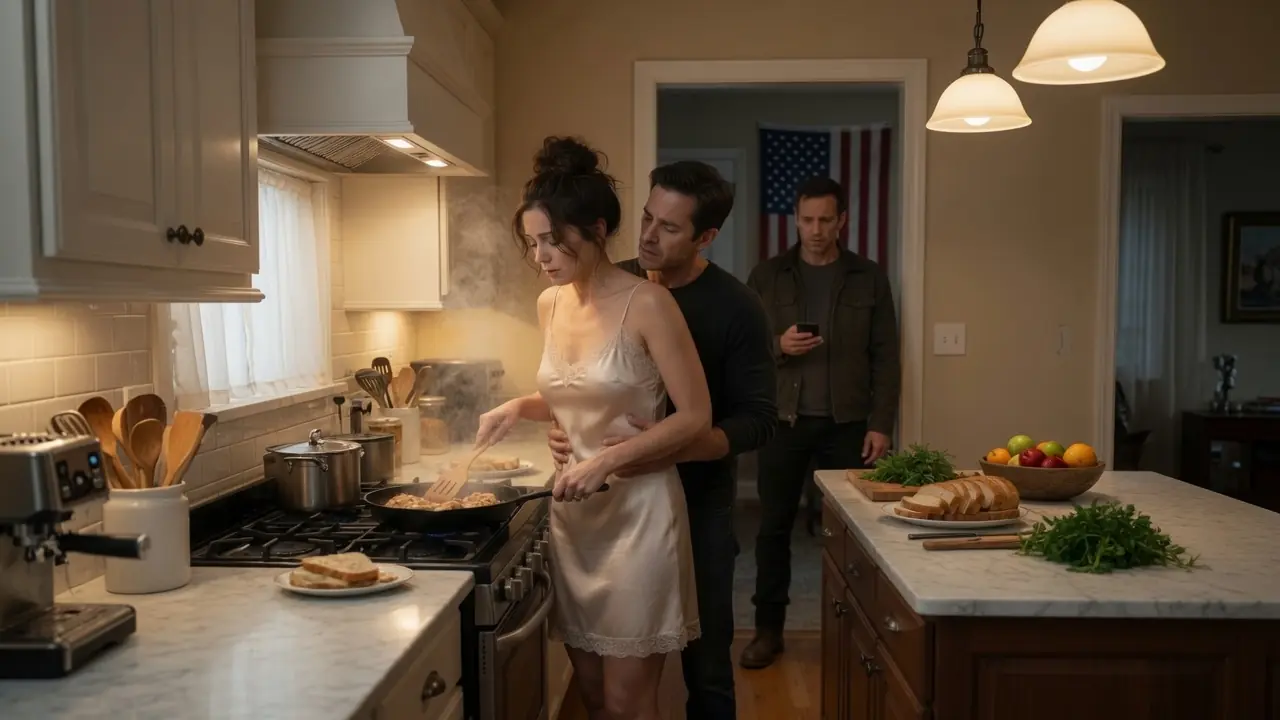
I had never said, Stay.
I had never said anything a wife would not be able to explain.
But sometimes the body knows what the mouth is still trying to deny.
His name was Nolan Pierce, and he lived three doors down from us on Briar Lane, one of those quiet Michigan streets where people waved while cutting grass, lined pumpkins on porches in October, and pretended closed blinds meant privacy instead of trouble.
My husband, Andrew, used to say the cleanest streets had the dirtiest secrets.
I used to tell him he watched too many crime shows.
That evening, the kitchen smelled like garlic butter, thyme, and chicken browning in a cast-iron pan. The window above the sink had begun to fog from the heat. Outside, porch lights were clicking on one by one, soft gold squares appearing against the blue-gray evening.
Everything about the night looked ordinary.
That was the part that made it feel unreal afterward.
Nolan had shown up holding a glass baking dish covered in foil.
He said his wife had found it in their garage cabinet and thought it belonged to me.
It did not.
I knew it did not.
We owned nothing with little painted strawberries around the rim.
Still, I opened the door wider.
That was the first mistake I could point to without arguing with myself.
The smaller mistakes had started months earlier.
A longer conversation by the mailbox.
A compliment I pretended not to enjoy.
A cup of coffee I should have handed to him on the porch instead of letting him drink at my kitchen island.
A joke about Andrew working too much that I laughed at before I remembered loyalty is sometimes built in tiny silences.
Nolan was the kind of man everyone liked.
He shoveled Mrs. Landry’s driveway before sunrise. He remembered which neighbors had bad knees. He waved at children, fixed loose fence boards, and carried himself like kindness was his natural weather.
At first, I thought he was harmless.
Then I thought he was lonely.
Then I told myself a dangerous sentence.
Nothing has happened.
That evening, I stood at the stove while Nolan set the dish on the counter behind me.
“Smells incredible,” he said.
“Thanks,” I replied, turning the chicken over.
His footsteps moved closer.
One.
Then another.
The kitchen narrowed around me.
“Nolan,” I said, but I said it too softly.
He laughed under his breath, like I had made the moment cute instead of wrong.
Then he leaned near my shoulder, close enough that I felt his warmth before I felt his words.
“Relax,” he whispered. “Andrew won’t be home for another hour.”
My hand froze around the tongs.
The chicken hissed in the pan.
The clock above the stove ticked once.
I should have turned around and told him to leave.
I should have stepped away.
I should have made the kitchen mine again.
Instead, I stood there for one second too long, caught between embarrassment and fear and a terrible little flicker of being wanted.
Then the floor creaked.
Not behind me.
At the kitchen entrance.
I turned.
Andrew stood in the doorway wearing his work jacket, the brown canvas one with drywall dust on the sleeves. His hair was damp from the weather. His phone was in his left hand.
His face was calm.
So calm I almost wished he would shout.
Nolan stepped back immediately.
“Andrew,” he said, forcing a smile. “Man, I was just dropping off—”
“Don’t,” Andrew said.
One word.
Quiet.
Flat.
Nolan stopped talking.
I heard myself say, “It isn’t what it looks like.”
The sentence died the moment it left my mouth.
Andrew looked at me.
Not at Nolan.
Me.
That was worse than anger.
He looked like a man who had finally found the shape of a thing he had been feeling in the dark.
He walked to the counter and placed a white envelope beside the cutting board.
Then he looked at the baking dish, the pan, Nolan, and me.
“Open it,” he said. “When you’re ready to stop protecting the wrong man.”
He turned and left.
The front door closed a few seconds later.
Not slammed.
Closed.
That soft click seemed to remove the air from the house.
Nolan let out a breath.
“Well,” he said, trying to sound amused, “that was dramatic.”
I stared at the envelope.
My hands were trembling.
“Leave.”
He blinked.
“Julia.”
“Leave my house.”
His face changed for half a second.
The friendly neighbor disappeared, and underneath him was someone irritated by inconvenience.
Then the mask returned.
“You need to be careful,” he said. “Andrew records things for a living, doesn’t he? Security systems, cameras, alarms. Men like that always find a way to make themselves look like victims.”
I looked at him then.
Really looked.
For the first time all evening, Nolan seemed less worried about me and more worried about what was inside the envelope.
“Get out,” I said.
He lifted both hands and walked toward the door.
“Fine. But don’t let him twist your head around. Call me before you do anything stupid.”
The door closed behind him.
I locked it.
Then locked the deadbolt.
Then stood there listening to the house.
No Andrew dropping his keys in the bowl.
No television from the living room.
No low whistle from the hallway as he took off his boots.
Just the chicken burning in the pan and my own breathing going shallow.
I turned off the stove.
The chicken was ruined at the edges.
Dinner was ruined.
Maybe that was the least ruined thing in the house.
I picked up the envelope.
It was not sealed.
Inside were four things.
A photograph.
A folded note.
A small black flash drive.
And a key I did not recognize.
The photograph came out first.
I almost dropped it.
It showed my kitchen.
The stove.
The fogged window.
The blue towel on the oven handle.
Me at the pan.
Nolan behind me.
Too close.
His mouth near my ear.
The timestamp in the lower corner read 6:18 p.m.
Two minutes before Andrew walked in.
I looked toward the smoke detector above the pantry door.
It looked normal.
But Andrew installed surveillance systems for businesses all over the county. He could hide a camera in a place I would dust around for months and never question.
I unfolded the note.
Julia,
If this was the first time Nolan crossed a line, tell me the truth.
If this was not the first time, read everything before you decide what kind of man I am.
My knees weakened.
I sat at the kitchen table.
The note continued in Andrew’s careful handwriting.
I came home early because I wanted to be wrong.
The side gate was open twice.
The mudroom sensor went offline three times.
Someone tried to access the garage keypad last Thursday.
You told me I was imagining things.
You told me Nolan was “just neighborly.”
You told me I was becoming controlling.
Maybe you believed that.
Maybe you needed to believe it.
I pressed one hand against my mouth.
I remembered those conversations.
Andrew standing in the laundry room with his phone open to the security app, frowning.
Andrew asking if I had moved the porch camera.
Andrew saying the fence latch had scratches near the lock.
And me sighing.
“Andrew, you see threats everywhere,” I had said.
Not screaming.
Not cruel.
But dismissive enough to make him stop trusting his own alarm.
I hated myself for that before I even finished the note.
This is not just about a man standing too close to my wife.
It is about whether you helped him make me look crazy.
It is about whether you still know the difference between kindness and access.
I folded the paper slowly.
The key sat on the table.
Small.
Brass.
A blue plastic tag attached to it.
There was no label.
My phone buzzed.
Nolan.
Don’t open anything until we talk.
Another message.
He’s going to make this about jealousy.
Then another.
Julia, answer me. You don’t know what Andrew has been doing.
My stomach turned cold.
That did not sound like innocence.
It sounded like someone trying to get ahead of evidence.
I took the flash drive to the small office beside the living room.
Andrew’s office.
The room where I had rolled my eyes whenever he locked the file cabinet.
The room I had once accused him of guarding like a bank vault.
I plugged the drive into the laptop.
Only one folder appeared.
OPEN BEFORE YOU CALL HIM.
Inside were six files.
Three photos.
One audio recording.
Two videos.
The first photo showed Nolan at our back gate on Wednesday at 10:43 p.m.
Andrew had been working late in Lansing that night.
I had been asleep upstairs.
Nolan wore a dark hoodie and gloves.
The second photo showed him crouched near our mudroom door, looking down at the keypad.
The third showed him standing in the side yard, staring through the kitchen window while I was not home.
I pushed back from the desk.
The chair hit the wall.
Suddenly every friendly wave, every casual knock, every helpful smile became something else.
Not neighborly.
Studied.
I opened the audio file.
For five seconds, there was only static.
Then Nolan’s voice came through.
“She’s easier than the last one.”
Another man laughed.
“How easy?”
“Not stupid,” Nolan said. “Lonely. There’s a difference.”
My skin went cold.
The other man asked, “What about the husband?”
“Andrew’s a problem. Security guy. Notices everything. But she thinks he’s paranoid, so I just lean into that.”
I stopped the recording.
I could not breathe.
Then I forced myself to press play again.
Nolan continued.
“You make the husband look controlling, the wife starts defending you. After that, she opens doors without noticing.”
The other man said something too low to hear.
Nolan laughed.
“Married women are the best. They’re ashamed before they’re angry. Shame keeps them quiet.”
I closed the laptop.
Then opened it again because I needed the whole ugly truth.
The first video showed our backyard at night.
Timestamp: Saturday, 2:11 a.m.
Nolan crossed the lawn quickly and went straight to the large planter beside the back steps.
The place where we had once kept a spare key until Andrew insisted it was unsafe.
Nolan lifted the planter and checked underneath.
Nothing.
He cursed softly.
Then he looked through the back door window for twelve full seconds.
The second video was from Andrew’s truck dashcam.
It showed Nolan meeting a woman in the parking lot behind the closed pharmacy at the edge of town.
At first, I did not recognize her.
Then she turned under the streetlight.
It was Nolan’s wife.
Caroline Pierce.
She looked pale, exhausted, and furious.
Her voice was muffled, but I could hear pieces.
“She isn’t the first.”
Nolan’s voice cut in, sharp.
“Get in the car.”
Caroline stepped back.
“You kept folders, Nolan. Folders.”
The video ended.
I sat in Andrew’s office while the house seemed to tilt around me.
My phone rang.
Andrew.
I answered before the second ring.
“Andrew.”
For a second, he said nothing.
Then, “Did you listen?”
“Yes.”
“Good.”
The word hurt.
“Why didn’t you tell me all of this before?”
“I tried to tell you what I knew,” he said. “You told me I was humiliating you by being suspicious.”
I closed my eyes.
“I didn’t know.”
“I know.”
That hurt more than blame.
Because Andrew was not accusing me of creating Nolan’s plan.
He was accusing me of helping Nolan dismiss the warnings.
“Where are you?” I whispered.
“At the end of the street.”
I went to the front window and looked through the curtain.
Andrew’s truck sat near the stop sign with its lights off.
He had not really left.
He had only left the kitchen.
“Please come back,” I said.
“I can’t yet.”
“Why?”
“Because if I come back right now, all I’ll have is pain. And I don’t want pain making decisions for me.”
Tears slid down my face.
“I’m sorry.”
“I believe that.”
Relief came too fast.
Then he said, “But I don’t know what you’re sorry for yet.”
The silence after that sentence was worse than shouting.
Because he was right.
I was sorry I had been seen.
Sorry I had been caught.
Sorry Nolan was not what I thought.
But beneath all that, there was a harder apology waiting.
“I liked it,” I whispered.
Andrew did not answer.
“I liked that Nolan noticed when I changed my hair. I liked that he asked about my day. I liked that he made me feel interesting when you were exhausted and quiet.”
My voice broke.
“I didn’t want to cheat. I swear I didn’t. But I liked standing near the edge and pretending I wasn’t.”
Andrew breathed out slowly.
“Why didn’t you tell me you felt invisible?”
“Because I thought it would sound like blame.”
“It would have hurt,” he said. “But it would have been honest.”
Another text from Nolan appeared.
Come outside. Two minutes. You need my side.
Then:
Don’t trust a man who hides cameras from his own wife.
I read it aloud to Andrew.
He gave a bitter laugh.
“There it is.”
“What?”
“He’s trying to make the evidence look worse than the crime.”
I looked at the smoke detector again.
“Why was there a camera in the kitchen?”
Andrew was quiet.
“When the mudroom sensor failed, I thought someone was accessing the router through the wall behind the pantry. I put a temporary camera there to see if it was an electrical issue or tampering.”
“And you didn’t tell me?”
“I was going to. Then I saw Nolan in the yard at two in the morning.”
I swallowed.
“Why didn’t you go to the police?”
“With what? A neighbor in a yard? A man near a gate? A wife telling me I was paranoid?” His voice was tired. “I needed proof. And I needed to know whether you were letting him in.”
I leaned against the desk.
“Has he been in the house when you weren’t home?” Andrew asked.
I closed my eyes.
“Yes.”
“How many times?”
“Four.”
The line went silent.
My shame filled it.
“The power outage,” I said. “The ladder. Once when he said Caroline had sent over zucchini bread. Tonight.”
“And the garage?”
“He never went into the garage.”
“Office?”
I hesitated.
“Julia.”
“He stood in the doorway once.”
“When?”
“Last Thursday.”
Andrew cursed under his breath.
“What?”
“That’s the night the bottom file drawer was open.”
My eyes moved to the cabinet under the window.
“What was in it?”
“Insurance papers. Storage lease. Copies of client contracts. My father’s estate documents.”
A sick thought moved through me.
“What did he want?”
“I don’t know yet.”
But his voice told me he had suspicions.
“Open the bottom drawer,” he said. “Look for a green folder marked Marsh Road.”
I opened the drawer.
The green folder was there.
The inside pocket was empty.
“The lease copy is gone,” I said.
“I know.”
“You know?”
“I checked yesterday.”
“Why didn’t you tell me?”
“Because I wanted to see if Nolan mentioned storage.”
The brass key on the kitchen table flashed through my mind.
“The key,” I whispered.
“What key?”
“There was a key in the envelope. Blue tag. No label.”
Andrew’s breathing changed.
“Bring it to the phone.”
I hurried back to the kitchen.
The key lay beside the photo, small and bright under the overhead light.
“It has a number stamped on it,” I said. “Unit 17.”
Andrew was silent for one beat too long.
“That’s my father’s storage unit.”
My stomach dropped.
“What’s in there?”
“Tools. Old ledgers. Family things. Some cash he didn’t trust banks with near the end.”
“How much cash?”
“Enough that Nolan would want the key.”
I remembered Nolan asking at the mailbox whether Andrew was still “cleaning out old family junk” from storage.
I remembered saying, “Tomorrow night, I think. He rented a trailer.”
A nothing conversation.
A casual answer.
A door opening.
I pressed my hand against my mouth.
“Andrew, I told him you’d be at the storage unit tomorrow.”
His voice lowered.
“When?”
“Two days ago. At the mailbox.”
“Did he ask if you’d be home?”
“Yes.”
My knees weakened.
“He said it must be nice to get a quiet night alone. I laughed. I didn’t think—”
“I know.”
But I could hear the damage in those two words.
Nolan had not only been trying to seduce me.
He had been using me.
Worse, he had been using my loneliness as a map.
The doorbell rang.
I froze.
It rang again.
Then Nolan’s voice came through the front door.
“Julia. Open up.”
I whispered into the phone, “He’s here.”
“Do not open the door,” Andrew said.
Nolan knocked lightly.
“Julia, don’t let him scare you. He’s been talking to Caroline behind your back.”
My heart lurched.
“Andrew?”
“Stay back from the door.”
“Were you meeting Caroline?”
“Yes.”
The word hit me hard even though the evidence had already pointed there.
“Why?”
“She contacted me,” he said. “She found folders on Nolan’s laptop. Yours was one of them.”
My hand tightened around the phone.
“My folder?”
“Yes.”
“What was in it?”
“Photos. Notes. Your schedule. My work hours. Your sister’s address. The Pilates studio. Receipts from places you mentioned casually. He was building a profile.”
Nolan knocked again.
His voice was softer now.
“He didn’t tell you about Caroline, did he?”
I almost answered.
That was the terrifying part.
Even knowing what he was, some trained part of me still wanted to respond to the voice at the door.
Andrew said, “Julia, listen to me. He doesn’t need you to believe him forever. He only needs to create five seconds of doubt.”
I stepped back.
Then a woman’s voice rang out from the front walk.
“Get away from her door, Nolan.”
I moved to the side window.
Caroline Pierce stood under the porch light, wearing a gray sweater and holding her phone up like a shield. Andrew stood near his truck at the curb, several yards away from her.
Not close.
Not intimate.
Just present.
Nolan turned on his wife.
“You need to go home.”
Caroline laughed once.
It was not a happy sound.
“I lived in your house for twelve years,” she said. “I know what your calm voice means. I’m not afraid of it tonight.”
A police cruiser turned onto Briar Lane.
No siren.
Just red and blue light sliding across the houses.
Then another cruiser followed.
Porch lights came on up and down the street.
Curtains shifted.
The neighborhood that had always smiled politely now watched with its mouth slightly open.
An officer stepped out.
“Nolan Pierce?”
Nolan’s whole body changed.
His shoulders relaxed.
His hands lifted.
His voice became smooth.
“Officer, I’m glad you’re here. This is a domestic misunderstanding. My neighbor’s husband has been threatening—”
“Hands where I can see them,” the officer said.
Nolan obeyed, but he looked toward my window.
Even from behind the curtain, I felt it.
The warning.
The promise.
Caroline spoke to the second officer.
“Check the garage. Locked cabinet behind the old freezer. He keeps copies there.”
Nolan’s face went white.
Only for a second.
But everyone saw it.
The officers did too.
Andrew looked toward the window, as if he knew I was watching.
Then he shook his head once.
A small signal.
Stay inside.
So I did.
For the next hour, police moved between Nolan’s house, Caroline’s car, and our porch. I sat on the stairs with my phone in my lap, listening to muffled voices through the walls.
I wanted to run outside.
I wanted to stand beside Andrew.
I wanted to prove I was on the right side now.
But wanting to be forgiven quickly is not the same as being useful.
So I stayed where he told me to stay.
When Andrew finally came inside, he did not look angry anymore.
He looked older.
In his hand was a clear evidence bag.
Inside was another key.
A copy of ours.
My house key.
I stood.
“No.”
“They found it in Nolan’s garage.”
“I never gave him a key.”
“I know.”
The words should have comforted me.
They did not.
Because if Nolan had a key, he had taken it while inside our home.
A home I had allowed him into.
“What else did they find?” I asked.
“Folders.”
“Mine?”
“Yes.”
I wrapped my arms around myself.
“What was in it?”
“Photos. Printed messages. Notes.”
“I didn’t send him anything.”
“I know. Most of it was ordinary.”
“That’s worse.”
“Yes.”
Andrew set the evidence bag on the table.
“There was a page with tomorrow circled.”
I looked at him.
“Storage night?”
He nodded.
The room seemed to sway.
“He was going to use your key to get into the unit,” I said.
“Maybe. Or use the house key while I was gone. Or both.”
I thought of Nolan behind me in the kitchen.
His whisper.
His confidence that Andrew would not be home for another hour.
“How did he know you’d come early?” I asked.
Andrew’s face went still.
“He didn’t.”
I stared at him.
“He wanted you to come home early,” he said.
“What?”
“He wanted me to see enough to react.”
Andrew reached into his jacket and pulled out a photocopied sheet.
“Caroline found this in his office.”
He handed it to me.
The page had my name written at the top.
Julia K.
Under it were dates.
Notes.
Check marks.
Likes praise but retreats afterward.
Defends me when A. questions.
Push angle: husband controlling.
Storage night Friday.
Create scene Thursday. If A. reacts, call police first. Use camera issue against him.
My throat closed.
Andrew’s voice was low.
“He wanted me to lose control.”
I looked at the kitchen.
At the spot where Nolan had stood.
At the stove.
At the envelope.
Andrew had walked in and seen his wife standing too still with another man too close.
And he had not shouted.
He had not swung.
He had not given Nolan the scene he wanted.
He had put proof on the counter and left before pain could make him careless.
For the first time, I understood what his calm had cost him.
I sat down slowly.
“I helped him,” I whispered.
Andrew did not say no.
That was how I knew he respected me enough not to soften the truth.
“You didn’t know the plan,” he said.
“But I helped him build the doorway.”
He looked away.
“Yes.”
That yes hurt.
It also gave me something solid to stand on.
Truth, ugly as it was, had edges.
A lie was fog.
Mark—no, Andrew—sat across from me at the kitchen table.
Neither of us touched.
“What happens now?” I asked.
“With Nolan?”
“With us.”
He rubbed both hands over his face.
“I don’t know.”
“I didn’t cheat.”
His eyes lifted.
“I know.”
“But I betrayed you.”
His face tightened.
“Yes.”
I nodded because I deserved the word.
“I need to tell you everything. Not so you’ll forgive me. So there isn’t anything else hidden where he can use it.”
Andrew leaned back slowly.
“Okay.”
So I told him.
I told him about the first compliment at the mailbox.
About the day Nolan said Andrew was lucky but did not seem grateful.
About the text I deleted because I knew it would hurt Andrew even though I had answered only, Don’t say that.
About the shoulder touch near the fence.
About laughing too long at the block party.
About telling myself none of it counted because there was no kiss, no hotel, no secret meeting.
Andrew listened.
He did not interrupt.
That made the telling harder.
At the end, I said, “I kept the line technically unbroken so I wouldn’t have to admit I was standing beside it.”
His eyes closed.
For a while, the only sound was the refrigerator humming.
Then he said, “I can survive being hurt by the truth. I don’t know if I can survive living beside someone who edits it for me.”
“I understand.”
“I don’t want you unsafe,” he said.
“But you don’t know if you want me close.”
His silence answered.
That night, he slept in the guest room.
The click of that door was softer than a slam.
It was also more final than any argument we had ever had.
The next morning, Briar Lane looked like nothing had happened.
Sprinklers clicked on.
A school bus stopped at the corner.
Mrs. Landry walked to her mailbox in a pink robe and pretended not to look at our house.
Suburbs are gifted at pretending disaster is private as long as it stays behind doors.
Detective Sonia Reyes came at ten.
She sat at our kitchen table, placed a recorder between us, and asked me questions that made every harmless moment sound newly dangerous.
When did Nolan first enter the house?
Did he ask about Andrew’s schedule?
Did he know about the storage unit?
Did he ever request access to the garage, office, basement, or keys?
Did he ever suggest Andrew was unstable?
Yes.
Yes.
Yes.
Yes.
Every answer felt like removing my own skin.
Detective Reyes did not judge me.
That almost made it worse.
At the end, she turned off the recorder.
“Mrs. Keller,” she said, “men like Nolan do not only look for unlocked doors. They look for unmet needs.”
I stared at the table.
“That makes me feel responsible.”
“You are responsible for your boundaries,” she said. “He is responsible for his crimes. Don’t confuse the two, but don’t ignore either one.”
After she left, I wrote that sentence down.
Then I waited for Andrew to come home.
He arrived after dark.
I had made soup, then felt foolish for making soup, then left it on the stove anyway.
He noticed.
“Did you eat?” he asked.
“No.”
He took down two bowls.
We ate at opposite sides of the table.
It was the saddest meal of my marriage.
Halfway through, my phone rang.
Caroline.
I looked at Andrew.
He nodded once.
I answered on speaker.
“Julia,” Caroline said, voice hoarse. “I’m sorry to call, but Detective Reyes said you should know this before it reaches you another way.”
Andrew sat straighter.
“What happened?” I asked.
“Nolan made bail.”
The spoon slipped from my hand.
Caroline continued, “They added charges after finding the files, but his lawyer argued nonviolent offenses, no prior convictions, ties to community. He’s out pending hearing.”
Andrew stood.
“Where is he?”
“I don’t know. Not here. Police said he can’t come near me or your property, but—”
A sound came from the back of our house.
Small.
Metallic.
A scrape near the mudroom.
Andrew’s eyes snapped toward the hallway.
Caroline’s voice came through the phone.
“Julia?”
The sound came again.
Not a knock.
Not a doorbell.
A key testing a lock.
Andrew put one finger to his lips.
Then he reached for his phone and called 911 with the other hand.
I stood frozen behind the kitchen table while the back doorknob turned slowly.
The deadbolt held.
Another scrape.
Andrew moved quietly toward the mudroom, but not close enough to the door. He raised his phone and began recording.
The knob stopped.
Then a voice came through the wood.
Soft.
Almost tender.
“Julia.”
My stomach went cold.
Nolan.
Andrew’s face did not change, but I saw his hand tighten.
“Julia,” Nolan whispered. “I know he’s in there. Listen to me before he ruins both of us.”
I did not move.
Andrew mouthed, Stay back.
Nolan continued, “You think I’m the villain because he showed you pictures. Ask yourself why he had pictures ready. Ask yourself what kind of husband waits to catch his wife instead of saving her.”
That arrow found its mark.
Not because I believed Nolan.
Because he knew exactly which bruise to press.
Andrew’s eyes flicked toward me.
I saw the fear there.
Not of Nolan.
Of me doubting him again.
And that was when I finally understood what loyalty required.
Not a feeling.
An action.
I walked to the hallway, keeping my distance from the door.
Andrew shook his head once, warning me.
But I spoke before he could stop me.
“Nolan.”
Silence.
Then, “Julia. Good. Open the door.”
“No.”
His voice tightened.
“You’re scared. I get it. He’s controlling the room.”
“No,” I said. “You are trying to.”
Andrew stared at me.
I kept my eyes on the door.
“You used my loneliness. You used my politeness. You used my marriage. And I helped you because I didn’t want to admit attention can be dangerous when you’re starving for it.”
Nolan was silent.
Then he laughed softly.
“There she is. Rehearsed speech from the husband.”
“No,” I said. “This one is mine.”
The sirens were distant now.
Growing closer.
Nolan heard them too.
His voice changed.
“Julia, if you let them take me, I’ll tell everyone what you wanted.”
My hands shook.
But my voice did not.
“Tell them. Then I’ll tell them what I allowed. And what I didn’t. I’m done letting shame do your work.”
The back steps creaked.
He was moving away.
Andrew stepped toward the window and looked out carefully.
“He’s heading toward the garage,” he whispered.
The police arrived less than thirty seconds later.
There was shouting.
A chase through the side yard.
A crash near the trash bins.
Then Nolan cursing as officers forced him to the ground.
I stood in the hallway shaking so badly I had to grip the wall.
Andrew lowered his phone.
For a long moment, neither of us spoke.
Then he said, “You answered him.”
“I know.”
“You shouldn’t have.”
“I know.”
“But you told the truth.”
I looked at him.
He looked back.
It was not forgiveness.
But it was the first thing that did not feel like collapse.
By midnight, Nolan was in custody again.
This time, the charges were heavier.
Violation of protective order.
Attempted unlawful entry.
Possession of stolen keys.
Evidence tampering.
Police later found the missing storage lease in his truck, along with printed maps of our block and notes about Andrew’s work schedule.
They also found other folders.
Other women.
Other households.
Other husbands he had studied.
Kara, the woman whose casserole dish he used, had moved away after her marriage nearly collapsed under accusations Nolan helped create. Another neighbor, Melissa, had filed a complaint years earlier and been dismissed as unstable.
Caroline gave a full statement.
So did I.
So did Andrew.
The case grew larger than Briar Lane.
Local news picked it up in the dry language of crime reporting.
Suburban Man Accused of Stalking, Fraud Plot, Pattern of Manipulation.
They did not mention my ruined chicken.
They did not mention the whisper in the kitchen.
They did not mention the way shame feels when you realize you were not the whole target, but you were still part of the route.
Life afterward did not heal quickly.
Andrew kept sleeping in the guest room for three weeks.
Then one night, he stood in the bedroom doorway and said, “I’m not ready to come back fully. But I’m tired of sleeping down the hall like a stranger.”
I moved to one side of the bed.
He lay down with a careful distance between us.
It felt like a bridge under construction.
Fragile.
Marked with warning signs.
Still, it was a bridge.
We started counseling.
At first, I hated it.
Not because the therapist blamed me.
Because she made me stop using Nolan’s crimes to hide from my choices.
“He groomed the situation,” she said.
“Yes.”
“You did not consent to being stalked.”
“No.”
“But you did participate in emotional secrecy.”
That phrase made me angry for two days.
Then it made me honest.
Emotional secrecy.
That was the thing.
Not an affair.
Not innocence.
Something in between.
Something unnamed enough to let me keep doing it.
Andrew had his own truths to speak.
He talked about disappearing into work after his father died. About coming home silent and calling it exhaustion. About noticing my loneliness and hoping it would pass without requiring him to become vulnerable.
“I thought providing was the same as being present,” he said once.
I cried then.
Not because it excused me.
Because truth from both sides made the room breathable.
Caroline moved in with her sister in Grand Rapids.
She called once a week at first, then less as her own life stabilized. She sent me a message months later that said, I still hate parts of what happened, but I don’t hate you anymore.
I cried over that too.
Forgiveness, I learned, sometimes arrives as a smaller sentence than we imagine.
Nolan took a plea deal the following spring.
The court hearing was small.
Too small for the amount of damage he had caused.
I read a statement.
My hands shook, but I read it.
I said he had not seduced me.
He had studied me.
I said he had used my need for attention and my fear of being judged to create silence.
I said I was responsible for my marriage, but he was responsible for choosing women’s shame as his hiding place.
Andrew sat behind me.
Caroline sat on the other side of the aisle.
When I finished, I did not look at Nolan.
I looked at the judge.
That mattered to me.
The storage unit was untouched.
Andrew’s father’s things remained safe.
Old tools.
War letters.
A cigar box of cash that smelled like cedar.
A ledger from the family’s first electrical business.
Andrew and I cleaned the unit together that summer.
It was hot, dusty work.
We argued twice.
Laughed once.
Cried unexpectedly when Andrew found his father’s pocketknife wrapped in a handkerchief.
At the end of the day, we loaded most of the tools into Andrew’s truck and drove home with the windows down.
Briar Lane looked different to me after that.
Not uglier.
More real.
Mrs. Landry still watered her flowers.
Children still rode bikes.
Porch lights still came on at dusk.
But I no longer believed quiet meant safe.
Safety had to be built.
With locks, yes.
With cameras sometimes.
But mostly with truth said early enough that predators had fewer shadows to use.
One year after the night in the kitchen, I cooked chicken again.
Garlic butter.
Thyme.
A cast-iron pan.
My hand shook when the smell filled the room.
Andrew noticed from the doorway.
“You okay?”
I looked at the stove.
Then at him.
“Yes,” I said. “But I need to tell you something before dinner.”
He came closer.
Not too close.
We had learned the value of asking space before entering it.
“What?”
“I felt lonely today.”
He nodded slowly.
“Thank you for telling me.”
“That still feels embarrassing.”
“I know.”
He leaned against the counter.
“I felt distant today too. Work was rough, and I could feel myself shutting down before I came home.”
The chicken hissed softly.
Outside, porch lights flickered on along Briar Lane.
Mrs. Landry’s flag moved in the wind.
Everything looked normal again.
But this time, normal did not mean hidden.
It meant ordinary truth spoken before it rotted into secrecy.
Andrew stepped forward and held out his hand.
I took it.
Not because everything was fixed.
Because we were fixing it.
Later that night, after dinner, we placed the old smoke detector camera in a box with the evidence copies, court papers, and the blue-tag storage key.
Andrew labeled the box:
What We Don’t Hide From Anymore.
I almost laughed.
Then I cried.
He did too, though he pretended at first that the dust was bad.
Years from now, people on Briar Lane will probably remember the police lights more than anything.
The neighbor arrested behind the garage.
The wife at the window.
The security husband.
The scandal that proved quiet streets are never as quiet as they look.
But that is not how I remember the night.
I remember the pan burning.
I remember Nolan’s whisper.
I remember my own stillness.
I remember Andrew placing an envelope on the counter instead of letting pain turn him into the man Nolan needed him to become.
And I remember the moment at the back door, when Nolan tried one last time to use my shame against me.
That was the moment I finally understood the difference between being caught and becoming honest.
Being caught is fear.
Honesty is choice.
I wish I had made that choice sooner.
I cannot change that.
But I can tell the truth now.
The neighbor got too close while I was cooking.
For one second, I let him.
Then my husband came home early with proof of a much darker story.
And the thing that saved us was not the camera, not the police, not even the envelope on the counter.
It was the painful, ordinary decision to stop protecting lies before they could become another locked door between us.