Right now, this is just a noise complaint. It was early September in the kind of neighborhood its own residents like to describe as the place where nothing ever happens. Manicured lawns, flags out for every holiday, the kind of street where everyone knows the neighbor's dog by name but has no real idea what happens behind their curtains at night. The call had come in to local police three times in one week, all from the same block, all with the same line.
There's a smell that won't go away. The people calling were not the parents of Emily and Daniel Whitfield. By the time this story is over, you'll understand that the smell was never the problem. It was the answer.
The one thing that finally told the truth after 6 months of nobody being able to see it. To understand what happened in that backyard, you first need to understand who these people were and how their lives had already become tangled together long before anyone smelled anything wrong in the late summer air. Karen and Robert Whitfield had lived on that street for 19 years. They'd raised their two kids, Emily, 22, and Daniel, 24, in a house with a white porch and an apple tree Robert had planted the year Emily was born.
They were the kind of family neighbors pointed to as the example, present, stable, generous. Every summer they hosted a block-wide barbecue. Every Christmas their lights were the first to go up and the last to come down. And then there was him.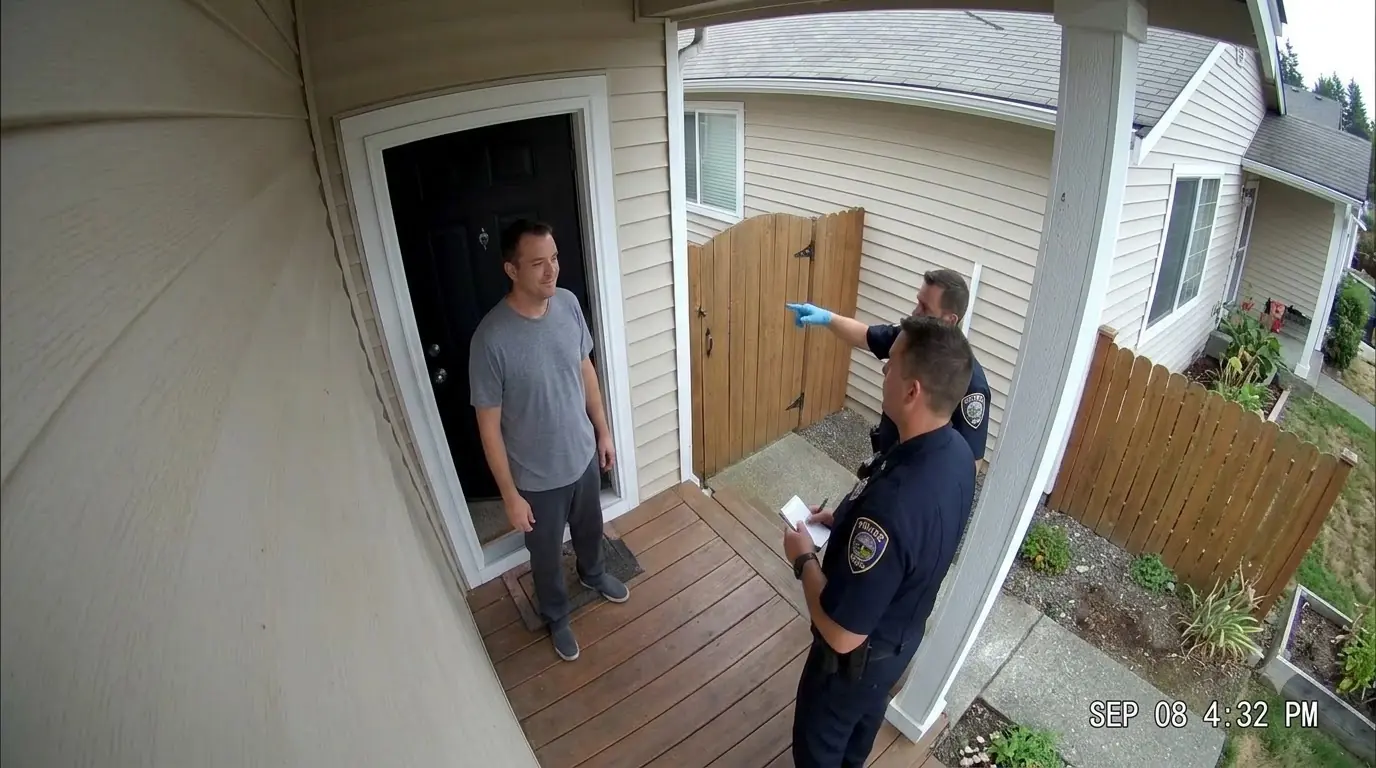
We'll call him what everyone on that street called him, the good neighbor. Forty years old, living alone in the house right next to the Whitfields for almost a decade. No family nearby, not much of a social life outside that block, as far as anyone could tell. But he had them.
The Whitfields had, in a sense, adopted him. Thursday dinners, a spare key left with him whenever they went on vacation. A relationship built brick by brick over years, out of small favors and trust accumulated drop by drop, until it looked, on paper, like real family. Nobody on that street ever had a reason to doubt him.
And that is exactly why, for months, nobody ever stopped to look past his backyard fence. To understand how deep that trust ran, you have to understand how it was built, year after year. It didn't come from one big gesture. It came from hundreds of small ones, repeated with almost surgical consistency.
Small favors. Constant presence. The kind of reliability that in a community slowly turns into something nobody questions anymore. Because questioning someone who's behaved that way for a decade would feel, frankly, unfair.
But trust built with patience has a dark side, too. One that rarely gets talked about. The more solid and selfless a bond looks to everyone watching, the less anyone feels entitled to ask the uncomfortable questions. Nobody ever asked the neighbor why he'd never married.
Why he had no other friends outside that one family. Why he spent so many evenings at their house instead of his own. The questions that, in hindsight, would look like glaring red flags seemed completely irrelevant at the time. He was the good neighbor, full stop.
There was nothing else to wonder about.
Emily and Daniel had gone missing in March. Six months before this story reaches its breaking point. They'd gone out together on a Saturday night to meet friends at a bar 20 minutes from home. They never got there.
Gas station cameras at the corner of their street caught them getting into the car at 9:47 p.m. After that moment, for 6 months, nothing. Police had opened a wide investigation, the way they always do in cases like this. They checked the bar the siblings never reached.
They checked exes, coworkers, social media contacts. They even checked, as gently as possible, whether there were debts, addictions, any reason either of them might have walked away on their own. Nothing. Emily worked as an assistant at a veterinary clinic and was saving for college.
Daniel had just started an electrician's apprenticeship. There wasn't a single person in their known circle with a motive to make them disappear.
For a brief stretch in early April, investigators focused on a former classmate of Daniel's, a guy he'd had a falling out with months earlier over money never paid back. For a few weeks, it looked like the most promising lead, a concrete motive, a documented history of tension in saved text messages, a shaky initial alibi. Police brought him in twice. They searched his apartment.
They pulled phone records from the night of the disappearance. In the end, the alibi held. He'd been exactly where he said he was, 40 minutes away, confirmed by independent witnesses and surveillance footage from a bar. The lead died there, leaving investigators right back where they started, and the family with another week of hope burned for nothing.
It's worth remembering that detail because it shows how far the investigation moved from the very beginning in the most logical and predictable direction, toward known conflicts, toward people with a visible motive, and how little it ever moved toward someone with no apparent reason to be suspected. The neighbor owed neither of them money. He'd never had a public argument with either of them. There wasn't a single message, a single fight, a single written trace in any police file connecting his name to a possible motive.
His only visible flaw to anyone looking was being too present, too available, too close to that family. And it was exactly that closeness that made him invisible as a suspect for six straight months. Because nobody was looking at the obvious person, the one too close to be suspected. The one who the very same night the siblings vanished showed up at the grieving parents' door with a cake and cried with them on the porch asking if there was anything at all he could do to help.
From that point, the story moved on two parallel tracks. Track one, the parents, Karen and Robert, clinging to every possible hope in the months after the disappearance. Flyers, search parties combing nearby woods, local news interviews with swollen eyes and cracking voices begging anyone with information to come forward. And every single evening, the neighbor right there with them, bringing food, answering the phone when false tips came in, driving them down country roads during nighttime searches.
The perfect public image of a man just as devastated as they were by the disappearance of two kids he treated almost like his own. Track two, whatever was happening behind his own fence once the streetlights went dark and nobody was left watching. We won't know for certain until much later in this story, but one detail, seemingly insignificant, is already starting to crack that perfect surface. A neighbor a few houses down, an elderly woman who walked her dog every morning at 6:00, would tell investigators months later that she'd noticed, as early as late March, a sound of disturbed earth coming from the backyard of that house, an engine, some kind of small excavator maybe, in the dead of night.
She hadn't thought much of it at the time. Who stops to suspect the neighbor who's grieving two missing kids like they were his own blood. There's another detail, collected only months later during door-to-door interviews, that nobody connected to anything at the time. A teenager living two houses down across the street would later say he'd woken up that same March night to use the bathroom, and had noticed, glancing out the window half asleep, that the lights in the neighbor's backyard were on.
Unusual since the whole block was normally dark by that hour. He hadn't thought about it for more than a second. A grown man doing yard work at odd hours at night isn't, on its own, something that raises alarm in anyone, least of all a half-asleep kid who just wants to get back to bed. But that light, at that exact point in the night, lines up with almost surgical precision with the last hour Emily and Daniel's phones ever pinged a cell tower in the area before going dark for good.
Months pass. Summer arrives and fades, hot and quiet, and the Whitfield case slowly slides out of local headlines, the way it almost always does when a disappearance stops producing new leads. Detectives assigned to the case get pulled onto other priorities. Flyers on utility poles fade under the sun, but Karen and Robert never stop.
And their neighbor, it should be said, doesn't seem to stop either. He keeps showing up, keeps offering help, keeps being, in everyone's eyes, the quiet pillar that broken family can still lean on. This is where something starts to shift, so slowly that almost nobody notices it happening in real time.
Toward the end of August, a resident two houses down is the first to notice something he describes to police as a heavy, sweetish smell that would not go away even with the windows shut. He initially chalks it up to a dead animal under a porch or stuck in an air duct, the kind of thing that happens now and then in any residential neighborhood. He calls animal control. Nobody finds anything.
The smell doesn't go away. If anything, with the late summer heat, it gets worse. A second complaint comes in a few days later from another house on the same block. Then a third.
Three different families within a week all complaining about the exact same thing, all convinced the source is somewhere near them, none able to point to exactly where. It's worth underlining a detail here. The people complaining about the smell at this stage are not the Whitfields. The parents of the two missing kids live just a few yards from the actual source of the problem.
Yet it's people further away who notice it first and more intensely. A cruel irony that won't become clear until the very end. It's worth pausing on that because it says something bigger about how human perception actually works when it's filtered through grief and habit. Karen and Robert had lived in that house for 19 years.
They knew every sound, every seasonal smell, every small shift in the air around them. To the point that, paradoxically, a gradual change could be harder for them to notice than for a stranger. On top of that was something even more painful. For months, the two parents had been living inside a suspended kind of grief.
An anticipation that consumed every thought, every ounce of energy, every capacity to pay attention to anything not directly tied to the search for their children. A strange smell in the late summer air for two people in that state could easily fade into the background against the weight of one much bigger question that followed them every single moment. Where are our kids? The families further away didn't have that filter.
For them, that smell was simply a practical problem to solve. And that's exactly why they noticed it with a clarity the Whitfields at that point in their lives were denied.
After the third call, local police decide to send two officers to walk the block and pin down the source. It's not urgent. It's the kind of routine check departments run dozens of times a year for neighbor complaints. Dumpsters, plumbing, dead animals.
The officers walk the street sniffing the air, trying to isolate where the smell gets strongest. And they inevitably stop right at the gate of the house next to the Whitfields. This is the moment this story circles back, literally, to where it started.
The officers knock. The man who opens the door is the same one who for 6 months has walked a shattered family through the worst nightmare of their lives. He smiles. He greets them with the ease of a man who has absolutely nothing to hide.
He says he hasn't noticed any particular smell, but invites them in to check anyway, just to be safe. There's no visible tension in him, no hesitation. It's exactly the behavior you'd expect from an innocent man. And that's precisely why for the first few minutes, the officers suspect nothing at all.
They check the inside of the house, kitchen, bathroom, basement. Everything tidy, everything normal. Everything strangely clean for the home of a man living alone. No clutter, no accumulated dust, none of the minor chaos that tends to characterize almost any home lived in for years by a single person.
It's a cleanliness that in hindsight will take on a very different meaning than simple tidiness. But in that moment, to two officers doing a routine check, it just looks like the home of a methodical man. They find nothing that explains the smell. The younger of the two officers is already about to write source unidentified on the report and move on to the next house.
It's the more experienced officer who pauses at the back door, looks past the glass out toward the yard, and notices that one corner near the back fence has a slightly different color of dirt than the rest of the lawn. Darker, more disturbed, as if someone had worked that patch recently and covered it back up in a hurry. He asks for permission to take a look outside. The man, for the first time in the entire conversation, hesitates for a fraction of a second before saying, "Yes."
It's a tiny detail, almost imperceptible, but it's the first crack in 6 months of flawless performance.
The officers step out into the yard. The smell out here is far stronger than inside the house, far stronger, in fact, than it had been out on the street. And this is where the story, for a moment, seems to take a completely different direction than the one you and everyone else were probably expecting up to this point. Because the first thought crossing the officers' minds, looking at that disturbed dirt next to a man who lives beside a family shattered by a double disappearance, isn't the obvious one.
It's that the man might simply have buried a dead animal. A dog, a neighborhood cat hit by a car. It happens. It's not at all rare for the source of an unpleasant smell in a private yard to be something completely innocent, even if buried in an unusual way.
That's the explanation the man himself gives when asked directly what's under that dirt. And he states it firmly. "His dog died a few months back," he says. And he didn't have the heart to take it to a vet for cremation.
So, he buried it right there in his own yard, the way countless families have done for generations. It's a plausible explanation, perfectly believable. The kind of small human detail that most people, hearing it, would accept without asking anything further. The officers, though, have to verify by procedure.
They ask the man if he has any veterinary paperwork for the dog. He says he doesn't, that the animal had never been registered with a vet. Another detail that, on its own, would mean nothing. But stacked on top of everything else, the hesitation at the door, the smell too strong for a small animal, the disturbed dirt wider than you'd expect for that kind of burial, it starts building a picture nobody present has the nerve to say out loud yet.
There's one more thing the officers only notice looking back on the scene later. Through the entire conversation about the dog, the man never once looks directly at the exact spot of disturbed dirt. He keeps his eyes on the officers, on the house, on any other point in the yard, except that one. The kind of detail that, alone, would mean absolutely nothing.
People look away for a thousand innocent reasons, but added to everything else, it starts tipping a scale nobody present can quite name yet.
One of the officers calls for backup, not for an arrest, just, as the report later puts it, for completeness of the check. It's a bureaucratic decision, almost trivial on paper. And it's that decision, made on an ordinary afternoon in early September, that changes the course of this story forever.
A second unit arrives. With them, a cadaver dog trained specifically to detect human remains. This is the point where the tension, contained and almost polite until now, changes register completely. The dog is walked into the yard.
It doesn't take more than 30 seconds before it stops, rigid, right over that darker rectangle of dirt. It doesn't bark. It sits. That's the signal every officer on scene recognizes instantly.
And it's the signal that turns a routine check into an active crime scene.
At this point, the man is moved away from the yard and held under watch while officers wait for authorization to dig. He'll later tell investigators he stayed strangely calm. He didn't protest. He didn't ask for a lawyer in that moment.
He simply stood by in silence while the men prepared to unearth what he had spent 6 months burying under layers of dirt and lies told with a choked-up voice to a family that trusted him more than anyone else on Earth.
Meanwhile, word of a police response at the neighbor's house spreads down the street with a speed typical of any small community. Karen and Robert, alerted by another resident, come out of their house and walk over to the tape that now cordons off the yard next to theirs. They have no idea yet what's happening. They ask an officer for an explanation, who tells them, with professional caution, only that it's a routine check, without adding anything else.
Karen, according to a witness present at the time, turns toward the neighbor's house and says, almost to herself, "I just hope he's okay. After everything he's done for us these past months." Nobody in that moment has the courage or the cruelty to tell her what might really be under that dirt.
The dig begins in the late afternoon. It moves slowly, carefully, the way it always does when human remains are suspected. Officers work in shifts, clearing dirt inch by inch as the afternoon light slowly fades toward sunset. Karen and Robert are kept behind the tape, but they stay, frozen, unable to leave, as if some instinct older than any official information were warning them that something irreversible was about to happen just a few yards away.
And after about 40 minutes, one officer's shovel hits something that isn't dirt, isn't rock, isn't a root. The nighttime noise heard by a neighbor back in late March suddenly takes on a new meaning: an engine, a small excavator in the dead of night in the days immediately following Emily and Daniel's disappearance.
That noise, forgotten for months, now takes on a meaning that runs cold. It wasn't innocent yard work. It was a man on the darkest night of his fabricated life digging the hole that would hide the truth for 6 months.
Two sets of remains are recovered from that yard. Follow-up analysis over the coming days will confirm what, by that September afternoon, almost everyone present had already stopped hoping wasn't true. The bodies belong to Emily and Daniel Whitfield. Buried together, just steps from the house where their parents had woken up every single day for 6 months hoping for a call that would bring them home alive.
The motive, when it emerges in the following days through early statements and deeper investigation, isn't that of a stranger, a robber, someone hunting a random target. It's something far closer, far more intimate. And precisely because of that, far harder for anyone on that street to accept. Over the years, the man had built an obsessive attachment to that family, one he described in his own words, as later reported by investigators, as the only real thing he'd ever had. An attachment that cracked open by a rejection, a distancing, something that in his mind represented an unbearable betrayal by the two kids he saw almost as his own, turned into something irreversible on the night of March 21st. According to the subsequent investigation, that night the two siblings had, for the first time in years, skipped a small habit that had quietly settled into place without anyone really noticing: stopping by to say goodbye to him before heading out.
A gesture that meant nothing at all to Emily and Daniel, who likely never thought twice about it. But for a man who had built his entire sense of identity around that family, that one small missed gesture appears to have become, in his mind, proof of an intolerable distance opening up between them. Reconstructing the timeline of that evening through phone records and street camera footage, investigators believe the man intercepted them not far from home using some plausible pretext. A request for help, car trouble, something ordinary enough not to raise any suspicion in two kids who, deep down, considered him almost a second father.
Because the man who killed Emily and Daniel wasn't a stranger who broke into their home in the dead of night. He was the same person who, just hours after burying them in his own backyard, showed up on their parents' porch with a cake, offering to help with the search. The same person who, for 6 months, drove Karen and Robert down country roads looking for their own kids, knowing at every single moment exactly where they were. The same person who cried, genuinely or not, on the shoulders of a shattered mother and father while their children remained buried a few dozen feet away on the other side of a plain wooden fence.
And the cruelest detail of all, the one that closes this story with a weight that's hard to shake, the first people to smell that buried truth were not Karen and Robert. It was strangers, families a few houses down, people with no direct connection at all to the two missing kids. The parents, the ones who would have given anything for a single clue, lived for months right next to the most devastating truth of their lives without ever being able to sense it. Blinded by the absolute trust they'd placed in the one neighbor they considered family.
The man was arrested that same afternoon in front of an entire block that, an hour earlier, still saw him as a quiet hero. Charges filed in the following days included the murder of both siblings and concealment of the bodies. The trial, according to local reporting, is still in its early stages, but the evidence gathered at the scene, including the testimony about that nighttime noise back in March, has been called by investigators among the strongest ever collected in a case like this in the county.
Karen and Robert Whitfield were finally able to bury their children somewhere other than the backyard of the man who had betrayed them in the most total way possible. Through a family spokesperson, they released a single public statement, short, almost impossible to read without feeling its weight: "We cried alongside the man who knew. Every single day for 6 months, he looked us in the eye knowing. There is no word in any language for what it means to find that out."
Maybe there really isn't. But there's a question this story leaves open, and it might be the most unsettling one of all. How many other doors on how many other quiet streets where nothing ever happens are hiding that exact same distance, just a few feet of dirt between the people desperately searching for the truth and the person who, every single day, chooses to keep burying it?