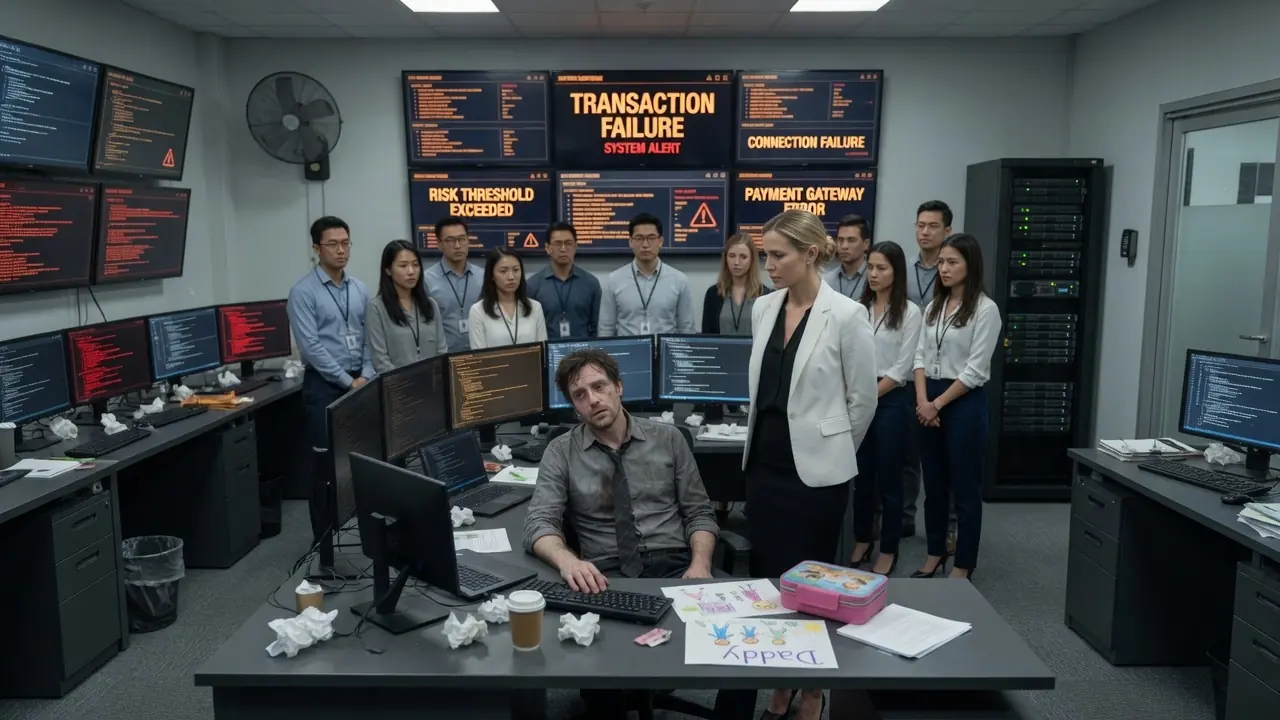
On the first morning Natalie Cross officially became CEO of the company, she entered the command center and found a man asleep in front of the main monitoring wall.
His head was folded over his arms. A cold coffee cup sat beside his keyboard. Around him, nearly thirty screens glowed with alerts, transaction logs, warnings, and restless streams of numbers that never stopped moving.
Natalie did not ask why he was sleeping.
She did not ask how long he had been there.
She did not ask why half the screens around him were flashing amber.
She saw a man asleep at the most critical desk in a financial technology company, and the image confirmed everything she had been told about the culture she had inherited.
Lazy.
Comfortable.
Undisciplined.
In front of the entire operations floor, she pointed at his badge and said, “Remove his access.”
The man lifted his head slowly.
His name was Ethan Vale.
He blinked as if he had been pulled back from somewhere much farther away than sleep. His face was pale with exhaustion, his shirt wrinkled, his eyes red from too many hours under fluorescent light.
“Wait,” he said, voice rough. “You need to listen to me about the core settlement cluster.”
Natalie cut him off.
“No. I don’t need an explanation from someone sleeping on duty during my first hour as CEO.”
Several engineers froze in their seats.
No one spoke.
Ethan tried again, more urgently this time.
“If anyone restarts the cluster—”
“I said no,” Natalie interrupted. “Security, take his badge. HR will process the termination immediately.”
Ethan looked at her for a long moment.
Not with anger.
Not even with fear.
With the hollow, terrible calm of a man watching a bridge collapse after spending two days holding it up with his bare hands.
He removed his badge and placed it on the desk.
Before he walked out, he turned to a younger engineer standing near the console and said four words.
“Do not reboot anything.”
Then he left.
By noon, those four words would become the most important warning in the entire building.
By one o’clock, the company’s payment infrastructure would begin failing layer by layer.
And by late afternoon, Natalie Cross would be standing in the middle of the same operations floor, realizing she had publicly fired the only man who knew how to stop the collapse.
HeliosPay was not an ordinary technology company.
A slow website might annoy customers. A broken app might create complaints. But HeliosPay processed corporate payments, instant wire verifications, payroll disbursements, international settlement confirmations, and transaction authentication for thousands of businesses across the country.
Its systems did not get to “have a bad day.”
One bad hour could trap payroll files in limbo, delay vendor payments, freeze corporate transfers, and create tens of millions of dollars in exposure before anyone outside the building even understood what had happened.
The company was not its glossy website.
It was not its investors.
It was not the glass tower downtown with its polished lobby and expensive coffee machine.
The company was the infrastructure.
Everything else was decoration.
Ethan Vale’s title was principal systems engineer, though the title barely described what he actually did.
He was thirty-six, quiet, usually rumpled, and almost aggressively uninterested in corporate theater. He did not network. He did not speak in meetings unless the topic required facts. He did not volunteer for committees or join happy hours or make himself visible to the people who measured value through presence.
New executives tended to overlook him.
Older engineers did not.
They knew Ethan understood HeliosPay’s architecture in the way a mechanic understands an old engine by sound. He knew which legacy services had been patched during a holiday outage six years ago. He knew which authentication relay should have been retired but could not be touched without breaking a reconciliation pathway nobody had documented.
He knew which databases were technically redundant but still quietly handled critical fallback logic.
He knew where the old code lived.
He knew where the real danger was.
Ethan carried the real version in his head.
Outside the company, he was the only parent of Lily Vale, an eight-year-old girl with serious eyes, a sharp memory, and a habit of asking questions adults were not prepared to answer.
His wife, Nora, had died after a long illness when Lily was four.
Since then, Ethan had built his life around two promises: keep Lily safe and keep the job that kept their life from falling apart.
He was not ambitious in the way the company understood ambition.
He did not want applause.
He wanted stability.
That was all.
Natalie Cross came from a different world.
She was thirty, brilliant, polished, and newly installed as CEO after her father, the company’s founder, stepped back due to failing health. She had earned degrees from the best schools, impressed difficult investors, and spent years proving she was more than a family name.
But leading HeliosPay was different from advising it.
She had inherited an aging, complicated, fragile machine full of people who knew more than she did about the parts that mattered most. She knew that. Privately, at least.
Publicly, she could not afford hesitation.
From her first day, she planned to send a message.
Accountability.
Discipline.
A company no longer run on old favors, old habits, and quiet tolerance for mediocrity.
So when she walked into the operations center and saw Ethan asleep, she believed she was seeing exactly what she had come to correct.
The problem was that she did not know what had happened during the previous forty-eight hours.
Two days earlier, Ethan had noticed something wrong in the authentication logs.
At first, it was small.
Too small for automated alerts.
A handful of irregular verification requests inside the international settlement queue. Nothing loud. Nothing that looked like an attack to the monitoring tools. The requests moved with the rhythm of legitimate internal traffic, which was precisely why they were dangerous.
They were not trying to break in quickly.
They were learning.
Ethan saw the pattern before the system did.
The requests were touching services in sequence, mapping what each layer could reach. They had entered through an old secondary relay attached to cross-border client verification, the kind of quiet edge service that had survived three modernization projects because no one remembered what would break if it was removed.
From there, the attackers were testing routes toward the central payment cluster.
Slowly.
Patiently.
Professionally.
Their goal was not chaos.
Their goal was timing.
If they triggered their attack during a high-volume processing window, they could redirect payment instructions, corrupt reconciliation logs, or freeze transaction states long enough to move funds through unverified endpoints.
Ethan escalated the anomaly to his manager, Paul Reddick.
Paul listened, frowned, and asked whether Ethan was certain.
Ethan said he was certain enough to start containment.
Paul’s face changed.
It was the day before the new CEO took control. A major incident report would land badly. It would raise questions about infrastructure investment, oversight, transition readiness, and executive accountability.
“Keep monitoring it,” Paul said. “Don’t escalate until we know more. We don’t need to create panic over a maybe.”
Ethan understood what that meant.
Stay quiet.
Keep the system running.
Do not embarrass anyone.
He ignored the spirit of the instruction while technically obeying the words.
He stayed.
He built temporary barriers around the compromised services. He rerouted suspicious traffic into controlled sinks. He patched nodes by hand, documented timestamps, and created manual guardrails around functions that should have had automated protections years earlier.
It was the kind of work that looked like nothing from the outside.
No dramatic red screen.
No alarms.
No executive dashboard changing from green to red.
Just one engineer walking through an old digital building in the dark, finding cracks in the walls, and pressing his weight against them before anyone upstairs noticed the foundation shifting.
By the second night, Ethan had been awake so long that time lost shape.
He drank vending machine coffee until it tasted like metal. He ate two granola bars and half a sandwich someone left in the break room. At midnight, he changed his shirt in the staff bathroom and washed his face with cold water because his eyes had started burning.
Several engineers saw him still at his desk and assumed he was handling a long-running incident.
No one understood the scale.
No one knew he had already prevented three attempted escalations inside the authentication layer.
No one knew he was fighting a live intrusion with temporary logic built faster than policy allowed and more carefully than the company deserved.
Near four in the morning, he found the real trap.
A delayed activation trigger had been planted inside the settlement cluster.
It was dormant.
Invisible during normal operations.
But if anyone performed a standard reboot, the trigger would fire, clear Ethan’s temporary defenses, reopen the attacker’s pathway, and allow the intrusion to enter the active payment environment.
A reboot was the most ordinary thing in the world.
That was what made it lethal.
Every engineer in the building knew to reboot services when latency rose.
Every supervisor had ordered it a hundred times.
So Ethan wrote the warning in every place he could think of.
In the incident notes.
In the patch log.
In the internal repository.
In a plain text summary marked urgent.
At the bottom, he added one line in capital letters.
DO NOT REBOOT THE CORE SETTLEMENT SERVICES. THIS IS NOT A PERFORMANCE ISSUE. CALL ME FIRST.
He added his personal number.
He intended to brief leadership in the morning.
He intended to walk into whatever office he had to walk into and force someone to understand.
But the body has its own chain of command.
At 7:23 a.m., sitting in front of the monitoring wall, Ethan rested his head on his arms for one minute.
His body took the minute and turned it into sleep.
Twenty-two minutes later, Natalie Cross walked in.
By 8:05, Ethan Vale no longer worked for HeliosPay.
For a few hours, nothing obvious happened.
That was the cruel part.
The defensive layers Ethan had built kept working after he left. They continued absorbing hostile requests. They continued masking the seriousness of the attack. They continued giving the appearance of stability to people who did not understand that stability was now a borrowed thing.
Natalie moved through her morning schedule with sharp precision.
She met with department heads. She spoke about operational discipline. She made clear that old habits would not survive under her leadership.
Some executives admired her decisiveness.
Some feared it.
In the technical department, the mood was darker.
A few engineers found Ethan’s notes in the repository. The writing was dense, rushed, full of shorthand and references only someone familiar with his habits could fully understand. But certain warnings were impossible to miss.
Do not reboot.
Manual isolation active.
Delayed trigger suspected.
Call before service restart.
Daniel Kim, the younger engineer Ethan had warned before leaving, read the notes three times and felt his stomach tighten.
He had worked under Ethan for two years.
He knew Ethan was not dramatic.
He knew Ethan did not exaggerate.
At 12:41 p.m., transaction latency began rising in the settlement cluster.
Clients were still processing, but slowly. Queues backed up. Authentication callbacks lagged. A supervisor named Greg Mallory stepped to the console and made the ordinary decision that had solved similar problems dozens of times before.
“Restart the core services,” he said.
Daniel turned sharply.
“No.”
Greg looked at him.
“What?”
“Ethan said not to reboot.”
Greg’s expression hardened.
“Ethan was terminated.”
“I know, but he left notes. He said this exact thing might happen.”
Greg glanced at the warning file, then at the growing queue times on the dashboard.
“We are not going to let a fired engineer run production from beyond the grave.”
Daniel tried one more time.
“He was here for two days.”
“And now he is not.”
Greg executed the restart.
For the first ninety seconds, the system improved.
Latency dropped.
Queues moved.
Greg exhaled.
Then the authentication tokens fell out of sync.
Not all at once.
In waves.
Payment sessions began returning state mismatches. Some transactions showed as pending and uninitialized at the same time. Reconciliation logs stopped matching verification responses. A subset of outbound instructions began attempting to route toward endpoints outside HeliosPay’s trusted network.
Daniel stared at the screen.
His mouth went dry.
The restart had cleared Ethan’s temporary logic.
The dormant trigger had fired.
By 1:03 p.m., the operations floor no longer sounded like an office.
It sounded like a ship taking on water.
Engineers shouted across rows. Phones rang without stopping. Client support escalations flooded the queue. Monitors shifted from amber to red. Every attempt to isolate the affected services caused another dependency to fail somewhere else.
Greg tried to roll back.
The rollback failed.
A senior engineer tried to block the outbound connections.
Three legitimate client routes broke with them.
Someone opened Ethan’s notes and began reading aloud, but understanding the warning was not the same as knowing how to reverse the damage.
The system had been held together by work no one else fully understood.
And the man who understood it had been escorted out before breakfast.
Natalie was pulled from an executive briefing at 1:17.
By the time she reached the operations center, the atmosphere was nothing like it had been that morning.
No one looked lazy.
No one looked comfortable.
Every face was pale with concentration or fear.
The monitoring wall was full of red.
“What is happening?” Natalie asked.
Daniel turned from his station.
His voice was quiet, but it carried.
“Ethan was holding the attack back manually. We rebooted the cluster. It triggered the breach.”
Natalie looked at him.
For one second, she did not understand.
Then she did.
“Where is the CTO?”
“On his way.”
“Who understands Ethan’s patch logic?”
No one answered.
That was the answer.
Natalie walked to an empty workstation and opened Ethan’s repository file.
She read the notes.
The timestamps.
The isolation steps.
The warnings.
The line at the bottom.
DO NOT REBOOT THE CORE SETTLEMENT SERVICES. THIS IS NOT A PERFORMANCE ISSUE. CALL ME FIRST.
Below it was his phone number.
Nobody had called.
Natalie sat very still.
In her mind, the morning returned with brutal clarity.
Ethan lifting his head.
His exhausted face.
His attempt to speak.
If anyone restarts the system—
She had not misunderstood him.
She had refused to hear him.
There is a difference, and the difference matters.
She called the number.
No answer.
She called again.
No answer.
A third time.
Nothing.
“HR,” she said, standing. “Find his home address.”
It took seven minutes.
Seven minutes during which the company lost ground every second.
Natalie took the address, left the operations center, and drove herself across town.
Ethan lived in an older apartment building on a quiet street lined with sycamores. It was not a poor neighborhood, exactly, but it was not the kind of place Natalie had imagined when she thought of senior technical staff responsible for billion-dollar infrastructure.
She stood outside his door and knocked.
No answer.
She knocked again.
Louder.
At last, the door opened.
A little girl stood there with a stuffed fox tucked under one arm.
She looked up at Natalie with clear, cautious eyes.
“Are you from Daddy’s work?”
Natalie’s throat tightened.
“Yes.”
The girl opened the door wider.
“He’s asleep.”
Inside, the apartment was small, neat, and visibly lived in. A school backpack rested near the table. A half-finished worksheet lay beside a glass of milk. On the sofa, Ethan was asleep on his side, still wearing the same clothes from the morning.
One shoe was off.
One was still on.
His laptop sat open on the coffee table, the screen locked but still glowing. A glass of water stood beside it, untouched.
He looked less like a careless employee than a person who had collapsed after outrunning his own body.
The little girl lowered her voice.
“I’m Lily. Daddy said something bad was happening at work. He said he just needed to close his eyes for a second.”
Natalie looked at Ethan.
Then at the child.
“How long has he been awake?”
Lily thought about it.
“He didn’t come home the night before last. Mrs. Patel stayed with me. Then he called yesterday and said he had to keep fixing it. He sounded funny.”
Natalie closed her eyes briefly.
Every assumption she had made that morning turned to ash.
She had not fired an irresponsible engineer.
She had fired a widowed father after he spent forty-eight hours saving her company while making sure his child was cared for by neighbors.
She knelt slightly.
“Lily, may I wake him?”
Lily hugged the stuffed fox tighter.
“Is the bad thing worse?”
Natalie did not lie.
“Yes.”
It took several attempts to wake Ethan.
He surfaced slowly, painfully, as if sleep had wrapped itself around his bones. When he finally recognized Natalie, no anger crossed his face.
Only exhaustion.
“What happened?” he asked.
“They rebooted.”
His eyes closed.
For a moment, the room was completely silent.
Then he reached for the laptop.
The metrics loaded.
He scanned them for less than a minute.
“Outbound trust path opened,” he said. “Token sync is gone. Reconciliation is probably contaminated.”
Natalie sat across from him.
“We need you.”
Ethan looked at Lily first.
“Did you eat?”
She nodded.
“Homework?”
“Almost done.”
“Mrs. Patel?”
“She said she can stay.”
Ethan looked at Natalie again.
“I’m not going back for the job.”
“I understand.”
“No,” he said. “I don’t think you do.”
He stood slowly, steadying himself on the edge of the sofa.
“I’m going back because if that system finishes failing, real people get hurt. Small businesses miss payroll. Vendors don’t get paid. Employees wonder why their money is gone. The company made mistakes, but the customers didn’t.”
Natalie absorbed the words.
No defense came to her.
None deserved to.
Ethan changed his shirt, kissed Lily’s forehead, and told her he would be back as soon as he could.
Lily handed him the stuffed fox.
“For luck.”
He almost smiled.
“I think you need him more.”
She pushed it into his hands.
“You’re fixing the bad thing.”
So he took it.
On the drive back, neither Ethan nor Natalie spoke.
When they entered the operations center, the room changed immediately.
Engineers turned.
Some looked relieved.
Some ashamed.
Some both.
Ethan did not waste time on either emotion.
He took the main console.
“Tell me every command executed after the reboot,” he said.
Greg began speaking.
Ethan stopped him.
“Not summaries. Commands.”
Greg swallowed and read from the log.
Ethan listened with total focus. No theatrics. No accusation. No wasted motion.
When the summary ended, Ethan was silent for maybe ten seconds.
Then he began assigning work.
“Daniel, isolate the anomalous outbound endpoints but don’t block them yet. Sinkhole them into a controlled route and preserve payload metadata.”
Daniel nodded and moved.
“Priya, I need current token state variance across all active payment sessions. Mark anything above threshold and quarantine without reversal.”
“On it.”
“Luis, build a mirror of the compromised relay. I want to see what they thought they could reach.”
He turned to Greg.
“You write down every command I issue. Exactly. If I say it, it goes into the incident record.”
Greg nodded, pale.
Ethan glanced toward Natalie.
“Legal needs to notify the top enterprise clients that we have a controlled technical incident affecting processing latency. Do not say breach until we confirm scope, but do not lie.”
Natalie turned to the general counsel.
“Do it.”
For the next two hours, Ethan did not so much fix the system as conduct it.
Every instruction had a place.
Every engineer became useful.
Every minute mattered.
The hostile outbound pathways were diverted into controlled observation. Suspended payment batches were quarantined before funds left trusted channels. Token synchronization was rebuilt from a clean reference state. The compromised relay was severed and rebuilt with fresh credentials.
Three high-value transactions were caught seconds before they would have routed through unverified endpoints.
Seventeen configuration changes closed the pathway the attackers had prepared.
By 4:02 p.m., the bleeding slowed.
By 4:41, the core settlement cluster stabilized.
By 5:18, HeliosPay was no longer on the edge of catastrophe.
There would still be consequences.
A full security audit.
Regulatory notices.
Client calls.
Manual reconciliation.
A painful review of every outdated system and every bad decision that had allowed one exhausted engineer to become the only real defense between the company and disaster.
But the company had survived.
Barely.
Because Ethan came back.
The emergency board meeting began at 6:30.
Ethan sat at the far end of the conference table with a band of exhaustion across his face. Natalie sat at the opposite end. Between them were the CTO, department heads, legal counsel, HR, and three board members dialing in remotely.
The timeline was presented.
Ethan identified the intrusion forty-eight hours earlier.
He escalated it.
His manager delayed formal reporting.
Ethan built temporary containment.
He documented the delayed trigger.
He warned against rebooting.
Natalie fired him before he could brief leadership.
The system was rebooted anyway.
The breach activated.
Ethan was recalled and stopped the attack.
After the technical report, the room filled with the usual careful language.
Communication gaps.
Transition stress.
Process failure.
Unclear escalation ownership.
Natalie listened for thirty seconds.
Then she stood.
“No.”
Everyone stopped.
“This was not an abstract process failure,” she said. “This was a leadership failure, and the first one was mine.”
No one moved.
“This morning, I saw Ethan asleep at his desk and decided I understood the situation without asking a single question. I did not look at the monitors. I did not review the alerts. I did not ask why he was there. I fired him publicly before he could complete one sentence.”
Her voice remained steady, but not untouched.
“I was wrong. My decision nearly caused catastrophic harm to this company and its clients. Ethan saved HeliosPay before I arrived, and then saved it again after I removed him.”
She turned toward him.
“Ethan, I apologize. Publicly, fully, and without qualification.”
The room was painfully quiet.
Ethan looked at her.
He did not smile.
He did not perform forgiveness for the benefit of executives who wanted a clean emotional ending.
He only gave one small nod.
Received.
Not erased.
There was a difference.
Over the following weeks, HeliosPay moved faster than anyone expected.
Paul Reddick, the manager who had told Ethan not to escalate, resigned before the internal review concluded. The CTO was moved into an advisory role after it became clear that his understanding of the legacy systems was dangerously shallow. Greg Mallory received a formal reprimand but remained employed after Ethan himself recommended retraining rather than dismissal.
Natalie offered Ethan a promotion immediately.
He did not accept immediately.
First, he negotiated.
Not for a corner office.
Not for a title.
Not even for salary, though that came later and came significantly.
He asked for structural changes.
A direct escalation path from frontline engineers to executive leadership for security incidents.
Mandatory rest rotation for critical operations staff.
No engineer could be allowed, praised, or pressured into becoming a single point of failure through exhaustion.
Production restart controls requiring contextual review during security events.
Formal protection for employees who raised urgent technical risks.
Updated documentation standards with dedicated time allocated for institutional knowledge transfer.
And an incident command structure that did not depend on hierarchy over expertise.
Natalie accepted every demand.
Not because it was generous.
Because it was correct.
Ethan became Director of Infrastructure Resilience, a title that finally came close to what he had already been doing unofficially for years.
His salary changed.
His authority changed.
More importantly, the company changed around him.
Slowly at first.
Then visibly.
Engineers spoke sooner.
Managers listened longer.
Meetings became less polished and more useful.
Natalie changed too.
Not into a softer person.
That would have been too simple and untrue.
She remained decisive. She remained demanding. She still expected high standards and disliked excuses.
But she learned to pause at the edge of judgment.
She learned to ask the second question.
The one that came after the image.
Why is this happening?
What am I not seeing?
Who in this room knows more than I do?
It was not humility as performance.
It was humility as survival.
The lesson had cost too much to become decorative.
A month after the incident, Natalie saw Ethan in the lobby at the end of the day.
He was kneeling beside Lily, adjusting one strap of her backpack while she explained something with animated seriousness. The stuffed fox was tucked under her arm. Ethan listened with the complete attention of a man who had spent too many years knowing time could not be wasted with the people who mattered.
Natalie stopped several feet away.
She had learned not every moment needed executive interruption.
Lily saw her first.
“You’re the work lady,” she said.
Ethan looked up.
For a second, Natalie saw him not as the engineer who had saved her company, not as the man she had wronged, but as a father whose daughter had once opened the door to the woman who had fired him.
“Yes,” Natalie said. “I am.”
Then she held out something small.
A red ribbon.
It had been tied around the stuffed fox the day Natalie visited Ethan’s apartment. Lily had left it in the back seat of Natalie’s car, and Natalie had kept forgetting to return it.
Lily brightened.
“Fox’s scarf!”
She took it and immediately tied it around the toy’s neck.
Ethan stood.
“Thank you.”
Natalie nodded.
“I should have returned it sooner.”
A small silence settled between them.
Not awkward.
Not easy either.
Just honest.
“I’m still sorry,” Natalie said quietly.
Ethan looked toward Lily, who was busy adjusting the fox’s scarf.
“I know.”
“I don’t expect that to fix it.”
“It doesn’t.”
Natalie nodded.
The answer hurt less than it deserved to.
Then Ethan added, “But it matters that you know that.”
She looked at him.
It was not forgiveness exactly.
It was not friendship yet.
It was something more useful than both.
A beginning built without pretending the damage had not happened.
The lobby doors opened and evening light spilled across the floor. Employees moved past them in small groups, talking softly, heading home, carrying laptops and bags and ordinary exhaustion.
HeliosPay was still standing.
Not because of the board.
Not because of the brand.
Not because of any speech about accountability.
Because one man had noticed what the system missed, worked until his body failed, warned them before leaving, and returned when people who did not deserve his help still needed it.
And because one woman, forced to confront the cost of her certainty, chose not to hide behind language clean enough to protect her pride.
Authority without listening had almost destroyed the company.
Expertise without recognition had almost destroyed the man.
What remained afterward was not simple.
But it was stronger.
And somewhere in the space between the woman who learned to ask and the man who had finally been heard, something real began to take shape.
Not trust.
Not yet.
But the first honest conditions under which trust might someday return.