The first rule of Stonelea was silence. It was not a rule written in the housekeeper's ledger, nor was it posted on any baize-covered board in the servants' hall. It was a rule delivered by atmosphere, by example, and at last by the thin, unsmiling mouth of Mrs. Selby herself. Cordelia Eversleigh, standing in the housekeeper's bare little parlor, felt the rule settle over her like a shroud.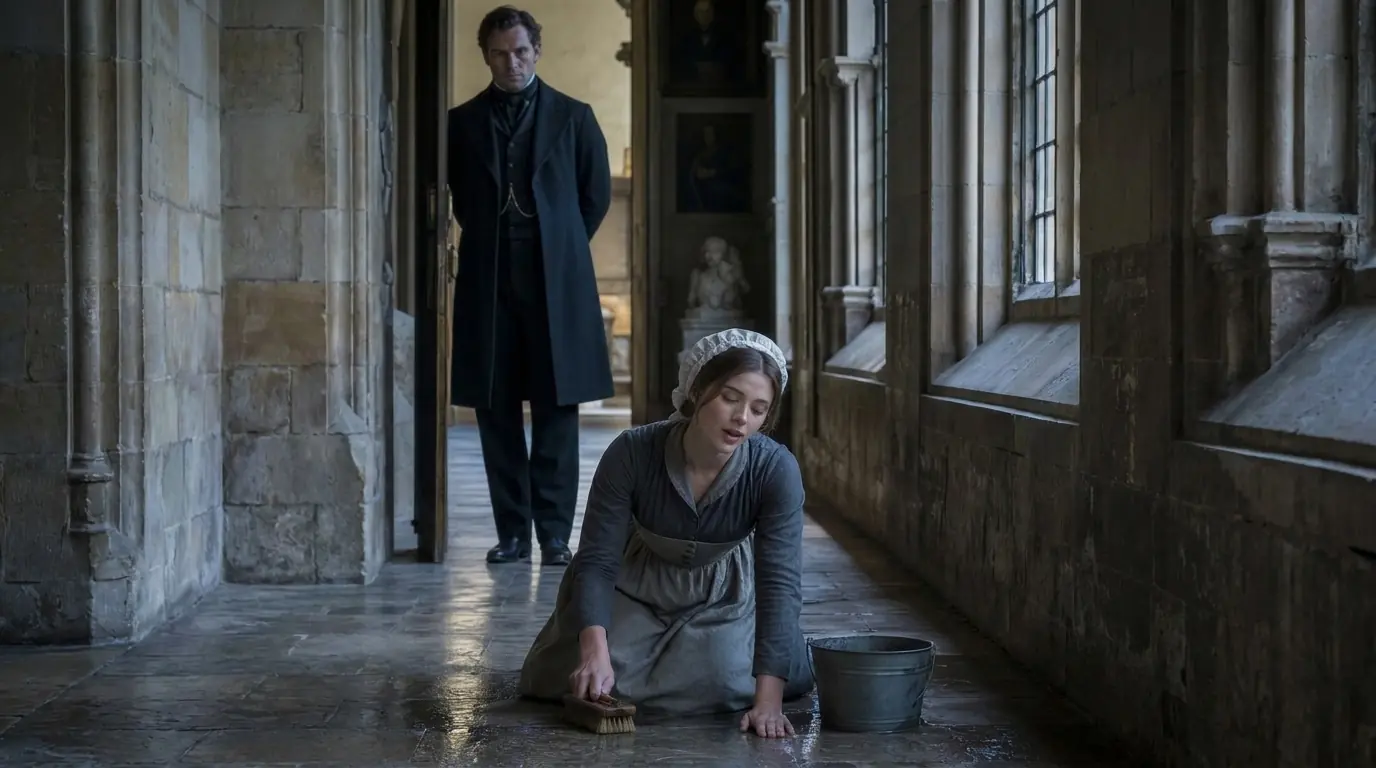
The room was cold, not only from the Cumberland wind that pressed against the windowpanes and found every gap in the old stone, but from a deeper, more deliberate chill that seemed to rise out of the walls. A single beam of watery afternoon light crossed the floor. The dust that turned within it was the only thing in that house, it seemed, permitted to move with any freedom. Your name is Mary, Mrs. Selby said.
It was not a question. Mary Cole, from Kendal. Your character is adequate, though your hands are perhaps too fine for a housemaid. Cordelia kept her own hands clasped behind her back, the calluses from her last desperate position as a laundress a sharp and secret rebuttal to the woman's verdict.
She had chosen the name Mary Cole because it was plain, forgettable, everything she now needed to be. Yes, Mrs. Selby. The housekeeper studied her a moment longer. She was a tall woman, narrow through the shoulders, her gray hair drawn back so tightly that it seemed to pull all expression from her face.
There was no cruelty in her, Cordelia would learn. There was only a kind of frost. The frost of a person who had taught herself year upon year to feel as little as possible. You will rise at 5:00.
Mrs. Selby said. You will black the grates. You will carry the coals. You will scrub the stone in the long gallery on your knees.
And you will say nothing to the family. You do not speak to His Grace. You do not speak to Lady Cecily. If His Grace passes you in a corridor, you turn to the wall and you wait until he has gone.
Do you understand me? Yes, Mrs. Selby. There is one rule above all others in this house. The housekeeper's voice did not rise.
If anything, it grew quieter. And the quiet was worse than shouting would have been. There is no music at Stonelea. None.
No singing. No whistling. No humming over your work as a foolish girl might. The pianoforte in the music room is shrouded and locked.
And it will stay so. The master does not abide music in any form. And any servant who forgets that finds herself put out upon the road by nightfall, character or no character. I have turned out two girls for it already.
I will not be sorry to turn out a third. Cordelia held very still. May I ask why, Mrs. Selby? It was the wrong question.
And she knew it the moment it left her. But she had asked it on purpose. She needed to know how much the woman would say. Mrs. Selby's mouth thinned further.
You may not. A good servant does not ask why. A good servant obeys and keeps her place and is grateful for a roof. She turned to the window and for one unguarded instant something passed over her hard face.
Something that was almost grief and almost anger and almost neither. The mistress is 18 months in her grave. She said to the glass rather than to Cordelia. That is all you need to know of it.
We do not sing here. We have nothing left to sing about. She did not weep. Cordelia understood, watching her, that Mrs. Selby had long ago learned the cost of weeping and had decided it was a luxury beyond a housekeeper's wages.
So this was Stonelea. A great house among the high Cumberland fells, gray as the stone it had grown from, set with its back to the mountains and its long face to a lake that lay flat and pewter-colored under the autumn sky. A house in mourning. A house that had forbidden itself the one thing that had ever truly belonged to Cordelia Eversleigh.
She had been singing since before she could speak in full sentences. Her mother had taught her the old airs of the dales and the borders, ballads that had been carried mouth to mouth for 200 years. Songs no one had ever written down. When her mother died, the songs were all she had been left.
When her father died, ruined and disgraced and broken in spirit, the songs had been the only thing the creditors could not take because they could not find them. They lived in her throat. They lived in her chest. They were the last unsold acre of the inheritance she had lost.
And she had come here to the one house in England where they were forbidden, because somewhere within these gray walls lay the proof that her father had been an honest man. She had not come for revenge. She wanted that understood, even if only to herself. She did not want to ruin anyone.
Did not want to watch a man fall. She wanted one thing only, the thing that the world had taken from a dead man who could no longer ask for it. She wanted his name returned to him. She wanted it said aloud by someone the world believed that Edmund Eversleigh had never stolen a shilling in his life.
For that, she would scrub stone on her knees and answer to the name of a stranger and hold her singing behind her teeth like a stone she was forbidden to set down. Bess will show you the attic where you'll sleep, Mrs. Selby said, dismissing her. Mind you keep to the back stairs. And Mary.
Yes, Mrs. Selby. Those fine hands of yours. The housekeeper looked at her and there was no warmth in the look, but there was something almost like a warning, almost like pity. Whatever they were before, they are a housemaid's hands now.
See that you do not forget it. This house does not forgive people for being more than they appear. You have no idea, Cordelia thought, lowering her eyes. You have no idea at all.
She came to know that old Finch, the butler, had served three generations of the family and moved through the house like a man walking in a church. She came to know that Thomas the gardener hardly ever spoke. That he tended the late mistress's rose walk in the cold as though she might still come out to see it. And that no one had the heart to tell him to stop.
She came to know the shape of the silence itself. It was not the silence of an empty house. Stonelea was full of people. It was the silence of a house where everyone had agreed, without ever saying so, to make themselves small, to soften their steps, to swallow their voices, because somewhere above them a man was grieving and his grief had become the law of the place.
She saw him only twice in those first weeks and both times from a distance. The Duke of Wickliffe was a tall man, taller than she had expected, with the kind of austere, well-cut features that the cold north light seemed to carve rather than soften. His hair was dark and beginning to gray at the temples, though he could not have been much past four-and-thirty. His eyes, when she dared a glance, were a deep and unsparing blue, the blue of the lake under cloud.
He still wore mourning, 18 months on, a black coat without ornament. He moved through his own house as though it did not belong to him, as though he were a guest who had outstayed his welcome and could not remember the way out. The first time she turned to the wall as she had been instructed and waited, and he passed her without a glance, a tall darkness going by, smelling faintly of cold air and ink. The second time she did not turn quite quickly enough, and for half a second their eyes met.
She expected nothing. She received nothing. He looked at her the way a man looks at a chair he does not intend to sit in and went on. That was all.
That was the whole of it. And yet she thought of it that night in the attic with the wind worrying at the slates and Bess asleep and snoring softly across the cold little room. She thought of how empty his face had been, not cruel. She had grown up around cruelty, had watched it wear the smiling mask of her father's false friends, and she knew its look.
The duke's face had not held cruelty. It had held nothing at all, the way a room holds nothing after the fire has gone out and the people have left and only the cold remains. There was a child in the house, too. Lady Cecily, the Duke's six-year-old daughter.
Cordelia saw her sometimes at the turn of the great staircase. A small grave figure in mourning gray. Always in the keeping of a stern nurse named Mrs. Tupp. The child never ran.
The child never called out. Cordelia who had been a noisy and a happy little girl once in a house that was gone now found something in the sight of that silent child that hurt her more than anything else at Stonelea. A child of six ought to be a kind of weather. A small storm of noise and want and joy.
This child was a held breath. Once passing on the back stairs, Cordelia heard the nurse say in the flat, hard voice of a woman repeating a lesson We do not raise our voices, my lady. We do not sing. You know what your singing did.
You know what your singing did. Cordelia carried those words with her for a long time after. She did not yet understand them. She would.
The proof she had come for was in the East Wing. She was almost certain of it. The East Wing was the late Duchess's and the East Wing was forbidden. Mrs. Selby had told her so on the first day in the same breath as the rule about singing.
The mistress's rooms were kept exactly as they had been left. They were dusted once a month by Mrs. Selby herself alone with the door locked behind her. No one else went in. No one else was permitted to go in.
The Duke had not crossed the threshold since the day his wife was buried. But the Duchess, Cordelia had reason to believe, had known the truth. The Duchess had been the one person in all of England who had begun, before she died, to set the wrong right. Cordelia knew it because of a letter, a single letter, water-stained and travel-worn, that had come to her father's lodgings in the last bad winter of his life, when they had nothing left but each other and a few sticks of furniture the bailiffs had not yet carried off.
She had read it to him by candle stub because his eyes had failed. It had been signed only with an initial, an H, but it had spoken plainly enough. It had said that the writer had come to understand a great wrong had been done to him. It had said that the writer was gathering what was needed to undo it, that it would take time and care and discretion, that it touched a person very near to her and must be managed gently for the sake of others.
It had begged him only to live and to wait and to trust that justice, though slow, was coming. Her father had wept when she read it, the first hope he had shown in 3 years. And then, before the spring, before the slow justice could arrive, he had died with the letter under his pillow and her name on his lips. It had taken Cordelia a year and a great deal of patient, frightened inquiry to learn who H had been.
To learn that the Duchess of Wickliffe, born Helena Branford, had quietly retained a man of business in the months before her death to look into certain old transactions. To learn that the Duchess had died of a fever that took her in a fortnight, suddenly, before anything was concluded. And to learn the one fact that had brought Cordelia north under a false name to scrub a stranger's floors. That the Duchess's brother, Mr. Reginald Branford, the very man whose ledgers had once destroyed Edmund Eversleigh, was now installed at Stoneleigh, the trusted manager of a grieving Duke's every affair.
Whatever Helena Branford had gathered, it was here, in her rooms, in her papers, behind a locked door in a forbidden wing of a silent house. Cordelia only had to find a way in. She held her singing for 41 days. She counted them, as she counted everything now, because counting was a way to keep from breaking.
41 days of swallowing the airs that rose in her throat over the wash water, of clamping her teeth on the Border's ballads that wanted out of her when the work was hard and the morning was black and cold. 41 days of being only her hands, her knees, her aching back, and never her voice. On the 42nd day, she forgot herself. It was very early, before 5:00 even, the house still wrapped in the last dark of an October morning.
She was alone in the long gallery on her knees, scrubbing the great cold flags of stone that ran the whole length of the west front. The work was brutal and the gallery was endless and she was so tired that her body had gone somewhere far away from her and into the empty space where her thoughts should have been there came unbidden the song her mother used to sing to her on exactly such black cold mornings as this. A lullaby of the fells old as the hills it named a tune that went down and down like water finding the low place asking nothing, promising nothing only staying. She did not decide to sing it.
That was the truth she would tell herself afterward and it was true. She did not decide. It simply came low and soft hardly more than a breath shaped into music the way warmth comes off a banked fire. She sang it the way her mother had sung it the way it had been sung for 200 years by women on their knees in cold houses and she did not even know she was doing it until the gallery began to fill with it.
The high cold vaulted space taking her small voice and holding it lifting it giving it back to her larger and stranger and more beautiful than it had left her. For the length of one verse she was not Mary Cole she was not even Cordelia Eversleigh she was only the song and the song was the only warm thing in the whole gray house. She did not hear the door. The Duke of Wickliffe had not slept.
He rarely slept now and never well. And on the worst nights, he gave it up entirely and went down to his study in the dark to sit among his accounts and his cold tea and the portrait of a woman he could not bear to look at and could not bring himself to take down. He'd been doing exactly that when he heard it. At first, he did not understand what it was.
Sound in Stonelea had become a thing that happened only at a distance and only by accident. The scrape of a grate, the fall of a coal, the wind. This was not those. This came up through the floor and along the cold corridors and under his door like water rising.
And it took him a moment, a long, terrible moment to understand that it was a human voice and that it was singing. He was on his feet before he knew he had risen. His first feeling was rage, pure and simple and almost a relief because rage at least was a thing he still knew how to feel. Some servant, some foolish girl who had not been told or had not believed or did not care.
He would put her out. He would put her out at once, this very hour, into the dark and the cold. And he would not be sorry because the rule was the rule. And the rule was the only wall standing between him and the thing he could not afford to feel.
He went out into the corridor to do it. And then he heard what she was singing. He knew the tune. Of course he knew the tune.
Helena had sung it. Not this song exactly but its sisters. The old airs of the high country she had loved. The ones she had brought into his cold southern blood like a window thrown open in a shut room.
She had sung them to Cecily. She had sung them to him in the early years, in the dark, her voice against his shoulder, and he had not understood, fool that he was, that a man could be given a thing so quietly that he never noticed he had it until it was taken away. He came to the gallery door and he stopped. The maid was on her knees with her back to him, a brush forgotten in her reddened hand, and she was singing into the empty dark as though the dark were a child she was putting to sleep.
She did not know he was there. There was no performance in it. Nothing offered. Nothing asked.
It was the most private thing he had ever witnessed. A person entirely alone with the only beautiful thing she owned. He meant to speak. He meant to end it.
He stood in the doorway with the words of dismissal cold and ready in his mouth. And the song went down and down like water finding the low place. And something in his chest that had been frozen for 18 months gave a single terrible crack, the way a frozen lake cracks in the thaw. A sound like a shot.
A sound like grief. A sound like the first unbearable promise of spring. He did not speak. One breath.
Two. Three. He stood and he listened to a servant break his most sacred rule. And he did nothing.
Because to stop her, he would have had to use his voice. And he was no longer certain that his voice would obey him. He listened to the end of the verse. He listened to the small, held silence after it.
And then before she could turn before she could see him and the song could become a thing that had happened between two people instead of a thing that had simply happened. He turned and went away down the corridor as silently as he had come. And he was shaking. And he did not understand why.
And he hated her. And he could not have said for the life of him whether he hated her for singing or for stopping. She found out within the day that someone had heard. It was Bess who told her, white-faced in the scullery.
Mrs. Selby knows. The girl whispered. She knows somebody sang in the gallery this morning. Old Finch heard it from his room and told her thinking it was one of the village girls come early.
She's in a temper like I've never seen. She's going to find out who and she's going to turn them out, Mary. I swear she is. She means it.
Cordelia's hands did not shake though she felt the cold go through her. 41 days of silence and on the 42nd she had thrown it all away. If she was turned out now she would never get into the East Wing. Her father's name would stay where it lay in the mud the world had thrown over it forever.
Did anyone see who it was? she asked keeping her voice level. No. Bess said.
That's the only mercy. Finch only heard. Nobody saw. But Mary, if she asks you, you can't lie to her.
You mustn't. She'll know. I have done nothing but lie since I came to this house, Cordelia thought. One more will not damn me.
Mrs. Selby assembled the female servants in the hall that afternoon and walked the line of them like an officer and asked each one looking into each face whether she had sung that morning in the gallery. And each girl said no. And Cordelia, when her turn came looked into the housekeeper's frost-gray eyes and said in a voice she made flat and stupid and frightened No, Mrs. Selby. I was carrying coals at the back, Mrs. Selby.
And Mrs. Selby looked at her a long moment. A moment in which Cordelia was sure, was certain that the woman saw straight through her to the bone. But the dismissal did not come. It was only later, much later, that Cordelia understood why.
It was only later that she learned the Duke had sent down a single line by his man that morning before Mrs. Selby had even begun her inquiry. The line had said The matter of the gallery is closed. There will be no inquiry and no dismissal. See that you understand me.
She did not know it then. She knew only that the axe had been raised and had not fallen and that for some reason she could not name the most silent and grieving house in England had decided to let her live. The old woman found her 3 days later. Cordelia was in the small parlor off the south corridor on her knees again.
This time at the grate, her arms black to the elbow when a voice behind her said Dry as autumn leaves. You are the one who sings. She turned. In the doorway, leaning on an ebony cane stood the most magnificent old woman Cordelia had ever seen.
She was tiny and bent and her face was a map of every year she had lived but her eyes were black and bright and entirely without mercy. And she was dressed in deep violet silk that had not been fashionable for 40 years and did not care. This was Cornelia, the Dowager Duchess of Wickliffe, the Duke's grandmother. Cordelia had heard of her that she kept to her own rooms in the south of the house that she was very old and very sharp and that the family went in some awe of her.
But she had never seen her for the Dowager did not trouble herself to walk among the servants. Cordelia scrambled up and dropped a curtsy her heart going hard. I beg your pardon your grace. I do not I have never I would not dream of Oh, do be quiet.
the old woman said not unkindly. You are a dreadful liar when you try which I find rather reassuring. It means you are honest by nature and only lying by necessity. I have always preferred that sort to the other.
She came into the room her cane tapping the boards and lowered herself into a chair as though she were doing the chair a favor. Sit down girl. Not there. There.
I am 81 years old and I will not crane my neck up at you like a hen. Bewildered, Cordelia sat on the edge of the chair indicated. Now. The dowager folded her ancient hands on the head of her cane and fixed Cordelia with her black bright eyes.
I have not heard music in this house for 18 months. I had begun to think I should die without hearing it again, which I confess I minded a great deal, having always found a silent house to be a coffin one has not yet had the courtesy to be buried in. And then, three mornings ago, before light, I lay in my bed and I heard a girl singing one of the old fell airs in the gallery. And I am told by my maid, who hears everything, that it was the new housemaid, the one with the fine hands, the one called Mary Cole.
She let the name fall and watched it land. And I find I should like to know who you really are. Cordelia went very still. One breath.
Two. Three. I am Mary Cole, your grace, she said. A housemaid from Kendal.
Mhm, said the dowager. And I am a milkmaid from Carlisle. She smiled. And it was a frightening smile, all the sharper for being genuine.
Child, I have spent 81 years in rooms full of people pretending to be what they are not. It is the only entertainment the gentry has ever reliably provided. I know a born lady when one curtsies to me, no matter what she has done to her hands. I knew it the moment you turned around.
The question is not whether you are hiding. The question is why and from whom and whether I ought to be afraid of you. It was the moment to decide. Cordelia knew it.
Everything in her training, everything in the long cold months of caution, told her to deny, to weep, to play the frightened servant. And something else in her, something older and more stubborn, the thing her father had given her along with the songs, told her that this old woman was the first ally she had found in a friendless house and that allies were not to be thrown away. She made the decision that would change everything. She did not tell the whole truth, but she told a true thing.
You need not be afraid of me, your grace, she said quietly. I have come to this house to right a wrong that was done to my family, not to commit one. I want to take nothing that does not belong to me. I want only to recover something that was stolen and that the law and the world have agreed to forget.
I am sorry to lie to you. I have lied to everyone here and I am ashamed of it and I would give a great deal to be able to use my own name. But if I used it, the man who wronged my family would put me out of this house within the hour and I would lose my only chance. So I am Mary Cole and I would beg you, with whatever a housemaid may beg, to let me stay Mary Cole a little longer.
The old woman looked at her for a long time. The fire ticked. The wind found the window. Helena would have liked you.
The dowager said at last. And her dry voice had gone for one instant rough. My granddaughter by marriage. She was a creature exactly like you.
All dignity and stubbornness and music. And she was the only person in this family worth a damn in three generations. My grandson included. And I have not been able to say her name aloud.
Since they put her in the ground. She wrapped the floor once with her cane. Hard. As though striking the grief away.
Very well Mary Cole. I do not know your wrong, and I do not yet know your right. But I know a liar who lies for a good reason. And I am too old and too bored to turn one away.
You will come to me of an evening. And you will sing the old airs. Since no one else in this mausoleum will. And in exchange I will be your friend.
Which you will find is worth more in this house than you presently imagine. Now go and wash your dreadful hands. You are getting soot on my chair. Singing for the dowager became the secret heart of Cordelia's days.
In the old woman's overheated overcrowded rooms. Full of 40 years of accumulated treasures. And the smell of beeswax and dried lavender. Cordelia was permitted to be for an hour each evening almost herself.
She sang the border's ballads and the fell airs and the old laments. And the dowager listened with her eyes shut. And her ancient face slack. And sometimes a tear ran down into the folds of her cheek, and neither of them remarked on it.
And the dowager, in return, talked. She talked of the family, of the dead duke and the dead duchess, of her grandson, who'd been a warm and laughing boy once, before the world had taught him that warmth was a wound. She talked of Helena. She loved him, the dowager said one evening, of the duke and his dead wife.
And he loved her, in his guarded way, more than he ever let her see, which is a thing I have told him to his face, and which he will not forgive me for. They were happy. Not always, no one is always, but truly. And then she took a fever in the space of a fortnight, in the spring, and she was gone.
And he has been a stone ever since. He forbade the music because she was the music. He thinks that if he silences the house, he can stop the bleeding. He is wrong, of course.
You cannot stop bleeding by refusing to look at the wound. But men are slow, child, and dukes are slowest of all. And grief makes fools of the cleverest of us. She opened her black eyes.
Do you know what frightens me most? It is not him. It is the child, Cecily. Cordelia had thought of the silent child often.
She stopped speaking when her mother died, the dowager said. Not all at once, by degrees, as though she were following her mother out of the room one step at a time. Now she barely speaks at all. And she never never sings.
Though Helena had her singing the little airs from the time she could stand. That dreadful top woman told her in her grief some monstrous thing that her singing had tired her mother. That her noise had made her ill. A lie.
A cruel, stupid, grieving lie. And the child believed it. And now she carries it. She thinks she sang her mother to death.
The old woman's voice shook. Six years old. And she thinks her own voice is a poison. And my grandson is too lost in his own pit to climb out and tell her otherwise.
So she goes silent. And he goes silent. And the house goes silent. And I sit here and I wait to die in the quiet.
The dowager was quiet a while. The fire spoke for both of them. You ask a great many careful questions for a housemaid. She said at last.
But there was no edge in it. Only a kind of tired amusement. Helena was the same. She would sit where you are sitting and turn a thing over and over until she had seen every side of it.
She had been turning something over at the end. I never learned what. She kept her papers in that little writing desk in the east wing. The rosewood one with the brass lock.
And after she died, my grandson had the room shut up and would not have it touched. There are letters in there, I think. Things she meant to set right and never had the time for. A debt to pay that was not her own, she said to me once near the end.
And then the fever took her, and she said nothing more. Cordelia kept her hands still in her lap. She kept her face the face of a servant who has heard a sad thing about a kind lady and is sorry for it. Inside, every nerve had drawn to a single point.
The East Wing, the rosewood desk, the brass lock, a debt that was not her own. It must grieve you, she said evenly, that the room stays shut. Everything in this house stays shut, the old woman said. That is what I have been telling you.
Cordelia went to the child the next morning. It was a risk. She had been forbidden to speak to Lady Cecily. But Cordelia Eversleigh had begun somewhere in these gray weeks to find again the woman she had been before the world broke her.
And that woman had never been able to leave a wounded thing alone. She found the child in the cold nursery, alone for once. The nurse gone down to her breakfast, sitting at the window with her small hands folded in her lap, looking out at the lake with an old woman's patience in a six-year-old's face. Cordelia did not speak to her of singing.
She did not speak to her at all at first. She simply came in quietly and began to lay the fire. And as she worked, she let herself hum, very low, hardly there, the same fell lullaby, the one that had undone her in the gallery, the one that went down and down like water. She did not look at the child.
She made it the most accidental thing in the world, a woman humming over her work, no more. She felt the child go still behind her. She felt, without turning, the small fierce attention of her. Cordelia hummed the verse through and let it end and said nothing and laid the last of the kindling and rose to go.
And as she reached the door, a voice behind her, thin and rusty and small as a wren's, a voice that had clearly not been much used, said, That was Mama's. Cordelia turned. The child was looking at her with enormous grave eyes. Yes.
Cordelia said gently. I expect a great many mothers sang it. Mine did. It is very old.
Older than this house, I should think. You're not allowed. Cecily whispered. And there was terror in it and longing.
Nobody is allowed. Cordelia knelt down slowly, so that her eyes were level with the child's. May I tell you a secret, my lady? she said.
I will not say it where anyone can hear. But singing never made anyone ill. Not ever. Not once in the whole history of the world.
A song cannot hurt a person any more than the sun can. It is one of the few things in this world that only ever does good, even when it makes us cry. Especially then. She paused.
Your mother loved to hear you sing. I am quite sure of it. I think it was one of the happiest sounds she ever knew. The child's chin trembled.
She did not answer, but she did not look away, either. And when Cordelia rose and left, she felt the small grave eyes follow her all the way out. And she knew that something somewhere in the frozen house had begun very quietly to thaw. The Duke summoned her a week later.
She thought, when Finch came for her, that the axe had finally fallen. She climbed the stairs to the master's study, certain she was about to be turned out, rehearsing already where she would go, what she would do, how she would find another way to the proof. She was shown in, and the door closed behind her. And she stood with her hands clasped and her eyes down, and waited to be destroyed.
The Duke was at the window with his back to her, a tall black figure against the gray afternoon. He did not turn at once. Silence stretched. You sing to my daughter, he said at last.
It was not a question. His voice was low and rough, a voice that did not get much use. Your Grace, I do not deny it. He turned then, and his deep blue eyes found her.
And she saw to her astonishment that there was no rage in them. There was something far more dangerous. There was need, naked and barely governed, the need of a man holding shut a door behind which something is screaming. She spoke to her nurse this morning.
Three sentences. She has not given that woman three sentences in a year. And when Mrs. Tupp asked her what had changed, she said, The new maid sings the songs Mama sang. He came toward her slowly.
I forbade music in this house. You know that. Everyone knows that. It is the only rule I have left the strength to make.
And you broke it in my own gallery, under my own roof. And again in my own nursery, to my own child. By every right I have, I should have put you out in the dark a month ago. Yes, your grace.
Cordelia said. She lifted her eyes to his. Because she found, suddenly, that she could not lie to this man with her gaze on the floor. And because she had decided in that instant to make the second decision that would change everything.
And yet you did not. You heard me in the gallery. And you closed the inquiry. And you let me stay.
So perhaps, your grace, you do not believe in your own law as wholly as you wish to. It was insolent. It was the kind of thing a housemaid was hanged for, near enough. And the Duke of Wickliffe stood very still and looked at her.
And something moved at the corner of his mouth. Not a smile. The almost of one. The first, almost, she would later think, in 18 months.
You are not what you appear to be. He said quietly. Her heart stopped. I am a housemaid, your grace.
No housemaid I have ever known looks a duke in the eye. And tells him his own laws are a sham. He studied her. And there was no menace in it.
Only a kind of weary wonder. As though she were the first interesting thing to enter his house in a year and a half. Who taught you the fell airs? My mother, your grace.
And where is she now? Dead, your grace. Some years. He nodded slowly.
He understood that kind of answer. He had a great many of them himself. My wife sang them, he said. And the words seemed to cost him something enormous to be dragged up from very deep.
She was not from this country. She came to it as a bride and she made it hers. She used to say the songs were the truest thing in the north. That you could lose everything else.
The land, the money, the name, but you could not lose a song. Because a song lives in the body and the body goes with you. He stopped. He had said more in those few sentences Cordelia would learn than he had said of his wife to any living person since the day she died.
When she died, I could not bear the sound of them. I cannot bear it now. And yet And yet, Cordelia said soft. And yet I stood in that gallery and I listened to you to the end, he said.
And it was the first morning in 18 months that I felt anything at all but cold. So I find, Miss Cole, that I do not know what to do with you. I cannot keep the rule and keep you both. And I have discovered that I am not willing to lose the only sound that has reached me since I buried my wife.
He turned back to the window as though he could not say the next part to her face. You will sing to my daughter. Quietly. In the nursery.
You will not noise it about the house. And you will come of an evening to the music room. And you will sing to me. That is all.
I ask nothing else of you. And you may refuse it without fear of dismissal. You have my word. But I am asking.
It should have been a triumph. It was the very thing she had not dared to hope for. The trust of the master of the house. A place close to him.
A path that might lead anywhere. And Cordelia stood in that cold, beautiful room. And looked at the back of the grieving man. Who had just shown her the worst of his wound.
And felt for the first time since she had come to Stonelea under a stolen name. The thing she had not bargained for and could not afford. She felt for him. I will sing to you, your grace.
She said. That was how the thaw began. It came on as the winter did. Slowly and then all at once.
A hard frost giving way by inches to a wet, wild northern spring. Cordelia sang to Cecily in the mornings. And the child began to answer. A word, then a sentence.
Then one extraordinary day. A whole verse of a song. In a small, wobbling, unpracticed voice. While Cordelia held her face very still.
So as not to frighten the moment away. And Cordelia sang to the Duke in the evenings. In the music room with its shrouded furniture. And its locked pianoforte.
That he had ordered unlocked and uncovered at last. And as the weeks went by, he began to talk to her between the songs. He told her of his boyhood. Of the warm laughing boy the dowager had described.
Of how that boy had been frozen out of him a degree at a time. By a cold father. And a colder world, until only the Duke remained, and the man was gone. He told her of Helena, more and more, until speaking of his dead wife to a living woman became strangely the thing that began to bring him back to life.
And Cordelia listened. And she sang. And she did not tell him who she was. And the not telling sat in her chest like a swallowed stone, growing heavier with every hour she came to care for him.
The change in Cecily came the way frost leaves a window. Not all at once, but in widening patches of clear glass. First, the humming. Then, the half word sung under her breath as she set out her wooden animals in their row.
Then, one gray afternoon in the nursery, with the rain walking its long fingers down the panes, the child sang. It was not a performance. Cordelia was mending a hem by the window, and the girl was on the floor with her lamb and her fox. And the song simply came out of her, small and uncertain, and then less uncertain.
An old air her mother must have given her before the silence took it away. Cordelia did not look up too quickly. She had learned that much. She let the voice find its feet.
She let the room hold it. She did not hear the door. The Duke stood in the frame with one hand still on the latch, and his face was a thing she would not forget as long as she lived. He had heard the voice, and come without deciding to come, the way a man crosses a frozen river before he remembers it can hold no weight.
For a moment, he did not move at all. One second, two, three. The child sang on, unaware. And the father stood and took it like a blow he had been waiting 18 months to receive.
Cordelia braced for the order. Stop. Be quiet. The old law of the house.
It did not come. What came instead was the Duke crossing the room very slowly, lowering himself to the floor beside his daughter in his fine dark coat among the wooden animals, and saying nothing at all. Cecily faltered. Looked at him.
The song stopped on a held breath, and the old fear came up plain in the small face, the certainty that she had done a forbidden thing, that her voice was the poison Mrs. Tupp had named. Don't stop, he said. His voice was not steady. Please, don't stop.
And the child, who had not been asked for anything in a year but obedience, sang the rest of it to her father in a thin, true thread of sound. And the Duke of Wickliffe bowed his head over her bright hair, and wept without sound, his arms coming around her at last. And Cordelia turned her face to the window, so that neither of them would have to be seen by her. And so that she would not have to be seen weeping, too.
The house did not fall down. The roof did not open. A child sang and was held. And the silence that had ruled Stonelea for a year and a half cracked clean across like ice in a thaw.
Later, in the corridor, he stopped her. He had mastered his face again, but not his eyes. You did that, he said. She did it herself, your grace.
No. He looked at her a long moment. I have lived in this house going on 2 years, and I could not give her back her voice. You did it in a season.
Who are you, Mary Cole? It was the question she had dreaded above all others, asked gently, asked by the one person whose good opinion she had come to need more than she had any right to need it. The truth rose in her throat. Her father's name, Kendal, the locked desk, all of it pressing to be spoken.
She swallowed it down. No one, your grace, she said. A servant who is fond of the child. He did not believe her.
She watched him not believe her. But he let it stand because he wanted it to stand, because the alternative was to lose the one warmth that had come into his house in a year. And so they both agreed in silence to the lie. And the swallowed stone in her chest grew heavier by another degree.
There was an evening, late, when she found him not in the music room, but in the dark beside the uncovered pianoforte, his hand resting on the keys without pressing them, his head bowed. He did not hear her come in. She saw, before he knew himself observed, what no one else at Stonelea was permitted to see. The Duke of Wickliffe with his guard entirely down, a man weeping silently in the dark for a woman 18 months dead, his shoulders shaking, one finger pressing at last a single soft note that hung in the air and would not stop.
She should have withdrawn. Instead, she crossed the room quietly and she did not touch him, did not presume so far, but she stood near him in the dark and she began very softly to sing. Not a lament, a lullaby, the one that went down and down like water finding the low place. She sang it to him the way her mother had sung it to her, the way Helena must have sung it to Cecily, the oldest comfort in the world, asking nothing, promising nothing, only staying.
And the Duke of Wickliffe wept and let himself be wept and did not send her away. When the song ended, he said without lifting his head in a voice that had broken entirely open, Nathaniel. Your Grace? My name, he said, it is Nathaniel.
No one has used it in so long I had begun to forget I had one. I should like He stopped. He lifted his head and looked at her. And his face in the dark was the face of a man who has decided to stop being a stone, whatever it costs him.
I should like to hear it again from you. She knew what she was doing. She knew it was a precipice. She said it anyway.
Nathaniel. The word fell into the dark between them like the soft single note still hanging in the air and changed everything and could not be unsaid. It was Reginald Branford who broke the spell as such men always do. Cordelia had been careful of him from the first.
She had marked him at once for what he was, the smooth and pleasant manager of the house, the late Duchess's brother, a handsome, florid man with a ready smile that never once reached his eyes. He moved through Stonelea with the ease of a man who has made himself indispensable to a master too grieved to question him. He held the keys to the estate's affairs. He held very nearly the Duke himself.
And Cordelia knew, as no one else in that house knew, that the keys he held had been bought with her father's ruin. She had kept out of his way, but she had not, it transpired, kept far enough. You take a great interest in the family, Mary Cole. Branford said to her one afternoon, having contrived to find her alone in the corridor outside the late Duchess's wing.
He smiled his pleasant smile. A housemaid who sings to Dukes. A housemaid who is admitted to the Dowager's rooms of an evening. A housemaid with the softest hands I ever saw on a coal girl.
You are a most remarkable maid. I confess I have grown curious about you. I keep my place, Mr. Branford. She said, looking at the floor.
Do you? His voice was warm as a fire and cold as the grate behind it. I wonder. You see, I make it my business to know the people in this house.
It is how I protect his Grace, who is, poor man, not himself, and so easily imposed upon by persons who might wish to take advantage of his grief. I have written to Kendal, Mary, to inquire after a Mary Cole, lately a laundress, with a character from a Mrs. Whatever it was. And do you know, it is the strangest thing. He leaned close, and the smile did not waver.
No one in Kendal has ever heard of you. Cordelia's blood went to ice, but she had been ruined once and survived it, and the survivor in her did not flinch. People forget a laundress, sir, she said. We are not memorable.
No, he agreed. You are not memorable at all. Which is exactly why I find you so very interesting. He straightened.
I shall keep inquiring, Mary Cole. I am a patient man and a thorough one. Sooner or later, I shall learn who you really are. And when I do, if I find you have come into this house to do my poor bereaved family any harm, the smile, at last, reached his eyes, and what was in them was not pleasant at all.
I shall have you transported, my dear, or hanged. The law is very obliging to gentlemen who protect dukes from adventuresses. Do enjoy your singing in the meantime. He went, humming, pleased with himself.
And Cordelia stood in the cold corridor and understood that the clock had begun to run, that she had, perhaps, days now and not weeks, that whatever she meant to find, she must find quickly before Reginald Branford's patient inquiries reached a town where the name Eversleigh was still remembered and matched it to a daughter who had vanished and brought the whole fragile structure of her hope down upon her head. She made the third decision. The one her father would have begged her not to make. She would enter the East Wing.
She did it that night. Mrs. Selby kept the key on the great ring at her belt by day and on a hook in her parlor by night. And Cordelia, who had spent her weeks learning the house as a prisoner learns a cell, knew exactly which hook. She waited until the house had gone down into its deep silence.
She took a single candle, shielded with her hand. She took the key. And she let herself, with a heart going like a drum, into the rooms of the dead Duchess of Wickliffe, where no servant was permitted to go. The rooms were a held breath.
Everything stood as Helena had left it 18 months before. The gowns in the press, the brushes on the table, the book face down on the chair where she had set it the last evening of her health, never dreaming she would not return to it. Cordelia moved through the dust and the dark with her candle, sick with grief for a woman she had never met. A woman who had tried to save her father and died too soon.
And she found at last what she had come north under a false name to find. The writing desk. And in the writing desk, beneath a false bottom that her searching fingers found by the grace of God or Helena's ghost, a packet of papers tied in faded ribbon. She read them by the failing candle, crouched on the cold floor, and her hands shook.
And she wept without knowing she wept. They were everything. They were more than everything. There was the report of Helena's man of business laying out impatient damning detail how the funds of the late Duke's mercantile trust had been quietly drained over 3 years and how the blame had been fixed by means of forged entries in a ledger upon the trust's honest agent a Mr. Edmund Eversleigh of York who had been ruined and disgraced and driven to his death for a theft he had not committed.
There was a copy of the forged ledger itself and beside it in Helena's own hand a careful proof of which entries were false and whose hand had truly written them. And there was a letter unfinished in Helena's hand addressed to her husband that began My dearest, by the time you read this I hope to have set right a wrong that has lain on my conscience and my family for too long. My brother Reginald has done a terrible thing and I have known of it longer than I can bear to confess and I mean at last to undo it whatever it costs us because I will not have an innocent man's children pay for my brother's sin. The letter broke off there.
The fever had taken her before she could finish it. Cordelia sat on the floor of the dead woman's room with the proof of her father's innocence in her two hands the thing she had crossed a country and surrendered her own name to find and she did not feel triumph. She felt only an enormous and terrible grief for Helena, who had died trying, for her father, who had died waiting, for all the years that could not be given back to anyone. She did not hear the door.
She had not heard the door once in all her time at Stonelea when it mattered most. I knew you were a thief, said Reginald Branford from the doorway with a candle of his own and no smile at all. I did not know you were such an ambitious one. The reckoning came the next morning, and it came as the dowager had foretold long ago, in the heart of the house itself.
Branford had not destroyed the papers in the night, and Cordelia would wonder ever after why. Perhaps he had not dared touch them alone in his dead sister's room. Perhaps some last thread of conscience had stayed his hand. Whatever the reason, he had instead locked Cordelia in the cold game larder, set a footman at the door, and gone to wake the duke with a story carefully built to save himself, that he had caught a thieving impostor ransacking the late duchess's private rooms, an adventuress who had wormed her way into the family's confidence under a false name, who had been spinning the bereaved duke and the failing old dowager alike, and who must be given to the magistrate at once before she could do further harm or worse, spread her vicious slanders.
And so, they were all assembled when Cordelia was brought up under guard into the great cold morning room. The duke, gray-faced and rigid, the dowager in her violet silk leaning hard on her cane, Branford pale and pleasant and deadly, and on a chair drawn near the door, the small grave figure of Lady Cecily, who had crept down unseen, and whom no one had the presence of mind to send away. This woman, Branford said, is not Mary Cole. There is no Mary Cole.
She is an adventuress who came into your house, your grace, under a false name and a forged character, who insinuated herself into your trust through your daughter and your grandmother, and who was discovered last night robbing my poor sister's grave, near enough ransacking her private papers for whatever she might steal or invent. I have her under guard. I beg you let me take her to the magistrate this hour before she can pour any more poison into your ear. The Duke turned to Cordelia.
His face was a stone again, the stone she had not seen in weeks, and it broke her heart to see it. Is it true? he said very low. Is your name not Cole?
She could have lied. Even then, even there, some frightened animal part of her wanted to lie. But she had made her decisions one after another all the way down, and there were no more lies left in her. And she found that she did not want to be Mary Cole one moment longer.
No, your grace, she said clearly. My name is not Cole. My name is Cordelia Eversleigh. I am the daughter of Edmund Eversleigh of York, an honest man who was destroyed by a forgery, and died in poverty and disgrace for a theft he never committed.
And I came into your house under a false name because the man who forged the ledger that ruined my father is standing in this room smiling at you and managing your every affair and would have had me thrown into the road the moment he heard my name. I came to find the proof of my father's innocence. And I found it. It is in your late wife's writing desk where she hid it before she died because she had discovered the truth and meant to set it right and ran out of time.
The room went perfectly still. One breath. Two. Three.
She is lying. Branford said. But something had gone wrong with his voice. She is lying.
It is the desperate slander of a thief, your grace. You cannot My sister kept papers in her desk. The duke said slowly, not looking at him. You told me there was nothing in those rooms of any consequence.
You told me when I could not bear to go in that you had seen to it all. There was nothing. Branford began. Send for the desk.
The duke said. It was the dowager who broke it in the end. While the footman went for the writing desk while Branford's pleasant face came apart by slow degrees into something old and frightened it was the old woman who rose trembling on her cane and crossed the room and stood before her granddaughter-in-law's accuser and looked up into his ruined face with 81 years of pitiless sight. I loved Helena.
She said. And Helena loved you, Reginald. God help her, her wicked brother. She loved you to the end and could not bear to expose you.
And it killed her, I think, the carrying of it. You sat at her funeral and wept. And all the time you knew. You let an innocent man rot in his grave to keep your own neck out of the noose.
And you came into the house of the sister you betrayed. And you ate at her husband's table. And you dandled her child upon your knee. Her voice did not rise.
It did not need to. I have lived a long time. And I have known a great many wicked people. And I tell you that the worst of them are not the monsters.
The worst of them are the men who smile. You poor frightened thing. You poor small frightened thing. What did you do it for?
Money you have spent and pleasures you have forgotten. And a fear that has eaten you alive for 20 years. Was it worth my Helena? Was it worth one hour of her?
And Reginald Branford, the smiling man, put his face into his hands and made a sound that was not pleasant at all. And did not deny it. And that was the end of him. The papers, when they came, said the rest.
It did not end in triumph. The duke read his dead wife's unfinished letter standing at the window with his back to them all. And when he turned, his face was wet. And he did not trouble to hide it.
He had the forged ledger and Helena's proof and the man of business's report sent to the family solicitor that same day. And within the month the name of Edmund Eversleigh was cleared, formally and publicly, in the records of the court that had destroyed it, and the trust restored to his heir what could be restored of his fortune, which was a part, never all. Reginald Branford was not hanged. The duke, for the sake of his dead wife, who had loved her brother to the last, did not press for the rope.
Branford was sent away, ruined, stripped, broken, to live out what years remained to him on a small remittance in a far place where no one knew his name, which, for a man who had built his whole life upon his name, was perhaps a harder sentence than the gallows. He went without protest. He had stopped, somewhere in that cold morning room, pretending to be anything at all. Cordelia did not feel the joy she had imagined all those months on her knees in the cold.
Her father was still dead. He had died waiting, with hope in his hand, and no clearing of his name could give him back one hour of the years the lie had stolen, or one ounce of the dignity it had ground out of him. That could not be undone. The world did not, in the end, give back what it took.
It only, sometimes, if one was very stubborn and very patient and very lucky, agreed at last to say the truth aloud. But there was this. Standing in the wreckage of the morning, with her true name spoken at last in the open air, Cordelia felt a small hand slip into hers. She looked down.
Lady Cecily, who had watched the whole terrible scene with her grave enormous eyes, looked back up at her, and said in a voice grown stronger these last weeks, a voice that was learning again to be a child's. Don't go, Mary. I mean She frowned, working it out. Cordelia, don't go.
Papa, tell her she mustn't go. And the Duke of Wickliffe crossed the room and stood before the woman who had come into his silent house under a stolen name and sung it back to life and looked at her with his deep blue eyes, no longer cold, no longer stone. Stay. He said.
Just the one word. The man's whole heart in a single syllable, as such men give it. And then, because she had taught him these long months that a man must sometimes use more words than he wishes to, he said, low and rough and certain, I have buried one woman I loved in this house, and I told myself I would never be such a fool again, that I would keep the doors shut and the music stopped and feel nothing, because feeling nothing was the only safety left to me. And then a thief broke into my gallery and sang, and I have not had a safe moment since, and I find I do not want one.
Stay, Cordelia. Not as a maid, not as a penance, as yourself. As the only person who has told me the truth in 18 months. I am asking.
You may refuse me without fear, but I am asking. Cordelia Eversleigh, who had not wept when they ruined her father, who had not wept when they buried him, who had learned a long time ago that tears were a luxury beyond her means, found that she could weep now, here, at last, in the warmth of a house that had decided to live again. Nathaniel, she said, and it was an answer. And he knew it.
The spring came late that year, as it always does in the high country. And then it came all at once, the way the thaw had come to the frozen house. By summer, the larches that gave the fells their name had gone from bare gray skeletons to a green so soft and new it hurt to look at. And the lake lay blue under a sky that had finally remembered how to be one.
And Stonelea, which had been a coffin one had not yet had the courtesy to be buried in, had become a house again. A house with doors thrown open and windows raised, and the sound of living coming out of every one of them. There was music in it now. There was music in it always.
The pianoforte stood uncovered and unlocked in the music room. And the dowager, who declared herself far too old to die now that things had at last become interesting, sat by it of an evening with her black eyes shut and her ancient face slack with a peace that had been a long time coming. And Lady Cecily, the silent child, the held breath, sang. She sang in the gallery, and she sang on the stairs, and she sang in the rose walk, where old Thomas tended the late duchess's roses.
And the old man, hearing her, wept. Because it was Helena's voice come back into the world in miniature. And because the roses had survived the winter after all. Cordelia married the Duke of Wickliffe in the small gray church in the valley in a gown that was neither refitted nor plain with her father's cleared name in the register beside her own.
She thought of him as she signed it. She thought of Helena, too. The woman she had never met who had tried to save her father and had given her life to the trying and to whom Cordelia owed everything including the man who now stood beside her with his guarded heart at last unguarded. She had finished what Helena began.
It was the only thanks she could offer a ghost. And she offered it with her whole soul. It was not a triumph without cost. She knew that.
She would always know it. There would be on certain gray mornings a grief that came in with the weather for her father who had not lived to see it for Helena who had not lived to finish it even in its strange way for Reginald Branford the poor small frightened smiling thing alone now in a far place with nothing left to him but the truth he had run from all his life. The world did not give back what it took. Some doors once shut stay shut.
Some names once spoken come too late to the ears that needed them most. But the house breathed. That was the thing. After 18 months of holding its breath the great gray house of Stonelea had let it out at last in music in laughter in the singing of a child who had learned again that her voice was not a poison but a gift.
The first rule of Stonelea had been silence. It was the first rule Cordelia ever broke. She had broken it on her knees in the cold dark of an October morning without meaning to. With the only thing she had left in all the world and a grieving man had stood in a doorway and listened to the end and could not walk away.
She had sung anyway. She had always, in the worst of her life, sung anyway. And it had made all the difference.