Every night, Daniel Brooks traded sleep for sixteen dollars an hour because across town, a little girl named Sophie was counting breaths through an inhaler that was almost empty.
That was not poetry to him.
That was life.
Rent, medicine, bus fare, school lunches, overdue hospital bills, and the small pink backpack Sophie insisted on carrying even when the zipper broke. Daniel had learned to measure the world in what could keep his daughter safe for one more month. Pride had become a luxury he could not always afford.
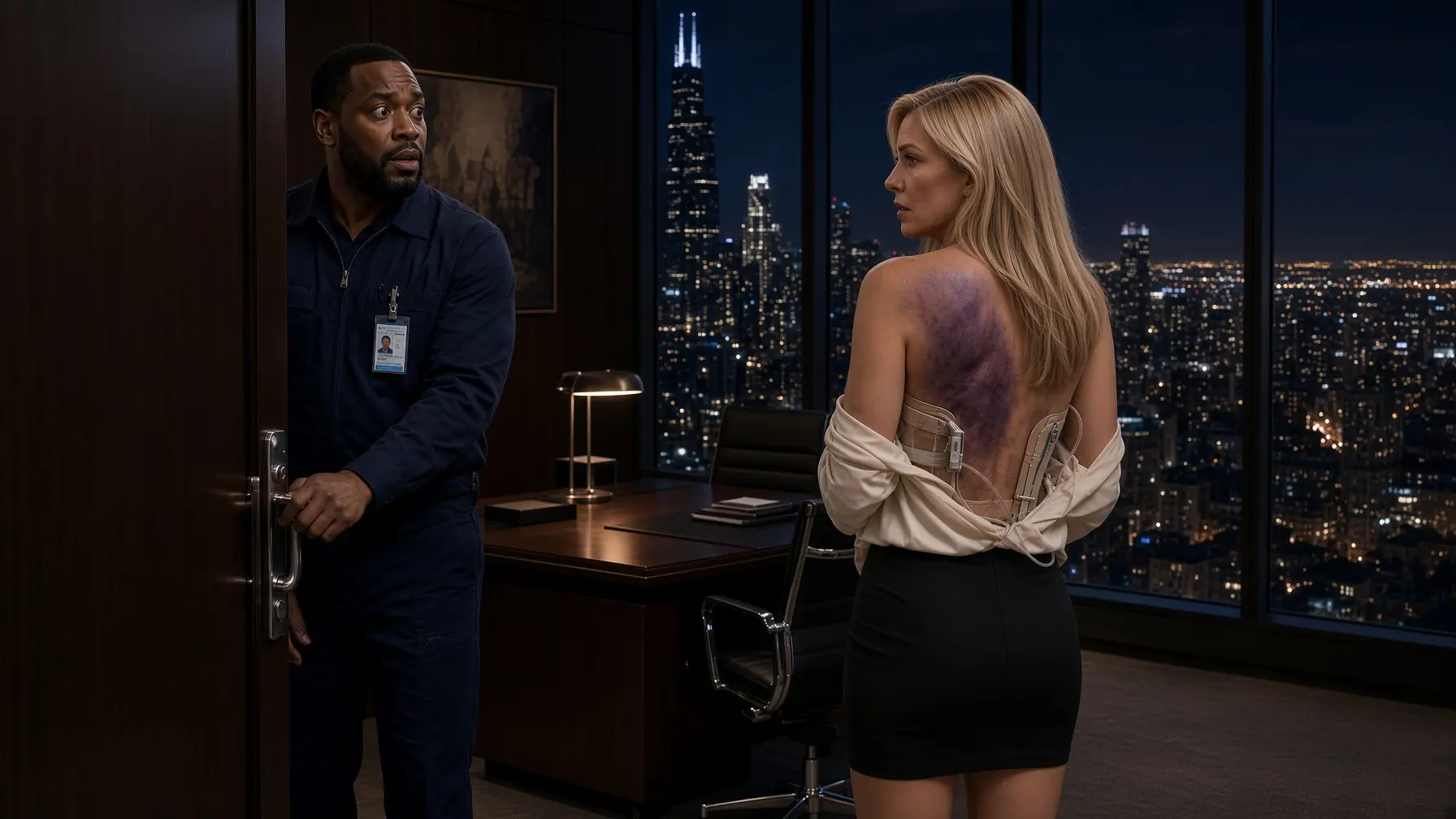
On an ordinary Wednesday night, inside one of the tallest corporate towers in Chicago, Daniel pushed open a door that should have been locked.
For half a second, the room held still.
A woman stood near the window with her blouse half off, her back turned toward him, city lights shining beyond the glass. Beneath her left shoulder blade was a medical pump secured against her skin, with a thin tube disappearing beneath a bandage along her ribs. Dark bruises marked her side in deep purple and green, not the kind a person got from bumping into furniture, but the kind that seemed to come from inside the body itself.
Daniel shut the door immediately.
He took one step backward into the hallway and stood perfectly still, one hand still on the cleaning cart.
He had seen enough.
More importantly, she had almost certainly seen that he had seen enough.
Before he could decide whether to leave, the door opened.
Vivian Hart stood in front of him fully dressed, her black blouse buttoned, her hair smooth, her expression composed in a way that felt almost unnatural. She was the chief executive officer of Hart Meridian Group, a company worth more than eleven billion dollars. Her photograph appeared in financial magazines, on conference screens, and once on a billboard Daniel passed every morning while driving Sophie to school.
Up close, she looked thinner than she did in the photographs.
Not weak.
Never weak.
But carefully held together.
“How much did you see?” she asked.
Daniel met her eyes.
“I knocked twice,” he said. “There was no answer. I opened the door a few inches. I realized someone was inside. I closed it.”
It was not the whole truth.
Both of them knew that.
Vivian studied him for a long moment.
“Come in, Mr…”
“Brooks.”
“Come in, Mr. Brooks.”
It was not a request.
Daniel left the cart in the hall and stepped into the office.
The room was large, quiet, and expensive without being warm. A dark desk faced the windows. A few framed awards hung on one wall. A photograph on the credenza had been turned face down, which Daniel noticed because people who hid photographs were usually hiding more than paper and glass.
Vivian sat behind the desk and gestured toward the chair opposite her.
Daniel did not sit immediately.
Old habits held him upright. He had served six years in the Army before his marriage broke apart, before the warehouse job, before the night shifts, before the bills became a kind of weather that never cleared. He had learned to assess rooms without looking like he was assessing them.
One door.
Two cameras.
A small black case on the desk that looked medical.
A woman powerful enough to destroy him before breakfast.
“Sit,” Vivian said.
This time, he did.
She opened a drawer, removed a printed document, and placed it between them.
“This is a confidentiality agreement,” she said. “It is strict, enforceable, and already prepared for situations involving executive privacy. You sign it, and what you saw tonight remains nothing. You do not mention it to your supervisor, coworkers, family, anyone.”
Daniel looked at the paper.
Vivian continued, “In return, your hourly rate becomes seventy-five dollars effective immediately under a confidential executive facilities assignment. Your daughter, Sophie Brooks, eight years old, asthma, will be placed on a private medical plan that covers prescriptions, specialists, emergency treatment, and respiratory equipment with no out-of-pocket costs.”
Daniel went completely still.
Not because of the money.
Because of Sophie’s name.
Because Vivian Hart had known his daughter existed before he knew he had entered a negotiation.
He did not ask how she knew. Asking would only confirm that she had people who could answer such questions faster than he could prepare himself. The point was not whether she had searched him. She had. The point was what she intended to do with what she found.
“And if I don’t sign?” Daniel asked.
Vivian’s face did not change.
“Then by morning, your employment record will show unauthorized access to an executive office, violation of restricted floor protocols, and possible handling of confidential materials. You will be removed from this building and flagged in our vendor security system. Any company that runs a background check for bonded facilities work will see it.”
She said it without anger.
That made it colder.
“I don’t want to do that,” she added. “But I will protect what must be protected.”
Daniel looked at the paper again.
He thought of Sophie sleeping in the small bedroom at the back of their apartment, one hand always curled around a stuffed blue elephant named Captain. He thought of the inhaler sitting on the kitchen shelf with maybe six doses left. He thought of the pulmonologist appointment he had delayed twice because the clinic wanted payment before seeing her again.
He thought of how quickly a man’s principles start sounding different when his child cannot breathe.
“Is she sick?” he asked.
Vivian’s eyes sharpened.
“That question is not part of the agreement.”
“No,” Daniel said. “But it is part of why you need someone at night.”
For the first time, something like irritation crossed her face.
“Sign the paper, Mr. Brooks.”
Daniel signed.
Vivian took the document, placed it back in the drawer, and locked it.
“You will continue your regular route. Two nights a week, you will report to the fifty-second floor first under a special facilities audit. Tasks will be left in sealed envelopes. Sometimes you will move items. Sometimes you will check access points. Occasionally you may be asked to assist with medical logistics. You will not improvise unless absolutely necessary.”
Daniel nodded.
“I have one question.”
“One.”
“What do I tell my supervisor when he asks why I’m going above my assigned floors?”
“I will have the audit entered into the system before your next shift. Your supervisor will see authorization but not details.”
Daniel stood.
Vivian looked at him a moment longer.
“The medical plan activates within forty-eight hours,” she said. “Your daughter’s prescription will be covered before the week ends.”
Daniel did not trust himself to answer.
He stepped into the hallway, took hold of his cleaning cart, and stood there with both hands on the handle. Everything looked exactly as it had before. The spray bottles, the folded rags, the trash liners, the small roll of blue bags tucked beside the dustpan.
But his life had shifted.
He finished the floor.
He emptied the conference room trash, wiped glass tables, vacuumed the corridor, and took the elevator down before dawn with the careful expression of a man who had not just signed away his silence in exchange for his daughter’s lungs. At 6:20 a.m., he clocked out and drove home through the pale gray light of morning.
Sophie was still asleep when he opened the apartment door.
Daniel stood at her doorway and listened.
Her breathing was soft.
Even.
For once, he did not count each breath like a man counting money he might not have.
Captain the elephant lay on the pillow beside her, its stitched smile turned toward the ceiling. Daniel looked at the inhaler on the small table near her bed and felt relief so sharp it almost hurt. By the end of the week, he would not have to choose between groceries and medicine.
He went to the kitchen, filled the kettle, and sat at the table.
Only then did his hands begin to shake.
The first two weeks of the arrangement were not dramatic.
That was what made them dangerous.
Daniel knew how to survive emergencies. Emergencies had noise, shape, direction. You moved, reacted, solved one immediate problem at a time. Vivian Hart’s world had none of that. It had quiet hallways, sealed envelopes, private elevators, soft carpet, and people who spoke like every sentence had been reviewed by a lawyer before leaving their mouths.
The fifty-second floor had its own rhythm.
The lights were lower.
The air seemed cooler.
Even the silence felt expensive.
Daniel learned to move through it without leaving a trace. He collected sealed medication bags from one locked drawer and placed them in another. He delivered files from Vivian’s office to a private courier box near the service elevator. He checked whether certain doors were open or closed at specific times.
The instructions were always exact.
Tuesday: remove green medical pouch from credenza drawer and transfer to black case before 9:15 p.m. Do not leave case unattended.
Thursday: place sealed folder from conference room C into service locker 52-B. Photograph locker seal only. Delete image after confirmation.
Sunday: keep east hallway clear between 12:10 a.m. and 12:25 a.m. Dr. Keene arriving through private access.
Daniel followed every instruction.
He did not ask questions.
That was not because he lacked curiosity. He had plenty of it. But curiosity had never paid rent, and in his experience, most people who survived complicated arrangements did so by knowing the difference between what was useful to know and what was dangerous to ask.
At home, the change felt unreal.
The insurance card arrived in a white envelope with no company logo on the outside. Daniel held it for nearly a minute before opening it. Sophie’s name was printed correctly. The coverage was active. The specialist appointment was scheduled for the following Monday.
He took Sophie to a pediatric pulmonologist in a clean building where the waiting room had soft chairs, actual toys, and nurses who did not look exhausted before noon.
The doctor read her chart before entering.
That detail nearly broke him.
Not because it was extraordinary.
Because it should not have felt extraordinary.
Sophie sat on the exam table in purple sneakers and told the doctor that Captain the elephant also wheezed sometimes at night. The doctor listened seriously, then said Captain might benefit from better pillow elevation. Sophie nodded as if receiving military instructions.
On the drive home, she fell asleep in the back seat.
Daniel watched her in the mirror.
Her mouth was slightly open.
Her breathing was clean.
For the first time in months, Daniel did not feel chased.
He told himself the arrangement was simple.
He would do the work.
Keep quiet.
Protect Sophie.
Stay invisible.
But life has a way of punishing simple plans by adding people to them.
The first person was Martin Voss.
Daniel noticed him during the fourth week, through the glass wall of a conference room on the forty-sixth floor. He was broad-shouldered, silver-haired, late fifties maybe, dressed in a navy suit that fit too well to be accidental. He sat to Vivian’s left during a strategy meeting, speaking with a smooth confidence that made everyone else at the table either look at him or pretend not to.
Vivian’s posture changed around him.
Only slightly.
A different angle of her shoulders.
A pause before answering.
Her left hand resting flat against the table longer than necessary.
Daniel had spent enough time reading rooms in places where getting it wrong could get someone killed. He knew when a person was managing pain. He also knew when someone in the room made that pain harder to hide.
He filed Martin Voss away as a problem.
The second person was Kyle Renner, his supervisor.
Kyle was not cruel, but he was territorial in the way middle managers often are when paperwork becomes the only proof they matter. He noticed patterns because patterns were his job. After three weeks of Daniel’s special audit assignments, Kyle stopped him near the freight elevator on the twenty-second floor.
“You’ve been upstairs a lot,” Kyle said.
Daniel kept one hand on the cart.
“Facilities audit.”
Kyle nodded slowly.
“I saw that.”
Daniel said nothing.
Kyle waited for more.
Daniel gave him nothing.
Finally, Kyle looked toward the elevator doors.
“I’m not accusing you of anything. Just saying, I notice things.”
Daniel nodded.
“So do I.”
Kyle’s eyes narrowed slightly.
Then the elevator opened, and Daniel pushed the cart inside.
He knew Kyle would keep watching.
That was manageable.
What was not manageable came in the sixth week.
Vivian was leading a late meeting in the forty-sixth floor conference room. Daniel had been positioned nearby under the pretense of restocking the service alcove. He could see through the glass, though he could not hear the conversation. Eight executives sat around the table, including Martin Voss.
Vivian stood at the head.
For the first fifteen minutes, she looked exactly as she always did in public: calm, precise, almost untouchable.
Then her right hand pressed flat against the table.
Daniel saw it.
Most people would not have.
It was not dramatic. Not a collapse. Not even a stumble. Just a hand taking weight, fingers spread slightly, the shoulder tightening in a way that said the body was negotiating with the will and losing.
Daniel picked up a folder from his cart.
Blank inside.
He walked into the conference room without hurry.
No one stopped him because people rarely stop staff members who look like they know exactly where they are going. Daniel crossed behind two chairs, came around to Vivian’s side, and set the folder beside her as if delivering something requested.
In the same motion, below the table line, he placed a small white tablet into her palm.
The fast-acting pain medication Dr. Laura Keene had given him three weeks earlier, during a private emergency protocol briefing Vivian had arranged without admitting she needed it.
Vivian’s fingers closed around it.
Daniel picked up the empty water glass beside her, walked to the credenza, filled it, and placed it near the folder. Then he left the room before anyone could ask why he had entered.
By the time the door closed behind him, Vivian was speaking again.
Her voice came through the glass muffled but steady.
Daniel stood by his cart and let his pulse slow.
After the meeting ended, Vivian came out last.
The hallway was empty except for him.
She walked past, stopped, and looked toward the city through the window.
“How long have you been carrying that medication?” she asked.
“Since Dr. Keene trained me.”
“That was not the question.”
“Three weeks.”
Vivian turned slightly.
“You did not ask permission before intervening.”
“No.”
“Why?”
“There wasn’t time to ask.”
For a long moment, she said nothing.
Then she looked back at the city.
“How long were you in the military?”
“Six years.”
“Army?”
“Yes.”
“What did you do?”
“Enough to recognize when a person is standing only because nobody has noticed they might fall.”
Her face remained unreadable.
But something in the air changed.
Not warmth.
Trust was too large a word.
Maybe recognition.
“Martin Voss has been asking questions about executive floor staffing,” she said.
“I figured.”
“You’ve noticed him.”
“Yes.”
“And?”
Daniel considered how much to say.
“He sits like he is measuring the room for new furniture.”
Vivian almost smiled.
Almost.
“He wants my position.”
“That was clear.”
“He also suspects something is wrong with my health.”
“That was clear too.”
Vivian looked at him then.
“You observe more than most people I pay to observe.”
“Most people look for what they expect.”
“And what do you look for?”
“What changes.”
That answer seemed to stay with her.
She stepped away from the window.
“Kyle Renner has also raised your audit access with building operations.”
“I know.”
“I’ll reinforce the paperwork.”
“Paperwork covers access,” Daniel said. “It does not cover curiosity.”
Vivian paused.
“True.”
She walked toward her office.
Daniel watched her go.
Her limp was barely visible.
But it was there.
That night, Daniel drove home thinking about Martin Voss and Kyle Renner, about Vivian’s hand on the table, about the tablet disappearing into her palm, about the strange way his life had split into two separate worlds. In one, he was a single father making sure Sophie had clean socks and the right inhaler spacer for school. In the other, he was the quiet hinge holding part of a billion-dollar company’s secret door closed.
Sophie was awake when he got home.
She sat at the kitchen table in pajamas, eating cereal from a chipped blue bowl. Captain the elephant sat propped beside the napkin holder with a piece of tissue taped over its trunk.
“He had a flare-up,” Sophie said seriously.
Daniel set down his keys.
“Captain did?”
“Yes. But I handled it.”
“What did you do?”
“I told him to breathe slower, like Dr. Patel said.”
Daniel sat across from her.
“That was smart.”
Sophie nodded.
“He’s dramatic, but brave.”
Daniel looked at the little elephant, then at his daughter’s steady breathing.
For a few minutes, the executive floors felt very far away.
He did not know that Martin Voss had already spoken to a security contractor named Eric Fallon.
He did not know Eric had been told to watch “the night cleaner on the special audit assignment” and report anything unusual directly to Martin, not through building management.
He did not know that Eric had already written his name in a private log.
Daniel Brooks.
Unusual executive floor access.
Frequent proximity to CEO.
He made coffee and listened to Sophie explain a dream about a penguin who drove a taxi.
And for that morning, he let himself stay in the world where that was the only story that mattered.
The Hart Meridian annual investor gala took place on the first Friday of December.
The event filled the grand ballroom of the Arden Hotel, six blocks from the tower. Three hundred guests moved beneath chandeliers: board members, major shareholders, technology partners, finance reporters, political donors, and the kind of people who smiled carefully because every conversation might become leverage later.
A string quartet played near the west wall.
Servers carried champagne.
Photographers waited near the entrance.
The room was not a party.
It was a message.
Hart Meridian was stable.
Hart Meridian was profitable.
Hart Meridian was led by Vivian Hart, and Vivian Hart did not break.
Daniel had been inside since 4:30 helping with logistical setup under the cover of the contracted event staff. His position was near the service entrance to the right of the stage. Close enough to move if needed. Far enough to remain forgettable.
He wore a dark jacket like the catering team, with the small emergency auto-injector inside his inner pocket.
Dr. Keene had trained him on it four nights earlier.
The tablet worked when there was time and cover. The gala offered neither. Vivian would be on stage, under lights, in front of investors and cameras, and any visible sign of distress would become a market event before dessert.
Daniel hated that phrase when Dr. Keene said it.
A market event.
As though a human body was another category of earnings risk.
Vivian had briefed him with the same clinical control she applied to everything.
Her remarks were scheduled for 8:20 p.m.
She had taken baseline medication at 5:00.
She was cleared to speak for twelve minutes.
If symptoms escalated, Daniel was to approach from stage right with a note card and administer the injector discreetly against the inside of her left wrist while appearing to deliver updated information.
Simple.
Nothing involving a ballroom full of wealthy people is ever simple.
Martin Voss arrived at 7:04.
Daniel saw him immediately.
Martin moved through the crowd with practiced ease, one hand on shoulders, one hand extended, one laugh placed exactly where it would buy him another inch of influence. He greeted board members warmly, spoke quietly with journalists, and kept returning to the same location near the front left of the stage.
From there, he could see Vivian clearly.
From there, Daniel could see him.
At 8:20, Vivian was introduced.
The applause was real.
That said something.
Even people who wanted her power respected the way she held it.
She walked to the podium in a black evening suit, hair pulled back, expression controlled, posture flawless. The room settled quickly because Vivian Hart did not waste words, and people in rooms like that valued the rare executive who spoke only when there was something worth hearing.
Daniel watched her hands.
For the first four minutes, they were steady on either side of the podium.
At five minutes and thirty seconds, her left hand tightened.
Not a gesture.
A grip.
Daniel was moving before the thought finished forming.
He picked up the folded note card from the service table and crossed the ballroom with the pace of staff carrying an urgent correction. Not fast enough to alarm anyone. Not slow enough to lose time. He climbed the side steps and moved toward Vivian.
Several people glanced up.
Martin Voss watched him the whole way.
Daniel reached Vivian and leaned slightly forward as if whispering.
With his right hand angled away from the audience, he pressed the auto-injector against the inside of her left wrist and administered the dose in less than three seconds. Then he set the note card on the podium, stepped back, and returned downstage.
Vivian did not stop speaking.
She did not miss a word.
Daniel reached the service corner and stood still.
His heartbeat was loud in his ears.
His face showed nothing.
What Daniel did not see until later was Eric Fallon standing near the rear bar with his phone angled toward the stage.
Eric had recorded eight seconds.
Enough to show Daniel approaching.
Enough to show the lean-in.
Enough to show his hand moving in a way no one delivering a note would need to move.
Not enough to prove what had happened.
More than enough for someone like Martin Voss.
By the time Vivian finished her remarks, Eric had already sent the clip to Martin’s private number.
Martin looked at his phone.
Then toward Daniel.
Their eyes met across the ballroom.
Martin smiled.
Small.
Private.
Daniel knew that smile.
It meant the game had changed.
The call came Monday morning at 8:17.
Daniel had slept less than two hours after his Sunday shift when his phone buzzed on the kitchen table. Kyle Renner’s message was short. Report to HR at 2:00 p.m. Sixth floor. Do not clock in before meeting.
Daniel read it twice.
Then he called Vivian.
She answered immediately.
“Martin has the gala footage,” she said.
Daniel sat down.
“How bad?”
“Bad enough for him to ask the board for a leadership capacity review. He is framing the incident as evidence that I am medically compromised and concealing material information.”
“He can prove that?”
“No.”
“But he can create uncertainty.”
“Yes.”
Daniel looked toward Sophie’s room.
“What about me?”
“He pushed building operations to open a formal review into your executive access. The audit documentation covers most of it, but not all. If Kyle follows the script Martin’s office sent him, they’ll try to separate you from me before the board meeting.”
Daniel poured coffee with one hand.
“When is the board meeting?”
“Martin requested emergency session at 5:00.”
“You should call it first.”
Silence.
Not long.
But enough.
“Why?” Vivian asked.
“Because if he sets the frame, you spend the meeting defending your body. If you set the frame, he spends it defending his conduct.”
Vivian said nothing.
Daniel continued, “Week three, I moved a red folder from your office to the private courier box. The cover referenced an authorization for a regional acquisition from three years ago. The signature formatting was wrong.”
Another silence.
Sharper this time.
“You noticed that?”
“I notice things.”
“That file is part of an independent review.”
“Against Martin?”
“Yes.”
“What is it?”
“Forged authorization on a nine-million-dollar subsidiary acquisition. We suspected him, but our outside counsel needed a reason to surface it without alerting him too early.”
“Does counsel have enough?”
“Patricia Lang has enough if she gets the physical file and the verified courier records.”
“How long does she need?”
“Four hours.”
Daniel looked at the clock.
“It is 8:24. Get her the file by 10:00. Call the board meeting yourself for 4:30 under your executive authority. Let Patricia present before Martin can define the reason everyone is in the room.”
Vivian’s voice changed slightly.
“You understand pressure rooms.”
“I understand ambushes.”
“This is not a battlefield.”
“No,” Daniel said. “But people still panic when they think the first story they hear is the safest one to believe.”
Vivian exhaled softly.
“I’ll move the file.”
“And Vivian?”
“Yes?”
“Have something ready for HR.”
“I already do.”
At 2:00 p.m., Daniel walked into Kyle Renner’s office on the sixth floor.
Kyle looked uncomfortable before the meeting even started. That told Daniel enough. A man reading his own thoughts looks different from a man reading someone else’s script. Kyle had a folder open, several printed logs, and the tired face of someone who had been handed a problem from above and told it was his responsibility now.
“Sit down,” Kyle said.
Daniel sat.
Kyle read the formal language about access irregularities, route deviations, executive floor presence, possible unauthorized contact with senior leadership, and review pending. Daniel let him finish without interruption. Then he reached into his jacket and placed a sealed envelope on the desk.
Kyle opened it.
Inside was a letter on Hart Meridian letterhead, signed by Vivian Hart and countersigned by the chief administrative officer. It confirmed that Daniel Brooks had been assigned to a confidential executive facilities and security assessment, with access to all relevant executive floors, events, and restricted areas as needed.
Kyle read it once.
Then again.
He closed the folder in front of him.
“That covers it.”
Daniel stood.
Kyle looked up.
“For what it’s worth, I didn’t like this.”
Daniel paused at the door.
“Then next time, ask who benefits from you doing it.”
Kyle looked down at the closed folder.
“Yeah,” he said quietly. “I will.”
By 4:30, Vivian had convened the board.
Patricia Lang presented a report that was clean, verified, and devastating. The acquisition authorization Martin Voss had used three years earlier carried a forged signature from a board committee chair who had been in surgery on the date of approval. Supporting emails had been altered. A subsidiary payment chain led back to an advisory firm owned through a trust connected to Martin’s brother-in-law.
Daniel heard none of it in real time.
He was back at the tower by then, working his route.
But he understood from the silence on the executive floors that something large was happening above him.
At 5:22, Martin Voss left the building.
He did not look toward the cameras.
He did not shake hands.
He did not smile.
By 6:10, Eric Fallon’s security contract was terminated. His access badge stopped working at the loading dock. By 6:45, the board had suspended Martin pending formal investigation. By 7:30, the headline alerts began appearing on financial feeds, carefully worded but clear enough for anyone who knew how to read them.
Hart Meridian Board Opens Inquiry Into Former Vice Chair Over Acquisition Irregularities.
Former vice chair.
That title told Daniel everything.
Vivian called him at 1:13 a.m.
He was in the service alcove near the forty-second floor restrooms, restocking paper towels.
“It is done,” she said.
Daniel leaned against the cart.
“Martin?”
“Gone.”
“Eric?”
“Gone.”
“Board?”
“Contained.”
“And your condition?”
Vivian was quiet.
Then she said, “I am going to disclose.”
Daniel did not speak.
“My medical team believes I can continue if we structure responsibilities differently. Patricia believes the market can absorb the information if it comes from me, on my terms, with a stability plan already in place.”
“That sounds right.”
“I should have done it months ago.”
“Maybe.”
“I thought hiding it was protecting the company.”
“Were you?”
Another pause.
“No,” she said. “I think I was protecting the version of myself people expected.”
That answer sat between them.
Daniel did not try to fill the silence.
Vivian continued, “I want to offer you a formal position. Director of executive security and logistics. Real title. Real authority. Real compensation. You have already been doing the job without being allowed to name it.”
Daniel looked down at his uniform.
“Why me?”
“Because you saw something you could have sold, ignored, or mishandled. Instead, you stayed. You observed. You acted when action was required. And you understand that discretion is not the same as obedience.”
Daniel thought of Sophie’s school, the peeling paint in their apartment, the pulmonologist, the emergency bills, the way his life had been narrowing until one accidental door opened into something impossible.
“What would the role pay?” he asked.
Vivian told him.
Daniel closed his eyes.
That number meant a better apartment.
A better school district.
No more deciding which bill could wait.
No more inhaler countdowns.
“I’ll take it,” he said.
“Good.”
Then, after a silence unlike her usual silences, Vivian added, “Thank you, Daniel.”
He had not expected that.
It stayed with him long after the call ended.
The disclosure came two weeks later.
Vivian Hart appeared in a controlled interview with a financial journalist respected enough to matter and measured enough not to turn illness into spectacle. She explained that she had been receiving treatment for a serious autoimmune condition affecting her blood and connective tissue. She stated that her leadership plan had been reviewed by her physicians, the board, and independent counsel.
She did not perform vulnerability.
That was not her style.
But she told the truth.
The stock dipped for one day, then stabilized. Analysts debated succession planning. Commentators praised the transparency. A few people speculated cruelly, because people often mistake distance for permission. Vivian ignored most of it and kept working.
The company did not fall apart.
That seemed to surprise everyone except the people who had been doing the actual work all along.
Daniel’s first day in his new role felt stranger than the night he opened the wrong door.
He wore a dark suit instead of a janitorial uniform.
His badge opened doors that had once required someone else’s authorization.
People who had ignored him for two years now looked up when he entered rooms.
Some were polite.
Some were confused.
Some were embarrassed because they remembered not knowing his name.
Daniel did not punish them for it.
He simply learned their names first.
At home, Sophie treated the whole thing like a promotion in a cartoon.
“Do you have an office now?” she asked.
“Small one.”
“Does it spin?”
“The chair?”
“Yes.”
“A little.”
“Can I spin in it?”
“No.”
She considered that.
“Then it is not a very good office.”
Daniel laughed.
That sound came easier now.
They moved three months later to a quieter neighborhood with trees near the sidewalks and a school where the nurse already knew Sophie’s asthma plan before the first day of class. Sophie got a bedroom with a window facing a maple tree. Captain the elephant sat on the sill like a security guard.
Daniel still woke early.
Old habits did not vanish because life improved.
Sometimes he stood in the kitchen before sunrise and listened to the apartment’s silence. No sirens close by. No neighbors shouting through thin walls. No wheeze from the bedroom down the hall. Just the hum of the refrigerator and the distant sound of traffic beginning elsewhere.
Vivian’s condition did not disappear.
Some months were better than others.
Some meetings were shorter.
Some travel was canceled.
Some days Daniel recognized the small signs before anyone else did: the pressure of her hand against the table, the controlled breath before standing, the slight delay before answering a question. He adjusted schedules, shifted rooms, moved medication protocols, blocked unnecessary access, and protected the space around her without making her feel managed.
That was the balance.
Help without ownership.
Protection without control.
Presence without noise.
One evening, nearly a year after the first night, Vivian called him into her office after a board meeting.
The same office.
The same windows.
The same city below.
The photograph on the credenza was no longer face down. It showed Vivian with a teenage boy at a lake, both of them laughing at something outside the frame. Daniel had never asked, and Vivian had never explained. Some doors did not need opening.
“You were right,” she said.
Daniel stood near the desk.
“About what?”
“Whoever controls the first narrative controls the outcome.”
He nodded.
“That applies often.”
“I used to think control meant never letting anyone see weakness.”
“That works until weakness needs logistics.”
Vivian almost smiled.
“That is an unpleasantly practical sentence.”
“I have several.”
She looked out toward the city.
“I built this company by making sure no one could use my private life against me. Then I built a prison out of the same habit.”
Daniel said nothing.
“Do you miss being invisible?” she asked.
He thought about it.
“Yes.”
Her eyes returned to him.
“Why?”
“Invisible people hear the truth by accident.”
“And visible people?”
“They have to decide which truths are still worth hearing.”
Vivian seemed to consider that.
Then she nodded once.
“You were wasted on floors three through forty-eight.”
“No,” Daniel said. “That is where I learned the building.”
Years passed.
Hart Meridian changed, though not all at once.
Companies rarely transform cleanly. They resist, reorganize, rename old habits, and call delay a process. But Vivian made changes that stuck because she understood now what secrecy had nearly cost her. The executive floor became less theatrical. Succession plans became real. Health disclosures became part of leadership policy instead of whispered liability.
Daniel built a security and logistics team that hired people from places most corporate recruiters never looked: veterans, paramedics, former night managers, hospital coordinators, people who knew how to stay calm when plans broke.
He trained them to look for changes.
Not drama.
Changes.
A hand gripping a podium.
A locked door that should be open.
A supervisor asking the wrong question too casually.
A powerful person smiling at the wrong time.
Sophie grew taller.
Her asthma became manageable with proper care. She joined the school science club, then the debate team, then announced at thirteen that she intended to become a doctor, an astronaut, or possibly a lawyer for astronauts. Daniel told her those were all reasonable if she finished her math homework.
She rolled her eyes in the way healthy children do when they trust the world enough to be annoyed by it.
That was the real miracle.
Not the job.
Not the title.
Not the money.
The eye roll.
The ordinary complaint over broccoli.
The backpack dropped in the hallway.
The steady breathing from the next room.
Daniel never forgot what had bought those things.
Not money alone.
A door.
A decision.
A piece of paper signed because a father had no room left for pride.
Years later, when Sophie was old enough to understand more of the story, she asked him about the night everything changed.
They were sitting at the kitchen table in the better apartment, though by then it was simply home. Captain the elephant, older and more repaired than original, sat on a shelf nearby. Sophie had a biology textbook open in front of her and a half-eaten bowl of cereal at her elbow.
“So you accidentally walked in on your boss?” she asked.
Daniel winced.
“Not how I’d phrase it.”
“But basically.”
“Basically.”
“And she threatened you?”
“Yes.”
“And helped me.”
“Yes.”
Sophie thought about that.
“Was she good or bad?”
Daniel looked toward the window.
People love questions that sort others into clean boxes. Life rarely cooperates. Vivian had threatened him. Vivian had saved his daughter’s medical care. Vivian had hidden too much. Vivian had learned to tell the truth. Daniel had signed because he needed to. He had stayed because staying became right.
“She was human,” he said finally.
Sophie frowned.
“That is a very adult answer.”
“It is also the true one.”
She tapped her pencil against the textbook.
“And you?”
“What about me?”
“Were you brave?”
Daniel almost laughed, then realized she was serious.
“No,” he said. “Not at first.”
“Then what were you?”
“Tired.”
Sophie smiled.
“That sounds like you.”
He smiled too.
“I was tired, scared, and trying to keep you safe. Sometimes that is what bravery looks like before it becomes pretty enough for stories.”
Years after that, when Daniel stood in front of a new team of executive security trainees, he told a version of the lesson without naming Vivian, Sophie, or the night door.
He said, “Most people think crisis begins with alarms. It usually begins smaller. A shift in posture. A missing file. A door left open. A person who knows too much deciding whether to run.”
The trainees listened.
Some understood immediately.
Most would understand later.
That was how lessons worked.
“You are not here to control people,” Daniel told them. “You are here to protect decisions before fear distorts them. Sometimes that means moving fast. Sometimes it means staying quiet. Sometimes it means carrying medication in your pocket and never needing credit for having it there.”
He paused.
“And sometimes the most important thing you do is not leave.”
He thought of the fifty-second floor.
The half-open door.
Vivian’s cold voice.
The NDA on the desk.
Sophie’s inhaler.
Martin Voss smiling across a ballroom.
The auto-injector hidden in his hand.
A forged signature in a red folder.
A life narrowing, then widening suddenly because he had stayed in the hallway long enough for the next door to open.
Daniel Brooks had spent years making himself invisible so no one could take his job, question his worth, or interfere with the one purpose that mattered.
Keeping Sophie alive.
But the night he opened the wrong door, invisibility became something else.
Preparation.
He had learned to move without noise.
To notice without staring.
To follow rules without surrendering judgment.
To stay calm while frightened.
To carry responsibility without expecting applause.
Those things had seemed small when he was pushing a cleaning cart through empty floors at two in the morning. They were not small. They were the exact tools required when a billion-dollar company, a powerful woman, and a little girl’s future all turned on a decision made in silence.
Not every accident is meaningless.
Not every closed door is protection.
And not every person working in the dark is lost there.
Sometimes the life you build while no one is watching becomes the reason you are ready when everything finally depends on you.