I never expected the end of my marriage to begin on an ordinary Tuesday night. My name is Daniel Mercer, I’m thirty-nine years old, and by that point my wife, Natalie, and I had been married for fourteen years. We had a nine-year-old daughter named Sophie, a mortgage, two aging cars, shared passwords, family traditions, and the kind of routines that make you believe a life is permanent simply because it has existed for a long time. I thought our marriage was struggling, but I did not think it was over.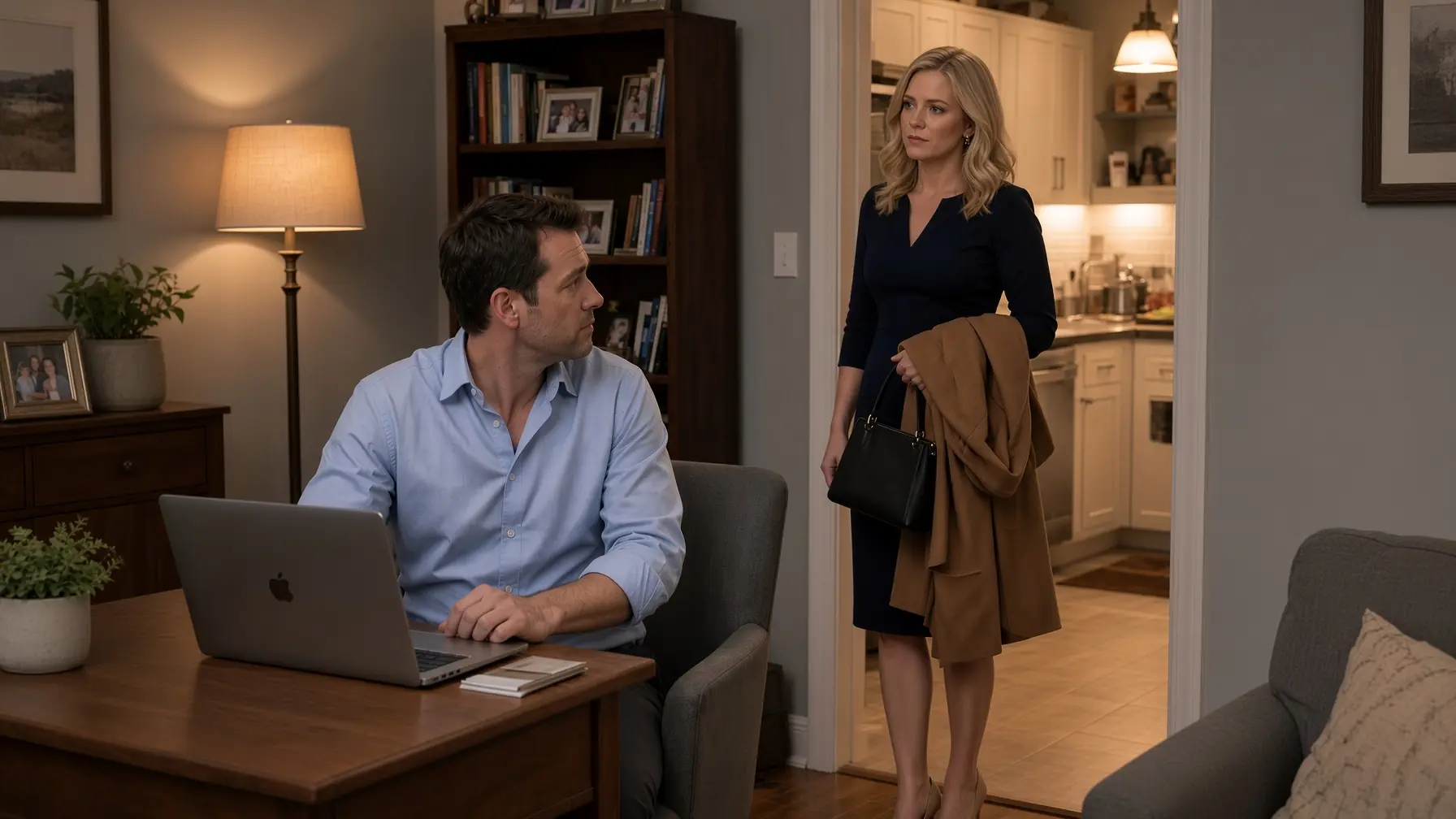
Natalie and I had always been different in ways people used to describe as complementary. She was spontaneous, expressive, quick to laugh, and capable of making strangers feel like friends within ten minutes. I was quieter, more careful, the kind of man who checked reservations twice and kept every important document in clearly labeled folders. For most of our marriage, I believed her energy pulled me into life while my steadiness gave her somewhere safe to land.
The first decade was not some perfect love story, but it was ours. We bought a small townhouse outside Raleigh, learned how to survive newborn exhaustion, argued over money, apologized badly, improved, failed again, and kept going. Sophie arrived loud, fearless, and completely uninterested in sleep, and somehow the three of us became a family before either of us understood what that really required. Looking back, I think I confused endurance with health for longer than I want to admit.
The changes started slowly enough that I could explain each one away. Natalie began staying later at work, bringing her phone into rooms where she used to leave it charging on the kitchen counter, and answering simple questions with distracted one-word responses. When I touched her shoulder while passing behind her, sometimes she would stiffen for half a second before relaxing again. I noticed all of it and became very skilled at pretending I hadn’t.
I blamed stress because stress was easier to fix than betrayal. Her department had been reorganized, her workload had increased, and she complained often about a new project that seemed to consume everyone on her team. I tried cooking more dinners, handling Sophie’s school pickups, and giving Natalie space when she said she was tired. Every adjustment I made felt like another small investment in the belief that if I became easier to love, eventually she would come back toward me.
She didn’t.
That Tuesday evening, Sophie was spending the night with my sister because the next morning was a teacher workday. I was sitting in the living room with my laptop open, finishing a financial report I should have completed at the office. My headphones were on, but no music was playing because I had muted it to concentrate. When I looked up, Natalie was standing in the doorway between the hall and living room.
She had changed clothes after work. Instead of the sweater and black slacks she had worn that morning, she had on a navy dress I remembered from a dinner we attended the previous year. Her hair was down, her makeup had been refreshed, and she held her purse against one hip as though she were already halfway out the door. Something in my chest tightened before she even spoke.
“Daniel,” she said quietly. “Aaron is taking me out tonight.”
My hands stopped above the keyboard. For a moment, my brain treated the sentence like a problem with missing information and tried to fill the gaps in harmless ways. Maybe Aaron was a coworker giving her a ride to a team dinner, or maybe several people from the office were meeting somewhere and she had phrased it badly. Then I looked at her face and knew immediately that none of those explanations were real.
“Aaron,” I repeated. “The guy from your project team?”
She nodded. Her eyes dropped briefly toward the floor, then returned to mine. “Yes.”
I closed the laptop carefully. “When you say he’s taking you out, what exactly are you saying?” My voice sounded strange to me because it was so calm. Natalie swallowed and said, “He asked me to dinner.”
I stared at her.
“And you said yes.”
“Yes.”
The room became impossibly quiet. There was no shouting, no dramatic crash, no music swelling behind the moment when fourteen years of marriage suddenly rearranged themselves in my head. There was only the hum of the refrigerator from the kitchen and the faint sound of a neighbor closing a car door outside. Sometimes the worst moments of your life arrive without the courtesy of atmosphere.
I asked the question even though I already knew the answer. “Does Aaron know you’re married?” Natalie flinched slightly. “Yes.”
“Does he know we’re still together?”
Another pause. “Yes.”
That answer did more damage than the first one. If Aaron knew about me, then this was not some misunderstanding created by a lonely coworker misreading signals. Natalie had allowed enough intimacy to develop that another man felt comfortable asking a married woman to dinner, and she had felt comfortable accepting. Whatever had happened between them did not begin when she put on that dress.
“How long?” I asked.
Natalie pressed her lips together. “Daniel, I don’t know what you want me to say.”
“The truth would be a start.”
She sighed, suddenly frustrated, as if my request were making the evening more difficult than she had expected. “We’ve been talking for a while.”
“How long is a while?”
“A few months.”
There it was.
A few months explained almost everything. The late-night messages, the distance in bed, the way she began volunteering for every office event, the sudden interest in clothes she had not touched in years. I had spent those same months wondering what I was doing wrong while another man slowly occupied the emotional space where our marriage used to live.
“Have you slept with him?” I asked.
“No.”
The answer came quickly.
I watched her face.
“Have you kissed him?”
She looked away.
I did not ask again.
The silence answered for her.
Natalie walked into the room and sat on the edge of the armchair opposite me. “I didn’t plan this,” she said. “It just happened.”
“No,” I replied. “Rain happens. Traffic happens. You talked to another man for months and kept it from your husband.”
Her eyes hardened slightly. “This is exactly why I was scared to tell you.”
I almost laughed. Not because anything was funny, but because the sentence was so familiar from every story where someone tries to turn secrecy into proof that honesty was unsafe. “You weren’t scared to tell me,” I said. “You were scared of what telling me would cost you.”
She crossed her arms. “Our marriage has been dead for a long time, Daniel.”
That sentence should have shocked me.
Instead, it clarified everything.
I leaned back and looked at her more carefully than I had in months. “Dead for both of us, or dead for you?” I asked.
Natalie did not answer.
I nodded slowly. “That’s what I thought.”
She started crying then, quietly at first. “I don’t know who I am anymore,” she said. “I feel like I’ve spent years being someone’s wife, someone’s mother, someone’s employee. Aaron makes me feel seen.”
I had heard versions of that sentiment before. I understood how people could become lost inside responsibilities, especially after years of marriage and parenting. But understanding why someone hurts you does not erase the fact that they chose to do it. Compassion and self-respect are not enemies.
“I’ve been here,” I said. “I’ve been trying to see you.”
“That’s not what I mean.”
“I know.”
She wiped her cheek. “I never wanted to hurt you.”
I lifted one hand.
“Stop.”
Her eyes widened.
“Please don’t tell me you never wanted to hurt me while you’re dressed for a date with another man.”
The words finally made her look ashamed.
I stood slowly. I expected anger to rush through me once I was on my feet, but something different happened. The anger was there, deep and hot, but beneath it was a colder realization that felt almost peaceful. I had spent years trying to repair something Natalie had already stopped protecting.
“I’m not going to compete with Aaron,” I said.
She looked up.
“I’m not going to beg you to stay home.”
“Daniel—”
“And I’m not going to spend tonight waiting for you to come back from a date and asking whether you chose me afterward.”
She stood. “What are you saying?”
“I’m saying you’re free to make whatever choice you want.”
My voice remained even.
“But I’m not going to stop living because you stopped choosing this marriage.”
Natalie stared at me.
For the first time all evening, she looked frightened.
I went into the bedroom and pulled an overnight bag from the closet. I packed jeans, shirts, underwear, my work laptop charger, toiletries, medications, and a spare pair of shoes. Natalie followed me halfway down the hall, then stopped in the doorway as though she did not know whether she was allowed to enter the room anymore.
“You’re leaving?”
“For tonight.”
“Where?”
“Does it matter?”
“Yes.”
I zipped the bag. “I’m staying somewhere I can think without watching my wife leave for dinner with another man.”
Her face crumpled.
“You’re making this sound worse than it is.”
I looked at her.
That sentence nearly changed my calm.
Instead, it strengthened it.
“Natalie, you are going on a date.”
“I said dinner.”
“With a man you’ve been emotionally involved with for months.”
She said nothing.
“I don’t have to exaggerate anything.”
I carried the bag toward the front door. Natalie followed several steps behind me. “What about Sophie?” she asked.
That stopped me.
Our daughter was the one person in the situation who had done absolutely nothing wrong.
“We protect her,” I said. “Whatever happens between us, we do not turn her into a messenger or make her choose sides.”
Natalie nodded slowly.
“Okay.”
I put my hand on the doorknob.
Behind me, she whispered, “Daniel.”
I did not turn around.
“I’m sorry.”
Maybe she meant it.
Maybe she didn’t.
At that moment, I could not afford to make her feelings my responsibility.
I walked outside.
The night air felt colder than I expected for North Carolina in early fall. I stood beside my car for several seconds, bag hanging from one hand, listening to distant traffic and somebody’s dog barking two houses down. My marriage had just cracked open, yet the neighborhood looked completely ordinary.
I drove without a destination for almost twenty minutes. Eventually I found myself turning onto the familiar street where my oldest friend, Patrick Hayes, lived. Patrick and I had known each other since college, survived bad jobs, bad apartments, his divorce, my father’s death, and enough stupid decisions to qualify as family. If there was anyone I could sit beside without performing strength, it was him.
He opened the door wearing sweatpants and holding a bowl of cereal. He looked at the overnight bag. Then at my face.
“What happened?”
I tried to answer.
Nothing came.
Patrick stepped aside.
“Come in.”
That was all.
I sat on his couch while a baseball game played silently on television. Patrick brought me a glass of water and took the armchair across from me without pressing. For nearly ten minutes, neither of us spoke.
Finally, I said, “Natalie went on a date tonight.”
Patrick’s expression changed.
“With who?”
“A guy from work.”
He leaned forward.
“She told you?”
“Right before leaving.”
His jaw tightened.
“Jesus.”
I looked at the dark television screen.
“She said the marriage has been dead for a long time.”
Patrick was quiet.
Then he asked, “Is it?”
I thought about that for a while.
“For her, apparently.”
“That isn’t what I asked.”
I looked at him.
Patrick continued. “Is it dead for you?”
That question hurt more than I expected.
“I think I’ve been trying to keep it alive by myself.”
He nodded slowly.
“Then maybe tonight isn’t when it died.”
I looked away.
Maybe he was right.
My phone buzzed in my pocket.
Natalie.