Silence falls the moment you stop begging.
When they ripped my mother’s coat from my shoulders, I did not scream. I memorized their faces. Aristocracy is just well-dressed cruelty wrapped in velvet and funded by our starvation. But winter has a long memory, and the north never forgets a debt.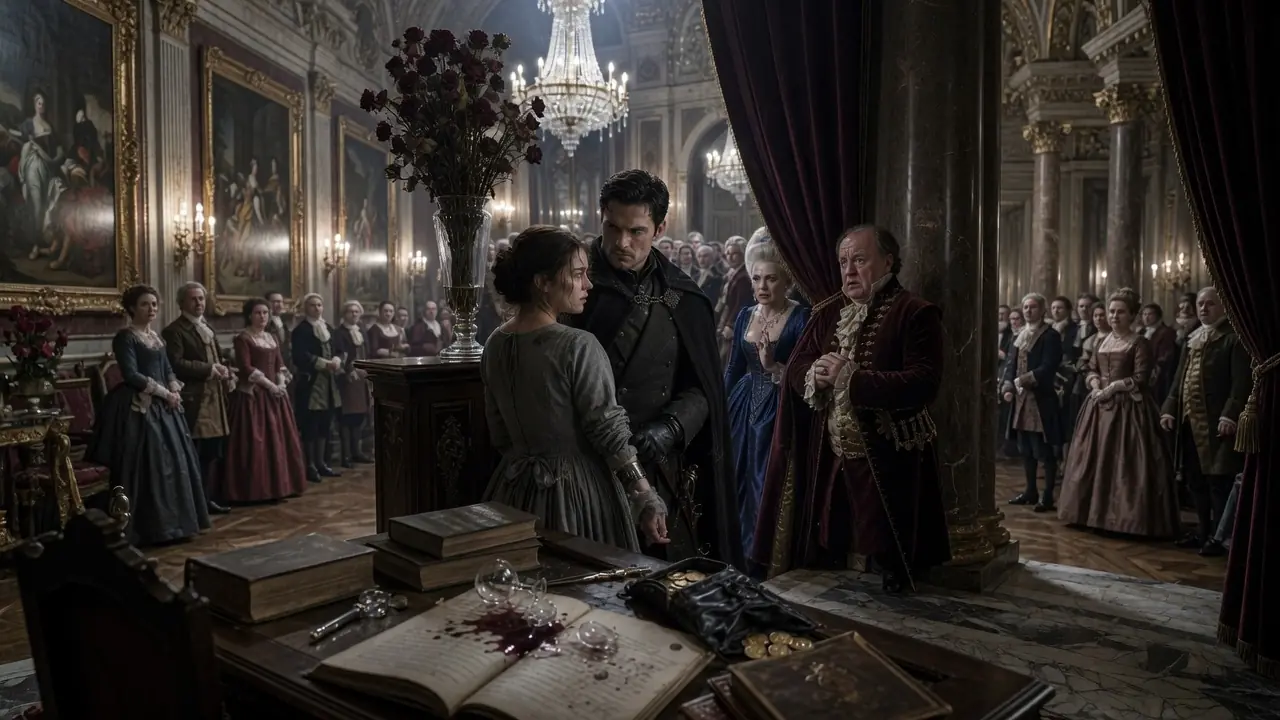
The grand ballroom of the Sun Palace smelled of stale champagne, dying roses, and the cloying, heavy musk of desperation. Lydia sat in the shadows of the servants’ alcove, her fingers numb as her quill scratched relentlessly against the thick parchment of the Harrington family ledger.
Out there, beneath a chandelier dripping with imported crystal, the elite of the capital danced to a string quartet. In here, tucked behind a velvet curtain near the drafty kitchen corridor, Lydia worked.
She was the Harrington estate’s human abacus, a ledger keeper bound by her late father’s insurmountable debts. She paused, blowing warm air into her cupped hands. Her knuckles were bruised purple from the cold, and her cuticles were permanently stained with cheap iron gall ink.
Through a slit in the heavy curtain, she watched the swirling sea of silk and taffeta. Lord Harrington was currently spinning the Duchess of Cornwall, his face flushed with imported brandy.
Lydia looked back at the numbers.
They were a disaster.
Lord Harrington was bankrupt. His velvet coats were frayed at the inner seams, mended meticulously by Lydia in the dark hours of the morning. His signet ring, which he flashed so proudly, was gilded brass. He had pawned the original gold one three months ago to pay for his mistress’s carriage.
The nobility saw a titan of industry.
Lydia saw a corpse rotting in fine clothes.
“You missed a spot, rat.”
The velvet curtain was suddenly yanked back. The harsh light of the ballroom flooded Lydia’s cramped space, blinding her for a moment.
She blinked away the glare to see Lady Cecilia Harrington standing in the entryway, flanked by two giggling sycophants. Cecilia wore a gown of crushed sapphire silk, her neck heavy with diamonds that, according to the ledger in front of Lydia, had not been paid for.
Lydia did not flinch. She set her quill down carefully, ensuring no ink spattered on the parchment.
“My lady, I am currently reconciling the accounts from the southern docks, as requested.”
Cecilia’s eyes narrowed. She despised Lydia. She despised the fact that a commoner, a girl pulled from the muddy slums of the lower city, understood the Harrington finances better than she did. More than that, she hated that Lydia never cried.
“I asked for these tallies yesterday,” Cecilia snapped, stepping into the alcove.
The heavy scent of gardenias rolled off her, masking the sour smell of unwashed bodies common among the courtiers.
“Are you illiterate as well as slow? Perhaps working in the dark has ruined whatever meager intelligence your beggar father passed down to you.”
Lydia kept her face entirely smooth.
“The tallies were delayed because the dock master refused to release the cargo, my lady. The harbor fees have been in arrears for six months.”
The two sycophants gasped behind their painted fans.
Cecilia’s face flushed an ugly, mottled red.
“You dare speak to me of arrears?” Cecilia hissed, stepping closer.
She raised her glass of red wine, tilting it dangerously over the open ledger.
“To me, you are nothing but a parasite living off our charity. A penniless commoner who eats our bread and sleeps under our roof. If I say the accounts are done, they are done.”
Lydia stared at the trembling rim of the glass. If the wine spilled, three weeks of meticulous accounting would be destroyed. Lord Harrington would blame her. The debt she owed them would double. She would be trapped in this house for another decade.
“Please, Lady Cecilia,” Lydia said.
Her voice was flat, devoid of the begging tone Cecilia clearly craved.
“The ink is fresh.”
“Then blow on it.”
Cecilia smiled, a thin, cruel slash of red lipstick.
She flicked her wrist.
The dark red liquid splashed across the open pages. The numbers, the undeniable proof of the Harrington family’s financial ruin, blurred instantly, bleeding into a useless crimson mess.
She did not shout.
She did not leap up.
Crying cost moisture, and she had spent her whole life learning to conserve what little she had.
Instead, she reached into her pocket, pulled out a gray linen rag, and began methodically dabbing at the binding.
Cecilia laughed, a high, piercing sound.
“Scrub hard, little rat. When you are finished, you can scrub the mud from my carriage wheels. It is all you are good for.”
Lydia did not look up. She kept her eyes on the ruined paper, her jaw locked so tightly her teeth ached. She calculated the cost of the paper, two shillings. The cost of the ink, three pence. The cost of her pride, unquantifiable.
Suddenly, the music in the ballroom stuttered and died.
It did not fade out gracefully. The cellist hit a wrong note. The violinist dragged a bow harshly across the strings, and then silence fell.
A heavy, suffocating quiet descended over the hundreds of guests.
Cecilia stopped laughing. She turned, her silken skirts rustling loudly in the sudden stillness.
A cold draft swept through the palace corridors, carrying the distinct scent of pine, wet stone, and ozone.
The crowd parted like a severed artery, pulling back to create a wide, empty path down the center of the ballroom.
Lydia leaned slightly, looking past Cecilia’s shoulder.
A man was walking through the sea of aristocrats.
He did not belong here, where the southern nobles wore powdered wigs and embroidered coats. This man wore heavy charcoal-gray wool cut with severe military precision. There was no lace at his throat. No jewels on his fingers.
He wore high leather boots that looked as though they had crossed snow, stone, and war roads just hours before. He was tall, broad-shouldered, and moved with a terrifying economy of motion.
Every step was deliberate.
He did not strut.
He stalked.
“Who?” one of Cecilia’s friends whispered, her voice trembling. “Who is that?”
Cecilia’s face drained of its flushed color, leaving her pale beneath her powder.
“The wolf,” she breathed. “Duke Gideon Croft. What is he doing in the capital?”
Lydia watched him.
Duke Gideon of the northern marches.
The man who controlled the iron mines, the coal veins, and the brutal northern armies. The southern crown relied entirely on his resources to keep their borders safe. The king himself feared him.
Gideon Croft stopped in the middle of the room.
His eyes, pale and flinty gray, like the edge of a frozen blade, swept over the crowd. He was not looking at the jewels. He was not looking at the women. He was scanning the room with the detached appraisal of a butcher looking at a herd of livestock.
Then his gaze locked onto the alcove.
Lydia felt the physical weight of Gideon’s stare before she fully processed it. It was a heavy, suffocating pressure, like the air dropping before a violent thunderstorm.
He did not look away.
Instead, he adjusted the heavy silver clasp of his cloak and began walking directly toward the velvet curtain.
The crowd scrambled to get out of his way, spilling champagne and tripping over their own trains. No one spoke. The only sound was the heavy, rhythmic thud of his boots against the polished marble.
Cecilia panicked.
She immediately stepped out of the alcove, blocking the entrance, pasting a sickeningly sweet smile onto her face.
“Your Grace,” Cecilia said, dropping into a deep, sweeping curtsy.
Her two friends scrambled to do the same, their foreheads practically touching the floor.
“What an unexpected honor. We had no idea the north was joining our humble festivities.”
Gideon did not stop.
He walked until the toes of his boots were inches from the edge of Cecilia’s gown. He looked down at her. He did not offer his hand. He did not bow.
“Move.”
His voice was a low rumble, devoid of inflection. It was not a request. It was a physical force.
Cecilia blinked, her smile faltering.
“I… Your Grace.”
“You are standing in my way,” Gideon said. “Move.”
Cecilia’s cheeks burned. Humiliated in front of the entire ballroom, she clumsily gathered her skirts and scurried to the side, nearly twisting her ankle in her haste.
Gideon stepped into the alcove.
The space immediately felt too small. He blocked the light from the ballroom, casting a long, dark shadow over Lydia and the ruined desk. He smelled of cold air, saddle leather, and the sharp bite of winter.
He looked at the desk. He looked at the shattered wine glass, the bleeding red stain on the ledger, and the damp rag clenched in Lydia’s ink-stained hands.
Finally, he looked at Lydia.
Lydia sat perfectly straight.
She did not lower her eyes.
She had spent five years being beaten down by aristocrats. She was not going to let this northern warlord see her flinch.
“You’re bleeding,” Gideon said softly.
Lydia frowned.
She looked down at her hands.
He was right. When she had grabbed the rag, she had blindly pressed her palm against a shard of the broken wine glass. A thin ribbon of dark red was trailing down her wrist, pooling at the cuff of her gray sleeve.
She had not even felt it.
“It is nothing, Your Grace,” Lydia said, her voice steady.
She quickly wrapped the rag around the cut, hiding the blood.
“Just a minor inconvenience.”
Gideon’s eyes narrowed. He stepped closer, leaning over the desk.
“An inconvenience,” he repeated, glancing back at Cecilia, who was hovering nervously just outside the alcove. “Did you throw the glass, Lady Harrington?”
Cecilia gasped, stepping forward defensively.
“She is a servant, Your Grace, an insolent, clumsy commoner who ruined my family’s financial records. She knocked the glass over herself.”
Gideon did not look at Cecilia. He kept his eyes locked on Lydia’s face.
“Is that true?” he asked her directly.
Lydia stared into his pale gray eyes.
She saw no pity there.
She saw calculation.
If she told the truth, Lord Harrington would punish her. If she lied, she would let Cecilia win.
But there was something in the Duke’s gaze, a challenge. He was not asking for the truth because he cared about justice. He was testing her.
“The ledger was ruined because Lady Harrington wished to see me scrub,” Lydia said clearly, her voice carrying out into the silent ballroom. “She poured the wine deliberately.”
A collective gasp echoed from the crowd outside.
No servant ever contradicted a noble in public.
It was social suicide. Sometimes, it was literal suicide.
Cecilia shrieked.
“You lying wretch! Lord Harrington, Lord Harrington, come here at once.”
The crowd parted again as Lord Harrington, swaying slightly from the brandy, pushed his way to the front. He took one look at Gideon Croft and went pale, but his wife’s screaming spurred him into a pathetic display of authority.
“What is the meaning of this?” Harrington demanded, trying to puff out his chest. “Your Grace, I apologize for this disturbance. The girl is an indentured scribe. She is prone to fits of hysteria. I will have her removed and punished immediately.”
Harrington reached past Gideon, his hand darting out to grab Lydia by the collar of her dress.
He never made contact.
Gideon’s hand shot out with terrifying speed. He caught Lord Harrington by the wrist and stopped him cold.
Harrington let out a high-pitched cry of pain, his knees buckling slightly.
Gideon did not raise his voice. He did not even look angry. He simply held the man’s wrist in a grip of iron.
“You will not touch her,” Gideon said.
“Your Grace,” Harrington hissed, sweating profusely, trying desperately to pull his arm back. “You forget yourself. This is my house. She is my property. She owes me a debt of ten thousand crowns.”
“Ten thousand crowns.”
Gideon mused over the number, his grip tightening just a fraction.
Harrington whimpered.
“A steep price for a girl wearing a dress held together by patches.”
“Her father was a thief,” Cecilia spat from the sidelines, emboldened by her husband’s presence. “He stole from our shipping lines. She is working off the debt of a criminal.”
Gideon finally released Harrington, tossing the man’s arm away as if holding it disgusted him.
He turned his attention entirely back to Lydia. He reached down, his large, calloused fingers gently taking her wrist, the one wrapped in the bloody rag.
Lydia tensed, but she did not pull away.
“A common thief,” Gideon murmured, looking at Lydia’s hand.
He was not looking at the cut. He was pushing back the fraying cuff of her gray wool sleeve.
Hidden beneath the fabric, resting tightly against her skin, was a heavy iron bracelet. It was completely plain, unadorned by jewels or engravings, save for a single, deeply etched crest on the inside of the wrist: a wolf’s head flanked by two crossed axes.
Lydia had worn it since she was a child. Her father had riveted it onto her wrist the night before he died, telling her it was worthless iron to anyone but her.
Gideon stared at the crest.
The temperature in the alcove seemed to drop another ten degrees.
When he finally looked up, his gray eyes were entirely black.
“Where did you get this?” he demanded, his voice a low, lethal whisper meant only for her.
“It was my father’s,” Lydia answered, her heart hammering against her ribs.
“Your father’s name?”
“Thomas,” she said. “Thomas Ward.”
Gideon let out a harsh, bitter exhale, almost a laugh.
“Ward. A clever joke for a man in hiding.”
He dropped her wrist and stood up to his full, towering height. He turned to face Lord Harrington and the sea of watching aristocrats.
“Lord Harrington,” Gideon said, his voice now booming, carrying to the very back of the ballroom. “You claim this woman owes you ten thousand crowns.”
Harrington rubbed his bruised wrist, nodding rapidly.
“Yes, Your Grace. Signed and witnessed by the crown’s magistrates. She is a penniless commoner bound to my estate.”
Gideon reached inside his heavy wool cloak. He pulled out a leather pouch, heavy and bulging, and tossed it casually onto the desk. It landed with a loud, metallic thud, crushing the shattered remains of the wine glass.
“There are twenty thousand gold imperials in that pouch,” Gideon said coldly. “Consider the debt paid, with interest.”
The ballroom erupted into frantic whispering.
Twenty thousand imperials.
It was a king’s ransom. It was enough to buy a small fleet of warships.
Cecilia stared at the pouch, her jaw practically on the floor.
“Your Grace,” Harrington stammered, his eyes wide with greed. “I accept. The girl is free to go. We are well rid of the wretch.”
“She is not a wretch,” Gideon said.
The whispering in the room instantly died again.
Gideon stepped back, gesturing to Lydia.
“Stand up.”
Lydia hesitated.
Her mind was racing.
Who was this man? Why was he paying a fortune for a ledger keeper?
She looked at the gold, then at Harrington’s greedy, sweating face.
She had spent five years chained to this desk.
Slowly, she pushed her chair back and stood up.
She was small compared to the Duke, her cheap gray dress a stark contrast to his dark authority.
“Look at her,” Gideon commanded the crowd. “You call her a commoner. You dress her in rags and make her scrub your floors.”
He turned slowly, glaring at the southern nobility.
“You southerners are blind, drowning in your own arrogance. You could not recognize royalty if it was bleeding on your ledgers.”
Cecilia let out a scoffing laugh, unable to help herself.
“Royalty? She is a rat from the gutters.”
Gideon turned his head slowly.
He did not say a word.
He simply looked at Cecilia.
The sneer died on the noblewoman’s face, replaced by stark, naked terror.
“Her name is not Ward,” Gideon declared, his voice ringing against the marble pillars. “She is the trueborn daughter of Silas Fenwick, the late lord of the Northern Watch. She is the heir to Frosthold, the rightful owner of the northern iron veins, and under the absolute protection of House Croft.”
The silence that followed was not just quiet.
It was absolute, suffocating paralysis.
Lydia stood completely still, her breath hitched in her throat.
Fenwick.
She knew that name.
Every child knew that name.
House Fenwick was one of the oldest, wealthiest bloodlines on the continent, wiped out twenty years ago in a brutal midnight massacre supposedly orchestrated by border bandits.
“That is impossible,” Lord Harrington whispered, his voice trembling.
He took a step backward.
“House Fenwick is dead. The line ended two decades ago.”
“The line survived,” Gideon corrected him, his tone dripping with disdain. “Lord Silas escaped with his infant daughter. He lived in poverty to hide her from the people who burned his estate to the ground. People, I might add, who carried southern steel.”
He cast a dark, knowing look over the gathered aristocrats.
Several prominent lords suddenly found their shoes incredibly interesting.
“You lie,” Cecilia breathed out.
Panic was beginning to fracture her powdered facade. If Lydia was a Fenwick, the Harringtons had just spent five years enslaving a high noble of the north.
It was an act of war.
“Where is your proof? A piece of iron jewelry? Anyone could forge that.”
Gideon did not argue. He calmly reached down to the desk and picked up the ruined ledger. Red wine dripped from the pages, splattering onto the floor.
“Proof,” Gideon mused.
He flipped the ruined book open.
“Let us talk of proof. Let us talk of the Harrington estate ledgers, a copy of which my spies retrieved from your dock master three days ago.”
Harrington’s face went from pale to ash.
“You stole my ledgers?”
“I audited them,” Gideon corrected softly. “And I found something fascinating. The debt Thomas Ward owed you never existed. The grain shipment that sank was insured by the crown. You collected the insurance, Lord Harrington, and then you forged a debt to enslave the man who discovered your embezzlement.”
Harrington shook his head violently.
“Slander. Lies.”
“Is it?” Gideon turned to Lydia. “You have kept his books for five years. You know the numbers better than he does. Tell me, Lady Fenwick, how much money did Lord Harrington siphon from the crown’s military fund last year?”
Lydia’s heart pounded.
She looked at Lord Harrington.
For five years, she had watched him drink away her life. She had watched him beat servants, starve his tenants, and humiliate her daily. She knew every false entry, every hidden account, every lie.
She looked at Gideon.
The Wolf of the North was offering her a loaded gun.
All she had to do was pull the trigger.
“Eighty-four thousand imperials,” Lydia said.
Her voice was calm, clear, and utterly devoid of mercy.
The ballroom exploded into chaos.
Southern ministers began shouting. Men in military uniforms pushed forward, glaring at Harrington. Embezzling from the military fund was high treason. The penalty was the gallows.
“She is lying,” Harrington screamed, spittle flying from his lips. “She is a vengeful wretch. Arrest her. Arrest them both.”
He lunged toward Lydia, his face contorted in blind, desperate rage.
Gideon moved faster than thought.
He stepped in front of Lydia, acting as a living shield of wool and muscle.
As Harrington collided with him, Gideon simply raised a heavy-booted foot and drove the lord backward. Harrington crashed into a table of champagne flutes. Crystal shattered. The aristocrat crumpled to the floor, gasping for air and clutching his ribs.
Cecilia screamed, dropping to her knees beside her husband.
Gideon did not even draw his sword. He stood calmly, adjusting his cuffs. He looked around the room, meeting the eyes of the highest-ranking nobles.
None of them moved to help Harrington.
“The crown’s auditors will arrive at your estate in the morning,” Gideon told the groaning man on the floor. “I suggest you spend the night making peace with your gods.”
He turned back to Lydia.
She was standing amid the wreckage of her former life, clutching her injured wrist. She looked up at him, her eyes wide, searching his face for the catch.
Men like Gideon Croft did not hand out salvation for free.
“Why?” she whispered so quietly only he could hear. “Why are you doing this?”
Gideon looked down at her.
For the first time, a flicker of genuine emotion crossed his cold face. It was not warmth exactly, but a deep, unyielding resolve.
“Because the north is bleeding,” he said softly. “The southern king plans to seize the iron mines. I need the rightful heir of Frosthold to rally the northern lords before war breaks out. You are the key to the north, Lydia.”
He reached out, offering her his arm.
“Your debt here is paid. Your chains are broken. Walk out of this palace with me, and I will give you the power to burn this entire rotten city to the ground.”
Lydia looked at his offered arm. She looked at the ruined ledger, the shattered glass, and the shivering, broken form of Lord Harrington on the floor.
She thought of her father dying in a freezing slum while these people drank imported wine.
She did not smile.
She did not cry.
Lydia reached out, ignoring his arm, and firmly took Gideon’s hand instead.
His grip was warm and calloused, rough as unpolished stone.
“Lead the way, Your Grace,” she said.
Gideon’s lips twitched into the ghost of a smile.
He turned, keeping her hand securely in his, and began to walk.
The southern nobility parted for them once again, but this time, they were not just backing away from the wolf.
They were bowing.
Men lowered their heads. Women dipped into deep curtsies. They bowed not out of respect, but out of absolute, unadulterated fear.
Lydia walked beside him, her spine straight, her chin raised.
The cold night air hit her face as the heavy palace doors swung open. The scent of pine and ozone washed over her, burying the stench of stale perfume and dying roses.
The penniless commoner was dead.
The daughter of the north was going home.
The transition from the velvet-draped south to the granite spine of the north was not a journey.
It was an unearthing.
It took three weeks.
The gilded carriages of the capital gave way to reinforced supply wagons by the seventh day. By the fourteenth, the dirt roads hardened into rutted tracks of permafrost. The sweet, cloying wine of the Harrington estate was replaced by bitter black ale and strips of salted venison that required a strong jaw to chew.
Lydia did not complain.
Every jolting mile, every biting gust of wind that slipped through her heavy woolen cloak, felt like a layer of mud being scrubbed from her skin.
They made camp at the base of the weeping, jagged peaks that marked the true border of the northern marches. The fire cracked and hissed, struggling against the damp chill.
Lydia sat on a fallen log, her stiff fingers wrapped around a tin cup of boiling chicory root. The iron bracelet on her wrist was freezing against her pulse.
Across the flames, Gideon watched her.
He had spent the last three weeks waiting for the facade to crack. He had expected tears when the velvet carriage was left behind. He had anticipated exhaustion, begging, or at least a demand for better rations.
He got nothing.
Lydia rode the draft horses when the wagons broke an axle. She ate the hardtack without soaking it first. When a freezing rain caught them on the ridge, she pulled her hood down and kept moving.
Gideon picked up a piece of dry kindling and tossed it into the fire. Sparks swirled into the dark canopy of pines.
“You have not asked about your father’s estate,” Gideon said.
The low rumble of his voice cut through the whistling wind.
Lydia stared into the fire.
“Is there an estate left to ask about? You said the southern mercenaries burned it to the ground twenty years ago.”
“Stone does not burn, Lydia.”
He shifted, the heavy leather of his armor creaking.
“The walls of Frosthold remain. The mines are still producing, but the lands have been managed by stewards. Men who are loyal to the north, but men who have grown accustomed to ruling without a liege.”
Lydia took a slow sip of the bitter drink. She let the heat sear her tongue, grounding her in the present.
“You mean they will not want to hand the keys over to a woman who spent the last five years balancing the books of a southern thief?”
“They will not want to hand the keys to a stranger,” Gideon corrected softly. “The north respects blood, but it worships strength. They will look at your pale skin and your lack of calluses, save for the ink stains, and they will see weakness. They will test you.”
“Let them.”
Gideon’s eyes narrowed slightly.
“You sound very confident for a woman who has never held a sword.”
Lydia finally looked up, meeting his flinty gray gaze.
“Swords are loud, Your Grace. They are heavy, messy, and they rust. I do not need a sword to ruin a man. I just need his ledger.”
A beat of silence passed.
Then Gideon let out a sharp, genuine bark of laughter.
It was a rough sound, unused and entirely startling in the quiet camp. It changed his face entirely, smoothing the harsh lines of his jaw and making him look less like a warlord and more like a man.
“Do not underestimate them,” Gideon warned, though his tone was lighter. “Lord Caldwell controls the eastern grain routes. Lord Hayes commands the heavy cavalry. They are proud, difficult men. If they sense you are merely my puppet, they will reject you. The southern king will use that fracture to march his armies across the border.”
Lydia set her tin cup down on the frozen earth. She leaned forward, resting her elbows on her knees.
“I am no one’s puppet, Gideon. Not anymore.”
She used his first name deliberately, a test of her own.
“You bought my debts. You did not buy me. If we are to secure the north, we do it as equals. You have the military might. I have the bloodline. And I know exactly how the southern economy functions. I know their supply lines, their shipping routes, and the exact limits of their treasury. I know how to starve them.”
Gideon looked at her for a long, silent moment.
The firelight danced across his scarred cheek. He was not looking at a rescued commoner. He was looking at a weapon he had unburied, realizing it was sharper than he had ever anticipated.
“Equals,” he repeated softly.
He nodded once, a gesture of absolute, unyielding respect.
“Get some sleep, Lady Fenwick. Tomorrow we reach Frosthold, and you take your mountain.”
The great hall of Frosthold smelled of wood smoke, old iron, and damp dog.
It was a cavernous, brutal structure carved from the living rock of the mountain. Banners of faded blue and silver hung from the rafters, heavy with decades of dust.
Lydia stood at the head of the long, scarred oak table. She wore proper northern attire now: thick leather boots, heavy skirts of dark indigo wool, and a high-collared doublet trimmed in sable. The iron bracelet, the crest of the wolf and crossed axes, rested openly on her wrist.
Before her stood the northern lords, five men of imposing stature wrapped in furs and hardened by endless winters.
They did not bow.
They stared at her with open, unapologetic skepticism.
Lord Caldwell, an older man with a face like a ruined cliffside, stepped forward. He slapped a thick leather-bound book onto the oak table. It echoed loudly in the cavernous hall.
“So, this is the lost wolf?” Caldwell sneered, his voice thick with gravel.
He glanced sideways at Gideon, who stood silently in the corner of the room, leaning against a stone pillar.
Gideon made no move to intervene.
This was her battle.
“Duke Gideon claims you are Silas’s daughter,” Caldwell continued, turning his hard eyes back to Lydia. “Forgive us if we do not fall to our knees. We have spent twenty years bleeding to keep the southern king’s hands off our mines. Now a girl raised in southern silks arrives to claim the profits of our labor.”
“I was not raised in silk, Lord Caldwell,” Lydia said.
Her voice was calm, carrying easily across the stone room.
“I was raised in the mud. I spent five years mending moth-eaten coats for bankrupt aristocrats while calculating the cost of the iron you dug from the earth.”
Caldwell snorted.
“A scribe. Wonderful. Can you stop a southern cavalry charge with a quill, girl?”
“No,” Lydia replied evenly. “But I can stop it before it ever reaches the border.”
She reached out and pulled the leather-bound book toward her.
It was the master ledger of Frosthold’s estates. She opened it. The pages were a mess of aggressive handwriting, disorganized tallies, and chaotic arithmetic.
To a layman, it was a headache.
To Lydia, it was a battlefield she understood perfectly.
The lords watched in baffled silence as her eyes darted across the columns. She flipped three pages, scanned a list of cargo weights, flipped back, and then slammed the book shut.
“Lord Hayes,” Lydia said, not looking up.
A massive bearded man near the back folded his tree-trunk arms.
“Yes?”
“You command the heavy cavalry,” Lydia said. “According to this, you requisitioned three thousand bushels of oats last month for the war horses. But Lord Caldwell’s eastern granaries only recorded a dispatch of two thousand.”
Caldwell stiffened.
“What are you implying, girl?”
“I am not implying anything. I am stating a mathematical fact.”
Lydia finally looked up, her gaze pinning Caldwell to the floor.
“There is a discrepancy of one thousand bushels. That is enough to feed a battalion of horses for two months. Where is the grain, Lord Caldwell?”
Caldwell flushed.
“The roads were washed out. The wagons were delayed.”
“The roads were frozen solid three weeks ago,” Lydia cut in sharply. “Mud washes out. Ice holds. Try again.”
The hall went dead silent.
The other lords shifted, looking at Caldwell with sudden, sharp suspicion.
“You sold it,” Lydia said.
The words dropped like stones into the quiet room.
“The southern king’s quartermasters are currently paying triple the standard rate for northern grain to stockpile their reserves. You sold our winter supply to the very army preparing to march against us, and you pocketed the gold.”
Caldwell’s hand dropped instinctively toward the hilt of his broadsword.
“You lying southern wretch. I will not be insulted in my own hall.”
The sharp metallic ring of steel clearing a scabbard echoed through the hall.
Gideon had not shouted. He had not rushed forward. He simply stood by the pillar, his massive longsword drawn and resting casually over his broad shoulder. His pale gray eyes were locked onto Caldwell.
The promise of sudden consequence hung heavily in the air.
Caldwell froze, his hand trembling above his hilt.
“She is the Lady of Frosthold,” Gideon murmured. His voice was terrifyingly calm. “Draw that blade, Caldwell, and I will have you dragged to the cells before your men can blink.”
Lydia did not flinch.
She stepped out from behind the table, walking slowly toward the terrified lord.
“You think me weak because I do not carry a weapon,” Lydia said, stopping just inches from Caldwell. “But I know the true weapon of war. It is not steel. It is logistics. It is coin. It is grain. The south is preparing to march, and they are doing it with your help.”
She turned to face the other lords.
“I am Lydia Fenwick. I spent my life balancing the ledgers of men who thought they owned me. I know exactly how they steal, how they hide it, and how they starve their own people. If you want to survive the coming war, you will follow me because I am going to bleed the south dry before they ever reach our mountains.”
She looked back at Caldwell.
“You have until sunset to retrieve the grain, Lord Caldwell, or I will seize your personal coffers to buy it back myself, and your title will be given to a man who understands loyalty.”
Caldwell swallowed hard.
He looked at the hard faces of his peers. He looked at Gideon’s drawn sword. Finally, he looked at the petite, iron-willed woman standing before him.
Slowly, agonizingly, he bowed his head.
“As you command, my lady.”
Lydia turned away, walking back to the head of the table.
She caught Gideon’s eye.
He slowly sheathed his sword, a feral, deeply satisfied smirk playing at the corner of his mouth.
The Wolf of the North had brought home a ledger keeper.
But looking at the bowed heads of the fiercest men in the kingdom, he knew the truth.
He had brought home a queen.