“Step away from the car.”
The command cut across the luxury parking plaza like a blade, sharp enough to make people turn before they even understood what was happening. Conversations stopped outside the steakhouse. A woman halfway into her silver Mercedes froze with one hand on the door. Two teenagers near the fountain looked up from their phones.
At the center of the plaza stood a black Lamborghini Aventador, polished so clean it reflected the palm trees, glass storefronts, and late Texas sunlight like a mirror.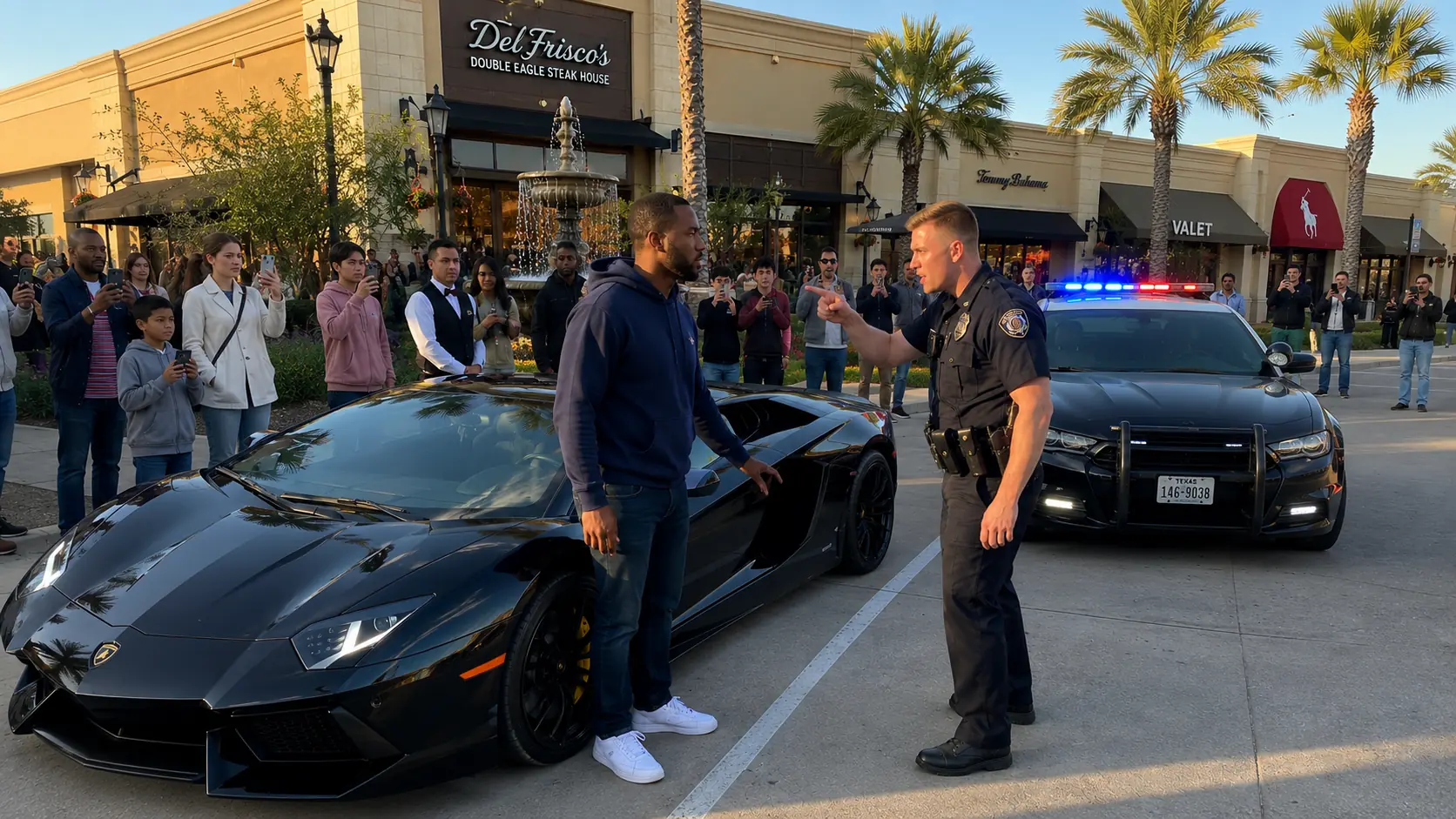
Beside it stood Damon Westbrook.
He was tall, Black, and dressed in a simple navy hoodie, dark jeans, and white sneakers that looked too ordinary for the car beside him. One hand rested on the driver’s side door handle. The other held his phone, still unlocked from the call he had just ended.
Behind him, a police cruiser idled with its lights flashing.
Red and blue slid across the pavement, over the Lamborghini’s glossy curves, and across the faces of the people now slowing down to watch. Officer Miles Carver stepped out from behind the open cruiser door with the practiced confidence of a man who believed he had already figured out the story. He was broad through the shoulders, pale-skinned, square-jawed, and young enough to still confuse volume with authority.
“Sir,” Carver said louder, “I told you to step away from the vehicle.”
Damon looked at him calmly. Not frightened. Not angry. Not even surprised. His expression had the quiet patience of a man who had learned long ago that panic only helped people who were waiting for you to lose control.
“Is there a problem, Officer?”
Carver pointed toward the Lamborghini. “This vehicle was reported stolen twelve minutes ago.”
A murmur passed through the crowd.
A stolen Lamborghini was the kind of sentence that made strangers pause even when they had no business pausing. A man leaving the cigar lounge stopped near the curb. A couple waiting outside the sushi restaurant leaned closer. One teenage boy in a baseball cap lifted his phone and began recording.
Damon glanced at the car, then back at the officer.
“That’s interesting,” he said. “Because it belongs to me.”
Carver laughed under his breath.
It was not a friendly laugh. It was the kind of laugh meant to place a man beneath the conversation before the conversation had even begun. He looked Damon up and down, taking in the hoodie, the jeans, the sneakers, and whatever story his mind had already built around them.
“Right,” Carver said. “Your Lamborghini.”
Damon’s eyes stayed steady. “Yes.”
“And I suppose you have proof of that.”
“I do.”
Carver tilted his head. “Then maybe you should start explaining how someone like you ended up with a vehicle like this.”
The words landed hard enough that the crowd felt them.
No one said anything at first. That was how these moments usually worked. People felt the wrongness before they found the courage to name it, and by then the moment had already moved on.
Damon slipped his phone into his pocket slowly.
“Someone like me,” he repeated.
Carver shrugged. “You heard me.”
“I did.”
“Then answer the question.”
Damon took one step away from the Lamborghini, not because he was surrendering, but because he wanted the officer to have no excuse to pretend he was threatened. He folded his arms loosely, his body calm, his voice even.
“I got the car from a dealership.”
Carver pulled out a small notebook. “Which dealership?”
Damon’s mouth moved slightly, almost a smile.
“Mine.”
A few people in the crowd exchanged looks.
Carver did not smile.
“Your dealership.”
“Yes.”
“Of course.”
The officer walked slowly around the Lamborghini, studying it like the car might confess if he stared long enough. The Aventador sat low and sharp under the Texas sun, its black paint reflecting Carver’s uniform in warped ribbons. The engine ticked softly as it cooled.
“Funny thing about stolen cars,” Carver said. “They always seem to end up in the hands of people who think nobody is paying attention.”
Damon looked around at the phones now pointed toward them.
Carver’s jaw tightened.
The crowd had grown to nearly twenty people. A valet leaned against his stand with one hand over his mouth. A delivery driver had stopped beside his van. The teenager recording whispered to his friend, “This is going to blow up.”
Carver noticed the phones and straightened his posture.
“Identification,” he said.
Damon removed a slim leather wallet from his pocket and handed over his driver’s license.
Carver studied it.
Damon Westbrook.
The officer looked from the card to Damon’s face, then back again, as if the name itself had somehow disappointed him.
“You are telling me this Lamborghini is registered to you?”
“That is what I’m telling you.”
Carver handed the license back but kept the suspicion in his face. “Then you won’t mind if we verify that.”
“Not at all.”
The officer stepped away and spoke into his radio. Dispatch crackled back through static. The plaza grew oddly quiet, as if everyone had entered the same held breath. Damon rested one hand on the roof of the Lamborghini, his posture still as relaxed as if he were leaning against his own kitchen counter.
A minute later, a second vehicle rolled into the plaza.
It was a black police SUV with no siren, no hurry, just authority arriving in a different shape. The door opened, and Police Chief Alan Prescott stepped out, adjusting the brim of his cap as his eyes scanned the scene.
The chief was in his late fifties, silver at the temples, broad in the chest, and polished in the way career officials often become after years of press conferences and city budget meetings. He looked at the Lamborghini first. Then he looked at Damon. Then he looked at the crowd.
“What do we have?” Prescott asked.
Carver stepped toward him quickly. “Possible auto theft, Chief. Vehicle was reported stolen through an automated alert.”
Prescott looked at Damon from head to toe.
The hoodie.
The sneakers.
The calm expression.
“This your vehicle?” the chief asked.
“Yes,” Damon said.
Prescott looked back at the Lamborghini. “That’s quite a car.”
Damon said nothing.
The chief’s eyes returned to him. “People who drive cars like this usually dress a little differently.”
The sentence hung there.
Longer than it should have.
A woman near the restaurant shifted uncomfortably. The teenager filming widened his eyes but kept the phone up. Officer Carver looked briefly satisfied, as if the chief had finally said out loud what Carver had been thinking from the start.
Damon studied Prescott carefully.
He did not speak right away.
Instead, he took out his phone, tapped a number, and waited for the call to connect.
When it did, he said only five quiet words.
“Bring the municipal file.”
Then he ended the call and slipped the phone back into his pocket.
Carver frowned. “Who was that?”
Damon looked at him. “Someone who can clear this up.”
Prescott folded his arms. “This would have been simpler if you had explained yourself from the beginning.”
“I did,” Damon said.
No one missed the answer.
The parking plaza settled into a strange silence. The patrol lights kept turning. The Lamborghini kept reflecting everyone around it, turning the whole scene into a moving picture of power, doubt, and curiosity.
Carver checked his radio again. Dispatch was still confirming the registration. Prescott waited with visible impatience, though his expression had grown more careful now that the crowd was larger. No chief liked cameras unless he was the one calling the press conference.
Then another engine approached.
A black Range Rover pulled into the plaza and stopped near the curb. Two people stepped out. The first was a woman in a charcoal business suit, carrying a leather folder under one arm. Her hair was pulled back tightly, and she walked with the calm precision of someone who had spent years entering rooms where men expected to be in charge.
Behind her came a younger man holding a tablet.
They moved directly toward Damon.
“Mr. Westbrook,” the woman said, giving him a respectful nod. “We came as quickly as we could.”
“Thank you, Claire.”
Officer Carver looked between them. “And you are?”
“Claire Bennett,” she said. “General counsel for Westbrook Motor Group.”
The name moved through the crowd like a spark catching dry grass.
Westbrook Motor Group.
A few people immediately looked down at their phones. Someone near the fountain whispered that he knew that name. Someone else said it was the company behind half the luxury dealerships across Texas and several municipal vehicle contracts.
Carver’s face tightened.
Prescott’s did not change, but his eyes did.
“What does Westbrook Motor Group have to do with this vehicle?” the chief asked.
Claire opened the folder and removed a set of documents. “Quite a lot. This Lamborghini Aventador is registered to Westbrook Motor Group under Damon Westbrook’s personal executive fleet account.”
The young man with the tablet stepped forward and turned the screen toward the officers.
There it was.
Vehicle identification number.
Plate number.
Registration.
Corporate ownership.
Executive authorization.
Damon’s name sat cleanly across the record.
Carver stared at the screen, then looked at the Lamborghini, then back to the tablet.
Prescott said, “Dispatch reported the vehicle as stolen.”
Claire nodded. “An automated location alert was triggered earlier this afternoon while the car was being transported between company facilities. The transport driver paused outside the designated route, which temporarily flagged the vehicle. The alert was cleared before Officer Carver arrived.”
The young man tapped the screen.
A timestamp appeared.
Cleared.
Confirmed.
Authorized pickup.
The crowd murmured louder.
Carver’s face reddened. “Dispatch didn’t say it was cleared.”
Claire’s expression stayed professional. “That may be a communication issue. It is not an ownership issue.”
Damon looked at Carver. “You asked where I got the car.”
Carver said nothing.
Damon rested his hand lightly on the Lamborghini’s roof. “The answer has not changed.”
Claire closed the folder.
“Mr. Westbrook owns Westbrook Motor Group,” she said clearly. “The company operates luxury dealerships, logistics networks, and municipal fleet partnerships in several states.”
The teenager recording whispered, “That’s him.”
The whisper spread.
People searched faster now. Screens lit up with Damon’s photograph. Business profiles. Magazine articles. Interviews. A Forbes feature from the year before. A headline about his company expanding electric fleet services in Texas and Arizona.
The mood changed completely.
Five minutes earlier, Damon had been a suspicious man beside a stolen car.
Now he was becoming exactly what the officers had not imagined.
The owner.
The client.
The taxpayer.
The contractor.
The man whose signature had quietly touched more of the city than either officer knew.
Prescott cleared his throat. “Mr. Westbrook, why didn’t you say you owned the company?”
Damon looked at him for a long moment.
“I said I owned the car.”
Prescott’s jaw shifted slightly.
Damon continued, “You did not believe that because I did not match the picture you had already made in your head.”
A ripple went through the crowd.
That sentence changed the air more than any document had.
Carver glanced toward the phones pointed at him. The crowd had crossed from curiosity into judgment, and he could feel it. He tried to straighten, but the authority he had arrived with no longer fit the moment.
Prescott stepped forward. “Let’s not turn this into something it is not.”
Damon’s expression remained calm. “What is it, Chief?”
“A misunderstanding.”
“No,” Damon said. “A misunderstanding is when two reasonable people lack the same information. This became something else when your officer looked at me, looked at this car, and decided the report made more sense than ownership.”
Carver opened his mouth, then closed it.
Prescott looked toward Claire. “Counsel, we are willing to resolve this professionally.”
Claire’s voice stayed even. “Professionally would mean acknowledging that the vehicle was cleared before contact escalated. It would also mean acknowledging that Mr. Westbrook’s appearance became part of your officers’ suspicion.”
“That is your interpretation,” Prescott said.
Damon looked directly at him. “No. That is your statement. People who drive cars like this usually dress a little differently.”
The chief went still.
Several people in the crowd murmured because they had heard it too.
The teenager filming whispered, “He got him.”
Prescott’s face hardened slightly, but he was too experienced to lash out while cameras were running. He looked at Damon with a measured expression, trying to find a path back to control.
“Mr. Westbrook,” he said carefully, “officers must make fast judgments in uncertain situations.”
Damon nodded. “That is true.”
Prescott seemed relieved.
Then Damon continued.
“The difference between observation and assumption is what happens after the first question. Your officer saw a Black man in a hoodie beside a Lamborghini and treated the idea of ownership as ridiculous. You arrived and added your own assumption to his.”
The plaza went quiet again.
Carver looked down.
Prescott glanced toward his SUV, then toward the cruiser.
Damon followed his gaze.
“Speaking of vehicles,” Damon said, “there is one more record you may want to review.”
Claire handed a second page to the young man with the tablet. He brought up a contract file, then turned it toward the chief.
Prescott looked at the screen.
His eyes stopped moving.
Carver leaned slightly to see it and went pale.
“Three years ago,” Damon said, “Westbrook Motor Group entered a municipal partnership with this city to modernize several fleet programs.”
Prescott said nothing.
Damon’s voice stayed steady. “That included maintenance, replacement scheduling, and financing support for multiple city departments.”
Claire added, “Including the police department fleet.”
The crowd turned almost as one toward the cruiser.
The same cruiser whose lights had been flashing behind Damon since the moment Carver arrived.
The upgraded light bar.
The newer model.
The department logo.
The vehicle that had carried the accusation.
Damon looked at Carver. “My company helps maintain the car you drove here in.”
Carver’s eyes dropped to the pavement.
Prescott’s posture changed.
Not dramatically.
Not enough for everyone to catch it.
But Damon caught it.
The chief suddenly understood that this was not only about a Lamborghini. It was about a police department publicly confronting a major city contractor whose company had just been insulted, doubted, and nearly detained in front of fifty witnesses and half the internet.
Prescott took a slow breath. “Mr. Westbrook, I see that there are layers here.”
“There were always layers,” Damon said. “You only started seeing them when they affected you.”
The words struck clean.
A woman near the restaurant nodded.
The delivery driver leaned off his van and said softly, “Damn.”
Prescott turned toward Carver. “Was the vehicle cleared before you made contact?”
Carver swallowed. “I did not receive that information, Chief.”
“That is not what I asked.”
Carver hesitated. “I don’t know.”
Damon looked at him. “But you knew enough to laugh when I said it was mine.”
Carver’s face flushed.
“I was following the report.”
“You were following your assumption.”
The crowd murmured again.
Prescott lifted one hand, trying to settle the space. “Everyone needs to calm down.”
Damon looked at him. “Everyone is calm. That may be the part making you uncomfortable.”
Prescott’s eyes narrowed, then softened when he remembered the cameras.
He turned to Claire. “What exactly are you asking for?”
Claire looked toward Damon.
Damon answered himself.
“Accountability.”
The word landed with the quiet force of a gavel.
Prescott folded his arms. “Accountability can mean many things.”
“Yes,” Damon said. “Tonight, it begins with clarity.”
The chief waited.
Damon looked around the plaza. “The vehicle was reported through an automatic alert. That part is explainable. What happened after is the problem. Your officer approached me as though guilt had already been assigned, and you reinforced the idea that I did not look like someone who could own what I own.”
Prescott’s jaw tightened. “That was not my intention.”
“Intent does not erase impact.”
Claire nodded slightly.
The crowd stayed silent.
Damon continued, “You can call this a misunderstanding and hope the videos disappear into the noise of the internet by morning. Or you can acknowledge what happened, preserve the footage, review the call, review the dispatch timing, and address the assumptions that turned a vehicle alert into a public accusation.”
The chief looked around.
Phones were everywhere.
This was not a private conversation anymore. It was evidence. It was reputation. It was trust being measured in real time.
Prescott turned toward Officer Carver.
“Officer Carver, return to your cruiser.”
Carver’s head snapped up. “Chief?”
“Now.”
Carver hesitated, then moved. The crowd watched him walk back to the patrol car, each step slower than the one before it. He stood beside the door, no longer the center of command, just a man being watched.
Prescott faced Damon again.
“Mr. Westbrook, I apologize for my earlier comment. It suggested you did not belong with your own vehicle. That statement should not have been made.”
The plaza became so quiet that the nearby fountain suddenly sounded loud.
Damon studied him.
The apology was not perfect.
But it was public.
And public mattered.
“Thank you for acknowledging it,” Damon said.
Prescott nodded once. “Officer Carver’s body-camera footage will be preserved. Dispatch logs will be reviewed. I will request an internal review of the response.”
Claire’s eyes sharpened. “Request?”
Prescott corrected himself. “Order.”
Damon watched him for another moment, then nodded.
“That is a start.”
The tension softened slightly, but it did not vanish.
Because everyone understood something important.
An apology did not erase the moment.
It only determined whether the moment could become useful.
Carver stood by the cruiser, staring at the ground. He had arrived expecting to control a suspected thief. Now he was part of a recorded lesson about how quickly authority could expose its own weakness.
Damon turned toward him.
“Officer Carver.”
Carver looked up reluctantly.
“You asked where I got the car,” Damon said. “You never asked what I built to get here.”
Carver said nothing.
“When I was nineteen,” Damon continued, “I walked into a dealership wearing the only suit I owned. I had saved for months to buy it. I did not go there to purchase a car. I went there to ask questions about the business.”
The crowd listened.
Even Prescott looked still.
“The man at the front desk asked if I was there to clean the showroom.”
A few people shifted uncomfortably.
Damon looked at the Lamborghini.
“I told him I was there to learn. He laughed. So I learned anyway.”
His voice remained calm, but something beneath it was heavier now.
“I learned financing. Inventory. Service contracts. Dealer licensing. Logistics. Manufacturer relationships. Fleet maintenance. Every door that closed in my face taught me where the hinges were.”
Claire lowered her eyes briefly, as if she had heard the story before and still respected it.
Damon continued, “I opened my first used-car lot with six vehicles and a trailer office that leaked when it rained. Then I opened another. Then a service center. Then a dealership. Then a fleet company. Years later, the same industry that once mistook me for the janitor had to compete with me.”
The crowd was completely silent.
Damon looked back at Carver.
“So when you see me beside this car and decide theft is more believable than ownership, you are not just making a mistake about a vehicle. You are repeating a story men like me have heard all our lives.”
Carver’s shoulders lowered.
Prescott rubbed a hand over his chin.
The teenager filming had stopped whispering.
Damon turned to the chief.
“The goal is not to humiliate your department,” he said. “The goal is to make sure the next person who doesn’t have my money, my lawyers, or my municipal contracts still gets treated like a citizen before being treated like a suspect.”
That sentence changed the crowd.
It was no longer about a billionaire and a Lamborghini.
It was about delivery drivers.
Valets.
Mechanics.
Teenagers.
Workers leaving late shifts.
Men and women standing beside things others believed they could not possibly own.
Prescott heard it too.
To his credit, he did not look away.
“You are right,” the chief said.
Carver looked up sharply, surprised by the admission.
Prescott continued, “This department needs to examine how automatic alerts, caller assumptions, and officer judgment interact during vehicle stops and suspicious-person responses. I will not pretend tonight was handled as well as it should have been.”
Damon nodded. “Good.”
“I would also like you to participate in a leadership training discussion with our command staff, if you are willing.”
Damon looked at him carefully. “I will participate if this does not become a photo opportunity.”
Prescott almost smiled, but thought better of it. “Fair.”
“No staged handshake in front of a banner,” Damon said. “No press release about community partnership while nothing changes. If I come, your officers listen. They ask honest questions. They hear what these moments feel like from the other side of the badge.”
Prescott nodded slowly. “Agreed.”
Claire made a note.
The crowd had started to breathe again.
A few people lowered their phones, not because the moment was no longer important, but because they seemed to understand it had shifted from spectacle into something quieter. The teenager kept filming, though now his face looked more thoughtful than excited.
Prescott turned toward Carver.
“Officer Carver, apologize to Mr. Westbrook.”
Carver’s face tightened.
For a second, pride fought for its last piece of ground.
Then he stepped forward.
“Mr. Westbrook,” he said, voice stiff at first, then quieter, “I apologize. I should have waited for confirmation before treating you like the car was stolen. I should not have assumed.”
Damon looked at him.
“You should have believed it was possible.”
Carver swallowed.
“Yes, sir.”
Damon nodded once. “Remember that difference.”
Carver lowered his eyes.
The chief dismissed him back to the cruiser, then faced Damon again.
“We will be in contact tomorrow,” Prescott said.
“My office will expect the footage and dispatch logs preserved tonight,” Claire said.
“They will be,” Prescott answered.
Damon opened the Lamborghini’s door, then paused.
The crowd watched him.
For the first time since the officers arrived, he smiled faintly.
Not with triumph.
With exhaustion.
“This car was never the important thing,” he said.
Prescott looked at him. “Then what was?”
Damon rested one hand on the open door.
“What people think they know before they know anything.”
No one answered.
Because the truth did not need help standing.
Damon lowered himself into the driver’s seat. The engine came alive with a deep, controlled growl that rolled through the plaza and vibrated in the pavement. The sound turned heads, but the attention now felt different.
He eased the Lamborghini forward slowly.
No rush.
No show.
Just a man leaving in the car that had always been his.
As he pulled out of the parking space, the crowd parted. Some people watched in silence. Others looked at the officers. A few looked at themselves in the dark glass of the storefronts, perhaps wondering what they had believed at the beginning of the night.
The next morning, the video was everywhere.
The caption was simple.
They accused him of stealing a Lamborghini. Then they found out he funded the police fleet.
By noon, the clip had crossed city pages, business forums, legal channels, and national news feeds. People replayed the moment Prescott said that drivers of cars like that usually dressed differently. They replayed Damon saying he had already explained himself. They replayed the contract reveal.
Westbrook Motor Group issued no dramatic statement.
Only one paragraph.
“We appreciate Chief Prescott’s public acknowledgement and expect the city to preserve all records connected to the incident. Our company remains committed to public safety partnerships that honor dignity, transparency, and equal treatment.”
The city moved fast because embarrassment moves government faster than conscience does.
Officer Carver was placed on administrative leave pending review. Dispatch procedures for automated vehicle alerts were updated. The department began a formal audit of high-value vehicle stops and ownership verification protocols.
But Damon cared less about press coverage than most people assumed.
He cared about what happened three weeks later.
Inside a police training room that smelled like coffee, carpet, and dry-erase markers, Damon stood in front of thirty officers, command staff, supervisors, and recruits. No banner. No photographer. No mayor pretending to listen from the back row.
Just the people who needed to hear it.
Chief Prescott sat in the front row.
Officer Carver sat three rows back.
Damon wore a suit this time, but he mentioned the hoodie before anyone else could.
“The hoodie was never evidence,” he said. “The car was never proof. The report was information, not a verdict. Your job is not to protect the assumptions that arrive first.”
No one spoke.
Damon looked across the room.
“When you meet someone, you are never seeing the whole story. You are seeing the cover of a book you have not earned the right to summarize.”
A few officers wrote that down.
Carver did not.
He simply listened.
Damon told them about the dealership at nineteen. He told them about being asked if he was there to clean the floors. He told them about saving, studying, failing, borrowing, building, getting laughed out of rooms, then buying the buildings where those rooms sat.
Then he told them about the parking lot.
Not as a humiliation.
As a warning.
“Most people do not have a general counsel five minutes away,” Damon said. “Most people do not have contracts that make a police chief pause. Most people do not have a crowd filming when an assumption becomes force.”
He looked directly at Carver.
“So the real question is not how you treat someone after you learn they are powerful. The question is how you treat them before you know whether they are.”
That landed.
Hard.
A month later, Officer Carver wrote Damon a letter.
It was not polished.
It did not sound like a lawyer had touched it.
He admitted he had looked at the hoodie before listening to the answer. He admitted he had enjoyed the authority of being certain. He admitted that when Damon said the dealership was his, Carver had treated it as a joke because part of him believed it had to be one.
Damon read the letter twice.
Then he placed it in a drawer.
He did not forgive the man completely.
But he respected the honesty.
Six months later, Damon returned to the same luxury plaza on a quiet Friday evening.
The Lamborghini was not with him.
He arrived in an old black pickup from his first dealership, restored but still rough in places, with leather seats that creaked and a radio knob that stuck when turned too far. He parked near the same row of storefronts and stepped out wearing jeans, boots, and a plain gray jacket.
The plaza looked the same.
Palm trees.
Glass.
Expensive cars.
Restaurant lights glowing gold against the evening.
But Damon knew places were never exactly the same after truth had happened there.
Near the valet stand, a young Black man in a delivery uniform stood beside a white Porsche, holding a set of keys while a woman searched her purse for a tip. An older man walking past looked at the young man, then at the car, and for a moment Damon saw the familiar question begin to form on his face.
Then the man looked away and kept walking.
No accusation.
No phone call.
No cruiser.
Damon watched the delivery driver smile, hand over the keys, accept the tip, and move on with his evening.
It was a small thing.
Almost nothing.
But small things were where culture either changed or stayed rotten.
Damon walked toward the restaurant entrance, then paused beside the space where the Lamborghini had sat months earlier. He could still see the reflection of the flashing lights if he let himself. He could still hear Carver’s laugh. He could still hear Prescott’s comment hanging in the air.
But he could also hear the apology.
The training room.
The silence after hard truth.
The letter.
Progress, Damon had learned, rarely arrived like thunder.
Sometimes it came quietly.
A corrected report.
A different question.
A young officer waiting three extra seconds before turning suspicion into command.
A powerful man refusing to turn humiliation into revenge when he could turn it into evidence instead.
Damon looked across the plaza as the Texas night settled around the storefronts.
He had built his company by understanding machines. Engines, supply chains, fleets, contracts, logistics. But people were harder. People could run for years on bad assumptions and still call themselves reliable.
That was why moments mattered.
Because every once in a while, an engine knocked loud enough for everyone to hear what was broken.
And if people were willing, truly willing, they could repair more than the machine.
They could repair the way they saw each other.
Damon stepped away from the parking space and continued toward the restaurant, calm as ever, carrying no need to prove what he owned.
The people who needed to know had learned.
The rest would learn eventually.