The white Gulfstream waited under the Houston morning sun like nothing in the world could touch it.
Its polished body reflected the private terminal windows, the fuel truck parked beside the wing, and the four flight attendants standing near the stairs with practiced smiles. Everything about the scene looked expensive, quiet, and controlled. That was the way private aviation sold itself: no crowds, no lines, no delays, no questions that made wealthy people uncomfortable.
Elias Morgan knew better.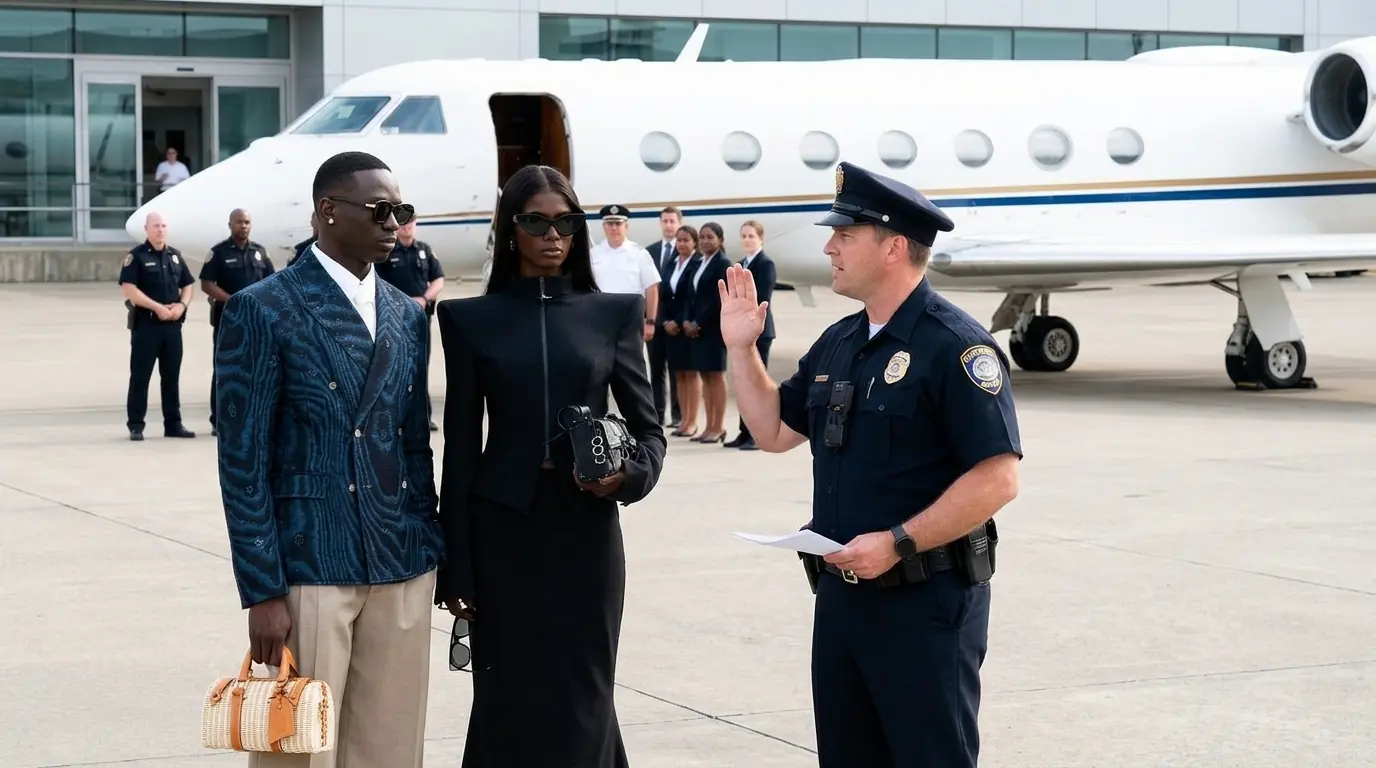
He had spent twenty-two years inspecting aircraft that looked flawless from the outside and hid danger beneath panels most passengers never saw. He could read a maintenance log the way some men read a confession. And that morning, walking beside his wife across the tarmac, he already knew the jet in front of them should not have been preparing to fly anywhere.
Renee Morgan walked at his side in a cream-colored suit, ivory heels clicking softly against the concrete.
She looked like a first-class passenger heading to a quiet anniversary trip. Her hair was swept back, her sunglasses were large, and the pearl earrings at her ears caught the sun when she turned her head. Anyone watching would see elegance first.
That was the point.
Renee was not only Elias’s wife. She was Dr. Renee Morgan, an aerospace systems engineer and federal human-factors consultant who had spent years investigating how pressure, fatigue, medical shortcuts, and corporate intimidation could turn a cockpit into a risk long before the wheels ever left the ground.
Elias wore a navy suit, dark glasses, and carried a leather overnight bag.
Inside that bag was a federal warrant package, two encrypted recorders, and a tablet showing the aircraft’s true status. The Gulfstream’s left engine mount had failed inspection. A cockpit oxygen line had lost pressure during testing. The federal grounding order had gone out electronically at 8:43 that morning.
The flight was still being fueled for Paris.
That was why Elias and Renee had come dressed as passengers.
Their reservation had been created through a federal shell company and accepted by the charter operator, Crestline Premier Aviation. The plan was simple: board as high-value clients, observe the crew’s preflight decisions, and determine whether the company would attempt to depart despite a federal hold.
They never reached the stairs.
A police officer stepped in front of them before Renee’s heel touched the painted safety line.
He was tall, white, broad through the shoulders, with the stiff posture of a man who enjoyed making other people stop. His nameplate read Officer Grant Keller. His hand rested near his belt, not on his weapon, but close enough to make sure they noticed it.
“Where do you think you’re going?” he asked.
Elias stopped calmly. “We’re passengers on this aircraft.”
Keller looked at the white Gulfstream, then back at them. His eyes moved over Elias’s Black face, Renee’s suit, the luggage, the sunglasses, and the boarding folder in Elias’s hand. The decision formed on his face before the facts had a chance to enter.
“No, you’re not.”
Renee removed her sunglasses slowly. “Excuse me?”
Keller pointed toward the terminal. “You two need to turn around and go back inside.”
Elias opened the folder and held out the charter documents. “Our confirmation lists us as passengers one and two. Elias and Renee Morgan. Seats 1A and 1B.”
Keller glanced at the papers for less than two seconds.
He did not scan the code.
He did not call the desk.
Instead, he laughed.
It was not loud, but it carried far enough for the captain standing near the stairs to hear it. The flight attendants kept their hands folded. None of them stepped forward.
“You expect me to believe you chartered that?” Keller asked.
Renee’s face remained still. “That is what the documents say.”
“People print fake documents every day.”
“Then verify them.”
Keller’s eyes hardened. “Don’t tell me how to do my job.”
Elias watched the captain at the base of the stairs. The man looked away too quickly. That mattered. People who know nothing usually look confused. People who know too much avoid eye contact.
“Officer,” Elias said, keeping his voice level, “why are you assigned to this terminal?”
Keller’s jaw moved. “Security concern.”
“What security concern?”
“You.”
Renee gave a small, humorless smile. “Convenient.”
Keller stepped closer. “Ma’am, I’m going to ask you once not to make this difficult.”
“You haven’t asked anything reasonable yet.”
The nearest flight attendant shifted her weight, but the captain gave her a look that stopped her before she spoke. Elias noticed that too. Fear had a sound even when nobody said a word.
Keller lifted his radio, then lowered it without pressing the button.
“You people walk in here dressed up and think everybody is supposed to pretend you belong,” he said.
The words landed on the concrete between them.
Renee tilted her head slightly. “Define you people.”
Keller’s mouth tightened. “Don’t start that.”
“I didn’t start anything. You did.”
The terminal manager stood behind the glass doors, watching from inside with one hand on his phone. He was close enough to see everything and far enough to pretend he could not hear it. Elias wondered how many times that man had watched someone be pushed out of a room and called it customer service.
Keller turned back toward Elias. “Show me real identification.”
Elias slid one hand toward his jacket pocket. Keller immediately touched his cuffs.
“Slow.”
“I am moving slowly.”
“Any sudden move and you’re both detained.”
“For what?” Renee asked.
“Unauthorized access.”
“We are authorized passengers.”
“No,” Keller said. “You’re trespassers who got past a lazy receptionist.”
The captain finally spoke from near the stairs. “Officer, perhaps it would be best if they waited inside while we confirm.”
His voice was smooth, but his eyes stayed tense.
Elias looked at him. “Captain, is this aircraft grounded?”
The captain went still.
Keller frowned. “What did you say?”
Elias held the captain’s gaze. “Tail number N742QH was placed under federal hold at 8:43 a.m. The order went to Crestline, airport operations, the flight crew, and the maintenance contractor.”
One of the flight attendants looked toward the captain.
The captain’s face tightened.
Keller turned toward him. “Is that true?”
The captain adjusted his cuff. “There appears to be a system discrepancy.”
“No,” Renee said. “There is a federal grounding order.”
Keller’s eyes narrowed, suddenly less certain but twice as angry. “Who are you people?”
This time, Elias reached into his jacket and removed two credential cases.
He opened the first.
Federal Aviation Administration.
Senior Air-Carrier Safety Inspector.
Then he opened the second and handed it to Renee.
Dr. Renee Morgan.
Federal Aerospace Safety Consultant.
Authorized Special Investigator.
Keller stared at the badges.
For a second, silence expanded across the tarmac.
The aircraft stairs remained lowered. The crew stayed frozen. Inside the terminal, the manager stopped pretending to make a phone call.
Keller’s hand hovered near his cuffs again.
“You expect me to believe the federal government sent inspectors dressed like private passengers?”
Elias lowered the credentials just enough for Keller to read them again. “We expected the crew to follow a grounding order.”
Renee looked past Keller toward the aircraft. “Instead, the plane is fueled, catered, staffed, and minutes from departure.”
Keller swallowed.
Then he made his last mistake.
“I’m detaining both of you until these badges are verified.”
Elias said nothing.
Renee only glanced toward the airport road.
The sound reached them before the vehicles did.
At first, it was a low growl beyond the hangars, easy to mistake for airport equipment. Then three black SUVs turned onto the service road, followed by a marked police command vehicle and an airport operations truck. They moved with purpose, not speed, the way official consequences move when they already know the address.
The lead SUV stopped near the Gulfstream.
Doors opened.
Two federal agents stepped out first, then an FAA enforcement supervisor, then Police Chief Marisol Vega in full uniform with a sealed warrant folder under one arm. She did not look at the aircraft. She did not look at the captain.
She walked straight to Officer Keller.
“Grant,” she said. “Step away from your weapon.”
Keller’s face changed.
“Chief, these two attempted to board under false pretenses.”
“Their credentials were confirmed with my office yesterday.”
He blinked. “Yesterday?”
Vega opened the folder. “Grant Keller, you are under arrest for bribery, obstruction, conspiracy, and deprivation of civil rights under color of law. Remove your service weapon and place it on the ground.”
The flight attendants backed away from the stairs.
The captain lowered his head.
The terminal manager disappeared from the window, only to reappear a moment later with his hands raised as agents entered the building behind him.
Keller looked at Elias, then Renee, then the chief. “This is insane.”
“No,” Chief Vega said. “This is documented.”
He tried one final move, the one men like him always try when confidence fails and panic begins.
“I was responding to a security request.”
“From whom?”
Keller’s mouth opened.
No answer came.
Chief Vega stepped closer. “Phone records show you received no official call. They also show repeated contact with Crestline’s operations director, Mason Greer, on prepaid phones tied to your brother’s bank account. So I’ll ask once more. Who sent you?”
Keller looked toward the captain.
The captain stared at the concrete.
A federal agent moved behind Keller. “Turn around.”
For three seconds, Keller remained where he was, as if still waiting for the old world to return and protect him. Then he removed his weapon, placed it on the ground, and let the agent cuff him in front of the jet he had been guarding for someone else.
Elias watched without pleasure.
A bad officer losing his badge did not undo the flights already risked, the mechanics already threatened, or the passengers who had boarded aircraft they were told were safe. It only stopped one gatekeeper from blocking the next truth.
The federal teams moved at once.
One group entered the aircraft and secured the cockpit. Another took the captain and first officer aside. A third moved into Crestline’s operations office, where dispatchers had been warned not to touch their computers.
The mechanic who had boarded with a laptop tried to slip through the service gate behind the fuel truck.
He did not make it ten steps.
Agents stopped him before he reached his car. His laptop was still open, connected to Crestline’s internal maintenance system. On the screen was the cleared status for the Gulfstream, updated only minutes earlier.
But Elias’s federal tablet still showed the hold.
That conflict was the key.
Crestline had built a second reality inside its own system. In the official federal record, aircraft remained grounded. In the company’s local dispatch software, those same aircraft appeared cleared for departure after someone manipulated internal restrictions.
If anything went wrong later, management could say the crew relied on the screen in front of them.
A software misunderstanding.
A clerical error.
A harmless technical glitch.
Renee had heard those phrases too many times from companies standing in the ashes of decisions they wanted to call accidents.
Inside the cockpit, investigators found fresh signatures on the preflight acceptance form. The captain had signed off on airworthiness at 9:19 a.m., seven minutes after texting Mason Greer.
Grounding still active. I will not carry this alone.
Greer’s reply sat underneath.
Keller will manage the distraction. Local system clears in five.
The captain had known.
The first officer had known enough to say nothing.
The flight attendants claimed they had been told the Morgans were troublemakers attempting to scam an upgrade onto a luxury charter. None of them had checked the manifest. None had asked the terminal desk. None had stepped forward when Keller mocked the couple in front of the aircraft.
One young attendant began crying during her interview.
“I thought something was wrong,” she said. “But the captain told us not to interfere.”
Renee listened, arms folded, her expression firm but not cruel. “Fear can explain silence. It cannot make silence safe.”
The attendant wiped her face. “I should have asked.”
“Yes,” Renee said. “You should have.”
In the operations office, agents found two sets of records.
The clean set was prepared for auditors: repairs completed, crews rested, medical clearances current, departures legal.
The hidden set was buried in a restricted folder under the name Weather Archive. Inside were photos of cracked engine brackets, failed oxygen pressure tests, fatigue reports, and medical notes altered after pilots were pressured to fly.
There were also names.
Employees were sorted into two lists.
Reliable.
Difficult.
Difficult meant mechanics who refused to backdate repairs. Pilots who requested rest. Dispatchers who asked why federal holds disappeared locally. One former technician had been escorted out by Keller after refusing to sign a repair he never performed.
The police report called him disruptive.
There was no mention of maintenance fraud.
That was Keller’s job.
He gave private intimidation a public uniform.
Crestline’s operations director, Mason Greer, was arrested at his home that afternoon before he could destroy his prepaid phone. Investigators found messages tying him to Keller, the mechanic, and two senior executives. Over three years, payments had moved through a shell consulting company into an account owned by Keller’s brother.
The invoices said risk assessment.
The money bought obstruction.
The deeper investigators went, the worse it became.
One flight had departed after a pilot reported chest pain and asked to be removed from duty. Renee found his medical note replaced by an older clearance form, then buried under a routine file update. He landed safely in Geneva but was hospitalized two days later with a cardiac condition that should have grounded him immediately.
Another aircraft carried eleven passengers to Aspen after technicians found fuel contamination. The mechanic who discovered it was removed from the hangar by Keller for “creating a disturbance.” The aircraft departed after a supervisor signed the inspection without repeating the test.
Nothing crashed.
That was how the scheme survived.
Every safe landing became a shield for the next unsafe departure.
Crestline treated survival as proof that the warnings were dramatic, inconvenient, or exaggerated. Elias had seen companies think that way before. They always sounded reasonable until metal failed, oxygen dropped, engines shuddered, or families waited at airports for passengers who never came home.
By sunset, the entire Crestline fleet was grounded.
Six aircraft sat on ramps across four states, red-tagged and sealed for inspection. Two were cleared after proper review. Three needed major repairs. One had falsified structural records so serious the FAA ordered it removed from service indefinitely.
Reporters gathered outside the Houston private terminal before Elias and Renee even left.
A dozen cameras pointed at them when they stepped through the doors. Questions came all at once.
Was this racial profiling?
Was this aviation corruption?
Was an officer bribed?
Were passengers almost put in danger?
Elias waited until the noise settled.
“It was all of those things,” he said. “Officer Keller profiled us before checking our documents. Crestline used him because they knew a uniform could delay the truth. And the aircraft behind him was being prepared for flight despite an active federal safety hold.”
Renee stepped closer to the microphones.
“The point is not that we were federal investigators,” she said. “The point is that we should not have needed federal credentials to be treated like people with valid documents. The law does not apply only after someone important proves they are important.”
Her words led the evening news.
By morning, Keller’s face appeared beside footage of him blocking the Morgans from the jet. The clip of him saying, “You people need to leave before the actual passengers arrive,” played again and again until the phrase became impossible to explain away.
His attorney tried.
So did Crestline.
Both failed.
The criminal case stretched for fourteen months.
Keller pleaded not guilty at first, claiming he had acted on legitimate security concerns. The terminal footage destroyed that claim. It showed him ignoring white passengers at another aircraft moments earlier, refusing to scan the Morgans’ confirmation, and using a hidden phone while pretending to request dispatch verification.
Bank records showed the money.
Messages showed coordination.
Pilots and mechanics testified about intimidation.
One former mechanic, Angela Soto, told the court Keller had stood in front of a hangar door and said, “You can leave walking or in cuffs,” after she refused to sign off on an engine inspection she never completed.
She cried on the stand, but her voice never broke.
Mason Greer tried blaming senior executives. Senior executives blamed Greer. The mechanic blamed pressure. The captain blamed the system.
Renee said later that was the thing about rot. Once light reached it, every piece tried to prove it belonged to something else.
Keller eventually took a plea deal.
Bribery.
Obstruction.
Civil-rights violations.
Conspiracy to interfere with federal aviation safety enforcement.
He lost his police certification permanently and received nine years in federal prison. Greer received fifteen. Two Crestline executives received shorter sentences after cooperating, though neither would ever work in aviation again.
The captain lost his airline transport privileges.
The mechanic who altered the internal system cooperated and served time, but his testimony helped prove the larger conspiracy.
Crestline Premier Aviation did not survive.
Its operating certificate was revoked, its remaining assets liquidated, and compensation funds established for employees who had been threatened or fired for refusing unsafe orders. Passengers on the affected flights were notified. Some were furious. Some were grateful. Most were shaken by how close luxury had come to becoming disaster.
Chief Vega ordered a full review of every airport police interaction involving private aviation operators.
No officer could respond to a terminal complaint without dispatch documentation, body-camera activation, and a clear legal basis. Private companies could no longer summon police through informal calls, personal relationships, or prepaid phones passed through back doors.
The FAA changed its procedure too.
Grounding orders now triggered direct alerts not only to operators, but to airport operations, crew devices, and the aircraft’s registered maintenance authority. A local company screen could no longer hide behind a different version of reality when the federal record said no.
Renee helped build a confidential reporting channel for pilots, flight attendants, and mechanics facing retaliation.
Reports bypassed company management.
Evidence went directly to regulators.
The first month, twenty-six reports came in from across the private aviation industry.
Three led to emergency inspections.
One likely prevented a serious accident.
Six months after the trials ended, Elias and Renee returned to the same terminal.
This time, there was no operation.
No hidden recorder.
No warrant folder.
They were finally taking the anniversary trip that had been swallowed by the investigation. Paris, ten days, no depositions, no testimony, no emergency calls if Elias could help it.
The terminal looked different under new management.
The glass had been cleaned. The staff wore new badges. A sign near the security desk listed passenger rights and reporting procedures in plain language, which made Renee smile more than the fresh flowers did.
A young attendant checked their passports, scanned the reservation, and said, “Welcome, Mr. and Dr. Morgan. Your aircraft is ready.”
No hesitation.
No suspicion.
No officer stepping into their path.
They walked across the tarmac in the soft afternoon light, past the place where Grant Keller had once stood with one hand near his cuffs and the certainty that he could decide who belonged beside a private jet.
Elias glanced at Renee. “You packed the safety reports, didn’t you?”
She smiled. “Only three.”
“Renee.”
“Fine. Two and a half.”
He laughed, and for the first time in months, the sound did not feel borrowed from a life they had not yet returned to.
At the bottom of the stairs, Renee paused and looked back across the tarmac.
A year earlier, Keller had believed the lie was the Black couple standing in front of the Gulfstream with expensive luggage and valid documents. He never imagined the real fraud was the aircraft behind him, the company protecting it, and the system that had allowed a uniform to become a wall between danger and the truth.
That was the lesson Elias carried from the case.
Prejudice rarely works alone.
It opens the door for corruption, gives shortcuts to cowards, and teaches systems to trust appearance over evidence. Keller thought he was guarding luxury from people who did not belong there. In reality, he was guarding a crime scene from the investigators sent to expose it.
Renee slipped her hand into Elias’s.
“Ready?” she asked.
He looked up at the open aircraft door.
This time, no one tried to stop them.
“Ready,” he said.
And together, they climbed the stairs.