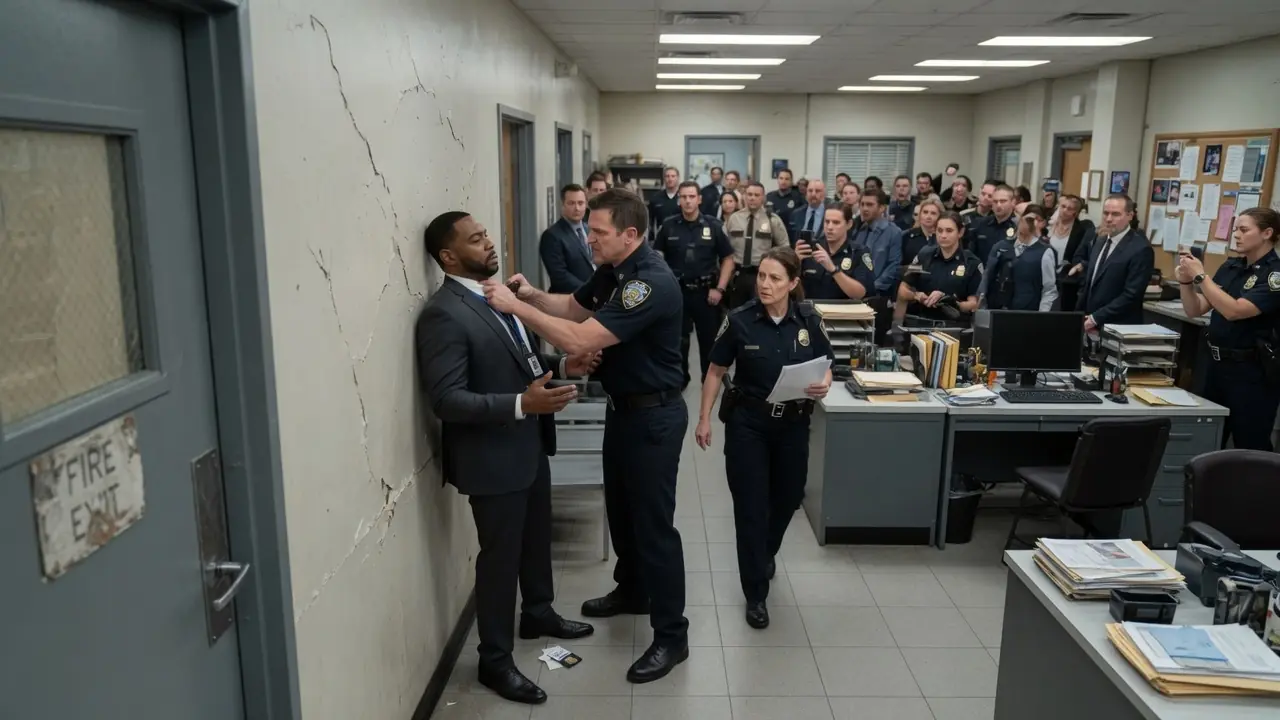
“Another Black thug thinking he can just walk into my station.”
Officer Darren Hale said it loud enough for half the lobby to hear.
Then he grabbed the Black man by the throat and drove him backward into the wall.
The impact cracked the plaster.
The man’s head snapped back, hard enough to make everyone nearby flinch. His eyes watered from the pressure on his neck, but he did not cry out. He did not swing. He did not shove back. He only lifted both hands slowly, palms open, showing he was not a threat.
That made Hale angrier.
He ripped the visitor badge from the man’s jacket and threw it onto the tile.
“You people don’t belong in here unless you’re in cuffs.”
It was 5:30 on a Tuesday afternoon.
Shift change.
The lobby of the precinct was crowded with officers clocking out, officers clocking in, clerks carrying files, radios crackling with traffic stops, and the smell of burnt coffee drifting from the break area.
Someone near the vending machine laughed once, nervously.
A sergeant walked past with a mug in her hand. She saw Hale’s fingers digging into the man’s throat. She saw the man’s back pinned against the wall. She saw the visitor badge on the floor.
Then she kept walking.
The Black man’s voice stayed level, even with Hale’s hand pressing against his windpipe.
“I’m here for tomorrow’s ceremony. Eight o’clock.”
Hale leaned closer.
“What ceremony?”
“The one arranged through the mayor’s office.”
That made a few officers look up.
Hale sneered, but something small flickered across his face. Not fear yet. Not recognition. Just the first crack in confidence.
“The mayor’s office?” he said. “You expect me to believe the mayor sent you?”
“I expect you to remove your hand from my throat.”
Hale tightened his grip.
The man swallowed against the pressure, but his gaze did not drop.
“Identification,” Hale snapped.
The man moved slowly, deliberately, the way Black men sometimes learn to move around police if they want to live long enough to explain themselves.
He reached into his jacket pocket and pulled out a driver’s license.
Hale snatched it from his hand.
The name read Marcus Ellington.
Age forty-three.
Address on the east side.
Hale stared at the license for one second too long.
Something changed in his eyes.
Then it disappeared.
Sergeant Paula Gaines came out from the back hallway carrying a stack of transfer paperwork. She had been with the department for nearly twenty years, long enough to know which officers were dangerous and which dangerous officers were protected.
She looked at Hale.
Then at Marcus.
Then at the cracked plaster behind him.
“This the guy?” she asked.
“No appointment list shows any Ellington,” Hale said.
Marcus’s voice remained calm.
“I need to speak with the watch commander. This meeting was confirmed through the mayor’s office and the city administrator.”
Gaines stepped closer, placing herself between Marcus and the front desk.
It was not accidental.
She blocked the exit without making it look like she was blocking the exit.
“You need to come with us,” she said. “We need to verify your story.”
Marcus looked around the lobby.
Officers looked away.
A clerk suddenly became very interested in a stack of forms. A detective near the coffee machine lowered his eyes. The sergeant with the mug disappeared into the hallway.
Marcus gave a small nod.
“I’ll come with you.”
Hale grabbed his arm anyway.
Too hard.
Marcus did not resist.
But as they started toward the hallway, he said quietly, “Just like my brother.”
Hale froze.
His grip tightened around Marcus’s arm.
“What did you say?”
Marcus looked at him.
“Nothing.”
Across the lobby, a young officer named Evan Miles sat at the dispatch desk.
He had been on the force for seven months and was still on probation. He was young enough to believe the oath mattered and experienced enough to know that saying so too loudly could end a career.
He watched Hale and Gaines lead Marcus down the back hallway.
Something in his stomach turned.
The recording app was already open.
Hale and Gaines took Marcus down a narrow hallway that smelled of old coffee, floor cleaner, and damp paper. Afternoon light cut through the thin windows, laying hard stripes across the concrete.
They stopped at a door marked Interview Room 2.
Hale shoved Marcus inside.
“Sit.”
The room was small.
Metal table.
Three chairs.
Camera in the corner.
The red recording light was off.
Marcus looked at it, then sat.
His breathing was controlled, though his neck already showed the beginning of bruises.
Gaines closed the door behind them.
She did not lock it yet.
That would come later.
First, they had to build the story.
Hale stood behind Marcus’s chair, using his size and position the way some men use weapons.
“Let’s try again,” he said. “Why are you really here?”
Marcus folded his hands on the table.
“I told you. Tomorrow’s ceremony. Eight o’clock.”
“What ceremony?”
“That is between me and your captain.”
Hale slammed both hands on the table.
The sound cracked through the room.
Marcus did not flinch.
“You’re in my station now,” Hale said. “You answer my questions.”
Marcus looked up at him.
“This is a public building.”
Hale smiled.
“Not for everyone.”
Gaines leaned against the door with her arms crossed.
“You walked in during shift change, refused to state your business clearly, and became hostile when Officer Hale tried to verify your identity.”
Marcus turned his head toward her.
“That is not what happened.”
“It will be,” she said.
The words landed coldly.
Not angry.
Not careless.
Practiced.
Marcus looked back at Hale.
“You’ve done this before.”
Hale stepped closer.
“What did you just say?”
“I said you have done this before.”
Gaines’s jaw tightened.
Hale bent down until his face was close to Marcus’s.
“You know what I think? I think you’re one of those community agitators. One of those complaint filers. One of those people who think they can walk in here and lecture police about how to do police work.”
“I never said I was a community liaison.”
“Then what are you?”
Marcus held his gaze.
“Someone who knows exactly what you are doing.”
For the first time, the room shifted.
Hale did not like the way Marcus said it.
No pleading. No fear. No desperate explaining.
Most men broke by now.
Most men tried to make themselves smaller.
Marcus sat with bloodless calm, as though the room belonged to memory and not to Hale.
“Search him,” Hale told Gaines.
Marcus’s eyes moved to her.
“You do not have legal grounds.”
Hale laughed.
“If I think you are armed, I do.”
“You do not think I am armed.”
“I think whatever I write in the report.”
Gaines stepped forward and pulled Marcus’s phone from his jacket pocket.
“Unlock it,” Hale said.
“No.”
Hale’s expression hardened.
“That was not a request.”
“And my answer was not confusion.”
Hale grabbed Marcus by the collar and yanked him halfway out of the chair.
“You want to play lawyer with me?”
Marcus’s hands lifted only enough to steady himself.
“I want you to follow the Constitution you swore to uphold.”
Hale slammed him back into the chair.
Then he moved behind him and dug his fingers into Marcus’s shoulders, pressing hard into points meant to hurt without leaving obvious damage.
“Last chance,” Hale said. “What ceremony?”
Marcus breathed through the pain.
“Tomorrow morning. Eight o’clock. Mayor, city council, command staff, state officials. All confirmed.”
Hale’s fingers paused.
Gaines noticed.
So did Marcus.
“You’re lying,” Hale said.
“No.”
“There is no ceremony tomorrow.”
“Yes, there is.”
Gaines exchanged a look with Hale.
She did not like this anymore.
The details were too specific.
Hale opened the door and shouted down the hallway.
“Miles! Get in here.”
Officer Evan Miles appeared a few seconds later.
His eyes went first to Marcus, then to Hale’s hand still near Marcus’s shoulder.
“Yes, sir?”
“Check tomorrow’s schedule. Anything with the mayor. Ceremony, meeting, whatever.”
Miles hesitated.
“Sir, Deputy Chief Carver usually handles—”
“Check it.”
Miles nodded and left.
The door closed again.
For several seconds, no one spoke.
Marcus sat at the table with his hands folded.
But his eyes carried something now.
A countdown.
Hale paced behind him.
Three steps.
Turn.
Three steps back.
The scrape of his boots sounded too loud in the room.
“You mentioned a brother,” Hale said.
Marcus said nothing.
“What brother?”
Silence.
Hale came around the table and leaned over him.
“I asked you a question.”
Marcus looked up.
“And I chose not to answer.”
Hale’s face changed.
He grabbed Marcus’s collar again, twisting the fabric until it pressed against his throat. Marcus’s hands came up instinctively, not to attack, only to keep from falling forward.
Gaines raised her voice toward the door.
“He’s resisting.”
Marcus was not resisting.
He was trying to breathe.
Hale’s forearm pressed into his chest.
His grip cut off air.
Then Hale crossed the line that would destroy him.
He shoved Marcus’s head forward.
Hard.
Marcus’s forehead struck the metal table edge with a sickening crack.
Blood opened above his eyebrow almost immediately.
It ran down his temple, into his collar, then onto the table.
Gaines did not move.
Hale stepped back, breathing heavily.
“You should not have resisted,” he said.
Marcus touched the cut.
His fingers came away red.
He looked at the blood for a moment.
Then he looked up at Hale.
“This is exactly what you did four years ago.”
Hale froze.
“What?”
“Four years ago,” Marcus said. “This room. My brother Julian. You beat him in here. Then he never walked out alive.”
Hale went still.
The door opened.
Officer Miles stood there with a printed schedule in his hand.
His eyes widened when he saw the blood.
“Sir…”
Hale turned.
“What?”
Miles swallowed.
“There is something on the calendar.”
Gaines lowered her arms.
“What?”
Miles held out the paper.
“Tomorrow morning, eight o’clock. Swearing-in ceremony for the new chief of police. Mayor Waverly, city council president, state representatives, full command staff. Conference hall.”
The room went silent.
Hale stared at the paper.
His face emptied.
“That is impossible.”
“It is on the internal calendar,” Miles said quietly.
Hale snatched the paper, read it, then crushed it in his fist.
“Get out.”
Miles looked at Marcus.
“He’s bleeding.”
“I said get out!”
Miles stepped back.
But before the door closed, Marcus and Miles looked at each other.
It lasted only a second.
Long enough.
Gaines locked the door.
The click echoed in the small room.
“This changes nothing,” Hale said, though his voice was thinner now. “You trespassed. You became aggressive. You were detained.”
Marcus pressed a folded napkin from the table to his forehead.
“Is that the story you want to write?”
“That is what happened.”
Gaines took a form from her folder.
A preprinted arrest report.
The kind that suggested she had filled in blanks around lies before.
Marcus watched her write.
“You already know the language.”
Gaines did not look up.
“Procedure.”
“No,” Marcus said. “Pattern.”
Hale leaned close to him again, but the confidence was leaking out of him now.
“Let me explain how this works. You came in making threats. I asked for identification. You assaulted me. Sergeant Gaines witnessed it. Officer Miles will confirm timeline. You get charged.”
“I have no criminal record.”
“You will.”
Marcus’s eyes stayed on his.
“Your career ends tomorrow morning at eight.”
Hale blinked.
Marcus continued.
“When I walk into that ceremony and take my oath, the first investigation I open will be into the death of Julian Ellington.”
Gaines stopped writing.
Hale’s lips parted.
“What did you just say?”
“My name is Marcus Ellington. Tomorrow morning, I become chief of police. And you just assaulted your new commanding officer.”
Hale stepped backward.
The color drained from his face so completely that even Gaines stared at him.
“Julian Ellington,” Hale whispered. “He was your brother?”
“He called for help during a mental health crisis,” Marcus said. “He needed medical care. You put him in this room, beat him, and wrote his death as a cardiac event.”
Gaines’s pen slipped from her fingers.
“You had Sergeant Gaines alter the incident logs,” Marcus continued. “You had Deputy Chief Harold Carver sign off on the Internal Affairs closure. You buried responding officers’ statements. You made evidence vanish.”
Hale backed into the wall.
“You set us up.”
“I came here for a meeting,” Marcus said. “You chose the rest.”
“You’re wearing a wire.”
“No.”
“You recorded this.”
“I didn’t need to.”
Marcus glanced toward the door.
“Your own officer did.”
Hale’s eyes snapped to the hallway.
“Miles.”
“He recognized the difference between an order and a crime,” Marcus said.
Gaines moved toward the radio.
“We need Carver.”
Marcus looked at her.
“Carver cannot save you.”
She stopped.
“He is part of this,” Marcus said. “Four years of payments from Victor Gaines. Evidence losses. Complaint dismissals. Civil rights claims buried before they reached review.”
Hale’s breathing turned shallow.
Gaines grabbed her radio.
“Deputy Chief Carver to Interview Room 2. Immediate.”
Marcus sat with blood drying on his face.
He did not demand medical attention.
He did not beg for a lawyer.
He waited.
Like a man who had already watched the clock run out.
Deputy Chief Harold Carver arrived three minutes later.
He filled the doorway with his expensive coat, polished shoes, and the calm, heavy presence of a man used to making problems disappear. He was fifty-seven, broad, silver-haired, with a watch that cost more than most officers made in a month.
His eyes moved around the room.
Blood on the table.
Hale pale against the wall.
Gaines by the door.
Marcus sitting calmly in the center of it all.
“What happened?”
Hale’s voice shook.
“He says he’s the new chief.”
Carver looked at Marcus.
For the first time, caution entered his face.
“Mr. Ellington.”
Marcus smiled faintly.
“So you do know my name.”
Carver ignored that.
“You are injured. Would you like medical attention?”
“After I speak with my attorney.”
“Of course,” Carver said smoothly. “But first we need to understand the situation. Officer Hale says you became aggressive during an ID check.”
“Hale is lying.”
“That is a serious accusation.”
“So is murder.”
The air seemed to leave the room.
Carver’s face did not change, but his eyes did.
Gaines saw it.
Marcus saw it.
“Julian Ellington died here four years ago,” Marcus said. “In this room. Hale assaulted him. Gaines covered it. You approved the report.”
Carver sat across from him.
“Mr. Ellington, I understand grief can make people search for someone to blame.”
“My grief did not alter evidence logs.”
Carver’s jaw tightened slightly.
Marcus continued.
“It did not receive cash transfers from Victor Gaines’s companies. It did not pressure the medical examiner. It did not erase witness statements.”
Carver leaned back.
“You are making claims you cannot prove.”
Marcus met his eyes.
“Federal investigators already proved them.”
Hale made a low sound.
Gaines looked at the floor.
Carver stood slowly.
“This conversation is over.”
“No,” Marcus said. “This department’s version of the truth is over.”
Carver moved toward the door.
“Hale, Gaines, process him. Assault on an officer, resisting arrest, trespassing. Transfer him to county before ten.”
Marcus nodded as if he had expected the words exactly.
“You will lose the paperwork. Hold me until after the ceremony. Claim my identity could not be verified. Create enough doubt for the mayor to delay the appointment.”
Carver turned back.
“You are very imaginative.”
“It is what you did to Julian. Held him overnight. By morning, he was dead.”
Carver’s eyes hardened.
“The report says medical emergency.”
“The report lies.”
“The report is official.”
“That used to matter more before we had copies of the original files.”
For the first time, Carver’s mask slipped.
Only for a second.
But enough.
Then the station fire alarm screamed through the building.
The sound split the air.
Hale flinched.
Gaines reached for her radio.
Carver swore under his breath.
“Stay with him,” he ordered Gaines. “Hale, come with me.”
Hale followed him out.
The door closed.
The alarm wailed through the walls.
Gaines and Marcus were alone.
She held her radio but did not speak.
Marcus watched her.
“Dispatcher Hannah Bell is copying the radio logs right now,” he said. “Officer Miles uploaded the lobby and room footage to three secure servers. FBI Agent Celeste Monroe is in the parking lot with DOJ attorney Isaac Reed and Mayor Waverly.”
Gaines stared at him.
“You’re lying.”
“Check the exterior cameras.”
Her hand shook as she opened the station security app on her phone.
The parking lot feed appeared.
Three black SUVs.
Federal plates.
People in FBI windbreakers standing near the entrance.
Gaines’s face went white.
“No.”
“The alarm was not an accident,” Marcus said. “Miles pulled it to create enough confusion for Hannah to finish copying the files.”
Gaines backed into the wall.
“We were careful.”
Marcus’s voice stayed steady.
“You were arrogant. That is not the same.”
The fire alarm suddenly stopped.
The silence was worse.
Gaines slid down the wall until she was sitting on the floor.
Her radio slipped from her hand.
“Julian was scared,” she whispered.
Marcus did not move.
Gaines stared at the table.
“He kept saying he couldn’t breathe. He kept asking for his mother. Hale told him to shut up. I told Hale to stop once. Just once.”
Her voice broke.
“Then I stopped saying it.”
Marcus’s eyes darkened.
“Why?”
“Because Carver said the department would protect us. Because Hale said if he went down, we all went down. Because I had a daughter in college. A pension. A mortgage.”
She covered her face.
“Because I was weak.”
The door opened.
Officer Evan Miles stood there.
Behind him were Agent Celeste Monroe, DOJ attorney Isaac Reed, and two federal agents.
“Mr. Ellington,” Agent Monroe said. “We need to get you medical care.”
Marcus stood slowly.
“After this is finished.”
Agent Monroe looked at the blood on his face, then nodded once.
“Then let’s finish it.”
Hale returned from the hallway and stopped dead when he saw the federal agents.
His face went through confusion, disbelief, and fear in the space of two seconds.
“What is this?”
Agent Monroe held up her credentials.
“Officer Darren Hale, step away from Marcus Ellington.”
“He is under arrest.”
“No,” Monroe said. “He was unlawfully detained and assaulted. Everything that happened here has been recorded.”
Carver appeared behind Hale.
He saw the agents.
He saw the mayor.
His expensive watch seemed suddenly absurd beneath the fluorescent lights.
Mayor Elaine Waverly stepped forward.
“Deputy Chief Carver, you are relieved of duty effective immediately.”
Carver smiled tightly.
“Mayor, I think you should be careful. This is a complex personnel matter.”
“No,” Waverly said. “This is a federal criminal investigation.”
The group moved to Conference Room A.
Officers gathered in the hall as word spread through the station. Some looked frightened. Some looked stunned. Some looked quietly relieved, as if they had been waiting for years for a door to open.
In the conference room, Miles connected his phone to the monitor.
The video began at exactly 5:30 p.m.
Marcus entering the lobby.
Hale approaching.
The words clear as glass.
“Another Black thug thinking he can just walk into my station.”
The grab.
The slam.
The crack in the plaster.
The visitor badge hitting the floor.
“You people don’t belong in here unless you’re in cuffs.”
No one spoke.
Hale closed his eyes.
The footage continued.
Marcus requesting the watch commander.
Gaines blocking his exit.
The hallway.
Interview Room 2.
The head slammed into the table.
Blood.
Marcus saying, “This is exactly what you did four years ago.”
Hale’s face freezing on camera.
Agent Monroe paused the video there.
“Officer Hale’s reaction upon hearing Julian Ellington’s name is significant,” she said. “It indicates recognition.”
DOJ attorney Isaac Reed opened a file.
“Now we move from today’s incident to the pattern.”
The screen changed.
A case file appeared.
Julian Ellington.
Age thirty-seven.
Black male.
Called 911 during a mental health crisis four years earlier.
Reed read from the transcript.
“I am scared. I am not trying to hurt anyone. I need help. Please send someone who knows what to do.”
His voice became heavier.
“Responding officers initially reported Mr. Ellington was cooperative and frightened, not violent. Then Officer Hale and Sergeant Gaines arrived. The mental health team was dismissed. Radio traffic stopped. Mr. Ellington died in custody less than two hours later.”
Monroe clicked to the medical file.
“Official cause: cardiac event during restraint.”
Another document appeared beside it.
“Independent forensic review: blunt force trauma to head, torso, ribs, and neck. Injuries inconsistent with the official report.”
Marcus sat still.
Only his hands moved, folding once tightly together.
Reed continued.
“Evidence room logs show the original photographs disappeared. Witness statements disappeared. The mental health team’s report disappeared. Sergeant Gaines’s signature appears on every altered entry.”
Gaines stared at the table.
Monroe looked at Carver.
“Deputy Chief Carver approved the Internal Affairs closure within forty-eight hours.”
The screen changed again.
Financial records.
Deposits.
Transfers.
Shell companies.
“Over four years,” Reed said, “Deputy Chief Harold Carver received three hundred eighty-six thousand dollars from entities connected to Victor Gaines, currently under federal indictment for narcotics trafficking and money laundering.”
Carver’s attorney had not arrived yet.
Carver spoke anyway.
“This is political theater.”
Mayor Waverly looked at him.
“No. This is rot.”
Reed nodded to Agent Monroe.
“Arrests.”
Federal agents stepped forward.
“Deputy Chief Harold Carver, you are under arrest for conspiracy to violate civil rights, obstruction of justice, evidence tampering, bribery, and accessory after the fact.”
Carver lifted his chin, but his hands shook when the cuffs closed.
“Officer Darren Hale,” Monroe continued, “you are under arrest for assault under color of authority, false imprisonment, civil rights violations, evidence tampering, and federal offenses connected to the death of Julian Ellington.”
Hale began crying.
Not loudly.
Not dramatically.
Just a broken, panicked sound.
“I didn’t mean for him to die.”
Marcus looked at him.
“My brother did not call you because he wanted to die.”
Hale bent forward, cuffed hands hanging uselessly.
“I’m sorry.”
“You are sorry because the room finally has witnesses,” Marcus said.
Gaines was next.
“Sergeant Paula Gaines, you are under arrest for conspiracy, evidence tampering, obstruction, and accessory to civil rights violations resulting in death.”
She did not resist.
As the three were led out, the hallway parted.
Officers watched them pass in handcuffs.
The sight traveled through the station faster than any announcement could have.
The men and women who had carried fear in silence watched power leave the building with its wrists locked behind its back.
Marcus asked for one moment alone in Interview Room 2.
No one argued.
The room was empty when he stepped inside.
The table had been wiped, but a faint smear of blood remained near the edge. His blood. Maybe, years ago, Julian’s too.
Marcus placed one hand on the cold metal.
“I’m sorry,” he whispered.
His voice was steady until it wasn’t.
“I am sorry it took so long.”
He touched the wall.
The one his brother may have leaned against while frightened, confused, asking for help from the very people who were killing him.
“They know now,” Marcus said. “Everyone knows.”
Officer Miles appeared quietly in the doorway.
“Sir?”
Marcus wiped his eyes once.
Miles stood straight.
“I should have spoken up sooner. About other things. Before today.”
Marcus looked at him.
“Today you did.”
“That doesn’t feel like enough.”
“It never does.”
Three days later, at City Hall, the ceremony hall was packed.
Mayor Waverly stood at the podium. City council members filled the first row. State representatives, community leaders, federal observers, and reporters lined the walls.
In the front row sat Marcus’s mother, Evelyn Ellington.
She wore a deep blue dress and a small silver pin shaped like a dove. In her lap, she held a framed photograph of Julian.
He was smiling in it.
Wide.
Unknowing.
Alive.
Marcus stood beside the podium in full dress uniform. The bandage above his eyebrow was still visible. He had refused to hide it.
Mayor Waverly’s voice carried through the hall.
“Today, this city appoints a new chief of police. But we do not do so under ordinary circumstances.”
The room quieted.
“Three days ago, Chief-designate Marcus Ellington entered the precinct for a scheduled meeting. He was unknown to most officers there. He was not wearing a uniform. He was a Black man walking into a police station during shift change.”
She paused.
“What happened next exposed a culture this city can no longer deny.”
Evelyn Ellington lowered her head.
The mayor continued.
“He was assaulted. Illegally detained. Threatened with false charges. The officers responsible are now under federal arrest. Their actions are connected to a broader investigation into misconduct, corruption, and the death of Julian Ellington four years ago.”
The photograph in Evelyn’s lap trembled.
“Today is not only a ceremony,” Waverly said. “It is a line in the ground.”
Marcus stepped forward.
He placed his hand on the Bible his mother had brought.
It was Julian’s Bible.
Old, worn, and marked with folded corners.
“Do you swear to uphold the Constitution of the United States and the laws of this state?” the mayor asked. “Do you swear to serve all citizens with integrity, fairness, and respect? Do you swear to hold yourself and this department accountable to the highest standard?”
Marcus looked toward his mother.
Then at Julian’s photograph.
“I do.”
His voice was clear.
“And I swear that every person who enters my station will be treated as someone’s child, someone’s brother, someone’s sister, someone’s parent. Not as a threat because of their skin. Not as a problem because of their fear. Not as disposable because they need help.”
The mayor nodded.
“Then by the authority vested in me, I appoint you Chief of Police Marcus Ellington.”
The room rose in applause.
Evelyn stood slowly, holding Julian’s photograph high enough for everyone to see.
Marcus looked at it.
For one moment, his face almost broke.
Then he stepped to the microphone.
“Thank you,” he said.
The applause faded.
“I came to this department because my brother died inside it. I came because for four years, my family was told to accept a lie. I came because forty-seven other families had complaints buried, evidence altered, or pain dismissed as misunderstanding.”
He looked out at the officers in the room.
“But I also came because not everyone in that building was corrupt. Some were afraid. Some were silent too long. Some were waiting for leadership that would not punish honesty.”
His eyes moved to Officer Evan Miles and dispatcher Hannah Bell, seated near the aisle.
“Those people are why reform is possible.”
He unfolded a paper.
“Effective immediately, this department will implement mandatory body cameras that cannot be disabled by individual officers. Interview rooms will record automatically. Civilian oversight will have subpoena power. Mental health crisis response will include trained professionals, not just armed officers. Every in-custody death from the past seven years will be independently reviewed.”
The room was silent now.
Listening.
“Officers who engaged in brutality, fraud, or coverups will be prosecuted. Officers who witnessed misconduct and stayed silent will have one chance to come forward. Officers who resisted corruption will be promoted.”
Marcus paused.
Then his voice softened.
“My brother’s name was Julian Ellington. He was funny. He liked old cars. He called our mother every Sunday. On the night he died, he was scared, and he called for help.”
Evelyn pressed the photograph to her chest.
“The people who answered that call failed him. Then they tried to erase him.”
Marcus looked into the cameras.
“They failed.”
After the ceremony, Marcus went straight to the precinct.
He entered through the same lobby where Hale had grabbed him by the throat.
The crack in the plaster was still there.
Marcus had ordered it left unrepaired for one week.
Not as spectacle.
As evidence.
Officers stopped when he walked in.
Some saluted.
Some could not meet his eyes.
Some looked relieved.
Marcus walked past them all and went to the office that had once belonged to Harold Carver.
It had been cleared out.
No expensive watch.
No framed awards.
No polished lies.
Hannah Bell knocked on the open door and entered with a banker’s box full of files.
“Chief,” she said, “these are the cold cases tied to misconduct complaints.”
Marcus looked at the box.
Each folder was a life.
A family.
A name that had been made inconvenient.
“Put them on the table,” he said.
Hannah did.
The first file on top read:
Terrence Cole, age twenty-five. Died in custody. Eight months before Julian.
Marcus opened it.
Then he picked up the phone and dialed the next-of-kin number.
A woman answered.
“Hello?”
Marcus took a breath.
“Mrs. Cole, my name is Marcus Ellington. I’m the new chief of police. I’m calling about your son Terrence. I believe there are questions that were never answered.”
On the other end, the woman began to cry.
Marcus stayed on the line.
He did not rush her.
He did not pass her to an assistant.
He listened.
Outside his office, shift change began.
Boots on tile.
Radios crackling.
Phones ringing.
The ordinary sound of a police station trying to become something different.
Down the hall, Interview Room 2 had a new camera installed.
The red light stayed on.
Above the door, a plaque had been mounted that morning.
Julian Ellington Reflection Room
Every person who enters this building belongs to someone.
Treat them accordingly.
Every officer would pass it.
Every day.
Every shift.
Some would resent it.
Some would ignore it.
Some would read it until it became harder to forget.
Marcus knew culture did not change in one ceremony.
It changed one decision at a time.
One report written honestly.
One officer stopped before he crossed a line.
One frightened person treated like a human being instead of a threat.
That was the work.
That was the oath.
And Marcus Ellington had not come to the precinct for revenge.
He had come to make sure no one else called for help and died behind a locked door.
That was his promise to Julian.
That was his promise to his mother.
That was his promise to the city.
And this time, the whole department would hear it.