The garden hose was still running when Officer Brent Maddox forced Camille Hart onto her knees.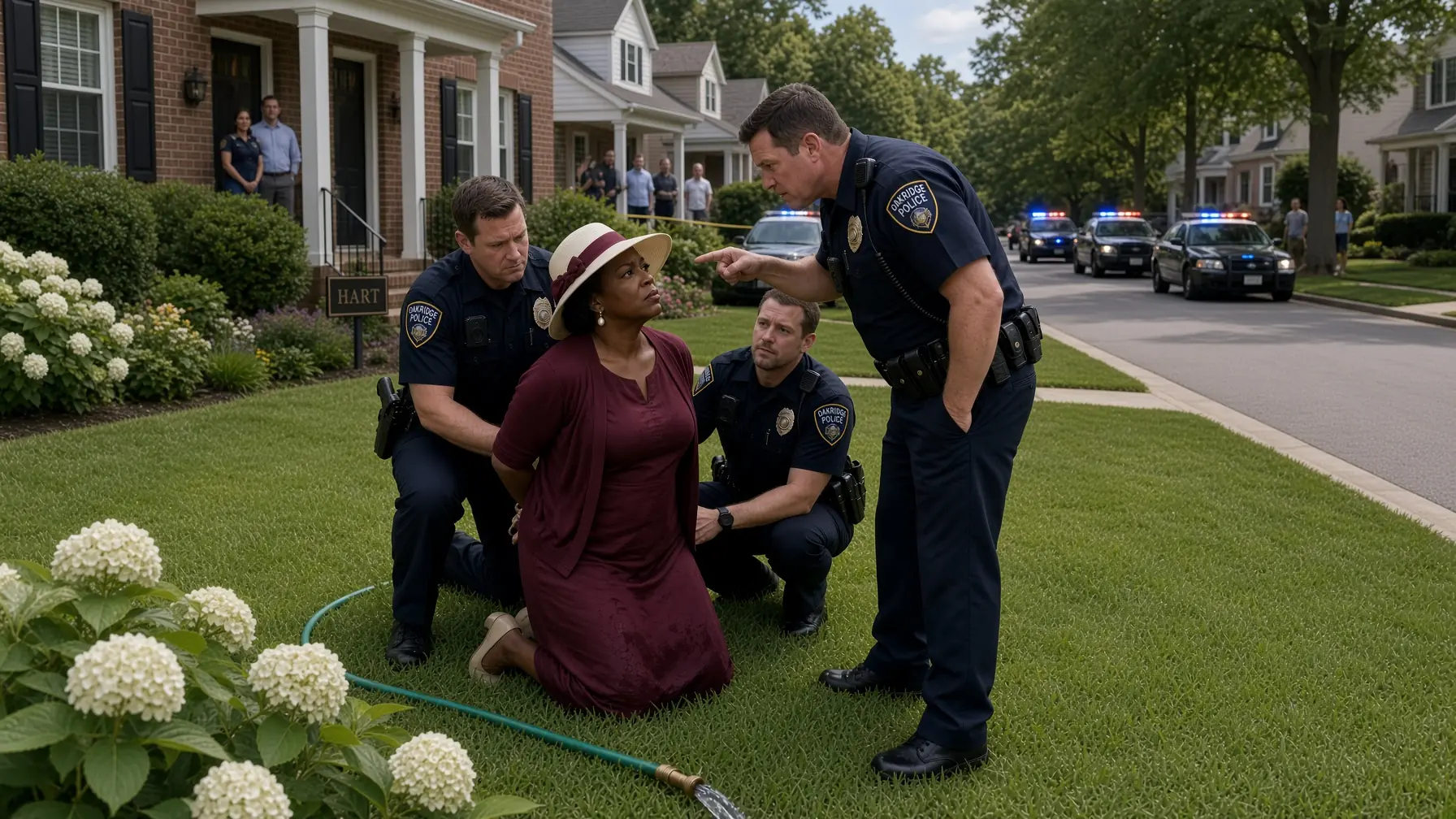
Water spilled across the front lawn in a shining stream, bending the blades of grass and soaking the hem of her pale yellow summer dress. The hydrangeas along the walkway had been half-watered, the white blossoms heavy with droplets, the kind of peaceful afternoon detail people notice only before something ugly happens. Camille’s sun hat had slipped crooked across her forehead, but her chin stayed lifted.
Maddox gripped her wrist too hard.
His partner, Officer Aaron Bell, stood two steps behind him with one hand raised as if he wanted to interrupt and could not decide whether courage was worth the trouble. A third officer, Paul Hensley, had crossed the lawn from the second patrol car and stopped near the flower bed, his face tight with uncertainty. Neighbors watched from porches, driveways, and behind curtains that no longer pretended to be closed.
Camille looked past Maddox’s shoulder toward the bend in the street.
“Take your hands off me,” she said evenly, “or be prepared to explain this to the people arriving in those black SUVs.”
Maddox leaned close enough that she could smell coffee on his breath.
“You’re not in any position to threaten anyone.”
Camille did not blink.
“Then keep talking,” she said. “In about thirty seconds, you’ll wish the body camera had run out of battery.”
The whole confrontation had started less than ten minutes earlier.
Camille had spent the morning working from her home office, reviewing briefs for a multistate corruption case that had already made three county executives nervous and two lobbyists suddenly interested in retirement. By noon, her eyes hurt from reading deposition summaries, and her shoulders had tightened into the familiar ache of a woman who lived too much of her life under fluorescent lights and political pressure.
So she closed the laptop.
For one hour, she decided, she would be a homeowner.
Not a public official.
Not a prosecutor.
Not the woman people called when a case became too dangerous for anyone else to touch.
Just a woman in a wide hat, watering hydrangeas outside a large brick house in a quiet Virginia suburb where the lawns were too perfect and the neighbors noticed everything.
She changed into a soft yellow dress, pulled a white cardigan around her shoulders, and put on the pale blue sun hat her daughter had given her the previous spring. The hat was too dramatic for gardening, but her daughter insisted it made her look like she belonged in a movie about rich widows with secrets.
Camille had laughed when she said it.
Now, standing barefoot in the grass with water curling around her ankles, she thought the hat might become evidence.
The first patrol car stopped at the curb just as she was watering the hydrangeas closest to the walkway.
Camille heard the tires before she saw the officer.
She turned her head and watched a white police cruiser settle beside her mailbox. Officer Maddox stepped out first, tall and broad, with close-cropped hair, pale skin, and the stiff confidence of a man who believed suspicion became fact when spoken in uniform. Officer Bell stepped out from the passenger side, younger, thinner, less sure of the scene before he even understood it.
A second cruiser pulled up seconds later.
Officer Hensley climbed out and glanced first at Camille, then at the house, then at the hose in her hand.
Camille turned the nozzle off.
Water still dripped from the metal tip.
“Put the hose down,” Maddox said.
She looked at him.
“Why?”
“We received a report of a suspicious person around this property.”
Camille paused.
“This property is mine.”
Maddox’s eyes moved over her hat, her dress, her bare feet, then toward the large brick house behind her. The look did not last long, but it said enough.
“We’ll determine that.”
Camille set the hose gently beside the flower bed.
“My identification is inside.”
Maddox stepped in front of her before she took even one step.
“You’re not going inside.”
Camille’s expression sharpened.
“Then how exactly would you like me to prove I live here?”
Bell glanced toward the mailbox.
The name HART was engraved clearly on a bronze plate beside the driveway. The same name was on the security plaque near the front walk and the small brass plate near the porch camera. Bell opened his mouth, but Maddox lifted one hand without looking at him.
“We have procedures,” Maddox said.
Camille almost smiled.
“Good. Follow them.”
The answer irritated him instantly.
“First, tell me what you’re doing here.”
“Watering my hydrangeas.”
“Don’t get smart.”
“You asked.”
Hensley shifted behind Maddox, looking toward the flowers as if they might help clarify the case.
Maddox folded his arms.
“The caller said an unfamiliar woman was wandering around the property and looking into windows.”
Camille slowly turned toward her living-room window.
“I was checking whether I left my phone inside.”
Maddox studied her.
“You expect me to believe this is your house?”
“I expect you to verify it.”
She nodded toward the front door.
“There are cameras above the porch, my car is registered to this address, and my identification is thirty feet from where you are standing.”
Bell tapped something into the mobile terminal clipped to his uniform.
“What’s your full name, ma’am?”
“Camille Elise Hart.”
Maddox looked annoyed that Bell had asked the most useful question in the whole conversation.
The terminal loaded slowly.
A dog barked somewhere down the block.
The hose continued leaking into the grass.
A woman across the street had stepped halfway onto her porch, phone already in hand, pretending to check a message while aiming the camera toward Camille.
Maddox’s gaze dropped to Camille’s hands.
“Turn around.”
Camille stayed still.
“For what?”
“Until we figure out who you are.”
“No.”
The word changed the air.
Maddox stepped closer.
“What did you say?”
Camille held his stare.
“I said no. I am standing on my own lawn, unarmed, answering your questions, and you have not given me a legal reason to put my hands behind my back.”
Bell spoke quietly.
“Brent, just give the system a second.”
Maddox did not look at him.
“She’s refusing instructions.”
Camille replied, “An instruction does not become lawful because you say it loudly.”
His jaw tightened.
“You want to play lawyer?”
“No,” Camille said.
She paused.
“I want you to do your job correctly.”
That was when Maddox grabbed her wrist.
Camille pulled back on instinct.
Not aggressively.
Not violently.
Just the ordinary movement of a person whose body recognized an unnecessary hand on it.
“Take your hand off me.”
Maddox used the movement as if he had been waiting for it.
“Stop resisting.”
“I am not resisting.”
He seized her other arm.
Bell stepped forward.
“Brent, hold on.”
Maddox forced Camille toward the grass.
Her knee struck the lawn before Hensley caught part of her weight, preventing her from falling face-first near the flower bed. The hose rolled beneath her dress, sending cold water across the grass and over one of her shoes.
Several neighbors came outside fully now.
Phones appeared.
No one stepped onto the lawn.
Camille understood the calculation happening around her. People were watching, recording, whispering, maybe even disapproving, but none of them wanted to become part of the thing unfolding in front of them. A suburb can be full of witnesses and still feel empty when the wrong person needs help.
Maddox ordered her hands behind her back.
Camille complied.
Not because he was right.
Because she knew exactly how fast a false report could become a worse one once bodies started moving. Arguing with words was one thing. Arguing with hands while three officers stood over her was another.
She lowered her voice.
“Officer Maddox, you are escalating before verification.”
He pulled one wrist back.
“Quiet.”
The cuff clicked around her left wrist.
Bell looked down at his screen.
Then he froze.
“Brent.”
Maddox was still bending Camille’s arm.
“What?”
“We got a match.”
“Good.”
“No,” Bell said, his voice changing. “I mean we got a match.”
Maddox turned his head.
Bell swallowed.
“This address is registered to Camille Hart.”
Hensley looked at the house, then at Camille.
Camille said nothing.
Bell scrolled farther.
His face changed again.
“There’s more.”
Before he could say it, engines sounded from the end of the street.
Three black SUVs turned the corner in tight formation.
They moved with the calm urgency of vehicles driven by people who had rehearsed arriving before trouble finished becoming disaster. The lead SUV accelerated, then braked hard at the curb. Doors opened almost at once.
Men and women in dark suits stepped into the street.
The first person out of the lead vehicle saw Camille on her knees and stopped for half a breath.
Then his face changed.
“Attorney General Hart!”
Maddox’s hand released her wrist as if the name had burned him.
Everything on the lawn went still.
The man crossed the grass quickly, credentials already in his hand.
“Special Agent Caleb Price, Executive Protection Division.”
Two more agents moved behind him while another began speaking into a radio. One agent positioned herself between the officers and Camille. Another scanned the street, the porches, the phones, the windows, the scene that had become larger than anyone local understood yet.
Maddox stared from Price to Camille.
“Attorney General?”
Camille slowly turned her head.
“Yes, Officer.”
For the first time, Maddox looked frightened.
Not regretful.
Not yet.
Frightened.
Camille Hart was the recently appointed Attorney General of the fictional Commonwealth of Avery, a neighboring-state legal chief who used her Virginia residence when work brought her near Washington. Before taking office, she had been a civil-rights attorney, a federal prosecutor, and the state solicitor who argued corruption cases powerful people thought would never reach daylight.
Her security detail did not normally sit outside her home when no specific threat existed.
That afternoon, they had been scheduled to collect her for a protected interstate meeting related to a public corruption investigation. They were early by less than one minute.
Less than one minute changed everything.
Agent Price knelt beside Camille.
“Ma’am, are you injured?”
Camille looked down at her soaked dress and cuffed wrist.
“Nothing serious.”
Price’s eyes moved to the handcuff.
His expression hardened.
“Who cuffed her?”
No one answered.
Camille answered for them.
“Officer Maddox.”
Maddox immediately began speaking.
“We received a suspicious-person call. She refused lawful commands and pulled away when I attempted to detain her.”
Camille looked at Bell.
“Is that what happened?”
Bell swallowed.
“No, ma’am.”
Maddox snapped, “Aaron.”
Bell ignored him.
“She said she lived here. I started verifying the address. Records came back matching her name.”
Price asked, “Was she restrained before or after verification returned?”
Bell hesitated.
“Before.”
Hensley added quietly, “She offered to retrieve identification.”
Maddox looked betrayed.
Camille remained kneeling.
“Would someone mind removing the handcuff?”
Only then did the neighbors seem to realize one wrist was still secured.
Bell moved quickly, unlocked the cuff, and helped her stand. Camille rubbed her wrist once, then stopped. Price picked up the sun hat from the grass and handed it to her with the kind of careful respect Maddox had failed to show the entire person wearing it.
Across the street, the woman recording whispered, “That’s the Attorney General.”
Another neighbor answered, “It shouldn’t matter who she is.”
Camille heard her.
She looked toward the woman.
“Exactly.”
The word traveled farther than she expected.
Maddox tried again.
“I had a report. We don’t know who people are when we arrive.”
Camille adjusted her cardigan.
“That is why verification exists.”
“You challenged my instructions.”
“I challenged an unnecessary detention.”
“You pulled away.”
“When you grabbed me without explaining why.”
He opened his mouth again.
Camille lifted one hand.
“No.”
He stopped.
“Do not rewrite this because you finally learned my title.”
The street went quiet.
Even the radios seemed quieter.
Camille pointed toward Bell’s body camera.
“Whatever happened is recorded there.”
Then she turned toward the porch.
“And there.”
The small black camera above the front door blinked beneath the porch light, watching the lawn where her hydrangeas still dripped in the afternoon sun.
Price stepped closer.
“We can secure the scene, ma’am.”
“No.”
He understood before she finished.
Camille continued, “This is not my investigation. Notify their supervisor. Preserve body-camera footage, dispatch audio, property verification records, the 911 call, and my home-security footage.”
Maddox looked at her.
“You’re opening an investigation?”
“I’m preserving evidence.”
She paused.
“Those are not the same thing.”
Twenty minutes later, Captain Dana Ellis arrived from the county police department.
She was a compact woman with silver at the temples and an expression that grew more troubled with every step across the lawn. By then, Camille had removed her wet shoes and stood barefoot near the walkway, one wrist reddened, her dress stained with grass and water. The hose had finally been turned off by Hensley, who now stood away from the others like a man beginning to understand what silence costs.
Captain Ellis approached carefully.
“Attorney General Hart, I am deeply sorry.”
Camille looked at her.
“For what?”
Ellis hesitated.
“For what happened here.”
“You do not know everything that happened here yet.”
Ellis glanced toward Maddox, Bell, and Hensley.
“No, ma’am.”
“Then investigate before apologizing for conclusions you have not reached.”
Ellis nodded.
That answer surprised several neighbors.
Camille was angry.
That was obvious to anyone who knew how to read stillness. But anger could not become the standard simply because she held a powerful office. She had prosecuted too many cases where assumptions replaced evidence, where officials acted first and justified later, where outrage contaminated facts until the truth had to fight through everyone’s need to feel right.
Evidence first.
Even when she was the one standing in a wet dress on her own lawn.
The first evidence came from dispatch.
At 2:06 p.m., a neighbor named Margaret Whitcomb called county police and reported “a Black woman wandering around the expensive house next door.” The dispatcher asked whether the woman was attempting to break in. Margaret said no. The dispatcher asked whether she had threatened anyone. No. Was she carrying a weapon? No. Was she damaging property?
“She has a hose,” Margaret said.
The dispatcher classified the call as a low-priority suspicious-person report.
No immediate danger.
No forced entry.
No weapon.
No emergency.
That mattered.
Body-camera footage showed the officers arriving four minutes later. Camille was plainly watering flowers. She did not flee. She did not hide. She did not refuse to identify herself. She stated the property was hers, offered to retrieve identification, and gave her full name.
Bell began checking records.
Maddox escalated before the check finished.
The footage captured everything.
Including a sentence Captain Ellis replayed three times in the internal affairs room.
Maddox had said, “People who own houses like this usually know how to cooperate.”
Ellis paused the video.
“What does that mean?”
Maddox sat across the table with a union representative beside him.
“Nothing.”
“That is not an answer.”
“I was frustrated.”
“By what?”
“She was challenging me.”
“Was she wrong?”
Maddox looked away.
That silence became part of the report.
The investigation widened within days.
Internal affairs pulled Maddox’s prior complaints.
There were eight.
Three involved suspicious-person calls at private residences. One was a Black real-estate agent unlocking a house for clients. Another was a Latino contractor replacing cabinets in a renovated colonial. Another was a delivery driver detained outside a gated townhouse complex after a resident said he looked “out of place.”
All were closed without formal discipline.
No single case had seemed enough to force major action.
Together, they told a story supervisors should have read sooner.
Camille learned about the pattern from Captain Ellis a week later.
She did not smile.
She did not say she was not surprised.
She looked at the files, then at the dates, then at the language used to close the complaints.
“Why were these handled separately?”
Ellis folded her hands.
“Different supervisors reviewed them.”
“That answers who, not why.”
Ellis took a breath.
“No one compared them.”
Camille closed the folder.
“That is the failure.”
One officer making a poor decision was serious.
A department collecting repeated warning signs without connecting them was more serious. Systems rarely collapse all at once. They leak first. They warn first. They give institutions the chance to correct harm before it becomes a headline.
This one had failed to listen.
Then came Margaret Whitcomb.
She refused to speak at first once she realized who Camille was. Her attorney arranged the interview three days later. The explanation she gave was painfully ordinary.
She had lived across the street for fourteen years.
The house had belonged to an older couple before Camille bought it eight months earlier. Camille traveled frequently between the state capital, Washington, and her Virginia residence, so Margaret had seen security vehicles, landscaping crews, and delivery staff more often than she had seen the actual homeowner.
That afternoon, she saw a Black woman checking the front window and watering flowers.
She called police.
“Why?” the investigator asked.
“I didn’t recognize her.”
“That is not the same as suspicious behavior.”
“She was walking around.”
“On the lawn?”
“Yes.”
“Doing what?”
“Watering.”
The investigator paused.
“What about that made you believe police were needed?”
Margaret went quiet.
Then she said the sentence that entered the report almost unchanged.
“I suppose I didn’t think she looked like someone who lived there.”
When Camille read that line, she set the folder down.
Her daughter, Brielle, sat across from her at the kitchen table with a mug of tea untouched between her hands. Brielle was twenty-four, studying public policy, and still young enough to want justice to arrive with a cleaner sound.
“You’re too calm,” Brielle said.
Camille almost laughed.
“I am not calm.”
“You look calm.”
“That is different.”
Brielle looked at her mother’s wrist, where the bruise had faded from red to yellow.
“What do you want to happen to him?”
Camille knew she meant Maddox.
“I want the investigation completed.”
“That is such a prosecutor answer.”
“It is the correct answer.”
“He put you on your knees in your own yard.”
“Yes.”
“You don’t want him fired?”
“I want whatever consequence the evidence supports.”
Brielle shook her head.
“I would be furious.”
“I am furious.”
Camille looked toward the hydrangeas outside the window.
“But if my anger becomes the standard, what happens when someone else with power is angry?”
Brielle did not answer.
She understood.
That conversation stayed with her longer than the video.
The internal investigation lasted eight weeks.
Maddox was removed from patrol during the review. Bell and Hensley were placed on temporary reassignment because they were material witnesses. The department invited an outside civil-rights consultant to examine suspicious-person response procedures, detention standards, and intervention responsibilities when one officer escalated without clear grounds.
The findings were uncomfortable.
Officers were treating caller suspicion as if it were evidence.
It was not.
A neighbor’s fear did not automatically create legal justification.
An unfamiliar face did not become probable cause because the house was expensive.
A person standing on a lawn did not become suspicious because the caller had not seen them before.
The consultant proposed a single question to begin every such response.
Suspicious because of what behavior?
Not because of the person’s race.
Not because of the neighborhood.
Not because they did not match a caller’s private idea of belonging.
Behavior.
Camille liked the question immediately.
She asked the department to build training around it, but she refused to direct Maddox’s discipline. That was important. She was the injured party and the Attorney General. Those two facts could not be allowed to sit in the same chair during discipline.
Maddox’s case proceeded separately.
Internal affairs found that he failed to wait for available verification, escalated a low-priority call without sufficient legal basis, used physical restraint prematurely, and made comments suggesting assumptions based on perceived neighborhood status. The prior complaints strengthened concerns about his judgment and pattern of conduct.
He received severe discipline and was removed from field patrol pending retraining and review.
Two months later, he resigned.
Some people wanted Camille to demand criminal charges.
She declined to influence any prosecutorial decision involving her own case.
“That belongs somewhere I cannot reach,” she told reporters.
The sentence frustrated people who wanted a cleaner revenge story.
Camille did not care.
Revenge is easy to understand.
Process is harder.
And she believed in process most when it was inconvenient.
Her office released a public timeline.
Only verified facts.
No privileged personnel records.
No dramatic statement.
A suspicious-person call was received.
Camille identified herself as the homeowner.
Property verification was underway.
She was physically restrained before the verification returned.
Body-camera and home-security footage documented the encounter.
The department opened an internal review.
Outside recommendations followed.
Everything else would proceed through established channels.
Reporters kept asking the same question.
“What would have happened if your security detail had not arrived?”
Camille finally answered during a press availability outside the state capitol.
“That is the question everyone should be asking.”
The room quieted.
She continued, “If my security detail had not arrived, I would still have been the homeowner.”
Pens stopped moving.
“If I had not been Attorney General, I would still have been the homeowner.”
Then she paused.
“And even if I had not been the homeowner, I would still have been entitled to lawful treatment.”
That quote spread faster than anything else she said.
Camille disliked how quickly the story became a headline about a powerful woman being mistaken for ordinary.
The message was backwards.
One evening, Agent Price stood in her kitchen while she made tea neither of them intended to drink. He had been assigned to her detail long enough to understand when she was angry beneath a professional voice.
“They keep saying Maddox picked the wrong woman,” she said.
Price leaned against the counter.
“He did.”
“No.”
Camille shook her head.
“He made the wrong decision.”
Price nodded slowly.
There was a difference.
A big one.
“If people learn only that they should be careful who they mistreat because she might be important,” Camille said, “then they have learned nothing.”
The following weekend, she went back to gardening.
No press.
No statement.
No political staging.
Just the hose, the soil, and the stubborn hydrangeas that had survived the whole mess better than some reputations.
A county cruiser rolled down the street and slowed.
Camille stopped watering.
The officer inside lifted one hand in a small wave.
She stared for half a second.
Then she waved back.
The cruiser kept moving.
Nothing else happened.
That ordinary moment felt strangely important.
Months later, Captain Ellis invited Camille to observe the department’s redesigned training program. Camille attended quietly at first, sitting along the back wall in a plain navy blazer while new officers worked through scenarios.
An instructor put a prompt on the screen.
Caller reports an unfamiliar person watering flowers outside an expensive home.
Several recruits shifted in their seats.
Everyone knew the reference.
The instructor asked, “What do we know?”
One recruit answered, “Someone called.”
“Correct.”
Another said, “The person is watering flowers.”
“Correct.”
A third said, “We do not know whether a crime occurred.”
The instructor nodded.
“Exactly.”
Then he asked the question.
“Suspicious because of what behavior?”
No one answered.
The instructor smiled faintly.
“Good. The absence of an answer matters.”
After class, Camille introduced herself.
The recruits straightened so fast she almost felt sorry for them.
“Relax,” she said.
A young officer raised his hand.
“Ma’am, after what happened, do you hate police?”
Camille considered him.
“No.”
He looked surprised.
“Why not?”
“Because three officers stood on my lawn.”
She looked around the classroom.
“One escalated. One tried to slow the escalation. One told the truth about what he saw. Uniforms do not make one personality.”
The room stayed quiet.
“My concern is whether the system encourages the right person and restrains the wrong one.”
That sentence made it into the training notes.
Officer Bell wrote Camille a letter a month later.
He apologized for not intervening sooner.
I knew the situation was going wrong before the cuff came out, he wrote. I thought contradicting a senior officer in front of a civilian would make things worse. I understand now that silence also becomes a decision.
Camille read that sentence twice.
Then she wrote back personally.
You cannot control another officer’s judgment. You are responsible for your own.
Bell kept the letter.
Years later, after becoming a field-training officer, he used the incident in academy instruction. He never used Camille’s title first. He described only the call, the lawn, the hose, the hesitation, and the moment he should have stepped forward sooner.
He told recruits the title did not matter.
That was the point.
Margaret Whitcomb sold her house before the next summer.
Before leaving, she crossed the street one afternoon while Camille was trimming roses near the walkway. Camille saw her coming and set the shears down. Margaret stopped several feet away, clutching a small envelope in both hands.
“I owe you an apology.”
Camille waited.
“I saw you and decided you didn’t belong here.”
“Yes.”
Margaret’s face tightened with discomfort.
“I told myself I was just concerned.”
Camille said nothing.
“I think I knew I wasn’t,” Margaret continued. “Not really.”
Camille remained quiet because some discomfort should not be rescued too quickly.
Margaret looked toward the row of expensive houses.
“I had an image in my head of who lived here.”
“And I did not match it.”
“No.”
Her eyes filled.
“I am sorry.”
Camille nodded once.
“I accept the apology.”
Margaret looked surprised.
“That’s all?”
“What were you expecting?”
“I don’t know. Maybe for you to tell me it’s okay.”
Camille picked up the shears.
“It was not okay.”
Margaret swallowed.
“No.”
“Learn something from it.”
“I will.”
“Then the apology has somewhere to go.”
Margaret walked away.
The hydrangeas bloomed spectacularly that year.
Camille joked that they had received enough public attention to become self-important.
Brielle did not find the joke funny.
Agent Price did.
Three years later, Camille completed her term as Attorney General.
At her farewell event, staff assembled photographs from her career: courtroom victories, consumer settlements, civil-rights actions, public-corruption convictions, press conferences, school visits, and one quiet picture Brielle had chosen herself.
Camille stood in her yard wearing the pale blue hat, holding the garden hose.
No police.
No handcuffs.
No SUVs.
Just a woman watering flowers.
Camille stopped in front of the photograph.
“This is the one you picked?”
Brielle smiled.
“Yes.”
“Why?”
“Because everyone remembers what happened after the police arrived.”
She looked at her mother.
“I want to remember what you were doing before.”
Camille stared at the image.
Watering flowers.
Nothing suspicious.
Nothing dramatic.
Nothing important.
Nothing requiring explanation.
That was precisely the point.
The story people told later usually began with Officer Maddox forcing a powerful Black woman onto her knees and ended with black SUVs arriving just in time to reveal who she was.
Camille preferred another version.
A woman was watering her garden.
Someone decided she did not belong.
An officer accepted that assumption too quickly.
Another officer hesitated.
A third eventually told the truth.
Evidence survived.
A department had to examine what it had ignored.
That version lacked the satisfying thunder of black SUVs turning the corner.
It also contained the actual lesson.
The SUVs did not make Camille innocent.
Her title did not make the detention wrong.
Her office did not create her rights.
Those things merely forced everyone to look closely at a mistake that might otherwise have been buried under another closed complaint file.
One quiet Sunday morning, years after the incident, Camille stood on the same lawn wearing the same pale blue hat.
The hose hummed softly in her hand.
Water spread across the hydrangeas, darkening the soil around their roots. A new family lived across the street now. Their little boy rode a bicycle in uneven circles on the sidewalk, training wheels rattling over cracks.
“Hi, Ms. Hart!” he called.
Camille waved.
“Good morning, Jonah.”
Nothing else happened.
No cruisers stopped.
No doors opened across the street.
No one demanded identification.
No engines roared around the corner.
For twenty peaceful minutes, Camille Hart was not an Attorney General, a headline, a former prosecutor, or the woman from the viral body-camera footage.
She was simply a homeowner watering her garden.
And after everything that had happened on that lawn, ordinary felt like victory.