“What are you doing with that little girl?”
Malcolm Price looked up from the park bench and saw the police officer standing over him.
The man wore dark sunglasses even though the afternoon sun had softened behind the oak trees. His shoulders were broad, his mouth already set in a hard line, and one hand rested near the radio on his vest like he had walked into danger instead of a public park full of children. Malcolm’s five-year-old daughter, Sophie, was curled against his side with her head on his sleeve, half asleep after nearly two hours of running herself wild.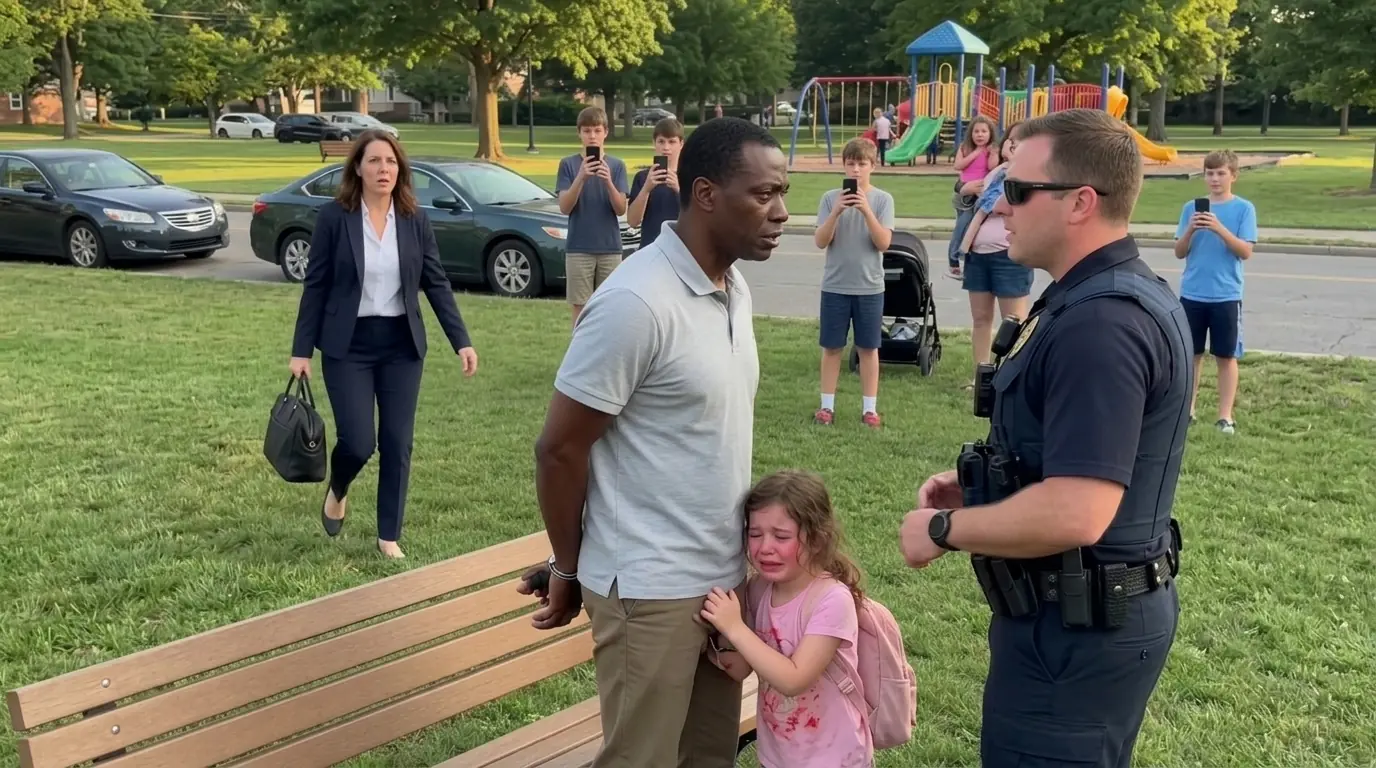
Malcolm kept both hands visible.
“Good afternoon, officer,” he said. “Is something wrong?”
The officer did not answer the greeting.
His eyes moved from Malcolm’s face to Sophie’s pink backpack on the bench, then down to Sophie herself. Her ponytail had come loose, one sneaker was untied, and there was still a strawberry stain on her shirt from the popsicle she had insisted she could eat without making a mess. She blinked up at the officer, confused and sleepy, then tucked herself closer to Malcolm.
The officer’s nameplate read Owen Kessler.
He looked at Sophie again, then at Malcolm.
“Whose child is this?”
Malcolm felt the whole afternoon change.
It was strange how fast peace could disappear. One minute, the park was all ducks, swings, warm air, and a child’s tired breathing. The next, Malcolm could feel every lesson he had learned as a Black man in America rise to the surface of his body. Keep your voice calm. Keep your hands visible. Do not move too quickly. Do not let anger look like guilt.
“She’s my daughter,” Malcolm said. “We’re waiting for her mom to pick us up.”
Kessler’s jaw tightened.
“I don’t believe you.”
Sophie sat up straighter, her little fingers reaching for Malcolm’s hand. “Daddy?”
Malcolm squeezed gently. “It’s okay, sweetheart.”
But Sophie heard the lie in his voice.
Children always do.
Riverside Park had never felt dangerous to Malcolm before that day.
It sat between two quiet neighborhoods on the west side of the city, with twelve acres of grass, oak trees, a duck pond, a fenced playground, and a walking path that looped around the whole place like a ribbon. On weekday afternoons, parents came with strollers, retired couples walked laps, teenagers sat under trees with fast food bags, and little kids treated the playground like it was a kingdom they had personally conquered.
Malcolm had brought Sophie there almost every Thursday since she could walk.
The swings were their first stop, always. Then the climbing wall. Then the slides. Then the pond, where Sophie had named at least half the ducks and loudly declared one goose to be “the mayor because he yells the most.” The bench near the main entrance was their regular waiting spot for Claire, who worked at the county courthouse and usually arrived just after five.
That bench had been part of their routine.
Part of their family geography.
A small, ordinary place where they belonged without thinking about it.
Malcolm was thirty-nine years old, an architect at a downtown design firm that specialized in public spaces. He designed libraries, affordable housing complexes, youth centers, and school renovations for neighborhoods that had spent decades being told to make do with what they had. He believed buildings could either welcome people or quietly push them away. He believed a doorway, a window, a bench, even the height of a fence could tell someone whether they were expected or merely tolerated.
He had built his life around making places feel safe.
But safety, he had learned, was never only about design.
It was also about who was allowed to sit still without being questioned.
Sophie was adopted.
Not partly.
Not technically.
Not in the whispered way some people used the word when they wanted to place distance between love and law.
She was Malcolm and Claire’s daughter in every way that mattered and every way the court recognized. They had brought her home when she was nine days old, wrapped in a yellow blanket, furious at the world, and so tiny Malcolm had held his breath the first time he lifted her. The first night, she cried for three hours, then fell asleep on his chest like she had chosen him and expected him to understand the assignment.
He did.
Claire used to joke that Sophie trained him faster than any parenting book ever could.
Before Sophie, there had been years of appointments, grief, tests, phone calls, hopes raised carefully and dropped harder each time. Claire could not carry a pregnancy safely. The doctors said it gently, but grief does not care how gentle the words are when they land. For months, the house felt quieter than it had any right to feel.
Then one night, Claire sat across from Malcolm at the kitchen table and said, “I don’t need a child who looks like us. I need a child who is ours.”
Malcolm reached for her hand.
“Then we find her,” he said.
And they did.
They found Sophie.
Or maybe Sophie found them.
From the beginning, people had questions.
Most were harmless enough, or at least intended to be. Is she yours? Where did you get her? Is her real mother around? Sometimes strangers assumed Malcolm was the nanny, the uncle, the stepfather, the family friend, anything except the word Sophie used without hesitation.
Daddy.
Malcolm learned to answer politely most days.
Claire did not always bother.
She was a prosecutor, and precision lived in her bones. She had spent fourteen years in courtrooms, speaking for victims, challenging sloppy police work, and reminding judges that law was supposed to protect people before it punished them. She did not tolerate lazy language, especially around her family.
That Thursday, Claire had texted at 4:12.
Court ran late. I’ll be there around five. Tell our girl I expect a full duck report.
Malcolm sent back a photo of Sophie leaning against him with her eyes half closed, clutching the little purple notebook where she had drawn Professor Quack, Captain Beak, and Mayor Goose.
Full report pending. She ran the park like a tiny supervisor.
Claire replied with three hearts.
By 4:40, Sophie was tired enough to rest her cheek against his arm. Her backpack sat between them. Her construction paper leaf collage from preschool was inside, along with a half-eaten granola bar, a small plastic dinosaur, and one rock she insisted looked like a potato.
Everything about the scene was ordinary.
A father.
A daughter.
A bench.
Then Officer Owen Kessler walked into the frame and decided it was not ordinary at all.
Kessler had been with the department for eight years.
His supervisors described him as proactive, alert, and child-focused. Those words looked good in reports. They sounded responsible in performance reviews. They also hid a pattern no one seemed eager to confront. Three complaints in five years had accused him of approaching fathers with children without cause.
A Black uncle walking with his niece.
A Latino father at a public pool with his blond stepdaughter.
A Black father carrying his sleeping toddler through a grocery store.
Each time, Kessler claimed the situation had felt off.
Each time, the department accepted that feeling as if it were evidence.
No missing child reports.
No frantic parents.
No suspicious behavior.
Only a man and a child whose relationship did not match what Kessler expected to see.
Each complaint had been closed with counseling or a verbal warning. Not because nothing happened, but because nothing disastrous happened yet. Institutions often treat warning signs like bad weather until the roof finally comes off. By then, everyone pretends to be shocked by the storm.
That afternoon, Kessler saw Malcolm and Sophie from the walking path.
A Black man.
A little white girl with blue eyes and soft brown curls.
His mind filled in the rest before he asked a single real question.
“Can you prove she’s your daughter?” Kessler asked.
Malcolm looked at him carefully. “I’m not carrying adoption papers in my pocket. We’re at the park.”
“That’s convenient.”
“It’s also normal.”
Kessler took half a step closer. “Normal fathers can prove they’re fathers.”
Malcolm felt Sophie’s hand tighten.
“That’s not true,” he said. “And you know it.”
Sophie looked up at the officer with her brow pinched. “He is my daddy.”
Her voice was small but clear.
Kessler glanced at her, then back at Malcolm.
It was like he had heard a noise, not a sentence.
“I need you to stand up.”
Malcolm did not move. “Why?”
“For the child’s safety.”
“My child is safe.”
“That’s what I’m trying to determine.”
“You’re not determining anything. You’re ignoring what she just told you.”
Kessler’s eyes hardened behind the sunglasses. “Sir, do not make this difficult.”
There it was.
The phrase that turned a person into a problem.
A woman pushing twins in a stroller slowed near the path. A jogger removed one earbud. Two teenage boys under an oak tree stopped laughing and looked over. Near the playground gate, a father holding a toddler shifted closer, unsure whether he was watching a misunderstanding or something worse.
Malcolm stood slowly.
He did it because he knew sitting while Kessler stood over him could be read as refusal. He also knew standing could be read as threat. There was no perfect move when someone had already decided the board belonged to them.
Sophie rose with him, still holding his hand.
“I’m Malcolm Price,” he said clearly. “This is Sophie Price. My wife, Claire Price, is on her way here. She can verify everything.”
“We’re not waiting for some woman you claim is your wife.”
Malcolm’s voice cooled. “You need to be careful.”
Kessler’s mouth tightened. “Are you threatening me?”
“No. I’m asking you to follow the law.”
“You people always want to talk law when children are involved.”
The air seemed to drop a few degrees.
Malcolm heard one of the teenagers whisper, “Yo, record this.”
A phone came up.
Then another.
Sophie’s eyes filled with tears now. “Daddy, can we go home?”
“Yes, baby,” Malcolm said. “We’re going home.”
Kessler stepped in front of them.
“No, you’re not.”
Malcolm looked at him. “Move.”
That single word cost him.
Kessler grabbed his wrist.
Malcolm did not pull away. He did not jerk. He did not raise his voice. Every instinct in him screamed to shield Sophie, to snatch his hand free, to put his body between his daughter and this man, but he knew what would happen if he moved too fast.
So he kept speaking.
Loud enough for the phones.
Loud enough for the body camera.
Loud enough for Sophie to hear the truth over her own fear.
“This is my daughter. She has told you I’m her father. You have no missing child report, no complaint, no probable cause, and no legal basis to detain me.”
Kessler twisted his arm behind his back.
The first cuff clicked.
Sophie screamed.
It ripped through the park, high and terrified, turning heads across the playground.
“Daddy!”
“I’m right here,” Malcolm said, though the words nearly broke in his throat.
The second cuff clicked.
Kessler pulled him back from the bench.
Sophie reached for him with both arms, sobbing so hard her whole small body shook. “Let go of my daddy! That’s my daddy!”
Kessler crouched slightly, trying to soften his voice.
“It’s okay, sweetheart. You don’t have to be afraid of him now.”
Malcolm’s face changed.
The whole park felt it.
His voice, when it came, was low and controlled but full of a fury no handcuffs could hold.
“She is afraid because you put her father in handcuffs.”
Kessler ignored him and reached for his radio.
“I need child protective response at Riverside Park. Possible abduction or unlawful custody situation.”
A woman near the stroller gasped.
One of the teenage boys said, “She keeps saying that’s her dad.”
Kessler turned toward him. “Back up.”
“I’m on a public path.”
“Back up now.”
The boy backed up two steps but kept filming.
Sophie’s crying had become ragged.
Malcolm could hear her trying to breathe between sobs. He had heard that sound once before, when she was three and fell from the bottom rung of the climbing wall. That day, he had scooped her up in half a second. Now his hands were locked behind him, and the only thing he could offer was his voice.
“Look at me, Sophie,” he said. “Look at Daddy.”
She looked through tears.
“You did nothing wrong.”
Kessler snapped, “Stop coaching her.”
Malcolm turned his head. “I’m comforting my child.”
“You mean the child.”
“My child.”
Then tires screeched near the park entrance.
A dark green sedan pulled up hard by the curb.
The driver’s door opened, and Claire Price stepped out wearing a navy courthouse suit, black flats, and the expression of a woman who had walked into a nightmare but refused to panic inside it. Her eyes moved fast. Sophie crying. Malcolm cuffed. Officer standing between them. Phones raised. Body camera active.
She took all of it in before she spoke.
Sophie saw her and screamed again.
“Mommy!”
Claire moved across the grass with controlled speed, dropped her work bag by the bench, and lifted Sophie into her arms. Sophie clung to her neck, sobbing into her blazer.
Claire kissed her daughter’s hair once.
Then she looked at Kessler.
“Why is my husband in handcuffs?”
Kessler blinked.
For the first time, the story in his head wobbled.
“Ma’am, I encountered this man with a child, and he refused to provide proof of custody—”
“This man?” Claire repeated.
Her voice was quiet enough to frighten people who knew courtrooms.
“That is Malcolm Price. He is my husband. This is Sophie Price. She is our daughter.”
Kessler opened his mouth.
Claire cut him off before sound arrived.
“Was there a missing child report?”
“No, but—”
“Was there a citizen complaint?”
“I observed—”
“Did you observe him threatening, hiding, restraining, or harming her?”
Kessler shifted. “Ma’am, the child appeared distressed.”
Claire’s eyes flashed. “After you handcuffed her father.”
The phones around them held steady.
Claire reached into her bag with one hand while holding Sophie with the other. She removed a leather credential case and opened it.
“Claire Price,” she said. “Senior prosecutor, county district attorney’s office. Now remove those cuffs from my husband before you add another violation to the list.”
Kessler stared at the credentials.
His face paled.
Claire lowered them.
“Now.”
Kessler moved behind Malcolm.
The cuffs opened.
Sophie lunged out of Claire’s arms toward him the moment his hands were free. Malcolm caught her, pulling her tight against his chest. She wrapped her legs around his waist and buried her face in his neck, still crying.
“I told him,” she sobbed. “I told him you’re my daddy.”
“I know,” Malcolm whispered. “You told the truth.”
Claire watched them for one second.
Only one.
Then she turned back to Kessler.
“Full name.”
“Owen Kessler.”
“Badge number.”
“5193.”
“Supervisor.”
“Lieutenant Monroe.”
“Department-issued body camera active?”
He hesitated.
Claire looked at the small lens on his chest. “That was not a hard question.”
“Yes.”
“Good.”
Kessler tried again, softer now. “Ms. Price, I was only trying to make sure the child was safe.”
“No,” Claire said. “You were trying to make reality fit your suspicion. My daughter told you who her father was. My husband told you who he was. You had no call, no emergency, no legal basis, and no excuse.”
His jaw tightened, but he said nothing.
“Let me explain what happens next,” Claire continued. “I will file a formal complaint before this day ends. I will request your body camera footage, dispatch records, prior complaints, and every incident report involving you and a parent with a child in the last five years. If there is a pattern, I will find it. If your department buried warnings, they will answer for that too.”
Kessler looked past her toward the crowd.
The crowd did not look sympathetic.
Claire took one step closer.
“You traumatized my daughter because you could not imagine a Black man as her father. That is not caution. That is bias wearing a badge.”
She took Malcolm’s free hand.
Then she walked her family to the car.
No one clapped.
No one cheered.
It was too ugly for that.
People simply stepped aside and let them pass.
In the car, Sophie cried until hiccups shook her small chest.
Malcolm sat in the passenger seat, rubbing his wrists, the red lines from the cuffs already rising on his skin. Claire drove with both hands on the wheel, jaw tight, eyes wet but focused on the road. She made it three blocks before pulling over in front of a quiet church parking lot.
She turned off the engine.
For a moment, only Sophie’s breathing filled the car.
Then Sophie whispered, “Was I bad?”
Malcolm turned around so fast the seat belt locked across his chest.
“No, sweetheart. No. You were not bad.”
“But he didn’t believe me.”
Claire closed her eyes for one second.
Then she unbuckled, climbed into the back seat, and knelt awkwardly beside Sophie’s booster seat.
“Baby,” she said gently, “some adults are wrong. Even adults in uniforms. You told the truth, and he made a wrong choice not to listen.”
“Why?”
The question hung there.
Too big for five.
Too honest for adults.
Claire looked at Malcolm.
He nodded once.
Claire took Sophie’s small hand. “Because sometimes people look at families and think they have to match in a certain way. They forget love makes families too. They forget judges and papers and birthdays and bedtime stories and pancakes and duck reports matter more than skin.”
Sophie looked at Malcolm’s wrists. “Did it hurt?”
He smiled, though his eyes were wet. “A little.”
“I was scared they would take you.”
His face nearly broke.
Claire touched his shoulder from the back seat.
Malcolm reached for Sophie’s hand. “I know. I was scared too. But I’m here.”
“Promise you won’t leave?”
He swallowed.
Every parent wants to promise forever.
Every honest parent knows the world is not always that kind.
“I promise I will always fight to come back to you,” he said. “Every time.”
Sophie nodded as if that was enough for now.
That night, she slept between them.
Not at first.
At first, she refused sleep entirely. She asked whether the officer knew their address, whether police could come into her room, whether she had to carry a picture of Malcolm in her backpack to prove he was her daddy. Claire answered each question with calm she did not feel. Malcolm answered what he could.
When Sophie finally drifted off, one hand gripping Malcolm’s shirt, he lay completely still.
Claire watched him in the dim light.
The red marks around his wrists looked darker now.
“I should’ve been there,” she whispered.
His eyes stayed on the ceiling. “You came.”
“I should’ve been there before the cuffs.”
“Claire.”
“He made her look at you like a danger.”
Malcolm closed his eyes.
That was the wound.
Not the metal.
Not the stares.
Not even the humiliation of standing in public with his hands behind his back.
It was the officer bending toward Sophie and telling her she did not have to be afraid of her own father anymore. Trying to rewrite her terror into evidence. Trying to steal the safest word in her world and make it questionable.
Daddy.
Malcolm’s voice broke. “He wanted her to doubt me.”
Claire moved closer, careful not to wake Sophie.
“She didn’t.”
“I know.”
“She fought for you.”
“I know.”
“She knew exactly who you were.”
Tears slid silently from the corners of his eyes.
Claire placed her hand over his.
“And now we fight for her.”
By morning, Claire had already built the beginning of a case.
She wrote a full timeline before sunrise, attaching photographs of Malcolm’s wrists, screenshots of Sophie’s texted duck drawings from earlier that day, the names of three witnesses who had reached out through social media, and the officer’s badge number. She filed a formal complaint with Internal Affairs at 7:12 a.m. At 8:00, she called Adrienne Bell, the civil rights attorney every police department in the state hated receiving certified mail from.
Adrienne answered before the second ring.
“Claire?”
“I need you.”
“What happened?”
Claire told her everything.
Adrienne did not interrupt.
When Claire finished, Adrienne said, “Bring Malcolm. Bring Sophie if she can handle sitting in the waiting room. We need to move before the department starts sanding down the facts.”
At Adrienne’s office, the next day felt like entering a different kind of courtroom.
There were no flags, no judge’s bench, no bailiff calling order. Just a conference table, a wall of case files, and a woman in a gray blazer reading every detail with the focus of someone who had seen too many families harmed by phrases like “for safety” and “out of caution.”
Adrienne looked at Malcolm’s wrists first.
Then at Sophie’s drawing from therapy that morning.
In the drawing, Malcolm was behind a line of blue scribbles labeled police. Sophie had drawn herself with a giant mouth, bigger than the rest of her face, shouting, THAT’S MY DADDY.
Adrienne sat back slowly.
“That drawing goes in the file,” she said.
Claire nodded.
Malcolm looked away.
Adrienne’s expression softened. “Mr. Price, I’m sorry.”
He let out a quiet breath. “I keep thinking I should have done something different.”
“No,” Adrienne said firmly. “You survived it correctly. That is not the same as being treated correctly.”
The sentence stayed with him.
Internal Affairs pulled the body camera footage within forty-eight hours.
Lieutenant Carmen Bellamy reviewed it alone in a small office with the blinds closed. She had expected bad. The complaint was too detailed not to be bad. But even after seventeen years in police oversight, she was not prepared for how ordinary the beginning looked.
A father and daughter on a bench.
A backpack.
A sleepy child.
No panic.
No threat.
No emergency.
Then Kessler’s voice.
“What are you doing with that little girl?”
Bellamy wrote it down.
Not, Is everything okay?
Not, Do you need help?
An accusation disguised as a question.
She watched Sophie say, “He is my daddy.”
She watched Kessler ignore her.
She watched Malcolm explain.
She watched Sophie repeat the truth.
She watched Kessler cuff him anyway.
Then came the moment that made Bellamy remove her glasses and sit back.
“It’s okay, sweetheart. You don’t have to be afraid of him anymore.”
Bellamy paused the video.
The little girl was not afraid of her father.
She was afraid for him.
That distinction sat at the center of the entire case.
Bellamy pulled Kessler’s personnel file.
Three prior complaints appeared in the misconduct database. Same pattern. Men with children. No emergency call. No criminal behavior. Kessler acting on suspicion he could never quite explain without revealing the shape of it.
The first complaint had been closed after a supervisor wrote: Officer acted in good faith concern for child welfare.
The second: No policy violation established.
The third: Counseling recommended.
Bellamy read the notes twice.
Then she opened a new section in her report.
Pattern of conduct.
Those three words changed everything.
The Internal Affairs report came down two weeks later.
It found that Officer Owen Kessler initiated an unlawful investigatory detention without reasonable suspicion, escalated a non-emergency encounter into an arrest-like seizure, disregarded repeated statements from both parent and child, falsely characterized the child’s distress, and placed Malcolm Price in handcuffs without probable cause.
It also found that prior complaints should have triggered formal retraining and supervisory review.
The recommendation was termination.
The department tried to delay.
Adrienne Bell did not let them.
She filed the civil rights lawsuit the following Monday.
Malcolm Price v. City of Brookhaven and Officer Owen Kessler.
False detention.
False arrest.
Violation of constitutional rights.
Intentional infliction of emotional distress.
Negligent supervision.
Discriminatory enforcement.
The complaint opened with one sentence from Sophie.
“That’s my daddy.”
The body camera clip became public through court filings six weeks later.
News outlets played it again and again.
A little girl saying the truth.
An officer looking past it.
A father standing still while the state locked his hands behind him.
The country reacted the way it often does when evidence becomes too clear to comfortably ignore. Some people were furious. Some were defensive. Some insisted the officer was only being careful, until the prior complaints surfaced and careful began to look exactly like pattern. Parents of adoptive and interracial families flooded social media with their own stories.
A Black father in Denver wrote that he carried adoption paperwork in his phone because a security guard once followed him through a museum.
A Filipino stepfather in Seattle said strangers had twice asked his white stepdaughter if she needed help.
A Black grandfather in Atlanta said he stopped taking his grandson to the park alone because he was tired of being stared at.
Malcolm read the messages late at night after Sophie slept.
Some made him feel less alone.
Some made him furious that loneliness had ever been required.
Claire read them too, but she read with a prosecutor’s eye. Pattern. Policy. Harm. Failure to intervene. The lawsuit was no longer only about one afternoon. It had become a doorway into every hidden incident the city had preferred to label isolated.
Three months later, the city settled.
Not because it wanted to do the right thing.
Because the body camera footage was too clean, the prior complaints too obvious, and Claire Price too prepared to testify under oath about every second of what happened to her child. Adrienne negotiated hard. Claire negotiated harder. Malcolm sat through most of it with Sophie’s drawing folded in his inside jacket pocket.
The settlement was 2.3 million dollars.
But the money was only one part.
The city formally acknowledged that Kessler had no lawful basis to detain Malcolm. It acknowledged prior complaints were mishandled. It agreed to create new policies for child welfare checks in public settings, requiring specific, articulable facts before separating a child from a caregiver or placing a caregiver in restraints.
Officers would be required to document any child-guardian stop.
Supervisors had to review every case involving attempted removal of a child from a parent.
Body camera footage would be preserved automatically.
A civilian review board received access to pattern complaints.
And every officer in the department had to complete training developed with adoptive-family advocates, civil rights lawyers, child psychologists, and parents who had lived the harm.
Claire insisted on one final condition.
Annual public reporting.
“Accountability kept private is just public relations,” she said.
Officer Kessler was fired before the settlement was signed.
He gave one local interview months later, claiming he had been trying to protect a child and that people did not understand how hard police work was. The station played his interview beside the body camera clip. Sophie’s small voice answered him better than any commentator could.
“He is my daddy.”
The interview did not help him.
No department hired him again.
Malcolm did not celebrate.
He did not feel triumphant when Kessler lost his badge. There was no joy in knowing a man’s career had ended, only relief that the power had been removed from hands that had used it carelessly. Consequence mattered, even when it came too late to prevent the first wound.
The harder work was at home.
Sophie had nightmares for months.
Sometimes she dreamed Malcolm was locked behind a fence. Sometimes she dreamed a police officer had taken her voice and she could not say “Daddy” loud enough. Sometimes she woke up crying and asked whether families had to match to be real.
Every time, Malcolm or Claire answered.
No.
Families do not have to match.
Yes, she was their daughter.
Yes, Malcolm was her daddy.
Yes, what the officer did was wrong.
No, she did not cause it.
No, telling the truth was never bad.
Her therapist, Dr. Elaine Porter, helped her draw the park again and again. In the first pictures, the police officer was huge and Malcolm had no hands. In the later pictures, Malcolm’s hands came back. Claire grew taller. Sophie drew herself standing between them with her arms stretched wide, as if protecting both parents at once.
One day, she drew the bench under the oak tree.
Above it, in purple crayon, she wrote:
OUR PARK.
Malcolm cried in the hallway when Claire showed him.
For six weeks after the incident, he could not go back to Riverside Park.
He tried once and turned the car around before reaching the entrance. His chest tightened. His palms went damp. He hated that a place built from laughter could become a landmark of fear. He hated even more that Sophie noticed.
One Thursday afternoon, she stood in the kitchen holding her purple notebook.
“Daddy,” she said, “we forgot the ducks for too long.”
He looked at Claire.
Claire looked back.
No pressure.
No instruction.
Only choice.
So they went.
All three of them.
They parked near the entrance. Malcolm sat behind the wheel for a minute after turning off the engine. Sophie waited quietly in the back seat, older than she had been six weeks earlier in a way that made him ache.
Then she said, “I can hold your hand.”
Malcolm looked at her in the mirror.
“I’d like that.”
They walked to the bench together.
Sophie sat between them, one hand in Malcolm’s, one in Claire’s. The park looked the same. Children shouted. Ducks crowded the pond. The oak leaves moved in the breeze like nothing had happened.
But something had happened.
And still, they were there.
That became the beginning of taking it back.
A year later, Riverside Park added a new sign near the entrance.
All families belong here.
It was part of a citywide campaign created after the settlement. Some people called it unnecessary. Some called it political. Some complained online that no one could even ask questions anymore. Malcolm did not bother responding.
He knew the difference between asking a question and building a cage from an assumption.
Sophie was six when the sign went up.
She sounded out the words slowly.
“All… families… belong… here.”
Then she looked up at Malcolm. “That means us.”
He smiled. “It always did.”
Five years passed.
Sophie turned ten and grew into a sharp, funny child with strong opinions about science fairs, graphic novels, and whether pancakes should count as dinner. She still loved the park. She still named ducks, though the names had improved only slightly. Professor Quack had been replaced by Senator Waddle, and Mayor Goose remained in power despite what Sophie called “serious leadership problems.”
Malcolm still took her on Thursdays.
Not every week, but often.
Claire still arrived from the courthouse when she could, sometimes in heels, sometimes in flats, sometimes carrying case files and a sandwich she had forgotten to eat. They still sat on the bench near the entrance. It was not innocent anymore, but it was theirs.
One Thursday in early fall, Sophie leaned against Malcolm’s arm the way she had when she was five.
A police cruiser rolled slowly along the road outside the park.
Malcolm felt her body notice.
He noticed too.
The cruiser kept going.
Sophie reached for his hand.
He took it.
Neither of them said anything for a moment.
Then she asked, “Do you think that officer ever understood what he did?”
Malcolm looked across the pond.
Senator Waddle waddled aggressively toward a piece of bread he was not supposed to have.
“I don’t know,” Malcolm said.
“Does it matter?”
“It matters if he ever wants to be better. But we don’t need him to understand for us to know the truth.”
Sophie nodded.
“Mom says accountability is not the same as revenge.”
“Your mom says a lot of things that sound like closing arguments.”
Sophie grinned. “She also says you hide cookies behind the oatmeal.”
“That is a confidential architectural storage system.”
She laughed, and the sound loosened something in him that had tightened the moment the cruiser appeared.
Claire arrived ten minutes later, walking fast across the grass with her blazer over one arm.
“Duck report?” she asked.
“Senator Waddle is under investigation,” Sophie said.
Claire looked serious. “Finally.”
They walked together toward the pond.
A family.
Not because strangers understood them.
Not because their skin tones explained them.
Not because paperwork could make love more visible to people determined not to see it.
Because every bedtime story, every fever, every school pickup, every Thursday at the park, every nightmare answered, every hand held, every promise kept had built something stronger than suspicion.
Officer Owen Kessler had tried to turn a father into a suspect and a daughter’s truth into background noise.
He failed.
The body camera saw it.
The witnesses saw it.
The court record preserved it.
The city had to answer for it.
But the final proof was simpler than any lawsuit.
It lived in the way Sophie still reached for Malcolm’s hand without hesitation.
It lived in the way he held it.
And every Thursday afternoon, when they returned to that bench near the main entrance of Riverside Park, Malcolm Price sat beside his daughter with nothing left to prove to anyone.
He was her father.
She had said it from the start.
The world just had to learn to listen.