Officer Derek Mason’s pistol came out before Marcus Williams had even finished folding the newspaper.
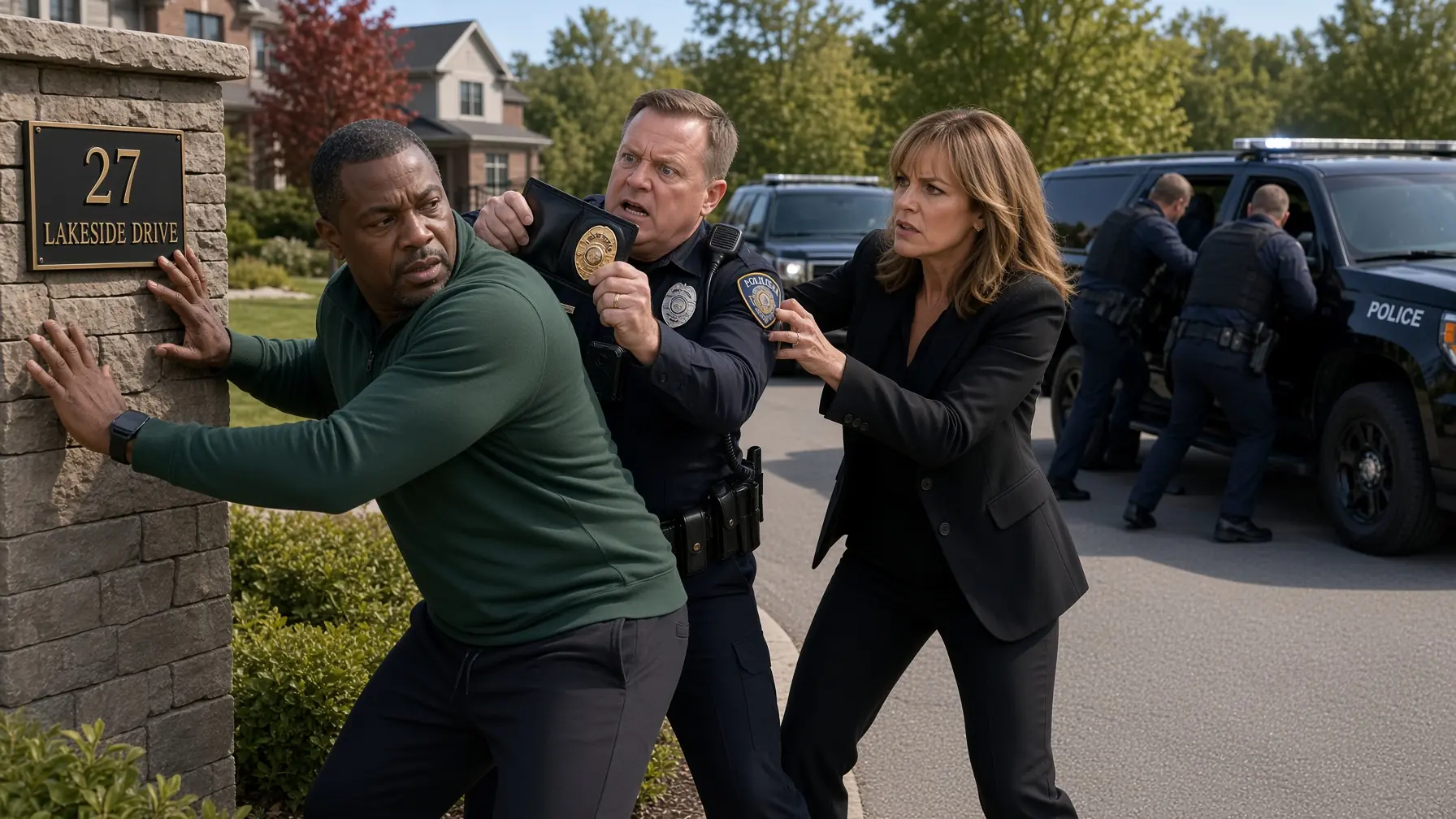
One second, Marcus was sitting beneath the morning sun with a cup of coffee cooling beside him and the Sunday paper spread across his knees.
The next, a uniformed patrol officer stood at the bottom of his porch steps with both hands wrapped around a service pistol pointed directly at Marcus’s chest.
Birds still moved through the maple trees lining Briarwood Lane.
A sprinkler clicked rhythmically three houses away.
Somewhere behind a cedar fence, a lawn mower kept running.
Everything around them remained ordinary.
That was what Marcus would remember later.
How quickly one man could turn an ordinary morning into something else while the rest of the world barely noticed.
Marcus did not move.
He looked at the gun.
Then at the officer.
Slowly, carefully, he folded the newspaper once and placed it beside his coffee.
“Hands where I can see them,” Mason ordered.
Marcus raised both hands.
“They’re visible.”
“Don't reach for anything.”
“I won't.”
Mason climbed one porch step.
“What are you doing here?”
Marcus glanced toward the large white-columned house behind him.
Then back.
“Drinking coffee.”
Mason’s eyes narrowed.
“And reading the newspaper.”
“I asked what you're doing at this residence.”
Something changed slightly in Marcus’s face.
Not anger.
Recognition.
“I live here.”
The gun did not move.
At 8:46 that Sunday morning, those three words should have started verification.
They did not prove Marcus owned the house.
But they offered a simple explanation.
One that could be checked.
The county property database existed.
Vehicle registration existed.
Dispatch could confirm the address.
Marcus’s driver’s license was inside.
His key was sitting on the porch table.
Through the front window, a framed family photograph showed Marcus standing beside his wife and daughter in the same front yard.
There were options.
Officer Derek Mason used none of them.
Instead, he studied Marcus.
Black sweatshirt.
Gray sweatpants.
House slippers.
Close-cropped hair beginning to gray at the temples.
Then he looked at the expensive homes around them.
As though Marcus and Briarwood Estates could not comfortably occupy the same frame.
“You got ID?”
“Inside.”
“Where?”
“My wallet is on the kitchen counter.”
“Don't go for it.”
“I wasn't planning to.”
Mason took another step.
“Anybody else inside?”
“My wife and daughter are at church.”
“So you're alone?”
“Yes.”
“Whose house is this?”
Marcus stared at him.
“Mine.”
“Name?”
“Marcus Williams.”
Mason paused.
Something about the name felt familiar.
He could not place it.
Marcus noticed.
“What was the call?”
“You don't need to worry about the call.”
“If somebody reported a crime at my house, I would like to know what crime.”
“I’m asking the questions.”
Marcus nodded once.
The small gesture irritated Mason more than open hostility probably would have.
There was no panic in Marcus’s voice.
No pleading.
No frantic attempt to prove he belonged.
That calmness did not mean Marcus felt safe.
He was a Black man sitting twenty feet from an armed officer who had already skipped several chances to lower his weapon.
Marcus understood exactly how little calm protected him.
One misunderstood movement could become permanent before credentials, cameras, reports, or apologies mattered.
So he kept his hands open.
His body still.
His voice ordinary.
“Then ask.”
Across Briarwood Lane, Elaine Porter stood behind the curtains of number 1187 with one hand covering her mouth.
She had made the call.
Thirty-eight minutes earlier, Elaine had been upstairs when she noticed Marcus sitting across the street.
She had lived in Briarwood Estates for only three weeks.
She barely knew her own next-door neighbors.
She knew even less about the Williams house.
During a property showing months earlier, a real-estate agent had mentioned that an older couple once lived there.
Elaine had seen a white-haired man collecting mail.
She did not know he had been the previous owner.
Did not know Marcus and Renee Williams had bought the house fourteen months earlier.
What Elaine saw that morning was a Black man in a dark sweatshirt sitting on the porch of a large home in an affluent subdivision.
She watched him drink coffee.
Watched him open a newspaper.
Watched him stand once to collect another section from the front step.
Then sit again.
He did not check windows.
Did not test the door.
Did not take anything.
Did not hide.
Nothing criminal occurred.
Yet Elaine’s discomfort grew.
At 8:22 she called the police non-emergency line.
The dispatcher asked:
“What is he doing?”
“Sitting on the porch.”
“Trying to enter?”
“No.”
“Looking through windows?”
“No.”
“Removing property?”
“No.”
“Threatening anyone?”
“No.”
“Do you know who lives there?”
Elaine hesitated.
“I thought an older couple did.”
“Have you confirmed that?”
“No.”
“Does the man have a weapon?”
“I can't see one.”
Then came the question Elaine would replay many times later.
“What makes him suspicious?”
She looked through the curtain again.
“He just doesn’t look like he belongs there.”
The dispatcher did not convert discomfort into burglary.
The call was entered carefully:
UNKNOWN MALE SEATED ON PORCH. NO CRIMINAL ACTIVITY OBSERVED. CALLER DOES NOT KNOW CURRENT HOMEOWNER.
When Derek Mason received the call, those details were read aloud.
His body camera and in-car recording would later confirm it.
But by the time he turned onto Briarwood Lane, something had changed in his mind.
An unknown man had become a possible trespasser.
A possible trespasser had become a possible burglar.
And by the time he stepped out of his patrol car, the possibility had become serious enough in his mind to justify drawing a gun before he had asked a single question.
“Stand up,” Mason ordered.
Marcus looked at him.
“Why?”
“Because I told you to.”
“That isn't a reason.”
Mason’s jaw tightened.
“You want to make this difficult?”
“No.”
“Then stand.”
Marcus rose slowly.
He was forty-seven.
Tall.
Broad through the shoulders.
Nearly two inches taller than Mason.
That seemed to increase the officer’s tension.
“Hands higher.”
Marcus raised them.
“Turn around.”
“What crime am I suspected of?”
“Turn around.”
Marcus complied.
He faced his own front door.
Mason climbed the remaining steps with the gun still in his right hand.
“I’m going to pat you down.”
Marcus looked slightly over his shoulder.
“I do not consent to a search.”
“It’s for officer safety.”
“What fact makes you believe I’m armed?”
Mason paused.
There were answers an officer could have given if facts supported them.
A visible bulge.
A reported weapon.
Threatening movement.
Repeated reaching.
A witness description.
None existed.
Instead Mason said:
“You keep questioning everything I tell you.”
Marcus’s voice stayed quiet.
“That isn't a weapon.”
“Face forward.”
Marcus did.
Mason frisked him.
Nothing.
No firearm.
No knife.
No suspicious object.
Only a house key in his sweatpants pocket.
Mason removed it.
Marcus turned his head slightly.
“Why are you taking that?”
“Evidence.”
“Of what?”
Mason looked toward the door.
“This could have come from inside.”
Marcus almost smiled.
“Yes.”
Mason heard disrespect where there was mostly disbelief.
“You think this is funny?”