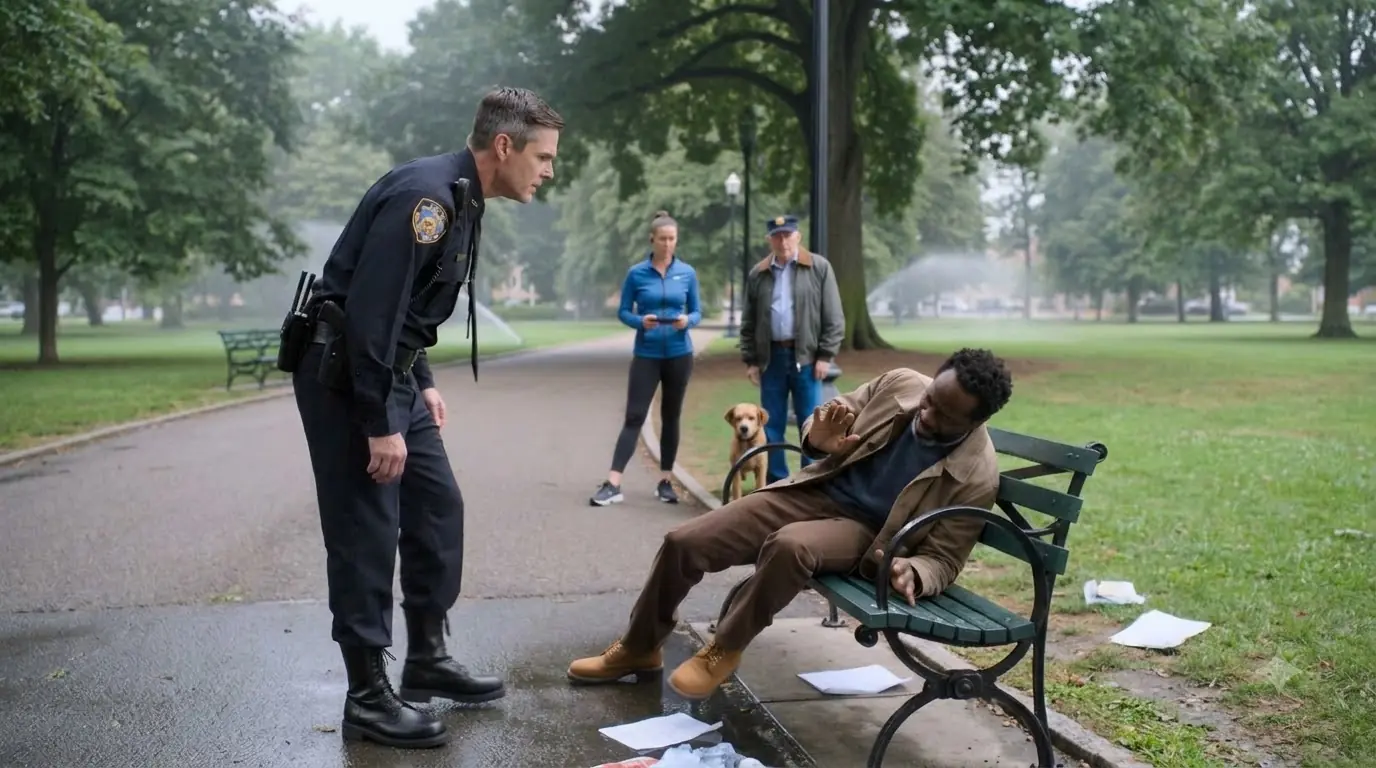
The first kick landed below the ribs.
Not hard enough to break anything.
Just hard enough to wake a man in pain and remind him who controlled the morning.
The Black man rolled off the bench and hit the cold pavement with one hand stretched out to stop his fall. His old canvas jacket dragged across a puddle left by the park sprinklers. A worn duffel bag tipped over beside him, spilling a folded shirt, a bottle of water, two protein bars, and a small notebook with a cracked black cover.
Officer Ethan Blake stood above him with one boot still planted near the bench.
“Get up,” Blake said. “This isn’t a shelter.”
The man blinked once, slow and steady, like someone waking from a deeper kind of exhaustion than sleep. He did not shout. He did not curse. He did not reach for the officer’s leg or scramble away like Blake expected.
He only sat up and said, “I’m sorry, officer. I didn’t mean to cause trouble.”
That answer irritated Blake more than defiance would have.
Polite men were harder to write up.
“Trouble?” Blake laughed. “You people always have a soft word for being where you don’t belong.”
Morning joggers slowed along the path.
A woman in a blue running jacket pulled one earbud out.
Near the fountain, a man walking a terrier stopped so abruptly the dog looked back at him, confused. Two cyclists coasted to the edge of the path. Nobody spoke yet, but the air had changed in that way public cruelty always changes it.
People noticed.
Then they decided whether noticing was going to cost them something.
Officer Blake bent down, grabbed the man by the collar, and dragged him upright. The man’s back struck the trunk of a sycamore tree. His jaw tightened once from the impact, but his hands stayed open at his sides.
Blake leaned close enough for the man to smell stale coffee on his breath.
“You got ID?”
“No, sir. Not on me.”
“Of course not.”
Blake turned slightly so the small crowd could hear him.
“Every morning it’s the same. Good people come here to run, walk their dogs, bring their kids, and then they have to step over trash sleeping on the benches.”
The man looked down at the spilled notebook near his duffel.
Blake noticed the glance.
He picked it up, flipped through it, and frowned at the neat handwriting inside.
Dates.
Times.
Descriptions.
Badge numbers.
“Look at this,” Blake said. “Got yourself a little diary?”
The man said nothing.
Blake waved the notebook in front of his face.
“What is it? Dealer list? Names of people you plan to rob? Places where folks leave purses in strollers?”
The woman in the blue running jacket raised her phone.
Her name was Laura Bennett.
She taught English at a public high school ten blocks away and ran through Franklin Park every Tuesday and Thursday before class. She had seen Officer Blake before. Not like this, not this close, but enough times to recognize the pattern. He always seemed to find the same kind of people to question.
Black men on benches.
Latino delivery workers cutting through the park.
Teenagers with backpacks.
Anyone who looked easier to accuse than apologize to.
Blake saw Laura’s phone.
“Ma’am,” he said sharply, “keep moving.”
Laura’s hand shook slightly.
She did not lower the phone.
“I’m on a public path.”
“And this is police business.”
“I can record from a public place.”
His eyes narrowed.
Somewhere behind Laura, the man with the terrier lifted his own phone. He was older, maybe seventy, wearing a faded Army cap and a windbreaker zipped to his chin. His name was Paul Whitcomb, and he had spent thirty years as a mail carrier before retirement taught him that watching the world quietly did not mean he had to accept everything in it.
He took one step closer.
Then another.
Blake turned back to the man against the tree.
“Hands on the bench.”
The man obeyed.
Slowly.
Clearly.
No sudden movements.
No resistance.
Officer Blake patted him down with unnecessary force, slamming both palms against his back, ribs, hips, and legs. It was not a search for weapons. Everyone watching could feel that. It was a performance of ownership.
The man kept breathing evenly.
In through the nose.
Out through the mouth.
Training, not fear.
But Blake did not know that.
He did not know the man in the worn jacket was not homeless.
He did not know the beard had been grown on purpose, the clothes chosen carefully, the duffel packed with clean items folded military-tight, or the cracked notebook designed to look harmless while hiding a week of documentation in plain sight.
He did not know the pen clipped inside the jacket pocket had a camera.
He did not know the button on the left sleeve was recording audio.
He did not know the man he had kicked awake was Captain Malcolm Hayes of Internal Affairs.
And he did not know today was the last day of a seven-day undercover operation built around him.
Franklin Park had once been the heart of East Fairmont.
Families held birthday parties under the sycamores.
Older men played chess near the fountain.
Kids learned to ride bikes along the curved path beside the basketball courts.
Then the condos came.
Coffee shops followed.
Old renters left quietly because rent increases did not need police escorts to remove people. They worked slowly, politely, through letters and online portals and new building owners who used words like redevelopment and opportunity. The neighborhood became cleaner, wealthier, and more watchful.
Officer Ethan Blake volunteered for the morning patrol route.
He called it preserving quality of life.
The complaint files called it something else.
Captain Hayes had read every one of them.
A Black nurse shoved against a patrol car after sleeping in her car between hospital shifts.
A Mexican groundskeeper searched twice in one week while walking to work before sunrise.
A college student handcuffed for “suspicious loitering” while waiting for the bus.
A homeless veteran pepper-sprayed after refusing to throw away his medication bag.
Twenty-two complaints in eleven years.
None sustained.
Each file carried the same dead language.
Insufficient evidence.
Officer acted within policy.
Subject became noncompliant.
No independent witness available.
Hayes had spent twenty-six years in law enforcement and knew exactly what those phrases could hide. He had written some of them himself early in his career, before experience and regret taught him that bureaucratic language could become a graveyard for truth.
So he came to Franklin Park without rank showing.
No suit.
No badge on his belt.
No department sedan.
No command presence.
Just an old jacket, a duffel bag, a notebook, a week’s worth of patience, and a hidden camera rolling before dawn.
For six mornings, he watched Blake work.
Day one, Blake searched a Black teenager’s backpack after claiming he smelled marijuana. He found algebra homework, a basketball jersey, and a sandwich wrapped in foil.
Day two, Blake threatened a Dominican delivery driver for resting on a bench during a break.
Day three, Blake told a homeless white man to move along, then bought him coffee after learning he had served in the Marines.
Day four, Blake emptied a Latino construction worker’s lunch bag onto the grass because the man “looked nervous.”
Day five, Blake ignored two drunk white college students yelling by the fountain but stopped a Black father walking a stroller because someone had reported “a suspicious male near children.”
Day six, Blake wrote a false report about a woman who complained after he searched her purse.
Hayes documented all of it.
What he needed was the incident Blake could not explain away.
Public.
Clear.
Witnessed.
Unmistakable.
On day seven, Blake gave it to him before the sun cleared the courthouse dome.
Blake shoved the notebook into Hayes’s chest.
“What are all these times and names?”
“Personal notes,” Hayes said.
“Personal notes about police officers?”
“Yes.”
Blake’s smile faded.
“Why?”
Hayes looked at him.
“To remember what happened.”
That was the wrong answer to give a man who depended on people forgetting.
Blake grabbed the duffel and dumped the rest of it onto the wet grass. Clothes. Protein bars. A toothbrush. Socks. A paperback book. A small framed photograph wrapped in a plastic bag.
The photograph landed face-up.
A woman in a yellow dress stood beside Hayes near a lake, laughing with her head turned slightly away from the camera.
Blake picked it up.
“Who’s this?”
Hayes’s eyes moved to the photo.
“My wife.”
Blake looked at the picture, then at him.
“She know you sleep in parks?”
Hayes did not answer.
Blake tossed the photograph onto the ground.
“Probably left you.”
Something in Hayes’s face changed.
Not enough for the crowd to notice.
Enough for him to feel the heat rise behind his eyes.
His wife, Renee, had been dead four years.
Cancer.
Not abandonment.
Not shame.
Not whatever ugly little story Blake needed to invent to make the man in front of him smaller.
Hayes breathed through it.
That was his job.
Officer Blake leaned down and picked up one of the protein bars crushed slightly in the wet grass. He held it up like evidence.
“Stolen?”
“No.”
“Bought it with what money?”
Hayes stayed silent.
Blake reached into his own pocket, pulled out a fifty-dollar bill, and waved it in front of Hayes’s face.
“You know what this is?”
“Yes.”
“This is what working people carry.”
He spat on the bill and dropped it at Hayes’s feet.
“Pick it up.”
The park became silent.
The fountains still ran.
Traffic still moved beyond the trees.
But every person near the path seemed to freeze around the single wet bill lying on the pavement.
Hayes looked down at it.
Then back at Blake.
He did not bend.
Blake’s jaw flexed.
“I said pick it up.”
Hayes’s voice stayed level.
“No.”
Laura Bennett whispered, “Oh my God,” and kept recording.
Paul Whitcomb’s phone was up now too.
The terrier had stopped pulling at the leash and sat beside his shoes as if even the dog understood the mood had shifted.
Officer Blake stepped closer.
“What did you say?”
“I said no.”
Blake grabbed Hayes by the jacket and slammed him against the sycamore again. This time the bark scraped the back of Hayes’s neck. A sharp pain ran down his ribs where the first kick had landed.
Still, he did not fight back.
Still, he kept his hands visible.
Blake keyed his radio.
“Unit 23 requesting backup at Franklin Park. Suspicious male, possible narcotics, refusing lawful commands.”
Hayes spoke clearly.
“I have not refused any lawful command. I have not been found with narcotics. I am unarmed and compliant.”
Blake turned on him.
“You keep talking like that, and I’ll give you something to narrate.”
A patrol SUV pulled up along the curb three minutes later.
Officer Ryan Vale stepped out first, young, nervous, still new enough to know policy but not confident enough to challenge senior cruelty. Behind him came Sergeant Elise Morgan, who had been Blake’s supervisor for five years and had signed off on more complaints than she cared to remember.
Blake briefed them quickly.
“Vagrant sleeping on the bench. No ID. Possible narcotics. Refusing to comply. Taking notes on officers like some kind of threat.”
Hayes looked at Sergeant Morgan.
“Sergeant, I have complied with every instruction except picking up money that Officer Blake spat on and threw at my feet.”
Morgan’s eyes flicked to the fifty-dollar bill.
Then to Blake.
Then away.
That was the moment Hayes understood she knew.
Not necessarily everything.
But enough.
Enough to know this was not clean.
Enough to stop it.
She did not.
“Sir,” Morgan said to Hayes, “cooperate and this will go easier.”
Hayes almost smiled.
Not because it was funny.
Because the sentence was older than anyone standing there.
Cooperate meant absorb the humiliation.
Cooperate meant make our paperwork easier.
Cooperate meant let the powerful finish quickly so the rest of us can pretend we did not see the shape of the damage.
Blake pulled out his cuffs.
“Turn around.”
Hayes looked directly at Laura’s camera.
“I am complying under protest.”
Blake snapped the first cuff around his wrist.
Then the second.
He tightened both too far.
Hayes’s fingers tingled.
“Too tight,” Hayes said.
Blake leaned near his ear.
“Good.”
Officer Vale looked at the cuffs.
Then at Sergeant Morgan.
“Sergeant, should we check his name first?”
Blake laughed.
“He doesn’t have ID.”
“Still,” Vale said carefully, “we could run him through mobile prints before transport.”
Blake turned on him.
“You got a problem with my stop?”
“No, sir.”
“Then stand there and learn something.”
Vale stepped back.
Another witness choosing silence because the cost of speech looked higher than the cost of shame.
Blake pushed Hayes toward the patrol SUV.
That was when Hayes stopped walking.
“Officer Blake,” he said, voice still even, “before you place me in that vehicle, I need to identify myself.”
Blake grinned.
“Here we go.”
“My name is Captain Malcolm Hayes. Internal Affairs Division. Badge number 6129.”
The words moved through the park slowly.
Not like thunder.
Like smoke.
People heard them, then turned them over, then looked at Blake to see if the world was about to change.
Blake laughed.
A hard, forced laugh.
“You hear that, Sarge? This guy says he’s Internal Affairs.”
Sergeant Morgan’s face tightened.
Officer Vale pulled out his department tablet before anyone told him to.
Hayes continued.
“Run badge 6129. Captain Malcolm Hayes. Internal Affairs. Special assignment.”
Blake grabbed the back of Hayes’s jacket.
“You are digging yourself into a felony.”
Vale typed.
His face changed.
He looked up at Sergeant Morgan.
“Sarge.”
Blake’s laugh died.
“What?”
Vale swallowed.
“Captain Malcolm Hayes. IA. Badge 6129.”
The crowd went fully quiet.
Blake stepped toward the tablet and stared at the screen. The photo showed Hayes clean-shaven, in dress uniform, captain’s bars on his collar, eyes steady as a courthouse wall.
The eyes matched.
Everything else did not, because that had been the point.
Blake looked back at Hayes.
“No.”
Hayes did not move.
“No,” Blake said again, louder. “This is fake.”
Sergeant Morgan took the tablet from Vale.
She looked once.
Then twice.
Her mouth opened slightly.
“Captain Hayes,” she said, barely above a whisper.
Blake’s panic flashed into anger.
“You set me up.”
Hayes looked at him.
“I observed your conduct.”
“You set me up.”
“I gave you seven days to act like an officer.”
Blake’s hand shot out and grabbed Hayes by the throat.
The crowd gasped.
Laura cried, “He’s choking him.”
Paul Whitcomb stepped forward.
“Officer, let him go.”
Blake shoved Hayes against the SUV so hard the side mirror rattled.
“Who else knows?”
Hayes’s voice was rough now, but controlled.
“Everyone who needs to.”
Sergeant Morgan finally moved.
“Ethan, stop.”
Blake did not release him.
“Ethan,” she said again, louder. “Let go.”
He turned toward her, eyes wild.
“You knew?”
“No.”
“Liar.”
“You need to stop.”
The word need was too late, but it was something.
Hayes spoke through the pressure on his throat.
“Officer Blake, my pen camera has been recording since first contact. Sleeve audio as well. Park security covers this area. Civilian witnesses are recording. Destroying evidence will add another charge.”
Blake’s eyes dropped to the pen clipped near the jacket pocket.
He yanked it free.
For one second, he held it like a snake.
Then he threw it onto the pavement and stomped it until plastic cracked.
Hayes looked down at the broken pen.
Then back at him.
“Thank you for demonstrating consciousness of guilt.”
That sentence broke the last of Blake’s control.
He lifted his fist.
Sergeant Morgan caught his arm.
Vale stepped in from the other side.
For a few seconds, all three officers struggled beside the SUV while Hayes stood cuffed, throat reddened, wrists burning, and cameras recording everything.
The crowd was no longer quiet.
“Take the cuffs off him.”
“He said he’s a captain.”
“Get a supervisor.”
“She’s recording.”
“I’m live right now.”
Laura’s video stream had crossed three thousand viewers.
Then seven.
Then twelve.
People were sharing it faster than anyone in the park could understand.
Officer Blake had thought he was humiliating a man no one would believe.
Instead, he had stepped onto a public stage and performed his own indictment.
An unmarked car pulled hard to the curb.
Deputy Chief Nora Caldwell got out before the engine fully settled.
She was Black, fifty-seven, silver at the temples, and carried herself with a kind of quiet force that made even shouting men reconsider volume. She took in Hayes, the cuffs, the red marks on his throat, the broken pen camera, Blake’s heaving chest, Morgan’s pale face, and the crowd of phones.
Her voice was calm.
That made it worse.
“Officer Blake, step away from Captain Hayes.”
Blake froze.
Caldwell repeated it.
“Now.”
This time, he moved.
Caldwell walked to Hayes and removed the cuffs herself.
“Captain, do you need medical?”
“After evidence preservation,” Hayes said.
Caldwell looked at Sergeant Morgan.
“Secure every recording. Vehicle cameras. Radio traffic. Body cameras. Park cameras. Civilian contacts. Nobody leaves without providing a witness statement if they’re willing.”
Then she faced Blake.
“Officer Ethan Blake, you are relieved of duty effective immediately. Surrender your badge, weapon, radio, and department ID.”
Blake’s face collapsed inward.
“Chief, I—”
“I am not interested in your report before I see the evidence.”
“My report will explain—”
“Your report,” Caldwell said, “will not be written before your lawyer arrives.”
That silenced him.
Piece by piece, Blake handed over the tools that had made him feel untouchable.
Weapon.
Badge.
Cuffs.
Radio.
ID.
The park watched him become smaller with every item removed.
Vale transported him to headquarters.
Sergeant Morgan stayed behind, looking like a woman who had just realized silence could become a charge of its own.
Hayes picked up the broken pen camera from the pavement.
Laura Bennett approached, still holding her phone.
“I have the whole thing,” she said. “From the kick.”
Hayes nodded.
“Thank you.”
“I almost kept running.”
He looked at her.
“But you didn’t.”
Paul Whitcomb stepped forward next.
“I’ve got video too. And notes. I started writing after he threw the bill.”
Hayes looked down.
The fifty-dollar bill still lay near the bench, damp and dirty.
“I saw that,” Paul said quietly. “I’m sorry.”
Hayes bent, picked up the bill carefully with two fingers, and placed it inside an evidence bag Caldwell handed him.
“He thought this showed worth,” Hayes said. “It will.”
By evening, the video had reached the entire city.
By the next morning, it had reached the country.
The headline changed depending on the outlet.
Cop Kicks Sleeping Man In Park, Learns He Is Internal Affairs Captain.
Undercover IA Operation Exposes Abuse In Franklin Park.
Officer Suspended After Viral Video Shows Harassment Of Black Captain.
But the headline Hayes cared about did not appear anywhere.
It was the one written in the faces of people who came forward after the video spread.
A grandmother whose grandson had been searched twice in one month.
A delivery driver whose charges were dismissed but whose job never returned.
A homeless veteran who had kept hospital discharge papers because Blake had thrown his medication into a trash can.
A nurse.
A student.
A father.
A man walking home from work.
A woman sitting near the fountain waiting for her bus.
Their stories arrived by email, voicemail, in person, through attorneys, through churches, through community groups, through people who had stopped believing reports mattered until they saw Blake’s badge come off in public.
Hayes read every statement.
Not summaries.
The statements.
Names.
Dates.
The words people used when they were finally believed.
Internal Affairs produced a preliminary report in nine days.
It was 183 pages.
Blake’s arrest patterns showed severe racial disparity. His searches produced contraband at a rate far lower than department average. His use-of-force reports reused the same phrases across unrelated encounters. His body camera had failed during seven of the last ten complaints. Sergeant Morgan had approved six of those reviews without requesting backup footage.
The system had not missed the pattern.
It had chosen not to read it.
The district attorney filed charges two weeks later.
Assault under color of authority.
False reporting.
Civil rights violations.
Destruction of evidence.
Witness intimidation.
The federal investigation followed within forty-eight hours.
Blake’s defense attorney called the undercover operation entrapment.
Hayes expected that.
Bad officers liked the word setup because it made their own choices sound like someone else’s trap.
At the first hearing, the prosecutor played Laura Bennett’s video.
The courtroom watched Blake kick a sleeping man awake.
Heard him say “your kind.”
Saw him throw money onto the ground.
Saw him tighten handcuffs.
Saw him grab Hayes by the throat after learning he was Internal Affairs.
There was no clever argument that could make the footage clean.
Sergeant Morgan testified under immunity.
Her voice shook.
“I knew Officer Blake crossed lines,” she said. “I told myself intervening would destroy team trust. I told myself the complaints were complicated. I told myself a lot of things because admitting the truth would have required action.”
The prosecutor asked, “And what was the truth?”
Morgan looked toward the victims seated behind Hayes.
“The truth was he was abusing people, and I helped protect him by staying quiet.”
That testimony changed the case.
Blake had acted.
Others had allowed.
A department that wanted one bad apple found itself facing the orchard.
The trial lasted eleven days.
Blake looked different without the uniform.
Not weaker exactly.
More ordinary.
That was the part that unsettled people. Cruelty had seemed larger when it wore a badge, a belt, a radio, a gun, and institutional confidence. In a suit beside his attorney, Blake looked like a man who had spent years borrowing power from a system and calling it character.
Hayes testified on day three.
The defense attorney tried to make the operation sound deceptive.
“You allowed Officer Blake to believe you were homeless.”
“I allowed him to believe what he chose to assume.”
“You did not identify yourself immediately.”
“No.”
“Why not?”
“Because the purpose of the operation was to document how he treated people when he believed they lacked institutional power.”
The courtroom went quiet.
The attorney shifted.
“So you wanted him to fail.”
Hayes looked at Blake.
“No. I wanted him to stop.”
The jury returned guilty verdicts on all major counts.
At sentencing, Judge Marion Ellis spoke directly to Blake.
“You believed dignity could be conditional. Conditional on appearance, income, race, housing status, and your assessment of a person’s usefulness. You were wrong. The law does not give you permission to degrade citizens before deciding whether they deserve rights.”
Blake stared down at the table.
The judge continued.
“You abused the authority granted by the public, and you did so repeatedly. Your badge did not protect the community from danger. It became the danger.”
He was sentenced to eleven years in prison, with state and federal time partly concurrent.
He lost his pension.
His certification was revoked permanently.
The civil settlements later reached more than four million dollars.
But the real consequence was larger than Blake.
Franklin Park became the starting point for a complete department overhaul.
Body cameras received tamper-proof activation systems.
All complaint files moved to an independent civilian review board.
Searches required clearer documentation and supervisor review.
Repeated body camera failures triggered automatic suspension pending investigation.
Use-of-force reports were audited quarterly by an outside firm.
Supervisors could be disciplined for rubber-stamping misconduct.
Training changed too.
Not the usual slideshow everyone forgot by lunch.
Real training.
Victims spoke.
Community members spoke.
Officers watched the Franklin Park video in full, without edits, without comforting commentary, without anyone allowing them to pretend it was only about Blake.
Hayes addressed the academy six months later.
Sixty recruits sat before him.
On the screen behind him was a still image from Laura’s video: Hayes on his knees, hands cuffed behind him, Blake standing over him.
Hayes let them look at it.
Then he said, “This picture is not about me. I had a badge hidden in my jacket. Most people do not.”
No one moved.
“That is why your oath matters. The person in front of you may have no title, no money, no witness, no clean clothes, no lawyer, no safe place to sleep. None of that reduces their rights. None of that reduces your duty.”
A recruit raised his hand.
“Captain, what if someone disrespects us?”
Hayes answered without hesitation.
“Then you remain professional.”
“What if they curse at us?”
“You remain professional.”
“What if they refuse to cooperate?”
“You follow the law, not your ego.”
The recruit lowered his hand.
Hayes looked across the room.
“Anyone can be calm when praised. Policing is what you do when your pride is challenged and no one important seems to be watching.”
One year after the incident, Franklin Park felt different.
Not perfect.
No place became perfect because one officer went to prison and one department rewrote policy.
But different.
Children played near the fountain without parents scanning for trouble. Dog walkers stopped under the sycamores. Joggers passed the bench where Hayes had slept undercover and sometimes slowed, reading the small bronze plaque installed beneath the tree.
Franklin Park
Dignity belongs to every person.
Witness makes truth harder to bury.
Laura Bennett still ran the same route.
She stopped there sometimes, not because she wanted to relive the fear, but because the plaque reminded her of the morning she almost chose silence and did not.
Paul Whitcomb still walked his terrier, though the dog was slower now.
Officer Ryan Vale, the young officer who had asked one careful question and then stepped back, returned to the park often as part of the new community patrol unit. He asked people if they needed help before asking why they were there. That sounded small.
It was not.
Sergeant Elise Morgan resigned before formal discipline concluded.
In her resignation letter, she wrote one sentence that Hayes kept in the IA training file.
I confused loyalty to an officer with loyalty to the oath.
Hayes read that sentence to every supervisor class.
Some hated it.
Good.
Useful sentences often sting.
As for Blake, he wrote apology letters from prison.
Some victims read them.
Some threw them away.
Some never opened them.
Hayes respected every choice.
Forgiveness was not evidence.
It was not policy.
It could not be required of people harmed by someone who finally ran out of protection.
Years later, people still told the story like a twist.
A racist cop kicked a sleeping Black man in the ribs.
The man turned out to be Internal Affairs.
The officer lost his badge, his pension, his freedom, and his reputation.
That version traveled easily because it satisfied something simple in the human heart. The bully picked the wrong victim. The powerful man was humbled. The reveal came at the perfect moment.
But Hayes never liked the phrase wrong victim.
There was no right victim.
There was no person low enough to kick awake.
No man poor enough to spit money at.
No Black body public enough for humiliation.
No bench, sidewalk, alley, shelter, station platform, or park where dignity stopped applying.
That was the story he wanted people to remember.
Not that Ethan Blake had accidentally abused a captain.
That Ethan Blake had abused many people because he believed they were not captains.
Hayes kept the fifty-dollar bill in his office.
Framed behind glass.
Still faintly stained from wet grass and spit.
Visitors asked about it sometimes.
He told them the truth.
“That bill is what arrogance thinks worth looks like.”
Then he pointed to the case files beside it.
“And those names are what worth actually is.”
The work continued.
Complaints still came.
Officers still made mistakes.
Some lied.
Some improved.
Some left when the department became less comfortable for men who missed the old silence.
Hayes considered that progress too.
A system should not be comfortable for people who need darkness to function.
On the second anniversary of the Franklin Park operation, Hayes visited the bench alone before sunrise.
He wore a suit this time.
No disguise.
No duffel.
No hidden camera.
The city was just waking.
Sprinklers clicked on near the east grass.
A bus hissed at the curb.
Somewhere across the street, the first coffee grinder of the morning began its familiar growl.
Hayes sat on the bench and looked at the path where Laura had stopped running.
He thought about how close she had come to moving on.
How close Paul had come to watching quietly.
How close Vale had come to never asking the first question.
How many times before that morning people had seen enough to know something was wrong, then decided wrong was safer to survive than challenge.
He did not judge them easily.
Fear was real.
Jobs were real.
Retaliation was real.
The cost of speaking was not evenly distributed.
But he also knew silence had a price too, and it was usually paid by the people with the least power to afford it.
A young man crossed the park wearing a janitorial uniform, headphones around his neck, lunch bag in hand. He passed a patrol car parked near the curb. The officer inside lifted a hand in greeting.
The young man lifted one back.
He did not speed up.
He did not lower his eyes.
He did not step off the path.
Hayes watched him continue through the park like it belonged to him.
Because it did.
That was the victory.
Not Blake in prison.
Not the viral video.
Not the headlines.
Not even the reforms.
The victory was a man walking through public space without shrinking.
The victory was a city learning, slowly and imperfectly, that safety did not mean removing people who made comfort uncomfortable.
It meant protecting everyone’s right to exist without being hunted by authority.
Hayes stood from the bench.
His ribs had healed.
His wrists had healed.
The small scar near his throat remained faint, barely visible unless the light caught it.
He did not mind.
Some marks were reminders.
Before leaving, he looked once more at the plaque beneath the tree.
Dignity belongs to every person.
Simple words.
Hard work.
That was the way most truth operated.
Simple to say.
Costly to build.
And always at risk when good people decide a cruel moment is none of their business.
Hayes walked toward his car as the park filled with morning.
Behind him, runners passed.
Dogs barked.
Parents pushed strollers.
An old man read on the bench.
No one moved him.
No one kicked him awake.
No one asked if he belonged.
For that morning, at least, the city remembered what it had learned.
And somewhere beyond the trees, under the sound of traffic and ordinary life, the lesson remained:
The person you dismiss may be documenting everything.
The person you degrade may carry more authority than you can imagine.
But even if they carry nothing at all, no badge, no title, no money, no witness, they still carry dignity.
And the moment you forget that may be the moment the whole world finally sees who you are.