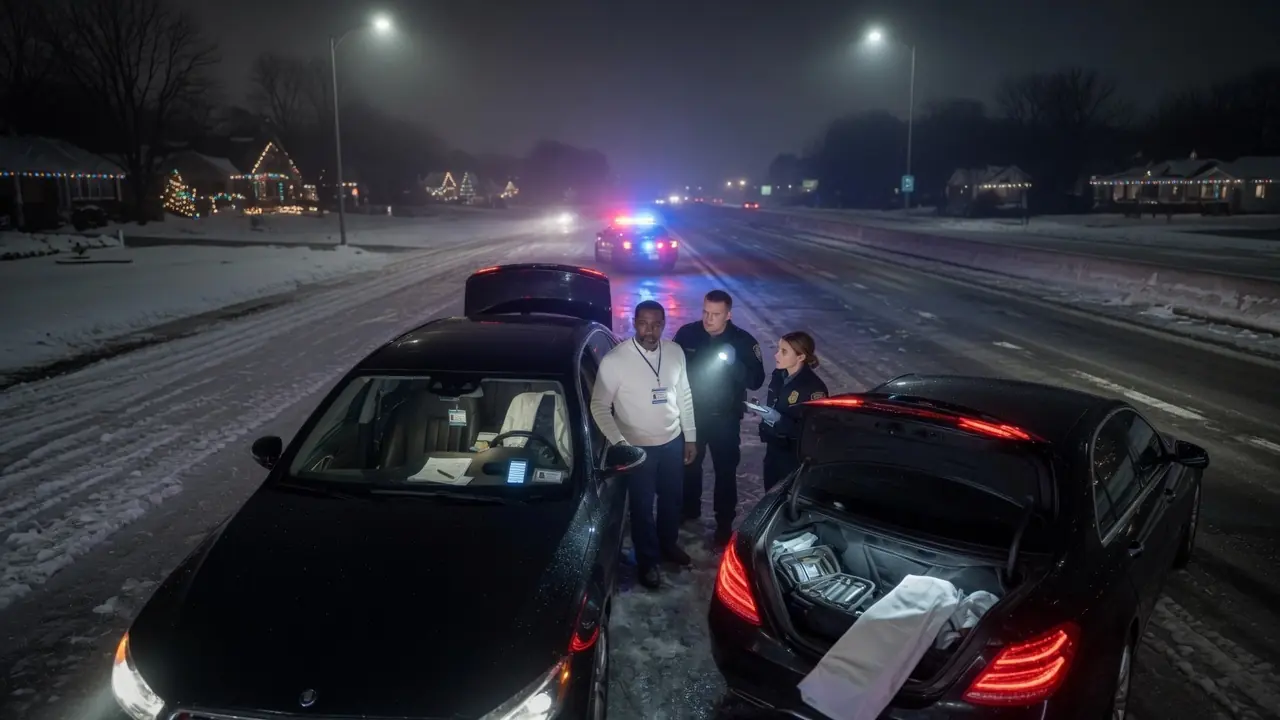
“Where did you steal this car from?”
Officer Tyler Bragg’s flashlight struck Dr. Marcus Bennett full in the face, bright enough to make his eyes water against the cold December dark. Red and blue lights rolled over the black Mercedes, over the icy shoulder of Interstate 85, over the thin white fog rising from the asphalt. Christmas lights glowed on houses far beyond the highway, soft and distant, like another world where people were still safe inside warm rooms.
Marcus kept both hands on the steering wheel.
He had learned that lesson before he learned algebra.
Hands visible. No sudden movements. Speak clearly. Do not give fear a shape they can call resistance.
“Officer,” he said, voice controlled, “my name is Dr. Marcus Bennett. I’m the chief of cardiac surgery at Saint Catherine Medical Center. I have a patient dying right now. I need to get to the operating room.”
Bragg laughed.
Not because he thought the answer was funny.
Because he wanted Marcus to understand that the truth would not matter unless Bragg decided to believe it.
“A doctor,” Bragg said, leaning closer to the window. “Driving a car like this, dressed like that, in the middle of the night?”
Marcus wore navy scrub pants, a charcoal sweater, and a hospital badge hanging clearly from the rearview mirror. His white coat was on the back seat. His surgical bag was in the trunk. His phone kept buzzing on the passenger seat with the same words lighting up the screen again and again.
Saint Catherine Emergency.
Bragg tapped the flashlight against the glass.
“Step out, boy.”
Inside the car, Marcus felt something in his chest tighten.
Not fear exactly.
Something older.
Something more tired.
“Officer, please. Call the hospital. Ask for Dr. Elaine Park in cardiac trauma. She will verify everything.”
Bragg’s mouth twisted.
“Everybody’s got a story when they get caught.”
The phone buzzed again.
Every second mattered.
What Officer Tyler Bragg did not know was that the woman dying inside Saint Catherine Medical Center was the wife of Captain Harold Gaines, the most respected man in his own department. And before the night ended, the words Bragg had spoken on that shoulder would come back to him under lights far brighter than his flashlight.
Six hours earlier, Marcus Bennett had been walking through the cardiac ICU with a paper cup of hospital coffee and the kind of exhaustion that lived behind the eyes.
He was forty-eight years old, tall, Black, neatly bearded, and known across Atlanta medical circles for three things: steady hands, impossible standards, and the rare ability to calm a family without lying to them. He had trained at Johns Hopkins, completed a fellowship in New York, returned south when Saint Catherine recruited him, and spent the last fifteen years cutting into chests people were terrified to open and giving hearts one more chance to keep time.
The residents followed him like ducklings.
Dr. Priya Desai asked about a post-operative valve patient, and Marcus slowed down long enough to explain the pressure gradient in plain English. Dr. Nolan West, who was smart but too eager, interrupted twice, and Marcus corrected him without humiliating him.
“Confidence is useful,” Marcus said, glancing at the young doctor. “But arrogance can kill a patient before the scalpel touches skin.”
The residents got quiet.
They wrote that down.
Marcus believed in teaching the way his first mentor had taught him: sharp when needed, generous when earned, always clear. He had been the only Black student in more than one room where people assumed he was lost, cleaning, assisting, observing, anything except belonging. Nobody had given him softness. But some had given him truth, and truth had been enough to build on.
By 7:10 p.m., he finished evening rounds.
A woman in room 412 had survived a difficult bypass that afternoon. Her husband stood when Marcus approached, both hands shaking around a Styrofoam cup.
“Dr. Bennett,” the man said, voice breaking, “you saved her.”
Marcus did not take praise easily.
He never knew where to put it.
“She came through strong,” he said. “The next twenty-four hours matter, but she did well.”
The man started crying.
Marcus stayed with him a moment longer than the schedule allowed.
That was the part people outside medicine rarely understood. Surgery was not only hands and steel. It was walking into waiting rooms where fear had already taken all the chairs. It was translating disaster into steps. It was being calm when families were falling apart because somebody had to keep the room from drowning.
By 7:45, Marcus was home.
His wife, Leah, had left a plate warming in the oven. Their daughter, Simone, was at the dining table with a half-built solar system model, Jupiter rolling dangerously close to the floor. Their son, Caleb, was lying upside down on the couch watching basketball highlights.
“Dad,” Caleb said, “you missed the best dunk.”
“I save hearts,” Marcus said, hanging his keys by the door. “I cannot also monitor every dunk in America.”
Simone looked up from her project.
“Can you help with Saturn’s rings?”
“I’ve repaired aortic valves smaller than that glue line.”
“Yes.”
For two hours, Marcus was not chief of surgery.
He was Dad.
He held cardboard planets, argued gently about whether Pluto deserved respect, ate reheated chicken, listened to Leah talk about a difficult architectural client, and pretended not to notice when Caleb tried to sneak a second cookie before bed.
By 11:18, the house was quiet.
Leah rested against him in bed, one hand on his chest.
“On call tonight?”
“Technically.”
“That means yes.”
Marcus smiled into the dark.
“It has been quiet.”
She lifted her head.
“You know better than to say that.”
He did.
At 11:31, his phone rang.
Marcus answered on the first vibration.
“Bennett.”
Dr. Elaine Park’s voice came through tight and urgent.
“Marcus, we need you now. Female, fifty-six, acute ascending aortic dissection. She collapsed at home. She’s unstable, pressure dropping, we’re prepping OR two.”
Marcus was already out of bed.
“Who’s covering?”
“Nobody who can do this fast enough. You’re the only one available within range.”
“Distance?”
“Twenty-one miles.”
“I’ll be there in eighteen minutes.”
“Marcus, she may not have eighteen.”
He grabbed scrub shoes, sweater, badge, phone, keys.
Leah sat up fully awake now.
“Bad?”
“Very.”
“Drive safe.”
“I’ll drive fast.”
“That is not the same thing.”
He kissed her forehead.
“I know.”
The Mercedes pulled out of the driveway at 11:36.
The roads were mostly empty. Cold air made the tires hum differently against the pavement. Marcus set the hospital route in his head rather than on the GPS. He knew every exit, every light, every bad merge. His mind was already in the operating room.
Dissection.
Tear in the aorta.
Control bleeding.
Repair.
No wasted motion.
No panic.
The phone rang again at 11:41.
Elaine did not bother with greeting.
“She’s deteriorating. We shocked her once. She came back, but barely.”
“Ten miles.”
“She’s asking for her husband.”
“Name?”
“Rebecca Gaines.”
Marcus stored it away but did not yet know why it mattered.
“Keep her alive until I get there.”
“We are trying.”
At 11:46, red and blue lights appeared behind him.
Marcus looked at the speedometer.
Eighty-two.
Speed limit sixty-five.
He swore once, quietly.
Then he signaled and pulled onto the shoulder.
He knew the calculation. Explain. Show ID. Maybe two minutes lost. Maybe three. Painful, dangerous, but manageable if the officer understood quickly. He turned on the interior light, lowered the window, placed both hands high on the wheel, and waited.
Officer Tyler Bragg approached the driver’s side.
His partner, Officer Nina Wallace, approached the passenger side.
Bragg was in his late thirties, broad, pale, square-jawed, with the stiff aggressive posture of a man who entered every encounter already offended. Wallace was younger, maybe early thirties, with alert eyes that moved first to Marcus’s hands, then to the hospital badge, then to the scrubs.
Bragg’s flashlight stayed on Marcus’s face.
“License and registration.”
Marcus kept his voice level.
“My license is in my wallet, left jacket pocket. Registration is in the glove compartment. I’m going to reach slowly.”
“Do it.”
Marcus handed both over.
“My name is Dr. Marcus Bennett. I’m chief of cardiac surgery at Saint Catherine Medical Center. I’m on my way to an emergency surgery. My hospital ID is hanging from the mirror.”
Bragg barely looked at it.
“Chief of surgery,” he said. “That so?”
“Yes.”
“Nice car for a hospital worker.”
Wallace glanced toward him.
Marcus let the sentence pass because the patient did not have time for his pride.
“Officer, please call Saint Catherine. The number is on the badge. Ask for Dr. Elaine Park. She will confirm.”
Bragg stepped back toward his cruiser with the documents.
“Stay put.”
Four minutes passed.
Then six.
Marcus watched the dashboard clock with a surgeon’s hatred of wasted time.
11:52.
11:53.
The phone buzzed again.
Elaine Park.
Then a text preview appeared.
Where are you? She’s crashing.
Marcus closed his eyes for half a second.
Breathe.
Bragg returned slowly, as if time belonged to him.
“Step out of the car.”
Marcus stared at him.
“Officer, my registration is valid. My license is valid. The car is registered to me. I need to leave.”
“I said step out.”
Wallace leaned in from the passenger side.
“Tyler, his credentials check visually. We should verify with the hospital.”
“I didn’t ask you.”
Marcus unbuckled and stepped out.
The cold hit him hard.
His breath showed white in the air.
Bragg looked him over with open contempt.
“So what are you really doing out here? Drugs in the trunk? Stolen car? Running for somebody?”
“I am a heart surgeon trying to reach a dying patient.”
“A Black heart surgeon in a hundred-thousand-dollar Mercedes.”
Marcus held his hands at his sides.
“That is correct.”
Bragg smiled.
“You hear how that sounds?”
“Yes,” Marcus said. “It sounds like you have already decided what I cannot be.”
Wallace’s face tightened.
Bragg stepped closer.
“You getting smart with me?”
“I am trying to save a life.”
“Pop the trunk.”
“On what grounds?”
“I smell marijuana.”
Marcus looked at him.
There was no smell.
No smoke.
No cause.
Only the oldest lie in modern clothing.
“I do not consent to a search.”
“That wasn’t the question.”
“My surgical bag is in the trunk. My emergency supplies are sterile.”
Bragg moved toward the trunk.
“Then you should have no problem opening it.”
Marcus pressed the release because refusal would cost more time than the violation.
Bragg lifted the trunk and unzipped the medical bag. He pulled out sterile gloves, sealed instruments, emergency medication, a portable stethoscope, and packets labeled for hospital use. He held up a surgical clamp like he had discovered contraband.
“Weapons.”
Wallace walked closer.
“Those are medical instruments.”
Bragg ignored her.
He began removing items and placing them on the cold pavement. Sterile packages touched road dust. A packet of patient consent forms fluttered loose in the wind. Marcus moved one step forward before stopping himself.
“Those are protected medical documents.”
“Then you should have kept them out of my traffic stop.”
Marcus’s phone rang again inside the car.
Bragg reached through the window and grabbed it before Marcus could speak.
The screen showed Saint Catherine Emergency.
Bragg answered.
“Yeah?”
Elaine’s voice came through loud enough to hear.
“Dr. Bennett? Thank God. Where are you? She’s in ventricular fibrillation. We’re losing her.”
Bragg smiled at Marcus.
“The doctor is busy.”
“Who is this?” Elaine snapped. “Put Dr. Bennett on the phone right now. This is a hospital emergency.”
Bragg looked almost amused.
“Ma’am, your doctor here is being detained.”
“Detained? Are you insane? He is the only surgeon who can save this woman.”
Bragg ended the call.
Then tossed the phone onto the hood of his cruiser.
For a moment, Marcus could not speak.
The world narrowed to Bragg’s face and the knowledge that somewhere under bright surgical lights, a woman’s heart was tearing apart while this man enjoyed control.
“You may have just killed her,” Marcus said.
Bragg’s eyes hardened.
“Careful.”
“No. You need to hear me. Every minute you hold me here lowers her chance of survival.”
“Then maybe you should have obeyed the speed limit.”
Wallace stepped forward.
“Tyler, stop. We need to verify and let him go.”
“Get back.”
“He’s telling the truth.”
“Are you his lawyer now?”
“I’m the officer watching you create a problem.”
Bragg turned on her so sharply that she stopped.
“You want to write my report for me too?”
Wallace said nothing, but Marcus saw her hand move toward her own radio.
Bragg saw it too.
“Touch that radio and I’ll write you up before shift ends.”
The highway hissed beside them.
A passing car slowed.
The driver, a middle-aged man in a business coat, pulled onto the shoulder ahead and raised his phone.
“Officer,” the man called, “I’m recording. That man is saying he’s a surgeon. You should call the hospital.”
Bragg pointed at him.
“Get back in your vehicle or you’re next.”
The man stayed where he was.
The phone stayed up.
That changed Bragg’s mood from cruel to angry.
He stormed toward Marcus.
“On your knees.”
Marcus stared at him.
“What?”
“You said you were begging. So beg.”
Wallace stepped between them before Marcus could answer.
“No.”
Bragg looked stunned.
“What did you say?”
“No,” Wallace repeated, voice shaking but clear. “I am not standing here while you humiliate a doctor during a medical emergency.”
Bragg reached for her radio.
She pulled back.
The radio clipped loose, hit the asphalt, and cracked.
That was when another set of headlights swept across the shoulder.
An unmarked police SUV pulled in behind the cruiser.
Captain Harold Gaines stepped out wearing a department jacket over civilian clothes. He had silver in his beard, captain’s bars on his collar, and the face of a man who had been dragged into trouble when he should have been at home.
“What is going on here?” he demanded.
Bragg straightened instantly.
“Captain, routine traffic stop. Subject was speeding and became noncompliant.”
Gaines looked at Marcus.
Then at the hospital badge.
Then at the scrubs.
Then at the surgical instruments scattered on the ground.
His expression changed slowly.
“Subject?” he said.
Bragg swallowed.
“Driver, sir.”
Gaines picked up the badge from where it had been knocked loose onto the passenger seat.
“Dr. Marcus Bennett?”
“Yes,” Marcus said, voice rough. “Chief of cardiac surgery at Saint Catherine. I’m trying to reach an emergency procedure.”
Gaines went still.
“What patient?”
Marcus hesitated only a second.
“Female, fifty-six. Acute ascending aortic dissection. Name is Rebecca Gaines.”
The captain’s face emptied.
“Rebecca?”
Marcus looked at him.
The realization landed between them.
Hard.
Gaines pulled out his phone with shaking fingers and called Saint Catherine on speaker.
“Dr. Park, this is Captain Harold Gaines. My wife Rebecca—”
Elaine cut him off.
“Captain, we have been trying to reach you. She is critical. We need Dr. Bennett now. Every minute counts.”
Gaines looked at Bragg.
Not with anger first.
With disbelief so complete it looked like grief.
“You stopped him,” he said.
Bragg’s mouth opened.
“Sir, I didn’t know it was your wife.”
That was the wrong answer.
Gaines stepped closer.
“You shouldn’t have needed it to be my wife.”
Bragg tried again.
“He was speeding. I followed protocol.”
“Protocol is verifying facts,” Gaines said, voice rising. “Protocol is listening when a man shows hospital credentials. Protocol is not tearing apart a surgeon’s car while a patient is dying.”
Wallace spoke, pale but steady.
“Captain, I advised Officer Bragg several times that Dr. Bennett’s credentials appeared legitimate and that we should verify. He refused.”
Gaines nodded once without looking away from Bragg.
“Badge and weapon.”
Bragg went white.
“Captain—”
“Now.”
The badge came off first.
Then the gun.
The same hands that had scattered surgical tools now shook so badly the magazine rattled in the holster.
Gaines threw his keys to Marcus.
“Take my vehicle. I’ll clear the route.”
Marcus did not waste another word.
He grabbed the essentials from the pavement, shoved what he could into the surgical bag, and ran to the unmarked SUV.
Gaines leaned into the driver’s window.
“Doctor,” he said, voice breaking now, “please.”
Marcus met his eyes.
“I’ll do everything humanly possible.”
Gaines keyed his radio.
“All units, emergency medical escort to Saint Catherine Medical Center. The driver is Dr. Marcus Bennett, cardiac surgeon. Clear every intersection from I-85 to the hospital. Anyone who stops that vehicle answers to me.”
Marcus pulled onto the highway at 12:16 a.m.
Thirty minutes after the first hospital call.
Thirty minutes Rebecca Gaines did not have.
At Saint Catherine, the emergency entrance was blazing with light.
Marcus abandoned the SUV in the ambulance lane, engine still running. Elaine met him at the doors in scrubs, mask hanging loose, eyes sharp with exhaustion.
“She coded twice,” she said as they ran. “We got her back, but barely.”
“Pressure?”
“Sixty-five over thirty on maximum support.”
“OR ready?”
“Two minutes ago.”
“Then let’s stop wasting them.”
He scrubbed in with violent focus.
Soap.
Brush.
Rinse.
Gown.
Gloves.
Mask.
By the time he entered the operating room, Rebecca Gaines was under drapes, intubated, pale beneath harsh surgical lights. The monitor told the story before anyone did. Her heart was still fighting, but not well. The tear had spread. Time had damaged everything.
Marcus held out his hand.
“Scalpel.”
The room obeyed.
For the next three hours, Marcus became what years had trained him to become.
Not a man humiliated on a highway.
Not a Black doctor forced to prove what was already hanging from his mirror.
Not a father with children asleep at home.
A surgeon.
Cut.
Clamp.
Repair.
Control bleeding.
Restart rhythm.
The first time Rebecca’s pressure bottomed out, Elaine looked across the table.
Marcus did not look away from the field.
“Not yet,” he said.
The second time, the room went frighteningly quiet.
Marcus reached deeper, adjusted the repair, and spoke to the team in the same calm voice he used when panic tried to enter a room without permission.
“We are not losing her because somebody else wasted our time.”
Nobody needed to ask what he meant.
At 3:08 a.m., Rebecca Gaines stabilized.
Marcus stepped back from the table slowly.
“Close.”
Elaine exhaled like she had been holding her breath for half the night.
“She’s alive.”
“Keep her that way.”
Only after he walked into the scrub room did Marcus notice his hands shaking.
Elaine stood beside him.
“You did it.”
“Barely.”
“Yes,” she said. “Barely still counts.”
Captain Gaines was waiting outside the OR doors, still in uniform, face gray with fear. He stood the moment Marcus appeared.
“My wife?”
Marcus removed his cap.
“She survived surgery. She is critical, but stable. If the next twenty-four hours go well, she has a real chance at recovery.”
Gaines covered his face with both hands.
The sob that came out of him was raw, human, and too exhausted to hide.
“Thank you,” he whispered. “Thank you.”
Marcus sat beside him because sometimes the doctor’s job did not end when the incision closed.
After a long silence, Gaines said, “He almost killed her.”
Marcus looked straight ahead.
“Yes.”
“I trained that officer.”
“Then you know this wasn’t only him.”
Gaines flinched.
Marcus let the words sit there.
“I have been questioned in hospitals while wearing a badge. I have had families ask whether there was another surgeon before I even introduced myself. I have been stopped in parking garages, boardrooms, hotel lobbies, and once outside my own medical conference.”
He turned to Gaines.
“Tonight was not new. It was just the first time your department’s prejudice landed on your doorstep before someone else’s.”
Gaines closed his eyes.
“I know.”
“Do you?”
The captain opened them again.
There was no defensiveness left in his face.
Only shame.
“I will.”
By 8:00 that morning, the story had reached local news.
By noon, it was national.
The man who recorded on the shoulder had uploaded everything: Bragg’s voice, the insult, Marcus explaining the emergency, Wallace trying to intervene, the phone call being hung up, the demand that Marcus get on his knees. Someone from Saint Catherine leaked the timeline showing the thirty-minute delay. Medical organizations issued statements. Doctors wrote furious posts. Black professionals told stories that sounded painfully familiar.
Saint Catherine held a press conference at 4:00 p.m.
Marcus stood beside the hospital president, still exhausted, still in scrubs, refusing to turn himself into a performance.
“I filed a complaint today,” he said. “Not because I want attention. Because the next person stopped by Officer Bragg might not have a hospital badge. The next person may not have witnesses. The next person may not be racing to save a police captain’s wife, and that should not be the thing that makes them worth believing.”
Officer Tyler Bragg was fired within forty-eight hours.
That was the easy part.
The harder part came after Captain Gaines ordered a full review of Bragg’s stops. Seventeen complaints in five years. Twelve from Black drivers. Four involved professional credentials being ignored. Two involved medical personnel. One involved a Black judge stopped outside the courthouse and accused of using a fake parking placard.
All had been dismissed.
All had been called misunderstandings, attitude problems, lack of cooperation, failure to comply.
That language began to look different once Marcus Bennett’s name sat at the center of the file.
Officer Nina Wallace gave a sworn statement.
She did not protect Bragg.
She did not protect herself either.
“I should have intervened sooner,” she said. “I recognized the problem before I acted. That delay matters.”
Captain Gaines read her statement twice.
Then ordered every officer in the department to attend intervention training built around that sentence.
The district attorney filed charges against Bragg: deprivation of rights under color of law, assault, obstruction of emergency medical care, official misconduct, and reckless endangerment.
The trial began five months later.
Marcus took the stand in a dark suit, calm and precise. The prosecutor asked what he had been thinking during the stop.
“My patient,” Marcus said. “Always my patient. I was calculating survival odds while watching an officer spend those odds like they belonged to him.”
The courtroom was silent.
The prosecutor asked what the stop made him feel.
Marcus paused.
“Reduced,” he said. “Not because I believed his words. Because he had the power to make his disbelief matter.”
Captain Gaines testified next.
He did not spare himself.
“My wife almost died because I served in a department that taught some officers suspicion before judgment,” he said. “Officer Bragg made the choice that night, but the culture helped him believe he could.”
Rebecca Gaines testified in a wheelchair.
She had recovered enough to speak, though slowly. She looked at Marcus first, then at the jury.
“I do not remember the operating room,” she said. “I remember waking up and my husband telling me a man fought to reach me while another man delayed him. I am alive because Dr. Bennett kept coming anyway.”
Then she looked at Bragg.
“I was lucky the person you hated was excellent at saving lives.”
The jury convicted Bragg on every major count.
He was sentenced to federal prison and permanently barred from law enforcement. The judge called his conduct “a deliberate abuse of public authority aggravated by racial contempt and reckless disregard for human life.”
Marcus did not celebrate.
Leah squeezed his hand when the sentence was read.
Outside the courthouse, reporters shouted questions.
“Dr. Bennett, do you forgive Officer Bragg?”
Marcus stopped.
The cameras tightened around him.
“Forgiveness is not the public’s business,” he said. “Accountability is.”
Then he walked away.
The lawsuit forced deeper change.
Saint Catherine, the city, and Captain Gaines’s department created a formal emergency medical verification protocol for traffic stops involving medical professionals responding to critical calls. Body cameras became mandatory for every stop. Disabling or obstructing cameras triggered automatic suspension. Repeated complaints could no longer be closed by the same chain of command that supervised the accused officer.
A civilian review board gained access to stop data.
The numbers told the truth faster than speeches did.
Black drivers were being searched at nearly four times the rate of white drivers on the same roads. Complaints from minority professionals were far more likely to be dismissed. Officers with repeated allegations had been promoted, protected, or quietly transferred instead of corrected.
Captain Gaines stayed in the department long enough to help build the reforms.
Then he retired.
At his retirement ceremony, he did not give the speech people expected.
“I used to think good intentions were enough if most officers meant well,” he said. “I was wrong. Systems do not become fair because good people feel bad after harm happens. They become fair when rules force courage before harm becomes irreversible.”
Nina Wallace was promoted two years later.
She became known for teaching young officers the sentence she once had to learn the hard way.
“If you see wrong and wait, you are not neutral. You are late.”
Marcus returned to surgery the week after the trial.
Not because he had healed.
Because hearts kept failing.
Families kept waiting.
Operating rooms kept filling with that strange combination of terror and hope.
A year later, Rebecca Gaines walked into Saint Catherine’s auditorium during Grand Rounds. She moved slowly but without help. Her husband stood beside her. In her hands was a small basket of cookies wrapped in a red cloth.
“My grandchildren helped,” she said.
Marcus smiled.
“You have grandchildren?”
“Four now,” Rebecca said. “One was born three months after the surgery. I got to hold him because you made it through that night.”
She hugged him.
It surprised him.
Then he hugged her back.
The room applauded, but quietly, as if everyone understood this was not for performance.
Later that afternoon, Marcus sat alone in his office. Sunlight crossed his desk and touched a framed photo of Leah, Simone, and Caleb at the beach. His phone buzzed.
A text from Leah.
Simone says she wants to be a surgeon now. She said you make hearts brave.
Marcus smiled.
Then typed back.
Tell her hearts are already brave. We just help them keep going.
His pager went off before he could put the phone down.
Another emergency.
He stood, took his white coat from the chair, and walked toward the elevator.
This was the part people often missed when they told the story. They wanted the highway, the racist officer, the captain’s wife, the courtroom, the sentence, the reform. They wanted the dramatic turn where the man treated like a criminal became the only person who could save the woman everyone suddenly cared about.
All of that was true.
But it was not the whole story.
The whole story was that Marcus Bennett had been exactly who he said he was from the first second of the stop. He did not become worthy when the captain arrived. He did not become credible when the patient turned out to matter to someone powerful. He did not become a doctor when the courtroom confirmed it.
He was already a doctor.
Already a father.
Already a husband.
Already a man with hands steady enough to repair a dying heart and a voice disciplined enough not to break when insult tried to make him smaller.
The tragedy was not that Officer Bragg stopped the wrong Black man.
The tragedy was that he thought there was a right one.
Years later, Marcus would still drive that same highway when called in at night. Sometimes he would pass the shoulder where the stop happened and feel his jaw tighten before he could stop it. Sometimes he would slow down without meaning to. Sometimes he would see red and blue lights behind another car and whisper a prayer for whoever sat inside.
Then he would keep driving.
Because somewhere ahead, someone might be waiting under surgical lights.
Someone’s mother.
Someone’s husband.
Someone’s child.
Someone’s wife.
And Marcus Bennett had built his life around one stubborn belief: that every heartbeat mattered before anyone knew whose it was.