The water was colder than Nathaniel Hayes expected.
That was the first thing he noticed.
Not the laughter.
Not the lawyers staring.
Not the tourists lifting phones.
The cold.
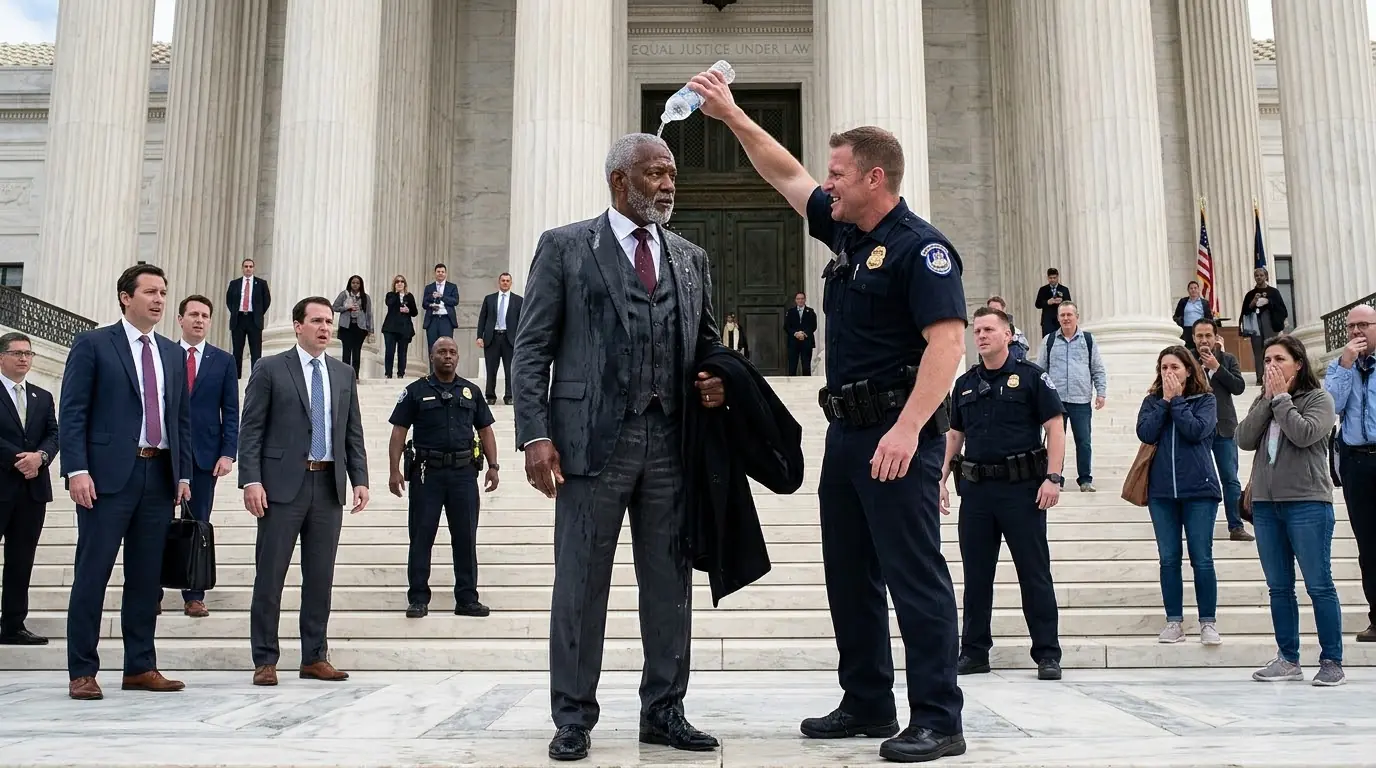
It struck the crown of his silver-gray hair and ran immediately down his forehead, through his eyebrows, across his closed eyes, and into the neatly trimmed white beard he had spent twenty minutes grooming that morning.
Then it reached his collar.
A sharp stream slid beneath the white shirt.
Another soaked the knot of his burgundy tie.
By the time Officer Derek Malloy had emptied half the bottle, Nathaniel’s charcoal three-piece suit was darkening from shoulder to waist.
Nathaniel stood perfectly still.
The broad marble steps of the United States Supreme Court stretched beneath him.
Behind him towered white columns, carved stone, and bronze doors large enough to make nearly every visitor feel insignificant.
It was 9:11 on a clear Tuesday morning in Washington, D.C.
The plaza was already busy.
Attorneys.
Clerks.
Tourists.
Federal employees.
Security officers.
A school group gathering near the sidewalk.
Three lawyers had stopped several steps below Nathaniel.
Two uniformed deputies stood near the security table.
A Black man in a navy suit watched from beside one of the columns.
Nobody moved.
Officer Malloy lifted the bottle higher and shook out the final drops.
“There.”
His mouth curved.
“Now you finally look like the nobody you really are.”
The bottle crackled in his fist.
Nathaniel opened his eyes.
Water ran from his eyelashes.
He looked at Malloy.
“You finished?”
That answer disappointed the officer.
Malloy had expected anger.
Perhaps shouting.
Maybe embarrassment dramatic enough to justify whatever he did next.
Instead Nathaniel’s voice carried the measured calm of a man who had spent four decades listening to other people mistake volume for authority.
Malloy stepped closer.
He was forty-three, white, broad through the chest, with short sandy-brown hair and the rigid posture of someone accustomed to a uniform opening space before he entered it.
His dark navy courthouse police shirt pulled tightly across his shoulders.
Badge polished.
Radio clipped high.
Body camera centered on his chest.
The small red indicator light was on.
Nathaniel had checked.
Of course he had.
Malloy jabbed one finger toward Nathaniel’s wet vest.
“You think this is funny?”
“No.”
“You think you're important?”
Nathaniel looked at him.
“I think you were given several opportunities to verify who I am.”
Malloy laughed.
“There it is again.”
“What?”
“That attitude.”
Nathaniel said nothing.
Malloy leaned closer.
“You people always think there’s some name you can drop.”
Nathaniel’s eyes sharpened.
“You people?”
Malloy’s smile became thinner.
“Visitors who don't understand how security works.”
Nathaniel did not answer immediately.
He had been alive long enough to recognize retreat disguised as clarification.
Malloy continued.
“You were told to use the public entrance.”
“I explained that I am scheduled through the judicial entrance.”
“You claimed.”
“I offered identification.”
“You reached into your coat after being told not to.”
“I asked permission first.”
“You kept arguing.”
“I kept correcting an error.”
Malloy’s jaw tightened.
The three attorneys below them had moved closer.
One, a young white woman carrying a leather briefcase, whispered to the man beside her:
“Is somebody calling a supervisor?”
One of the deputies heard.
He looked toward Malloy.
Then Nathaniel.
Then away.
Nathaniel noticed that too.
Everything mattered now.
The words.
The pauses.
Who had seen what.
Who had decided silence was safer.
Malloy stepped nearly chest-to-chest with him.
“You're nothing here.”
Nathaniel wiped water from one eye with two fingers.
Malloy’s voice rose.
“What the hell are you going to do about it?”
“Nothing.”
The officer smiled.
“That’s what I thought.”
Nathaniel finished wiping his face.
Then looked past Malloy toward the courthouse doors.
“Not personally.”
Malloy frowned.
“What?”
Before Nathaniel could answer, the enormous bronze doors opened.
Conversation stopped.
A senior court marshal stepped into the sunlight.
Thomas Avery was sixty-one, tall, narrow, silver-haired, and had served in Supreme Court security administration for more than twenty-five years.
His gaze swept the steps.
Then stopped on Nathaniel.
Everything in his face changed.
“Your Honor?”
The words traveled farther than they should have.
One of the attorneys straightened immediately.
The two deputies near the table went rigid.
The Black man in the navy suit lifted his head.
Malloy’s smile disappeared.
Avery descended one step.
Then another.
“Judge Hayes.”
Nathaniel inclined his head.
“Marshal Avery.”
Derek Malloy slowly turned.
For perhaps three seconds, he seemed unable to assemble the information he was hearing.
Then:
“Judge?”
Nathaniel looked at him.
“Yes.”
Malloy’s face drained.
Avery reached them.
His eyes moved across Nathaniel’s soaked hair.
The water running from the cuff of his jacket.
The empty bottle in Malloy’s hand.
Then the faces around them.
“What happened?”
Malloy spoke first.
“Sir, there was a misunderstanding.”
Nathaniel did not move.
Avery looked at him.
“Your Honor?”
Nathaniel answered:
“Officer Malloy was unable to verify my access status.”
Malloy nodded quickly.
“Exactly.”
Nathaniel continued:
“So he poured a bottle of water over my head.”
Silence.
Avery’s eyes slowly shifted to Malloy.
The officer swallowed.
“I can explain.”
Nathaniel looked toward the camera mounted high above the bronze doors.
Then at Malloy’s body camera.
“I imagine you’ll have several opportunities.”
Malloy’s breathing changed.
Avery turned toward one of the deputies.
“Sergeant Collins.”
The deputy stepped forward.
“Sir.”
“Preserve exterior video from 8:45 forward.”
“Yes, sir.”
“Officer Malloy’s body-camera file too.”
Malloy’s head snapped around.
“Marshal, I haven't—”
Avery raised one hand.
“Do not discuss substance here.”
Malloy stopped.
“Understood?”
“Yes, sir.”
“Good.”
Another man emerged through the doors carrying a tablet.
Deputy Marshal Samuel Price.
Avery spoke quietly to him.
“Contact Professional Responsibility.”
Price nodded.
Malloy looked at Nathaniel.
“I didn't know.”
That sentence finally broke Nathaniel’s composure.
Not visibly.
His face remained calm.
But something in his eyes hardened.
“That was obvious.”
Malloy opened his mouth.
Nathaniel continued.
“And irrelevant.”
The officer stared.
Nathaniel said:
“My name should not have been necessary for you to understand that pouring water over someone you found inconvenient was unacceptable.”
Avery glanced at him.
Nathaniel could tell he approved of the sentence and hated the circumstances requiring it.
Malloy looked around.
The attorneys.
The deputies.
The tourists.
Phones.
Camera.
He suddenly seemed smaller.
“Sir, I thought he was refusing—”
Avery interrupted.
“Officer.”
Malloy stopped.
Avery’s voice stayed low.
“You are being instructed not to make spontaneous statements about an incident that will be formally reviewed.”
Malloy nodded.
“Yes, sir.”
“Remain on these steps until your watch commander arrives.”
Malloy’s face changed again.
“Am I suspended?”
“That decision is not being made on the staircase.”
Nathaniel appreciated that.
Procedure.
Not theater.
Avery turned.
“Judge Hayes, the conference has been waiting.”
Nathaniel looked down at his soaked suit.
“I noticed.”
For the first time, Avery almost smiled.
Then:
“We have a private room upstairs.”
Nathaniel nodded.
He started toward the doors.
The young attorney with the briefcase spoke.
“Your Honor?”
Nathaniel stopped.
She looked nervous.
“I saw what happened.”
Malloy stared at her.
Nathaniel noticed.