He called him a thug.
He called him trash.
Then he pulled his fist back and swung like the badge on his chest gave him permission to rewrite the law with his knuckles. Officer Nolan Briggs thought it was just another quiet Sunday morning in Brookhaven, just another chance to remind a man in a gray hoodie who was really in charge.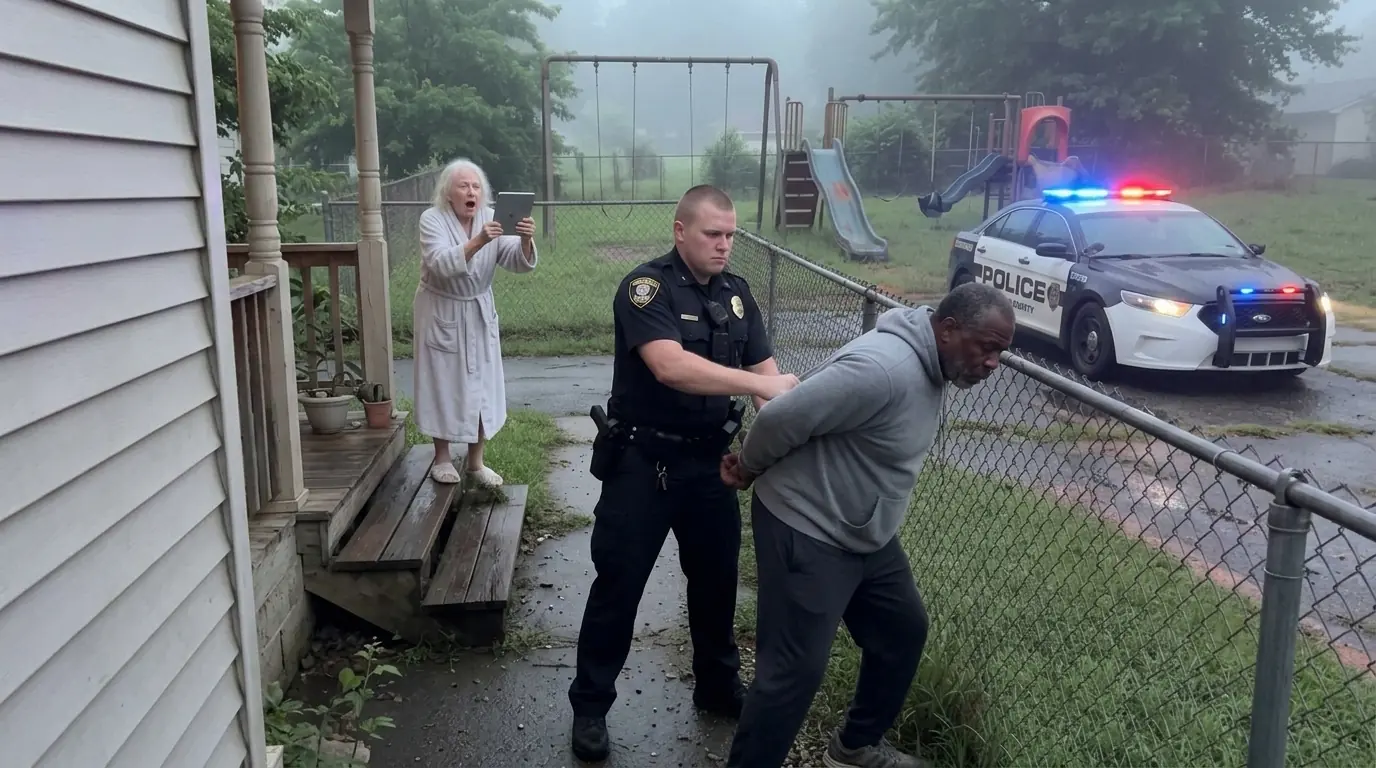
He had no idea the man bent over beside the rusty swing set was the mayor of the city.
Mayor Isaiah Whitaker hit the gravel hard, air punched out of his lungs, cheek scraped against the chain-link fence, hands locked behind his back too tightly to catch himself. For one strange second, all he could hear was the distant creak of the broken swing moving in the wind. Then Briggs leaned over him and said, “Stay down, boy,” and the whole morning changed forever.
This was not just a story about one bad arrest.
It was a story about what happens when a man who thinks power means cruelty finally meets someone who understands power as responsibility. It began before the fog lifted off the Northgate lawns, before church bells rang, before the city woke up enough to realize its mayor had left home without a suit, without a security detail, and without anyone to announce who he was.
Isaiah Whitaker tied the laces on his old running shoes at 6:12 a.m.
At forty-six, he still had the broad shoulders and solid frame of the college linebacker he used to be, though the years had softened the sharpness around his eyes. His wife, Camille, stood in the kitchen with a mug in both hands, watching him pull a plain gray hoodie over his head. She had seen that look on him before, the one that meant somebody had emailed him about a city problem and he was about to go see it with his own eyes.
“You know it’s Sunday, right?” Camille asked. “You remember the concept of a day off?”
Isaiah smiled without turning around. “The swing set at Mason Park.”
Camille sighed. “What about it?”
“Three parents sent photos this week. Rusted chains, sharp bolts, bad slide panel. Parks director says the inspection report will come in ten days.”
“And you do not trust paper more than your own eyes.”
“I trust paper after my eyes.”
That was Isaiah.
He did not lead Brookhaven from behind polished wood and framed photographs. He led from cracked sidewalks, flooded basements, late-night neighborhood meetings, school cafeterias, and city parks where parents asked him questions no press conference ever reached. He had become the first Black mayor in Brookhaven’s 128-year history not because he gave the cleanest speeches, but because people believed he would show up.
And he did.
He jogged out into the cool morning wearing no watch worth noticing, no expensive shoes, no pin on his hoodie, and no visible sign that he was the man who signed budgets, appointed department heads, and could summon half the city government with one phone call. He liked mornings like that. No podium. No cameras. Just a citizen moving through the city he had sworn to serve.
Mason Park sat near Fourth and Linden, on the edge of Northgate, a neighborhood with trimmed hedges, two-car garages, and residents who talked about safety in tones that often meant something else.
By 6:47, Isaiah reached the park and slowed to a walk. The grass was damp, the air smelled faintly of wet leaves, and the playground sat empty beneath a pair of old maple trees. He approached the swing set, crouched near the support beam, and frowned when he saw the rust.
The parents were right.
The chain links were corroded. One bolt near the left swing had worked itself loose, leaving a sharp edge exactly where a child’s hand might grab. The slide had a cracked plastic seam that could catch skin or clothing if a kid came down too fast. Isaiah took out his phone, an older model with a cracked corner on the screen, and began taking pictures.
He was so focused on the bolt that he did not hear the cruiser until the tires crunched over gravel behind him.
“Hey.”
The voice was sharp, not a greeting but an order.
Isaiah stood slowly and turned around. A Brookhaven patrol car idled near the curb, driver’s window down, exhaust curling into the cold morning. The officer behind the wheel was young, maybe late twenties, with a buzz cut, pale eyes, and a mouth shaped like he had been looking for a reason to sneer all day.
The driver’s door opened.
Officer Nolan Briggs stepped out with one hand already resting near his holster.
“Step away from the equipment.”
Isaiah raised his eyebrows, confused but calm. “Good morning, officer. I’m just checking the condition of the playground.”
“I said step away.”
Isaiah put his phone down at his side. “I’m Mayor Isaiah Whitaker. I’m taking photos for the city maintenance request. If you give me a second, I can show you my ID.”
Briggs let out a short laugh.
It had no humor in it.
“Mayor,” he said. “Right. And I’m the governor.”
Isaiah studied him. He knew most of the senior officers, but Briggs was not familiar. Later, he would learn Briggs had transferred from a neighboring county eight months earlier with what the file called a clean disciplinary history. Later, he would learn that clean meant complaints had been settled quietly, reports had been softened, and warning signs had been moved instead of addressed.
But that morning, all Isaiah saw was a young officer deciding the story before checking a single fact.
“We’ve had vandalism in this park,” Briggs said, walking closer. “Metal stripped. Graffiti. Tools stolen from the maintenance shed.”
“I understand,” Isaiah replied. “I’m not vandalizing anything. I’m documenting a hazard.”
“In a hoodie at seven in the morning?”
Isaiah’s voice stayed even. “Yes. On my morning run.”
Briggs looked him up and down. Worn shoes. Gray hoodie. Sweat on his forehead. Phone with a cracked screen. He did not see a mayor. He saw a category, and the category had already been convicted in his mind.
“Hands where I can see them.”
Isaiah lifted both hands slowly. “Officer Briggs, I’m going to repeat myself clearly. My wallet is in my back pocket. My identification is inside it. I am the mayor of Brookhaven.”
Briggs stepped closer until only a few feet separated them. “You people love titles when you’re caught doing dirt.”
Isaiah’s eyes changed.
Not anger exactly.
Something colder.
“You people?”
Briggs’s jaw tightened. “Turn around. Hands on the fence.”
“Officer, you are making a serious mistake.”
“Last warning.”
So Isaiah turned slowly and placed both hands on the chain-link fence.
“I am complying,” he said loudly. “I am not resisting. My wallet is in my back pocket. My name is Isaiah Whitaker.”
Briggs came up behind him and grabbed his left wrist.
Hard.
“Stop tensing up.”
“I’m not tensing.”
Briggs twisted his arm higher. “Don’t tell me what you’re doing.”
Pain shot through Isaiah’s shoulder. The fence pressed cold against his palms. He kept breathing slowly, trying to hold his voice steady, trying not to give Briggs the panic he seemed hungry to hear.
“Check my wallet,” Isaiah said. “You can verify this in ten seconds.”
“Shut up.”
Briggs shoved him forward.
Isaiah’s cheek hit the fence, metal biting into skin. A small burst of pain opened along his face. Across the street, a front door opened, and an elderly woman in a robe stepped onto her porch.
“What are you doing?” she shouted. “That’s Mayor Whitaker!”
Briggs glanced toward her. “Get back inside, ma’am.”
“That is the mayor!”
Briggs ignored her.
He yanked Isaiah’s other arm behind his back and snapped the cuffs on tight enough that Isaiah felt the metal cut skin. Then he spun him around by the front of his hoodie. The officer’s face was red now, not from exertion, but from being contradicted.
“You think you can embarrass me?” Briggs hissed.
“I’m telling you the truth,” Isaiah said. “And you are about to lose your badge.”
The words landed exactly where pride lives.
Briggs pulled his fist back and drove it into Isaiah’s stomach.
The punch folded him.
Air left his lungs in a harsh, broken sound. His knees hit the gravel, and for a moment the world narrowed to pain, cuffs, damp grass, and the taste of blood where his teeth had cut his lip. Briggs stood over him, breathing hard, satisfied in the awful way of a man who mistook domination for control.
The woman across the street screamed, “Stop!”
Briggs bent down and grabbed Isaiah by the cuffs, wrenching him upward. “Get up.”
Isaiah groaned as his shoulders burned.
“I am not resisting,” he said again, voice hoarse.
“Sure you’re not.”
Briggs dragged him toward the cruiser, shoved him against the back door, and slammed his head against the roofline before pushing him inside. Isaiah fell awkwardly across the hard plastic back seat, ribs throbbing, wrists numb, cheek wet with blood.
Briggs slammed the door.
For the first time that morning, Isaiah did not try to explain.
He memorized.
Badge number.
Time.
Location.
Witness.
Words used.
Force used.
Lie beginning.
Briggs climbed into the driver’s seat and picked up the radio.
“Dispatch, Unit Seven-Adam. Got one in custody at Mason Park. Suspect caught tampering with playground equipment. Resisted arrest. Transporting to booking.”
“Copy, Seven-Adam,” dispatch crackled. “Subject name?”
Briggs looked in the rearview mirror.
Isaiah met his eyes.
“My wallet,” Isaiah said calmly. “Back right pocket.”
Briggs smiled.
“John Doe,” he told dispatch. “Refused to identify.”
The cruiser pulled away from the curb.
Through the window, Isaiah saw the elderly woman on her porch with a phone pressed to her ear. She was not calling the police. She was calling someone who would know what to do.
Isaiah leaned back against the plastic seat, every breath sending pain across his ribs.
Briggs thought he was taking a nobody to jail.
In truth, he was driving his own career into the ground.
The ride to the station lasted twelve minutes.
To Isaiah, it felt longer.
The cuffs were too tight, and his fingers had begun to tingle. His cheek burned where the fence had scraped it, and his stomach ached from the punch. In the front seat, Briggs hummed under his breath and tapped the steering wheel, still riding the rush of what he thought had been a successful arrest.
He did not sound worried.
That told Isaiah plenty.
The cruiser entered the sally port behind the Brookhaven Police Department, and the metal door rolled down behind them with a heavy clang. Briggs opened the back door and grabbed Isaiah by the arm.
“End of the line, superstar.”
Isaiah stumbled out onto the concrete, caught himself, and stood upright despite the pain. His hoodie was torn at the collar. Blood had dried at the edge of his cheek. The handcuffs had left red rings around his wrists.
Briggs shoved him toward booking.
“Walk.”
The intake room smelled of stale coffee, disinfectant, old paperwork, and tired human beings. A few officers stood near desks. A man arrested for public intoxication muttered from a bench. Radios crackled. A printer jammed somewhere behind the counter.
Briggs marched Isaiah through the center of the room like he wanted an audience.
“Caught this one stripping playground metal,” he announced. “Wouldn’t ID. Resisted. Took a little convincing.”
At the booking desk, Sergeant Harold Mercer typed into a computer without looking up. He was near sixty, gray-haired, thick around the middle, and had the voice of a man who had spent thirty years asking questions he already knew the answers to.
“Name?”
“Refused,” Briggs said smugly. “Put him down as John Doe until prints come back.”
Mercer finished typing, hit enter, and finally looked up.
The room stopped.
Not slowly.
All at once.
Mercer’s face drained of color. His eyes moved from Isaiah’s bleeding cheek to the cuffs, then to the torn hoodie, then back to Isaiah’s face. His chair scraped hard against the floor as he stood.
“Mayor Whitaker?”
Briggs frowned. “What?”
Mercer did not look at him yet. “Mr. Mayor, my God.”
The word hit the room like a dropped weapon.
Mayor.
Briggs froze.
His eyes moved to Isaiah’s face again, but now the pieces rearranged themselves. The campaign posters. The photo in the station lobby. The televised budget address. The man at the press conference after the flood last spring.
Isaiah Whitaker.
Mayor of Brookhaven.
The man Briggs had punched.
The man he had dragged in as John Doe.
“Keys,” Mercer barked.
Briggs did not move.
“Give me the damn keys.”
Briggs fumbled at his belt, hands shaking now. Mercer snatched the keys from him and unlocked the cuffs himself. When the metal released, Isaiah brought his hands forward slowly. His wrists were swollen and ringed with bleeding marks.
Every officer in the room saw them.
Isaiah rubbed one wrist, then looked at Briggs.
“You accused me of vandalism,” he said quietly. “You ignored my identification. You called me boy. You punched me while I was handcuffed.”
Briggs swallowed.
“I thought—”
“You thought I was nobody.”
The words were not shouted.
That made them worse.
Before Briggs could answer, the double doors at the far end of the room burst open.
Police Chief Marcus Bell stormed in wearing a windbreaker over golf clothes, his face tight with fury. Behind him came Camille Whitaker, still in jeans and a sweater, fear moving across her face until she saw Isaiah standing. Then the fear broke into something sharper.
“Isaiah.”
She crossed the room quickly, taking his face in both hands, her eyes filling when she saw the bruise.
“Mrs. Alden called,” she said. “She said she saw an officer hit you.”
Chief Bell stopped in front of Briggs.
The room seemed to shrink around them.
“Nolan Briggs,” Bell said, voice low and dangerous. “Tell me why the mayor of this city is bleeding in my booking room.”
Briggs lifted both hands slightly. “Chief, I can explain. He refused to comply. I didn’t know who he was. He was reaching—”
“My wallet was in my back pocket,” Isaiah said. “I told him three times.”
Bell looked at Mercer. “Search the wallet.”
Mercer reached carefully into Isaiah’s back pocket and removed a slim leather wallet. He opened it and placed the contents on the counter.
Driver’s license.
City credential.
Gold mayoral badge.
The badge caught the fluorescent light.
Briggs stared at it like it was a sentence being read aloud.
Bell extended his hand. “Gun and badge.”
Briggs blinked. “Chief, please.”
“Gun and badge. Now.”
“It was a mistake.”
“No,” Bell said. “A wrong address is a mistake. This was a decision.”
Briggs’s hands shook too hard to unclasp the holster. Bell stepped in, removed the weapon himself, and handed it to Mercer. Then he pulled the badge from Briggs’s uniform and dropped it onto the counter.
The sound was small.
Final.
“You are suspended immediately pending termination and criminal investigation,” Bell said. “You will not access a department system. You will not speak to witnesses. You will wait for Internal Affairs in Interview Room Two.”
Briggs looked around the room, searching for support.
No one moved.
No one defended him.
Men who had laughed with him the previous Friday now looked at the floor.
Isaiah stepped forward.
Everyone went still.
Briggs flinched, expecting anger in a form he understood.
Isaiah stopped close enough for Briggs to hear him clearly.
“I am not going to hit you,” Isaiah said. “That is the difference between your kind of power and mine.”
Briggs’s lips trembled.
“I want you to remember this moment,” Isaiah continued. “Not because I am the mayor. Because every person you ever treated like this deserved the same protection you are suddenly hoping my title gives you.”
Briggs looked down.
Isaiah turned to Chief Bell.
“I want the body cam secured. Dash cam secured. Sally port footage secured. Booking footage preserved. Full medical documentation. And I want charges referred today.”
Bell nodded. “Yes, Mr. Mayor.”
“I’m not asking as mayor,” Isaiah said. “I’m asking as a citizen who was falsely arrested and assaulted.”
Briggs let out a small sound. “Please. I have a family.”
Isaiah looked back at him.
“So did I when you put your fist in my stomach.”
The room went silent.
Two officers escorted Briggs away. This time, his hands were not cuffed yet, but he walked like a man already feeling cold metal on his wrists. His footsteps faded down the hall.
Camille touched Isaiah’s arm. “Hospital. Now.”
“I’m fine.”
“You are a terrible liar.”
He almost smiled.
Then he turned to Sergeant Mercer. “The playground at Mason Park is dangerous. Rusted swing chains, cracked slide panel, exposed bolt on the left frame.”
Mercer stared at him for half a second, then nodded quickly. “I’ll put the work order in immediately.”
“Today,” Isaiah said.
“Yes, sir. Today.”
By the time Camille helped Isaiah out through the front of the station, the first news van was pulling up.
Mrs. Alden had not only called Camille.
She had called a reporter.
By Monday morning, Nolan Briggs was not just suspended.
He was nationally known.
Mrs. Alden had recorded the arrest from her porch on an old tablet, and the video was shaky but clear enough. It showed the fence. It showed the cuffs. It showed the punch. It caught Briggs calling Isaiah “boy,” and it caught Isaiah saying, “I am not resisting,” just before his knees hit the gravel.
The clip spread fast.
Local news first.
Then national outlets.
Then international.
Panels discussed it. Commentators argued over it. Former officers defended procedure until the punch replayed, and then even they shifted uncomfortably in their chairs. If an officer could do that to a mayor, people asked, what had he done to those whose names never made a headline?
Briggs sat in his apartment with the blinds closed and watched himself become a symbol.
His phone rang until he shut it off.
Reporters knocked.
Neighbors stared.
Old friends stopped answering messages.
He threw the remote at the wall during one segment where a civil rights attorney called him “a uniformed predator with probable cause issues.” Plastic shattered against the baseboard. Briggs stood breathing hard in the silence afterward, surrounded by pizza boxes, unopened mail, and the sour smell of a life collapsing.
“They don’t know,” he said to the empty room. “He baited me.”
The knock came that evening.
Three heavy hits on the door.
Briggs grabbed a baseball bat from beside the couch and moved toward it.
“Who is it?”
“Open up, Nolan. It’s Victor Kane.”
Briggs lowered the bat.
Victor Kane was the police union’s fixer, a short, expensive man with silver hair, sharp suits, and a smile that always looked like it had been negotiated. He had saved officers before. Bad shootings. Drunk driving wrecks. Missing evidence. Reports that needed gentler language.
When Victor walked in, he looked around the apartment and wrinkled his nose.
“You look like hell.”
“I’m going to prison,” Briggs said.
“Not if you stop acting like a confession with legs.”
Victor sat on the couch, brushed aside a fast-food bag, and opened his briefcase.
“There is video,” Briggs said.
“There is video of a complicated encounter.”
“I punched him.”
“You used force during an arrest.”
“He’s the mayor.”
“He is a politician,” Victor said smoothly. “And politicians stage things.”
Briggs looked up.
Victor leaned forward. “Why was he alone in a hoodie? Why no security detail? Why no city vehicle? Why reach toward his pocket after being told to keep his hands visible?”
“He said his wallet was there.”
“According to him.”
“But the video—”
“The video has no context,” Victor said. “Context is our job.”
Briggs stared at him.
The lie felt warm because it was easier than shame.
Victor slid a document across the table. “We sue the city. We sue Whitaker personally. Emotional distress. Defamation. Hostile work environment. Political retaliation. We claim he set you up to create an anti-police spectacle before budget negotiations.”
“That can work?”
“It does not need to win immediately,” Victor said. “It needs to muddy the water.”
Briggs picked up the pen.
His hand shook, but he signed.
By the time the town hall arrived two weeks later, Brookhaven felt less like a city and more like a courtroom with traffic lights.
Victor Kane had worked hard.
Friendly blogs ran headlines asking whether Mayor Whitaker had staged his own arrest. Anonymous sources claimed Isaiah had been “agitated” at the scene. One retired officer said no mayor should approach public property in a hoodie without notifying police. Another claimed Briggs feared for his life because Isaiah was “a large man reaching for his pocket.”
Half the city was furious.
Half was confused.
And confusion was exactly what Victor wanted.
The town hall filled the Brookhaven Civic Auditorium with nearly two thousand people. Supporters of the mayor held signs reading Justice Is Not Optional. Supporters of Briggs waved blue flags and signs saying Due Process For Officers. Cameras lined the back wall. Reporters filled the aisles.
Briggs sat in the front row beside Victor Kane, clean-shaven, wearing a navy suit Victor had chosen for him.
“You look steady,” Victor whispered.
“I don’t feel steady.”
“You don’t need to feel it. You need to perform it.”
The lights dimmed.
Isaiah Whitaker walked onto the stage.
He moved slowly because his ribs were still taped beneath his shirt. The bruise on his cheek had faded to yellow at the edges, but it remained visible under the bright lights. He reached the podium, adjusted the microphone, and let the room settle.
“Thank you for coming,” he said. “I called this meeting because Brookhaven is wounded. Not only by what happened to me, but by what it revealed about us.”
Victor stood before Isaiah could continue.
That was the strategy.
Interrupt early.
Control the room.
Turn the victim into the accused.
“Mr. Mayor,” Victor said loudly, projecting without a microphone, “with respect, this city is wounded because you chose to weaponize your office against a young officer who was doing his job.”
Boos and applause crashed into each other.
Victor lifted both hands.
“You created a scene. You refused a lawful order. You reached toward your waistband. Officer Briggs reacted as he was trained to react.”
Isaiah waited until the noise thinned.
Then he looked directly at Briggs.
“Officer Briggs, is that your account?”
Victor leaned toward him. “Stand.”
Briggs stood.
Flashbulbs popped.
He swallowed, then spoke loudly enough to carry.
“Yes. You were wearing a hoodie. You were acting suspicious around city equipment. You refused to identify yourself properly. You moved your hand toward your pocket. I believed you could have had a weapon.”
The lie felt different in public.
Bigger.
But once it left his mouth, he could not pull it back.
Isaiah nodded slowly. “So you feared for your life.”
“Yes.”
“And the punch was necessary.”
“Yes.”
“And you were professional throughout the encounter.”
Briggs lifted his chin. “I followed my training.”
Isaiah looked down at his notes.
Then back at the room.
“I am glad we have that on the record.”
Victor frowned.
Something cold moved through Briggs’s chest.
Isaiah turned toward the technician’s booth. “Please play the file labeled Unit Seven internal audio.”
Victor snapped, “Objection.”
A few people laughed nervously because this was not a courtroom.
Isaiah’s voice hardened. “The dash camera lens was covered by Officer Briggs’s clipboard during transport. But the internal audio system continued recording from the moment the vehicle started.”
Briggs felt the blood leave his hands.
Isaiah faced the audience. “This audio was captured after I was handcuffed and placed in the back seat, while Officer Briggs believed I was too injured to respond.”
The room went silent.
The speakers crackled.
A car door slammed.
Then Briggs’s voice filled the auditorium.
“Got another one. Stupid thug thinks he owns the place.”
A gasp moved through the crowd.
The audio continued.
“Mayor. Yeah, right. Even if he is, I’ll write it as resisting. My word against his. Mercer will process it. They always do.”
Victor’s face went pale.
Briggs gripped the back of the chair in front of him.
The recording kept playing.
A phone rang.
Briggs answered.
“Hey. Yeah, just bagged one at Mason Park. Nah, he’s whining in the back. I put him down as John Doe. Let him sit a while. Teach him what respect means.”
The auditorium was frozen.
Then came the worst part.
“You can do whatever you want to these people if you write it clean.”
The audio clicked off.
For three seconds, there was nothing.
No coughing.
No whispering.
No movement.
Then the room erupted.
People shouted. Signs fell. A woman near the front began crying. Even several people holding support signs for Briggs lowered them slowly, their faces twisting with the horror of realizing they had been used to defend a lie.
Briggs stood motionless.
“That’s fake,” he whispered. “That’s AI. That’s not—”
“It has been authenticated by federal investigators,” Isaiah said.
At that moment, the side doors opened.
Six agents in navy windbreakers entered, FBI in yellow letters across their backs. They moved with calm precision down the aisle, ignoring the shouting crowd. The lead agent, a woman named Special Agent Mira Chen, stopped in front of Briggs.
“Nolan Briggs,” she said. “You are under arrest for deprivation of rights under color of law, falsifying official reports, obstruction, and perjury.”
Briggs turned to Victor. “Do something.”
Victor stepped away.
“I was not informed of this evidence,” he said quickly, loud enough for nearby reporters to hear. “My representation does not extend to perjured statements.”
Briggs stared at him. “Victor.”
Victor would not meet his eyes.
Agent Chen turned Briggs around.
The cuffs clicked onto his wrists.
The sound seemed impossibly loud.
Only then did Briggs understand that this was not suspension, not public embarrassment, not a lawsuit strategy gone bad. This was federal prison coming down the aisle in polished shoes.
“I didn’t mean it,” he said as agents walked him toward the exit. “I was doing my job. Please.”
No one answered.
Isaiah watched from the stage.
He did not smile.
He did not raise his fist.
When the room finally quieted, he leaned toward the microphone.
“There is no victory here tonight,” he said. “A man lost his badge because he confused cruelty with authority. A community lost trust because too many systems protected that confusion. But let this be clear in Brookhaven: a badge is not a shield for lies, and no one is too powerful to answer for what they do.”
Then he stepped away from the podium.
Outside, sirens wailed.
Inside, the room sat with the truth.
Nolan Briggs served thirty months in federal prison.
The sentence was shorter than many people wanted and longer than he ever imagined surviving. He lost his badge, his pension, his marriage, and any version of himself that could still pretend the world was unfair only because people were against him. His wife divorced him six months into the sentence and moved with their daughter to Oregon, changing back to her maiden name.
When he walked out of Terre Haute, freedom felt less like release than exile.
The internet had not forgotten him.
A search of his name brought up the punch, the audio, the arrest at the town hall, the slow-motion clip of federal agents turning him around while the crowd screamed. Construction crews would not hire him. Security companies rejected him before interviews. Warehouses told him he was a liability. Landscaping crews said they did not want trouble.
He applied everywhere.
Nobody wanted the man from the video.
By winter, he was living in a damp studio apartment over a pawn shop on the Southside, eating instant noodles, dodging calls from collection agencies, and staring at a pink eviction notice taped to his door. Pride had kept him from asking for help. Hunger began negotiating with pride.
Then the letter arrived.
City of Brookhaven Municipal Reintegration Program.
It offered transitional employment for people with felony convictions who could not secure private-sector work.
Briggs laughed when he read it.
A harsh, ugly sound.
He knew that program. He had mocked it as mayoral softness when Isaiah created it. He had called it a gift bag for criminals. He had said men who committed felonies deserved the consequences of their choices.
Now the city was offering him work.
He almost tore the letter in half.
Then his stomach growled.
He reported Tuesday at 6:00 a.m.
The uniform was not navy blue. It was a bright orange city maintenance jumpsuit with reflective strips across the chest and back. It made him visible in the way he once believed certain people deserved to be visible: not as a person, but as labor.
His supervisor was a man named Darnell Tate, broad, quiet, and unsentimental. Darnell had done five years for robbery in his twenties, turned his life around, and now ran the reintegration crews with the discipline of someone who did not confuse second chances with softness.
Darnell looked over the clipboard.
“Nolan Briggs.”
Briggs nodded, face burning.
“You’re on park cleanup.”
Briggs swallowed. “Which park?”
“Mason.”
The name hit him in the stomach harder than any punch.
Darnell noticed.
He did not comment.
“Graffiti on the back fence. Trash along the walking path. You work clean, keep quiet, follow instructions, and get paid. You start trouble, you are gone.”
“Yes, sir.”
“Don’t sir me. Just work.”
The van ride was silent.
Three other men sat beside him, and all of them recognized him. Nobody spoke. Their silence was not fear. It was refusal. He had spent years thinking silence meant people were beneath him. Now he understood silence could mean they had already judged him and found him not worth the breath.
When the van stopped at Fourth and Linden, Briggs stepped out and felt his knees weaken.
Mason Park looked different.
The rusted swing set was gone. The cracked slide had been replaced by a blue and yellow structure with rounded edges and fresh mulch underneath. A new sign near the entrance read: Mason Community Playground — Safe Spaces, Shared City. Children ran across the new rubber surface while parents watched from benches under young shade trees.
It was beautiful.
That somehow made it worse.
Darnell pointed toward the chain-link fence behind the playground. “Back fence. Someone tagged it last night. Scrub it clean.”
Briggs took the bucket, brush, and solvent.
He walked to the fence.
It was the same fence.
He could see the place where Isaiah’s face had hit the metal, though of course no mark remained. He remembered the sound. The cuffs. The word boy leaving his own mouth like poison he had once mistaken for power.
His hands shook as he knelt.
The graffiti was red.
Crude, meaningless, ugly.
He dipped the brush into solvent and began scrubbing.
Scrub.
Scrub.
Scrub.
The chemical smell burned his nose. His knees ached against the dirt. Sweat slid down his temple even though the air was cool. Joggers passed without looking at him. Parents pushed strollers. A woman told her son not to run too close to the maintenance workers.
For the first time in years, Briggs was invisible.
Not feared.
Not obeyed.
Not watched with caution.
Just another man in orange cleaning a fence.
“You missed a spot.”
The voice was calm, deep, and familiar enough to stop his breathing.
Briggs froze.
Slowly, he lowered the brush and looked up.
Isaiah Whitaker stood five feet away.
He was not wearing a hoodie now. He wore a charcoal suit, white shirt, and dark tie. His hair had more gray at the temples than before, and his face carried the steady, tired confidence of a man who had survived the worst story told about him and kept walking.
He was no longer mayor.
He was State Senator Isaiah Whitaker now, widely expected to run for governor within two years.
Briggs tried to stand and nearly stumbled.
“Senator,” he managed.
Isaiah looked him over.
Orange jumpsuit.
Dirty hands.
Gray stubble.
Tired eyes.
Then he looked at the fence.
“Briggs.”
“It’s just Nolan now,” he said, voice cracking. “Just Nolan.”
The silence between them carried four years.
Briggs expected anger. He expected Isaiah to call Darnell over and have him fired. He expected a public humiliation, something that would feel fair because he had earned it. He almost wanted it, because punishment was easier to understand than mercy.
“I heard you were in the program,” Isaiah said.
Briggs nodded. “Nobody else would hire me.”
“I know.”
Briggs looked down. “Then I guess this is funny.”
“No.”
The answer surprised him.
Isaiah took one step closer. “I expanded the program last year. Removed the restriction that excluded former law enforcement with felony convictions, as long as the offense did not involve ongoing public safety access.”
Briggs stared at him.
“You did what?”
“I opened the door for you.”
The brush slipped from Briggs’s hand into the dirt.
“Why?”
Isaiah did not answer quickly.
Children laughed behind him on the new playground. A little boy jumped from the bottom step of the slide, landed badly, then got up laughing. Somewhere near the picnic tables, a mother called out for someone to use hand sanitizer before eating.
Finally, Isaiah spoke.
“Because punishment is not the same thing as repair.”
Briggs blinked hard.
“You punched me,” Isaiah continued. “You lied about me. You tried to ruin my life because you thought I was powerless. You went to prison. You lost your badge. You lost the right to carry authority over people. That was consequence.”
Briggs looked at the ground.
“But if I build a city where people can never come back from the worst thing they did,” Isaiah said, “then I have built another kind of cage. I am not interested in cages. I am interested in whether people can learn.”
Briggs’s throat tightened.
“I learned,” he whispered. “I swear to God, I learned.”
Isaiah studied him.
“Every day I see this fence,” Briggs said. “Even when I’m not here. I hear what I said. I hear that audio. I see your face against the metal. I was a monster.”
“You were a man who chose monstrous things,” Isaiah said. “Do not hide inside the word monster. It lets you pretend you were something other than responsible.”
Briggs absorbed that like a blow.
Then nodded.
“Yes.”
Isaiah reached into his suit pocket.
Briggs flinched before he could stop himself.
The old fear jumped out of him, sudden and humiliating. Isaiah noticed. He paused long enough for Briggs to understand the moment. This was what fear felt like when someone with power reached into a pocket.
Then Isaiah removed a white handkerchief.
“You’ve got solvent on your face,” he said.
Briggs stared at the cloth.
It was clean.
Monogrammed.
Too good for his hands.
“I’ll ruin it.”
“Take it.”
Briggs took it with trembling fingers and wiped his forehead. The cloth came away gray with dirt and chemical streaks. Shame rose hot behind his eyes.
“I’m sorry,” he said. “I never said it right. I’m sorry for what I did to you.”
Isaiah looked him in the eye.
“I accept your apology.”
Briggs nearly broke at that.
“But do not stop with me,” Isaiah said. “Apologize to the community by finishing the work. Not with speeches. Not with interviews. With work.”
Briggs nodded quickly. “I will. I’ll make it clean.”
“I know.”
“How?”
Isaiah looked at the fence, then at the playground. “Because now you know what it feels like to be the man on the ground.”
The words settled between them.
Isaiah checked his watch.
“I have a dedication ceremony.”
He turned to leave, then stopped and looked back.
“Nolan.”
“Yes, Senator?”
“The next time you see someone in a hoodie, someone tired, someone angry, someone who does not look like power to you, remember this fence. Remember that everybody is someone’s father, brother, husband, mayor, or child. And even when they are none of those things to you, they are still somebody.”
Briggs swallowed.
“I will.”
Isaiah nodded once and walked toward the pavilion, where a crowd had gathered near a ribbon and a row of folding chairs.
Briggs stood alone by the fence, holding the dirty handkerchief.
For a long moment, he did not move.
Then he picked up the brush.
He knelt.
And he scrubbed.
He scrubbed until the red paint broke apart. He scrubbed until the metal showed clean beneath it. He scrubbed while children laughed behind him and the man he once tried to destroy spoke at a podium about safe parks, second chances, and the duty of a city to protect everyone inside it.
Nolan Briggs had once believed protecting and serving meant people should fear him.
Now he was sweating in an orange jumpsuit, cleaning a fence under the sun, serving people who would never know his name and protecting a playground he once used as the stage for his cruelty.
For the first time in his life, the work was honest.
And that was where his real sentence ended.
Not at the prison gate.
Not when the cameras forgot him.
Not when the city gave him a job.
It ended there, on his knees beside the fence at Mason Park, scrubbing away red paint until the metal shone, finally understanding that a badge had never made him powerful.
Accountability did.
Humility did.
And service, real service, had always looked more like the brush in his hand than the gun he once wore on his hip.