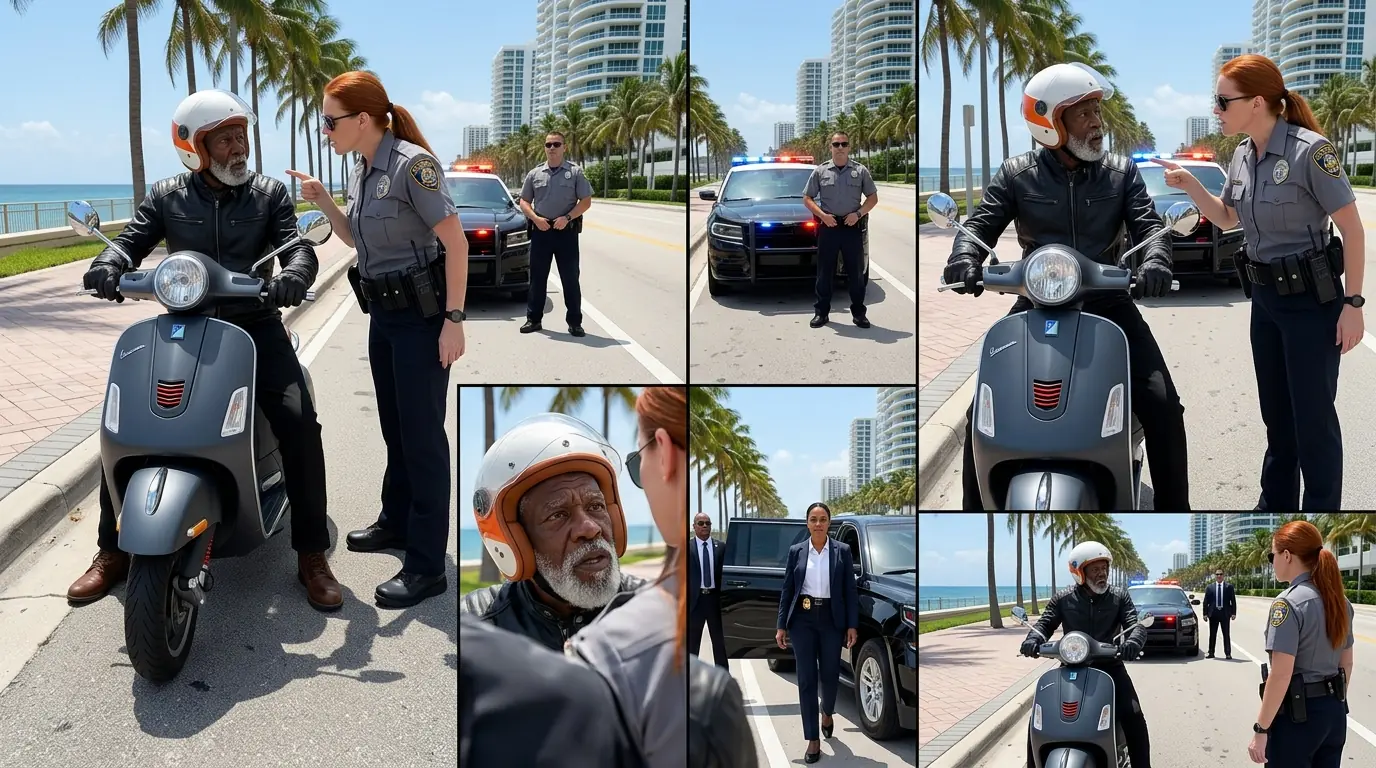
“Turn the engine off and get off the scooter.”
Walter Hayes heard every word through the open visor of his helmet, but he waited half a second before moving. To his right, the Atlantic flashed bright blue between rows of palms, beachfront hotels, and white condominium towers along Fort Lauderdale’s coastal boulevard. The graphite-gray Vespa beneath him had fewer than two hundred miles on it and was still so new that Walter sometimes caught himself smiling whenever the engine started.
He turned toward the officer standing beside him.
She pointed toward the scooter.
“Off.”
Walter shut down the engine.
“Am I being detained?”
The question changed her face.
Not dramatically.
Just enough.
Officer Megan Price was probably somewhere in her late thirties, fit, fair-skinned, with auburn hair pulled into a tight knot beneath her patrol cap. Her dark sunglasses reflected Walter, the scooter, and the line of morning traffic slowing behind them. A body camera blinked red against the center of her uniform.
“Yes.”
Walter placed both boots on the pavement.
“For what?”
“Step away from the bike first.”
“It’s a scooter.”
Her mouth tightened.
“Step away from the vehicle.”
Walter did.
He was seventy years old, six feet tall, deep-brown skin, close-cropped silver hair beneath the helmet, and a neatly trimmed gray beard that had turned almost completely white during the year after his wife died. He wore a black perforated riding jacket, dark jeans, brown boots, and gloves designed for far more serious riding than his little Italian scooter would ever require.
Price studied him.
Then the Vespa.
Then him again.
“Registration.”
Walter pointed toward the storage compartment beneath the seat.
“It’s inside.”
“Open it.”
He reached.
Her right hand moved immediately toward the holster on her belt.
“Slow down.”
Walter stopped.
“You asked me to open it.”
“I told you to move slowly.”
He waited.
She gave a small nod.
Walter unlocked the storage compartment and removed a flat leather document case containing his license, registration, insurance card, and the purchase receipt he had not yet bothered removing.
He handed it over.
Price looked at the registration first.
Then the license.
WALTER JAMES HAYES.
Fort Lauderdale address.
Seventy years old.
She looked toward the scooter.
“This belongs to you?”
Walter glanced at the registration in her hand.
“That’s what Florida says.”
Her expression hardened.
“Don’t get sarcastic.”
“I answered you.”
A younger male officer stood near the cruiser’s passenger side.
His name tag read OWENS.
Walter saw the smallest movement at the corner of the man’s mouth.
Price saw it too.
“This scooter is six days old,” she said.
“Yes.”
“You bought it?”
Walter looked at her.
“Yes.”
“From where?”
“Broward Motorsports.”
“You have proof?”
“You’re holding the registration.”
“That only tells me what paperwork says.”
Walter became very still.
Not afraid.
Attentive.
He had spent nearly four decades learning that distinction.
Fear made people hurry.
Attention made them remember exact words.
“You ran the plate before you approached me?”
Price stared.
“Yes.”
“And whose name came back?”
She did not answer.
Walter waited.
Price lowered the registration.
“These scooters get stolen.”
“Was this one reported stolen?”
“No.”
“Was the plate?”
“No.”
“Did the VIN return any problem?”
“I haven’t checked the VIN yet.”
Walter nodded toward the Vespa.
“Please do.”
Price ignored the invitation.
“You changed lanes without signaling.”
Walter looked back toward the intersection.
“I signaled.”
“No, you did not.”
“The scooter logs basic ride data through the manufacturer application.”
Price stared.
“What are you talking about?”
“Turn signal use is part of the ride telemetry.”
She laughed once.
“You’re telling me your scooter has a black box now?”
“I’m telling you the indicator activation can be checked.”
Price stepped closer.
“You trying to argue a traffic stop with an app?”
“No.”
Walter looked toward her chest.
“I’m saying your camera, the traffic camera at Seventeenth Street, and the vehicle log can settle it.”
Officer Owens looked away.
Price’s jaw tightened.
“You got an answer for everything?”
“Not everything.”
Walter’s voice stayed polite.
“Mostly the things you keep asking me.”
Price removed her sunglasses.
Her eyes were pale green.
“Put your hands on the seat.”
Walter did not move.
“Why?”
“Officer safety.”
“Have I threatened you?”
“Hands on the seat.”
Walter looked directly at the body camera.
Then complied.
That mattered.
Not because he agreed.
Because his question now existed on the recording before obedience did.
Walter placed both gloved palms on the Vespa seat.
Price walked behind him.
“Weapons?”
“No.”
“Drugs?”
“No.”
“Prescription narcotics?”
“No.”
“Large amount of cash?”
Walter’s expression changed.
That question was different.
He turned his head slightly.
“What does cash have to do with a lane-change stop?”
“Face forward.”
Walter did.
The sound of the ocean seemed louder for a moment.
Large amount of cash?
He knew that phrase.
Not because police had ever asked him personally.
Because he had read it repeatedly during the previous month.
Seven complaints sat inside a federal working file Walter had reviewed.
Six involved Black motorists.
One involved a Colombian-American restaurant owner.
All had been stopped within a twelve-mile stretch of South Florida coastal roads.
Five drivers had been asked about cash before any search occurred.
Four vehicles were searched.
Three motorists had money seized under suspicion that the currency represented drug proceeds.
No narcotics were found in any of those cases.
No criminal charges followed.
Only one driver had received all of his money back.
Walter kept his voice even.
“I have ordinary personal belongings.”
Price stopped behind him.
“How much cash?”
“That is not relevant.”
“It becomes relevant if I suspect criminal activity.”
“What criminal activity?”
She stepped into his peripheral vision.
“You seem nervous.”
Walter almost smiled.
“A minute ago I was argumentative.”
“You’re both.”
“What am I nervous about?”
“You tell me.”
Walter looked straight ahead.
“I’m nervous that a turn-signal allegation somehow became a conversation about whether I have cash.”
Price’s face hardened.
“Open the storage compartment again.”
“No.”
Owens looked over.
Price seemed almost surprised.
“What did you say?”
“I do not consent to a search.”
“I did not ask for consent.”
“You told me to open a compartment containing personal property.”
“I’m investigating.”
“A turn signal?”
“Vehicle theft.”
“The plate cleared.”
“Paperwork can be fraudulent.”
“Check the VIN.”
“We will.”
Walter nodded.
“Good.”
Price took another step toward him.
“Open it.”
“No.”
“You are interfering with a lawful investigation.”
Walter’s voice remained calm.
“No.”
“You keep refusing instructions.”
“I followed every safety instruction.”
“You’re not cooperating.”
Walter looked toward Owens.
“What does cooperation require?”
Owens shifted uncomfortably.
“Sir, just make this easy.”
“I am making it easy.”
Price laughed.
“You think this is easy?”
“I handed over every document requested.”
Walter looked toward her.
“The part you don’t like is that I am asking why.”
Price lowered her voice.
“You want to go to jail today?”
“No.”
“Then stop talking.”
Walter stopped.
The silence seemed to bother her even more.
People who depended on reaction often did not know what to do when someone simply waited.
Price studied the Vespa again.
Walter understood why it caught attention.
It was a beautiful machine.
Metallic graphite paint.
Brown leather seat.
Chrome trim.
Touring windshield.
Rear storage box.
Everything Walter had told himself for years he did not need.
His wife, Evelyn, used to complain that he treated enjoyment like an audit finding.
“You save money like every dollar might testify against you later,” she once told him.
They had been married forty-five years.
Evelyn died sixteen months earlier.
Pancreatic cancer.
Seven months from diagnosis to funeral.
Afterward, Walter spent months moving through their Fort Lauderdale condo as though every room were a museum dedicated to routines that no longer worked.
One afternoon, while sorting photographs, he found a picture from their honeymoon.
Florence.
Walter, twenty-five years old, sitting on a rented Vespa.
Evelyn behind him, both arms around his waist, laughing so hard her eyes were nearly closed.
On the back she had written:
When we’re old, buy one of these and stop being responsible for ten minutes.
Three weeks later, Walter bought the scooter.
Not because he wanted to feel twenty-five.
Because grief had taught him that postponing harmless joy was a terrible financial strategy.
Now Officer Price stared at the Vespa as though the machine and the man standing beside it required reconciliation.
“How much was it?”
Walter remained silent.
She snapped her fingers.
“I asked you something.”
“You instructed me to stop talking.”
Owens coughed into his hand.
Price turned sharply.
“Problem?”
“No, ma’am.”
She looked back at Walter.
“How much did you pay?”
“A little over ten thousand with accessories.”
Her eyebrows rose.
“You finance it?”
“No.”
“Paid cash?”
“I used a bank transfer.”
“You paid in full?”
“Yes.”
“With what income?”
Walter slowly turned his head.
“My own.”
Price smiled.
“There.”
Walter frowned.
“What?”
“That attitude.”
He almost felt sorry for her.
She was treating resistance as evidence because facts had stopped cooperating.
A second patrol cruiser approached.
It stopped behind the first.
Two officers stepped out.
Walter’s concern rose.
Not because there were now four officers.
Because the stop was expanding while the stated reason kept changing.
He looked toward Price.
“Am I free to go?”
“No.”
“What offense are you currently investigating?”
“Possible vehicle theft.”
“The registration cleared.”
“VIN hasn’t.”
Walter nodded.
“Run it.”
Price gestured toward Owens.
He crouched beside the scooter and read the VIN into his radio.
Dispatch responded quickly.
Valid.
Registered to Walter James Hayes.
Purchase record confirmed.
No theft report.
No insurance problem.
Walter waited.
Price looked toward the ocean.
“Am I free to leave?”
“No.”
“Why?”
She turned.
“I have concerns narcotics may be involved.”
Owens stared at her.
“Megan.”
She ignored him.
Walter’s expression barely moved.
“What fact created that concern?”
“Your behavior.”
“What behavior?”
“Your excessive nervousness.”
“You already described me as argumentative.”
“Those aren’t mutually exclusive.”
“No.”
Walter nodded.
“But neither is evidence of narcotics.”
Price stepped close enough that Walter could smell coffee on her breath.
“Enough.”
He stopped talking.
She pointed toward the Vespa.
“Open the compartment.”