Officer Grant Keller put his hand on twelve-year-old Jordan Brooks’s shoulder and pushed his face straight into the birthday cake.
For half a second, nobody moved.
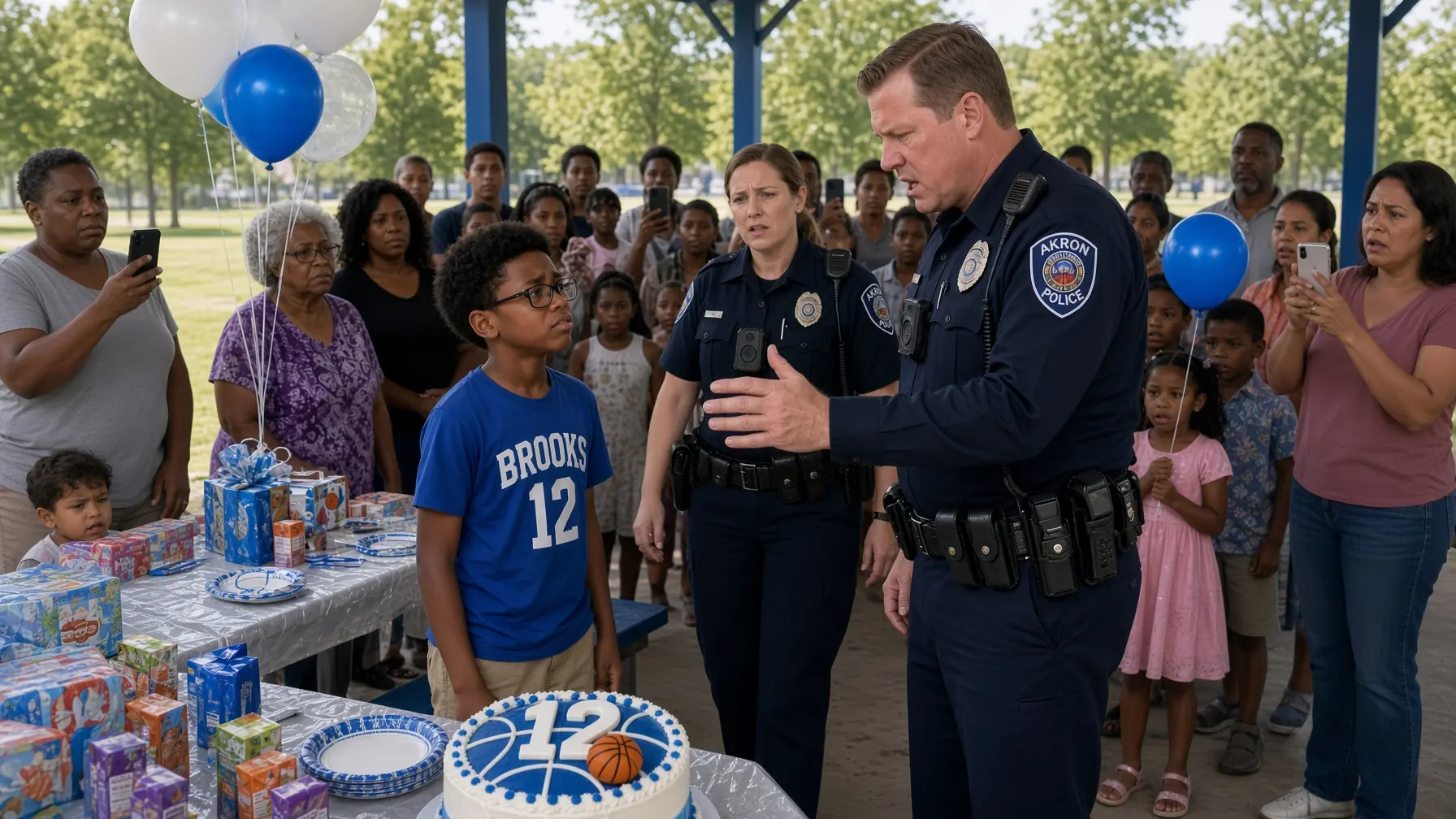
Not the children gathered beneath the blue picnic pavilion.
Not the mothers standing beside the coolers.
Not the two teenage cousins holding balloons.
Not even Keller’s younger partner, who had been standing ten feet away with his mouth already open to say something.
Jordan came back up with white frosting covering his nose, one cheek, and the front of his glasses.
The cake slid sideways across the plastic tablecloth.
A blue candle rolled onto the pavement.
One of the little girls screamed.
Another child started crying.
And Officer Keller said:
“Maybe now you’ll learn to listen when an adult tells you something.”
Jordan stared at him.
He did not cry.
That somehow made the scene worse.
He stood there with frosting dripping from his chin, breathing hard, looking less embarrassed than stunned.
Then somebody behind the officer said:
“Take your hand off my son.”
The voice was quiet.
Keller turned.
A tall Black man in jeans and a dark quarter-zip was walking across the grass toward the pavilion.
He carried a paper grocery bag in one hand.
A folded city park reservation permit in the other.
He was forty-four years old.
Broad-shouldered.
Gray beginning at the edges of his beard.
His name was Marcus Brooks.
And the instant Jordan saw him, everything he had been holding inside broke.
“Dad.”
Marcus dropped the grocery bag.
Ice spilled across the grass.
He did not run.
He did not shout.
He simply kept walking.
Officer Keller raised one hand.
“Sir, stay back.”
Marcus looked at the frosting on Jordan’s face.
Then at Keller’s hand still resting on the boy’s shoulder.
“I said take your hand off my son.”
Something in his voice finally reached Keller.
He removed it.
But by then, nearly every phone beneath that pavilion was recording.
And none of the people standing there yet understood why the officer’s younger partner had suddenly gone pale.
Three minutes earlier, it had been an ordinary birthday party.
Jordan Brooks turned twelve on a warm Saturday in May.
His father had reserved Pavilion Four at Emerson Park from noon until four.
The park sat near the edge of Brookhaven, a prosperous suburb outside Columbus, Ohio, where wide bike trails wound past baseball fields, small ponds, and playgrounds built from expensive recycled materials.
Marcus had chosen the park because Jordan loved basketball.
There were two courts twenty yards from the pavilion.
A playground for the younger children.
Enough open grass for the football Jordan’s uncle brought.
Nothing complicated.
Twenty-three guests.
Most of them family.
Ten children.
Several parents.
Jordan’s grandmother Denise.
His aunt Keisha.
Two cousins in high school.
One chocolate-and-vanilla sheet cake decorated with a basketball and the number twelve.
Marcus had paid the reservation fee three weeks earlier.
The permit sat folded in his pocket for most of the afternoon.
At 1:37, Denise realized they were almost out of ice.
Marcus took the empty cooler to his SUV.
The extra bags were inside a grocery sack near the rear cargo area.
He expected to be gone less than five minutes.
That was when Officer Grant Keller arrived.
The call itself was not dramatic.
A resident walking near the tennis courts had contacted the non-emergency line about “a large group of teenagers being loud around Pavilion Four.”
The caller mentioned music.
Possibly alcohol.
No fight.
No weapons.
No property damage.
The dispatcher asked whether the group was threatening anyone.
The caller said no.
Asked whether the pavilion appeared reserved.
The caller did not know.
The call was coded as a low-priority park disturbance.
Officer Emily Ross was driving.
Keller sat in the passenger seat.
Ross had been on patrol for nineteen months.
Keller had been with Brookhaven Police for sixteen years.
He was her field-training officer that month.
When they turned into the parking lot, Ross saw balloons first.
Then streamers.
Then children.
“Birthday party,” she said.
Keller looked through the windshield.
“Maybe.”
Ross glanced at him.
There were several Black teenagers near the basketball court.
A few younger children running between picnic tables.
Adults under the pavilion.
Music playing from a small Bluetooth speaker.
Nothing Ross could see looked remotely like a fight.
Keller opened his door.
“Let’s shut it down.”
Ross paused.
“Shut down what?”
“The disturbance.”
“We can just talk to whoever reserved it.”
Keller looked at her.
“That’s what I said.”
It was not.
But Ross had already learned that correcting Keller directly usually made the next hour longer.
They walked toward the pavilion.
Jordan saw the uniforms first.
He had been carrying a stack of paper plates toward the cake table.
His aunt Keisha lowered the music.
“Can I help you, officers?”
Keller did not answer her.
He looked across the pavilion.
“How old are these kids?”
Keisha frowned.
“Different ages.”
“Who’s responsible for them?”
“Several of us.”
“Who reserved the pavilion?”
“My brother.”
“Where is he?”
“At the parking lot getting ice.”
Keller looked toward the basketball court.
Two boys had stopped playing.
One held the ball against his hip.
Keller raised his voice.
“Everybody over here.”
The boys looked at each other.
Keisha said:
“They're part of the party.”
“I said everybody over here.”
Ross glanced at Keller.
“Sir, ma’am, we received a noise complaint.”
Keisha nodded.
“Okay. We can turn the music down.”
“It’s already down,” Ross said.
Keller looked at her.
Ross stopped talking.
Jordan placed the plates on the table.
“Dad has the permit.”
Keller’s eyes moved to him.
“What?”
“My dad reserved this pavilion.”
“I wasn't talking to you.”
Jordan became quiet.
Keisha stepped between them slightly.
“He's right. Marcus has the reservation.”
Keller looked around.
Several children were staring.
“There have been complaints about a group causing problems.”
Keisha frowned.
“What problems?”
“Noise. Possible alcohol.”
Jordan’s grandmother opened one cooler.
Juice boxes.
Water.
Soda.
“Would you like to inspect our dangerous Capri Suns?” Denise asked.
Keisha whispered:
“Mom.”
Keller did not smile.
“Let's not get cute.”
Denise’s expression changed.
“I’m seventy-one years old. I’m standing at my grandson’s birthday party.”
“And I'm responding to a complaint.”
“Then respond to it.”
“I am.”
“No.”
Denise pointed toward the speaker.
“You said noise. We turned it down.”
She gestured toward the coolers.
“You said alcohol. There isn't any.”
Then toward the children.
“What exactly are you still investigating?”
Ross looked down.
Keller looked at Denise.
“I'm investigating whether you're authorized to use this pavilion.”
Keisha said:
“We are.”
“Show me the permit.”
“Marcus has it.”
“Then until Marcus gets back, I can't verify that.”
Jordan spoke again.
“He'll be here in a minute.”
Keller turned sharply.
“Boy, I told you once not to interrupt me.”
Jordan’s face tightened.
His cousin Malik, fourteen, stepped closer.
“He was just telling you—”
Keller pointed.
“You. Sit down.”
Malik stared.
“What?”
“Sit.”
Keisha said:
“He doesn't have to sit because you don't like him talking.”
That changed Keller’s posture.
His shoulders came forward.
His voice became lower.
“Ma’am, I need you to stop interfering.”
Ross tried again.
“Officer Keller, I can check the pavilion reservation through dispatch.”