At 3:26 on a bright Tuesday afternoon, Officer Harold Briggs grabbed Nia Carter by the upper arm and told her to stop acting like she had choices.
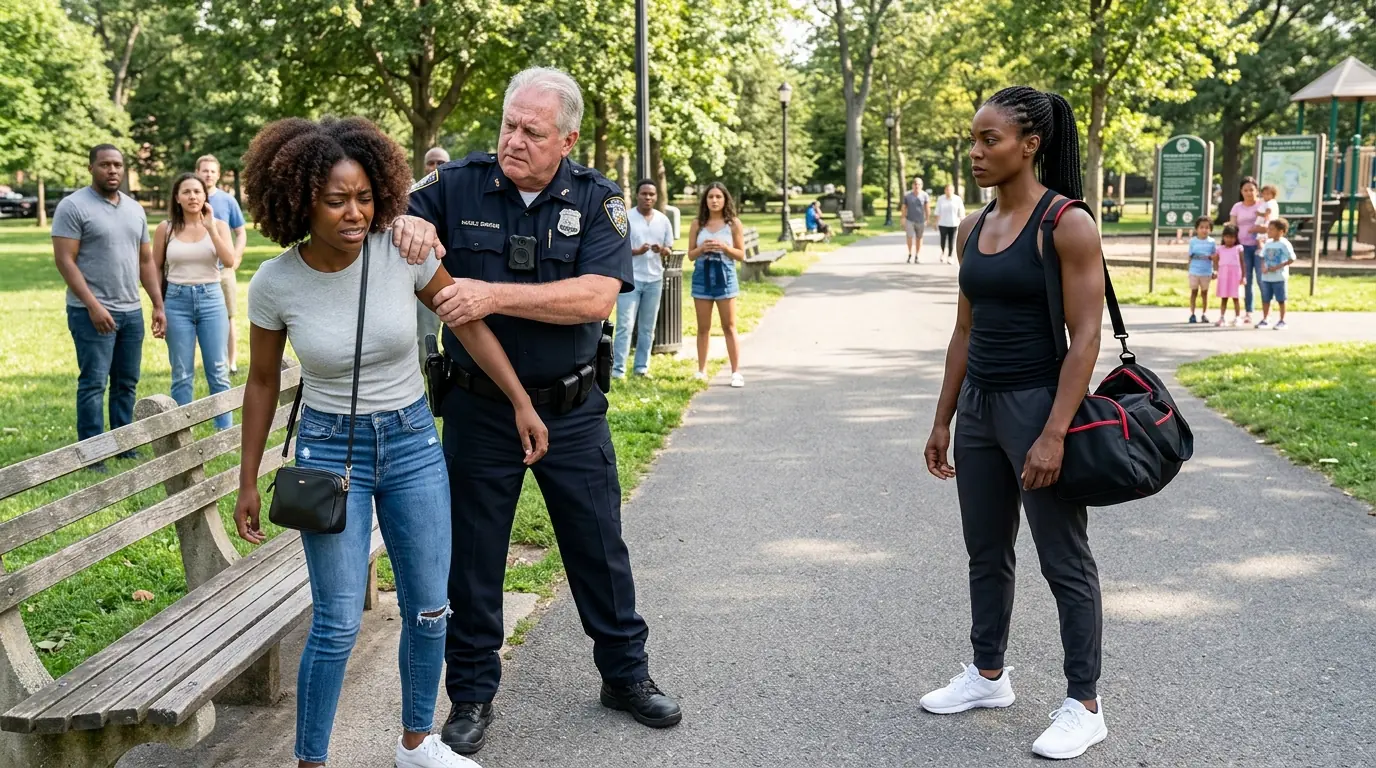
Nia had been sitting on a wooden bench in Riverside Park for eleven minutes.
That was all.
She had not been drinking.
Had not been yelling.
Had not been fighting.
Had not damaged anything.
She was twenty-four years old, wearing jeans, white sneakers, and a green T-shirt under a light jacket. A paper cup of iced coffee sat beside her. Her small crossbody bag rested on her lap.
She had come to the park because her apartment felt too quiet.
Three weeks earlier, Nia had lost her job at a dental office after the practice closed unexpectedly. That morning, she had finished another interview and did not want to go home yet.
So she bought coffee.
Sat near the fountain.
And called her older sister.
The call lasted four minutes.
Then Nia put in one earbud and watched people move along the path.
Joggers.
Parents with strollers.
A man throwing a tennis ball for a golden retriever.
Nothing unusual.
Until Officer Harold Briggs entered the park.
Briggs was fifty-eight and had been a police officer for twenty-seven years.
Gray hair.
Heavy shoulders.
A lined face that made him look permanently annoyed.
People who worked with him often called him “old school.”
Sometimes that meant experienced.
Sometimes it meant impatient.
With Briggs, it usually meant both.
He had been dispatched to Riverside after someone called about a woman arguing near the east parking lot.
The caller described her as young, wearing dark clothing, possibly intoxicated.
By the time Briggs arrived, the woman involved in the argument was gone.
So was the man she had apparently been arguing with.
Briggs drove slowly through the park.
Then he saw Nia.
Young woman.
Alone.
Near the east side.
Wrong shirt color.
Wrong location by almost two hundred yards.
But close enough for a man who had already decided he had found his problem.
He stopped beside the path.
“Hey.”
Nia looked around.
Briggs pointed at her.
“You.”
She removed one earbud.
“Me?”
“Stand up.”
Nia blinked.
“Why?”
Briggs’s expression changed immediately.
“Stand up.”
She looked behind him.
No one else.
“Officer, did I do something?”
“That’s what I’m trying to find out.”
Nia stood slowly.
Her coffee remained on the bench.
“Do you have ID?”
“Yes.”
“Give it to me.”
She reached toward her bag.
Briggs’s right hand immediately moved near his belt.
“Slow.”
Nia stopped.
“You just told me to get it.”
“Then get it without being stupid.”
Her face changed.
“Excuse me?”
“There it is.”
“What?”
“The attitude.”
Nia stared at him.
She felt something familiar and dangerous begin forming.
Not necessarily because of the badge.
Because of the rhythm.
Question.
Command.
Question about command.
Accusation of attitude.
She had seen videos like this.
Her father had talked to her about encounters like this before she was old enough to drive.
Keep your hands visible.
Speak clearly.
Do not match anger with anger.
So Nia inhaled slowly.
“My wallet is inside the front pocket.”
Briggs nodded.
“Get it.”
She did.
He took the license.
“Nia Carter.”
“Yes.”
“Where do you live?”
“Three blocks from here.”
“What are you doing in the park?”
“Sitting.”
Briggs looked up.
“Don’t get smart.”
“I’m answering.”
“Why are you here?”
“I had an interview nearby.”
“What kind of interview?”
Nia frowned.
“Why does that matter?”
Briggs lowered the license.
“You were reported causing a disturbance.”
Her eyes widened.
“I wasn’t.”
“Someone says otherwise.”
“Who?”
“Doesn’t concern you.”
“What did they say I did?”
Briggs stepped closer.
“Were you arguing with a man in the parking lot?”
“No.”
“You sure?”
“Yes.”
“Have you been drinking?”
“No.”
“Drugs?”
“No.”
Nia gave a short, nervous laugh.
Not because anything was funny.
Because the questions had become absurd.
That laugh was a mistake.
Briggs interpreted it as disrespect.
“What’s funny?”
“Nothing.”
“You think I’m wasting your time?”
“I think you have the wrong person.”
His face hardened.
“I’ll decide that.”
Several feet away, a cyclist slowed.
An older man walking his dog looked over.
Nia noticed them.
Briggs noticed her noticing.
“Eyes here.”
She looked back.
“Am I being detained?”
That was the question that changed everything.
Briggs had heard it hundreds of times.
From lawyers.
From teenagers.
From people who watched police videos online.
He hated it.
Not the legality of it.
The challenge.
The implication that someone else believed they were entitled to define his authority.
“You’re not going anywhere.”
Nia swallowed.
“So I am detained?”
Briggs stepped closer.
“I told you not to play games.”
“I’m not playing games.”
“Put your bag down.”
“Why?”
“Bag. Down.”
Nia placed it on the bench.
“Turn around.”
Her breathing changed.
“What?”
“Turn around.”
“Officer, I haven’t done anything.”