Officer Carl Redding had spent nineteen years believing his badge made him bigger than the people standing in front of him.
That belief showed in the way he walked.
It showed in the way he leaned into car windows before asking questions.
It showed in the way shop owners on Market and Seventh lowered their eyes whenever his cruiser rolled by.
On a bright Tuesday morning in Lakeford’s financial district, that belief finally caught up with him.
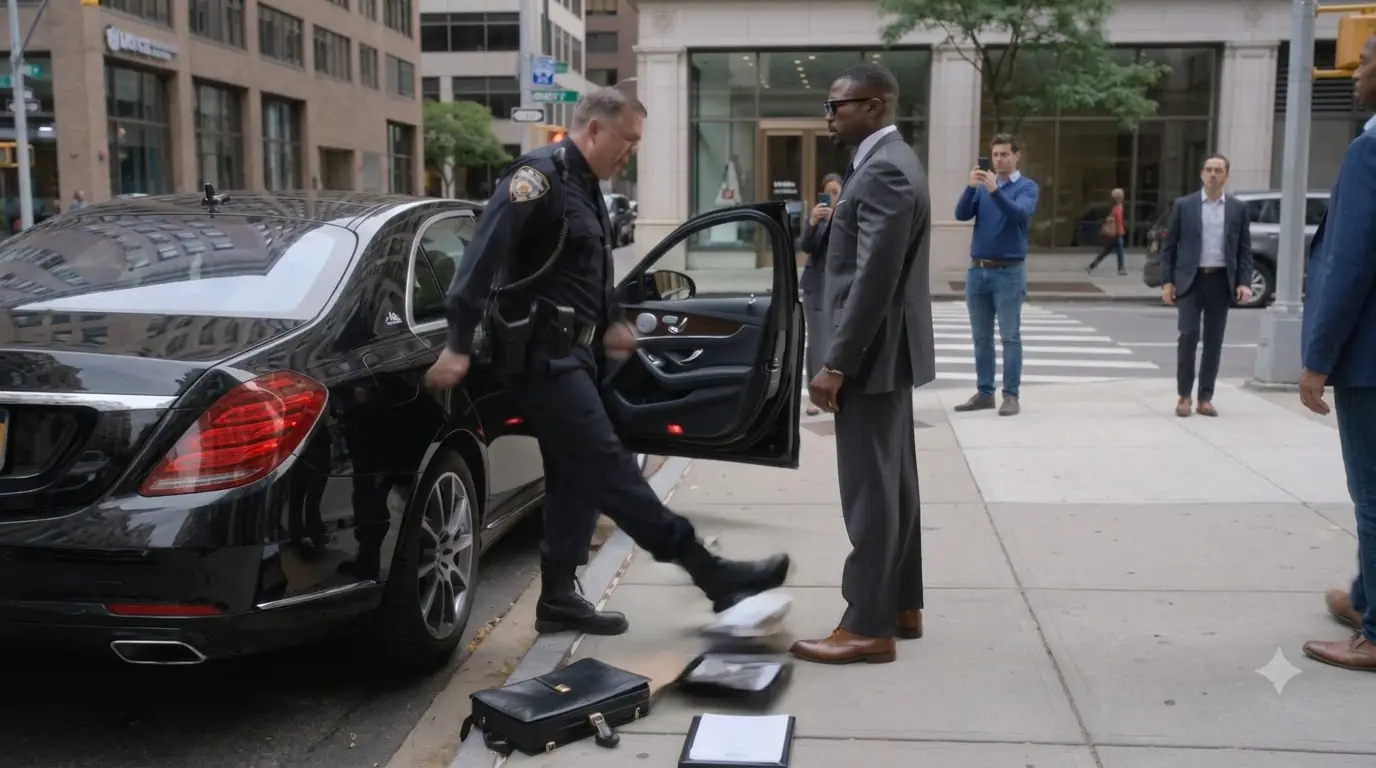
Redding stood beside a black Mercedes sedan, one hand on his belt, the other still hanging loose after striking the man in front of him. The slap had been loud enough to stop traffic. A delivery cyclist braked so hard his back tire lifted. A woman carrying coffee froze with the cup halfway to her mouth.
The man Redding had slapped stood near the curb in a charcoal suit, dark tie, and polished brown shoes.
His sunglasses lay broken on the sidewalk.
A thin line of blood marked the corner of his mouth.
His cheek had already begun to swell, a red handprint blooming against deep brown skin.
Redding smiled like a man pleased with his work.
“That’s what happens when people forget where they are,” he said.
The crowd went still.
No one needed him to say what he meant by people.
Everyone heard it anyway.
The man in the suit slowly lifted a white handkerchief and touched it to his lip. He did not curse. He did not swing back. He did not even step away.
He looked at the officer’s badge, read the number, and spoke in a voice so calm it made the slap seem even uglier.
“Officer Carl Redding. Badge 3186.”
Redding’s smile widened.
He thought the man was trying to scare him with formal language.
He had heard that tone before from Black professionals who believed degrees, suits, salaries, or careful grammar might protect them from a man like him. Redding enjoyed reminding them otherwise. In his world, power did not come from education. It came from who could put hands on whom and still go home with a pension.
What he did not know was that the man bleeding on the sidewalk was Dr. Elijah Mercer.
And Dr. Elijah Mercer was supposed to begin his first day as Lakeford’s new chief of police in less than fifteen minutes.
Thirty minutes earlier, Elijah had stood in front of the mirror in room 1704 of the Kingsley Hotel, adjusting the cuffs of his shirt.
The room overlooked downtown Lakeford, a city of glass towers, old brick neighborhoods, river bridges, and police scandals that had aged faster than the buildings around them. On the desk behind him rested a leather credential case, a printed briefing packet, and a framed photograph of his mother standing outside a small church in Birmingham, smiling like she already knew her son would outgrow every room that underestimated him.
Elijah was forty-nine, tall, composed, and tired in the way reformers become tired when every victory requires dragging an institution toward its own stated values.
He had worn a uniform for twenty-four years.
Started as a patrol officer in Mason County.
Worked nights while earning his master’s degree.
Completed a doctorate in public safety leadership.
Led two federal reform teams.
Helped rebuild one department after a corruption scandal and another after a consent decree nearly swallowed it whole.
Lakeford had recruited him because the department had become impossible to defend.
Too many complaints.
Too many body cameras mysteriously disabled.
Too many settlements paid quietly.
Too many citizens, especially Black and Latino citizens, saying the same names over and over while the department claimed it found no pattern.
One of those names was Carl Redding.
Elijah had read the file the night before.
Seventeen citizen complaints in twelve months.
Forty-one use-of-force reports in three years.
Six civil claims settled without admission of wrongdoing.
Three teenagers injured during stops that began with vague suspicion and ended with rewritten reports.
Redding’s supervisors described him as firm, old-school, and highly experienced.
Elijah knew those words.
They were often the soft blanket placed over cruelty so institutions could sleep at night.
He slipped the credential case into his inside jacket pocket.
The gold shield inside was new.
Chief of Police.
Lakeford Police Department.
The title felt less like an achievement than a warning.
He was not coming to Lakeford to be celebrated.
He was coming to cut infection out of an institution that had spent years calling the wound a misunderstanding.
He left the hotel at 8:12.
The Mercedes was waiting in the parking garage.
His driver had called in sick that morning, and Elijah chose not to replace him. He wanted one quiet drive before the meetings began. One ordinary stretch of city before cameras, introductions, department politics, union resistance, and the private resentment of men who believed reform meant disrespect.
Classical guitar played softly through the speakers as he pulled onto Market Street.
At the same time, Officer Carl Redding sat in Unit 19 outside a coffee shop on Seventh.
He watched the morning crowd with a predator’s boredom.
Redding knew this corner better than most people knew their own kitchens. He knew which shop owners would stay quiet. He knew which office workers would look uncomfortable but keep walking. He knew which delivery drivers could be pushed and which young men would mouth off just enough to justify force on paper.
His body camera was off.
It had been off most of the morning.
He called it battery management.
Others called it convenient.
Dispatch crackled over the radio.
“Unit 19, routine patrol near Market and Seventh. Reminder, new chief arrival today. Keep district clear.”
Redding rolled his eyes.
“Copy.”
New chief.
Outside reformer.
Academic type.
Probably another polished speaker with soft hands and big ideas about community trust. Redding had survived chiefs before. He had survived oversight boards, policy memos, sensitivity training, public outrage, and three mayors who promised accountability in front of cameras, then let the union clean up the details.
He sipped his coffee and watched a black Mercedes drift across the lane marker to avoid a pothole.
Two seconds.
No danger.
No crash.
No real violation worth anyone’s time.
Redding smiled.
“Got you.”
He hit the lights.
Elijah saw the cruiser in his mirror and breathed once through his nose.
He had been stopped many times in his life.
Sometimes for real reasons.
Often for the invisible offense of being a Black man in a car someone thought looked too expensive for him. He knew the routine before the cruiser door opened. Hands visible. Window down. Voice calm. No sudden movements. Give no performance they can edit into threat.
He pulled over directly in front of Delia’s Phone Repair.
That was intentional.
A visible place.
A public place.
A place with cameras.
Delia Alvarez, the shop owner, looked up from unlocking the front gate.
Her heart sank when she saw Redding’s cruiser.