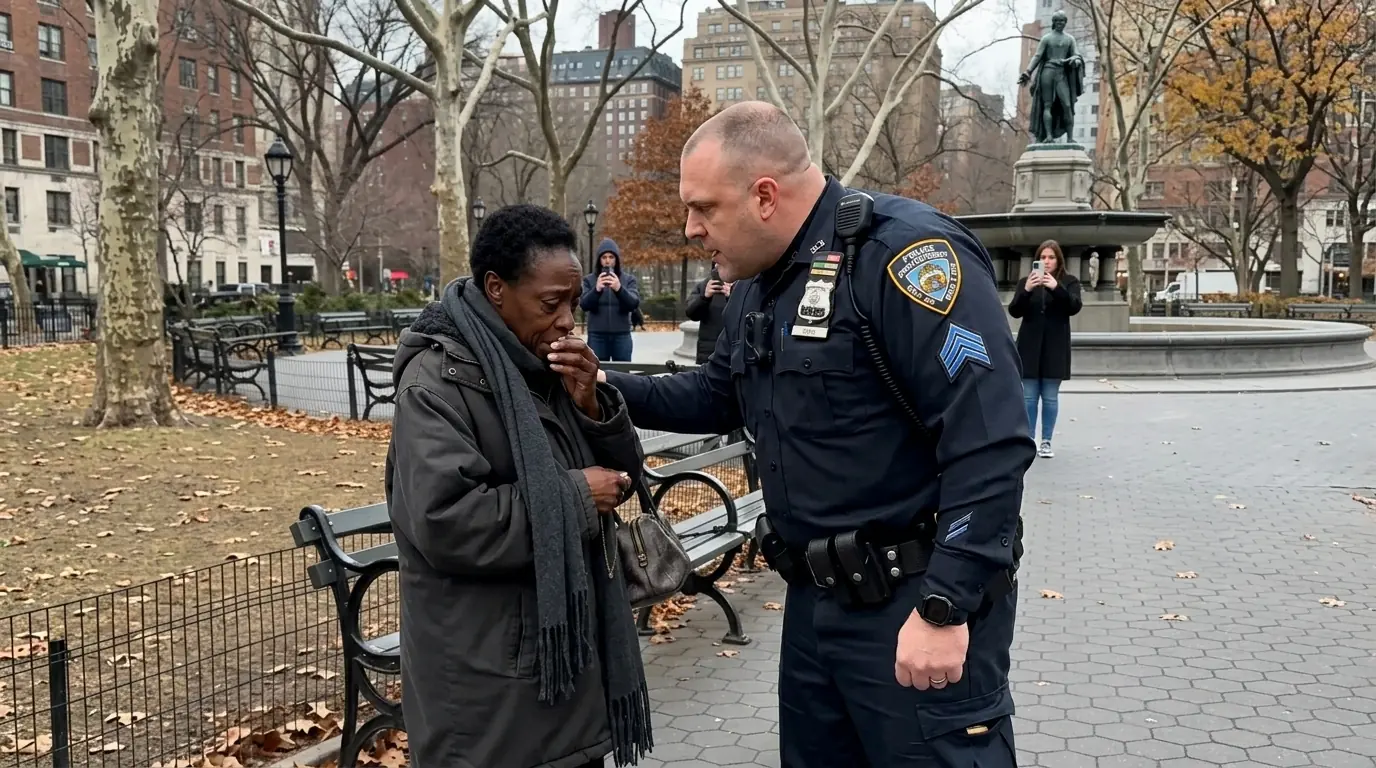
The slap cracked through the park like a branch breaking in winter.
For one second, nobody moved.
Not the jogger standing near the fountain with one foot still raised behind him. Not the woman holding two leashes and a paper cup of coffee. Not the old man at the chess table who had been pretending not to watch. Not the coffee vendor near the north gate, whose hand froze halfway over a row of paper lids.
Officer Nolan Briggs stood in front of the woman on the bench with his hand still hanging in the air.
The woman did not scream.
She did not fall.
She simply touched her cheek with two fingers, as if confirming the body still belonged to her, then looked down at the thin silver necklace that had snapped from her neck and landed in the gravel near her shoes.
Her notebook lay open on the bench beside her.
A page trembled in the cold wind.
Officer Briggs stepped closer.
“Pick up your things and move,” he said. “I’m tired of seeing people like you treat this park like a shelter.”
The woman looked up at him slowly.
Her cheek was already turning red.
“You have made a very serious mistake,” she said.
Her voice was quiet.
Too quiet for a threat.
Too steady for fear.
Briggs laughed because men like him often laugh at the last warning they will ever receive.
Central Park West was not Central Park, though tourists made that mistake sometimes. It was a smaller municipal park in the middle of Fairmont City, tucked between government buildings, luxury apartments, coffee shops, and an old stone library with lions carved over the entrance. In warmer months, it filled with office workers eating salads from plastic bowls and children chasing pigeons with the solemn mission of tiny emperors.
But this was late November.
The morning was gray, and cold had settled into every bench, railing, and fountain stone.
The woman on the third bench from the fountain had been there before sunrise.
She wore a coat too large for her narrow shoulders, fingerless gloves, dark boots with worn soles, and a knit cap pulled low over her curls. A leather notebook rested against her knees, cracked from use and swollen at the edges from rain. She wrote in it every morning, small careful handwriting moving across the page with the discipline of someone making a record, not a memory.
Most people thought she was homeless.
Some thought she was unstable.
A few thought she was harmless and therefore invisible.
Her name was Amara Vale.
She was thirty-five years old.
And for three years, she had been the city’s most carefully protected secret.
Nobody in the park knew that.
Leon Porter knew only that she liked black coffee.
Leon ran the coffee cart near the north gate. He was sixty-two, widowed, and had worked that corner long enough to know who tipped, who stole napkins, who pretended not to see the old men sleeping under the library overhang, and who gave kindness only when there was an audience for it.
Amara had never asked him for money.
That was one of the first things he noticed.
She never held out a cup. Never blocked the path. Never approached strangers. Every morning, she sat on the same bench with the same notebook, writing down whatever the city revealed before it had finished waking up.
One morning, Leon brought her coffee because it was cold enough that pity felt useless without action.
She looked at the cup.
Then at him.
“Thank you, Mr. Porter.”
He had never told her his last name.
That should have surprised him more than it did.
“How’d you know that?” he asked.
She nodded toward his cart license taped near the register.
“People rarely read what is placed in plain sight.”
Leon laughed.
After that, he brought her coffee most mornings.
No charge.
He learned small things.
She spoke politely, almost formally. She remembered the names of delivery workers, street sweepers, public gardeners, and unhoused people who moved through the park in shifting patterns depending on weather, patrol schedules, and pride. She never wasted food. She folded every napkin before throwing it away. She could give directions to any courthouse, clinic, shelter, subway entrance, bus line, or government office within a five-mile radius.
Once, a woman from Ohio asked for help finding the state records building.
Before Leon could answer, Amara looked up from her notebook and said, “Two blocks east, one block south, north entrance only after nine. Security line is shorter if you use the side door by the loading dock.”
The tourist thanked her.
Amara went back to writing.
People had theories about her.
The chess players thought she used to be a teacher.
A groundskeeper named Felix thought she had worked for the city once.
Curtis, an older man who slept near the bandstand when the shelter filled up, swore she looked like someone from the news, but he could never remember who.
“She got old eyes,” Curtis told Leon one morning.
“She’s thirty-something.”
“I didn’t say old face,” Curtis said. “I said old eyes.”
Amara heard that and smiled faintly, but she did not correct him.
Her notebook held everything.
Not secrets in the dramatic sense.
No spy codes.
No grand confession.
Just names, dates, patterns, small cruelties, and smaller mercies.
Officer spoke roughly to man near fountain. Man obeyed. Officer searched bag without consent.
Teenage boy gave gloves to woman by library steps. Did not wait to be thanked.
City worker removed blankets from pavilion during rain. Four people displaced.
Woman in red coat bought soup for Curtis. Curtis cried after she left.
Patrol car circled twice. No interaction.
Leon Porter refused payment from elderly veteran. Claimed coffee had already gone cold.
Amara wrote the city as it was when nobody believed it mattered.
That was the point.
Three years earlier, Amara Vale had not sat on benches in oversized coats.
She had stood behind podiums.
She had worn sharp suits, controlled her voice in televised hearings, and become one of the most recognizable civil rights attorneys in the country before the age of thirty-two. Her father, Senator Elias Vale, had been preparing to run for president. Her mother had been a federal judge. Her older brother ran a nonprofit housing fund.
The Vale family did not merely know power.
They lived inside its machinery.
Then Amara disappeared.
The official story said exhaustion.
A private retreat.
Medical leave.
The unofficial stories were worse.
Addiction.
Breakdown.
Family scandal.
Some said her father had hidden her away because she had become inconvenient. Some said she had run from a life that never allowed her to breathe. Some said she had lost her mind after a federal investigation into city shelters collapsed under political pressure and three witnesses vanished back into the streets before they could testify.
The truth was quieter.
Amara went where testimony was disappearing.
She went to live close enough to hear it before fear swallowed it.
Not alone, exactly.
A federal security detail tracked her from a distance. A retired marshal checked in twice a week. Her silver necklace contained a silent distress transmitter disguised as a simple pendant. Her family hated the arrangement. The Justice Department tolerated it because Amara had uncovered more in six months on the street than task forces had managed in two years from conference rooms.
She was documenting a network of abuse and corruption that preyed on people nobody believed.
Private security contractors paid by the city to “manage” parks.
Police officers who cleared benches before donors walked through.
Shelter administrators who traded beds for silence.
Developers who pressured the city to make poverty less visible near expensive buildings.
Amara’s notebook was not a symptom.
It was evidence.
And that morning, Officer Nolan Briggs walked straight into the center of it.
Briggs had patrolled that district for eleven years.
He liked the park clean.
That was how he put it.
Clean meant no tents under the bandstand. No old men sleeping near the fountain. No women with carts resting by the library wall. No teenagers sitting too long with backpacks. No one who reminded rich pedestrians that the city had a conscience problem.
He did not think of himself as cruel.
Cruel men rarely do.
He thought of himself as practical.
Orderly.
The kind of officer who did what softer people were too afraid to do.
His complaint file told a different story.
Eight excessive force allegations.
Twelve harassment complaints from unhoused residents.
Four claims of destroyed property.
One lawsuit from a veteran whose medication was thrown into a trash compactor during a park sweep.
Every complaint had been closed.
Unfounded.
Inconclusive.
Officer discretion.
No sustained misconduct.
That morning, dispatch sent a vague call.
Female near fountain bothering patrons.
Possible mental health issue.
Caller declined to provide name.
Officer Briggs accepted before anyone else could.
His partner, Officer Grace Dalton, sat beside him in the cruiser.
She was forty, cautious, and had spent most of the last year watching Briggs turn small encounters into performances. She had told herself it was easier to redirect him after the fact than confront him in front of civilians. She knew that was cowardice wearing the costume of strategy.
The cruiser rolled up along the park access road at 7:22 a.m.
Briggs stepped out first.
Grace followed.
Amara looked up from her notebook before either officer reached her.
“Ma’am,” Briggs said, loudly enough for nearby joggers to hear, “time to clear out.”
Amara closed the notebook.
“Good morning, Officer.”
“Don’t start with me.”
“I asked nothing.”
“You’re loitering.”
“This is a public park.”
“You’re making people uncomfortable.”
“Which people?”
Briggs’s jaw tightened.
“The ones who called.”
“What did they say I did?”
He took a step closer.
“Listen, I’m not here to debate.”
“Then what are you here to do?”
Grace shifted her weight.
The question was calm, but she heard something beneath it.
Not defiance.
Precision.
Briggs heard only challenge.
“I’m here to tell you to get your things and leave.”
“Under what authority?”
That was the moment his pride entered the encounter faster than his training could stop it.
“You people always want to play lawyer.”
Amara’s eyes lifted.
“You people?”
Grace inhaled softly.
Briggs pointed toward the path.
“Up. Now.”
Amara rose slowly.
Her movements were measured, careful, almost graceful despite the oversized coat. The notebook stayed tucked under one arm. A cold wind came off the fountain and caught the thin scarf around her neck, pulling it loose.
It tumbled into the gravel.
Amara bent down to pick it up.
Briggs grabbed her wrist.
She pulled back on instinct, not violently, just enough to protect balance.
His palm struck her across the face.
The sound cut through the park.
The scarf lay forgotten.
The silver necklace snapped loose and hit the ground.
Grace stepped forward instantly.
“Nolan, stop.”
Leon shouted from the coffee cart. “What is wrong with you? She didn’t do anything.”
Briggs turned on him.
“Stay out of this.”
Leon left the cart anyway.
People began stopping.
A cyclist. Two joggers. A woman with a terrier. A man in a gray suit holding a phone already halfway raised. Curtis stood from the chess table, old blanket wrapped around his shoulders, eyes wide with a kind of fear that came from experience rather than surprise.
Amara touched her cheek.
Then knelt to pick up the necklace.
Grace noticed how carefully she held it.
Not like jewelry.
Like equipment.
The pendant was cracked.
A tiny red light blinked once, then disappeared.
Grace’s stomach tightened.
“Ma’am,” she said carefully, “are you injured?”
Amara looked at her.
“Officer Dalton, your partner assaulted me without lawful cause.”
Grace froze.
She had not given her name.
The badge was visible, yes, but Amara had not glanced at it.
Briggs reached for his cuffs.
“She resisted a lawful order.”
“No,” Grace said.
Briggs turned.
“What?”
“No,” Grace repeated, firmer this time. “She bent down for her scarf. She did not strike you. She did not threaten you. She did not resist.”
His face reddened.
“You taking her side?”
“I’m stating what happened.”
“The hell you are.”
The crowd murmured.
Phones were up now.
Leon pointed toward Amara. “I’ve seen that woman every morning for a year. She helps people. She doesn’t bother anybody.”
A jogger added, “I saw the whole thing. She bent down. He hit her.”
The woman with the terrier said, “I’m recording.”
Briggs looked around and saw the room of authority shrinking.
The park had become a witness stand.
He hated that.
He stepped toward Amara again.
“You’re under arrest for disorderly conduct.”
Grace moved between them.
“You are not putting cuffs on her.”
Briggs’s eyes widened.
Before he could answer, his radio crackled.
“Unit 17, hold position. Do not proceed with arrest. Repeat, do not proceed.”
Both officers froze.
The dispatcher’s voice sharpened.
“All units near Central Park West, hold perimeter. Federal protective detail inbound. ETA two minutes.”
Briggs stared at the radio.
“What?”
Grace looked toward Amara.
Amara stood still, necklace in one hand, notebook in the other.
Her face gave nothing away.
Then the sound arrived.
Low engines.
Heavy tires.
Three black armored SUVs turned onto the access road without sirens, lights flashing silently across bare trees and wet stone. They moved with a precision local police never had, forming a half-circle around the fountain and closing the park paths before anyone understood the shape of what was happening.
Men and women in dark suits stepped out.
Not hurried.
Not confused.
Trained.
They formed a perimeter around the bench, the fountain, the officers, and the woman in the oversized coat.
The crowd backed away instinctively.
Leon did not.
He stood beside his coffee cart, hands clenched, watching like a man afraid kindness had not been enough.
From the middle SUV emerged an older Black man in a charcoal overcoat.
He was tall, silver-haired, and moved with the authority of someone used to rooms adjusting when he entered. His face held fear first. Then relief. Then fury so controlled it looked almost peaceful.
“Amara,” he said.
The crowd turned toward the woman.
She closed her eyes for one second.
“Hello, Marcus.”
Officer Briggs looked between them.
“Who is this?”
The older man ignored him.
He approached Amara, stopping a few feet away as if even now he respected her space.
“Are you hurt?”
“I’m fine.”
“You are not fine.”
“No,” she said. “But I am functional.”
His jaw tightened.
Only then did he turn toward Briggs.
“I am Deputy Attorney General Marcus Ellison. This woman is Amara Vale, a protected federal witness, civil rights attorney, and special consultant to the Department of Justice investigation into municipal abuse of unhoused citizens.”
The park went silent.
The words rolled outward in waves.
Protected federal witness.
Civil rights attorney.
Department of Justice.
Briggs’s mouth opened.
Nothing came out.
Grace looked like the ground had shifted under her.
Leon whispered, “I knew she wasn’t just writing poems.”
Amara almost smiled.
Almost.
Deputy Attorney General Ellison looked at Briggs’s hand near the cuffs.
“Officer, step away from her.”
Briggs tried to recover.
“Sir, we had a complaint. She was loitering. She resisted—”
Grace cut in.
“No, sir.”
Everyone looked at her.
Her voice shook, but it held.
“She did not resist. She asked what law she had broken. She stood when ordered. Her scarf fell. She bent down to retrieve it. Officer Briggs struck her.”
Briggs stared at her.
“You don’t know what you’re doing.”
Grace did not look away.
“For once, I think I do.”
Ellison nodded to one of the federal agents.
“Secure Officer Briggs’s body camera, cruiser camera, radio traffic, and call record. Separate him from his partner. Preserve every civilian recording in this park if witnesses are willing to provide it.”
Briggs stepped back.
“You can’t just take my equipment.”
Ellison’s eyes turned cold.
“You assaulted a protected federal witness during an active civil rights investigation triggered by behavior exactly like yours. Officer, you are standing in the center of the thing we came to prove.”
Those words landed harder than the slap.
Two federal agents approached Briggs.
He did not run.
Men like him rarely run at first.
They remain surprised that consequences have legs.
Grace removed her body camera and handed it to an agent voluntarily. Her hands trembled.
Amara watched her.
“Thank you for telling the truth.”
Grace looked down.
“I should have done it sooner.”
“Yes,” Amara said.
No cruelty.
No comfort.
Just fact.
Leon stepped forward with a cup of coffee in his hand.
Black.
No sugar.
He held it out to Amara.
“I don’t know if this is allowed anymore.”
For the first time that morning, her expression softened.
“It is.”
She took the cup with both hands.
Ellison looked at Leon.
“You know her?”
“No,” Leon said. “Not really. But I know what I’ve seen.”
“That may matter very much.”
Leon nodded.
“It should have mattered before the SUVs.”
Ellison held his gaze.
“Yes,” he said. “It should have.”
Within an hour, the park was closed.
Not because Amara requested it.
Because investigators needed the fountain path preserved as a scene.
The bench was photographed.
The gravel where the necklace fell was marked.
The anonymous complaint was traced to a prepaid phone used three times before, each call targeting unhoused people near areas scheduled for donor walks, development tours, or city inspections.
That mattered.
It meant the call was not random.
It was part of the pattern.
By noon, Officer Nolan Briggs was suspended pending investigation.
By evening, the video had spread across the country.
A homeless woman slapped in the park.
Federal agents arrive.
She was no homeless woman.
Amara hated that headline.
She said so to Ellison before the night ended.
“I was homeless for three years in every way that mattered.”
“You had protection,” he said.
“Distant protection. Hidden protection. Protection that arrived after the slap. The people in my notebook do not have necklaces.”
He did not argue.
He knew better.
The investigation widened faster than the city could control.
Amara’s notebooks were copied, cataloged, and entered into evidence. There were twenty-three of them, each labeled by date. Three years of observations. Names of officers. Shelter contractors. Security guards. Sweep schedules. Confiscated blankets. Destroyed medication. Missing complaint forms. Anonymous calls that preceded clearings of parks before donor events.
Her handwriting had become a map of cruelty disguised as maintenance.
The city had paid private contractors millions to keep public spaces “accessible.”
That word appeared in contracts again and again.
Accessible meant people with homes felt comfortable.
Accessible meant people without homes were moved before sunrise.
Accessible meant medication dumped in trash bags, tents cut open, IDs lost, family photos thrown away, veterans told to move along, women pushed out from lit areas into darker streets because darkness made poverty less visible.
Officer Briggs was only one part.
But he was a loud part.
His files opened first.
Eleven years of complaints.
A veteran whose backpack was thrown into a garbage truck.
A mother with two children pushed out of a covered pavilion during freezing rain.
A man arrested for disorderly conduct after asking where his insulin had gone.
A teenager struck during a bench clearing and charged with resisting.
Most of the complainants had no address.
That made them easy to dismiss.
The old reports used familiar language.
Noncompliant.
Agitated.
Refused direction.
Appeared unstable.
Officer safety concern.
Amara had written their names.
That changed everything.
Because once names appeared in ink, they stopped being weather.
Deputy Attorney General Ellison convened a federal civil rights investigation into the city’s parks department, police unit, private security contracts, and shelter referral system. Subpoenas landed on desks before department heads finished pretending surprise.
Leon testified for six hours.
He wore his best brown coat and brought his coffee cart license in a folder because he thought federal offices might require extra proof that he belonged there. Amara saw it and quietly told him one document was enough.
Leon told investigators about Briggs.
About the sweeps.
About the mornings when people vanished from benches and returned days later without blankets, medicine, or shoes.
He told them how Amara had documented everything.
“She never asked for anything,” he said. “That was the strange part. Everybody looked at her like she needed saving, but she was watching us to see who needed telling on.”
Curtis testified too.
He wore a clean shirt supplied by a shelter volunteer and kept twisting a paper cup in his hands.
“She remembered my sister’s name,” he said.
The investigator asked why that mattered.
Curtis looked offended by the question.
“Because I told it to her once.”
Officer Grace Dalton gave a sworn statement.
She admitted Briggs had escalated stops for months. She admitted she had redirected him quietly but rarely confronted him openly. She admitted her silence had protected her comfort more than vulnerable people.
At the end of her statement, she said, “I thought not joining cruelty was enough. It wasn’t.”
That line traveled far.
So did Amara’s reply when a reporter asked whether she blamed Dalton.
“I blame systems that teach decent people to confuse discomfort with danger and silence with neutrality.”
Briggs was terminated three weeks later.
His union protested.
Then the body camera footage came out.
The slap.
The lie.
The attempted arrest.
The prior recordings.
The union went quiet.
A grand jury indicted Briggs for deprivation of rights under color of law, assault, falsifying reports, and obstruction tied to prior complaints. The charges did not cover every harm he caused. They never do. Law is often smaller than damage.
But it was something.
At trial, prosecutors played the park video first.
Then they called Amara.
She entered the courtroom in a navy suit, her hair pulled back, the silver necklace repaired and resting at her throat. She looked nothing like the woman on the bench and exactly like her.
Briggs did not look at her.
The prosecutor asked why she had lived in the park for three years.
Amara looked at the jury.
“Because people kept disappearing from the official record,” she said. “I wanted to know where they went.”
“You could have conducted interviews.”
“I did.”
“You could have done so from an office.”
“No,” she said. “An office changes what people say. A bench changes what people show.”
The courtroom went quiet.
The prosecutor asked about the notebook.
Amara held it in both hands.
“This is volume eighteen. It includes seventy-two park interactions over a four-month period. It records who was helped, who was moved, who was threatened, who returned, and who did not.”
“Why write down small acts of kindness too?”
Amara looked toward Leon, sitting in the back row.
“Because cruelty is not the only evidence that matters. If we document harm without documenting humanity, we let the harm define the people it was done to.”
Briggs’s defense attorney suggested she had provoked the officer by questioning him.
Amara did not blink.
“Questions are not provocation.”
He asked whether she understood that officers must maintain order.
“I do,” she said. “But order without dignity is only fear arranged neatly.”
That sentence made the evening news.
Briggs was convicted on the major charges.
He was sentenced to prison and permanently barred from law enforcement. The judge, an older woman with no patience for theatrical remorse, said his conduct represented “not one loss of temper, but a pattern of contempt toward people he believed could not be believed.”
The city settled the federal case months later under a consent decree.
The parks unit was dissolved and rebuilt.
Private security contracts were suspended pending review.
No property belonging to an unhoused person could be destroyed without inventory, notice, and storage. Medication and identification documents had to be preserved. Sweeps near parks required outreach workers, medical support, and written justification. Anonymous complaints could no longer trigger removals without observable conduct.
A civilian oversight board was created, and for the first time, seats were reserved for people who had experienced homelessness.
Curtis accepted one seat after Amara convinced him that being nervous was not disqualification.
Leon accepted another.
“I sell coffee,” he told her.
“You witnessed the city,” she said.
He had no answer for that.
Grace Dalton remained with the department, but not on patrol at first. She spent six months assigned to the oversight transition team, listening to the same people she had once watched Briggs harass. Some forgave her. Some did not. She learned to accept both without asking to be comforted.
Amara refused every interview request for weeks.
Then she agreed to one.
Not with a cable network.
With a local public radio reporter who had spent years covering housing policy when no one paid attention.
They met near the fountain.
The bench was empty.
The reporter asked if Amara planned to return to public life.
Amara looked at the fountain, the coffee cart, the paths where leaves gathered in small piles.
“I never left public life,” she said. “I left public status.”
The reporter asked what she learned.
Amara thought a long time.
“That invisibility is not emptiness. It is a place where powerful people reveal themselves.”
A year later, Central Park West looked different.
Not dramatically.
Cities rarely change dramatically for the people who need change most.
But the bench remained.
Leon’s coffee cart had a new sign painted by Curtis: Porter Coffee, Strong Enough For Court Testimony.
Amara laughed the first time she saw it.
The old bandstand had been converted into a day outreach hub with lockers, charging stations, caseworkers, and medical support twice a week. It was imperfect. Underfunded. Sometimes chaotic. But people used it because it did not begin by treating them as a nuisance.
A plaque near the fountain read:
Public space belongs to the public, including those with nowhere else to go.
No one agreed on who wrote that line.
Amara did.
She never admitted it.
On the anniversary of the slap, she returned to the third bench from the fountain.
Not in the oversized coat.
In a simple gray one that fit.
The repaired necklace rested against her collarbone. Her notebook sat on her lap. A new one, this time, clean leather and blank pages. Leon brought coffee and sat beside her without asking permission because after a year, he had earned the right to know when silence was welcome and when companionship was better.
“You writing again?” he asked.
“Yes.”
“About what?”
She looked across the path.
A young police officer had stopped near the fountain, speaking with an old man pushing a shopping cart. The officer’s hands were visible. His voice was low. A caseworker stood nearby. The old man shook his head at first, then nodded slowly.
Amara wrote one sentence.
Officer asked before ordering.
Leon leaned over.
“That all?”
“For today,” she said.
He smiled.
Near the library steps, Curtis argued with another board member over whether the new lockers needed better labels. A woman who had once slept beneath the pavilion now worked at the outreach desk, helping people fill out forms she used to fear. A child fed pigeons under his mother’s watchful eye. Joggers still passed too quickly to notice half the world around them.
The city had not become kind.
But it had become easier to prove when it wasn’t.
That mattered.
Amara watched the park breathe around her.
Three years of her life had lived inside those notebooks. Three years of cold mornings, careful handwriting, distant security, hidden transmitters, almost-trust, and people revealing themselves because they believed a woman on a bench could not matter.
That had been their mistake.
Not because she had a famous name.
Not because federal agents came.
Not because a broken necklace could summon armored vehicles into a park.
Their mistake was believing that a person unseen was a person without power.
People later told the story as if the twist was that the homeless woman was secretly important.
Amara hated that version too.
Every homeless woman is important.
Every man sleeping under a bridge is important.
Every veteran with a torn backpack, every mother carrying papers in a plastic bag, every teenager hiding in a train station, every old man feeding pigeons because birds do not ask for an address before accepting bread.
Her title only forced people to notice what should never have required a title.
When the wind moved through the park that morning, leaves scattered across the gravel in gold and rust-colored spirals, the same way they had on the day Officer Briggs struck her. Amara touched her cheek without thinking. The bruise was long gone.
The memory was not.
Memory, she had learned, could become many things.
A wound.
A map.
A record.
A weapon.
A doorway.
She opened the notebook and wrote again.
Kindness observed at 8:13 a.m. Coffee vendor offered free drink to man short on coins. Man insisted on paying tomorrow. Vendor said tomorrow counts.
Then she closed the book.
Leon looked at her.
“You done?”
“For now.”
“You ever going to stop writing things down?”
Amara looked across the fountain toward the street where the black SUVs had once arrived too late to prevent the slap but early enough to expose the system behind it.
“No,” she said.
“Why?”
She picked up her coffee.
“Because people behave differently when they remember someone might be keeping the record.”
Leon nodded like that made sense.
And in the gray morning light, on the third bench from the fountain, Amara Vale sat with her notebook, her silver necklace, and her coffee, no longer invisible but still watching.
Because the city had taught her one hard truth.
Cruelty survives in places where no one writes it down.
And Amara intended to write everything.