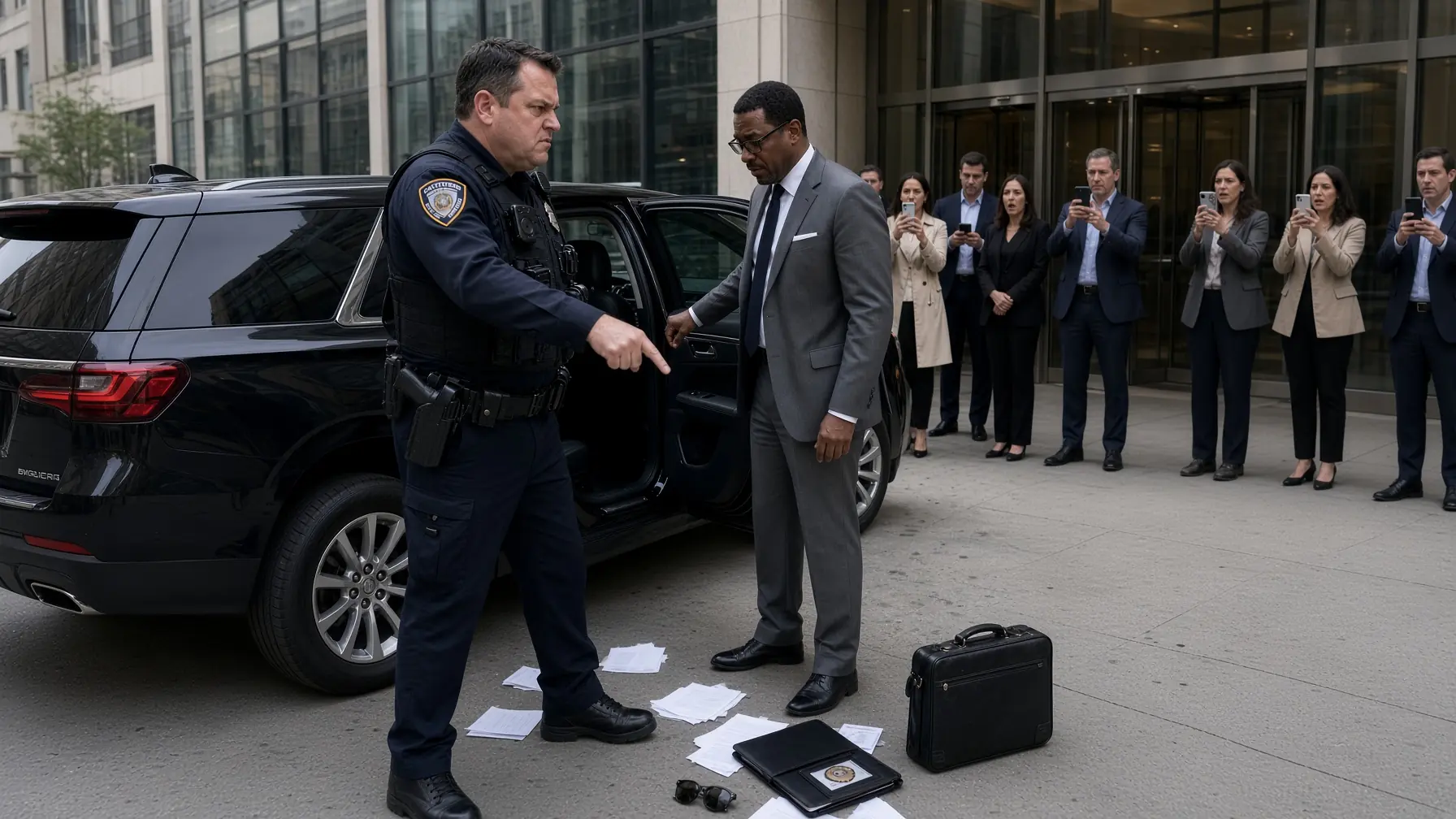
The Officer Slapped The Man In The Suit | Then Learned He Was The New Police Chief

The Officer Slapped The Man In The Suit | Then Learned He Was The New Police Chief
Reader Theme:
Font Size:
24px


Officer Grant Keller had spent eighteen years treating his badge like a crown.

You could hear it in his voice before you saw it on his chest. It was there when he leaned into car windows too close, when he made teenagers empty their pockets on sidewalks, when shop owners along Hamilton Avenue lowered their eyes the moment his cruiser slowed near their doors. In his mind, the city was divided into people who obeyed him quickly and people who needed to be taught why they should have.

On a clear Tuesday morning in Westbridge, that belief finally met the wrong sidewalk.

Keller stood beside a dark blue Lexus sedan outside a coffee shop on Hamilton and Ninth, his right hand still hanging loose after striking the man in front of him. The slap had been sharp enough to stop a bus driver mid-turn and make a cyclist skid toward the curb. A paper coffee cup rolled across the pavement, spilling cream in a pale line beside a pair of broken sunglasses.

The man Keller had slapped stood near the curb in a charcoal suit, white shirt, navy tie, and polished oxblood shoes.

A thin line of blood marked the corner of his mouth. His left cheek had already begun to swell, the red print of Keller’s hand rising against his deep brown skin. He did not fall, curse, or swing back.

He simply lifted a handkerchief to his lip and looked at Keller’s badge.

“Officer Grant Keller,” he said calmly. “Badge 2741.”

Keller smiled because he thought the man was trying to scare him.

He had heard that tone before from Black men who wore expensive suits and believed careful speech could protect them. Lawyers, consultants, executives, doctors, professors—men who thought credentials changed the basic order of the street. Keller enjoyed reminding them that a badge could still put their face against a wall faster than any degree could save them.

What Keller did not know was that the man bleeding on the sidewalk was Dr. Marcus Ellison.

And Dr. Marcus Ellison was supposed to walk into Westbridge Police Headquarters as the city’s new chief of police in less than twenty minutes.

Forty minutes earlier, Marcus had stood in front of the mirror in room 1908 of the Brantley Hotel, adjusting the cuffs of his shirt.

The room looked out over downtown Westbridge, a city of glass office towers, old brick storefronts, river bridges, and police scandals people spoke about in lowered voices because nothing ever seemed to change. On the desk behind him sat a leather credential case, a printed transition packet, and a framed photograph of his mother outside a small church in Mobile, Alabama, smiling as if she had always known her son would survive rooms built to underestimate him.

Marcus was fifty years old, tall, composed, and tired in the quiet way reformers become tired when every clean sentence hides years of resistance.

He had worn a uniform for twenty-five years. He started as a patrol officer in a working-class county outside Atlanta, earned his master’s degree at night, completed a doctorate in criminal justice leadership, and later led federal monitoring teams in two departments that had nearly collapsed under corruption and civil rights lawsuits. Westbridge had recruited him because its police department had reached the point where polite promises no longer fooled anyone.

Too many complaints.

Too many missing body-camera files.

Too many settlements paid with taxpayer money and no admission of wrongdoing.

Too many Black and Latino residents telling the same stories about the same officers while department leadership kept calling each case isolated. One name appeared again and again in the reports Marcus had reviewed the night before.

Grant Keller.

Sixteen citizen complaints in eleven months. Thirty-eight use-of-force reports over three years. Four civil claims quietly settled. Two minors injured during stops that began with vague suspicion and ended with nearly identical language in Keller’s reports.

His supervisors called him direct, experienced, firm, and old-school.

Marcus knew those words.

They were often the soft cloth institutions wrapped around cruelty so they did not have to look at the blood underneath.

He slipped the credential case into his inside jacket pocket.

The gold shield inside was new.

Chief of Police.

Westbridge Police Department.

Marcus did not feel proud when he looked at it. He felt the weight of every person who had written a complaint and waited for an answer that never came. He was not coming to Westbridge to be welcomed.

He was coming to cut rot out of a department that had spent years calling infection tradition.

He left the hotel at 8:06.

His assigned driver had called in sick that morning, and Marcus decided not to request another one. He wanted one quiet drive through the city before the introduction ceremony, before the cameras, before the union president’s forced handshake, before the smiling politicians who wanted reform as long as it did not cost them votes. He wanted to see Westbridge from the driver’s seat before everyone started showing him what they wanted him to see.

Classical piano played softly through the speakers as he pulled onto Hamilton Avenue.

At that same moment, Officer Grant Keller sat in Unit 22 outside a coffee shop near Ninth Street, nursing a paper cup and watching the morning crowd with practiced boredom.

Keller knew that corner. He knew which shop owners would keep their mouths shut. He knew which office workers would look away while pretending to check emails. He knew which young men could be pressed hard enough to react and which ones would swallow the humiliation.

His body camera was off.

It had been off since roll call.

He called that battery management.

People on Hamilton Avenue called it convenient.

Dispatch crackled over the radio.

“Unit 22, new chief arrival this morning. Maintain routine patrol presence around central corridor.”

Keller rolled his eyes.

“Copy.”

New chief.

Outside reformer.

Academic type.

Probably another polished speaker with a speech about trust and transparency. Keller had survived chiefs before. He had survived civilian boards, community outrage, policy memos, viral clips, retraining sessions, and two mayors who promised accountability in public before letting the department bury everything in procedure.

Then he saw the Lexus drift across the lane marker to avoid a pothole.

Two seconds.

No danger.

No near collision.

Nothing worth turning into a stop unless a man already wanted one.

Keller smiled.

He hit the lights.

Marcus saw the cruiser in his mirror and breathed once through his nose.

He had been stopped enough times in his life to understand the choreography. Hands visible. Window down. Voice calm. No sudden movements. Give them nothing that can be edited into danger later.

He pulled over in front of Delia’s Flower & Phone Repair because it had outdoor cameras pointing toward the street.

That choice was deliberate.

A public place.

A visible place.

A place where witnesses could gather before a report tried to replace memory.

Inside the shop, the owner, Rosa Martinez, looked up from unlocking the front gate and felt her stomach tighten when she saw Keller’s cruiser.

Everyone on Hamilton and Ninth knew that cruiser.

Eight months earlier, Keller had slammed her nephew Mateo against the same brick wall after claiming he matched a theft description nobody could produce. Mateo was seventeen, carrying a box of phone screens from a supplier, and still crossed the street whenever he saw Keller’s patrol car. Rosa filed a complaint with photos, a witness name, and the repair invoice proving Mateo was working.

Nothing happened.

Across the street, a local videographer named Jayden Brooks was filming his usual morning livestream.

Jayden was twenty-nine, sharp-eyed, and known online for documenting small city life: food trucks, street musicians, neighborhood protests, bad parking, and the strange beauty of Westbridge before office workers swallowed the sidewalks. His camera had been pointed at a busker tuning a guitar when he saw Keller approaching the Lexus.

Jayden turned the lens.

“Officer Keller again,” he murmured to his viewers. “Let’s stay with this.”

Keller reached the driver’s window.

“License and registration.”

Marcus kept both hands on the wheel.

“Good morning, Officer. Can you tell me the reason for the stop?”

“I said license and registration.”

“I heard you. I’m asking respectfully.”

Keller leaned closer.

“You crossed the lane back there.”

“I moved around a pothole.”

“Step out of the vehicle.”

Marcus paused.

He knew the law well enough to challenge the order. He also knew law on paper and survival on pavement were not always the same thing. The sidewalk was waking up around them, and every second mattered.

He opened the door slowly.

“I am stepping out now.”

He said it clearly for the cameras.

Keller noticed.

He disliked it immediately.

Marcus stood beside the car, hands visible, posture calm. The morning sun caught the edge of his watch, not flashy, just refined enough to irritate a man already looking for reasons. Keller’s eyes moved from the watch to the Lexus, then to the suit, then to Marcus’s face.

“Nice car.”

“Thank you.”

“What do you do?”

“I work in public safety.”

Keller gave a short laugh.

“Public safety. That right?”

“Yes.”

“You people always have polished titles now. Consultant. Director. Doctor. Public safety.” He glanced toward the small gathering crowd. “Still can’t stay in your lane.”

Rosa stepped outside with her phone already recording.

Jayden’s livestream audience doubled.

A few office workers slowed by the crosswalk.

A bookstore owner named Evelyn Pierce came to her doorway and watched with narrowed eyes. Evelyn was seventy-one, white-haired, and had owned Pierce Books for nearly forty years. She had seen Keller stop teenagers, delivery drivers, suited professionals, homeless men, and one elderly pastor who had done nothing except sit too long on the bench outside her store.

She had called the department twice.

No one returned her calls.

Marcus spoke evenly.

“Officer, my license is in my wallet, inside left jacket pocket. My registration and insurance are in the glove compartment. I am willing to provide both.”

Keller did not like the narration.

“Hands on the hood.”

“Are you conducting a search?”

“You acting nervous.”

“I am standing still.”

“You arguing?”

“I am asking for the basis.”

That was when Keller’s face changed.

It was small, but Marcus caught it. He had trained enough officers to recognize the moment authority stops serving law and starts defending ego. Keller was no longer trying to establish what happened. He was trying to make sure everyone saw what happened when a man like Marcus questioned him.

Keller shoved Marcus toward the brick wall beside Rosa’s shop.

Phones lifted.

Jayden spoke into his livestream.

“Officer just pushed the driver against the wall. Driver has been calm. No visible threat.”

Keller patted Marcus down roughly.

Then he opened the Lexus door and began searching inside.

“I do not consent to a search,” Marcus said clearly.

“Didn’t ask.”

“You do not have probable cause.”

Keller grabbed the leather briefcase from the passenger seat.

“Then you won’t mind me checking.”

He dumped the contents onto the sidewalk.

Papers slid across the concrete.

A printed transition briefing.

A sealed department memo.

A folder labeled First 100 Days.

A photograph of Marcus’s mother in a simple silver frame.

The credential case remained inside Marcus’s jacket pocket.

Keller kicked through the papers with the toe of his boot.

“Look at all this,” he said loudly. “Man’s got paperwork like he’s important.”

Rosa stepped forward.

“You can’t just throw his things on the sidewalk.”

Keller turned on her.

“Ma’am, step back unless you want to interfere.”

Evelyn raised her phone higher.

“Interfere with what? You stopped him for avoiding a pothole.”

Keller pointed at Marcus.

“He’s being uncooperative.”

“No, he isn’t,” Jayden called from across the street. “I’ve got it live.”

Keller’s jaw tightened.

Cameras were supposed to make citizens nervous.

Instead, they were making the street braver.

Marcus watched Keller closely.

The officer’s shoulders had risen. His breathing was heavier. His hands were moving faster now, not in fear but in performance. He was escalating because the story in his head needed Marcus to become a problem.

“Marcus Ellison,” Keller said, reading the license he finally pulled from the wallet. “Doctor?”

“Yes.”

“What kind of doctor?”

“Criminal justice leadership.”

Keller smirked.

“So not a real doctor.”

The crowd murmured.

Marcus gave him nothing.

“Officer Keller, badge 2741, I am requesting that a supervisor be called to this location.”

The badge number hit Keller harder than Marcus expected.

His eyes narrowed.

People who filed complaints learned badge numbers.

People with attorneys learned badge numbers.

People who caused problems for officers like Keller learned badge numbers.

“Don’t say my badge number like you know me,” Keller snapped.

“I am identifying the officer conducting this stop.”

“You think that suit makes you somebody?”

“No.”

“You think that car makes you better than me?”

“No.”

“You think because you talk like you swallowed a courtroom, I won’t put you where you belong?”

The sentence hung in the air.

Everyone heard it.

Rosa whispered, “There it is.”

Marcus turned his face slightly toward Jayden’s livestream.

“I am unarmed. I am compliant. Officer Keller has conducted a search without consent and is now escalating verbally. I am requesting a supervisor again.”

That was when Keller slapped him.

The sound cracked against the storefronts.

Marcus’s head turned with the force. His sunglasses flew from his face and skidded across the sidewalk, one lens breaking near the curb. Blood appeared at the corner of his mouth, and a bright red handprint rose across his cheek.

For one full second, Hamilton Avenue seemed to stop breathing.

Then every phone moved closer.

Keller stepped back with the satisfied look of a man who believed pain had restored order.

“Maybe now you’ll learn respect.”

Marcus lifted the handkerchief from his pocket and touched it to his lip.

He kept his eyes on Keller.

“Officer Keller has just struck me without provocation. Time is approximately 8:43 a.m. Multiple witnesses are present.”

Keller’s smile faltered.

The calm was wrong.

Men he hit usually shouted, cursed, folded, or gave him the reaction his report would later need. Marcus did none of those things. He stood there bleeding and spoke like a man building a record in real time.

Rosa said, “I recorded it.”

Jayden’s livestream jumped from twelve hundred viewers to ten thousand.

Comments flooded the screen.

He slapped him.

That man didn’t touch him.

Badge 2741.

Someone call the station.

Evelyn stepped off the curb with her phone raised.

“I’ve watched you for years, Grant Keller,” she said. “You hurt that Alvarez boy. You emptied Mr. Chen’s backpack. You threw a delivery driver’s food into the gutter. We all saw you.”

Keller turned toward her.

“Ma’am, step back.”

“No,” Evelyn said. “You step down.”

A sound moved through the crowd.

Shock first.

Then approval.

Keller reached for his cuffs.

“Turn around,” he said to Marcus. “You’re under arrest.”

“For what charge?”

“Disorderly conduct.”

“I have not been disorderly.”

“Obstruction.”

“I have not obstructed.”

“Resisting.”

“I have not resisted.”

Keller stepped closer.

“I said turn around.”

Marcus slowly reached toward his inside jacket pocket.

Keller’s hand snapped toward his weapon.

“Don’t move.”

Marcus froze.

“My credentials are in my inside pocket. I am going to remove them slowly with two fingers.”

“Credentials for what?”

Marcus looked directly at him.

“For the position I was on my way to assume.”

The crowd went quiet.

Keller’s eyes narrowed.

Marcus removed the leather case and opened it.

The gold shield caught the morning light.

Dr. Marcus Ellison
Chief of Police
Westbridge Police Department

Keller’s face emptied.

Not slowly.

It drained all at once, like the street itself had pulled the arrogance from him.

His eyes moved from the badge to Marcus’s bleeding mouth, then to the handprint on his cheek, then to the crowd of cameras around them.

The street understood before Keller did.

Jayden nearly forgot he was filming.

“Hold on,” he said to his livestream. “The man Officer Keller just slapped is the new police chief.”

Rosa covered her mouth.

Evelyn Pierce smiled without joy.

“Well,” she said, “that answers why the Lord gave me bad knees and made me open late.”

Keller took one step back.

“Sir, I didn’t know.”

Marcus closed the credential case.

“That is not a defense.”

“No, I mean, if I had known you were the chief—”

“You would have treated me differently.”

Keller swallowed.

“That’s not what I meant.”

“That is exactly what you meant.”

Every camera caught it.

Marcus stepped forward just enough for Keller to feel the distance change.

“You are telling me rank would have protected me from your conduct. That means you knew your conduct was wrong before you knew who I was.”

Keller’s mouth opened.

No answer came.

Any answer would condemn him.

Marcus reached for Keller’s shoulder radio.

Keller did not stop him.

“Dispatch, this is Chief Marcus Ellison at Hamilton and Ninth. I need a supervisor, Internal Affairs, and medical response to my location. Officer Grant Keller, badge 2741, is to be relieved of duty immediately pending investigation for excessive force, unlawful search, and potential civil rights violations.”

The dispatcher hesitated.

“Chief Ellison?”

“Yes,” Marcus said. “My first briefing will be delayed.”

A ripple of stunned laughter moved through the crowd.

Keller looked smaller now.

Not because Marcus shouted.

He had not shouted once.

Keller looked smaller because the thing he had relied on for years—the belief that his report would outweigh everyone else’s truth—had failed in public.

Lieutenant Dana Ortiz arrived within five minutes.

She stepped from her cruiser, saw Marcus’s face, saw Keller, saw the papers on the sidewalk, saw the crowd, and understood that the new chief’s first official crisis had begun before he reached headquarters.

“Chief Ellison,” she said.

“Lieutenant Ortiz,” Marcus replied. “Take Officer Keller’s weapon, badge, cuffs, radio, and department ID. Preserve his body camera, vehicle camera, dispatch audio, and all radio traffic. Note that his body camera appears to be off.”

Ortiz looked at Keller.

“Officer Keller, remove your duty belt.”

Keller’s hands shook.

“Dana, come on.”

“Do it.”

That one sentence told Hamilton Avenue that the old order had cracked.

Keller no longer owned the corner.

He no longer owned the narrative.

He no longer owned even the silence of other officers.

Piece by piece, he removed the tools that had made him feel untouchable.

Weapon.

Radio.

Cuffs.

Badge.

The crowd did not cheer.

That mattered.

This was not entertainment.

It was correction.

Rosa stepped forward as Ortiz escorted Keller toward the cruiser.

“My nephew Mateo filed a complaint,” she said to Marcus. “They ignored us.”

Marcus looked at her.

“What is his full name?”

“Mateo Alvarez.”

“I will find the file.”

“They said it was reviewed.”

“I did not ask what they said.”

Rosa’s eyes filled.

Evelyn came next, holding her phone in one hand and an old spiral notebook in the other.

“I kept names,” she said.

Marcus looked down.

“Names?”

“Dates. Descriptions. What I saw. I started writing them because I thought someday somebody might care.”

Marcus’s expression softened.

“I care.”

She nodded once.

“Good. Because I’m too old to carry this alone anymore.”

By noon, Jayden’s livestream had spread across the city.

By midafternoon, national outlets had picked it up.

By sunset, the phrase The Chief at Hamilton and Ninth had become a symbol of an institution accidentally exposing itself.

Marcus held his first press conference that evening.

The bandage near his lip was visible. The handprint on his cheek had darkened. Behind him stood the mayor, Lieutenant Ortiz, Rosa Martinez, Evelyn Pierce, Jayden Brooks, and several residents from the neighborhood.

That arrangement was intentional.

Marcus did not want the department standing alone behind him.

The department had been alone with itself for too long.

“Today, before I entered police headquarters as chief, I experienced what many Westbridge residents have described for years,” he said. “I was stopped on weak grounds, searched without consent, verbally degraded, struck without provocation, and threatened with arrest while compliant.”

The cameras clicked.

He continued.

“The difference between me and many prior victims is not that I deserved better. The difference is that I had a title Officer Keller did not expect. That should trouble every person in this city.”

Rosa looked down.

Evelyn nodded.

Marcus’s voice stayed steady.

“Justice cannot depend on the victim turning out to be powerful. Rights do not activate when a badge recognizes another badge.”

The mayor shifted uncomfortably.

Marcus noticed.

He did not care.

“Effective immediately, every complaint involving Officer Grant Keller will be reopened. Any file closed without independent witness contact will be reviewed again. Body-camera deactivations will be audited department-wide. Use-of-force reports will be examined by an external civil rights team.”

He paused.

“Officers who serve honorably should welcome accountability. Officers who fear accountability should ask themselves what they have been protecting.”

Three weeks later, federal investigators arrived.

Special Agent Naomi Reed from the Civil Rights Division entered Marcus’s office with two assistants, a rolling cart of files, and a face that suggested she had read enough to know Westbridge’s problem was not limited to one slap.

Evelyn’s notebook sat in the top evidence folder.

Agent Reed opened a file.

“We have identified twenty-eight potential victims connected to Officer Keller over the past six years. Twenty are Black. Six are Latino. Two are Asian. Five were minors during the incidents.”

Marcus looked at the photographs.

A split lip.

Bruised wrists.

Broken glasses.

A teenager with a swollen cheek.

A delivery driver with gravel embedded in both palms.

A pastor standing beside a dented car door.

His own face had gone viral because he was chief.

These faces had vanished because people with power had not found them important enough.

That knowledge stayed with him longer than the slap.

Agent Reed continued.

“The pattern is consistent. Vague stops. Verbal escalation when citizens ask questions. Force justified by noncompliance. Missing or deactivated cameras. Supervisory sign-off using nearly identical language.”

Marcus closed one folder carefully.

“Who signed off?”

Reed gave him two names.

He already knew them.

Men like Keller did not last eighteen years by themselves.

They lasted because paperwork learned to kneel around them.

The investigation widened.

Internal Affairs found complaints marked unfounded even when witness names were attached. Body camera logs showed repeated unexplained gaps. Supervisors copied and pasted language across reports. Union representatives had contacted officers before investigators interviewed witnesses.

The system had not failed by accident.

It had protected itself on purpose.

Keller was indicted in federal court seven weeks after the slap.

The charges included deprivation of rights under color of law, falsification of police reports, obstruction of a civil rights investigation, and assault. He arrived in a gray suit that did not fit well, without his badge, without his belt, without the public armor he had confused with character.

His attorney tried to frame the slap as a single emotional mistake.

Assistant U.S. Attorney Jordan Hale did not allow it.

“One recorded slap revealed what years of ignored complaints had already shown,” Hale told the court. “Officer Keller used the authority of the state to intimidate citizens he believed had no power to be believed.”

The courtroom screen played the Hamilton and Ninth video.

Then Rosa’s nephew Mateo testified.

He was eighteen now, taller than his aunt, voice tight but steady.

“He told me boys like me only understood pain,” Mateo said. “Then he shoved me into the wall. My aunt filed a complaint because she said truth had to matter. Nothing happened until he hit the chief.”

Marcus sat in the front row.

That sentence hurt more than the slap.

Nothing happened until he hit the chief.

It became the line he carried into every reform meeting afterward.

Evelyn testified with her notebook.

Dates.

Times.

Weather.

Names.

What Keller said when he thought no one important was listening.

The defense tried to suggest she was confused because of her age.

Evelyn looked at the lawyer over the rim of her glasses.

“Young man, I remember every bully I ever met. He just had the misfortune of being predictable.”

The courtroom laughed.

The judge allowed it.

Keller accepted a plea agreement after two supervisors agreed to cooperate. He received thirty-six months in federal prison, permanent decertification from law enforcement, restitution obligations to several victims, and a reduced pension after state disciplinary proceedings. His name became part of mandatory academy training across the region.

Marcus did not treat the sentence as victory.

A sentence punished one man.

Reform had to punish the conditions that made him possible.

Within four months, Westbridge launched the Ellison Accountability Plan.

Every use of force required independent review.

Body-camera deactivation without documented cause triggered automatic investigation.

Citizen complaints went to an external civilian oversight office before entering the department chain.

Repeat complaint patterns created mandatory intervention.

Supervisors who signed lazy or false reviews faced discipline.

Officers received constitutional policing training led not only by attorneys and instructors, but by residents whose complaints had once been ignored.

Some officers hated it.

Some resigned.

A few called Marcus a traitor in anonymous group chats.

He saved every screenshot.

Not because he was sensitive.

Because culture tells the truth when it thinks the room is private.

Six months after the incident, Marcus returned to Hamilton and Ninth.

The corner looked ordinary again.

Buses sighed at the curb.

Commuters moved past with coffee and phones.

Rosa’s shop sign flickered above the door, still half-broken because Mateo had promised to fix it and then left for orientation week.

A bronze marker had been installed near the place where Marcus’s sunglasses shattered.

It read:

Hamilton and Ninth
Where Witness Became Accountability

Rosa stood beside him with her arms folded.

“Mateo got into the justice studies program,” she said.

Marcus smiled.

“He told me.”

“He wants to be a public defender.”

“Good.”

“I thought you’d say police officer.”

“I want him wherever his conscience tells him to stand.”

Rosa looked at the marker.

“For months after what happened to him, I hated this corner.”

Marcus nodded.

“I understand.”

Evelyn Pierce arrived slowly with a paper bag in one hand and her cane in the other.

“I brought muffins,” she announced. “Nobody make speeches about it.”

Jayden came too, camera lowered at his side.

His livestream from the slap had changed his career, pushing him into documentary work on police accountability. But he was careful when people called him brave.

“I held a phone,” he often said. “Other people carried the damage.”

Lieutenant Ortiz arrived in uniform.

She now led Professional Standards.

Marcus had appointed her because she had not asked for the position and because she understood that loyalty to the public sometimes meant making the department uncomfortable.

“Chief,” she said, “first quarterly report is ready. Complaints are down thirty-four percent. Sustained findings are up because we’re actually investigating. Body camera compliance is at ninety-eight percent.”

Evelyn snorted.

“What were they doing before?”

Ortiz looked at her.

“Protecting themselves.”

“At least you said it.”

Marcus watched the corner for a moment.

A young Black man in a suit passed a patrol car without stiffening.

A Latina delivery driver asked an officer for directions with no fear in her face.

Small things.

Huge things.

Reform was not finished.

It never would be.

But the corner no longer belonged entirely to silence.

Later that afternoon, Marcus visited the police academy.

Recruits sat in rows, uniforms pressed, boots shining, faces eager in the dangerous way young officers can be eager before experience teaches humility. On the screen behind him was the frozen image from Jayden’s video: Keller’s hand in motion, Marcus’s face turning, the crowd watching.

Marcus let them sit with the image.

Then he spoke.

“This is not shown to embarrass this department. It is shown because embarrassment is often the doorway to honesty.”

No one moved.

“The officer who struck me believed he was alone with his authority. He was wrong. There were cameras, witnesses, history, and every ignored complaint standing on that sidewalk with him.”

He walked slowly across the front of the room.

“Some of you will be obeyed before you have earned wisdom. Some of you will carry weapons before you fully understand restraint. Some of you will feel fear, anger, pride, and disrespect on the street.”

He turned back to the screen.

“What you do next is policing.”

A recruit raised her hand.

“What happened to Officer Keller, sir?”

“He went to prison.”

Another asked, “Do you forgive him?”

Marcus paused.

The question followed him everywhere.

“I do not build reform around forgiveness,” he said. “I build it around prevention.”

That answer stayed in the room.

Good.

It needed to.

Years later, people still told the story like instant karma.

A racist officer slapped a Black man in a suit.

The Black man turned out to be the new police chief.

The officer lost his badge, went to prison, and became the warning every recruit heard before graduation.

That version was satisfying.

It was also incomplete.

Marcus always told the longer version.

He told people about Rosa pressing record because her nephew had been hurt and no one listened. He told them about Evelyn keeping a notebook because memory becomes evidence when someone refuses to let it die. He told them about Jayden’s livestream, the witnesses who stayed, the dispatcher who asked for probable cause, and Ortiz arriving quickly enough to make the old department blink.

He told them justice should not depend on the victim having credentials in his pocket.

That was the real lesson.

The slap mattered because it was visible.

The hidden pattern mattered more.

Cruelty rarely begins on the day it becomes famous. It starts earlier, smaller, protected by paperwork, disbelief, and people who call repeated harm isolated. A handprint on a police chief’s face was not the beginning of Westbridge’s problem.

It was the moment the problem forgot to hide.

Marcus kept the broken sunglasses in a box in his office.

Not displayed.

Not framed.

Just kept.

Sometimes, when meetings drifted into soft language and people began saying things like unfortunate incident or community perception, he opened the box and placed the broken frames on the table. The room always changed after that.

Objects can tell the truth when people have talked too long.

On the third anniversary of Hamilton and Ninth, Mateo Alvarez stood beside the bronze marker in a suit of his own.

He was leaving for law school the following week.

Rosa cried and pretended she had allergies.

Evelyn complained that everyone was making too much fuss, then hugged him longer than anyone else. Jayden recorded a short video, not live this time, just for the family. Chief Marcus Ellison stood nearby, older now, still straight-backed, still carrying anger like a tool instead of a fire.

Mateo looked at the plaque.

“Sometimes I hate that it took him hitting you.”

Marcus nodded.

“I hate that too.”

“But something changed.”

“Yes.”

Mateo turned toward him.

“How do we keep it changing?”

Marcus looked across the street at the patrol car parked outside the coffee shop.

Then at the people walking past without lowering their eyes.

“We keep records,” he said. “We tell the truth early. We believe patterns before they become scandals. And we never let anyone convince us that dignity has to prove itself first.”

The afternoon sun touched the bronze marker.

Traffic moved.

Coffee shops filled.

Phones rang.

Life continued, the way life always does after history happens in public.

But Hamilton and Ninth remembered.

It remembered the slap.

It remembered the silence after.

It remembered the badge opening in the sunlight.

It remembered the crowd choosing not to disappear.

And every officer who worked that corner after Grant Keller knew the story before stepping out of the cruiser.

The street had seen what happened when power confused fear with respect.

The city had seen what happened when one man thought his badge could erase another man’s humanity.

And Marcus Ellison made sure no one in uniform forgot the simplest truth of the job:

A badge gives you authority.

It does not give you ownership.

It does not give you permission to humiliate.

It does not turn prejudice into procedure.

And if you ever raise your hand against someone because you think no one important is watching, you may discover too late that the whole city is.

News in the same category

News Post