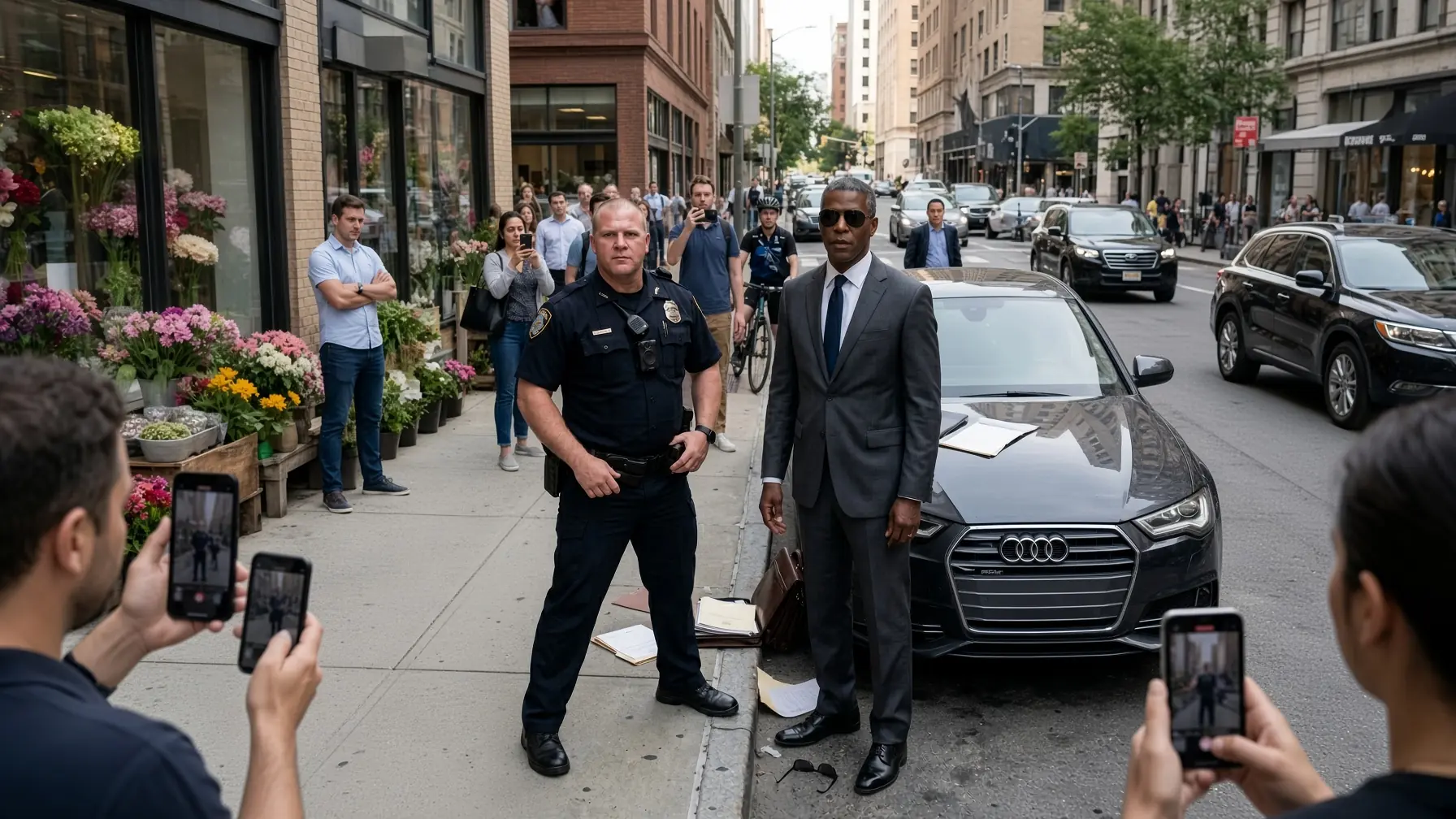
Officer Grant Whitaker thought the street belonged to him.
That was his first mistake.
His second mistake was thinking the Black man in the charcoal suit would lower his eyes, swallow the insult, and disappear like so many others had done before. Whitaker had spent nearly nineteen years wearing a badge in Brookhaven City, long enough to learn which supervisors looked away, which complaints vanished, and which citizens could be intimidated into silence.
At 8:37 on a bright Tuesday morning, he slapped the wrong man in front of half the financial district.
The sound cracked across Hanover and Ninth like a dropped board on concrete.
People stopped mid-step. A woman in a coffee line froze with her card still in her hand. A bike courier braked so sharply his rear tire skidded sideways. On the corner, a florist named Rosa Delgado looked up from unlocking her shop and whispered, “Not again.”
The man who had been slapped stood beside a dark Audi sedan, one hand still visible, the other holding a leather document folder.
His sunglasses had fallen to the sidewalk and broken near the curb. A red handprint appeared across his cheek, sharp against his brown skin. Blood gathered at the corner of his mouth, then slid down toward the collar of his white shirt.
Officer Whitaker flexed his fingers.
He looked almost pleased.
“That’s what happens,” he said, loud enough for the growing crowd to hear, “when people forget how to respect authority.”
The man in the suit slowly wiped the blood from his lip with a folded handkerchief.
His voice stayed calm.
Too calm.
“Officer Grant Whitaker,” he said. “Badge number 3186.”
Whitaker smirked.
He thought the man was trying to scare him with details. He thought he was dealing with another educated Black professional who knew a few legal phrases and believed that would change the power balance on the street. He thought the badge on his chest still meant he controlled the ending.
He had no idea the man he had just assaulted was Dr. Malcolm Reeves, the newly appointed Chief of Police for Brookhaven City.
Thirty minutes earlier, Malcolm Reeves stood in front of a hotel mirror, adjusting the knot of his dark blue tie.
The morning had started quietly. Room service coffee, a folder of briefing notes, and the low hum of downtown traffic rising from the street below. On the desk beside his laptop sat his appointment letter, signed by the mayor and confirmed by the city council after months of scandal, public pressure, and protests outside police headquarters.
Chief of Police.
Brookhaven City Police Department.
Reeves looked at those words longer than he expected.
He had worn uniforms before. Patrol officer. Detective. Reform consultant. Federal oversight advisor. He had spent twenty-six years studying the difference between law enforcement and control, between public safety and public fear.
He had earned a doctorate in criminology from Georgetown, a law degree from Columbia, and a reputation for walking into broken departments and making powerful people uncomfortable.
Brookhaven had called him because the city had run out of prettier options.
There were lawsuits. Body-camera failures. Missing complaint files. Protest videos. A federal review already circling the department like storm clouds. The mayor wanted calm. The union wanted protection. The community wanted someone to finally admit the obvious.
The department was sick.
Today was supposed to be Reeves’s first day.
He planned to arrive at headquarters by nine, meet command staff, and begin with a simple message: the old culture was over. No more buried complaints. No more violent officers protected by paperwork. No more treating public trust like a public relations slogan.
He slipped his new badge case into the inside pocket of his jacket.
Then he left the hotel and drove toward headquarters.
Three miles away, Officer Grant Whitaker was already hunting.
He sat behind the wheel of Unit 219, rolling slowly through the financial district with one hand resting near his belt. Whitaker was forty-seven, thick-necked, clean-shaven, and proud in the way men become when they confuse fear with respect. His uniform was pressed. His boots shined. His body camera was off.
It was almost always off when he worked Hanover and Ninth.
Dispatch had reminded officers that the new chief would be arriving that morning. Whitaker barely listened. He had survived four chiefs, two acting chiefs, three internal reviews, and more complaints than he could remember. New chiefs came in promising reform. Then the union pushed back, the paperwork slowed, and men like him kept doing what they had always done.
“Unit 219,” dispatch said. “Routine patrol near Hanover corridor. Keep the area clear. Command staff movement expected this morning.”
Whitaker took a sip of coffee.
“Copy.”
To him, keeping the area clear meant deciding who belonged.
The intersection of Hanover and Ninth was one of Brookhaven’s busiest corners. Glass towers rose above old storefronts. Bankers crossed paths with delivery drivers. Lawyers hurried past food carts. Office workers moved with coffee in one hand and phones in the other.
Rosa Delgado opened her flower shop every morning at 8:00.
She knew Whitaker’s cruiser.
Everyone on the corner did.
Nine months earlier, Whitaker had shoved her nephew against the brick wall outside her shop and slapped him twice during a stop that produced no charges. Rosa filed a complaint. She brought photographs. She gave names of witnesses. The department sent her a letter saying the matter had been reviewed and no misconduct was found.
Her nephew stopped walking past police officers after that.
Now Rosa watched Whitaker circle the block again.
Her stomach tightened.
Across the street, a young videographer named Caleb Moore was livestreaming his morning neighborhood segment. He was twenty-seven, energetic, and building a local following by filming downtown life in small human pieces. Food trucks. Street musicians. New murals. Small businesses opening before the towers swallowed the day.
“Good morning, Brookhaven,” Caleb said into his phone. “Hanover and Ninth is already moving. Coffee line is long, buses are late, and Miss Rosa is putting out sunflowers again.”
Near the bookstore, Vivian Hargrove arranged a display of used hardcovers outside her front window.
She was seventy-two, white-haired, and sharp as broken glass when something offended her sense of justice. She had owned Hargrove Books for thirty-nine years and had watched officers come and go. She had also watched Whitaker humiliate people on that corner more times than she could count.
Vivian had kept notes.
Dates.
Names.
Descriptions.
She told herself someday someone would ask.
On the third floor above a café, civil rights attorney Daniel Kim paused by his window with a mug of tea in his hand. He saw Whitaker’s cruiser creeping past the intersection for the third time in fifteen minutes.
Daniel knew that pattern.
The slow roll. The scanning. The pause near an expensive car when the driver did not match the officer’s imagination of who should be behind the wheel. He placed his tea on the desk and reached for his phone before the lights even came on.
Malcolm Reeves’s Audi entered the intersection at 8:35.
A delivery van cut wide from the right lane, and Reeves eased left for a second to avoid clipping its mirror. It was nothing. A harmless correction any reasonable driver would understand.
Whitaker saw an excuse.
“Got him,” he muttered.
He hit the lights.
The siren chirped once, sharp and unnecessary.
Reeves saw the patrol car in his mirror and exhaled slowly. He had been pulled over more times than he had been promoted. That old arithmetic still lived in his body. Both hands went to the wheel automatically.
He guided the Audi to a bright curb directly in front of Rosa’s shop.
Witnesses mattered.
Phones mattered.
Light mattered.
Whitaker got out of the cruiser and walked toward the car with the swagger of a man approaching a stage.
“License and registration,” he barked before Reeves lowered the window all the way.
“Good morning, Officer,” Reeves said. “Can you tell me the reason for the stop?”
“You crossed the lane back there.”
“I moved to avoid a delivery vehicle.”
“I didn’t ask for excuses. Step out.”
“For a lane correction?”
“Step out of the vehicle now.”
Rosa heard the tone and moved to the doorway of her shop.
Her phone came up before she fully understood she had reached for it.
Reeves stepped out slowly.
He kept both hands visible.
That detail made Daniel Kim begin recording from the third-floor window. It made Caleb turn his livestream toward the stop. It made Vivian leave the bookstore display and stand on the sidewalk with her jaw set hard.
Whitaker positioned Reeves against the brick wall beside the flower shop.
“Hands on the wall.”
Reeves complied.
“You always drive like that in other people’s neighborhoods?” Whitaker asked.
Reeves kept his voice steady.
“I work downtown.”
“Doing what?”
“I’m on my way to work now.”
Whitaker glanced at the Audi.
“Nice car.”
Reeves did not respond.
“That kind of car draws attention when the driver looks nervous.”
“I am not nervous.”
“You sure?”
“I am fully compliant.”
Whitaker stepped closer.
“You people always use that word. Compliant. Like you memorized it from a lawsuit.”
The phrase moved across the sidewalk like smoke.
Rosa’s hand tightened around her phone.
Caleb’s livestream view count started rising.
Reeves turned his head slightly toward the cameras.
“Officer Whitaker, I am not consenting to any search of my vehicle. I am asking whether I am being cited, detained, or released.”
Whitaker smiled.
“There it is. Lawyer talk.”
He reached through the open door and pulled Reeves’s briefcase from the passenger seat.
“Officer,” Reeves said, still calm, “that case contains confidential legal and departmental documents.”
Whitaker dropped it onto the hood of the Audi and opened it.
Papers spilled out.
A Columbia Law diploma copy.
Federal oversight files.
A sealed packet from the mayor’s office.