The water ran in clean silver lines over the hood of the old Plymouth.
Marcus Delaney stood in his own driveway with a sponge in one hand and a garden hose at his feet, listening to Sam Cooke drift from a small speaker inside the garage. It was late Saturday afternoon in Westbridge Hills, the kind of neighborhood where every lawn looked professionally threatened into perfection and every house seemed to have more windows than people.
Marcus wore a faded navy T-shirt, old jeans, and sneakers with paint on one side.
Nothing about him looked official.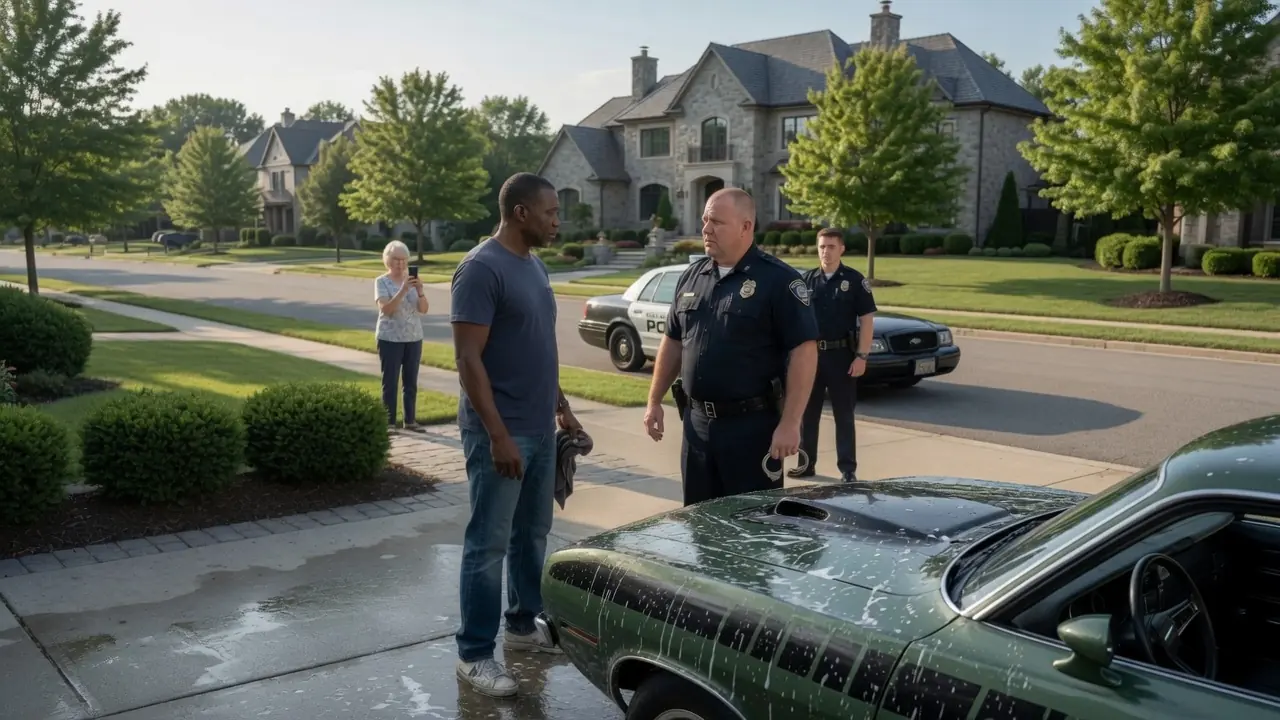
Nothing about him looked powerful.
That was the point.
He had moved into the house on Ashbury Lane three weeks earlier, though most of the neighbors had not bothered to learn his name. They noticed the moving truck, the classic car, and the fact that the new homeowner was a Black man who spent Saturday afternoons working in his garage instead of hiring someone else to do it.
People had opinions about that.
They always did.
The car was a 1970 Plymouth Barracuda, deep green with black racing stripes and chrome polished bright enough to catch the sun. Marcus had bought it twenty-two years ago as a rusted shell from a man outside Baltimore who said it was good for parts and not much else. Marcus spent weekends rebuilding it piece by piece while his first marriage fell apart, while his daughter grew up, while the job got heavier year after year.
That car had heard more truth from him than most people had.
So when Saturday came, and his new office was still filled with unopened boxes, Marcus chose the driveway over paperwork.
He had earned one quiet afternoon.
At fifty-one, Marcus had nearly thirty years in law enforcement behind him. Narcotics, homicide, internal affairs, special investigations. He had been shot at twice, sued once, praised publicly more times than he trusted, and disappointed by enough officers to know that a badge could reveal character or rot it from the inside.
Three months earlier, the mayor of Westbridge appointed him deputy chief of police.
Not for decoration.
For cleanup.
The department had become a problem everyone whispered about and no one wanted to name directly. Too many excessive force complaints. Too many traffic stops that ended with seized cash and no charges. Too many lawsuits settled quietly. Too many citizens who said the same thing in different ways: certain officers treated the city like private property.
Marcus had not officially taken public command yet.
His swearing-in was scheduled for Monday morning.
Until then, he was simply a man washing his car in the driveway of the house he bought with thirty years of work.
Two blocks away, Patrol Unit 19 turned onto Ashbury Lane.
Behind the wheel was Officer Grant Phelps, a twelve-year veteran with thick forearms, a shaved head, and the kind of posture that made every conversation feel like a challenge. He had built his career on aggressive stops, loud commands, and the comfortable protection of supervisors who liked his numbers more than they questioned his methods.
In the passenger seat sat Officer Noah Bell, twenty-six, six months out of the academy, still new enough to remember the Constitution as something more than an obstacle.
Noah noticed the car first.
“Nice Barracuda,” he said.
Phelps slowed.
His eyes moved from the car to Marcus, then to the house behind him.
“Too nice.”
Noah looked over.
“What do you mean?”
Phelps tapped the steering wheel with two fingers.
“You see him around here before?”
“No. But I’ve only been assigned this side of town for a month.”
Phelps gave a dry laugh.
“Exactly.”
Noah looked back at Marcus, who was rinsing soap from the front fender.
“He’s washing a car.”
“In front of a two-million-dollar house.”
“Could be his house.”
Phelps turned the cruiser toward the curb.
“Rookie, people who live here don’t wash their own cars in old sneakers.”
Noah felt the first small drop of dread settle into his stomach.
The cruiser stopped in front of the house.
Marcus heard the engine before the doors opened.
After nearly three decades in policing, he could identify the sound of a patrol car the way some men recognized birds. He did not startle. He did not turn too fast. He simply shut off the hose, set it down, and looked toward the street.
Phelps stepped out first.
He did not adjust his tone for a homeowner.
He did not introduce himself.
He walked up to the edge of Marcus’s driveway with his thumbs hooked in his duty belt and his right hand resting too close to his taser.
“Hey,” Phelps called. “Whose car is that?”
Marcus wiped water from his forearm with a towel.
“Afternoon, officer.”
“I asked whose car that is.”
Marcus looked at the Barracuda.
Then back at him.
“Mine.”
Phelps smiled in a way that was not a smile.
“Yours.”
“That’s what I said.”
Noah stood near the passenger door of the cruiser, watching the exchange with his jaw tight.
Marcus noticed him.
He noticed everything.
Phelps stepped onto the driveway.
One boot on private property.
Then the other.
“Pretty expensive piece of machinery for a Saturday side hustle.”
Marcus tilted his head slightly.
“Side hustle?”
“You detailing cars in this neighborhood?”
“No.”
“You working for the owner?”
“I am the owner.”
Phelps looked at the house, then at Marcus, then at the car again.
He chuckled.
Not because anything was funny.
Because disbelief needed somewhere to go.
“Convenient answer.”
Marcus picked up the microfiber towel and slowly dried the hood.
“What seems to be the issue, Officer Phelps?”
Phelps stiffened at the sound of his name.
He did not like being read before he had finished performing authority.
“The issue is we’ve had thefts in neighborhoods like this. Classic cars. Tools. Garage break-ins. I see somebody I don’t recognize standing around a high-end vehicle, I ask questions.”
“Standing around?”
Marcus kept drying the car.
“I was washing it.”
“You got ID?”
“No.”
Phelps blinked.
“No?”
“No, I’m not providing identification without a lawful basis for the request.”
Noah’s eyes dropped briefly to the pavement.
He knew Marcus was right.
Phelps knew it too, though ego began shouting louder than training.
“You don’t decide what’s lawful out here.”
Marcus folded the towel once and placed it on the fender.
“Actually, the law decides that. You can ask for my name. I can decline unless you have reasonable, articulable suspicion that I have committed, am committing, or am about to commit a crime.”
Phelps took another step closer.
“I don’t know what YouTube lawyer nonsense you watched, but when an officer asks for ID, you provide ID.”
“That is not the law.”
“It is today.”
Marcus sighed.
Not loudly.
Just enough.
That sigh seemed to offend Phelps more than any insult could have.
The neighbor across the street opened her front door.
Mrs. Elaine Robards, seventy-eight, wearing gardening gloves and holding a half-dead basil plant, stepped onto her porch and stopped. She had brought Marcus banana bread the week he moved in and was one of the few people on Ashbury Lane who had introduced herself without turning curiosity into interrogation.
She watched the officers.
Marcus saw her watching.
So did Phelps.
An audience changed things.
Not for the better.
Phelps raised his voice.
“Put the towel down and step away from the vehicle.”
“For what purpose?”
“You are being detained.”
“Based on what?”
“Suspicious activity.”
“What activity?”
Phelps’s jaw tightened.
“You’re in front of a residence that you have not proven belongs to you.”
“I don’t have to prove ownership of my home to stand in my own driveway.”
“You’re refusing a lawful order.”
“No,” Marcus said. “You are giving an unlawful one.”
Noah took a small step forward.
“Grant, maybe we should run the plate first. If it comes back to this address—”
Phelps turned sharply.
“Stay out of it.”
Noah stopped.
Marcus looked at the rookie.
He saw the conflict there.
Fear of a training officer.
Fear of the badge beside him.
Fear of doing the right thing too early in a career built around rank.
“Officer Bell,” Marcus said, reading the rookie’s nameplate, “what did they teach you at the academy about consensual encounters?”
Noah’s face paled.
Phelps barked, “Do not answer him.”
Marcus kept his eyes on Noah.
“They taught you an officer needs more than a hunch to detain someone. They taught you the difference between suspicion and discomfort. They taught you private property does not become a search zone because an officer dislikes the look of the person standing on it.”
Noah swallowed.
“Yes, sir.”
Phelps spun toward him.
“What did you say?”
Noah’s mouth closed.
Marcus felt the old familiar disappointment settle deeper.
Not surprise.
Disappointment.
Phelps stepped closer until he was only a few feet away.
“Hands on the hood.”
Marcus looked at him for a long second.
“Do not do this.”
“Hands on the hood.”
“You are ordering a citizen onto his own vehicle, in his own driveway, without reasonable suspicion, probable cause, or a warrant.”
“I’m ordering you to comply.”
Marcus’s voice dropped.
That was when Noah noticed the change.
Until then, Marcus had sounded calm like a patient homeowner. Now he sounded calm like command. There was weight beneath it, something trained, old, and dangerous in the way real authority sounds when it no longer needs volume.
“If you place your hands on me,” Marcus said, “you will spend the rest of your career explaining why you mistook prejudice for police work.”
Phelps laughed.
But the laugh came too late.
It had fear under it.
“You threatening me?”
“No. I’m offering you the last clean exit you’re going to get.”
Phelps unsnapped his holster strap.
The click was small.
It still cut through the afternoon.
Mrs. Robards gasped from across the street.
Noah’s eyes widened.
“Grant,” he said softly. “Don’t.”
Phelps ignored him.
“Turn around.”
Marcus raised both hands slowly.
Not surrender.
Documentation.
He projected his voice clearly toward both body cameras.
“I am complying under protest. I am not resisting. I am going to retrieve identification from my back right pocket slowly and only because Officer Phelps has threatened to detain me unlawfully.”
Phelps smirked.
“Just get it.”
Marcus reached back with two fingers and pulled out a black leather badge wallet.
Phelps saw the wallet and reached for it.
Marcus pulled it back slightly.
“Read it carefully.”
Then he flipped it open.
The gold shield caught the sun.
For a moment, Phelps’s face showed only impatience.
Then his eyes landed on the words.
Deputy Chief of Police.
Westbridge Police Department.
Under the shield was the ID card.
Marcus Delaney.
Deputy Chief.
The photograph showed the same man in a dress uniform, with commendation bars on his chest and a face that looked far less patient than the man holding the badge in the driveway.
Noah saw it over Phelps’s shoulder.
His back snapped straight.
“Oh my God,” he whispered.
Phelps stopped breathing.
The swagger disappeared first.
Then the color.
Then the smirk.
His hand dropped away from the cuffs as if they had burned him.
Marcus let the silence stretch.
He wanted Phelps to feel every inch of the distance between the man he thought he was harassing and the man actually standing in front of him.
Then Marcus closed the wallet.
“Officer Phelps,” he said, no longer sounding like a homeowner at all. “Do you still want me to put my hands on the hood?”
Phelps opened his mouth.
Nothing came out.
He looked toward Noah, then toward the cruiser, then toward Mrs. Robards, who had moved to the end of her walkway with her phone in one hand.
“Chief,” Phelps stammered. “I didn’t know—”
Marcus stepped forward.
Phelps stepped back.
“That is the problem.”
“Sir, I mean, if I had known who you were—”
Marcus’s eyes hardened.
“If you had known who I was, you would have behaved. Which means you knew how to behave the entire time.”
Phelps swallowed.
“Sir, it was a misunderstanding.”
“No. A misunderstanding is when you turn onto the wrong street. What happened here was an unlawful detention attempt, trespass, escalation without cause, and a threat of force against a citizen who knew his rights.”
Marcus looked toward Noah.
“Officer Bell.”
Noah straightened.
“Yes, sir.”
“What did Officer Phelps do wrong?”
The rookie froze.
Phelps’s eyes snapped toward him.
Marcus did not look away.
“Answer the question.”
Noah’s voice shook.
“He failed to establish reasonable suspicion. He entered private property without cause. He escalated a consensual encounter into a detention. He used a threat of handcuffs to compel ID. He unsnapped his holster without an active threat.”
The words seemed to cost him something.
But he said them.
Marcus nodded once.
“At least someone in that cruiser remembers training.”
Phelps looked physically ill.
“Chief, please. I’ve got twelve years on.”
“Then you’ve had twelve years to learn better.”
Marcus put the badge wallet back in his pocket.
“Your shift is over.”
Phelps blinked.
“Sir?”
“You are relieved of duty effective immediately. Officer Bell will drive the cruiser back to the precinct. You will sit in the passenger seat. Upon arrival, you will surrender your badge and sidearm to the watch commander pending internal affairs review.”
Phelps’s mouth trembled.
“Chief, my badge—”
“Did I ask for debate?”
“No, sir.”
Marcus picked up the sponge from the bucket.
“Get off my property.”
Phelps walked backward at first, as though turning his back might make things worse.
Then he moved down the driveway with none of the heavy confidence he had carried up it.
Noah paused at the curb.
“Sir,” he said, voice quiet. “I’m sorry.”
Marcus looked at him.
“Be better than sorry.”
Noah nodded.
The cruiser pulled away without lights.
Without siren.
Without authority.
Marcus stood in his driveway as the sun warmed the wet hood of the Barracuda.
Mrs. Robards called from across the street.
“Marcus, are you all right?”
He turned to her and smiled.
“I’m fine, Elaine.”
She lifted her phone.
“I recorded everything after he stepped on your driveway.”
Marcus looked at the departing cruiser.
“Good.”
On Monday morning, Westbridge Police Headquarters felt like a building trying not to breathe.
Rumors had moved through the department all weekend. Patrol officers whispered in locker rooms. Sergeants stopped mid-conversation when supervisors passed. Someone had already nicknamed the incident “the driveway disaster,” which was the kind of humor departments used when fear needed a mask.
Marcus arrived at 7:15 in full dress uniform.
The silver oak leaves on his collar caught the hallway light. His badge sat on his chest. Every officer he passed straightened, some out of respect, most out of survival.
Captain Harold Vance met him outside the command conference room.
Vance had been with the department twenty-four years and had perfected the art of staying employed by never standing too close to trouble. He smiled too quickly when Marcus approached.
“Deputy Chief Delaney. Welcome officially.”
Marcus did not return the smile.
“Is he inside?”
“Yes, sir. Phelps and the union rep.”
“Body camera footage?”
“Pulled and queued.”
“Good.”
Inside the conference room, Grant Phelps sat beside a union representative named Carl Berman, a broad man with a red face and the exhausted confidence of someone paid to defend the indefensible.
Phelps looked smaller in civilian clothes.
That was always the illusion uniforms created.
Berman began before Marcus sat down.
“Deputy Chief, before we get started, my client wants to express regret for what was clearly an unfortunate misunderstanding during a proactive patrol interaction.”
Marcus sat.
He folded his hands on the table.
“Carl, if you call a civil rights violation a proactive patrol interaction again, this meeting will become shorter and uglier.”
Berman’s mouth closed.
Captain Vance clicked the remote.
Noah Bell’s body camera filled the screen.
The recording began with Phelps inside the cruiser.
“People who live here don’t wash their own cars in old sneakers.”
Phelps flinched.
The video continued.
The driveway.
The demand for ID.
The step onto private property.
The refusal to identify a crime.
The threat of cuffs.
The unsnapping of the holster.
Marcus calmly announcing every movement before retrieving his wallet.
When the badge appeared on screen, Berman looked down at his legal pad and stopped pretending to write.
Marcus paused the video on the image of Phelps’s hand near his weapon.
“Explain the tactical justification.”
Phelps swallowed.
“Sir, I perceived possible noncompliance.”
“Noncompliance with what lawful order?”
Phelps did not answer.
Marcus waited.
The silence worked better than anger.
Finally, Phelps whispered, “There was no lawful order.”
“Good. We are starting with truth.”
Berman tried again.
“My client made an error in judgment. A serious one, but still an error. He has twelve years of service and commendations—”
“His commendations do not erase the video.”
“Termination is extreme.”
“Termination is the floor,” Marcus said.
The room went still.
Marcus opened a folder.
“In the forty-eight hours since this incident, I reviewed Officer Phelps’s complaint history. Nine excessive force allegations. Six unlawful stop complaints. Four vehicle search complaints. Two civil suits settled by the city. All cleared internally.”
Vance shifted in his chair.
Marcus looked at him.
“Captain, you supervised three of those reviews.”
Vance’s face tightened.
“Yes, sir.”
“Then we will have a separate conversation.”
Phelps closed his eyes.
For the first time, he seemed to understand the driveway was not the end of something.
It was the opening door.
Marcus pushed the folder forward.
“Officer Grant Phelps is suspended without pay effective immediately pending termination proceedings. Badge and weapon remain secured. You are prohibited from contact with witnesses, complainants, or Officer Bell.”
Phelps looked up sharply.
“Noah?”
Marcus heard the fear there.
Not for Noah.
Of Noah.
Interesting.
“Is there a reason you would need to contact him?”
“No, sir.”
“Then you should have no problem obeying that order.”
Berman exhaled slowly.
Phelps looked at the table.
And just like that, the loudest officer in the patrol division became a man staring at wood grain.
That should have been the end of it.
A bad officer caught profiling the wrong man.
Suspended.
Terminated.
A satisfying story with a clean finish.
But rotten systems rarely end where the first smell appears.
Two nights later, Noah Bell knocked on Marcus’s office door after midnight.
The building had thinned to the night shift and vending machine hum. Marcus was still there, jacket off, sleeves rolled, reading through old complaints that should have troubled somebody long before him.
Noah stood in the doorway wearing jeans and a black hoodie.
He held a spiral notebook against his chest.
“Officer Bell,” Marcus said. “You’re off duty.”
“Yes, sir.”
“Then why are you here?”
Noah looked down the hall before closing the door.
“Because Phelps wasn’t the worst of it.”
Marcus set down the file.
Noah sat only after Marcus gestured to the chair. Even then, he perched on the edge like he might need to run. The notebook in his hands was worn at the corners, packed with loose papers and sticky tabs.
“They call it the toll road,” Noah said.
Marcus did not move.
“Who does?”
“Phelps. Sergeant Wade Collins. Lieutenant Adrian Knox. A few others on night patrol.”
Noah opened the notebook.
Pages filled with dates, times, plate numbers, locations, names, and dollar amounts stared back at Marcus.
“They target drivers passing through the north commercial corridor or the wealthy neighborhoods near the county line,” Noah continued. “Out-of-state plates, contractors, people leaving car shows, cash businesses, immigrants who might not want trouble, anyone they think can be scared into silence.”
Marcus’s face went cold.
“What do they take?”
“Cash mostly. Sometimes tools. Sometimes they impound cars and charge storage fees through a towing company tied to Collins’s brother-in-law.”
Noah pointed at one page.
“They call the stops consent searches, but they pressure people until consent is meaningless. If they find cash, they call it suspected drug proceeds. Some of it gets reported. Some doesn’t.”
“How much?”
Noah swallowed.
“In the six months I’ve been here, I tracked around two hundred thousand.”
The office seemed to shrink around the number.
Marcus leaned back slowly.
“Why keep the notebook?”
“Because I knew if I just complained, it would disappear.”
“Why give it to me now?”
Noah’s eyes reddened.
“Because on Saturday, I watched Phelps do to you what they do to everyone they think can’t fight back. And if you hadn’t had that badge, I would have stood there while he put you on your own hood.”
His voice broke slightly.
“I joined to be police. Not a lookout for thieves.”
Marcus looked at the notebook.
Then at the young officer.
There are moments in a department when a rookie becomes more important than every veteran in the room.
This was one of them.
“You understand what this means?”
“Yes, sir.”
“If I take this forward, this becomes bigger than internal affairs. Federal corruption. Civil rights. Racketeering if the pattern holds.”
“I understand.”
“They will come for you.”
Noah’s jaw tightened.
“I know.”
Marcus picked up his phone.
There were not many people he trusted with a case like this.
One of them answered on the second ring.
“Delaney,” said Special Agent Miriam Fox. “Tell me your first week didn’t already turn into a federal case.”
Marcus looked at Noah’s notebook.
“Not my first week,” he said. “My first weekend.”
By midnight, Marcus, Noah, and Miriam Fox were sitting in the back booth of a twenty-four-hour diner two towns over.
Miriam was forty-eight, FBI public corruption, with sharp eyes and a calm voice that made liars nervous before they understood why. She wore a gray jacket, drank black coffee, and turned Noah’s notebook page by page without wasting a word.
When she finished, she looked at Marcus.
“This is organized.”
“Yes.”
“This is not a few bad stops.”
“No.”
She tapped the page.
“Lieutenant Knox appears in too many places to be coincidence.”
Marcus nodded.
“Patrol commander.”
“Then we need him on tape.”
Noah rubbed both hands over his face.
“I’m scheduled with Collins Thursday night.”
Miriam looked at him.
“Can you wear a wire?”
Noah hesitated only long enough to show he understood the danger.
“Yes.”
Marcus did not like it.
That did not mean it was wrong.
The sting took place two nights later on a wet industrial road behind the old rail yards.
The bait was an undercover FBI agent named Victor Sloane driving a black Mercedes G-Wagon with Florida plates, expensive enough to draw attention and isolated enough to invite corruption. In the rear cargo compartment sat a duffel bag containing eighty thousand dollars in marked federal money.
Noah rode passenger in Collins’s cruiser.
A recording device was taped beneath his vest.
Marcus sat in an unmarked surveillance van with Miriam Fox three blocks away, watching through three camera feeds and listening to every word.
Collins spotted the Mercedes within six minutes.
“Look at this beauty,” he said. “Florida plates. Rich guy. Probably dirty.”
Noah kept his voice neutral.
“He’s holding the lane.”
Collins smiled.
“He won’t be in a second.”
The cruiser drifted closer.
Collins flicked on the lights.
The Mercedes pulled over.
The stop followed the script Noah had described.
No introduction.
No clear violation.
Immediate suspicion.
Driver out of the car.
Pat-down.
Search request phrased like an order.
When Agent Sloane hesitated, Collins leaned in close.
“You can make this easy or you can make this expensive.”
The duffel bag was discovered within minutes.
Collins went still when he saw the cash.
Then he smiled.
“Jackpot.”
He radioed Lieutenant Adrian Knox.
Knox arrived in an unmarked SUV ten minutes later, rain shining on his black jacket. He was tall, handsome in the way corrupt men often are when confidence has done more work than character, and he carried himself like every street belonged to him.
He opened the duffel.
Looked at the cash.
Then looked at Sloane.
“You got paperwork for this money?”
“It’s for a vehicle purchase.”
Knox laughed softly.
“Sure it is.”
He pulled a form from inside his jacket.
Civil asset forfeiture waiver.
Already printed.
Already waiting.
That detail mattered.
“You sign this,” Knox said, “you drive away tonight. No arrest. No booking. No court date. You don’t sign it, I take the money, the car, and you.”
Sloane looked afraid.
He was very good at looking afraid.
“Can you do that?”
Knox stepped closer.
“I can do whatever paperwork says I did.”
In the van, Miriam whispered, “There it is.”
Marcus said, “Take them.”
The road exploded in white light.
Three FBI vehicles blocked both ends of the street. Agents emerged with weapons drawn and voices sharp enough to cut through rain. Collins dropped to his knees so fast his hat fell off. Knox froze with one hand on the duffel bag and the other on the waiver form.
Noah stepped back, opened his jacket, and showed the recording device.
Knox stared at him.
“You little snake.”
Marcus stepped from the van.
Rain darkened his suit jacket.
He walked toward Knox without hurry.
“No,” Marcus said. “He’s the only one in your crew who remembered what the uniform meant.”
Knox tried to recover.
“Deputy Chief, this is not what it looks like.”
Marcus looked at the duffel bag.
The waiver.
The marked money.
The undercover agent.
The FBI teams.
“It is exactly what it looks like.”
Knox’s face hardened.
“You don’t understand how this department works.”
Marcus stepped closer.
“I was hired because of how this department works.”
Miriam gave the order.
Knox was cuffed first.
Then Collins.
By morning, five officers were in federal custody.
Grant Phelps was arrested before his termination hearing even began.
He had arrived in a cheap suit with his union rep, expecting a fight over procedure. Instead, FBI agents met him in the precinct lobby and arrested him for conspiracy, extortion under color of law, and deprivation of civil rights.
The lobby went silent as they cuffed him.
No one laughed.
No one defended him out loud.
The blue wall did not fall dramatically.
It cracked in public.
That was enough.
The investigation widened quickly.
Victims came forward once the news broke.
A contractor who lost payroll cash after being stopped near the county line.
A grandmother from Georgia whose church donation money was seized during a traffic stop and never returned.
A young mechanic forced to pay hundreds in towing fees after refusing a search.
A delivery driver threatened with resisting arrest when he asked why his van was being searched.
The notebook had names.
The FBI found the people.
Some had receipts.
Some had recordings.
Some had only memory, which had not been enough before but became enough when placed beside everyone else’s.
Marcus held his swearing-in ceremony one week late.
The mayor wanted to move it indoors.
Marcus refused.
They stood on the steps of city hall under a clear morning sky, reporters gathered below, officers standing in rows that looked more nervous than proud. The department had lost five senior personnel in one week. More suspensions were coming. Internal affairs was being rebuilt from outside the old chain of command.
The city wanted reassurance.
Marcus gave them truth instead.
He raised his right hand and took the oath.
When it was done, he stepped to the microphone.
“I was brought here to help restore trust,” he said. “Trust does not return because a department says the right words. It returns when citizens see that the badge protects them from abuse, not the other way around.”
The crowd was quiet.
Marcus continued.
“What happened here was not one bad interaction in a driveway. It was a symptom. We found a pattern. We named it. And now we will dismantle it.”
He looked toward the front row.
Noah Bell stood there in a fresh uniform, face pale but steady.
Marcus nodded once in his direction.
“Courage in policing is not loud. It is not aggressive. It is not the ability to dominate a person who is already afraid. Courage is telling the truth when silence would protect your career.”
Noah’s eyes dropped for a second.
Then lifted.
The applause began slowly.
Then grew.
Marcus did not smile for the cameras.
This was not victory yet.
This was cleanup.
That afternoon, he returned home, changed out of his dress uniform, and walked into the garage.
The Barracuda still needed finishing.
The hood had dried with faint soap streaks from where Saturday’s wash had been interrupted.
Marcus filled the bucket again.
He turned on the speaker.
Sam Cooke played low.
Mrs. Robards appeared across the street with her watering can.
“Trying again?” she called.
Marcus smiled.
“Trying again.”
He dipped the sponge into the water and drew it across the hood.
Slow.
Even.
Careful.
Two weeks earlier, an officer had stood in that same driveway and thought Marcus was a target because he saw a Black man, an expensive car, and a neighborhood he believed should have explained both.
That officer had not simply misjudged a man.
He had revealed a department.
And sometimes that is how rot is found.
Not in a report.
Not in a meeting.
Not in a speech.
Sometimes it shows itself in a driveway on a quiet Saturday afternoon, when a man is washing the car he built with his own hands and an officer decides he does not look like he belongs beside it.
Grant Phelps thought authority came from the weapon on his hip.
Adrian Knox thought authority came from fear.
The toll road crew thought authority meant taking from people who could not fight back.
They were wrong.
Real authority was quieter.
It was a rookie writing down the truth in a spiral notebook.
It was a neighbor recording from her porch.
It was a badge used not to dominate a citizen, but to stop officers who had forgotten citizens were the reason badges existed at all.
Marcus rinsed the hood until the water ran clear.
Then he stood back and looked at the car.
The afternoon sun caught the green paint and turned it almost black at the edges.
Beautiful.
Restored.
Not perfect.
But honest.
Monday would bring more hearings, more reforms, more ugly files dragged into daylight.
There would be union complaints, press questions, political pressure, and officers who confused accountability with betrayal. Marcus knew all of that. He had been around too long to mistake one good week for a clean department.
But the work had started.
That mattered.
He picked up the towel and began drying the Barracuda, panel by panel, the same way he planned to rebuild the department.
Not with speeches.
Not with slogans.
Piece by piece.
Until the shine was real.