The clock on the dashboard read 1:17 a.m.
Cold rain slid across the windshield of the black Mercedes S-Class in thin silver lines, breaking the highway lights into long trembling streaks. Elise Whitfield kept both hands steady on the wheel, her posture straight despite the exhaustion sitting heavy in her shoulders. The cruise control held at exactly 55 miles per hour, not one mile over the legal limit.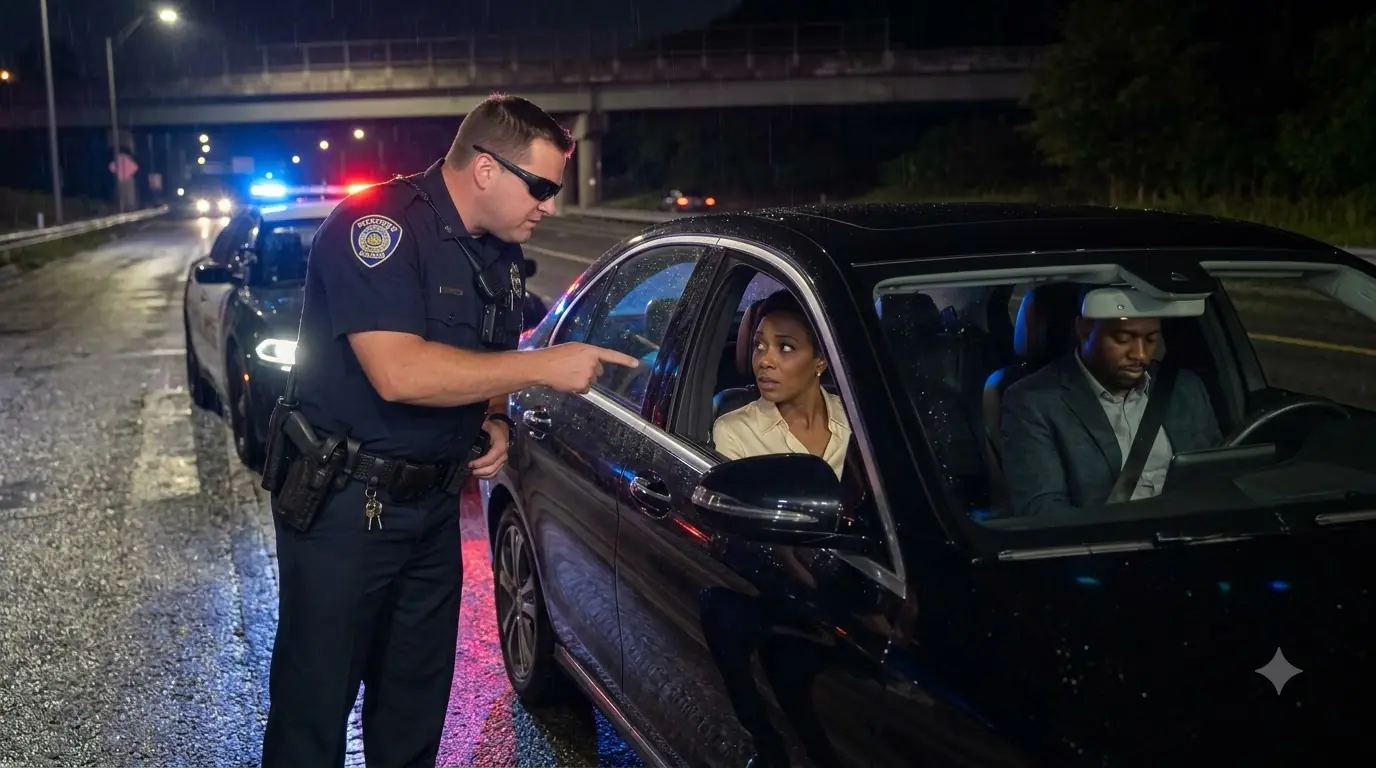
Elise was not the kind of woman who invited chaos.
She was a senior litigation attorney, the kind of lawyer who read fine print for a living and remembered dates other people forgot. Her world was built out of filings, contracts, depositions, and clean language that left very little room for confusion. Tonight, though, she was not thinking about court or clients or settlement strategy.
She was thinking about getting home.
In the passenger seat beside her, her husband, Marcus Whitfield, was asleep so deeply he seemed carved into the shadows. His seat was reclined, his dark wool coat pulled across his chest, and the side of his face was barely visible beneath the dim amber light from the dashboard. He had barely made it through the charity gala downtown before a migraine hit him so hard he had to take prescription medication in the parking garage.
Within fifteen minutes, he was gone.
Not lightly sleeping.
Gone.
Marcus had been appointed chief of police for the city of Ravensbrook only four months earlier. He had been brought in from outside after three lawsuits, two suspicious internal clearances, and one leaked video had turned the department into a national embarrassment. Since taking the job, he had worked eighty-hour weeks, fought the police union, fired two commanders, reassigned a corrupt narcotics unit, and slept less than any doctor would recommend.
Tonight was supposed to be the first quiet ride home in weeks.
Elise turned the jazz on the radio down to a whisper and glanced at him once. Even in sleep, his jaw looked tight, as if the department’s problems had followed him into the passenger seat. She almost reached over to touch his hand, then decided to let him sleep.
They were twelve minutes from home.
Then red and blue lights exploded behind her.
The entire cabin flashed with color. The rearview mirror filled with glare. A siren chirped twice, sharp and demanding, cutting through the rain like a command shouted into her chest.
Elise’s heart jumped before her mind caught up.
It did not matter that she was wealthy.
It did not matter that she was educated.
It did not matter that the man sleeping beside her was the most powerful law enforcement officer in the city.
She was a Black woman driving a luxury car after midnight on a dark stretch of road, and that old American fear rose in her body before logic could stop it.
“Marcus,” she whispered.
He did not move.
His breathing stayed slow, heavy, medicated.
Elise swallowed, clicked on her turn signal, and guided the Mercedes onto the gravel shoulder of Route 17. She put the car in park, turned on the interior light, rolled down her window all the way, and placed both hands on top of the steering wheel. Open palms. Visible fingers. No sudden movements.
She had never been arrested.
She had never committed a crime.
Still, she knew the posture.
Behind her, a cruiser door opened.
In the side mirror, an officer stepped out into the rain. He took his time, walking slowly through the headlights with the kind of swagger that belonged to men who mistook authority for ownership. He was broad through the shoulders, thick-necked, and his face carried a sneer before he even reached the window.
Officer Ryan Kessler.
Elise did not know his name yet, but Marcus did.
Kessler had been with Ravensbrook PD for eleven years. His file was full of complaints that had been softened, buried, or explained away by supervisors who preferred comfortable lies to hard discipline. Excessive force. Racial profiling. Illegal searches. Hostile conduct during traffic stops.
He was exactly the kind of officer Marcus had been trying to remove.
They had never met face-to-face.
That was about to change.
Kessler stopped just behind Elise’s window, then slammed the metal end of his flashlight against the glass hard enough to make her flinch.
“License, registration, insurance. Now.”
No greeting.
No explanation.
No reason for the stop.
Just command.
Elise blinked as he shoved the flashlight beam into her face. The white light burned across her eyes, bright enough to make the dashboard vanish. Still, she kept her voice calm.
“I didn’t ask for a speech,” Kessler snapped. “Hand them over.”
His right hand rested on the butt of his sidearm.
Elise moved with exaggerated care. She lifted her purse, opened it slowly, removed her wallet, and pulled out her license. Then she took the registration and insurance card from the folder in the console and passed everything through the window.
Kessler snatched them from her fingers.
He looked at the license, then swept the flashlight across the interior of the car. Cream leather. Polished wood trim. Clean floor mats. A designer briefcase in the back seat. The beam passed briefly over the passenger side, where Marcus lay reclined under the dark coat, his face hidden by the angle and the shadows.
Kessler barely looked at him.
To him, the passenger was either asleep, drunk, or irrelevant.
His attention returned to Elise.
“Elise Whitfield,” he read slowly, dragging her name like he had found it suspicious. “This is a lot of car to be driving around at one in the morning.”
Elise held his gaze. “The car belongs to me, officer. The registration confirms that.”
He gave a short laugh. “That right?”
“Yes.”
“What exactly do you do that pays for something like this?”
Elise felt heat rise behind her sternum, but she did not let it reach her face. “I’m a senior litigation partner at Whitman, Cross and Bell downtown. May I ask why I was pulled over?”
Kessler leaned closer. Rainwater dripped from the brim of his hat onto the window frame. He smelled like coffee, mint gum, and wet uniform fabric.
“You were swerving.”
Elise’s brow tightened. “I was not swerving.”
“You calling me a liar?”
“I’m saying my cruise control is set to the speed limit, and the lane assist is active. I have been centered in my lane.”
His eyes narrowed. “You got a mouth on you.”
Elise took a slow breath. “Officer, if you are issuing a citation, please do so. It is late, and we are trying to get home.”
“We?”
“My husband is asleep in the passenger seat.”
Kessler glanced toward the dark passenger side, uninterested. “He drunk?”
“He has a migraine.”
“Convenient.”
Elise’s hands tightened slightly on the wheel.
Kessler noticed.
He smiled.
Men like him liked fear best when it tried to hide under discipline.
“You know,” he said, stepping back half a pace, “now that I’m standing here, I smell something.”
Elise’s stomach dropped.
She knew exactly where this was going.
Kessler lifted his chin and projected his voice, clearly aware of the dash camera running behind him. “Strong odor of marijuana coming from the vehicle.”
“That is false,” Elise said immediately.
His smile widened. “Step out of the car.”
“There is no marijuana in this car. Neither I nor my husband smoke. This vehicle is clean.”
“I said step out.”
Elise looked at his nameplate. “Officer Kessler, I do not consent to a search, and I do not accept your fabricated claim as probable cause.”
His face changed.
Not surprised.
Insulted.
He hated the legal language more than the refusal. He hated that she knew the shape of the trap before he finished building it. He hated being answered instead of obeyed.
“You don’t get to consent when I smell narcotics,” he barked.
“You do not smell narcotics.”
“Step out of the damn car.”
In the passenger seat, Marcus’s eyes opened.
He did not move.
For two seconds, he could not place himself. Rain. Siren light. Highway. Elise’s voice. A male officer outside the window, aggressive, escalating, lying.
The migraine medication still weighted his body, but training cut through it like a blade.
He recognized the voice.
Ryan Kessler.
Marcus had spent part of that very morning reading Kessler’s Internal Affairs history. He had been deciding whether there was enough legal support to terminate him immediately or whether they needed one more incident that would survive union arbitration.
Now, lying in the darkness beside his wife, Marcus understood the incident had arrived.
His first instinct was to sit up.
His second was better.
If he revealed himself too soon, Kessler would retreat. He would apologize, blame the rain, claim he had misunderstood, and bury the stop under polished report language. It would become another complaint, another denial, another union fight.
But if Marcus stayed still a little longer, Kessler would show the truth on camera.
And if backup arrived, the whole department would show whether rot traveled alone or in groups.
Marcus slowly moved one hand beneath the coat and reached toward Elise’s thigh. He gave her two firm squeezes.
Their old signal.
I am awake.
I am here.
Trust me.
Elise’s body went still for half a heartbeat.
She did not look at him.
She did not give him away.
But something changed in her posture. The fear that had been isolating her snapped into something colder and stronger. She was not alone in the dark anymore. She was an attorney sitting inside evidence as it unfolded.
Kessler grabbed the shoulder microphone clipped to his uniform.
“Dispatch, Unit Twelve. I’ve got a 10-15 on Route 17, mile marker 22. Driver is combative, refusing lawful orders, suspected narcotics in the vehicle. Send backup code three.”
Elise’s pulse kicked at the word.
Combative.
That word had done more damage than most weapons. It could turn still hands into danger. It could turn a calm voice into aggression. It could turn a lie into paperwork.
“I am sitting still with my hands visible,” Elise said clearly. “I am not combative. I have not threatened you. I have not refused identification. You are escalating without legal basis.”
Kessler leaned into the open window, his face hard and close.
“Last chance, Elise. You unbuckle that seat belt and step out, or I drag you out by that expensive hair and charge you with resisting.”
“If you reach into my car,” Elise said, voice steady now, “you will be violating my Fourth Amendment rights.”
Kessler laughed.
It was a cruel sound, loose and confident in the rain.
“Oh, I love it,” he said. “You want to play lawyer. Good. When the boys get here, we’re going to tear this pretty little car apart, find what you’re hiding, impound it, and let you explain your rights from county lockup.”
In the shadows, Marcus’s jaw tightened.
His hands stayed still.
His eyes stayed open.
Keep talking, Ryan, he thought.
Keep digging.
The backup sirens arrived fast.
Two cruisers tore around the bend and braked hard behind Kessler’s unit, tires throwing dirty water into the shoulder. Their headlights boxed the Mercedes in. Doors opened, and three officers stepped out into the freezing rain.
The first was a rookie, Officer Caleb Price, thin and nervous, one hand hovering near his taser like he had been trained by fear instead of judgment.
Behind him came Sergeant Dale Rowan, a twenty-year veteran with tired eyes and the reputation of a man who looked away when looking would cost him. The third officer stayed closer to the cruisers, scanning the highway with his flashlight.
Kessler’s confidence expanded the moment he saw them.
“Got a good one,” he called out. “Driver swerving all over the lane, vehicle smells like weed, and now she wants to argue constitutional law.”
Sergeant Rowan approached the driver’s side and shined his flashlight into Elise’s face. “Ma’am, step out of the vehicle.”
Elise kept her hands visible. “Sergeant, I want your body camera to record that I do not consent to a search. I have told Officer Kessler there are no narcotics in this vehicle, and his claim of smelling marijuana is false.”
Rowan scoffed. “Officer says he smells contraband. That gives us probable cause.”
“No, it gives you his assertion.”
“That’s enough for tonight.”
Kessler pulled the driver’s door open hard enough that the hinges popped. Rain blew into the cabin. Elise unbuckled slowly and stepped out with her hands raised.
The cold rain soaked her blouse immediately.
Officer Price moved in too fast and grabbed her by the upper arm. He pushed her against the rear quarter panel of the Mercedes, patting her down with nervous aggression. Elise stared straight ahead, jaw tight, as water ran down her face and the side of her neck.
“She’s clean,” Price muttered.
Kessler grunted. “Watch her.”
He leaned into the driver’s side and began searching with his flashlight. He opened the center console. Looked under the seat. Checked the door compartment. Found nothing but napkins, a phone charger, and a small bottle of hand sanitizer.
His frustration grew.
He wanted evidence because evidence would make the lie feel righteous.
When the driver’s side gave him nothing, he slammed the door and marched around the front of the car. The headlights caught him in flashes through the rain. He reached the passenger side, grabbed the chrome handle, and yanked the door open without knocking.
“All right,” he said, shoving his flashlight inside. “Let’s see what you’re hiding over—”
The words stopped.
Not faded.
Stopped.
The flashlight beam struck the passenger seat. It caught the dark wool coat, the broad shoulders beneath it, and the face of the man now sitting upright in the shadows.
Marcus Whitfield did not blink.
He stared directly into the light with the calm fury of a man who had heard every word and memorized all of it.
For three seconds, the only sound on Route 17 was rain ticking against metal.
Kessler’s brain seemed to fail all at once.
He knew that face.
Every officer in Ravensbrook knew that face. It had been on the front page of the city paper for months. It hung in the lobby of headquarters. It appeared in every internal email sent after the new reform plan. The face belonged to the man who had fired Deputy Chief Arlen Blake his first week and reassigned half the old command staff by the second.
Chief Marcus Whitfield.
Kessler took one stumbling step backward.
“Chief?”
His voice came out thin and strange.
Marcus reached up slowly and pushed the flashlight beam away from his face.
“Officer Kessler,” he said.
He did not shout.
He did not need to.
The quiet was worse.
“Are you absolutely certain you smelled marijuana in this vehicle?”
Kessler’s hand shook so badly that the flashlight beam jumped across the wet pavement. “Chief, I—”
Marcus unbuckled his seat belt and stepped out of the car.
He stood to his full height, tall and broad, coat slipping from one shoulder, eyes locked on the officer who had just threatened his wife. Rain hit his face, but he did not wipe it away.
“If you smelled marijuana in this vehicle,” Marcus said, “then you are alleging that your chief of police is transporting narcotics. Is that your official statement?”
Across the roof of the car, Sergeant Rowan stared at him in horror.
Officer Price released Elise’s arm and backed away like he had touched fire.
“Chief Whitfield,” Rowan blurted. “We didn’t know. Kessler called it in as a combative suspect. We were responding to backup.”
Marcus did not look at him yet.
His eyes stayed on Kessler.
“I asked you a question.”
Kessler swallowed. “It was raining. The window was open. Maybe I smelled something from outside. I was trying to do my job.”
“Your job?”
Marcus’s voice finally cracked like a whip.
Elise had heard that tone only once before, during a city council hearing when Marcus exposed a commander for falsifying use-of-force statistics. It was not anger without control. It was control sharpened into anger.
“Your job is to protect the people of this city,” Marcus said. “Your job is to uphold the law. Not to invent probable cause because a Black woman in a luxury car refused to be frightened enough for you.”
Kessler’s mouth opened, then closed.
“I listened to you mock my wife,” Marcus continued. “I listened to you question her ownership of her own vehicle. I listened to you threaten to drag her out by her hair. I listened to you fabricate the odor of narcotics to justify an illegal search.”
He pointed to the body camera on Kessler’s chest.
“And I am grateful your camera is recording, because District Attorney Alana Pierce is going to want every second of that footage.”
Kessler’s knees bent slightly.
“Prosecution?” he whispered.
Marcus stepped closer. “Yes.”
“Chief, please. I have fifteen years. I have a pension. I have a family.”
“You had my wife standing in the rain while you lied about her being a criminal.”
“I didn’t know she was your wife.”
Marcus’s eyes hardened. “That is not the excuse you think it is.”
The rain came harder.
No one moved.
Marcus turned his head toward Rowan and Price. Both men snapped straighter before he said their names.
“Sergeant Rowan. Officer Price.”
“Yes, Chief,” they answered almost together.
“Release Mrs. Whitfield immediately.”
Price lifted both hands, panicked. “Yes, sir. I’m sorry, ma’am. I’m sorry.”
Elise stepped away from the car slowly, smoothing her soaked blouse with both hands. Her face was calm now, but not soft. She walked to Marcus’s side and stood there, rain sliding from her hair to her shoulders.
Marcus looked at Rowan.
“You will approach Officer Kessler. You will remove his duty belt, badge, and sidearm. You will place him in the back of your cruiser. He is under arrest for official misconduct, filing a false report, unlawful detention, and terroristic threats. District Attorney Pierce can decide what else fits by morning.”
Rowan hesitated.
Only a fraction of a second.
Marcus saw it.
“If you hesitate again,” he said, voice dropping dangerously low, “you will be sitting beside him.”
Rowan moved.
He approached Kessler with both hands visible. “Turn around, Ryan.”
Kessler looked at him like betrayal had a face. “Dale, come on.”
“Turn around.”
Kessler’s shoulders slumped.
The man who had swaggered up to Elise’s window now looked smaller than his uniform. Rowan removed the gun first, then the badge, then the duty belt. Price stepped in and cuffed him with shaking hands.
The steel clicked.
Kessler began crying when the cuffs tightened.
Not quietly.
Not with dignity.
Openly, childishly, as if consequences were a cruelty being done to him instead of a mirror being held up.
“Please, Chief,” he said. “Please. I made a mistake.”
Marcus looked at him. “A mistake is turning onto the wrong road. You built a false felony stop one lie at a time.”
Rowan guided Kessler to the cruiser and put him in the back seat.
The door slammed.
For a moment, the scene was almost quiet again.
Just rain.
Engines.
Flashing lights.
A beautiful car on the shoulder.
A Black woman standing soaked beside her husband, watching a man learn too late that power can change direction.
Marcus turned to Rowan.
“At 0600 hours, I want Internal Affairs Commander Lucinda Vale in my office. I want every traffic stop, arrest, search, use-of-force incident, and complaint involving Officer Kessler reviewed for the last ten years.”
Rowan nodded quickly. “Yes, Chief.”
“And every supervisor who cleared him.”
Rowan swallowed.
“Yes, Chief.”
Marcus stepped closer. “If anyone alters, loses, delays, edits, or forgets a single file, I will dismantle their career personally and legally. Is that clear?”
“Crystal clear.”
“Good. Take him to central booking. Process him like any other violent suspect.”
Rowan returned to his cruiser.
The officers drove away in a clumsy line, red and blue lights fading into the rain until the highway became dark again. The shoulder felt suddenly larger without them. The night had not become safe, exactly, but the danger had been removed from the road and placed behind metal mesh.
Marcus turned to Elise.
The chief disappeared.
Her husband remained.
He reached out and gently wiped a raindrop from her cheek with his thumb.
“Are you hurt?”
“No,” she said.
“Did he hurt your arm?”
She looked down at the place where Price had grabbed her. “It’ll bruise.”
Marcus’s jaw tightened.
Elise touched his wrist. “Don’t go back into chief mode. Not yet.”
He exhaled slowly.
“I heard everything.”
“I know.”
“I should have sat up sooner.”
“No,” Elise said. “You did exactly what you had to do.”
Marcus looked at the highway behind them, where the lights had vanished. “I hated it.”
“So did I.”
For a moment, neither of them spoke.
Rain tapped softly on the roof of the Mercedes. Somewhere beyond the trees, a truck passed in the opposite lane, its tires hissing over wet asphalt. The world kept moving, indifferent as ever, but inside the quiet between them, something had shifted.
Elise opened the driver’s door and glanced at the soaked seat.
Marcus walked around and opened the passenger side for her instead. “I’ll drive.”
“You were unconscious twenty minutes ago.”
“I am very awake now.”
Despite everything, she almost smiled.
They switched seats.
Marcus adjusted the mirrors, turned down the heat, and pulled the car back onto Route 17. Elise sat beside him wrapped in his coat, arms folded, watching the rain run across the window. Her face reflected faintly in the glass, calm but tired.
“Do you know what scares me?” she asked.
Marcus glanced at her.
“He did not change because he realized I was a person,” she said. “He changed because he realized who you were.”
Marcus said nothing.
Because there was no defense against that truth.
“He was ready to take me to jail,” Elise continued. “He was ready to write me up as combative. He was ready to search my car, invent evidence, maybe worse. And the only reason it stopped is because his boss happened to be in the passenger seat.”
Marcus gripped the wheel a little tighter.
“That is exactly why tomorrow does not stop with Kessler.”
Elise turned toward him. “Good.”
At 5:42 a.m., Marcus walked into Ravensbrook Police Headquarters.
He had not slept.
Neither had Elise.
She came with him, hair pulled back, arm already bruising, wearing dry clothes and the expression of a woman prepared to turn trauma into a record. Marcus wore his dark suit, no tie, and the kind of quiet on his face that made officers step out of his path before they understood why.
At 6:00 sharp, Commander Lucinda Vale entered his office.
She was Internal Affairs through and through. Gray hair, square glasses, no patience for charm. She had transferred in with Marcus from another city and had a reputation so severe that officers called her “the audit” when they thought she could not hear them.
She could usually hear them.
Marcus handed her a folder.
“Ryan Kessler. Last ten years. Every stop, every complaint, every search, every dismissed allegation, every supervisor who signed off.”
Lucinda opened the folder and read the first page.
Her mouth tightened.
“How wide do you want this?”
Marcus looked through the glass wall toward the bullpen, where officers pretended not to watch.
“All the way.”
The audit began that morning.
By noon, Kessler’s body-camera footage had been preserved and transferred. By two, the dash-camera audio had been extracted. By sunset, Lucinda’s team had identified twenty-three complaints that matched the same pattern.
Late-night stops.
Black drivers.
Luxury vehicles.
Claims of odor.
Escalation after legal objections.
Searches that found nothing.
Reports using the same words: combative, nervous, evasive, furtive movements.
Four drivers had lost jobs after arrests that were later dismissed.
Two had paid thousands in legal fees.
One woman had spent a weekend in county jail because she refused to let Kessler search her trunk without cause.
Another man had his car impounded, then sold at auction before his case was thrown out.
The rot was not a bad stop.
It was a business model.
Elise read the early summary at Marcus’s conference table with a yellow highlighter in her hand. She marked repeated phrases, supervisor approvals, missing body-camera gaps, and identical report language. Lawyer mode had returned fully now, and the bruise on her arm only made her quieter.
Quiet, Marcus had learned, was when Elise became most dangerous.
“This is not just Kessler,” she said.
“I know.”
“Rowan appears on seven approvals.”
“I know.”
“The old deputy chief signed three complaint closures without interviewing the complainants.”
“I know.”
Elise looked up. “Then you know this needs to leave the building.”
Marcus nodded. “It will.”
The next morning, he stood before the press.
He did not soften it.
He did not talk about isolated incidents.
He did not hide behind process.
He told the city that Officer Ryan Kessler had been arrested after an unlawful traffic stop, false probable-cause claim, and threat against a civilian. He told them the civilian was his wife, but the investigation would not be limited to her case. He announced a full external review of traffic stops, search practices, complaint closures, and supervisor accountability.
A reporter asked whether he was taking the incident personally.
Marcus stared at him for a moment.
“Yes,” he said. “Because every citizen should be personal to this department.”
That clip traveled fast.
So did the body-camera footage.
The city watched Kessler shine the light into Elise’s face. They heard him ask whose car it was. They heard him claim marijuana. They heard him threaten to drag her out by her hair. They saw the passenger door open. They saw the exact second his face changed.
People replayed that moment over and over.
Not because it was funny.
Because it revealed the truth too cleanly.
The law had not changed when Marcus sat up. The facts had not changed. The car had not changed. Elise had not changed. Only Kessler’s understanding of her proximity to power changed, and that was the entire problem.
District Attorney Alana Pierce filed charges within forty-eight hours.
Official oppression.
Filing a false police report.
Unlawful detention.
Terroristic threats.
Attempted illegal search under color of law.
The union tried to defend him.
For six hours.
Then more footage surfaced.
Three prior stops. Same tone. Same claim. Same swagger. Same collapse of courtesy when citizens knew their rights.
By the end of the week, the union representative released a statement about respecting due process and declined further comment.
Kessler’s trial took place eight months later.
Elise testified first.
She wore a navy suit and spoke with the same clarity she had used on the roadside. She did not exaggerate. She did not cry. She did not need to. She explained the stop, the false odor claim, the threat, the way the word combative turned her stillness into danger.
Marcus testified the next day.
The defense attorney tried to suggest he had set Kessler up.
Marcus did not blink.
“I was asleep,” he said. “Officer Kessler created the situation without my help.”
The courtroom went very quiet.
The body-camera footage did the rest.
The jury convicted Kessler on all major counts.
He received four years in state prison, loss of certification, and a lifetime ban from law enforcement employment in the state. Sergeant Rowan was not criminally charged, but he was terminated for failure to intervene, false support of an unlawful stop, and approving prior deficient reports. Officer Price kept his job only after testifying fully, completing remedial training, and accepting a two-year probationary discipline agreement.
Lucinda’s audit lasted eleven months.
When it ended, Ravensbrook PD looked different.
Seven officers terminated.
Three supervisors demoted.
Fourteen cases reopened.
A new policy requiring articulable, documented facts for vehicle searches.
Mandatory supervisor review for every odor-based probable cause claim.
Automatic release of body-camera footage to an independent review unit when complaints involved racial profiling or unlawful search allegations.
A civilian oversight board with subpoena power.
And one line Marcus ordered printed at the front of every field training manual:
A citizen knowing their rights is not suspicious behavior.
Elise framed a copy for his office.
He hated that she did.
He kept it anyway.
One year after the stop, Marcus and Elise drove home from another late event downtown.
This time, Elise was in the passenger seat.
Marcus drove.
Rain tapped lightly against the windshield, softer than it had that night, almost gentle. Route 17 stretched ahead, dark and wet beneath the streetlights. When they passed mile marker 22, Elise turned her head toward the shoulder.
Marcus noticed.
“You okay?”
She watched the place where the stop had happened.
For a moment, she could still see the lights. Feel the cold rain. Hear Kessler’s voice. Feel Marcus’s hand squeezing her thigh beneath the coat.
Then she looked forward.
“I’m okay.”
Marcus nodded.
They drove in silence for another mile.
Then Elise said, “I still think about what would have happened if you weren’t there.”
Marcus did too.
Every week.
Every time the audit uncovered another stop.
Every time a civilian complaint arrived with shaking voice and familiar language.
Every time an officer rolled his eyes during training and then quickly stopped when Marcus looked over.
“That’s why the work continues,” he said.
Elise reached over and rested her hand on his.
“Good.”
The Mercedes moved through the rain, steady and centered in its lane.
Behind them, no lights flashed.
No siren broke the night.
No officer invented danger out of dignity.
Not that night.
And not, Marcus hoped, as easily ever again.
Because one corrupt officer had thought he was stopping a Black woman alone in a luxury car after midnight.
He thought she was an easy target.
He thought the sleeping man beside her did not matter.
But the man in the passenger seat had heard everything.
And by the time Chief Marcus Whitfield opened his eyes, Officer Ryan Kessler had already written the end of his own career.