“My name is Judge Vivian Hart. You can verify that before this becomes worse.”
Sergeant Mason Crowe laughed in the middle of the wine aisle.
“A judge?” he said. “Sure. And I’m the governor. People like you always have a title when trouble starts.”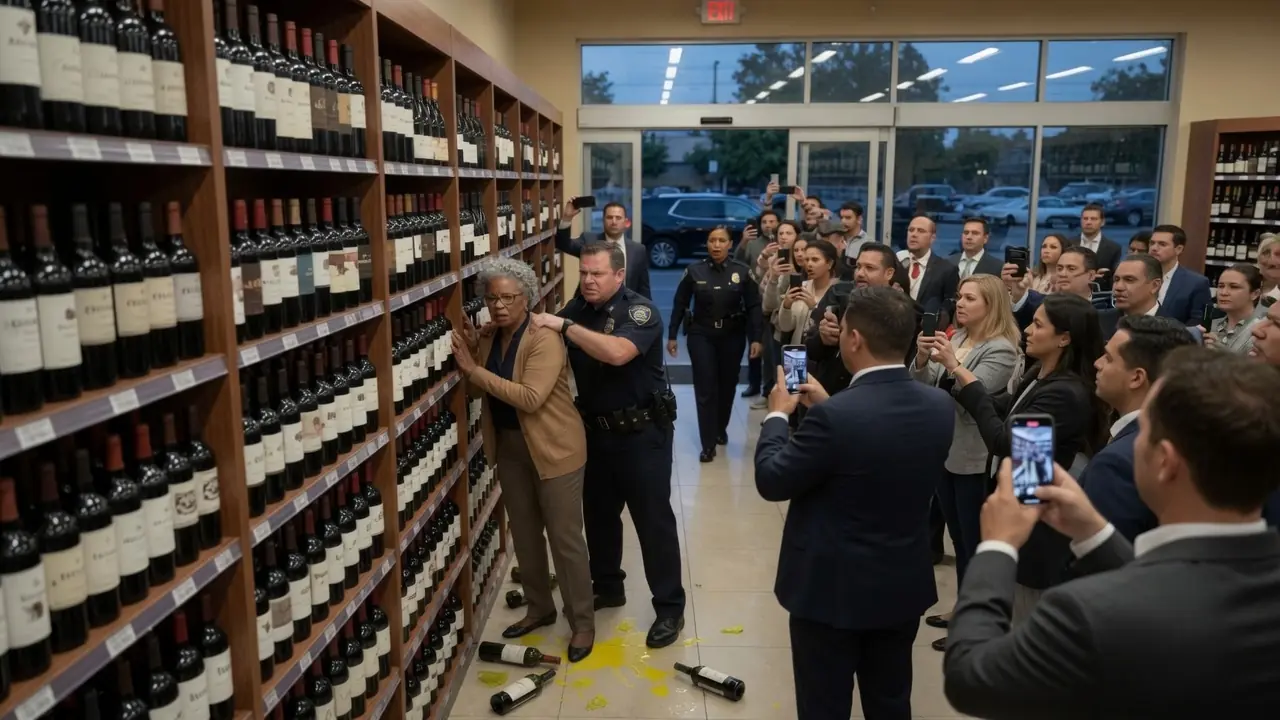
Vivian Hart stood still with both hands raised, palms open, her purse hanging from her left wrist and a bottle of Bordeaux sitting untouched on the shelf beside her. Soft jazz floated through the speakers of Bellweather Market, the kind of polished grocery store where the cheese counter had marble displays, the carts rolled quietly, and a single bottle of wine could cost more than a family’s electric bill.
It was 7:46 on a Wednesday evening in Laurel Ridge, a suburb where lawns were professionally trimmed and people liked to believe bad things happened somewhere else.
Vivian had stopped there on her way home from court. She was fifty-nine years old, a Black woman with short silver curls, reading glasses low on her nose, and a camel cardigan over a navy blouse and slacks. After ten hours of motions, sentencing memos, and two attorneys arguing as if volume could replace law, all she wanted was salmon, green beans, and a decent bottle of wine for dinner.
For twenty-four years, she had served on the federal bench.
She had sentenced corrupt officials, ruled on civil-rights cases, overturned illegal searches, and written opinions that were cited in law schools across the country. Lawyers stood when she entered a courtroom. Marshals lowered their voices around her. Defendants who had sworn they feared no one learned quickly that Judge Vivian Hart did not need volume to command a room.
But none of that mattered in Bellweather Market.
Not to Mason Crowe.
Not before he knew her name.
Not before cameras captured what assumptions could become when a badge gave them permission.
The first thing Crowe saw when he entered the store was not conduct.
It was color.
He had been dispatched to Bellweather after an anonymous caller reported a “suspicious woman” in the wine section. No theft. No weapon. No threat. Just a woman who, according to the caller, looked “out of place” and had been standing near expensive bottles for too long.
Crowe did not ask dispatch for more.
He did not need more.
At forty-six, with nineteen years on the force, Mason Crowe had built a career out of calling his instincts evidence. His supervisors described him as firm, experienced, and proactive. His personnel file, the sealed one the public was never supposed to see, told a different story.
Twenty-nine complaints in fourteen years.
Excessive force.
Racial profiling.
Illegal searches.
Threats during routine encounters.
Every one had been dismissed as unfounded, misunderstood, or unsupported by evidence. The city had paid settlements quietly. Internal Affairs had called each case isolated. Crowe had learned the oldest lesson bad officers learn inside weak systems: if you write the report first, the truth has to fight uphill.
His partner that evening was Officer Jared Ellis.
Jared was thirty-one, six years on the job, and known around the department as reliable. In practice, reliable meant he never complicated another officer’s story. He did not ask hard questions. He did not challenge senior cops. He had seen enough misconduct to know what it looked like and enough department politics to know silence was safer than integrity.
He followed Crowe through the automatic doors of Bellweather Market and into the soft-lit luxury of the store.
Crowe scanned the produce section, the deli counter, the bakery, the polished checkout lanes.
Then his eyes stopped on Vivian Hart.
The only Black customer in the wine aisle.
She was reading the back label of a Bordeaux with the careful concentration of a woman deciding whether the bottle was worth the price. Her cart held salmon, asparagus, a loaf of sourdough, lemons, and a small box of sea salt crackers. Nothing about her behavior suggested danger.
That did not matter.
Crowe’s hand drifted toward his belt as he walked toward her.
Vivian sensed him before he spoke. Judges spend years learning the temperature of a room. She knew the difference between someone passing by and someone approaching with purpose. She placed the bottle back on the shelf and turned.
Crowe stopped three feet from her.
“What are you doing here?”
The question was not a question.
Vivian looked at his uniform, then his nameplate.
“Good evening, Sergeant. I’m shopping.”
“At this hour?”
“It is not yet eight o’clock.”
“In this store?”
Vivian paused.
That was the first true warning.
Not because the question was loud, but because it revealed the world inside his head.
“Yes,” she said. “In this store.”
Crowe looked at her cart, then at her purse, then back at her face.
“I need to see some identification.”
Vivian’s expression remained calm. “On what grounds?”
“That is not a legal basis.”
Behind him, Jared shifted slightly.
Vivian noticed.
So did Crowe.
The sergeant stepped closer. “Ma’am, don’t start with me.”
“I am not starting anything. I am asking why an officer is demanding identification from a person shopping in a grocery store.”
“We got a call.”
“What did the caller report?”
“A suspicious person.”
“What suspicious conduct?”
Crowe’s eyes hardened. “That’s what I’m determining.”
“No,” Vivian said. “You are detaining first and hoping suspicion will explain itself later.”
The jazz music kept playing.
Somewhere near the cheese counter, a shopper laughed softly at something before realizing the mood had changed. A stock clerk pushing a cart of sparkling water stopped at the end of the aisle. A woman in a gray coat looked over from the bakery.
Crowe’s face flushed.
“Empty your pockets.”
Vivian stared at him.
“No.”
The word landed cleanly.
Crowe blinked once. “Excuse me?”
“You have no probable cause, no reasonable suspicion that I am armed, and no lawful basis to search me.”
Crowe gave a short laugh.
“You people always learn just enough law to make things difficult.”
Jared looked down.
Vivian heard the phrase.
So did the store.
She took a slow breath. “Sergeant Crowe, I am Judge Vivian Hart of the United States District Court. My identification is in my purse. You may verify that in thirty seconds if you allow me to retrieve it.”
Crowe smiled with open contempt.
“A federal judge. Right.”
“I advise you to slow down.”
“I advise you to empty your pockets.”
“You are making a serious mistake.”
“No,” he said, stepping closer. “You are.”
Vivian moved her hand slowly toward her purse.
It was the movement he had demanded and the movement he would use against her.
Before her fingers reached the zipper, Crowe shouted.
“Hands! Stop reaching!”
Vivian froze instantly, both hands rising to shoulder height.
“My identification is in the purse,” she said clearly. “You asked for identification.”
“You were reaching for a weapon.”
“No, Sergeant. I was complying with your demand.”
The contradiction was captured by four store cameras.
An officer demanding ID.
A woman reaching for ID.
The same officer treating compliance as a threat.
Crowe grabbed Vivian by the shoulder and spun her toward the wine shelf.
The force of it knocked her reading glasses crooked. Several bottles rattled. One toppled, hit the tile, and shattered. Red wine spread across the floor like a dark stain opening beneath their feet.
“Hands on the shelf.”
Vivian placed both hands flat against the wood.
Her voice stayed steady.
“I do not consent to this search. I am complying under duress.”
“Stop talking.”
“I am documenting my objection.”
“I said stop talking.”
Crowe kicked her feet apart with his boot.
The humiliation was deliberate.
Vivian knew it the way she knew the shape of a false police report before the second page. This was not officer safety. This was dominance. This was a man teaching a lesson to someone who had dared answer him with law.
His hands moved across her body in a search that went far beyond a pat-down.
Rough.
Invasive.
Punitive.
Jared stood behind him and watched.
He said nothing.
Vivian closed her eyes for one second and reopened them.
Her mind separated from the shame because it had to.
Left shoulder grabbed.
Right wrist twisted.
Search exceeds Terry frisk.
No articulable suspicion.
Racial remark witnessed.
Partner failed to intervene.
Everything became evidence.
A retired librarian named Helen Morris stood at the end of the aisle with one hand over her mouth. She was seventy-two and had spent forty years teaching students how to read not only words, but the world behind them. She knew wrong when she saw it.
A young married couple, Priya and Daniel Shah, both still wearing scrubs from Laurel Ridge Medical Center, watched from near the organic produce. They did not speak. They simply pulled out their phones and began recording.
A man named Robert Gaines, a retired Army sergeant major with a straight back and a weathered face, stepped closer from the deli section.
His voice carried.
“I’m witnessing an unlawful search of a compliant civilian.”
Crowe turned his head. “Back up.”
Robert did not move. “I will provide a sworn statement.”
“I said back up before I arrest you for obstruction.”
Helen Morris’s voice cut in, sharp and clear.
“You should be ashamed of yourself.”
Crowe glared at her. “Ma’am, this is police business.”
“No,” Helen said. “This is bullying with a badge.”
The aisle went still.
Crowe’s search found nothing.
Because there was nothing to find.
No weapon.
No stolen merchandise.
No reason for any of this.
Vivian kept her hands on the shelf and spoke clearly enough for every phone and microphone to catch.
“My name is Vivian Hart. I am a federal judge for the United States District Court. I have not consented to this search. I have been detained without legal cause, searched without reasonable suspicion, and subjected to excessive force.”
Crowe laughed again.
“You hear that, Ellis? We got ourselves a Supreme Court justice in the wine aisle.”
Jared’s face tightened.
Still, he said nothing.
Vivian turned her head slightly. “Am I free to leave?”
It was the question that should have ended the encounter.
Instead, it broke something in Crowe.
Maybe it was the phones. Maybe it was the witnesses. Maybe it was the calm in her voice, the refusal to beg, the refusal to shrink. Maybe it was the fact that the woman he had tried to reduce to suspicion still sounded like the most authoritative person in the aisle.
His hand shot out.
He grabbed her arm and twisted it violently behind her back.
Pain flashed across Vivian’s face, but she did not fight him.
Crowe drove her forward.
Her forehead struck the metal edge of the wine shelf with a sickening sound.
More bottles crashed down.
Glass exploded against the tile.
Red wine splashed across Vivian’s cardigan, the floor, the broken lenses of her reading glasses. Blood opened at her hairline and ran down the side of her face.
Priya screamed.
Robert shouted, “That is assault!”
Crowe forced Vivian down to the floor, his knee pressing into the center of her back, pinning her among broken glass and spilled wine.
Vivian did not resist.
She let her body go still, an old survival instinct older than any courtroom. She knew how officers wrote reports. She knew how body movement became resistance when truth was inconvenient. She knew that even pain had to be managed carefully when the person hurting you controlled the language of the arrest.
Crowe yanked her wrists behind her.
The cuffs snapped tight.
Too tight.
Metal cut into skin already strained from the twist.
Vivian’s breath caught.
Jared finally stepped forward half a step.
“Mason,” he said quietly.
Crowe snapped, “Control the crowd.”
Jared looked at the phones, the blood, the glass.
Then he stepped back.
It was the most important failure of his life.
Crowe hauled Vivian to her feet without regard for the blood running down her face. She swayed for one second. Robert moved as if to help, but Crowe pointed at him.
“Don’t touch my suspect.”
“She needs medical attention,” Robert said.
“She needs jail.”
Vivian lifted her head.
Blood had reached her cheek now, dark against her skin.
Her voice, when it came, was low but unmistakable.
“Sergeant Crowe, for every camera recording this, I am Judge Vivian Hart of the United States District Court for the Northern District. You are violating my constitutional rights, falsifying the basis for an arrest, and assaulting a federal officer of the court.”
For one second, Crowe froze.
It was brief.
But every camera caught it.
A flicker of fear.
Then he doubled down.
“I don’t care if you’re the Queen of England,” he said. “You’re going in for resisting arrest, disorderly conduct, and assaulting an officer.”
Every word was false.
The cameras already knew it.
The witnesses knew it.
Vivian knew it.
But Crowe had spent nineteen years trusting paperwork to outlive truth.
He shoved her toward the front of the store.
Arthur Medina had managed Bellweather Market for seventeen years.
He knew the regulars, the staff, the delivery drivers, the customers who liked help and the customers who preferred distance. He had built that store into the most profitable location in the region by making it feel calm, safe, and dignified.
He was in the back office reviewing inventory when a teenage stock clerk burst in.
“Mr. Medina, there’s blood in the wine aisle. A cop hurt a woman.”
Arthur was moving before the sentence finished.
When he reached the front, he saw broken bottles, red wine, a crowd with phones raised, and a Black woman in handcuffs with blood on her face being pushed toward the exit by Sergeant Mason Crowe.
Arthur stepped in front of the automatic doors.
He was not a large man, but in that moment he seemed impossible to move.
“What happened?”
Crowe barked, “Step aside.”
Arthur looked at Vivian’s forehead. “Why is my customer bleeding?”
“She’s under arrest.”
“For what?”
“Obstruction and assault.”
Arthur glanced at the cameras above the wine aisle, then the cameras above the registers, then the one above the exit.
“This store records in high definition from every angle,” he said. “With audio.”
Crowe’s expression shifted.
Not much.
Enough.
Arthur pulled out his phone.
“I’m calling corporate counsel, and then I’m calling Chief Marisol Vega directly.”
“Do that and I’ll arrest you too.”
Arthur’s eyes hardened. “Then you’ll do it on nine cameras.”
He made the calls.
The power in the store changed while he spoke.
Crowe felt it.
Vivian felt it.
The witnesses felt it too, because suddenly the man with the badge no longer controlled the room alone.
Chief Marisol Vega arrived fourteen minutes later in an unmarked black SUV.
Chiefs do not respond personally to ordinary grocery-store incidents. They send lieutenants, captains, statements, excuses. But Arthur Medina’s voice had told her this was not ordinary, and the first sentence he spoke had been enough to make her leave a city budget meeting without explanation.
A Black woman in handcuffs.
Bleeding.
Multiple witnesses.
Officer Crowe.
That last name had done the rest.
Vega entered Bellweather Market and stopped just inside the doors.
She saw Vivian sitting in a chair near the customer-service desk now, still cuffed, a folded towel pressed to her forehead by Priya Shah. She saw Mason Crowe standing rigid near the exit. She saw Jared Ellis pale beside him. She saw the crowd of witnesses who had refused to leave.
Vega had been chief for six years.
She knew a disaster when it looked back at her.
“Body camera,” she said to Crowe.
He answered too fast. “It malfunctioned.”
Vega’s eyes narrowed. “Of course it did.”
“It wasn’t recording properly.”
“When did it fail?”
“I’m not sure.”
She turned to Jared. “Yours?”
Jared swallowed. “Mine was on.”
Crowe looked at him sharply.
That look told Vega almost as much as the footage would.
She walked to Vivian.
“Ma’am, I’m Chief Marisol Vega. I’m going to have those cuffs removed, and medics are on the way.”
Vivian looked up at her, blood still running along the side of her face.
“My name is Judge Vivian Hart.”
The chief went very still.
Vivian continued.
“United States District Court for the Northern District.”
The silence that followed was heavy enough to press against the walls.
Chief Vega turned slowly toward Crowe.
His face had lost color.
“Remove the cuffs,” she said.
Crowe opened his mouth.
“Now.”
Jared fumbled for the keys.
The cuffs came off, revealing deep red marks already turning purple around Vivian’s wrists. She flexed her fingers slowly, pain moving through them in visible waves. The paramedics arrived moments later and began treating the wound above her brow.
It would need stitches.
Maybe surgery.
The bone near her eye might be fractured.
Chief Vega listened to the paramedic, then turned to the store.
“I need every witness to remain available. Officers are coming to take statements. Mr. Medina, preserve every second of footage from every camera. No one deletes anything. No one edits anything. Chain of custody starts now.”
Arthur nodded. “Already locked.”
Vivian lowered the towel from her forehead.
“Chief Vega.”
The chief turned back.
Vivian’s voice had regained the authority of the bench.
“I want Sergeant Crowe’s full personnel history, use-of-force record, citizen complaints, body-camera audit logs, and every case in which Officer Ellis was present during a complaint. I want dispatch audio and the anonymous call preserved. I want the Department of Justice notified tonight.”
Vega did not argue.
“Yes, Your Honor.”
The words changed the store.
Your Honor.
Some witnesses inhaled sharply.
Crowe stared at the floor.
Vega walked to him.
“Badge and weapon.”
Crowe’s jaw tightened. “Chief, you haven’t heard my side.”
“I watched enough standing here.”
“You don’t know what happened.”
“I know a federal judge is bleeding in a grocery store after you claim your body camera failed.”
His hand shook when he removed his badge.
It was a small tremor.
But it was there.
For nineteen years, that badge had opened doors, ended arguments, silenced complaints, and turned fear into compliance. Now it lay in Chief Vega’s palm like ordinary metal.
Jared surrendered his weapon too.
He looked sick.
He should have.
The videos hit the internet before Vivian received her final stitch at Laurel Ridge Medical Center.
Priya and Daniel Shah posted their recordings first. Robert Gaines uploaded his video with a simple caption: I saw this happen. She never resisted. Helen Morris gave an interview from the store parking lot that same night, her voice steady as she told reporters, “I watched an officer hurt a woman because he could, and I watched his partner let him.”
By morning, the videos had been viewed millions of times.
By the next evening, every major network was playing the footage.
Crowe’s approach.
The demand for ID.
Vivian’s calm questions.
The illegal search.
The racial comments.
The slam into the shelf.
The blood.
The cuffs.
There was no convenient ambiguity.
No blurred movement to argue over.
No missing angle.
No audio gap.
The footage was devastating because it left so little room for anyone invested in denial.
Then the leaks began.
Twenty-nine complaints against Mason Crowe.
Fourteen years.
Black teenagers stopped outside their own homes.
A nurse searched in a hospital parking lot after a night shift.
A professor handcuffed outside a library.
A city employee thrown against his car during a traffic stop that began with a broken taillight and ended with a concussion.
Every complaint sounded different in detail and identical in structure.
Crowe saw someone.
Crowe decided they did not belong.
Crowe escalated.
The department dismissed.
Reporters dug through city financial records and found more.
Over $900,000 in settlements tied to Crowe’s conduct.
None publicly acknowledged.
None attached to discipline.
None enough to stop him before Vivian Hart entered a wine aisle in a cardigan and forced the country to see what the city had hidden.
The FBI announced its civil-rights investigation within seventy-two hours.
The Department of Justice followed with a broader pattern-and-practice review of the Laurel Ridge Police Department. Federal officials wanted to know how one officer could accumulate twenty-nine complaints and remain on patrol. They wanted to know how often body cameras “malfunctioned” during controversial encounters. They wanted to know who signed the dismissals.
By Monday morning, Mason Crowe was arrested at his home.
News helicopters circled overhead as FBI agents led him down the front steps in handcuffs.
The charges were federal assault under color of law, deprivation of civil rights, falsifying official reports, obstruction of justice, and evidence tampering connected to the body-camera shutdown. Forensic review showed he had manually disabled his camera forty-two seconds before approaching Vivian in the wine aisle.
Jared Ellis was arrested the same day.
Failure to intervene.
Accessory after the fact.
False reporting.
His silence had finally become a crime with a case number.
Vivian gave one televised statement from her living room a week later.
Fourteen stitches ran above her eyebrow. Bruises circled both wrists. A dark shadow remained beneath one eye where the impact had fractured bone near the socket.
She sat upright, composed, the way she sat on the bench.
“I am a federal judge,” she said. “I had every tool a citizen could have after an unlawful arrest: legal knowledge, public credibility, professional relationships, and video evidence from multiple angles.”
She paused.
“And still, I was injured, humiliated, and falsely accused before help arrived.”
The country listened.
Vivian looked directly into the camera.
“This case is not only about what happened to me. It is about the twenty-nine people who complained before me and were not believed. It is about every person whose encounter was not recorded, whose bruises were explained away, whose complaint was filed into silence.”
Her voice did not shake.
“I will pursue accountability because I can. But this case belongs to the people who could not.”
The trial began five months later.
The courtroom was packed every morning.
Reporters lined the hallway before sunrise. Law students filled the back rows. Former complainants against Mason Crowe sat together on the left side of the gallery, some meeting for the first time, all recognizing pieces of their own stories in one another.
Crowe looked smaller in a suit.
Without the uniform, the belt, the radio, and the performance of authority, he seemed less like the man who had dominated the wine aisle and more like someone stunned that the world had finally stopped cooperating with him.
The prosecution played the footage in full.
No commentary at first.
Just video.
The jury watched Vivian examine a wine bottle.
They watched Crowe approach.
They heard him demand ID.
They heard her ask for legal grounds.
They heard his remark about “people like you.”
They watched him order her to empty her pockets, then treat her attempt to comply as a threat.
They watched the search.
They watched the violence.
They watched blood appear.
By the time the video ended, no one in the jury box looked at Crowe.
The witnesses testified next.
Helen Morris described the scene with the precise outrage of a retired teacher who had spent a lifetime correcting falsehoods.
“She was calm,” Helen said. “He was not. She was reasonable. He was not. And everyone there knew it.”
Robert Gaines testified that Crowe’s use of force was not control, but punishment.
Priya Shah cried on the stand while describing the sound Vivian’s head made against the shelf.
Arthur Medina testified about blocking the doors, preserving the footage, and calling Chief Vega because “what I saw was not an arrest. It was an assault leaving my store.”
Jared Ellis testified under a cooperation agreement.
He admitted Crowe had no lawful basis to detain Vivian. He admitted Crowe disabled his camera intentionally. He admitted he had seen similar conduct before and had helped write reports that made the encounters look justified.
The courtroom was silent when the prosecutor asked why.
Jared stared down at his hands.
“Because telling the truth meant becoming the next problem.”
The prosecutor’s voice remained flat.
“So you let citizens become the problem instead?”
Jared did not answer.
He did not need to.
Medical experts described Vivian’s injuries: concussion, laceration, fractured orbital bone, nerve damage in her wrists, permanent scarring. Use-of-force experts testified that Crowe’s actions violated training, policy, law, and basic human judgment.
The defense tried to argue fear.
Fear for officer safety.
Fear of a weapon.
Fear of uncertainty.
But the video answered every argument before it could breathe.
A fifty-nine-year-old woman in a cardigan.
Hands raised.
Voice calm.
No weapon.
No threat.
No resistance.
The jury deliberated for three hours and seventeen minutes.
Guilty on all major counts.
Mason Crowe was sentenced to thirteen years in federal prison.
Jared Ellis received four years for failure to intervene, false reporting, and obstruction.
When Crowe was led from the courtroom in handcuffs, he passed within a few feet of Vivian. She sat in the front row, the scar above her brow visible, her hands folded in her lap.
He did not look at her.
He could not.
The civil settlement came six weeks later.
But settlement was too small a word for what Vivian Hart forced the city to sign.
The financial amount was $16.2 million, the largest police-misconduct settlement in the state’s history. Headlines focused on the number because numbers are easy for the public to understand. Vivian cared less about the money than the machinery behind it.
The consent decree mattered more.
Six officers with complaint patterns similar to Crowe’s were terminated immediately.
All sealed misconduct files involving civil-rights allegations were unsealed.
Every prior complainant was notified.
Body cameras were replaced with a system officers could not manually deactivate during public encounters. Footage would upload automatically to a third-party evidence server. Supervisors could not erase it. Officers could not edit it. Internal Affairs could not bury it.
A civilian oversight board was created with subpoena power.
Misconduct complaints would be published within thirty days.
Use-of-force incidents would receive external review when serious injury occurred.
Officers with repeated complaints could no longer remain on patrol while the department “monitored” them.
Vivian insisted on one provision personally.
The training academy would be renamed the Hart Center for Constitutional Policing.
Not as a tribute to her.
As a warning.
Every recruit entering the building would see the name and learn the case. Every class would watch the Bellweather footage. Every officer would be taught that the Constitution is not an obstacle to police work. It is the boundary that makes police work lawful.
Chief Marisol Vega resigned three days after the consent decree was signed.
She accepted responsibility for a department culture she had inherited but failed to dismantle fast enough. Four city council members faced recall petitions. Two resigned. One lost re-election by the largest margin in the city’s modern history.
More victims came forward.
A Black nurse detained outside a clinic.
A college student dragged from his car during a traffic stop.
A veteran forced to the pavement outside his own apartment building.
Each story had lived alone in someone’s memory until Vivian’s case gave it company.
Each received review.
Some received settlements.
All received something many had been denied the first time.
Belief.
One year after the night at Bellweather Market, Vivian Hart returned to the federal courthouse.
The courtroom was full.
Clerks, lawyers, colleagues, reporters, former complainants, civil-rights advocates, and ordinary citizens sat shoulder to shoulder. Vivian entered through the side door in her black robe. The room rose.
The scar above her brow was visible.
Her clerks had suggested makeup. A specialist had offered to minimize it. Vivian refused both.
The scar was not decoration.
It was record.
She took her seat behind the bench and looked over the courtroom the way she always had.
Steady.
Clear.
Unmoved by spectacle.
“Please be seated,” she said.
The familiar words carried a different weight now.
After court, she announced the creation of the Hart Justice Fund, providing legal representation for victims of police misconduct whose cases lacked video, public attention, or political value. She funded it with most of her settlement money and recruited lawyers from across the country to serve.
When reporters asked whether she thought about Mason Crowe, she said no.
That was true.
She did not waste much thought on him.
She thought about the twenty-nine complaints before her.
She thought about how many cities had their own Crowes.
She thought about the people still standing in grocery stores, parking lots, apartment lobbies, and sidewalks being told they did not belong.
She thought about what happens when no one is recording.
The documentary about the case aired that winter.
It ended with two images.
First, Mason Crowe being led from federal court in handcuffs, head down, stripped of the power he had abused for nearly two decades.
Then Vivian Hart walking slowly through Bellweather Market one year later.
She returned to the wine aisle.
The shelf had been repaired.
The tile replaced.
No trace of red wine or blood remained.
Arthur Medina stood nearby, quiet and respectful, giving her space.
Vivian picked up a bottle of Bordeaux.
She read the label.
Then she placed it in her cart.
A reporter asked from a careful distance, “Your Honor, why come back here?”
Vivian looked at the shelf for a moment.
Then she answered.
“Because I was never the one who did not belong.”
The camera held on her face.
The scar caught the store’s soft light.
The screen faded to black.
White text appeared.
Twenty-nine complaints. Fourteen years. One grocery aisle. One truth too visible to bury.
But the truth had never begun with the cameras.
The cameras only forced people to see it.
Vivian Hart had known it the entire time.
Dignity does not begin when a badge recognizes it.
Rights do not exist only when an officer chooses to respect them.
And justice, when it finally arrives late, bruised, and bleeding, must turn back toward every person left behind and carry them forward too.