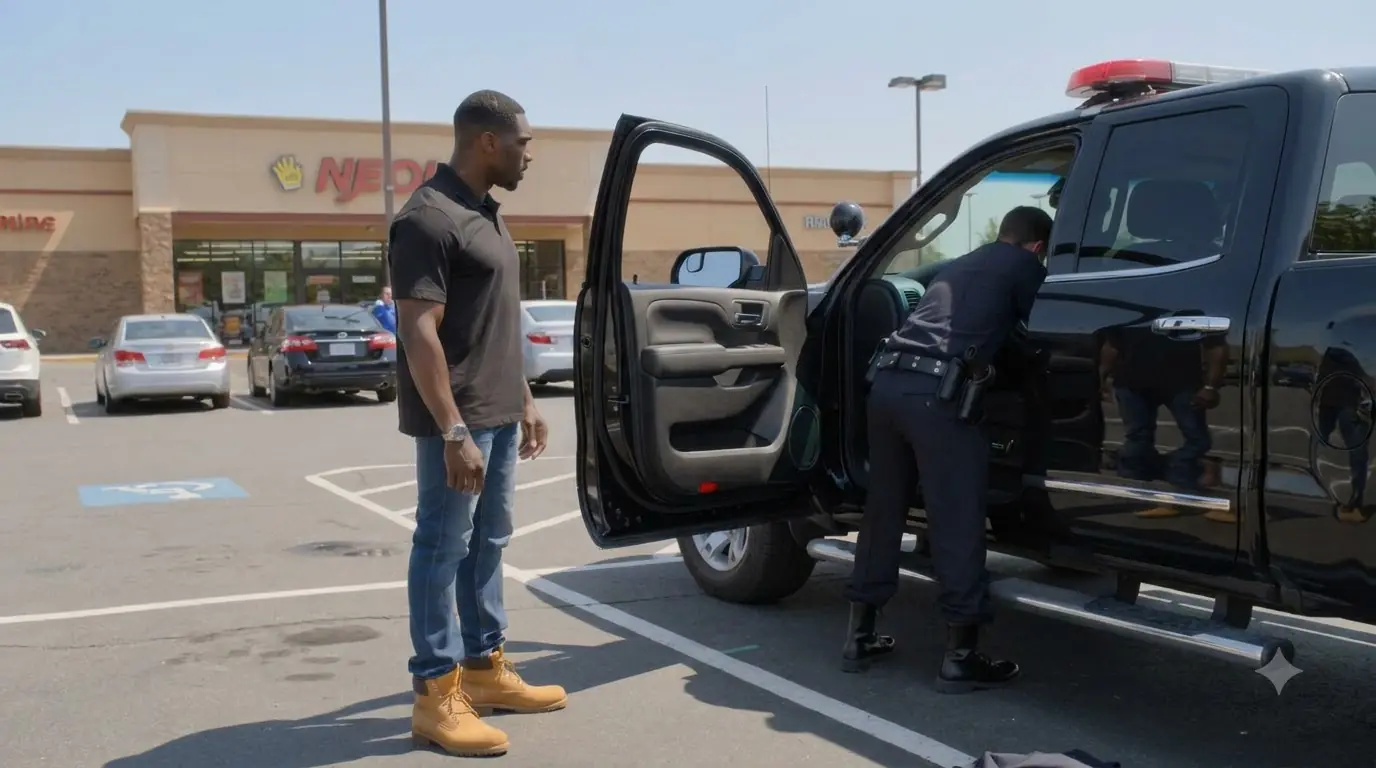
“Stop.”
The word came from the dark shoulder of Route 31 like it had been waiting there all night.
Senior Chief Malcolm Reeves kept both hands on the steering wheel, exactly where the officer could see them. The dome light was on. The window was down. Cool Georgia air drifted into the cab, carrying the smell of pine trees, warm asphalt, and the peach pound cake his mother had wrapped in foil on the passenger seat.
“Officer,” Malcolm said calmly, “may I ask why I was stopped?”
Officer Owen Maddox stepped closer to the driver’s window. His flashlight swept across Malcolm’s face, then across the leather seats, the folded duffel in the back, the birthday cake box, and the small wrapped gift riding beside it. His eyes came back to Malcolm, and something ugly settled behind them.
“You people always want to ask questions first,” Maddox said.
Malcolm did not blink.
“Sir, I’m asking for the legal reason for the stop.”
Maddox smiled without warmth.
“Step out of the truck.”
“Officer, my license, registration, and insurance are current. I have complied with your instructions. I am asking for the basis of the detention.”
“Out,” Maddox snapped. “Let’s see what you’re hiding.”
Within minutes, Malcolm’s life was scattered across the gravel.
Pressed clothes were dumped beside the rear tire. A framed photograph of his late father in dress uniform lay face down near the edge of the shoulder. The cake his mother had baked had been cut open with a pocketknife and left bleeding crumbs and icing across the passenger seat.
Maddox found nothing.
Then his flashlight landed beneath the driver’s seat.
A flat steel safe was bolted to the floor frame, matte black, secured, and untouched.
Maddox’s grin returned.
“Well,” he said softly. “There it is.”
Malcolm’s voice remained steady.
“I can open it.”
“You better.”
Malcolm entered the code with careful fingers. The lock released with a soft metallic click. The lid rose, and Maddox aimed his flashlight inside.
Two objects caught the beam.
And for the first time that night, Officer Owen Maddox forgot how to speak.
Eighteen hours earlier, Malcolm Reeves had been sitting at a plain gray desk inside the Pentagon.
The clock on his monitor read 05:21. The hallway outside smelled like floor wax, burnt coffee, and the kind of recycled air that belonged to government buildings where no one ever really went home. A cleaning machine hummed somewhere near the elevators, steady and low, like the building was breathing in its sleep.
His nameplate read:
Reeves, M.
Senior Chief, USN
Joint Operations Liaison
That meant different things depending on who asked.
To most people, it sounded like an office job with too many acronyms. To those who understood the world behind secured doors, it meant Malcolm Reeves had spent enough years in dangerous places that senior officers trusted him when official reports sounded too clean. He had been in rooms without windows, on aircraft without markings, and in briefings where maps changed before sunrise.
He was thirty-nine years old.
He had nineteen deployments behind him.
On his desk sat a chipped coffee mug, a dull CENTCOM challenge coin, and a framed photograph of his mother, Ruth Ann Reeves, standing in a church choir robe with both hands raised mid-song.
Her sixty-sixth birthday was that weekend.
Malcolm closed his classified laptop, locked it away, and pulled a dark navy windbreaker over his khaki uniform. Colonel Peter Lang, his section lead, had approved four days of leave and told him not to answer any calls unless the building was actually on fire.
“Tell your mother happy birthday from the Joint Staff,” Lang had said. “And if she makes that peach cake again, remember the chain of command.”
Malcolm gave him a rare smile.
“Yes, sir.”
The drive south was long, but he did not mind it.
He stopped for coffee once outside Richmond, gas near the Carolina line, and a sandwich he barely tasted somewhere past Augusta. He listened to a sermon for a while, then old soul music, then silence. Silence had become a kind of companion over the years, one that never asked him to explain what certain memories still did to him.
By late morning, he reached Pine Hollow, Georgia.
Pine Hollow had a courthouse square, one diner everybody argued about but kept visiting, a fading motel sign that had not worked properly in years, and a church with a bell that still sounded like Sunday even on a Saturday. It was the kind of town where people said they knew everybody, which mostly meant they knew who they wanted to recognize.
Malcolm drove past the square with both hands easy on the wheel.
Two older white men sat outside the hardware store.
They watched the black Ford F-150 pass.
Malcolm nodded.
Neither man nodded back.
Greater Mercy Baptist sat four blocks from the square, white paint peeling near the steps, red brick foundation patched in three different shades. Ruth Ann Reeves was already standing outside when Malcolm arrived, still in her choir robe, waiting as if she had known the exact second his truck would turn the corner.
“My baby finally remembered where home is,” she called.
“Mama, I’m early.”
“You’re late if I missed you before I saw you.”
She hugged him for a long time.
Malcolm closed his eyes.
For a few seconds, he was not Senior Chief Reeves. Not the man commanders called when briefings got too polished. Not the sailor with a service record locked behind acronyms and redactions.
He was just Ruth Ann’s son.
The birthday dinner lasted longer than he expected and not long enough.
Aunts, cousins, church ladies, deacons, neighbors, and children he did not recognize filled the little house until the walls seemed to breathe with voices. Someone brought fried chicken. Someone else brought greens. His mother made the peach pound cake herself and told everyone Malcolm had bought it because she wanted him to get credit for something.
His niece, Kayla, cornered him on the porch after dinner.
She was seventeen, sharp-eyed, and already more determined than most adults.
“Uncle Malcolm,” she said, “I want the Naval Academy.”
He looked at her.
“That a question or a warning?”
“A statement.”
He laughed.
“Good. Then we start Monday.”
She hugged him quickly, as if she was too old for it but needed it anyway.
At 9:37 p.m., his secure phone vibrated once on the kitchen counter.
No ringtone.
No display name.
Only a short message from a number that did not exist in any normal directory.
BLACKWATER WINDOW 0700. SCIF REQUIRED. IMMEDIATE RETURN.
Malcolm read it twice.
His mother looked at his face and knew before he spoke.
“You have to go.”
“I’m sorry, Mama.”
She pressed her lips together.
“Tonight?”
“Tonight.”
For a moment, the room around them kept laughing, eating, telling stories, and clattering forks against plates. Then Ruth Ann’s eyes softened. She had been married to a Marine for thirty-one years. She knew that service took men before dessert and sometimes before goodbye.
She packed him cake.
Then peach cobbler.
Then a small wrapped box containing the sapphire necklace he had brought for her but had not yet given.
“Take it with you,” she said.
“Mama, this is your gift.”
“Then bring it back next weekend and give it to me properly.”
He kissed her forehead.
“I’ll call when I stop.”
“You better.”
He loaded the truck under the porch light and turned north toward Virginia.
Route 31 ran dark between stretches of pine and peach orchard. Mile marker 92 stood under an old billboard advertising Coca-Cola in chipped red paint. Officer Owen Maddox had parked in that shadow for almost a decade.
He liked the spot.
The billboard swallowed the cruiser’s outline, and drivers did not see him until the blue lights were already in the mirror. He sat behind the wheel with a cup of sunflower seed shells in the console and sports radio murmuring low through the speakers. The Falcons had lost again, and that had left him looking for somewhere to put the irritation.
At 10:11 p.m., Malcolm’s black F-150 came over the rise.
Newer model.
Clean body.
Virginia plate.
Government-style registration, but attached to a private name.
Maddox typed the plate into the terminal.
Clean.
No warrants.
No stolen vehicle flag.
No registration issue.
He typed it again, slower this time, as if the system had failed to understand the assignment.
Still clean.
Then the truck passed beneath the cruiser’s hidden light, and Maddox saw the driver for half a second.
Black.
Late thirties.
Composed.
For Maddox, that was enough to become curious.
And curiosity, in the wrong uniform, can become danger faster than hate.
He hit the lights.
Malcolm eased onto the shoulder with the turn signal on.
No sudden movement.
No hard braking.
He placed both hands at ten and two, turned on the dome light with his elbow, and lowered the window only after the truck had come to a full stop. His father had taught him those steps before Malcolm ever had a driver’s license.
“Hands visible,” his father used to say. “Voice even. Pride quiet. Survival first.”
Maddox did not approach like the academy taught.
He walked first to the front bumper, tapped the hood three times with his flashlight, then circled slowly toward the driver’s window. The performance was deliberate. He wanted Malcolm to feel watched, inspected, already accused.
Malcolm did not react.
That bothered him.
“License, registration, insurance,” Maddox said. “Do it slow.”
“Yes, officer. My right hand is going to my wallet. My left will stay visible. Registration is in the glove box.”
“Listen to you,” Maddox said. “Practiced.”
Malcolm retrieved everything and handed it over.
The documents were current.
The license valid.
The registration clean.
Maddox folded them once and slid them into the back pocket of his uniform pants.
Malcolm watched the movement.
“Officer, those documents are in your custody. May I have the reason for the stop?”
Maddox leaned slightly into the window.
“You were doing fifty-six in a fifty-five.”
Malcolm paused.
“One mile over?”
“That’s speeding.”
“Sir, radar tolerance is generally wider than that. I would respectfully ask—”
“You would respectfully shut your mouth and step out.”
Malcolm kept his hands on the wheel.
“Am I being detained?”
Maddox smiled.
“You are now.”
A second set of headlights came over the rise.
Pine County Sheriff’s Unit 14 pulled in behind Maddox’s cruiser. Deputy Jenna Price stepped out, small-framed, twenty-four years old, six months on patrol, with her body camera mounted squarely in the center of her vest. The red light was blinking.
Jenna had become a deputy because her uncle, a retired state trooper, told her the job needed people who still knew how to feel shame.
Six months in, she had learned shame was not always welcome.
She recognized Maddox’s cruiser before she saw the driver.
Her stomach tightened.
Four weeks earlier, near mile marker 90, Maddox had stopped Reverend Amos Reed, a seventy-year-old pastor driving home from a hospital visit. He searched the pastor’s sedan for almost an hour, dumped sermon notes into the dirt, and called for a dog after claiming he smelled narcotics through a closed window. The dog “alerted” only after Maddox tapped the rear wheel well twice with his boot.
Jenna heard it.
Her camera heard it.
She said nothing.
That night, she sat in her kitchen watching the footage until 3:00 a.m., hating herself more with every replay.
She told herself the next time would be different.
The next time had arrived wearing a navy windbreaker and sitting behind the wheel with both hands exactly where they should be.
Maddox did not greet her.
He gestured toward the truck.
“Price, pay attention. This is what I call the three signs. New truck, out-of-state plate, driver too calm. You learn the three signs, you’ll make cases.”
Jenna looked at Malcolm.
He did not look drunk.
He did not look high.
He looked controlled.
That was not probable cause.
That was a person trying to live through the next five minutes.
“Officer,” Malcolm said, “for safety, I am informing you there is a lawfully secured firearm inside a federal lockbox bolted beneath the driver’s seat. I am not reaching for it. I am disclosing it voluntarily.”
Maddox’s eyes lit up.
“There we go.”
“It is locked, secured, and associated with Department of Defense credentials.”
“I didn’t ask for your résumé.”
Jenna’s hand moved to her body camera.
She tapped it once.
The indicator brightened.
Maddox noticed.
“What are you doing?”
“Making sure it’s on.”
“It’s always on.”
“Now I’m sure.”
Maddox stared at her.
Then he rapped the window with his flashlight.
“Out.”
Malcolm stepped out slowly. His hands stayed visible. He walked to the rear bumper when ordered and sat on it, posture straight, face calm. Not a suspect. Not a frightened man. A man measuring the cost of every movement.
Maddox radioed for canine.
The handler arrived nine minutes later with a Belgian Malinois named Ranger. The handler, Deputy Kyle Henson, had gone to high school with Maddox and had never once contradicted him in front of another deputy.
Ranger circled the truck.
Once.
Twice.
Nothing.
His nose passed the driver’s door, the rear tire, the bumper, then returned to the handler’s leg.
No alert.
Maddox stepped casually toward the front passenger wheel well.
Two soft taps.
Boot against metal.
Ranger sat.
Then barked once.
Maddox clapped his hands.
“Alert. Probable cause.”
Jenna keyed her radio before fear could stop her.
“Dispatch, Unit 14. Canine alert at mile marker 92. Be advised, my body camera audio captured a wheel tap immediately before the alert.”
Maddox turned slowly.
“What did you just say?”
Jenna’s voice trembled only slightly.
“I said what happened.”
“You better learn how to remember right.”
Malcolm spoke from the bumper.
“I do not consent to a search of my vehicle. I am asserting that right on the record. Any search conducted after a manufactured canine alert is unlawful.”
Maddox laughed.
“You hear that, Price? We got ourselves a law professor.”
Then he opened the truck door.
The search became destruction.
The glove compartment was yanked open hard enough to crack the plastic hinge. Insurance cards, registration copies, a pocket Bible, a folded church program, and a black-and-white photo of Malcolm’s father in Marine dress blues spilled out and scattered across the gravel.
The photograph landed face down.
Maddox stepped on one corner while reaching back into the cab.
Malcolm watched.
His face did not move.
That was the first thing Jenna would remember later.
Not the anger.
The absence of it.
The way a man held himself together while someone stepped on his father’s face.
Maddox dragged the duffel from the back seat and pulled the zipper so hard it broke. Pressed khaki uniforms spilled onto the shoulder. He kicked one shirt aside, leaving dust across the sleeve. He opened a toiletry bag, dumped it, shook a pair of boots, flipped socks inside out, and held up a running watch like he had found contraband.
“What’s this? Timer?”
“A watch,” Malcolm said.
Maddox threw it onto the gravel.
The glass cracked.
Then came the birthday cake.
Maddox lifted the white bakery box from the passenger seat and opened it.
The smell of peach, vanilla, and buttercream rose into the night air. For one second, something human might have entered the scene. It did not stay.
Maddox sank his pocketknife into the cake and cut through the center.
“People hide pills in cakes,” he said, as if teaching a class.
He wiped the frosting from the blade onto the passenger seat.
Jenna’s jaw tightened.
Her camera kept recording.
Maddox found the wrapped jewelry box next. Pale blue paper. Silver ribbon. A small card tucked under the bow.
To Mama, with love.
He ripped the paper off.
The sapphire necklace inside caught the flashlight.
Maddox shook the box near his ear, then tossed it into the footwell.
Malcolm closed his eyes for one breath.
Then opened them.
He had counted breaths under mortar fire.
He had counted breaths while waiting in a ditch with blood in his boot and sand in his teeth.
He could count them here.
Maddox turned to Jenna with the satisfaction of a man performing expertise.
“This is what my FTO taught me. You don’t stop when the first places are clean. You keep going. They want you tired. They want you embarrassed to dig. You don’t quit until the truck tells the truth.”
“The truck hasn’t said anything,” Jenna said quietly.
Maddox ignored her.
He pulled the floor mat from under the driver’s seat.
That was when the flashlight hit the safe.
Flat steel.
Bolted down.
Combination lock.
Maddox straightened slowly.
“What’s in the box?”
Malcolm stood from the bumper only after Maddox pointed toward it.
“That is a federally registered Department of Defense lockbox,” he said. “Inside is a lawfully secured firearm, federal credentials, and military property. I am again asking you to stop and call a supervisor.”
“Open it.”
“Officer—”
“Open it.”
Malcolm knelt beside the driver’s seat.
He turned slightly so Jenna’s body camera had a clear view of his hands.
One number.
Two.
Three.
Four.
Five.
Six.
The safe opened.
Maddox leaned in, eager.
On top sat a leather credential wallet with worn gold corners.
Maddox took it out and opened it with one hand.
The flashlight beam landed on a photograph of Malcolm in uniform, staring directly into the camera.
United States Department of Defense.
Reeves, Malcolm A.
E-8 Senior Chief, USN.
Assignment: Pentagon, Joint Operations Liaison.
Compartmented Access Authorized.
The hologram shifted from star to flag and back again as the light moved.
Maddox’s smile disappeared.
Not faded.
Disappeared.
His hand slowed.
Inside the safe sat a small black velvet case.
He opened it.
Gold caught the beam.
An anchor.
A flintlock pistol.
An eagle.
A trident.
A Navy SEAL Trident.
Beneath it lay a blue ribbon with a silver star mounted at the center.
For one long second, the dark shoulder of Route 31 seemed to lose all sound.
No cicadas.
No radio.
No passing cars.
Only the breathing of three people standing beside a truck that had suddenly become something else entirely.
Maddox tried to recover.
“This stuff can be bought online,” he said.
His voice had changed.
Anybody could hear it.
The certainty was gone.
“People fake military all the time.”
Jenna spoke clearly.
“Brad.”
“Shut up.”
“My camera is recording. It recorded the wheel tap. It recorded the search. It is recording the credential wallet and the Trident.”
“I said shut up.”
Malcolm rose to his feet.
He was not physically larger than Maddox, but the air around him seemed to narrow.
“Officer Maddox,” he said, “my name is Senior Chief Malcolm A. Reeves, United States Navy. The credential wallet in your left hand belongs to the Department of Defense. The warfare device in your right hand is the official insignia of the Naval Special Warfare community. The ribbon beneath it is a Silver Star awarded for actions in 2017.”
Maddox swallowed.
Malcolm continued, voice even.
“You removed those items from a locked federal container inside my vehicle without a warrant and without consent. I am giving you one opportunity to place them into documented custody properly. Do not hand them back casually and pretend this did not happen.”
Maddox looked toward Jenna, then the cruiser, then the empty road.
Every direction had become a wall.
Malcolm removed a second phone from the inside pocket of his windbreaker. It was matte black, rubber-edged, and unmarked except for a small Department of Defense seal.
Maddox took one step back.
“What is that?”
“A secure government communications device. I am placing a call on speaker.”
Malcolm tapped once.
A single ring.
A crisp voice answered.
“Joint watch floor. Lieutenant Commander Hayes. This line is unsecured. Identify.”
“Hayes, Senior Chief Reeves. Authentication Blackfin Seven Two Echo.”
Two seconds of typing.
“Authentication confirmed. Status?”
“I am being unlawfully detained at Route 31, mile marker 92, Pine County, Georgia. Local officer has conducted a warrantless vehicle search following a manufactured canine alert. Officer is currently in possession of my CAC, my Trident, and Silver Star, removed from a secured DOD lockbox.”
The voice changed.
“Are you injured?”
“No.”
“Immediate notifications?”
“Colonel Lang, DOD Inspector General, FBI Atlanta Field Office, Naval Special Warfare Command legal.”
“Copy all. Chain initiated.”
The line clicked dead.
Maddox stared at the phone.
“Senior Chief,” he said quickly, “let’s just slow this down. This is a misunderstanding.”
Malcolm looked at him.
“No, officer. A misunderstanding is when both people are missing the facts. You had the facts. You cut through them looking for something else.”
Maddox tried to hand the Trident back.
Malcolm did not take it.
“You treated those items as evidence. They remain evidence. Your supervisor will document the chain.”
Jenna keyed her radio.
“Dispatch, Unit 14. Request Sheriff Whitcomb to mile marker 92 immediately. Also requesting preservation of Unit 14 body camera footage from this stop.”
She paused.
Then her voice steadied.
“And preservation of footage from the stop involving Reverend Amos Reed at mile marker 90, dated four weeks ago. Possible similar canine cue captured on audio. I am making this request as a witness.”
The radio stayed silent for one full second.
Then dispatch answered.
“Unit 14, preservation request logged at 23:18.”
Maddox stepped toward her.
“Jenna, don’t do this. We’re partners.”
She did not move.
“I should have done it last time.”
“You don’t know what you’re doing.”
“I know exactly what I’m doing.”
“You’re ruining me.”
“No,” she said. “I’m finally telling the truth.”
Sheriff Raymond Whitcomb arrived twelve minutes later.
He was sixty years old, former Army MP, sheriff for three terms, and a man who had heard too many complaints about Owen Maddox to pretend surprise belonged anywhere near his face. He parked behind the cruisers and sat for a moment before getting out, both hands on the wheel.
Through the windshield, he saw the truck, the scattered clothes, the ruined cake, the crushed photograph, Jenna standing stiff and pale, Maddox holding military property in hands that no longer looked powerful.
The sheriff stepped out slowly.
He walked straight to Maddox.
“Owen,” he said, “badge and weapon.”
Maddox’s face went white.
“Sheriff—”
“Badge and weapon. Now.”
“I was conducting a lawful search.”
“You were conducting the end of your career.”
Maddox looked toward Malcolm.
“He matched the indicators. My training—”
Whitcomb stepped closer.
“The badge.”
Maddox removed it with shaking fingers.
Then the sidearm.
Whitcomb took both and turned away from him like the decision had already moved beyond argument.
“Sit in your cruiser.”
“Sheriff, the dog alerted.”
“The dog alerted because you tapped the wheel,” Whitcomb said. “And this time, the camera caught more than your report.”
Maddox had nothing left.
He got in the cruiser.
Whitcomb turned to Malcolm and removed his hat.
“Senior Chief Reeves, I am Sheriff Raymond Whitcomb. I am taking control of this scene. I owe you an apology, but I also know that apology is not enough.”
Malcolm held his gaze.
“That is correct.”
Whitcomb nodded.
“I will not pretend tonight is the first complaint. I should have acted sooner.”
“That is a start.”
“Not enough.”
“No.”
Whitcomb accepted the answer.
He carefully took the credential wallet, the Trident case, and the Silver Star ribbon from Maddox’s cruiser inventory tray and placed each item in separate clear evidence bags. He wrote the time, date, location, and his own initials across the seals.
Then he asked Malcolm to confirm every item on camera.
Malcolm did.
Jenna helped reload the truck.
She picked up the photograph of Malcolm’s father from the gravel and brushed it gently with the sleeve of her uniform. She handed it back with both hands.
“I’m sorry, Senior Chief.”
Malcolm looked at the photo.
Then at her.
“You told the truth tonight.”
Her eyes shone.
“I waited too long.”
“Yes,” he said.
She absorbed that without defense.
He added, “But you stopped waiting.”
At 12:41 a.m., Malcolm pointed the F-150 north again.
The cake was ruined.
The necklace was rewrapped badly but safely.
The khakis were dusty.
His father’s photo now had a cracked frame.
His hands remained at ten and two longer than necessary.
Forty minutes later, he pulled into the parking lot of a Waffle House outside Macon and called his mother.
“I’m delayed,” he said.
Ruth Ann was quiet.
“Mmm-hmm.”
“Mama.”
“You safe?”
“Yes.”
“You hurt?”
“No.”
“Then I’ll hear the rest when you’re ready.”
“Yes, ma’am.”
“Bring my necklace back next weekend.”
That made him smile for the first time since the stop.
“Yes, ma’am.”
Then he called his attorney, Dana Whitaker, in Alexandria.
She answered on the second ring.
“Tell me.”
Malcolm looked out through the windshield at the yellow Waffle House sign.
“File it.”
She said, “Already opening the folder.”
For Malcolm Reeves, the traffic stop was over.
For Owen Maddox, it had only begun.
By sunrise, FBI Special Agent Lena Corbett sat in Sheriff Whitcomb’s office with two laptops, a subpoena request, and the kind of calm that frightened guilty departments. By noon, eighteen months of Maddox’s body camera footage, canine deployment logs, stop reports, and dispatch audio were sealed for review.
The numbers came back two weeks later.
Over eighteen months on Route 31, Maddox had conducted 347 stops.
Two hundred ninety-one involved Black or Latino drivers.
Pine County was nearly seventy percent white.
The math did not need emotion.
It carried its own accusation.
The canine alerts were worse.
In five stops, secondary audio caught a soft double tap before the dog alerted. In three cases, the drivers had refused consent before the dog arrived. In all five reports, Maddox had written that the dog alerted naturally. No contraband was found in four of those searches.
Reverend Amos Reed was contacted on a Wednesday afternoon.
He listened to Agent Corbett explain the investigation.
Then he said quietly, “I have been waiting for somebody to call me back.”
A schoolteacher named Marisol Vega came forward next.
Then a college student named Jordan Ellis.
Then a delivery driver named Terrance Bell.
One by one, the pattern became too large for anyone to call isolated.
The local news broke the story first.
By the next morning, national outlets had it.
The headline that stuck was simple.
The Trident Under The Seat.
Veterans groups spoke out.
Civil rights attorneys got involved.
Naval Special Warfare released no details about Malcolm’s service beyond what was necessary, but one retired operator posted a short message that spread quickly:
Senior Chief Reeves is the kind of man who comes home quietly. The law should let him.
The federal trial opened in Atlanta nine months after the stop.
Owen Maddox faced charges for deprivation of rights under color of law, falsification of official records, obstruction, and witness tampering after phone records showed he had called Jenna Price repeatedly, urging her to “remember the stop correctly.”
Jenna testified on day two.
She wore a pressed uniform and looked younger than everyone expected.
The prosecutor asked why she had not spoken up during Reverend Reed’s stop.
Jenna sat silent for several seconds.
Then she said, “Because I was afraid of Officer Maddox. And because I told myself I would be better next time. That is how people like me let people like him keep hurting people. We turn courage into a future promise instead of a present duty.”
Reverend Reed sat in the second row.
He lowered his head.
Not in shame.
In recognition.
Malcolm testified on day three.
He wore dress uniform.
The Silver Star sat on his chest.
The Trident rested above it.
He raised his right hand and swore the oath while looking directly at the jury.
The prosecutor asked, “Senior Chief Reeves, how did you remain calm during the stop?”
Malcolm answered, “I have been in places where panic killed faster than bullets. That night, my calm was not consent. It was survival.”
The courtroom went still.
He continued, “I was not fighting overseas that night. I was fighting to be treated like a citizen on a public road.”
The defense called Maddox on day four.
He wore a suit that looked borrowed and a face that tried to look misunderstood.
He spoke about indicators.
Training.
Experience.
Instinct.
He repeated that people could buy military items online.
Then the prosecution played the body camera footage.
The wheel tap.
The search.
The cake being sliced.
The father’s photograph under his boot.
The moment the safe opened.
The moment Maddox saw the credential wallet.
The moment he opened the Trident case.
His face told the truth before any lawyer could.
The jury deliberated for six hours.
Guilty on all counts.
The sentence came two months later.
Eighty-seven months in federal prison.
Permanent decertification as a peace officer in Georgia.
Three years supervised release.
Federal firearms prohibition.
The county settled civil claims with Malcolm, Reverend Reed, Marisol Vega, Jordan Ellis, and several others. Malcolm never disclosed the amount. The same week the settlement cleared, he donated half to a scholarship fund at Greater Mercy Baptist and half to organizations supporting veterans and body camera accountability.
Sheriff Whitcomb did not run for re-election.
Jenna Price was promoted to sergeant two years later.
She became the deputy who taught body camera ethics at the state academy, but she never began with the night at mile marker 92. She always began with Reverend Reed at mile marker 90.
“I start there,” she told every class, “because the first time I failed matters as much as the night I finally spoke.”
That line became part of the curriculum.
At Greater Mercy Baptist, Ruth Ann Reeves stood in the choir wearing a blue robe on the first Sunday after the verdict. The new scholarship sign outside the church bore her family name, though she told everyone Malcolm made too much fuss.
Kayla, his niece, received early acceptance to the Naval Academy the following spring.
When Malcolm heard, he sat down on his mother’s porch and cried quietly enough that only Ruth Ann noticed.
She did not tease him.
Not that time.
She only put one hand on his shoulder and said, “Your daddy would’ve liked this.”
Malcolm nodded.
He already knew.
One year later, the old Coca-Cola billboard still cast its shadow across mile marker 92.
Cruisers still parked there sometimes.
Cars still slowed when they saw reflective decals.
The pines still moved in the night wind.
But no one tapped wheels anymore.
That mattered.
A driver stopped on that road might not have a Trident beneath the seat.
They might not have a Silver Star.
They might not have a secure phone connected to the Pentagon.
They might not have a deputy willing to finally tell the truth.
That was why the record mattered.
The camera mattered.
The first lie mattered.
And the first person brave enough to stop repeating it mattered too.
Years later, people told Malcolm’s story like a reversal.
A racist officer stopped a Black man on a dark highway.
The officer tore through his truck.
Then he found out the man was a decorated Navy SEAL working at the Pentagon.
That version was true.
It was also too small.
The deeper truth was not that Owen Maddox stopped the wrong Black man.
There should never have been a right Black man to treat that way.
The deeper truth was that every unlawful stop before Malcolm had helped build the confidence Maddox carried into that night. Every quiet victim. Every false report. Every officer who heard the wheel tap and looked away. Every supervisor who saw numbers that made no sense and decided not to ask why.
Silence had been training him too.
So when Jenna Price finally spoke, she did not become perfect.
She became necessary.
And when Malcolm opened that safe, the Trident did not make him more worthy of dignity.
It only forced the world around him to recognize a dignity that had been present before the flashlight ever hit the velvet case.
He deserved lawful treatment before anyone knew his rank.
Before anyone saw the Silver Star.
Before anyone heard the Pentagon answer his call.
He deserved it when he was just a man driving home from his mother’s birthday with cake on the seat, a gift in the footwell, and both hands visible on the wheel.
That should have been enough.
On the anniversary of the stop, Malcolm returned to Greater Mercy Baptist.
Not for a speech.
For his mother’s birthday.
The cake this time was whole.
The sapphire necklace sat at Ruth Ann’s throat.
Kayla wore her Naval Academy sweatshirt and kept touching the sleeve like she still did not fully believe it belonged to her.
After dinner, Malcolm stepped onto the porch with a cup of coffee.
Route 31 lay miles away in the dark.
His mother came outside and stood beside him.
“You still think about it?” she asked.
“Yes.”
“Angry?”
“Sometimes.”
“Good,” she said.
He looked at her.
“Good?”
“Anger tells you where something hurt. Just don’t let it drive.”
Malcolm smiled faintly.
“You been saving that one?”
“I’m your mother. I’ve been saving everything.”
They stood together in the porch light.
Inside, family laughed.
The house smelled like peach cake, coffee, and home.
For four seconds, Malcolm was not Senior Chief Reeves.
Not a witness.
Not a headline.
Not a man whose worst traffic stop became evidence in federal court.
He was Ruth Ann’s son again.
And this time, when he eventually drove north beneath the dark Georgia sky, he carried more than ruined cake and a broken frame.
He carried a record that had held.
A deputy who had finally told the truth.
A road that had changed because evidence survived the night.
And a lesson written too clearly to ignore.
Truth only needs one honest witness.
But silence needs everyone.