“Three grand in cash? Save the story. We’re taking it.”
Officer Brent Cole said it with the relaxed confidence of a man who had done this sort of thing before and never been challenged hard enough to worry about consequences.
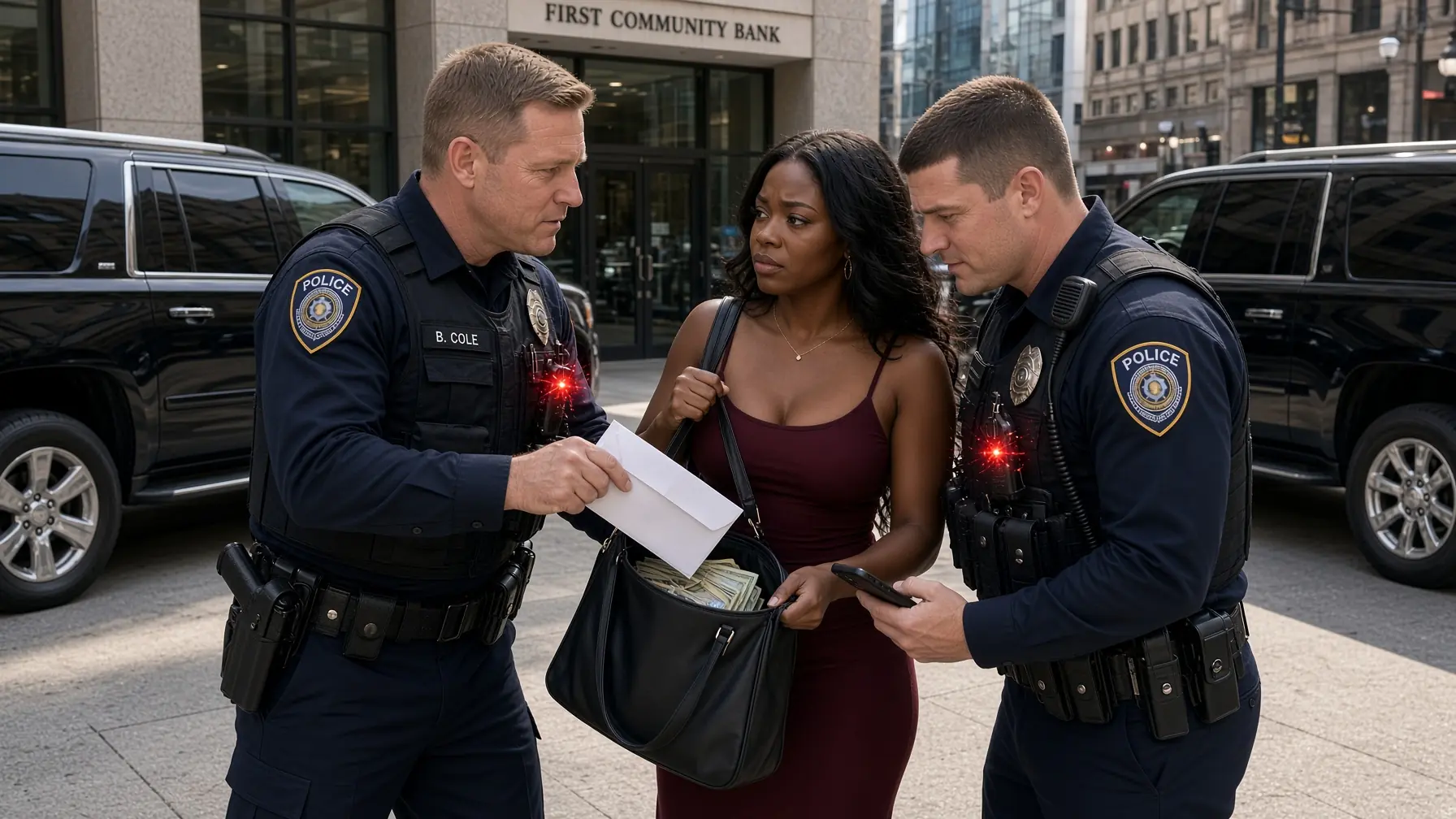
I stood on the sidewalk just outside First Community Bank with the late afternoon sun warming my shoulders and the glass doors still moving slowly behind me from where I had pushed through them seconds earlier. In my handbag was the white bank envelope I had just received from the teller inside. Three thousand dollars. Legal money. Documented money. Money withdrawn from my grandfather’s pension account to pay for the wheelchair lift installation he needed before the weekend.
My name is Simone Bennett.
I was twenty-seven years old that afternoon, standing in black heels on polished downtown concrete, wearing a dark-red spaghetti-strap dress and trying very hard not to let two uniformed officers turn me into a public spectacle.
Officer Cole stood directly in front of me.
Six-one. Broad shoulders. Sandy blond hair. Pale blue eyes that had already decided my explanation was irrelevant.
Beside me was Officer Tyler Shaw, shorter, thicker, brown buzz-cut, light stubble, and the sort of dismissive smirk that belongs on a schoolyard bully who finally found a badge.
People were slowing down now.
That was the part men like Cole and Shaw counted on.
An audience made ordinary people feel smaller.
Shaw reached straight into the opening of my handbag before I could even process how bold the move was.
His fingers closed around the white envelope.
I instinctively grabbed the strap of the bag, but I didn’t touch him.
That mattered.
I knew it mattered.
Women like me learn early that in moments like that, the truth is never the only thing in danger. So is interpretation.
He pulled the envelope free, opened it, and looked down at the bills.
Then he exchanged a smug glance with Cole.
There it was.
That quick little shared look that said the two of them believed they were in control now.
Cole took the envelope from him and casually tucked it against his vest as though it already belonged to the state, or perhaps more accurately, to him.
“We’re seizing this pending investigation,” he said.
I stared at him.
“Investigation of what?”
Cole shrugged.
“Possible fraud. Suspicious withdrawal. Maybe stolen funds. Depends how honest you want to be next.”
I looked past his shoulder through the glass bank doors.
The teller who had handed me the envelope was still at her station. I could see her. A man in a tan blazer was using the ATM alcove. A security guard stood ten feet inside the lobby pretending not to notice the confrontation happening on the other side of the glass.
“The teller is right behind those doors,” I said, keeping my voice steady. “You can walk ten feet and verify the withdrawal.”
Shaw laughed.
That sound stuck with me longer than it should have.
Not because it was loud.
Because it was practiced.
Because it carried the bored contempt of a man who thinks he’s seen this scene a hundred times and knows exactly how it ends.
“Keep pushing,” he said, “and we’ll add fraud and obstruction.”
The sidewalk had gone quieter.
A woman near the stone column slowed with her shopping bags.
A man beside the police cruiser pretended to check his phone while watching everything.
Someone across the street had already started recording.
Cole stepped closer.
Too close.
I could smell coffee and mint on his breath.
He lowered his voice just enough to make it feel personal.
“Here’s what’s going to happen,” he said. “You’re going to stop arguing, let us hold the envelope, and maybe you walk away without cuffs.”
The word maybe sat between us like a threat dressed as mercy.
I studied his badge number.
Then Shaw’s.
Not dramatically.
Not like television.
Just carefully.
Badge numbers. Name plates. The cruiser unit marking. The time on the bank’s exterior security camera mount. The reflection in the glass. The witnesses.
My grandfather used to say panic is what happens when your mind outruns your options.
I had no intention of panicking.
Three thousand dollars was a lot of money to my family.
But that was not what settled something cold and clear inside me.
What settled it was the way Cole held that envelope against his vest while refusing the easiest verification in the world.
He did not want the truth.
That told me this was not a misunderstanding.
It was a choice.
So I took out my phone.
Shaw smirked.
“Calling who?”
I unlocked it and pressed one name.
Naomi.
Cole saw it but apparently it meant nothing to him.
The call connected on the second ring.
“Simone?”
Her voice was clear, calm, and alert immediately.
I said, “Naomi? It’s Simone. First Community Bank. Send your team.”
There was no wasted question.
No confusion.
No What happened?
She knew from my tone that I was not making a social call.
“I’m on it,” she said.
I hung up.
Cole’s eyebrow lifted.
“…Who the hell is Naomi Pierce?”
I looked at him.
“You’ll find out.”
He actually smiled.
That was the moment he lost.
Not legally.
Not officially.
But in the deeper way arrogance loses the second it mistakes calm for weakness.
Because if he had been smarter, he would have heard what I heard in my own voice during that call.
Not fear.
Not bluffing.
Certainty.
The next thirty seconds changed the air on the whole block.
Both officers’ radios crackled at the same time.
They looked down almost in unison.
Dispatch said something clipped and fast.
Then from the far end of the street, three black SUVs turned the corner.
Unmarked.
New.
Dark glass.
They stopped along the curb beside the bank with the clean precision of people who were not improvising.
Cole’s smile vanished.
Shaw straightened.
The doors opened.
And Naomi Pierce stepped out of the middle vehicle.
The first thing most people noticed about Naomi was presence.
Not beauty, though she had that too.
Not the fitted charcoal dress, not the sharp black heels, not the smooth confidence in every step.
It was presence.
She moved like someone accustomed to rooms shifting when she entered them.
Naomi was thirty-four years old, tall, elegant, dark-haired, and one of the most dangerous women in the state if you happened to be a public official with something to hide.
Officially, she was Special Inspector Naomi Pierce, director of the State Public Integrity Response Unit.
Unofficially, she was what city departments whispered about when the press started asking the wrong questions and old complaints resurfaced.
Her unit did not chase ordinary mistakes.
It investigated patterns.
Civil-rights violations.
Evidence tampering.
Fraud under color of law.
Cash seizures that somehow never made clean paper trails.
Officers who learned to use procedure like a weapon.
She was also my cousin.
Not the close, grew-up-next-door kind.
The family reunion kind.
But close enough that when my mother died four years earlier, Naomi had sat with me in a black dress and stayed long after everyone else left.
Close enough that when my grandfather’s mobility got worse last year and I had to start handling more of his appointments, Naomi checked in quietly without making it seem like pity.
Close enough that I knew exactly what would happen if I called and used that voice.
She approached without rushing.
That made the officers look more flustered somehow.
Two men and a woman got out behind her. All three wore plainclothes. Two flashed credentials at once. One already had a tablet in hand.
Naomi’s eyes went first to me.
Then to Officer Cole.
Then to the white envelope tucked against his vest.
She stopped three feet away.
“Who has possession of the property?” she asked.
Cole blinked.
“What is this?”
Naomi took out her credentials and held them up just long enough.
“Special Inspector Naomi Pierce, State Public Integrity Response Unit. Answer the question.”
I watched the exact moment his confidence broke apart and tried to reassemble into something procedural.
“This is a police matter,” Cole said.
Naomi nodded slightly.