"Have you finally lost your mind, boy?"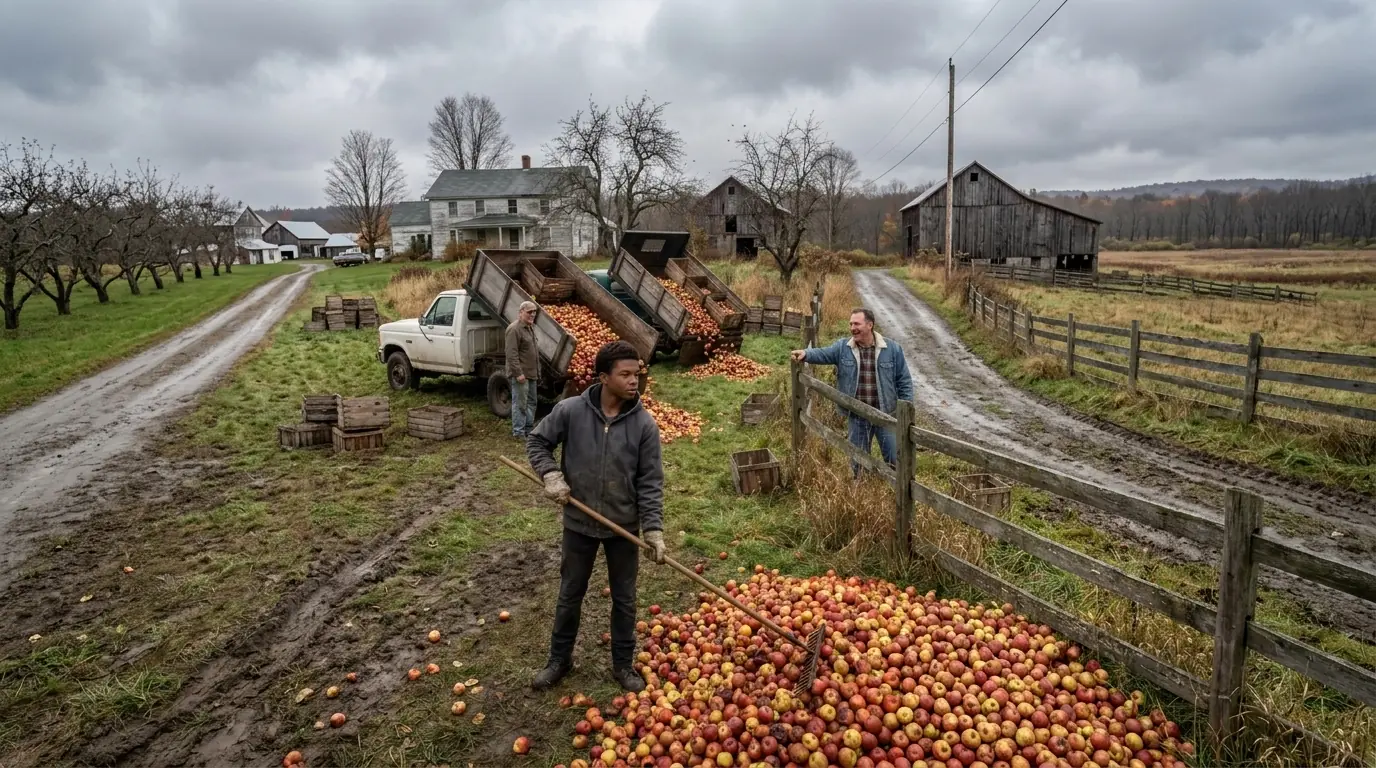
The neighbor was shouting over the fence now, laughing so hard he could barely get it out. "Look at you, twenty years old, raking garbage like it's gold."
Two flatbed trucks kept dumping thousands of pounds of rotting apples, burying eleven acres of Arthur Carter's land. Bruised, split, crawling with wasps.
"You hear me? The whole town's laughing at you. What are you going to do? Eat it?"
Arthur never looked up. "Tell the orchard to send more next week," he said to the driver.
More? Every Tuesday, the trucks came back. He never asked for a dollar; he begged for more. And not one person laughing guessed what he was building behind that barn. What did he see that they couldn't?
The answer starts eighteen months before the first truck ever turned off the county road, in a place that had nothing to do with apples.
Arthur Carter was working the overnight shift at a distribution warehouse on the edge of Rochester, scanning boxes down a conveyor line for people he would never meet. He had left community college two semesters in, not because he wanted to, but because the tuition math stopped working, and the warehouse paid enough to cover a rented room and not much else. He was twenty years old and already tired in a way that sleep did not fix. The kind of tired that comes from spending your best hours doing something that leaves no mark on the world. He punched in at eleven at night and punched out at seven in the morning, and in between, he moved other people's things from one place to another and tried not to think too hard about where his own life was going.
Then his grandmother died, and everything he owned that mattered arrived in a single envelope.
Ruth Carter had raised him more than anyone else had. His mother worked long hours when he was small, and the summers he remembered best were the ones spent at Ruth's place outside Millbrook, a couple of hours south, where the air smelled like cut grass and woodsmoke, and the porch sagged a little more each year.
Ruth had never owned much. What she had was eleven acres she and her late husband bought decades back—land that had been in the family longer than Arthur had been alive, passed down through people who had worked harder for it than they were ever paid to. When she passed, she left it to him. A leaning farmhouse, a barn full of equipment gone stiff with rust, and an orchard nobody had pruned in more than ten years, the old apple trees half-swallowed by wild grass.
He drove down for the funeral and meant to stay two days. He stayed five. On the last morning, he walked the overgrown rows in the cold, running his hand along bark that hadn't felt a saw in a decade. And something in him refused to get back on the highway to Rochester.
So, he didn't. He gave notice at the warehouse over the phone, packed what fit in his car, and moved into the farmhouse with no plan bigger than fixing the porch before winter set in.
Millbrook noticed him the way small towns notice anyone new. It was a place where people still lifted two fingers off the steering wheel when they passed you on the road. And a young Black man moving alone into old Ruth Carter's place was worth a second look at the feed store and a little quiet talk after church. Most of it was harmless. Some of it carried a weight underneath the friendliness, a curiosity about whether the city kid knew the first thing about the land he'd landed on.
Arthur felt it and said little. He had learned young that the fastest way to disarm a room that had already made up its mind about you was to be steady and let the work speak. The trouble was, he didn't yet have any work to speak for him.
Three miles down the county road sat Halverson Orchards, one of the largest commercial apple growers in the region, moving tens of thousands of tons of fruit every season into supermarkets and juice plants across the Northeast. And not every apple that came off those trees was fit for either place. There were bruised drops that hit the ground too hard, fruit stung by hail, apples that sat one day too long before picking and went soft at the shoulder.
All of it was money the orchard lost twice. Once when the fruit failed to sell, and again when they paid to make it disappear. Tipping fees, hauling, diesel for trucks that carried the rejects to a composting facility two counties over. Every autumn, the rot cost them real money to get rid of.
That was the situation when Grant Ashby heard, through the kind of mutual acquaintance every small county runs on, that the old Carter place had empty acreage and a new young owner who could use any income at all. Grant was the orchard's operations manager, a weathered man in his fifties who had spent his whole life around fruit and had the sun-cracked hands to prove it. He drove out one afternoon in a mud-spattered truck, introduced himself on the porch, and laid out an offer that struck Arthur as almost suspiciously simple.
"Here's the thing," Grant said, leaning against the porch rail like he'd known the family for years. "We generate a lot of fruit we can't use. Right now, I pay good money to haul it off. What I'd rather do is bring it here. You've got the room. I dump the rejects on your land, you don't pay a cent, and I save myself the tipping fees. Everybody comes out ahead."
Arthur asked what the catch was.
"No catch," Grant said. "It's rotten apples. Nobody wants rotten apples. Most folks in your spot either want me to pay them for the trouble, or they run me off because they don't want the smell and the wasps." He gave a small shrug. "I figured it was worth asking."
It should have taken Arthur a while to decide. A reasonable person weighs the smell, the mess, the yellow jackets, the sight of thousands of pounds of decay sitting behind the barn where anyone driving past could see it. A reasonable person asks for a night to think.
Arthur said yes before Grant had finished explaining the arrangement a second time.
What made him answer that fast wasn't a plan. He didn't have one. It was his grandmother's voice, surfacing out of nowhere with a clarity that startled him. When he was young, Ruth used to work the ugly bin at the farmers market—the crate of apples too scarred or lopsided to sell at full price—buying the whole lot for almost nothing. She'd spend the evening turning them into applesauce and pie filling and dried rings strung on twine over the wood stove, and the whole house would go warm and sweet with it. He'd asked her once why she didn't just buy the nice apples like everybody else did.
She wiped her hands on her apron and gave him an answer he didn't understand for another decade. "The fruit doesn't know it's supposed to be worth less," she told him. "People decided that. Nature never did."
He hadn't thought about that sentence in years. It had been sitting in him the whole time like a seed in cold ground, waiting for the right season. Standing on the porch with Grant Ashby offering him a mountain of garbage for free, it cracked open all at once, and Arthur understood that he was being handed the exact thing his grandmother had spent her life picking out of ugly bins. Except now, it was arriving by the truckload.
He didn't say any of that to Grant. He just said yes, shook the man's rough hand, and watched him drive off looking mildly puzzled by how eager the kid had been. Grant admitted later to one of his crew that he'd half expected a call within the week asking him to stop. Most people who took the fruit lasted one delivery before the reality of it changed their minds.
The reality arrived the following Tuesday, and it was worse than Arthur had imagined and better than he could have hoped. Two flatbeds backed up to a stretch of grass behind the old cider barn, dropped their tailgates, and let a slow, thudding avalanche of apples pour out onto his land. The smell hit him first, thick and fermented and alive. The pile was enormous, far more fruit than one person could ever hope to do anything with, and for a moment he stood there and felt the full weight of what he'd agreed to.
Word got around Millbrook faster than the trucks could deliver. Within a week, half the town had an opinion about the Carter boy and his rotten apples. His mother called from Rochester to ask carefully whether he was doing all right out there alone. A man at the feed store asked whether he'd cleared it with the county before he brought a bear problem down on the whole township. Somebody's cousin drove past slow with a phone out the window, and a photo of the growing pile turned up online with a caption that earned more laughing faces than the person probably meant it to. The joke wrote itself: City kid inherits a farm and the first thing he does is start collecting garbage.
Arthur heard all of it and kept showing up every Tuesday morning to meet the trucks anyway. That was the choice. Though nobody watching understood it as one, he could still walk away. He could call Grant and say the smell was too much, the neighbors were talking, the whole thing had been a mistake. And no one in Millbrook would have blamed him. Every rational signal the world was sending told him to quit while the pile was still small enough to haul off and forget.
Or he could commit to a mountain of rot on the strength of one sentence a dead woman had spoken to a child a decade ago, with no experience, no money to speak of, no farming background, and no idea yet how a soft brown apple became anything worth the trouble.
He stood behind the barn one gray afternoon in the second week, hands jammed in his pockets, and looked at the pile the way you look at a decision that has already half-made itself. The fruit was breaking down in front of him. Wasps traced lazy circles over the top of it. Somewhere under all that decay was the thing his grandmother had been trying to show him at a folding table at the farmers market. And he was either going to spend the next stretch of his life learning how to see it, or he was going to be the punchline the town had already decided he was.
He didn't call Grant to cancel. That evening, he went into the barn instead, found the old cider press under a tarp, and started trying to work the rust loose from its joints. He didn't know it yet, but it would take most of a year, a dozen ruined batches, and more late nights than he could count before that decision turned into anything he could hold in his hands. He only knew that quitting felt like calling his grandmother a liar. And he wasn't willing to do that. Not over apples, not over anything.
The choice was made. What came next was the part nobody warned him about. The part where wanting it turned out to be the easiest thing he'd have to do. Because knowing what he wanted to make and knowing how to make it were two different countries, and there was no bridge between them except failure.
The plan itself was sound, at least on paper. Apple cider vinegar had real market value, a long shelf life, and best of all, it did not care what the fruit looked like going in. A vinegar bottle never showed the bruise. If anything, rot was almost an advantage because overripe apples carry more natural sugar, and sugar was exactly what the whole process needed to work with. Arthur figured that out early, reading late into the night on a secondhand laptop with the farmhouse quiet around him. And for about a week, the logic of it made him feel like he'd cracked something the rest of the world had missed. Everyone else saw garbage. He saw raw material that came free by the truckload.
Then he actually tried to make vinegar, and the raw material humbled him. His first attempt was a disaster he could still smell weeks later. He crushed a few hundred pounds of apples in the old cider press, which he'd finally worked loose enough to turn, and hauled the pulp and juice into food-grade buckets he'd bought with money he did not really have to spare. Then he covered them and waited for nature to do what his grandmother always made sound so simple.
What nature did was grow a thick gray film across the surface and produce a stench so sharp it drove him out of the barn for two full days. He had skipped sanitizing his equipment, assuming apples that were already rotting couldn't get more contaminated than they were. Wild mold got there before anything useful did, and the whole batch went to ruin before it ever had a chance. He poured it out behind the barn, added it to the pile it had come from, and started over.
Money was already tight by then. The land carried no mortgage, which was the one mercy in the whole arrangement. But a leaning farmhouse still ate oil and electricity, and the savings that had felt like a cushion in Rochester drained faster than he expected. He picked up hours where he could, unloading feed trucks, helping a neighbor patch a roof, whatever came within driving distance. And he learned to buy his buckets and his supplies in the smallest quantities that would still get him to the next batch. Every ruined attempt wasn't just a lesson. It was money he'd worked a day of somebody else's labor to earn poured out onto the ground.
The second batch went further before it fell apart. He sanitized this time, scrubbing everything until his hands ached, and he'd learned that the wild yeast already living on the apple skins would start fermentation on its own if he simply left the crushed fruit alone in a covered container. It worked. The juice fizzed and turned cloudy. And after about two weeks, much of its sugar had converted into alcohol. For the first time, the barn smelled like something intentional instead of something accidental. And Arthur let himself believe he was close.
Then it stalled. The alcohol sat there for a month and refused to become vinegar. He'd sealed the containers up tight, the way you'd store anything you wanted to protect. And in doing so, he had suffocated the very thing he needed. The acetic acid bacteria that turn alcohol into vinegar need oxygen to do their work, and Arthur had locked them in an airless room, wondering why nothing was happening. By the time he understood the mistake, the batch had gone flat and strange, neither wine nor vinegar, and it joined the first one out behind the barn.
He started leaving the containers loosely covered with breathable cloth instead of tight lids, and the third batch finally began to turn. It also nearly gave him a heart attack. He'd loosened most of the jugs, but forgotten one, and pressure built up inside it through a long, cold evening until at eleven at night, it blew its cap clean across the barn floor with a crack like a slammed door. Arthur was crossing the barn with a flashlight when it went off, and he dropped the light and stood there in the sudden dark with his heart slamming, waiting to understand what had just happened. When he found the cap twenty feet away and worked out what it meant, he actually laughed alone at nearly midnight in a cold barn that smelled of fermenting fruit. It was the laugh of a man with nothing left to do but keep going.
The fourth batch became vinegar. Technically. It was also cloudy and sour in all the wrong ways. And no two jugs tasted the same. He'd been throwing apples from different weeks into the same crush. Fruit at wildly different stages of rot. High sugar next to low with no consistency in his ratios and no way to predict what he'd get. Some of it was almost drinkable. Some of it was harsh enough to make his eyes water. All of it was proof that he could technically produce vinegar and still be nowhere near producing anything a person would pay for.
That was the bottom of it. The stretch where wanting the thing counted for nothing. He was months in. He'd poured out more fruit than he'd saved, spent money he couldn't afford, and become, as far as Millbrook could tell, exactly the joke the town had cast him as. Some nights he sat on the farmhouse steps in the dark and let himself wonder honestly whether "steady" was just a nice word for stubborn, and whether stubborn was going to be the thing that sank him.
What turned it was a question he almost didn't ask. He joined an online fermentation forum weeks earlier and mostly read without posting, embarrassed to reveal how little he knew among people who talked about pH and cultures like a second language. One night, low enough to swallow his pride, he typed out everything that was going wrong—the cloudiness, the inconsistency, the harsh edges—and hit send before he could delete it.
The next morning, his phone rang with a number he didn't know.
"You the young man with the apple problem?" the voice said. It belonged to Milo Sandquist, a retired winemaker two counties over who'd read the post and decided a phone call would be faster than typing. Milo had spent forty years making wine before his knees and his patience for the business gave out. And he talked to Arthur for the better part of an hour like they'd known each other for years.
"Your problem isn't your apples," Milo told him. "Your problem is you're flying blind. You're guessing where you ought to be measuring."
He walked Arthur through the things nobody had thought to tell him. How to test pH with strips instead of hoping for the best, so he'd actually know where a batch stood instead of finding out by taste when it was too late. How to care for the "mother"—the living cellulose culture that forms on the surface during fermentation—and can be skimmed, kept alive, and used to seed the next batch instead of starting from nothing every single time. The basic chemistry of what he was really doing: sugar to alcohol to acid. Each stage with its own needs, its own pace, its own way of going wrong.
"You're not cooking," Milo said near the end of the call. "You're keeping something alive. Treat it like that and it'll start behaving."
Arthur took notes on the back of an envelope, and then when the envelope ran out, on a spiral notebook he dug out of a kitchen drawer and never stopped using after that.
The fifth batch was steady. It was also thin. Drinkable, but flat. Nowhere near the balance he was chasing. And it told him something the earlier failures hadn't. His problem now wasn't chemistry. He'd more or less learned the chemistry. His problem was the fruit itself—the random mix of whatever the trucks happened to bring on a given Tuesday. And he wasn't going to get consistency out of raw material he couldn't predict.
So he started paying attention to the apples the way Milo had taught him to pay attention to everything else. He kept the notebook beside the barrels and logged everything in careful columns. Batch numbers, apple varieties, fermentation times, pH readings, taken night after night with a flashlight clenched in his teeth because the barn had no good light. He learned which fruit fermented fast and which dragged.
And he found something that surprised him. The tart, older drops from the orchard's ancient trees, the ones on the back rows Grant barely bothered with anymore, made a sharper, more complex vinegar than the sweet, modern varieties off the newer plantings. The ugliest, least wanted fruit on the least wanted rows was the fruit that tasted like something worth selling.
He learned to skim the mother carefully and keep a portion of it alive between batches, so each new run started with a head start instead of from zero. He learned to filter the finished vinegar through layers of cheesecloth until it ran clear instead of muddy. And by the sixth batch, standing in the barn on a cold October evening with a spoon in his hand, he tasted something that stopped him where he stood.
It was sharp and bright, faintly sweet at the edges, clean all the way through. It tasted nothing like the harsh, cloudy liquid from the spring. It tasted like an answer.
Arthur sat down on an overturned bucket and just breathed for a minute, the spoon still in his hand, the notebook open on the barrel beside him. He thought about his grandmother at the farmers market, buying the ugly bin for almost nothing, and about how long it had taken him to understand what she'd been showing him. He'd needed most of a year, a dozen ruined batches, an exploded jug, and a stranger's phone call to arrive at the thing she'd known standing at a folding table with an apron on. But he'd arrived. He had it now in a jar in his own hands, and no one could tell him it wasn't real. That jar was where eleven months of failure quietly ended, and something else began.
He should have known that making a good product would turn out to be the simple part. Because a good product, he discovered, is not the same thing as a business. And the distance between the two was its own long education.
He couldn't just fill jars and hand them across a counter. Selling a food product commercially meant licensing, meant inspections, meant a stack of paperwork and regulations he'd never anticipated, and had to teach himself one confusing form at a time. It meant proving his barn operation was clean enough, documented enough, safe enough to a county that had mostly known him as the kid collecting rot behind his grandmother's place.
It meant, too, that the random truckloads that had gotten him this far were suddenly a liability. He knew now that his best vinegar came from specific fruit off specific trees, and he couldn't build anything on a supply that changed every Tuesday depending on what Grant's crew swept up. He needed consistency in the one thing he'd been taking entirely on chance.
And it meant that the moment anyone actually wanted his vinegar in quantity, he ran headfirst into the limits of being one person with a cider press and a barn full of barrels. He'd give a jar to a neighbor who'd been kind to him, or to the woman at the feed store who never once laughed at the pile, and the feedback would come back warmer than he expected. Someone would ask if he had more, and the honest answer was no. Not yet. Not at any scale that mattered. Every bit of interest he generated only exposed how little he could actually deliver. And behind all of it sat the quieter work of convincing people that a twenty-year-old they'd written off had any business standing behind a product at all.
The thing that forced the decision came at a small food festival late that autumn. He'd rented the cheapest table available, driven over with a case of his best bottles and a hand-lettered sign, and spent the day pouring samples onto little paper squares for people who mostly walked past. Late in the afternoon, a man in a canvas jacket stopped, tried a sample, went quiet in a considering way, and then came back around for a second.
"Who makes this?" the man asked.
"I do," Arthur said.
The man introduced himself as a buyer for a regional distributor, the kind of operation that moved specialty products into stores across several states. He asked a few sharp questions about how much Arthur could produce, how consistent he could keep it, how fast he could scale, and then he named a volume casually, the way you'd name a number that was nothing unusual on his end of the business.
It was a volume Arthur could not come close to producing. Not in the barn, not alone, not with one rebuilt cider press and a notebook full of batches measured in gallons. When this man was talking in a language of pallets, there it was laid out plain in the middle of a fairground. He could smile, take the man's card, admit the truth, and stay exactly where he was. A talented amateur with a good jar of vinegar and a story the town told at his expense. That was the safe road, and it was real, and no one would have faulted him for it.
Or he could bet everything he didn't quite have on the chance that he could become the kind of operation that answered a number like that with a yes.
He took the card. He drove home in the dark, turning it over in his mind the whole way. And by the time he pulled into the drive, he already knew, the way he'd known on the porch with Grant, that safe was never going to be enough for him.
He converted the old equipment shed into a proper production space, working through the winter with his own hands and money he borrowed against the land. The same eleven acres his family had held for generations, now signed against a jar of vinegar and a hunch. He bought fermentation tanks to replace the patchwork of buckets and jugs. He went to Grant and asked for the first time for something specific in return for taking the orchard's rot: to have those tart old tree drops set aside for him instead of buried in the general mix. And Grant, who'd watched the kid outlast every prediction he'd made, agreed.
And he hired his first employee, a former orchard hand named Dale Winters, who'd worked apples his whole life and knew the fruit better than Arthur ever would. A steady older man who showed up the first morning, looked over the operation, and said only that he'd seen crazier ideas make money.
Arthur signed the papers, spent the money, took on the debt, and put his name on all of it. He had bet the whole inheritance on a jar of vinegar and a dead woman's sentence. He had no idea yet that the hardest test of all was still ahead of him, and that betting everything was easy compared to what it would take to keep from losing it.
The hardest test arrived the way real trouble usually does, not as a single disaster, but as everything coming due at once. The distributor's order was real now, signed and scheduled, a volume that had seemed impossible at that fairground table and was now simply his to deliver or fail to deliver. He had the shed converted, the tanks installed, Dale Winters on the payroll, and the tart old tree drops set aside for him every week. What he did not have was margin for a single thing to go wrong.
And in those first months of real production, everything wanted to.
Scaling up broke the quiet certainties the barn had taught him. A process he could hold in his head across a dozen buckets became something else entirely across tanks that held more fruit than his whole first year had produced. The mother cultures that behaved so obediently in small jars turned temperamental at volume. A batch that would have been a minor loss back when he measured in gallons was now a catastrophe measured against an order with a due date and a debt behind it. He'd lie awake doing the arithmetic, the borrowed money against the land, the timeline against the tanks, the whole inheritance balanced on whether a living thing he couldn't fully control would cooperate on a schedule.
The worst of it came in the dead of winter, weeks out from his first real delivery, when a full tank turned on him. He walked into the shed one morning and knew before he reached it that something was wrong. The smell off, the surface not doing what it should. A whole tank of vinegar, a huge share of the batch that order depended on, had gone bad. The cold had crept into the shed overnight through a gap he hadn't sealed. The temperature had swung, and the culture had failed. Weeks of work, a wall of set-aside fruit, and a meaningful piece of the money he'd borrowed. All of it souring into something he'd have to pour out behind the barn like he was starting over.
Except he wasn't starting over. He was already all the way in with a due date closing in and nothing behind him to fall back on.
That was rock bottom. Standing in the cold shed in front of a ruined tank, a young man with no business experience, no cushion, and nowhere to retreat, staring down the real possibility that he'd bet the land his family had held for generations on a jar of vinegar and lost. He could feel every prediction the town had ever made about him, lined up and waiting to be proven right. The kid who collected garbage. The city boy who thought he could farm. The whole weight of the doubt he'd carried since the day he moved in pressed down on him at once, and for a long moment, he genuinely did not know if he could climb out from under it.
He called Dale before he called anyone else. The older man drove over, looked at the tank, looked at the gap in the shed wall where the cold had gotten in, and didn't offer comfort so much as work.
"Well," Dale said, running a hand along the failed seam. "Now you know where the cold gets in. That's worth something. Question is whether you've got enough good product left in the other tanks and enough fruit banked to make the number smaller."
That was the turn. Not a rescue. Just a problem broken into pieces small enough to pick up.
Arthur went back to the notebook. He'd kept every reading, every batch, every variety and time and temperature. And buried in those columns was the knowledge of exactly what he had left, what it could become, and how fast. He sealed the shed properly. He held the surviving tanks like a man holding his breath, testing pH morning and night, skimming and tending the mothers with a care that bordered on prayer. He went back to Grant and asked for more of the old tree fruit. And Grant, who by now set his watch by the Carter kid outlasting every doubt anyone had about him, found a way to get it to him.
He and Dale worked through what was left of the winter to rebuild the batch the cold had cost him. And when the first delivery date came, Arthur met it. Not comfortably, not with room to spare, but he met it. Pallets loaded and shipped, the number answered with a yes.
After all, that was the thing that turned everything else. Once he could deliver at volume and keep the quality steady, the doors that had been closed to a one-man barn operation started opening on their own. He registered the name properly, Millbrook Reserve Vinegar, and kept the labels plain on purpose. The orchard's name, the harvest year, a short line about where the fruit came from, because he'd learned that people cared about the story in the bottle almost as much as the taste in it.
A local chef named Owen Pruitt, who ran a small farm-to-table place twenty minutes off and had tried an early jar passed along by a friend, became his first real standing customer, buying by the case for his vinaigrettes and his pickling. Owen introduced him to a farm shop two towns over. The farm shop's owner introduced him to a specialty grocer who put a handful of bottles on a shelf right beside imported balsamics that cost three times the price.
Each new relationship solved a problem the last one had created and quietly forced him to grow. Owen's orders alone were too small to justify the tanks. The farm shop's volume pushed him past the point where the equipment paid for itself. The grocer wanted consistent labeling and a shelf-stable product, which made him formalize his bottling and filtering for good. And the distributor's appetite kept outrunning what he and Dale could manage between them, until Arthur brought on a second employee to handle bottling and shipping. The operation finally started to look less like a stubborn young man in a shed and more like a company.
By the third year, Millbrook Reserve Vinegar sat on shelves in health food stores across three states, and the business had crossed into six figures in annual revenue. A number Arthur still had trouble saying out loud without a short, disbelieving laugh, remembering the neighbor who'd once asked, only half joking, what exactly he was burying back there.
The orchard that had once paid to make its rot disappear had become something close to a partner. Grant Ashby set aside specific varieties at Arthur's request now instead of dumping a random mix. And Halverson Orchards saved real money, no longer hauling fruit two counties over to be composted. What had started as a favor to a young man with no plan had turned into an arrangement that put money in both their pockets. And Grant, who'd expected a cancellation call in the first week, took a quiet kind of pride in having been the one to back the truck up to that barn.
Arthur thought often in that stretch about how closely the vinegar's process had mirrored his own. Apples that looked finished, worthless, past saving, had needed nothing more than time, oxygen, and the right conditions to become something else entirely. He had needed roughly the same. Time to fail his way toward knowing what he was doing. Room to breathe when everything sealed up tight around him. And the right conditions. A stranger's phone call. A steady older hand. An orchard willing to set fruit aside that let a doubted twenty-year-old turn into whatever he was becoming now.
The people who'd once slowed their trucks to stare at the rotting pile became customers. The neighbor who joked about buried bodies bought a case for his daughter's wedding favors and told the story at the reception like he'd believed in the kid all along. The person whose mocking photo had once collected all those laughing faces online now tagged Millbrook Reserve Vinegar in their own grocery hauls without a trace of irony, as though they'd never held a phone out a car window at all.
Arthur never brought any of it up. When a former skeptic walked through his door, he treated them the way he treated everyone, with a sample spoon and a straight answer to whatever they asked. He didn't need the apology. He'd stopped needing it somewhere back in that cold shed in front of that ruined tank, when he discovered the one thing about himself he hadn't been sure of. That he would not quit, even when quitting was the reasonable thing to do. The shelf space said everything that needed saying, and he let it.
What the whole thing had never really been about in the end was vinegar. It was about a way of looking at the world that most people never bother to practice. Ruth Carter had spent her life proving that value doesn't vanish just because something looks broken or bruised or unwanted. It only gets harder for most people to see. Easy to drive past, easy to laugh at, easy to pay someone to haul away.
It had taken her grandson a year of failed batches, a jug across a dark barn, a ruined tank in a cold shed, and the near loss of everything his family had held for generations to learn that she'd been right the whole time. And maybe that's the part worth sitting with for a second. Because it isn't really about apples, and it was never only about a young man in New York. Almost everyone has a pile behind their own barn. Some skill you talked yourself out of because you started too late. An idea you're half embarrassed to say out loud. A second chance that showed up looking so much like a burden that you almost paid someone to haul it away.
The world is very quick to tell you what's finished, what's too far gone, what a person like you has no business trying. Most of the time, it's easier to agree with it and drive on. But the lesson Ruth left her grandson is one you can actually use, and it's smaller and harder than it sounds.
It isn't that everything broken is secretly valuable, because most rot is just rot, and pretending otherwise is its own kind of trap. It's that value doesn't announce itself. It waits under conditions most people won't sit still long enough to provide. Time, patience, the willingness to fail a dozen times in a cold room with no one clapping, the humility to call a stranger and admit you don't know what you're doing. Arthur didn't succeed because the apples were secretly gold. He succeeded because he was willing to do the slow, unglamorous, unwitnessed work of finding out whether they could be long after everyone else had stopped wondering.
So, here's the honest question to carry out of this one: What have you already written off in your own life that might just be waiting on the right conditions instead of a different you? And what would it cost you, really, to give it eleven months before you decide it's worthless?
Somewhere right now, another truck is backing up to a pile of something everyone has already decided is worthless. Most people will drive past it without a second look. But every once in a while, someone slows down. Someone stops. And they turn out to be the one who was right. The fruit never knew it was supposed to be worth less. People decided that; nature never did. And every so often, someone comes along stubborn enough to prove them wrong.