Perfectly good potatoes, too ugly for the shelf.
Fifty tons of them.
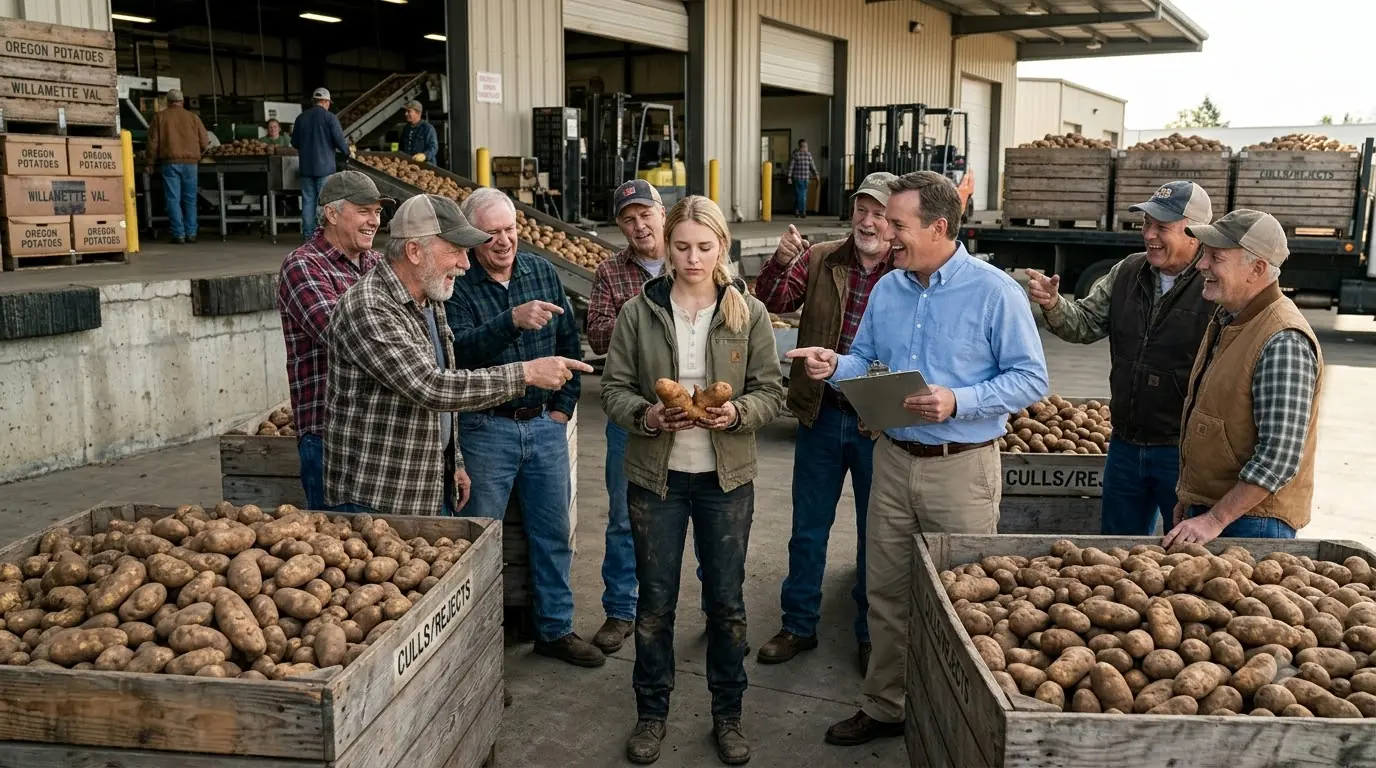
The packing house said they weren't worth the fuel to haul away. But Clara opened her grandfather's journal that night and found a page where he had written one line and underlined it twice.
Ugly is just honest.
Clara stood at the gate with her weight shifted to one hip, one hand resting on the top rail and the other holding a potato the size of a man's fist. The flatbed was already a quarter mile down the gravel road, kicking up a pale cloud that hung in the October air like something ashamed of itself.
No signature. No receipt. No paperwork at all.
Just 50 tons of Russet Burbanks dumped in a ridge along the inside of her fence line and the sound of a diesel engine getting smaller.
Perfectly good potatoes.
Too ugly for the shelf.
Fifty tons of them, and she owned every one for free.
The Angstrom Farm sat on 120 acres in the Willamette Valley, about nine miles south of where the Yamhill River bends toward McMinnville. It was good ground, the kind of deep silty loam that holds moisture without drowning roots, the kind that turns almost black when you work it right.
Reliable rain came from November through April. Yields were decent most years, around 22 tons per acre in a strong season, which put the place comfortably above the county average.
Henry Angstrom had worked that soil for 41 years. Before him, his father had broken it with a team of Percherons during the Depression.
The land knew what it was supposed to do.
Henry died 14 months earlier, mid-harvest, slumped forward on the seat of his tractor with his hands still on the wheel. Clara was 23 then, fresh off two years of community college and a string of waitressing jobs in Corvallis that paid just enough to keep her thinking she didn't need the farm.
She was wrong about that.
The farm needed her.
And somewhere underneath the grief, the paperwork, and the property taxes, she needed it back.
So she came home.
She moved into the clapboard farmhouse with its drafty kitchen and wood stove that smoked whenever the wind came from the southeast. She planted the spring crop herself, following Henry's rotation notes pinned to the barn wall.
Russet Burbanks.
Same as always.
Same seed stock.
Same rows.
For years, decades really, the entire Angstrom harvest had gone to one buyer.
Apprentice Valley Produce operated a packing house about 12 miles east, a long cinder-block building with loading docks on three sides and a parking lot full of refrigerated trucks. They graded, washed, sized, and boxed potatoes for grocery chains up and down the West Coast.
Dale Apprentice ran operations.
You would recognize the type.
Stocky, soft-bodied, thinning sandy-brown hair combed back as neatly as a catalog photograph, hazel-green eyes set a little too close together. He always wore pressed khaki slacks and a tucked-in light-blue Oxford with a company pen in the breast pocket, as if he were heading to a business lunch instead of spending his days inside a warehouse that smelled like wet starch and diesel.
He carried a steel clipboard with a rubber grip.
He held it against his hip the way a preacher holds a Bible, not because he always needed it, but because it made him feel like the authority in every room.
Dale had dealt with Henry for years. He tolerated the old man's stubbornness because Henry's potatoes were clean, his yields were consistent, and he rarely argued about price.
But Clara was not Henry.
Clara was a 24-year-old woman with wheat-blonde hair pulled into a low ponytail and soil stains on the knees of her jeans.
Dale Apprentice looked at her the way you might look at a stray dog sitting in a parking space you wanted.
That season's cull rate was catastrophic.
A wet spring, almost six inches above normal through April and May, pushed the tubers into strange growth. Forked shapes. Knobs. Potatoes that looked like they were trying to become two potatoes at once. Oversized ones, lumpy ones, tubers split at the shoulders.
The grocery chains wouldn't touch them.
Cosmetic standards.
The boxes had to look uniform, clean, and smooth-skinned.
Anything that didn't fit the template got pulled off the grading line and thrown into reject bins.
Fifty tons of rejects.
Out of Clara's total harvest, that was nearly 40 percent.
Dale called her on a Tuesday.
He didn't ask how she was doing.
He didn't mention the weather.
He didn't waste a single syllable on courtesy.
He told her the cull rate. He told her the disposal fee was $75 per ton, and he told her she could either pay $3,750 to have Apprentice Valley haul the rejects away or she could take them back.
"Honestly, Clara," he said, and she could practically hear the clipboard tapping against his thigh through the telephone, "I don't know why your granddad didn't just sell when he had the chance. This place has been marginal for years. You're a nice girl, but nice doesn't move product."
A nice girl.
That was what he called her.
As if she were somebody's daughter waiting to be picked up from practice.
Clara said four words.
"I'll take them back."
So there she stood.
Gate.
Potato pile.
Dust settling.
She pulled the small brass-capped folding knife from her right front pocket, the one with its handle wrapped in black electrical tape, the one that had belonged to Henry, and split the potato in her hand lengthwise.
The blade went through cleanly.
Inside, the flesh was white as chalk, dense and dry at the cut.
High starch.
No hollow heart.
No brown center.
No ring rot.
She pressed her thumb into the exposed face and felt the texture.
Firm.
Fine-grained.
The kind of cell structure that held up under heat.
This was perfectly good food.
Every single tuber in that pile was perfectly good food.
They were just ugly.
That evening, Clara sat at the farmhouse kitchen table with the desk lamp pulled close and Henry's green clothbound journal open in front of her.
The spine was cracked. The pages were soft at the edges from years of handling.
Henry had kept notes on everything.
Soil pH readings by quadrant.
Planting dates cross-referenced with moon phases.
Observations about earthworm density after cover-crop rotations.
But one section, maybe 30 pages in, was different.
Notes from a trip to Idaho in 1968.
A farmer outside Boise who had been experimenting with turning cull potatoes into distilled spirits.
Washing.
Mashing.
Fermenting.
Distilling.
Potato vodka.
The page had been dog-eared so hard that the corner had worn almost to felt.
One line was written in Henry's tight, forward-leaning hand and underlined twice in pencil.
Ugly is just honest.
Two neighbors stopped by that week.
Clara saw them slow their trucks at the gate, stare at the potato pile, then pull into the drive.
The first was a hay farmer named Ridley, who leaned against his tailgate and told her a developer out of Portland had been buying parcels along the valley road.
Good money.
Fair offers.
The second was a woman from the Grange who said essentially the same thing in softer language.
Clara listened to both of them.
She stood with her arms folded, the café-au-lait birthmark on the left side of her neck just visible above her jacket collar, and waited until they had finished.
Then she said five words.
"The farm is not for sale."
They left uncomfortable, the way people do when they expected gratitude and got a closed door instead.
That night, the kitchen was dark except for the desk lamp.
Clara sat with the journal open to the Idaho pages, reading Henry's notes about starch, fermentation, and the basic principles behind potato spirits. His pencil sketches showed an old-fashioned copper still, with measurements and observations written in the margins.
She closed the journal on the underlined phrase.
Ugly is just honest.
She set it on the kitchen table beside her grandfather's brass-capped knife, then walked out to the barn in the dark to begin sorting potatoes by hand.
The barn smelled like cold earth and raw starch.
One fluorescent tube buzzed overhead, throwing a bluish wash across the concrete floor where Clara had dumped her first load.
Maybe 400 pounds of potatoes spread across a plywood sorting table Henry must have built 20 years earlier.
The wood was warped.
The legs were steady.
She pulled her wheat-blonde hair tighter into its low ponytail, wiped her hands on the knees of her already stained jeans, and opened the green clothbound journal to a page marked with a bent paperclip.
Henry's handwriting was small, precise, relentless.
He had drawn a chart with five columns.
Size.
Shape.
Skin condition.
Flesh color.
And one column he had labeled simply density.
Beneath the chart, he had written about why starch content mattered. Denser potatoes tended to carry more starch in their cells, and that mattered if the goal was not the grocery shelf but conversion into another product entirely.
Henry had underlined one sentence twice.
The ugly ones are almost always denser.
So Clara did what the journal told her to do.
She made a simple comparison using water density and began testing samples from the pile against smooth, conventionally attractive potatoes from the same field. The rough, misshapen potatoes behaved differently again and again.
They were heavier for their size.
Denser.
Clara stared at the first batch for a long time.
Then she started cutting.
Sixteen hours a day.
Seven days straight.
She sorted through the entire load, every misshapen, scarred, knobbed, dirt-caked potato that Apprentice Valley had sneered at.