Dr. Maya Whitfield arrived at the private terminal before the sun had fully risen over New Jersey.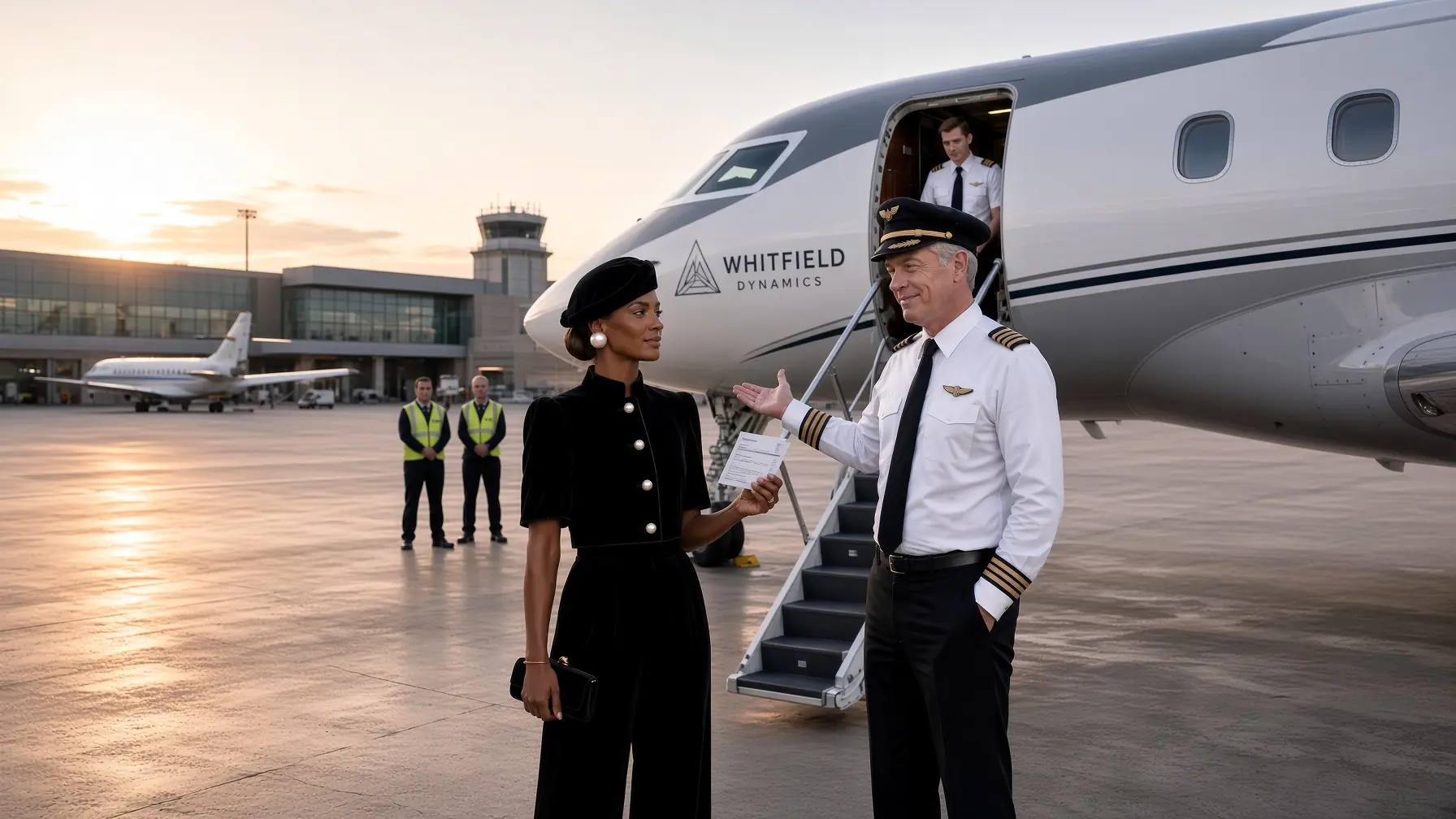
The sky above Teterboro still held that pale blue-gray color that makes every runway light look sharper than it should. Fuel trucks moved slowly across the tarmac. Ground crews in reflective vests walked with coffee in one hand and radios clipped to their collars, preparing for the kind of morning where wealthy people expected everything to happen quietly and exactly on time.
Maya had a 9:00 a.m. departure.
By noon, she needed to be in Denver to close the final phase of a medical robotics acquisition that had taken eight months, five law firms, two federal approvals, and more patience than any deal deserved. Whitfield Dynamics was already one of the fastest-growing technology companies in the country. If the merger with Northline Surgical went through, Maya’s company would become the dominant name in precision robotic operating systems.
Everything about that day mattered.
The lawyers were waiting.
The Northline board was nervous.
Her own directors were already texting before dawn, pretending to ask simple questions while actually asking whether she had slept.
She had not.
Still, Maya stepped from the black town car looking calm, rested, and immaculately put together. She wore a charcoal tailored suit, low heels, a cream blouse, and a slim gold watch her mother had given her when the first Whitfield Dynamics prototype finally worked without catching fire. Her hair was pulled back in a clean twist, and in one hand she carried a leather document case filled with acquisition papers, FAA credentials, and the kind of authority most people never recognized until it was too late.
The driver came around with her carry-on.
“Dr. Whitfield,” he said, lowering his voice with quiet admiration. “My daughter did a school project on women in tech last month. Your name came up.”
Maya smiled.
“That is the best compliment I’ve had this week.”
“She wants to build machines now.”
“Tell her to build the kind people said she couldn’t.”
The driver laughed softly and handed her the bag.
Maya thanked him, stepped through the glass doors, and entered the private terminal where money moved so smoothly it almost looked polite. Men in navy suits stood near the coffee bar. Assistants whispered into phones. Pilots crossed the lobby carrying flight bags, walking with the confidence of people who knew exactly who belonged where.
Maya knew that confidence well.
She also knew what happened when it met someone it did not expect.
At the front counter, a middle-aged white businessman was being helped by a smiling attendant. The attendant knew his name without checking the screen. She asked whether he wanted the usual sparkling water stocked onboard and reminded him that his preferred Wall Street Journal was already in the cabin.
“Have a wonderful flight, Mr. Ellsworth,” she said warmly.
When Maya stepped forward next, the same smile dimmed.
Not vanished.
Dimmed.
That was always how it began.
“Name?” the attendant asked.
“Maya Whitfield.”
The woman looked at the screen, then at Maya’s face, then back at the screen.
“Identification.”
Maya handed over her driver’s license.
The woman studied it longer than necessary.
“I’ll need another form.”
Maya took out her passport card and placed it beside the license.
The woman looked at both documents, then frowned faintly.
“Are you flying with the Whitfield party?”
Maya looked at her.
“I am the Whitfield party.”
A small pause followed.
The attendant typed something into the computer, lips pressed together as if she were trying to make the reservation confess a different truth. Then she handed back the documents without quite meeting Maya’s eyes.
“Please wait there. Security has selected you for additional screening.”
Maya glanced across the terminal.
Mr. Ellsworth had already been escorted through without removing a belt, opening a bag, or proving that he was who the system clearly believed him to be.
Maya accepted the instruction without protest.
That was not the same as accepting the insult.
A security officer took her carry-on, opened the compartments, swabbed the handles, examined the laptop, and asked whether the document case contained “anything sensitive.” Maya nearly laughed. Instead, she said yes, and watched him freeze when he realized he had no idea what the next question should be.
Ten minutes later, she collected her belongings and walked toward the tarmac.
Across the terminal, Captain Richard Calloway watched her.
He was fifty-two, tall, white, silver at the temples, with the posture of a man who had spent decades being addressed as Captain and never fully recovered from the pleasure of it. His uniform was immaculate. His shoes gleamed. His face carried that practiced mixture of command and charm that made wealthy passengers trust him before he had earned it.
He leaned toward his first officer.
“Who cleared her out here?”
The first officer, Evan Price, glanced over.
“She might be with the Whitfield flight.”
Calloway looked at Maya again.
“Not likely.”
Evan shifted uncomfortably.
“Should we verify?”
Calloway gave a short laugh.
“I know my manifest.”
That was the beginning of the end.
The jet waited at the edge of the ramp, white and silver beneath the morning light, a Gulfstream G700 with the Whitfield Dynamics logo painted on the tail: a silver W cut through by a thin blue line. Maya had approved that logo twelve years earlier at a kitchen table with three engineers, a cold pizza, and a bank account that could barely cover payroll. Seeing it on the tail of her own aircraft still did something strange to her chest.
Not pride exactly.
Memory.
The plane was not a toy.
It was a tool.
A mobile office, a secure communications platform, and sometimes the only reason she could leave a meeting in Washington, land in San Diego, review a production floor, and return to New York before midnight. It had also become a symbol that irritated people who liked their symbols arranged in familiar ways.
Maya crossed the tarmac toward it.
Before she reached the stairs, Captain Calloway stepped into her path.
He did not stand aside.
He planted himself at the base of the stairs, shoulders squared, one hand resting on the rail as if the aircraft were his private porch.
“Ma’am,” he said, voice slow and measured in a way that was not courtesy. “This area is restricted.”
Maya stopped.
“I’m aware.”
“The passenger terminal is back that way.”
“I’m here for the Whitfield flight.”
Calloway’s expression hardened by one degree.
“This aircraft is being prepared for its owner.”
“Yes.”
He waited.
Maya took her boarding documents from the leather case and extended them.
“I am scheduled on this departure.”
Calloway glanced at the papers without taking them.
“Do you have written authorization from Dr. Whitfield?”
Maya looked at him carefully.
“I am Dr. Whitfield.”
Calloway smiled.
It was small.
Almost pitying.
“Let’s not make this harder than it needs to be.”
The words moved through Maya like cold water.
Not because she had never heard them.
Because she had.
In hotels.
In corporate lobbies.
At investment conferences.
At private clubs where she had been invited to speak and still asked whether she was event staff.
She had built a life large enough to enter almost any room, and still, in certain rooms, someone always wanted her to prove the doorway had not made a mistake.
She kept her voice even.
“Captain, if you check the manifest, the ownership documents, or call my office, this will be resolved in less than a minute.”
“I fly important clients every week,” Calloway said. “I know how these things work.”
“So do I.”
“Then you know unauthorized access to a private aircraft is serious.”
Maya felt her jaw tighten.
“Unauthorized access to my own aircraft would be difficult.”
Calloway turned toward the terminal and raised one hand.
A ramp security officer began walking toward them.
Evan Price appeared in the cockpit doorway above, watching with growing discomfort.
“Captain,” Evan called. “Maybe we should confirm with dispatch.”
Calloway did not turn around.
“Stay with preflight.”
Evan stayed silent.
That silence would cost him less than Calloway, but it would still cost him something.
The ramp security officer arrived, a younger man with a shaved head and a hand already resting too close to his taser.
“Problem?” he asked Calloway.
“This woman is attempting to board a private aircraft without authorization.”
Maya turned to him.
“I have documents. I have ID. I have the corporate registration for the aircraft in my case.”
The security officer did not ask to see them.
He looked at Calloway first.
That told Maya everything.
“Ma’am, step away from the stairs.”
“No.”
The word landed cleanly.
Calloway blinked.
The security officer stiffened.
Maya continued, “I will step to the side while you verify my identity. I will not leave the aircraft area based on a false accusation.”
Calloway’s face reddened.
“False accusation?”
“You have called me unauthorized without reviewing my documents.”
“I know the owner of this plane.”
Maya tilted her head.
“Do you?”
“Yes,” he snapped. “Dr. Whitfield is a distinguished gentleman. I have flown him personally.”
A quiet settled over the ramp.
Evan Price, still near the cockpit doorway, closed his eyes briefly.
The security officer looked uncertain for the first time.
Maya smiled then.
Not warmly.
Just enough.
“A distinguished gentleman,” she repeated.
Calloway doubled down because arrogance rarely turns back when the cliff is already visible.
“Tall. Gray hair. Usually travels with an assistant. Very private.”
Maya gave him one last opportunity.
“You are certain?”
“Absolutely.”
“Then you have never flown Dr. Whitfield.”
Calloway stepped closer.
“I’m done entertaining this. Security, remove her.”
The security officer took Maya by the elbow.
Not hard.
Not gently either.
Maya looked down at his hand.
“You are now detaining the owner of this aircraft.”
He hesitated.
Calloway barked, “Do your job.”
A second security officer arrived, older, with tired eyes and better instincts. His name badge read Franklin. He studied Maya, then Calloway, then the aircraft logo, then the boarding documents still in Maya’s hand.
“Ma’am,” Franklin said carefully, “can I see your ID?”
Maya held it out.
Before he could take it, the younger officer said, “Terminal manager is on the way.”
The terminal manager came half-running across the tarmac with a clipboard tucked against his chest.
His name was Grant Feldman, and he had the anxious face of a man who had built a career out of avoiding trouble by agreeing with the loudest authority in the area. He did not ask Maya what happened. He turned directly to Calloway.
“Captain?”
Calloway answered quickly.
“She’s trying to access Dr. Whitfield’s jet. Claims she’s the owner.”
Feldman looked at Maya.
Then at her documents.
Then back at Calloway.
“Ma’am, I need you to come back inside while we sort this out.”
“We can sort it out here,” Maya said. “Look at my ID. Run the aircraft registration. Call Whitfield Dynamics. Call the number on the flight plan.”
Feldman took the driver’s license and corporate ID.
He studied them as if trying to decide whether authenticity could be overruled by discomfort.
“These are unusual,” he said finally.
Maya’s eyes hardened.
“Unusual?”
“They could be fabricated.”
A few ground crew had stopped working.
Two pilots from another jet watched from a distance.
A group of passengers near a nearby aircraft whispered among themselves.
Maya felt the old heat rise at the back of her neck. The public heat. The humiliation that comes not only from being questioned, but from knowing everyone is watching to see whether you will be believed. It had followed her from classrooms to conference rooms to billion-dollar negotiations.
She had learned to breathe through it.
But breathing through something was not the same as letting it pass.
“I am asking you one more time,” she said. “Run the documents.”
Calloway snorted.
“Anyone can print credentials.”
Maya turned to him.
“And anyone can wear a captain’s uniform while failing the simplest test of professionalism.”
The line struck him cleanly.
His expression changed from smug to angry.
“Security,” he said. “Get her inside.”
The younger officer tightened his grip.
Franklin looked uncomfortable, but he did not stop it.
They began guiding Maya away from the stairs.
She walked with them.
Slowly.
Deliberately.
Her posture remained straight, her shoulders square, chin lifted. She would not twist away. She would not shout. She would not give Calloway the scene he needed to write a cleaner report.
“This is an unlawful detention,” she said clearly enough for the watching crew to hear. “I have offered valid identification and proof of ownership. You have refused to verify both.”
The younger officer muttered, “Keep walking.”
Maya did.
But each step clarified something inside her.
She had let too many moments pass in the name of strategy.
The investor who handed her his empty cup at her own funding pitch.
The hotel employee who sent her toward the staff elevator before her keynote.
The board member who asked whether she was taking notes, not realizing she was leading the acquisition discussion.
Every time, she had told herself success would answer for her.
But success does not speak unless someone forces the room to listen.
Twenty steps from the aircraft, Maya stopped.
The officers stopped with her.
Calloway folded his arms, satisfied.
Feldman checked his watch, irritated by the delay.
Maya took out her phone.
The younger officer stiffened.
“Keep your hands where I can see them.”
“I am making a call.”
“Not until we clear you.”
Maya looked at Franklin.
He understood, too late, that the safest thing in the world would have been to check her documents five minutes ago.
“She can make the call,” Franklin said.
Maya stepped a few feet away, still in clear view of everyone.
She called her chief of staff.
Julian Reed answered on the first ring.
“Good morning, Dr. Whitfield.”
“Julian,” she said, voice calm and exact. “Initiate Protocol Meridian.”
There was half a second of silence.
Then Julian’s voice changed.
“Confirmed. Location?”
“Teterboro. Whitfield Dynamics G700. Captain Richard Calloway. Terminal manager Grant Feldman. Security officers involved.”
“Understood. Response window twelve minutes.”
“Also connect legal. Begin documentation hold immediately. Pull flight contract, crew records, terminal footage, and all FAA liaison contacts.”
“Already moving.”
She ended the call and dialed general counsel.
“Marianne,” Maya said. “Document incident. Teterboro ramp. False unauthorized-access claim. Discriminatory denial of boarding. Physical detention. Refusal to verify credentials.”
Her lawyer did not interrupt.
Maya gave exact times, exact wording, names, body positions, witnesses, and the order of events. That was how she thought under pressure. Not in emotion. In records.
“Do you want immediate intervention?” Marianne asked.
“No. Full procedural response. Preserve everything.”
Calloway walked toward her, red-faced now.
“That is enough,” he snapped. “You are not going to stall this aircraft any longer.”
Maya looked at him.
Something in her face made him stop two feet sooner than he intended.
“You are right about one thing, Captain Calloway,” she said quietly. “This has gone on long enough.”
A black town car sped onto the tarmac before he could answer.
It moved faster than ramp traffic usually allowed, then stopped with clean precision beside the terminal vehicle lane. The rear door opened, and Julian Reed stepped out in a dark suit, carrying a leather portfolio in one hand and Maya’s secondary credential wallet in the other.
Calloway’s face brightened with sudden relief.
He thought the person he had expected had finally arrived.
He was wrong again.
Julian walked straight past Calloway.
Past Feldman.
Past the security officers.
He stopped in front of Maya and handed her the portfolio with both hands.
“Dr. Whitfield,” he said clearly. “Aircraft ownership documents, FAA board credentials, and the contract record you requested.”
The tarmac seemed to freeze.
The younger security officer released Maya’s arm.
Franklin stepped back immediately.
Feldman stared at Julian, then at Maya, then at the logo on the aircraft as if the letters had changed while he was not looking.
Calloway tried to recover.
“This could be staged.”
Julian turned to him.
“It is staged only in the sense that you created the scene and we arrived with paperwork.”
Maya opened the portfolio and laid out the documents on the hood of the terminal vehicle.
Government ID.
Corporate ID.
Aircraft registration.
FAA advisory credentials.
Flight manifest.
Crew contract.
Every line pointed to the same truth.
Dr. Maya Elise Whitfield.
Owner, Whitfield Dynamics.
Registered owner of the aircraft.
Principal passenger on the 9:00 a.m. departure.
Feldman’s face went pale.
“Dr. Whitfield,” he stammered. “There appears to have been a misunderstanding.”
Maya looked at him.
“No. There has been a refusal to understand.”
No one spoke.
Calloway stared at the documents.
His earlier confidence had not disappeared entirely. It had become desperation, which was more dangerous because it still wanted to win.
“I was protecting the aircraft,” he said.
“You were blocking the owner.”
“I had reason to believe—”
“You had an assumption,” Maya said. “Then you built authority around it.”
Julian handed her one more document.
Maya took it without looking away from Calloway.
“Captain Richard Calloway,” she said, “FAA Airline Transport Pilot certificate number 381922. Two customer conduct complaints in the last eighteen months. One unresolved. One settled privately. One prior simulator check notation regarding cockpit resource communication.”
Calloway’s mouth opened.
No sound came out.
“You have flown for Sterling Atlantic Charter for seven years,” Maya continued. “You have never flown me. You have never met me. You lied on this tarmac when you claimed otherwise.”
Feldman looked at Calloway.
Evan Price had come down the stairs by then, standing near the lower step with his flight bag in hand and guilt across his face.
Maya turned to Calloway fully.
“Perhaps I should properly introduce myself.”
The silence became complete.
“My name is Dr. Maya Whitfield. I am the founder and CEO of Whitfield Dynamics. I am also chair of the Federal Aviation Equity and Safety Compliance Council, operating under FAA oversight.”
Calloway’s face emptied.
The words reached him slowly.
Then all at once.
Maya signed the document Julian had placed in front of her.
“Pending formal review of this incident, your authorization to operate flights under federal charter compliance agreements is suspended effective immediately. Your certificate will be reviewed by the council and by FAA enforcement.”
She handed him the paper.
He took it automatically.
His hands trembled.
“You can’t do that.”
“I just did.”
“This was a misunderstanding.”
Maya’s voice remained level.
“No, Captain. A misunderstanding is when two people lack the same information. You were offered the information repeatedly and refused it because it came from someone you had already decided did not belong.”
The words hit harder than a shout.
Feldman stepped forward.
“Dr. Whitfield, please allow the terminal to make this right.”
“You will have that opportunity during the compliance review.”
His shoulders dropped.
“Review?”
“Yes,” Maya said. “Your terminal staff questioned valid identification, escalated without verification, permitted physical detention, and deferred entirely to a pilot who was factually wrong from the first sentence. My team will be here within forty-eight hours.”
Two replacement pilots approached from the terminal then.
A woman in a captain’s uniform led them, carrying her flight bag with steady confidence.
“Dr. Whitfield,” she said. “Captain Leona Banks. We are ready when you are.”
Maya turned toward her.
“Thank you, Captain.”
Calloway watched the handoff in disbelief.
Everything he thought he controlled had moved around him and continued without him.
Maya walked to the stairs.
At the first step, she paused and looked back.
“You did not fail because you did not recognize me,” she said. “You failed because you believed recognition was required before respect.”
Then she boarded her own jet.
The door closed behind her with quiet finality.
From her cabin seat, Maya watched through the window as Calloway remained on the tarmac, holding the suspension order. He looked smaller now without the stairs beneath him. Feldman stood nearby, clipboard limp at his side, while Franklin spoke quietly to the younger security officer whose face had gone white.
The aircraft began to move.
Maya did not feel victorious.
She felt tired.
There is a particular exhaustion that comes after being proven right about something you wish were not true. The cabin around her was beautiful. Cream leather. Walnut veneer. Secure screens. Fresh coffee placed beside her by a flight attendant who had clearly been briefed to treat the morning gently.
Julian sat across from her.
“Legal has everything,” he said. “Board recording started. FAA liaison confirmed. Sterling Atlantic has been notified.”
“Good.”
“Denver knows you’ll be late.”
“Tell them the meeting starts when I arrive.”
Julian almost smiled.
“They assumed that.”
As the jet lifted into the sky, Teterboro shrank beneath them.
Maya looked out at the runways and thought of every person who had stood in a space like that with less power than she had. Someone with a ticket but no title. A young executive mistaken for staff. A family questioned because they did not look like private passengers. A pilot applicant told politely that clients had certain expectations.
The morning had not begun with Calloway.
It had only become visible through him.
One week later, the boardroom at Sterling Atlantic Charter felt like a room waiting for a sentence.
Twelve executives sat around a long table in midtown Manhattan. The windows offered a clean view of the city, but nobody looked at it. At the head of the table sat CEO Martin Sloane, a man who normally filled rooms with easy confidence and expensive optimism.
That morning, he looked like he had not slept.
On the wall screen, security footage from Teterboro played again.
No audio was needed.
Calloway blocking the stairs.
Maya offering documents.
The security officers gripping her arms.
Feldman aligning himself with the captain.
Julian arriving.
Calloway’s posture changing as the documents appeared.
The public version of the clip had already been viewed millions of times.
The internal version was worse.
It contained angles the internet had not seen.
It showed Evan Price watching from the stairs and failing to intervene. It showed Feldman ignoring Maya’s ID. It showed Calloway making a dismissive gesture toward the service entrance. It showed a company culture revealed in body language before any investigation wrote a word.
The public relations director spoke first.
“The hashtag is still trending. Every major network has covered it. Several corporate clients are asking whether Sterling Atlantic can ensure fair treatment of passengers and owners.”
General counsel clicked to the next slide.
“The legal exposure is severe. Dr. Whitfield is not simply a passenger. She is an aircraft owner, a federal compliance chair, and the complainant in an incident with video evidence, witness testimony, and a suspended pilot.”
Calloway sat at the far end of the table.
He was not wearing his uniform.
That, more than anything, seemed to have hollowed him out.
His suit looked rumpled, his face gray, his eyes red from nights spent watching the same footage of himself destroy his own career.
“It was one mistake,” he said.
The HR director looked at him.
“No. It was a chain of choices.”
“I was protecting the aircraft.”
“You blocked the owner from boarding.”
“I didn’t know.”
The general counsel leaned forward.
“You claimed you knew Dr. Whitfield personally. You described a man who does not exist. You told security she was unauthorized. You failed to verify documents offered directly to you.”
Calloway looked toward Martin Sloane.
“Twenty-eight years of flying should count for something.”
Sloane’s jaw tightened.
“It does. It means you had twenty-eight years to know better.”
No one defended him after that.
The vote to terminate his contract was unanimous.
Evan Price received disciplinary action for failure to intervene and was ordered into retraining before he could return to duty. Grant Feldman was removed from terminal operations pending a full compliance review. The younger security officer was suspended by the terminal authority. Franklin, who had eventually asked for ID but failed to stop the detention, received formal discipline and later requested to testify honestly.
That mattered.
Not enough to erase what happened.
Enough to show the difference between regret and self-preservation.
At FAA headquarters in Washington, Maya reviewed the first complaint file late that night.
Then the second.
Then the tenth.
Then the forty-third.
The Sterling Atlantic investigation had opened a door, and behind it stood years of quiet damage. A Black venture capitalist asked to prove he owned a fractional share before boarding. A Latina founder searched twice in one week on “random” selection. A South Asian family questioned for taking photographs near their own chartered aircraft. A young Black pilot told by a client-facing coordinator that “some passengers prefer a traditional cockpit look.”
Maya sat with the files longer than her staff expected.
She read the names.
Not summaries.
Names.
People had been humiliated in silence because the private aviation industry was built around discretion, and discretion had become a convenient hiding place for discrimination. Nobody wanted to complain too loudly when the service itself depended on access. Nobody wanted to risk being labeled difficult in a world where reputations traveled faster than formal reports.
Maya understood that.
She had spent years choosing battles.
Now the battle had chosen her.
At a press conference two weeks later, cameras filled the briefing room.
Reporters wanted a dramatic quote about Calloway. They wanted the personal story. They wanted the moment of revelation at the stairs, the look on his face, the suspension paper in his hands.
Maya gave them something else.
“This is not about one captain,” she said. “It is not about one terminal. It is not about whether one woman in one moment could prove she belonged on one aircraft.”
The room quieted.
“This is about a regulated industry in which assumptions can affect access, safety, and dignity. Private aviation does not become exempt from civil rights because the furniture is nicer.”
Pens moved quickly.
Cameras clicked.
Maya continued.
“We are launching a comprehensive review of discrimination complaints, customer access procedures, pilot conduct standards, and terminal security escalation practices across charter aviation providers.”
A reporter asked whether she felt Calloway deserved permanent career consequences.
Maya paused.
“Consequences should match conduct, not headlines. That is why there will be a process.”
Another reporter asked whether she had been angry.
“Yes,” Maya said.
The answer surprised them.
Then she added, “But anger is not a policy. Anger points to the fire. It does not rebuild the building.”
That line became the one the networks played all night.
Maya wished they had played the next one more.
“The measure of accountability is not whether the powerful person is satisfied. It is whether the next person with less power is protected.”
The FAA hearing took place three weeks later.
The room was formal, paneled, and quiet in the way government rooms become when careers are being weighed. Calloway entered with an aviation attorney, no uniform, no captain’s bars, no polished airline confidence to hide behind. He looked thinner than he had on the tarmac.
Maya sat at the witness table, not on the voting panel.
She had recused herself from the final decision because fairness mattered most when she had every reason to abandon it.
The hearing officer reviewed Calloway’s record.
Thousands of flight hours.
Multiple aircraft ratings.
Years of service.
Then the other file opened.
Three prior passenger complaints. Two staff reports that never reached compliance. One notation from a certification examiner about dismissive behavior toward crew. A message from a former flight attendant describing his comments about “certain passengers pretending to be owners.”
Evan Price testified by video.
His voice was low.
“I should have spoken when he first blocked her. I knew something was wrong. I knew he had not checked the manifest. I stayed quiet because he was the captain.”
The hearing officer asked, “And what did that silence allow?”
Evan swallowed.
“It allowed the situation to become abuse.”
Calloway’s attorney argued that the incident had been stressful, fast-moving, and based on a genuine security concern.
The footage played again.
Slowly.
Maya offering documents.
Calloway refusing.
Maya asking for verification.
Calloway calling security.
Maya being held by the arms.
Calloway claiming Dr. Whitfield was a man he had flown many times.
There was no fast-moving confusion in the video.
Only escalation.
Only assumption.
Only authority protecting itself from correction.
When Calloway finally spoke, his voice cracked.
“I gave my life to flying.”
The panel chair looked at him.
“That is why you knew how much trust your certificate carried.”
He said nothing.
“Safety culture is not limited to mechanical skill,” she continued. “A pilot who allows bias to override verification, communication, and judgment creates risk. Not only social risk. Operational risk.”
The deliberation lasted forty-one minutes.
The ruling was permanent revocation of Calloway’s eligibility to operate under commercial charter authority, with the possibility of limited private recertification only after a multi-year review, retraining, psychological evaluation, and compliance hearing.
It was not the clean dramatic ending the public expected.
It was better.
It was process.
Calloway surrendered his certificate to the clerk with shaking hands.
As he left, he looked once toward Maya.
She gave him one professional nod.
Not forgiveness.
Not triumph.
Recognition that the process had done what it was meant to do.
Within six months, the Whitfield incident had become a turning point in private aviation.
Sterling Atlantic Charter settled with several former passengers and entered a strict compliance agreement. Mandatory anti-bias training became tied to pilot recertification for charter operations. Terminals adopted verification-first policies, requiring staff to confirm manifests and ownership records before escalating security claims against passengers.
A new independent reporting channel was created for discrimination complaints in private aviation.
For the first time, passengers could report directly to a federal review office instead of relying on the same company that had failed them.
The numbers changed quickly.
Complaints rose at first.
Not because discrimination suddenly increased.
Because people finally believed their reports might land somewhere other than a locked drawer.
Maya considered that a painful kind of progress.
At Sterling Atlantic headquarters, the training room carried a still image from the Teterboro footage.
Maya standing at the bottom of her own jet stairs, documents in hand, while Calloway blocked the way.
Under it were seven words.
Verify before authority becomes assumption.
Some pilots hated the poster.
Good.
A useful lesson does not need to be comfortable.
One year later, Maya returned to Teterboro for another morning departure.
The terminal had changed.
Not cosmetically.
Structurally.
A new manager greeted her at the entrance: Angela Brooks, former FAA field inspector, Black, steady-eyed, and famously allergic to excuses. The counter staff processed passengers with the same professional warmth regardless of whether they arrived in tailored suits, hoodies, designer luggage, or work boots.
No extra “random” screening waited for Maya.
No double look at her ID.
No staff member confused her with someone’s assistant.
“Good morning, Dr. Whitfield,” Angela said. “Your aircraft is ready. Captain Banks is completing final checks.”
“Thank you.”
Maya crossed the tarmac beneath a bright morning sky.
Her Gulfstream waited in the same place it had waited a year earlier. The logo on the tail shone freshly painted after maintenance. At the bottom of the stairs stood Captain Leona Banks, the woman who had replaced Calloway that day and later became one of the most requested pilots in the Sterling Atlantic system.
She was Black, thirty-six, composed, and sharp in the way people become when they have fought long enough to earn ease.
“Welcome aboard, Dr. Whitfield,” Banks said. “Weather is clean all the way to San Francisco. We should land early.”
Maya smiled.
“I like that kind of forecast.”
As they climbed the stairs, Banks paused.
“I wanted to thank you personally.”
Maya looked at her.
“For what?”
“The Meridian Scholarship. I was in the first class.”
Maya’s expression softened.
The Meridian Scholarship had been created after the incident, named not for Maya, but for her grandmother, Elise Whitfield, who had cleaned aircraft in Atlanta in the 1960s and dreamed of flying one but was told women did not belong in cockpits.
“You earned your seat,” Maya said.
“Yes,” Banks replied. “But someone had to make sure the door was real.”
Inside the cabin, Julian waited with briefing notes.
“The San Francisco team is ready. The robotics division has a regulatory update at noon. Your remarks for tonight’s aviation academy graduation are on the secure drive.”
Maya settled into her seat.
“What title did they settle on?”
Julian glanced at the tablet.
“Recognizing Authority Before It Introduces Itself.”
Maya looked out the window.
The stairs withdrew.
The door closed.
The aircraft began to taxi.
As the jet accelerated down the runway, Maya watched Teterboro fall away beneath the wing. The place where she had been humiliated had become the place where an industry started correcting itself. Not fully. Not perfectly. Change rarely arrives as cleanly as press releases pretend.
But measurably.
Verifiably.
Structurally.
That mattered more than applause.
That evening, Maya stood before a graduating class at the National Aviation Academy.
Young pilots filled the hall: women, men, Black, white, Latino, Asian, Native, people with accents, people with military backgrounds, people whose families had never once imagined private aviation as a future until someone placed a possibility in front of them.
Captain Leona Banks sat in the front row.
So did several scholarship recipients.
Maya looked at them and thought of her grandmother cleaning aircraft she was never allowed to fly.
Then she began.
“Power does not always arrive wearing the face you expect,” she said. “Sometimes it carries a briefcase. Sometimes it wears a uniform. Sometimes it sits in economy. Sometimes it owns the aircraft. Sometimes it cleans the cabin. Sometimes it is still learning how to enter the room without apologizing for taking up space.”
The room was silent.
“Your responsibility in aviation is not only to fly safely. It is to see accurately. Bias is not just a moral failure. It is an operational failure. When you decide who belongs before you check the facts, you have already compromised judgment.”
She paused.
“Respect is not a courtesy you extend after someone proves importance. It is a baseline required before importance is known.”
That became the line people remembered.
But Maya knew the speech was bigger than one line.
It was about the quiet mechanisms that protect dignity when memory fades.
Check the manifest.
Read the document.
Listen before escalating.
Question the captain if the captain is wrong.
Keep the camera running.
Preserve the complaint.
Protect the person with no title as fiercely as the person whose name appears on the tail.
After the ceremony, a young graduate approached Maya.
She was Latina, nervous, holding her cap in both hands.
“Dr. Whitfield,” she said, “my father drives fuel trucks at an airport. He told me people like us don’t usually end up flying the planes.”
Maya smiled.
“What do you think now?”
The young woman looked down at her wings.
“I think maybe he was wrong.”
“No,” Maya said gently. “He was describing the world he saw. Your job is to help build the one he deserved to see.”
The graduate nodded, tears bright in her eyes.
That was the victory.
Not Calloway losing his career.
Not the viral video.
Not the company settlement.
Not even the new regulations, though they mattered deeply.
The victory was a young pilot holding her wings like proof that the sky had become a little less guarded.
Years later, people still told the story in the simplest way.
A pilot told a Black woman to use the service entrance.
He thought she was cleaning staff.
Then he learned she owned the jet and regulated his license.
That version made people lean forward.
It had the twist they liked.
But Maya always corrected it when she had the chance.
“The problem,” she would say, “was not that he failed to recognize me. The problem was that he thought recognition was the price of respect.”
That was the whole story.
A woman should not need to own the jet to be treated lawfully beside it.
She should not need an emergency protocol, a legal team, a federal title, or a chief of staff arriving with a leather portfolio.
She should not need power to receive dignity.
But because Maya had power, she used it for the people who did not.
That was the part worth remembering.
Not the door closing on Calloway.
The doors opening after him.
Not the humiliation on the tarmac.
The protocol that made the next humiliation harder to hide.
Not the jet climbing into the sky.
The sky changing, slowly, so the next person would not have to fight so hard just to board what already belonged to them.
And if you ever stand between someone and the place they have every right to enter, remember this:
Authority may not look the way you expect.
Power may not announce itself before you disrespect it.
And dignity should never have to prove who owns the plane.