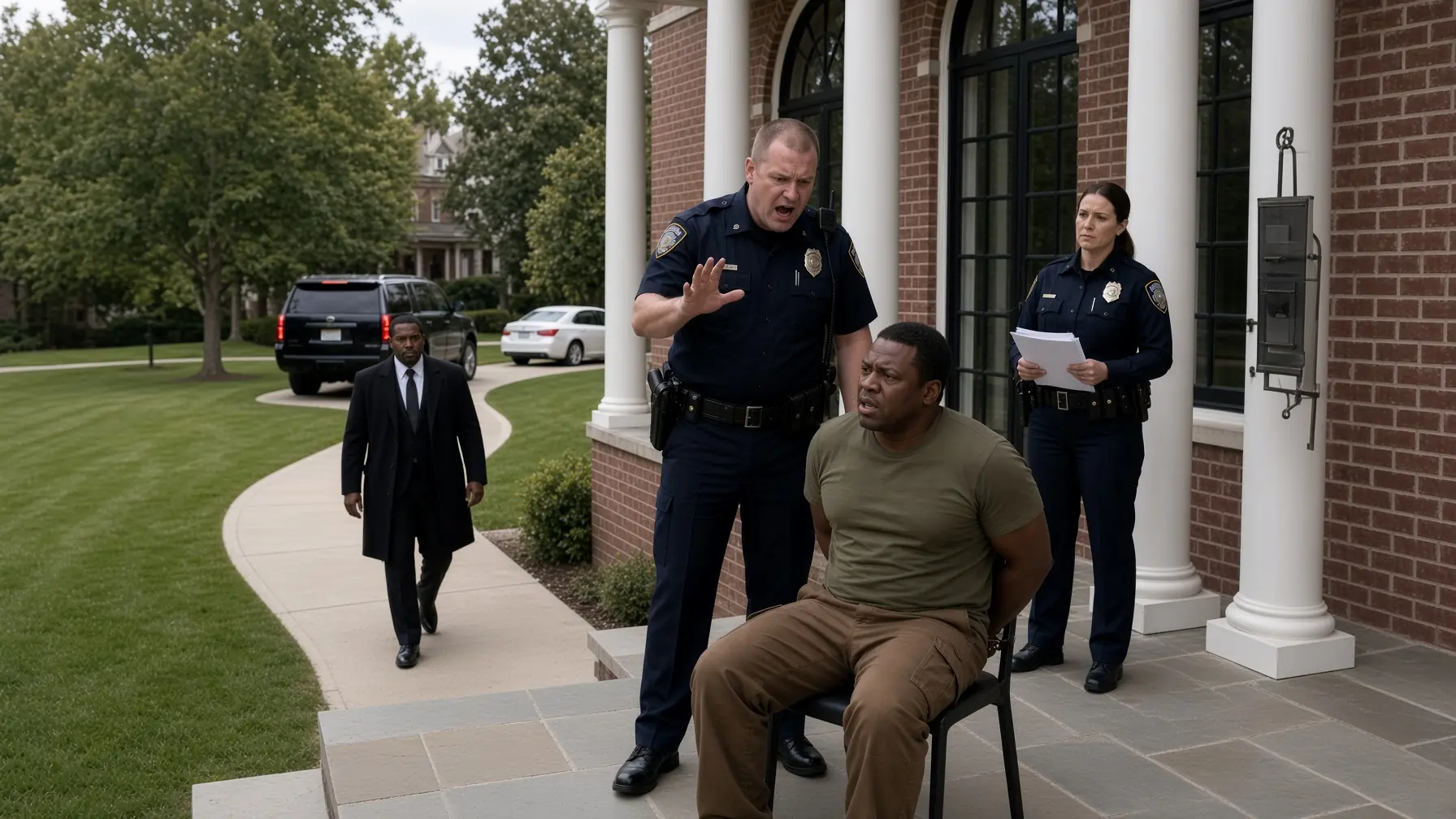
By the time the first police cruiser turned onto Briarstone Lane, Leon Walker had already finished mowing the front lawn.
The grass lay clean and even beneath the morning sun, except for one narrow strip near the driveway where he had paused to move the rake. His gray T-shirt was damp with sweat, his work pants were streaked green at the knees, and his old brown boots carried clumps of fresh grass along the soles. The mower sat cooling beside the garage, ticking softly in the quiet.
Leon was fifty-eight years old, Black, tall, and built with the worn strength of a man who had spent more years carrying weight than talking about it.
He had silver at his temples now.
His back ached most mornings.
One knee complained when rain came.
But he still cut his own grass every Saturday because the work steadied him. The smell of fresh lawn, the rhythm of the mower, the small satisfaction of straight lines across his yard—those things were peaceful. After a life spent in places where peace had to be guarded, ordinary work felt almost sacred.
Then three police cars came down the street with lights flashing.
The sound tore through the neighborhood.
Birds lifted from the maple trees.
A dog barked from behind a white fence.
Curtains moved in the houses across the road.
Leon looked up from the rake in his hand and watched the cruisers stop in front of his home, the largest brick colonial on the block. The red and blue lights flashed across the porch columns, across the polished windows, across the garage door he had opened ten minutes earlier with the remote clipped to his belt.
He did not run.
He did not shout.
He did not look surprised.
A man who had spent twenty-six years in uniform learned early that fear moved faster when you fed it. So Leon set the rake down carefully, wiped sweat from his forehead, and lifted both hands where the officers could see them.
“Officers,” he said, calm and clear, “this is my home.”
The first officer stepped from the lead cruiser with one hand near his belt.
Sergeant Evan Harrow was broad, white, late forties, with a square jaw and a voice that seemed built for commands. His eyes moved from Leon’s grass-stained clothes to the brick house behind him, then back to the mower, the rake, and the open garage.
“Keep your hands up.”
Leon kept them raised.
“My identification is in my wallet,” he said. “My keys are in my pocket. I also have a copy of the property deed on my phone if you want to verify it.”
Officer Blake Ford, younger but louder, stepped from the second cruiser and gave a short laugh.
“You expect us to believe you own this place?”
Leon looked at him.
“Yes,” he said. “Because I do.”
Ford looked him up and down.
“Then why are you dressed like the landscaper?”
Leon glanced at his stained shirt, then back at the officer.
“Because I was landscaping.”
A few neighbors had already stepped outside.
Phones appeared in hands.
Across the street, Marjorie Bellamy stood on her porch with her arms folded tightly across her chest. She had moved into the neighborhood less than a month earlier, into the white house with black shutters and a brass mailbox she polished twice a week. She knew the HOA president, the trash schedule, and which homes had sprinkler systems.
She had never asked who lived next door.
That morning, she had watched Leon from behind her kitchen window. She saw him unlock the side gate, move around the garage, carry tools across the yard, and walk up the porch steps like he belonged there. Instead of wondering whether he might be the homeowner, she decided he was a worker who had crossed some invisible line.
So she called the police.
She told dispatch there was “a suspicious man” around the big brick house.
She said he had tools.
She said he was trying to get into the garage.
She did not mention a broken lock because there was no broken lock.
She did not mention a shattered window because there was no shattered window.
She did not mention anything stolen because nothing had been stolen.
What she reported was a feeling.
And now that feeling had arrived in three police cars.
Officer Sofia Ramirez stepped out of the third cruiser last. She was twenty-eight, still new enough to look at evidence before the senior officers told her what it meant. Her eyes moved quickly from Leon’s raised hands to the mower, the garage, the house number, the mailbox, and the remote clipped to his belt.
Something about the scene did not sit right with her.
“Sergeant,” she said quietly, “we should confirm the address.”
Harrow ignored her.
He walked closer to Leon.
“Slowly reach for your wallet.”
Leon moved his right hand toward his back pocket with deliberate care.
Ford shifted.
Leon stopped immediately.
Harrow nodded.
Only then did Leon remove his wallet, open it, and hold out his driver’s license between two fingers.
Harrow took it.
The printed address matched the house behind him.
Briarstone Lane.
Number eighteen.
Leon Walker.
Harrow looked at the card for less than two seconds.
Ramirez saw the address.
So did Ford.
But Harrow did not read it aloud over the radio.
Leon reached carefully into another pocket.
“I also keep a folded copy of the closing papers in my truck. The deed is on my phone, and the property tax record is public.”
Ford smirked.
“That’s a lot of paperwork for a guy cutting grass.”
Leon kept his voice even.
“A homeowner can cut grass.”
The words were simple.
That made them harder to dismiss.
Marjorie raised her voice from across the street.
“I saw him going around the side of the house with tools.”
Leon turned his head slightly.
“Mrs. Bellamy, I introduced myself two weeks ago.”
Her face flushed.
“I met a man named Leon. I didn’t know you lived there.”
A strange silence moved across the neighbors.
It was not an innocent sentence, though she wanted it to sound like one.
Leon looked back at Harrow.
“May I show you the garage remote?”
“Don’t touch anything.”
“The remote is clipped to my belt.”
“I said don’t touch anything.”
Leon lowered his hand again.
The garage stood open behind him.
Inside were storage shelves, a workbench, a gray pickup truck, a wall of garden tools, and a folded American flag in a wooden case on the back shelf. The flag had once flown over a forward base where Leon had commanded men and women through nights that still sometimes returned in dreams.
No one asked about the flag.
No one asked about the truck.
No one asked why the garage looked less like a burglary scene and more like a man’s ordinary Saturday morning.
Ramirez spoke again.
“Sergeant, his license shows this address.”
Harrow’s jaw tightened.
“I can read.”
“Then maybe we should verify before—”
“Officer Ramirez,” Harrow said, voice sharp, “watch his hands.”
She went quiet.
But her body camera remained pointed toward the license in Harrow’s hand.
Leon noticed that.
He said nothing.
Ford moved closer.
“What do you do for work?”
“I’m retired.”
“Retired from what?”
“The Army.”
Ford let out another short laugh.
“Everybody was in the Army when they need a story.”
Something flickered in Leon’s eyes.
Not anger exactly.
Something older.
He could have listed the years.
He could have named the units.
He could have spoken of deserts, mountains, bad roads, worse nights, men carried under fire, letters written to families, and decisions that followed him long after retirement.
He did not.
He simply stood on his own driveway with his hands raised.
Harrow looked at the growing crowd.
More phones were up now.
More neighbors watched from porches, lawns, windows, and doorways. His authority had become public, and public authority is dangerous when the person holding it fears looking wrong more than being wrong.
“Turn around,” Harrow said.
Leon looked at him.
“For what?”
“Turn around. Hands behind your back.”
Ramirez stepped forward.
“Sergeant, wait.”
“Stand down.”
Leon stared at Harrow for one long second.
Not defiant.
Not pleading.
Disappointed.
Then he slowly turned around.
The first cuff closed around his right wrist.
Cold metal against warm skin.
The second cuff clicked shut.
For the first time that morning, the calm on Leon’s face cracked. Only slightly. Only for half a breath. But those watching closely saw the wound before discipline covered it again.
He did not resist.
He did not pull away.
He knew exactly how quickly resistance could be written into a report by people who had already refused to read the truth in his hand.
Harrow guided him to the porch step and made him sit.
Leon sat upright, wrists cuffed behind him, grass clinging to his boots, mower silent beside the driveway, open garage behind him, his own license still in the sergeant’s hand.
Across the street, one man muttered, “Some people really will try anything.”
A few nervous laughs followed.
Leon lowered his eyes once.
Not in shame.
In control.
He had taught younger soldiers that dignity was not the absence of humiliation. Sometimes dignity was what remained when humiliation failed to change your posture.
That lesson now belonged to him again.
Six months earlier, most people on Briarstone Lane did not know much about Leon Walker.
He had lived at number eighteen for nearly three years, purchasing the big brick colonial after retiring from active duty. He paid cash for part of it, financed the rest, and never thought twice about whether a man should have to explain why he owned what he owned.
He kept to himself.
He rose before dawn.
He drank coffee on the back porch while the street was still dark.
He trimmed hedges with the patience of a man who had once inspected equipment before convoys rolled out.
He shoveled snow for Mrs. Evelyn Price two doors down before she woke up.
He repaired a teenager’s bike chain near the corner and refused payment.
He moved a fallen branch from Marjorie Bellamy’s driveway the week after she arrived, then went home before she saw him.
He was polite.
Quiet.
Useful.
But he did not perform friendliness for comfort.
Some neighbors appreciated that.
Others turned it into suspicion.
The truth was that Leon had spent too many years giving orders in places where mistakes cost lives. After retirement, he wanted fewer words. Fewer crowds. Fewer explanations. He wanted a good chair, a quiet study, a clean yard, and the right to be ordinary.
Inside his home, in a room facing the backyard, were photographs he rarely showed anyone.
A younger Leon in uniform beside men whose names still tightened his throat.
A desert base under a sky too bright to trust.
A shadow box of medals kept on a low shelf, not displayed in the front hall.
A folded flag from a base closing ceremony.
A letter from a general, written in a hand less steady than the message.
Leon never introduced himself as a hero.
He disliked the word.
The people who deserved it most, in his experience, were the ones who did not get to grow old enough to reject it.
Now he sat on his porch while strangers recorded him.
His wrists ached.
His knee throbbed.
His lawn remained unfinished.
And the woman who had called police watched from across the street, beginning to understand that her imagination had become a weapon in someone else’s hands.
Ramirez moved closer to Harrow.
“Sergeant, dispatch can verify the deed in minutes.”
Harrow did not answer.
She tried again.
“We have the license. We have the garage open with no signs of forced entry. The truck is in the garage. We should slow this down.”
Ford looked at her.
“You always this soft?”
Ramirez’s jaw tightened.
“No. I’m accurate.”
Harrow turned toward her.
“Enough.”
Then a low engine entered the street.
Different from the patrol cars.
Deeper.
Steadier.
Heads turned.
A dark military SUV rolled onto Briarstone Lane and slowed near the gathered crowd. It had no siren, no flashing lights, no dramatic escort. It moved with the controlled certainty of a vehicle that did not need to announce power because power was already inside.
It stopped behind the cruisers.
The front passenger door opened first.
A colonel stepped out in full uniform.
Colonel Nathan Brooks.
His eyes scanned the scene once and stopped on Leon sitting cuffed on the porch.
His expression changed so sharply that Ramirez saw it from twenty feet away.
“What happened?” he demanded.
Harrow walked toward him.
“This is an active police matter.”
Brooks did not look at him.
His eyes remained on Leon.
“Why is he in handcuffs?”
No one answered quickly enough.
Then another vehicle appeared at the end of the street.
Long.
Black.
Official.
The kind of car that made conversations stop before it reached the curb.
Colonel Brooks turned toward it and snapped into posture.
The limousine stopped behind the SUV.
The rear door opened.
General Arthur Grayson stepped out.
Four silver stars shone on his shoulders.
The street went silent.
Even the neighbors holding phones seemed to lower them without realizing it.
General Grayson was tall, white-haired, and severe in the way of men who no longer wasted expression. He did not look at the crowd first. He did not look at Harrow. He did not look at the house.
He looked at Leon.
Cuffed.
Seated.
Humiliated in front of the home he owned.
For one brief second, pain moved through the general’s face.
Then command replaced it.
He crossed the lawn with long, controlled strides.
Harrow stepped forward.
“Sir, we’re dealing with a reported break-in.”
General Grayson stopped.
His voice was quiet.
“Who verified the address?”
Harrow hesitated.
“We’re still investigating.”
The general’s eyes moved to the license in Harrow’s hand.
“Is that his identification?”
“Yes, sir.”
“Did you read the address?”
Harrow’s face tightened.
“We had a caller report—”
“That was not my question.”
The street held its breath.
General Grayson repeated it.
“Did you read the address?”
Ramirez answered before Harrow could shape another evasion.
“The license matches the residence, sir.”
Harrow turned sharply.
Ramirez kept her eyes forward.
General Grayson looked at her, then back at Harrow.
“Remove those cuffs.”
Harrow did not move.
For a fraction of a second, pride fought survival on his face.
Then Ford fumbled for the keys and hurried to the porch.
Metal clicked.
The cuffs opened.
Leon brought his hands forward slowly.
Red marks circled both wrists.
He did not rub them.
General Grayson stepped onto the porch and, to the shock of everyone watching, lowered himself to one knee in front of Leon.
“Command Sergeant Major Walker,” he said, voice low. “I am sorry we are late.”
A ripple moved through the crowd.
Command Sergeant Major.
Leon gave him a tired look.
“Retired, Arthur.”
The general’s mouth tightened into something that almost became a smile.
“You never let me get away with that.”
“Rank ends. Bad habits remain.”
For half a breath, they were not a general and a retired soldier on a suburban porch.
They were two men who had known each other before titles became ceremony.
Then Grayson stood.
He turned toward the officers, the neighbors, the cameras, and the woman across the street whose phone now hung uselessly at her side.
“Do you know who this man is?”
No one answered.
Leon closed his eyes briefly.
He did not want this.
He had never wanted his life dragged into public for proof.
But the general continued because the morning had already become public, and silence now would protect the wrong lesson.
“This is Command Sergeant Major Leon Walker, United States Army, retired. He served this country for more than twenty-six years. He led soldiers through operations most of you will never hear about. He carried wounded men through terrain helicopters could not reach. He stayed in places where other men had every excuse to leave.”
The crowd seemed to shrink.
General Grayson’s voice lowered.
“Long before I wore these stars, I served under him.”
He looked at Leon.
“And on a night I have never forgotten, he saved my life.”
No one moved.
Even the birds seemed absent from the trees.
The general faced Harrow again.
“This man showed you identification. He offered property records. His garage was open without evidence of forced entry. His behavior was calm. His hands were visible. Yet you chose restraint before verification because you decided the truth did not look right wearing grass-stained clothes.”
Harrow’s face went pale.
Ford stared at the porch floor.
Ramirez looked down, not from guilt alone, but from the weight of knowing she had seen the turn coming and still had not stopped it.
Leon stood slowly.
His knee resisted.
Grayson reached out slightly, then stopped himself because he knew Leon would not want help unless he asked.
Leon looked at him.
“I’m all right.”
General Grayson studied the red marks on his wrists.
“No,” he said quietly. “You are controlled. That is not the same as being all right.”
The sentence landed harder than anger.
The police chief arrived within the hour.
By then, the neighborhood had lost its appetite for spectacle.
People who had been filming slipped their phones into pockets. The man who had laughed across the street went inside and did not come back out. Marjorie Bellamy stood frozen near her porch, her face tight with a kind of shame she had not yet learned how to carry.
The chief asked for every recording.
Body cameras.
Dispatch audio.
Neighbor videos.
Porch camera footage.
Vehicle camera footage.
Officer reports.
The original 911 call.
Nothing was to be deleted.
Nothing summarized before review.
Nothing softened.
The first review took less than a day to identify the obvious.
Leon’s license matched the address.
His copy of the deed matched county records.
The garage remote worked because it was his garage.
The pickup inside was registered to him.
No lock had been broken.
No window had been damaged.
No alarm had been triggered.
No item had been removed from the house.
Marjorie Bellamy’s call had been based entirely on assumption.
Sergeant Harrow’s decision had turned that assumption into force.
Officer Ramirez told investigators that she had asked for verification before the cuffs were applied. Her body camera showed the license in Harrow’s hand. It also showed Leon offering every reasonable answer while the scene continued to escalate.
That mattered.
Not because it erased what happened.
Because it proved the truth had been available before harm became official.
The department suspended Harrow pending review.
Ford was placed on restricted duty and ordered into remedial training.
Ramirez received no medal, no public praise, and no excuse from her own conscience.
When she came to Leon’s house three days later to take a supplemental statement, she stood on his porch with her hat in both hands.
“I should have pushed harder,” she said.
Leon looked at her for a long moment.
“Yes.”
The word did not punish.
It did not comfort.
It simply told the truth.
Ramirez swallowed.
“I knew something was wrong.”
“And?”
“I waited for someone with more rank to fix it.”
Leon nodded slightly.
“That is how wrong things survive.”
She looked down.
“I’m sorry.”
“I believe you.”
Her eyes lifted.
He added, “Now make it mean something.”
She did.
Months later, her written statement would become one of the clearest pieces in the policy review. She did not make herself the hero. She wrote the parts that mattered: the address, the hesitation, the order to stand down, the moment when procedure failed because authority refused correction.
That kind of honesty cost her socially inside the department.
It also saved her career from becoming smaller than her conscience.
As for Marjorie Bellamy, she avoided Leon for nine days.
On the tenth, she crossed the street carrying an envelope and no casserole, which Leon appreciated because guilt should not always arrive with sugar.
He was trimming the roses near the porch when she stopped several feet away.
“Mr. Walker.”
He turned.
“Mrs. Bellamy.”
She held out the envelope.
“I wrote an apology.”
He did not take it immediately.
“What did you see that morning?”
She blinked.
“I put it in the letter.”
“I’m asking you now.”
She looked toward the lawn.
“I saw you mowing.”
“And?”
“I saw you open the garage.”
“And?”
Her voice grew smaller.
“I saw you walk around the property like you lived there.”
Leon waited.
Marjorie’s eyes filled.
“And I decided you didn’t.”
The truth sat between them.
Finally honest.
Leon took the envelope.
“Keep that sentence,” he said.
She looked confused.
“Where?”
“In your mind. Every time you think fear is the same as good judgment.”
She nodded through tears.
“I am sorry.”
“I know.”
“Do you forgive me?”
Leon looked at the roses.
“Not today.”
The answer hurt her.
It was supposed to.
Not all cruelty, once recognized, is owed immediate relief.
But he added, “You can still learn today.”
She accepted that, which was the first decent thing she did without defending herself.
The community meeting happened the following week in the elementary school gym.
The room filled beyond capacity.
Neighbors.
Police officers.
Veterans.
Local officials.
People who had never spoken to Leon now sat in rows waiting for him to explain what the morning had meant, as if the man harmed by their assumptions was also responsible for translating them.
Leon almost declined.
Then General Grayson called.
“Say what they need to hear,” he told him.
“I’m tired of teaching grown people how to see.”
“I know.”
“Then why should I?”
A pause.
“Because some of them are finally listening.”
So Leon went.
He stood at the front of the gym wearing a dark jacket and no medals.
General Grayson sat in the back row.
Colonel Brooks stood beside the wall.
Marjorie sat near the aisle, hands folded tightly in her lap.
Sergeant Harrow did not attend.
Officer Ford did.
Officer Ramirez sat in uniform, back straight, eyes forward.
The police chief explained the department’s review first.
He admitted the call had been mishandled.
He admitted verification should have occurred before restraint.
He admitted that clothing, race, and assumption had been allowed to outweigh documentation.
The room listened.
Then Leon stood.
“I do not want this community to remember me because a general came to my street,” he said.
No one moved.
“I want you to remember what was already true before he arrived.”
He let that settle.
“My name was on the license. My name was on the deed. My keys opened the door. My remote opened the garage. My truck was registered there. My behavior was calm. My hands were visible. The facts were not hiding.”
He looked across the room.
“They were ignored.”
Marjorie lowered her eyes.
Leon continued.
“The mistake was not that officers failed to recognize my military service. My service had nothing to do with whether I had the right to stand in my own yard.”
The gym became very quiet.
“The mistake was believing dignity needed a résumé.”
That sentence stayed with people.
Some wrote it down.
Some simply felt it land where excuses had been.
Leon looked toward the officers.
“I respect law. I respect duty. I respect difficult work done under pressure. But authority is most dangerous when it moves faster than verification. A badge does not turn suspicion into fact. A uniform does not make your first thought correct.”
Then he looked toward the neighbors.
“And fear does not become truth just because you call it in.”
No applause came immediately.
Good.
Applause can become a way to avoid thinking.
Leon sat down, and the silence remained long enough to do its work.
The department changed its residential call procedure within two months.
The new rule was called the Verification Pause.
If someone claimed to live at a property and there was no immediate threat, officers had to check available evidence before escalating restraint. Identification. Vehicle registration. Keys. Electronic garage access. County property records. Utility records. Mail. Neighbor confirmation. Anything reasonable and available at the scene.
If officers used handcuffs before verification, they had to state the immediate safety reason over the radio.
Not later.
Not in a report written after the adrenaline faded.
Right then.
A new field appeared in the digital report system.
Residency evidence reviewed.
Cases could not close until that field was completed.
Some officers complained at first.
They said it slowed them down.
Then the data showed it reduced false residential detentions.
It also reduced complaints.
The green check box became ordinary.
That meant it was working.
Leon heard about the first case it prevented from Officer Ramirez.
A man in work clothes had been reported entering a townhouse garage.
He turned out to be the owner’s brother, there to repair a water heater.
The officer checked his ID, called the owner, verified the key code, and cleared the call in six minutes.
No cuffs.
No crowd.
No humiliation.
When Ramirez told Leon, he nodded.
“That is the apology I wanted.”
Life on Briarstone Lane changed slowly.
Not beautifully.
Not magically.
No neighborhood becomes honest overnight because one wrong morning was recorded.
Some neighbors apologized because they were sorry.
Some apologized because they were embarrassed.
Some avoided Leon completely, which was its own confession.
Mrs. Price, the elderly widow, brought him peach cobbler and said, “I should have come outside sooner.”
Leon told her, “You’re eighty-two.”
She pointed a spoon at him.
“I still know how to open a door.”
That made him smile.
Marjorie began introducing herself properly to new neighbors.
She also joined the welcome committee and insisted every household receive a directory, not because people needed surveillance, but because ignorance had already done enough damage on that street.
Leon did not become her friend.
But one morning in spring, he saw her struggling with a broken garden hose and walked over with a wrench.
She looked startled.
“You don’t have to help me.”
“I know.”
He fixed it in less than three minutes.
She thanked him softly.
He nodded and went home.
That was not forgiveness either.
It was simply Leon refusing to let someone else’s failure decide the limits of his decency.
General Grayson visited again that summer, this time without the limousine.
He arrived in an ordinary sedan, wearing civilian clothes, carrying two coffees and a folder he did not intend to open unless Leon asked. They sat on the back porch while evening settled over the yard.
“You know,” Grayson said, “they want you to speak at the leadership academy.”
“No.”
“I told them you’d say that.”
“Then why ask?”
“Because I wanted the pleasure of being right.”
Leon almost smiled.
Grayson looked toward the lawn.
“You taught half the Army how to think under pressure. You can teach some civilians.”
“I wanted quiet.”
“I know.”
“I earned quiet.”
“You did.”
They sat with that for a while.
Then Leon said, “One class.”
Grayson smiled.
“One is how it starts.”
“Don’t push your luck.”
The class became part of a leadership program for police supervisors, emergency managers, and veterans moving into public service.
Leon called his session First Thought, Final Harm.
He stood before the room in plain clothes and told the story without hero music.
A man mowing.
A neighbor calling.
A license ignored.
A subordinate unheard.
A pair of cuffs.
A general arriving too late to prevent the harm but soon enough to expose it.
Then he asked the room one question.
“What fact did they need that they did not already have?”
No one answered.
Because the answer was none.
That was the lesson.
Not that Leon had been secretly important.
Not that rank could rescue dignity.
The lesson was that the truth had been present before authority chose to respect it.
Years passed.
The story faded from headlines, then from social media, then from people’s daily conversations. But it did not fade from Briarstone Lane. It lived in smaller habits.
Neighbors asked names before inventing stories.
Officers checked addresses before reaching for cuffs.
Ramirez became a field training officer and taught rookies that the most dangerous phrase in policing was “It looked wrong” when no one could explain what wrong meant.
Ford improved slowly, painfully, after discipline.
Harrow left the department within a year.
Leon did not celebrate that.
A ruined career was not the same as justice.
Justice was the next person not being cuffed in their own driveway because someone had learned to pause.
Every Saturday, Leon still mowed his lawn.
His knee worsened.
His daughter told him to hire a landscaper.
General Grayson told him he was stubborn enough to qualify as government property.
Leon ignored them both.
He mowed because it was his lawn.
Because ordinary routines taken by humiliation must be reclaimed in ordinary ways.
Because the mower, the grass, the garage, and the quiet street belonged to the life he had built after service, and he would not surrender that life to one morning’s ignorance.
One Saturday, a little boy from two houses down stopped at the edge of the driveway while Leon cleaned grass from the mower wheels.
“Mr. Walker?”
Leon looked up.
“Yes?”
“My dad says you used to be a soldier.”
“I did.”
“Were you famous?”
“No.”
“What were you?”
Leon thought about that.
A commander.
A witness.
A survivor.
A man who had carried orders, grief, and responsibility longer than he admitted.
Finally, he said, “Responsible for people.”
The boy frowned.
“That’s not a job.”
Leon smiled.
“It should be.”
The boy considered this and nodded with the seriousness only children can bring to simple wisdom.
“Can I help with leaves in the fall?”
“Ask your father.”
“He said to ask you.”
“Then yes.”
The boy ran off satisfied.
Leon watched him go, and for the first time in a long while, the driveway felt only like a driveway.
No cruisers.
No cuffs.
No crowd.
No lights flashing across the brick.
Just a man, a mower, a street, and a morning allowed to remain ordinary.
That was the victory.
Not the general stepping out of the limousine.
Not the neighbors going silent.
Not the policy with its new green check box.
All of that mattered.
But the victory was smaller.
A homeowner could open his garage without proving his humanity.
A child could ask about leaves.
An officer somewhere could slow down before harm.
A caller could be asked, “What did you actually see?”
Years later, people still told the story the dramatic way.
A Black man was handcuffed outside his own mansion.
Then a four-star general arrived.
Then everyone found out he was a decorated command leader who had once saved that general’s life.
That version was true.
It was also too small.
Leon preferred the quieter version.
A man cut his grass.
A neighbor made an assumption.
Police turned that assumption into force.
Then the truth, which had been there the whole time, finally became too visible to ignore.
The general’s arrival did not create Leon’s worth.
His uniform had not created it either.
The medals in his study did not create it.
The flag in his garage did not create it.
Leon Walker had deserved dignity before anyone knew what he had done, before anyone heard his rank, before anyone learned that powerful men remembered his name with gratitude.
He deserved it when he was just a man in grass-stained boots, standing in his own driveway with a rake beside him and proof in his pocket.
That should have been enough.
And on Briarstone Lane, after one ugly Saturday morning, people finally began to understand that “should have” is not good enough unless it changes what happens next.