Richard Harlan believed authority should be visible.
He liked polished shoes, straight ties, silent hallways, and doors that opened before he reached them.
He liked faculty members who stood when he entered a meeting.
He liked students who understood immediately that a principal’s question was rarely an invitation to debate.
Most of all, he liked Westbridge Academy to look expensive.
The private school occupied eleven acres outside Boston, Massachusetts, and every inch of it seemed designed to suggest permanence.
White limestone.
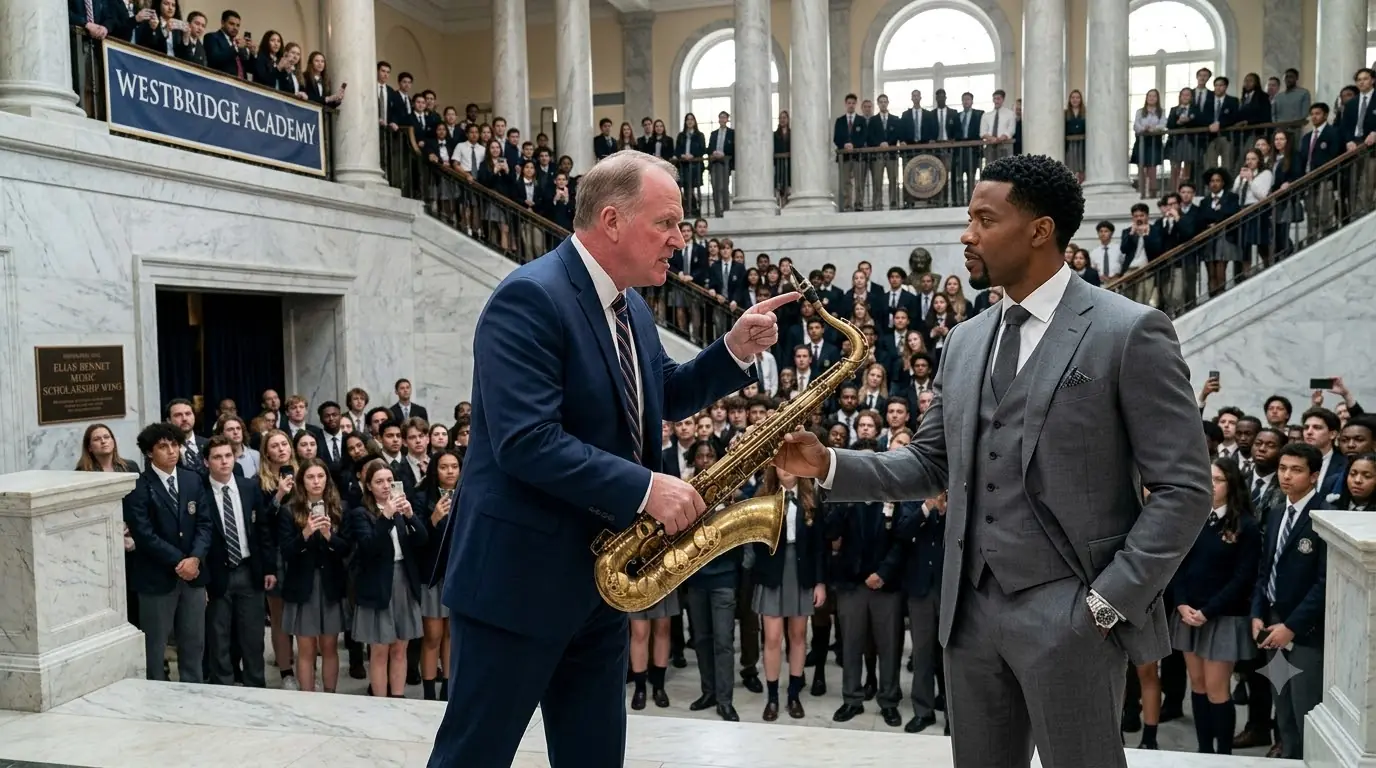
Marble floors.
Tall arched windows.
Oak-paneled classrooms.
A library with a vaulted ceiling imported from an estate in Connecticut.
Parents sometimes joked that tuition paid as much for the architecture as the education.
Richard never corrected them.
Architecture mattered.
Appearance mattered.
Reputation mattered.
That was why the man standing in the center of the atrium on Friday afternoon bothered him before the man had even spoken.
Richard noticed him from the second-floor balcony.
Thirty-four years old, perhaps.
Black.
Tall.
Athletic.
Expensive gray three-piece suit.
Perfect white shirt.
Gray silk tie.
Dark pocket square.
Shoes polished enough to reflect the marble beneath them.
He stood near the entrance to the music corridor with one hand in his trouser pocket, examining a brass plaque mounted beside the archway.
He looked completely at ease.
That, more than anything else, caught Richard’s attention.
Visitors usually looked lost.
Parents looked impressed.
Contractors looked hurried.
Alumni looked nostalgic.
This man looked as if he were inspecting something he already owned.
Richard disliked that immediately.
He descended the stairs.
The Friday student assembly had just ended, so hundreds of students were spilling from the auditorium into the main atrium.
Uniform blazers.
Khaki trousers.
Pleated skirts.
Phones already appearing despite school policy.
Teachers tried directing traffic.
Near the music corridor, the stranger remained motionless.
Richard approached.
“Excuse me.”
The man turned.
Richard had expected surprise.
Instead he received a calm glance from dark brown eyes.
“Yes?”
“This hallway is restricted during rehearsal hours.”
The stranger looked toward the open double doors.
“I know.”
Richard’s eyebrows tightened.
“Then you understand you're not supposed to be here.”
“I understand the sign.”
Richard waited.
The man did not move.
“What is your name?”
“Elias Bennett.”
Something about the name touched the edge of Richard’s memory.
Not enough.
He had been principal for seven years.
Thousands of alumni names passed through donor lists, award programs, databases, and yearbooks.
He did not pretend to remember all of them.
“Are you a parent?”
“No.”
“Vendor?”
“No.”
“Scheduled guest?”
“Yes.”
Richard looked toward the reception desk.
Nobody had called him.
“With whom?”
“Several people.”
“That isn't an answer.”
Elias glanced toward the plaque again.
It read:
ELIAS BENNETT SCHOLARSHIP WING
Below that:
EMPOWERING FUTURES THROUGH LEGACY
Richard followed his eyes.
“You're interested in the music wing?”
Elias gave a faint smile.
“You could say that.”
Richard immediately made the wrong assumption.
He had seen people do this before.
Visitors taking photographs beside donor plaques.
Contractors joking about famous names.
Prospective parents pretending familiarity with benefactors.
A man in a designer suit standing beside a plaque bearing the same surname might easily turn coincidence into a story.
Richard folded his arms.
“Related?”
Elias looked at him.
“To whom?”
“The Bennett family.”
The faint smile disappeared.
“There is no Bennett family foundation.”
Richard felt impatience.
“The donor.”
Elias looked toward the letters.
“You don't know who donated it?”
Richard bristled.
“Of course I do.”
That was not entirely true.
The wing had been funded six years earlier by a private gift routed through the Heritage Arts Trust.
The donor requested anonymity except for one condition.
The facility would carry the name Elias Bennett.
The board had approved.
Richard had assumed Elias Bennett was a deceased relative.
Perhaps a father.
Perhaps a son.
The trust had never clarified.
He had never considered the matter particularly important.
Money mattered.
Names were ceremonial.
Richard said:
“A benefactor chose the name.”
Elias turned back toward him.
“And you never asked why?”
“The board handled the agreement.”
“I see.”
Something about the response irritated Richard.
Not the words.
The tone.
As though Elias had just confirmed something disappointing.
“Sir, I need you to return to the public area.”
Elias reached inside his jacket.
Richard’s attention sharpened.
Elias withdrew a folded visitor credential.
Before Richard could read it, a voice called from behind.
“Mr. Harlan!”
Megan Walsh, assistant director of student affairs, hurried through the crowd.
She was thirty-two, red-haired, efficient, and perpetually worried about Richard’s temper.
“Mr. Harlan, the conservatory students are assembling for the donor presentation.”
Richard nodded impatiently.
“I know.”
Megan glanced at Elias.
Her expression changed.
Recognition?
Richard noticed.
“You know this gentleman?”
Megan opened her mouth.
Elias spoke first.
“We haven't met.”
Megan stopped.
Richard looked between them.
“Then what's the problem?”
“Nothing.”
Megan stared at Elias again.
She seemed uncertain.
Richard disliked uncertainty in subordinates.
He turned back toward Elias.
“Visitor pass.”
Elias handed it over.
Richard read.
ELIAS BENNETT
SPECIAL GUEST
BOARD OFFICE
Richard looked up.
“What is this for?”
“The meeting.”
“What meeting?”
“The one your board scheduled.”
Richard’s irritation became suspicion.
Friday afternoon included a trustees’ arts committee review at four.
Richard was expected to present Westbridge’s five-year expansion plan.
Donor representatives were supposed to attend.
He had not received their names.
“Are you with Heritage Arts?”
Elias answered:
“I have an interest in their work.”
Again.
Not a direct answer.
Richard handed the pass back.
“Then you can wait in the board reception room.”
Elias did not take it immediately.
His gaze moved past Richard toward the rehearsal hall.
Music drifted through the open doors.
A saxophone scale.
Incorrect fingering.
The player stopped.
Started again.
Elias listened.
Richard noticed.
“You play?”
Elias finally took the credential.
“A little.”
Richard almost smiled.
The phrase sounded like false modesty.
He had spent enough years around wealthy parents to recognize men who claimed casual expertise after taking three lessons twenty years earlier.
“Then you'll appreciate how seriously we protect rehearsal time.”
Elias looked at him.
“I used to rehearse in that room.”
Richard paused.
“When?”
“Long before your time.”
“You attended Westbridge?”
“Yes.”
“Graduated?”
“No.”
Richard’s expression shifted.
There it was.
The missing piece.
A former student.
Did not graduate.
Returned wearing a suit expensive enough to announce success.
Standing beside a donor plaque bearing his own name.
Richard had met this archetype.
People who left schools badly often returned years later wanting recognition.
They needed witnesses.
They needed the institution to acknowledge it had underestimated them.
Richard found such performances tedious.
“What year?”
“2008.”
Richard nodded.
“You left?”
“Yes.”
“Expelled?”
A group of students passing nearby slowed.
Elias’s expression hardened slightly.
“No.”
“Asked to withdraw?”
“No.”
“Then?”
“My scholarship disappeared.”
Richard gave a short shrug.
“That happens when standards aren't maintained.”
Elias stared at him.
Richard realized he had gone too far.