“Is this a joke?”
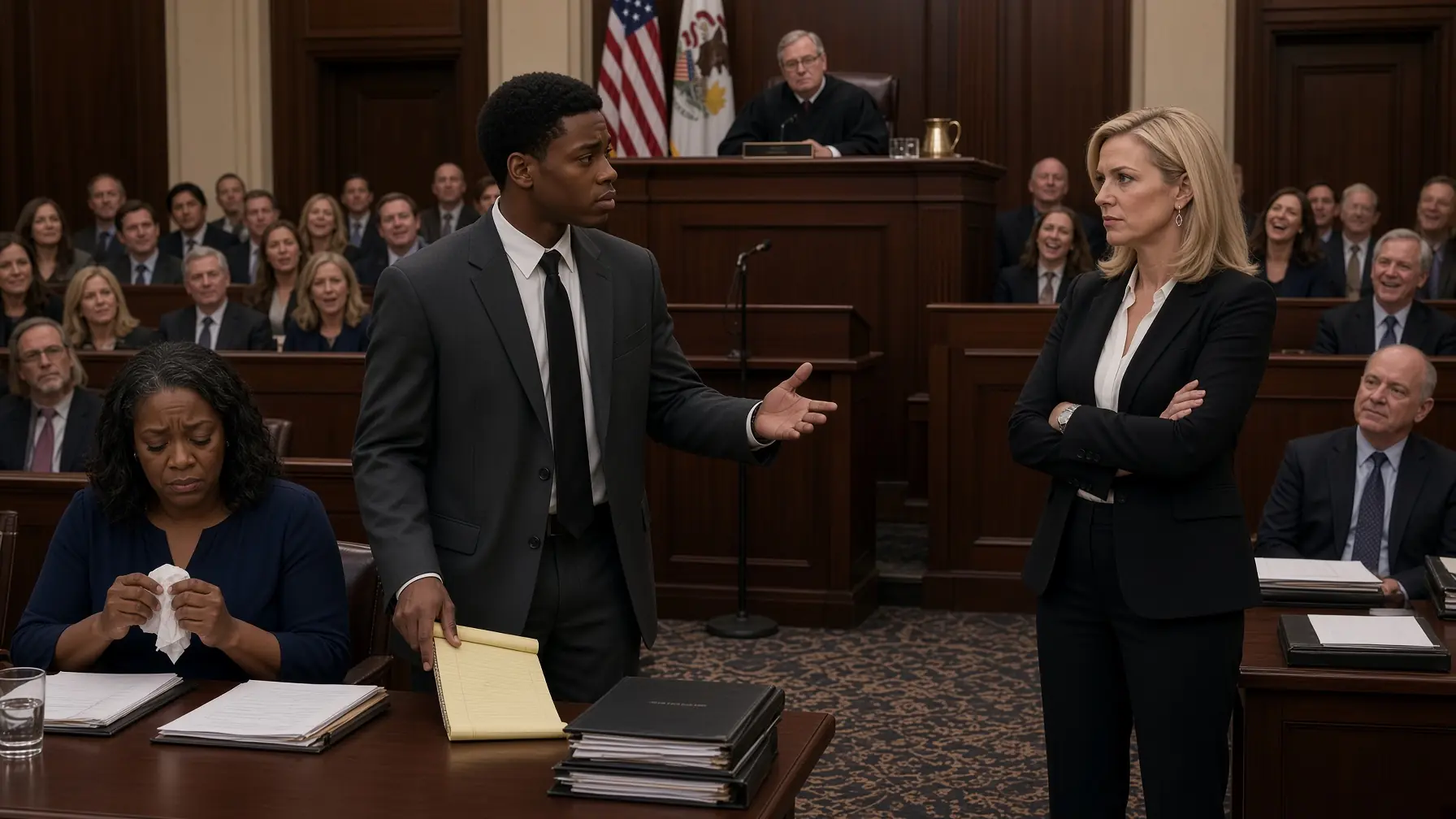
Assistant State’s Attorney Dana Pierce did not bother lowering her voice. She stood in the center of Courtroom 302 with one hand resting on the prosecution table and looked directly at nineteen-year-old Elijah Cross as if somebody had allowed a high school student to wander into the wrong room.
“Your Honor, this is a felony fraud trial, not a law-school exercise. Mrs. Cross is facing years in prison, and we are seriously going to let a teenager question a forensic accountant?”
A few people in the gallery laughed.
Not loudly.
That made it worse.
Elijah stood beside the defense table in a charcoal suit purchased for thirty-two dollars from a thrift store on South Halsted. The shoulders were slightly too wide, and his tie had been knotted three times that morning before it stopped looking crooked. Beside him sat his mother, Sarah Cross, forty-nine years old, hands folded tightly over a tissue she had already torn into four pieces.
At the far end of the table sat the person Dana kept pretending did not exist: Professor Lena Ortiz, a licensed Illinois attorney and director of a criminal-defense clinic at a Chicago law school.
Elijah was not secretly pretending to be a lawyer.
He was a second-year law student who had entered college years earlier than most people, completed an accelerated mathematics degree at seventeen, and then enrolled in law school. Under Illinois’s student-practice rules, and under Ortiz’s direct supervision, he had been certified to perform limited courtroom work.
He could not independently represent his mother.
He could not sign whatever he wanted or improvise around professional rules.
Professor Ortiz remained attorney of record and responsible for every decision.
But Elijah could question witnesses.
And Dana Pierce hated that almost as much as she hated losing.
Judge Arthur Harrison looked over his glasses.
“Ms. Pierce, Mr. Cross’s certification is in the record. Professor Ortiz remains supervising counsel. We addressed this yesterday.”
Dana smiled.
“I understand that, Your Honor. I’m simply concerned the jury may confuse enthusiasm with expertise.”
Judge Harrison’s expression hardened.
“Then perhaps stop emphasizing his age in front of them.”
The gallery went quiet.
Elijah said nothing.
That had become one of the first things Professor Ortiz taught him.
When the judge has already made your point, do not stand up and make it worse.
Dana turned toward him.
“Proceed, Mr. Cross.”
Her smile returned.
She thought she was giving him enough rope.
The witness in front of him was Martin Heller, a forensic accountant who had spent fourteen years investigating municipal fraud. Heller wore rimless glasses and spoke in the patient tone of a man accustomed to juries assuming spreadsheets were magic.
On the monitor behind him glowed the prosecution’s most important exhibit.
Three electronic transfers.
$71,400.
$83,200.
$64,700.
Total: $219,300.
The money had been diverted from a city-administered neighborhood redevelopment fund into two shell vendors, then routed through additional accounts.
And according to the prosecution, all three transfers had been authorized using Sarah Cross’s municipal employee credentials.
Dana’s case was not that Sarah had personally sat in a dark room hacking bank servers.
It was more plausible than that.
Sarah had worked for eighteen years in the laundry operations office at a city-owned hospital. Her job involved uniforms, linen inventory, supplier deliveries, and reconciliation of vendor invoices. Because the hospital belonged to a municipal network, Sarah possessed a city employee login giving her access to procurement applications.
She could not approve multimillion-dollar contracts.
She could not release city treasury funds by herself.
But the prosecution claimed she had provided her credentials to someone inside the Department of Community Development, helping bypass an internal control while receiving a share of the stolen money through cash withdrawals and payments disguised as reimbursements.
The state’s theory had holes.
Dana had filled them with confidence.
Elijah approached the lectern carrying six pages.
“Mr. Heller, when you say Mrs. Cross authorized these transfers, you mean her username and authentication token appear in the audit records?”
“That is correct.”
“You did not see her physically make the transfers.”
“No.”
“There is no surveillance video showing her at the workstation.”
“No.”
“No witness saw her use that workstation.”
“Not to my knowledge.”
Dana rose.
“Objection. Asked and answered in prior testimony.”
“Sustained,” Harrison said.
Elijah changed direction.
“The workstation associated with the transaction is identified in the log as terminal CD-4F-117?”
Heller glanced down.
“Yes.”
“Where is that terminal?”
Dana stood again.
“Objection. Foundation.”
Elijah felt heat climb the back of his neck.
“I can establish—”
“Then establish it first,” Harrison said.
A few jurors looked away.
Elijah returned to the witness.
“Did you personally inspect CD-4F-117?”
“No.”
“Do you know its physical location from your own observation?”
“No.”
“Then your report identifying it as a fourth-floor municipal workstation came from somebody else?”
Dana was standing before he finished.
“Hearsay.”
“Sustained.”
Elijah stopped.
This was what Dana did.
She did not merely know the rules.
She could see his destination three questions before he got there and block the road while he was still building it.
He returned to his notes.
“Mr. Heller, does an authentication log prove who physically typed at a keyboard?”
“No.”
“Could credentials theoretically be used by somebody other than the assigned employee?”
“Under certain conditions.”
“What conditions?”
“Credential theft. Sharing. Remote access. Malware. Administrative impersonation. There are several possibilities.”
Elijah looked toward the jury.
“So the log proves the credential was used, not the person.”
Dana shot up.
“Objection. Argumentative.”
“Sustained.”
Harrison looked at Elijah.
“Ask a question.”
Elijah nodded.
“Can you determine from Exhibit 42 alone whether Mrs. Cross physically initiated the transfers?”
Heller hesitated.
“No.”
It was the best answer Elijah had gotten all morning.
Dana repaired it immediately on redirect.
“But Mr. Heller, did your investigation find any indication before trial that Mrs. Cross’s credentials had been compromised?”
Elijah looked up.
Heller answered, “I was not provided evidence establishing that.”
“Did Mrs. Cross report her credentials stolen?”
“No.”
“Did she claim her account had been hacked before law enforcement confronted her?”
“No.”
“Did financial records show cash deposits into an account connected to her household?”
“Yes.”
Sarah whispered beside Elijah, “That was your tuition money.”
He knew.
Two cash deposits totaling $8,000 had become one of Dana’s favorite facts.
The money came from Elijah’s late grandfather, who had kept savings in cash and given it to Sarah shortly before his death.
There were no formal receipts.
No bank transfer.
No perfect documentation.
Just a family explanation that looked weak beside electronic records.
Dana faced the jury.
“No further questions.”
Heller stepped down.
Judge Harrison recessed for lunch.
The moment the jury left, Dana gathered her files and looked across the aisle at Elijah.
“You keep trying to turn possibility into evidence.”
Professor Ortiz said, “Dana.”
Pierce ignored her.
“Credential theft. Malware. Remote access. You can list every word in a cybersecurity glossary. It doesn’t make any of them true.”
Elijah closed his notebook.
“No.”
Dana waited.
“It means your logs don’t establish what you keep saying they establish.”
Her smile disappeared.
Professor Ortiz touched Elijah’s arm.
“That’s enough.”
He stopped.
Dana walked away.
Sarah watched her leave.
“She scares me.”
Elijah turned.
His mother was not joking.
He sat beside her.
“I know.”
“What if she’s right?”
“About what?”
“What if you can’t prove it?”
Elijah looked toward the empty witness stand.
That was the question he had been trying not to answer for six months.
Innocence and proof were not the same thing.
Sarah Cross could be completely innocent and still lose if the admissible evidence told a story the jury believed more strongly than hers.
That was what frightened him.
Not corruption.
Not Dana Pierce.
Not even prison.
Proof.
Sarah had been arrested seven months earlier at 5:40 in the morning.
Two investigators arrived while she was preparing oatmeal.
They took her phone.
Laptop.
Work identification.
A cardboard box containing tax records.
The city placed her on unpaid leave the same day.
Within forty-eight hours, prosecutors froze approximately $31,000 in family savings under a parallel civil asset-restraint petition, arguing that some of it represented proceeds from the fraud. A notice was also filed against the small two-flat Sarah owned with her sister because prosecutors claimed improvements to the property may have been funded with criminal proceeds.
That financial restraint did not make legal representation impossible.
Sarah qualified for appointed counsel.
But the first public defender assigned to her carried a caseload that would have exhausted three people.
He was not incompetent.
He was drowning.
The state offered a plea: admit one count of theft, cooperate against unnamed co-conspirators, and prosecutors would recommend four years instead of pursuing charges carrying substantially greater exposure.
Sarah refused.
“I can’t cooperate against people I don’t know.”
The public defender told her the evidence was strong.
He was not threatening her.
He was explaining risk.
Elijah left that meeting furious at everyone except the one person he should have blamed least.
Two weeks later, Professor Lena Ortiz heard about the case through a legal-aid referral. Her clinic usually handled post-conviction work, but something about Sarah’s discovery file interested her.
So did Elijah.
At nineteen, he was the youngest student in her class and by far the most irritating.
He remembered everything.
Not magically.
He took meticulous notes and had an unusually strong memory for structured information. If somebody gave him a hundred pages and asked where a particular phrase appeared, he could often find it faster than people who had practiced law longer than he had been alive.
But he had a weakness.
He believed understanding something meant he could explain it.
Courtrooms punished that belief.
Professor Ortiz taught him otherwise.
The first time he proposed personally taking over Sarah’s defense, Ortiz stared at him for several seconds.
“No.”
“I’m certified.”
“No.”
“I know the file better than anyone.”
“That is not the same thing as knowing how to try a felony.”
“I can learn.”
“While your mother faces prison?”
Elijah went silent.
Ortiz leaned forward.
“You want to help her?”
“Yes.”
“Then stop making this about whether you are extraordinary.”
That sentence hurt.
She continued.
“Find facts.”
So he did.
By the time trial began, Elijah had indexed 11,842 pages of discovery.
Bank statements.
City procurement records.
Phone extractions.
Emails.
Badge-access logs.
Employee manuals.
Vendor files.
Server exports.
Interview summaries.
Dana’s case relied on accumulation.
Sarah’s credentials.
Sarah’s signature on routine invoices connected to one shell vendor before it became fraudulent.
The unexplained cash deposits.
A phone call between Sarah and a deputy procurement director the week before the first transfer.
And Exhibit 42.