The first thing Eleanor Whitaker noticed about Thomas Reed was his right hand.
Not his height, though he stood several inches taller than most of the men who worked cattle around Harlow County. Not the worn tan hat pulled low over dark hair that badly needed cutting. Not even the gray-blue eyes that seemed to measure everything before allowing the rest of his face to react.
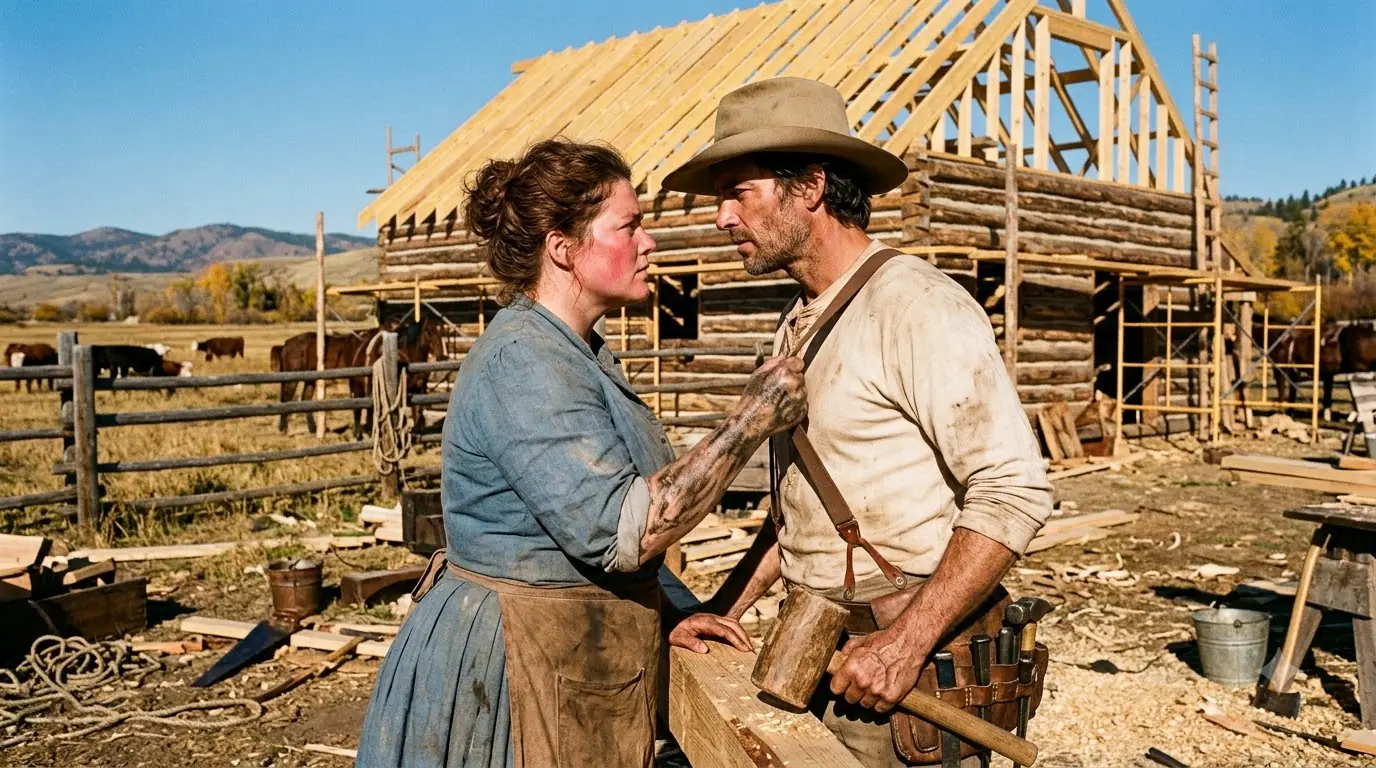
His hand.
Three fingers curled slightly toward his palm and never fully straightened.
Thomas tried to hide them when he approached the Whitaker Ranch gate on a cold September morning in 1885, but Eleanor had spent half her life noticing the things men hoped she would overlook. A widow managing one hundred and sixty-eight acres alone did not survive by pretending not to see weakness, hunger, dishonest intentions, or fear.
“You the carpenter?” she asked.
Thomas stopped beside the gate.
“Depends who’s asking.”
Eleanor rested one thick forearm across the top rail.
“The woman holding the money.”
That almost made him smile.
Almost.
“Then yes.”
Eleanor looked past him.
No wagon.
No horse.
No partner.
Only a rolled bedroll strapped behind one shoulder and a heavy leather tool bundle hanging against his hip.
“You walked?”
“Last seven miles.”
“Why?”
“My horse decided we had different opinions about ownership.”
This time Eleanor did smile.
“Horse steal itself?”
“Apparently.”
She opened the gate.
“Barn’s this way.”
Thomas followed.
That was how it began.
No romance.
No thunderbolt.
No destiny whispering across the Montana prairie.
Only a widow with a collapsing barn and a drifter whose damaged hand made most employers doubt whether he could swing a hammer anymore.
Eleanor needed cheap labor.
Thomas needed winter work.
Neither expected the arrangement to last longer than six weeks.
Both were wrong.
Whitaker Ranch had belonged to Eleanor’s husband, Samuel, before it belonged to her.
That was how almost everyone in Harlow County described it.
Samuel Whitaker’s place.
Samuel’s cattle.
Samuel’s north pasture.
Samuel’s barn.
Even five years after pneumonia took him in January of 1880, neighbors still occasionally asked Eleanor whether she had considered selling “his ranch.”
Eleanor stopped correcting them after the first year.
Land did not care what people called it.
It cared who fixed fences.
Who hauled water.
Who stayed awake beside a calving cow through freezing rain.
Who knew which south meadow flooded during spring thaw and which cottonwood near the creek always drew lightning.
Samuel had loved the place.
Eleanor had worked it.
There was a difference.
She had been twenty-seven when they married, older than most brides in the territory and already accustomed to men making comments about her size. Samuel was one of the few who never did.
At least not cruelly.
He called her strong.
Eleanor remembered that because the word sounded different coming from a man who meant it as admiration rather than consolation.
Samuel died after only four years of marriage.
No children.
No life insurance.
No miracle inheritance.
He left Eleanor one ranch, seventeen cattle, seven horses, a badly organized ledger, and enough debt to make three bankers speak to her as though grief had also made her stupid.
She survived.
Barely at first.
Then better.
By 1885, Whitaker Ranch had forty-three cattle, nine horses, three hired hands during roundup, and one catastrophic problem.
The barn roof was failing.
A June windstorm had ripped away half the west side.
Rain followed.
Then rot.
A support beam cracked in August.
By September, Eleanor had no choice.
Rebuild.
Or lose the structure entirely before winter.
She had money for materials.
Almost.
Labor was another matter.
Then Thomas Reed arrived.
He walked around the barn twice before saying anything.
Eleanor followed several steps behind.
The building had been raised twenty-two years earlier. Its lower timber frame remained solid, but the upper walls leaned enough that even Eleanor could see trouble without a carpenter.
Thomas put one hand against a post.
Pressed.
Listened.
“You hear something?”
Eleanor asked.
“Yes.”
“What?”
“Money leaving your pocket.”
She stared at him.
Thomas finally smiled.
It changed his face.
Not dramatically.
But enough to make Eleanor aware that he was younger-looking than she first thought.
“How bad?”
“Roof comes off.”
“I know.”
“West frame needs replacing.”
“I know.”
“Two corner braces too.”
“I know.”
“Then why’d you ask me?”
“I wanted to know if you knew.”
Thomas looked at her.
“That how you hire everyone?”
“Yes.”
“Must be exhausting.”
“It keeps idiots away.”
He walked to the northern foundation.
Crouched.
His damaged fingers brushed over the wood.
Eleanor watched.
“You can work with that hand?”
Thomas did not look up.
“Yes.”
“Didn’t ask whether it hurts.”
His shoulders tightened.
“Good.”
She waited.
He stood.
“You ask every man about his body before giving him work?”
“Only the ones whose body determines whether my barn falls down.”
Thomas looked toward her.
Eleanor refused to apologize.
After several seconds, he flexed the damaged hand.
“Three years ago, pulley line caught me at a logging camp outside Helena.”
“Crushed two knuckles.”
“Tore tendons.”
“Doctor said I’d never use it properly.”
“Were they right?”
“No.”
“Can you hold a saw?”
“Yes.”
“Drive nails?”
“Yes.”
“Climb?”
“Yes.”
“Lift?”
“Yes.”
“Anything you can’t do?”
Thomas stared at her.
“Play piano.”
Eleanor snorted.
“Then you’re hired.”
He blinked.
“That’s it?”
“What else?”
“Most men want proof.”
“Most men don’t have half a roof missing.”
She held out her hand.
Thomas looked at it.
Then shook with his left.
Eleanor noticed.
Said nothing.
The first week was business.
Thomas slept in an empty room beside the kitchen because the bunkhouse had no stove and autumn nights had already started turning sharp.
He woke before Eleanor.
That annoyed her.
She considered waking before everyone part of ownership.
Thomas ruined the habit.
By dawn, coffee would already be heating and he would be outside measuring timber.
He worked carefully.
Not quickly.
Eleanor initially disliked that.
Then understood why.
His right hand required planning.
Thomas positioned wood before lifting it.
Used clamps where stronger men used grip.
Balanced weight against his forearm.
Built small jigs to hold pieces steady.
Nothing he did looked impressive from a distance.
Yet after six days, the west frame stood straighter than it had in years.
Eleanor stopped worrying about speed.
She began watching technique.
Thomas noticed.
“You supervising?”
“I’m paying.”
“Same thing?”
“Usually.”
“You going to tell me how to cut that brace?”
“If you keep doing it wrong.”
Thomas looked toward the line he had marked.
“What’s wrong?”
“Nothing.”
“Then why say it?”
Eleanor smiled.
“Wanted to see if you’d argue.”
He stared.
“You enjoy being difficult.”
“Very much.”
Their first friendship grew out of irritation.
By the second week, Thomas knew where Eleanor kept nails, rope, tack, coffee, flour, and the good whiskey she pretended not to own.
Eleanor knew he hated beans but ate them without complaint.
She learned he had been married once.
Not from him.
From a folded photograph that fell from his bedroll while she helped move his things away from a leaking window.
A young woman stood beside Thomas in the picture.
Different Thomas.
Clean shirt.
No beard.
Both hands normal.
A little girl stood between them.
Eleanor replaced the photograph without asking.
Thomas brought it up three nights later.
“You saw it.”
They sat at the kitchen table.
Rain tapped against the windows.
Eleanor looked up from the account book.
“Yes.”
“You going to ask?”
“No.”
“Why?”
“You’ll tell me if you want.”
Thomas studied her.
Most people found Eleanor intimidating.
Not because she shouted.
She rarely did.
Because she did not rush to fill silence.
People often told more truth when left inside it.
Thomas eventually spoke.
“Her name was Anna.”
Eleanor closed the ledger.
“My wife.”
“The girl was Lily.”
“Your daughter?”
“Yes.”
Eleanor waited.
Thomas looked toward the stove.
“Fever.”
“Both?”
“Lily first.”
“Anna eight days later.”
Eleanor felt something tighten in her chest.
“When?”
“Seven years.”
She nodded.
“I’m sorry.”
Thomas smiled bitterly.
“Everybody says that.”
“What should they say?”
“Nothing.”
“Then I’ll say nothing.”
He looked toward her.
Eleanor opened the ledger again.
That somehow made him grateful.
A week later, Thomas asked about Samuel.
They were replacing rafters.